|
recaplica
Climate Refugees: What They Are and Why the Law Doesn't Recognize Them |
| © 2026 Recaplica · recaplica.com — All rights reserved |
Climate Refugees: What They Are and Why the Law Doesn't Recognize ThemWhat to print Page numbers appear when printing with default margins. SlidesChoose a cut Flash10 slidesThe essential thread, to present in classFull14 slidesEvery chapter and the deeper detailBoth come with speaker notes. In 30 seconds quick readClimate refugees is the popular name for people who leave their homes, inside or across national borders, because of sudden climate events or slow-moving environmental change. Some regions risk becoming uninhabitable not for one reason but for a combination of factors: water scarcity, falling farm output and rising sea levels. The World Bank projects that more than 216 million people could be forced to move within their own country for these reasons by 2050. International law, though, still has no recognized legal status for people who flee the climate: the 1951 Refugee Convention protects only those who fear persecution for race, religion, nationality, membership of a particular social group or political opinion, and climate is not among these five grounds. Key Points
Key figures
Deep DiveWhat climate refugees arePeople sometimes get called “climate refugees” when they leave their homes because of a sudden climate event, such as a flood or a cyclone, or a slower-moving environmental shift, such as desertification. The move can stay within a country’s own borders or cross an international one: these are two different phenomena, with different legal consequences, and most of the available projections cover only the first case. The International Organization for Migration (IOM), the United Nations agency responsible for the topic, defines “climate migration” as the movement of a person or group of people who, for sudden or gradual reasons linked to climate change, are obliged to leave their habitual residence, or choose to do so, either within a state or across an international border. It is a working definition, used for statistical and operational purposes, not a rule of international law: the distinction matters, and the reason becomes clear further on. Why a region becomes uninhabitableNo region becomes uninhabitable for a single reason. According to the World Bank, internal climate migration stems from three factors combined: water stress, falling agricultural productivity and rising sea levels. These three pressures often overlap in the same area: a coastal region can lose farmland to salt water pushing into the water table, while the same drought that cuts harvests also makes drinking water scarcer.
The projections: how many people, when, whereAccording to the World Bank, more than 216 million people could move within their own country’s borders by 2050 for these reasons: it is a modeled projection, not a count of people already on the move, and it covers only internal migration. The regional breakdown of the same projection points to Sub-Saharan Africa as the most exposed area, with up to 86 million internal climate migrants, followed by East Asia and the Pacific (49 million) and South Asia (40 million). The same study notes that coordinated action on climate and development could cut the projected migration by up to 80%, and that migration “hotspots” could begin emerging as early as 2030. Data on displacement that has already happened comes instead from IDMC, the internal displacement monitoring centre linked to the Norwegian Refugee Council. According to IDMC, at the end of 2025 the number of people still displaced worldwide by disasters stood at 13.6 million, 37% more than in 2024; that same year, in East Asia and the Pacific, late-year typhoons and storms contributed to roughly a third of global displacement combined from conflict and disasters. This distinction matters: it is displacement that had already occurred by 2025, not the 2050 projection above. Why there is no legal statusAnyone seeking protection as a refugee under international law must fit the definition in Article 1A(2) of the 1951 Refugee Convention: a person outside their own country who has a well-founded fear of being persecuted for reasons of race, religion, nationality, membership of a particular social group or political opinion. These are five grounds, and only five, and climate change is not among them. According to IOM, there is no legal definition for people who move for environmental reasons, nor one accepted internationally; the terms “climate refugee” and “environmental refugee” have no basis in international refugee law. IOM and UNHCR both avoid these terms because they consider them misleading and unable to capture important aspects of the phenomenon, such as the fact that most of this movement stays within a single country, where that state’s own law applies rather than an international refugee treaty. It’s the same reason understanding what a legal norm is helps here: a working definition used by a UN agency for statistics is not, on its own, a rule that obliges states to grant protection. The Teitiota case: a limited principle, not a statusIn 2020 the UN Human Rights Committee reviewed the case of Ioane Teitiota, a citizen of Kiribati deported from New Zealand after the country’s courts had rejected his claim for protection linked to the risks of rising seas to his homeland. The Committee found no violation in his specific case: Teitiota’s deportation itself was not judged unlawful. The value of the decision lies in the principle, not the individual outcome. According to the Committee, the obligation not to expel or return a person, arising from the right to life under the Covenant on Civil and Political Rights, can be broader than the non-refoulement principle found in refugee law: a deportation can become unlawful if it exposes a person to a reasonably foreseeable risk of serious harm, such as extreme deprivation linked to climate. Estimates available in 2020 suggested rising seas could render Kiribati uninhabitable within 10 to 15 years of that point. It remains a principle to apply case by case, not an automatic category: the Committee did not create a climate refugee status, and the decision does not touch the Refugee Convention, a separate treaty applied by a separate body. Who decides, without a shared ruleWithout a shared international status, the response to climate displacement gets built country by country, with tools that differ widely: temporary humanitarian permits, internal relocation programs, bilateral agreements. It’s the same reason that, on a larger scale, understanding how the European Union works helps frame the problem: an issue that crosses national borders, like climate, struggles to find a shared answer until a treaty explicitly recognizes it, and every union or regional bloc sets its own rules for how much, and how, to coordinate. Slide deckSlides ready to download and make your own in PowerPoint or Google Slides, with speaker notes. Pick the Flash cut or the Full one.   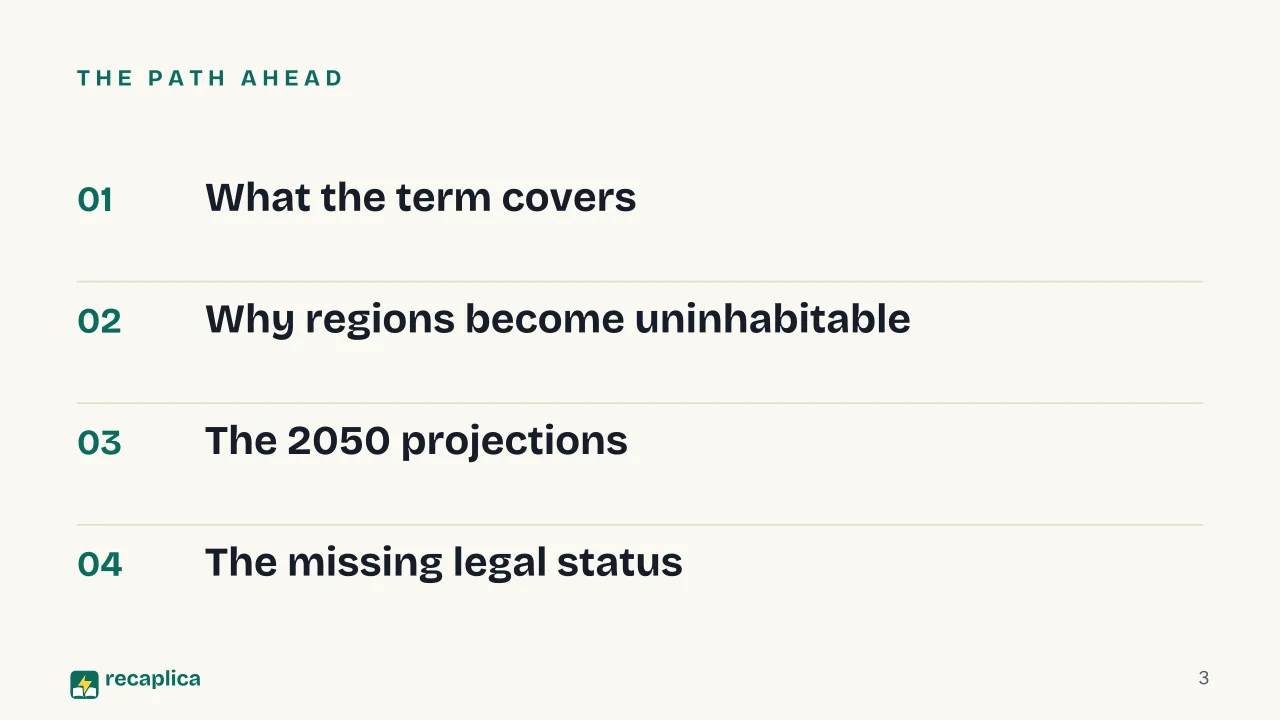  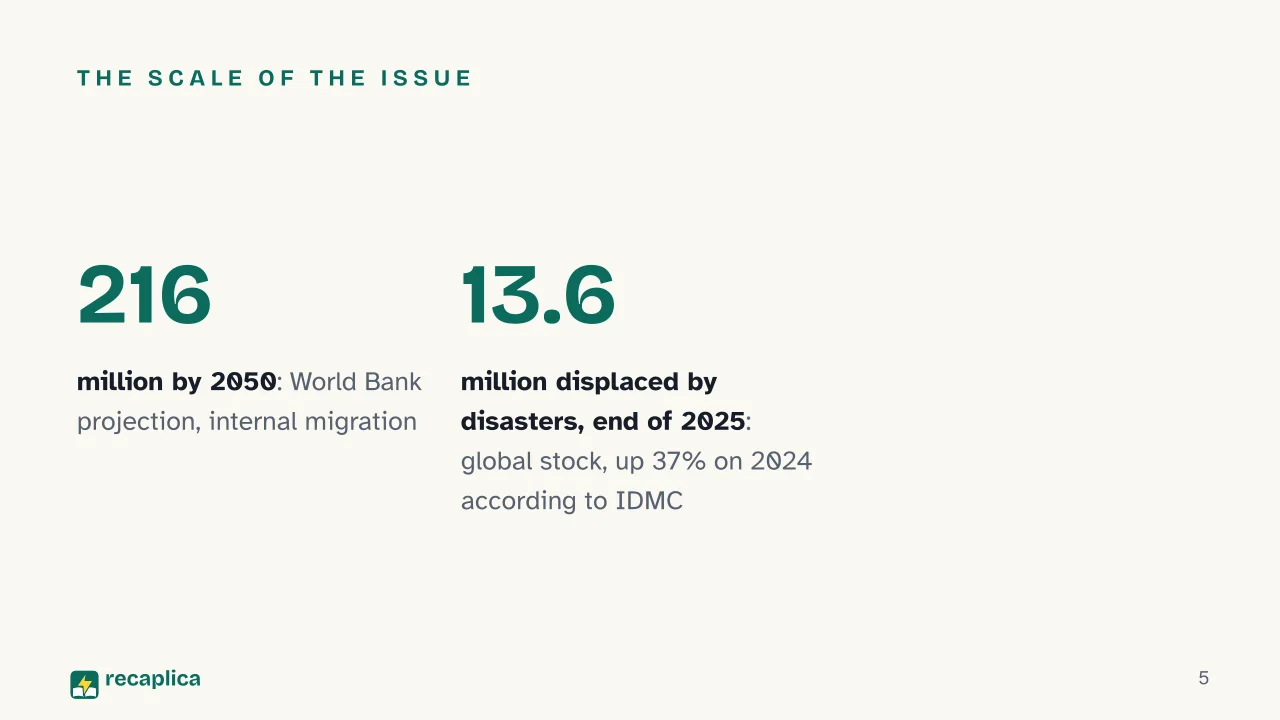  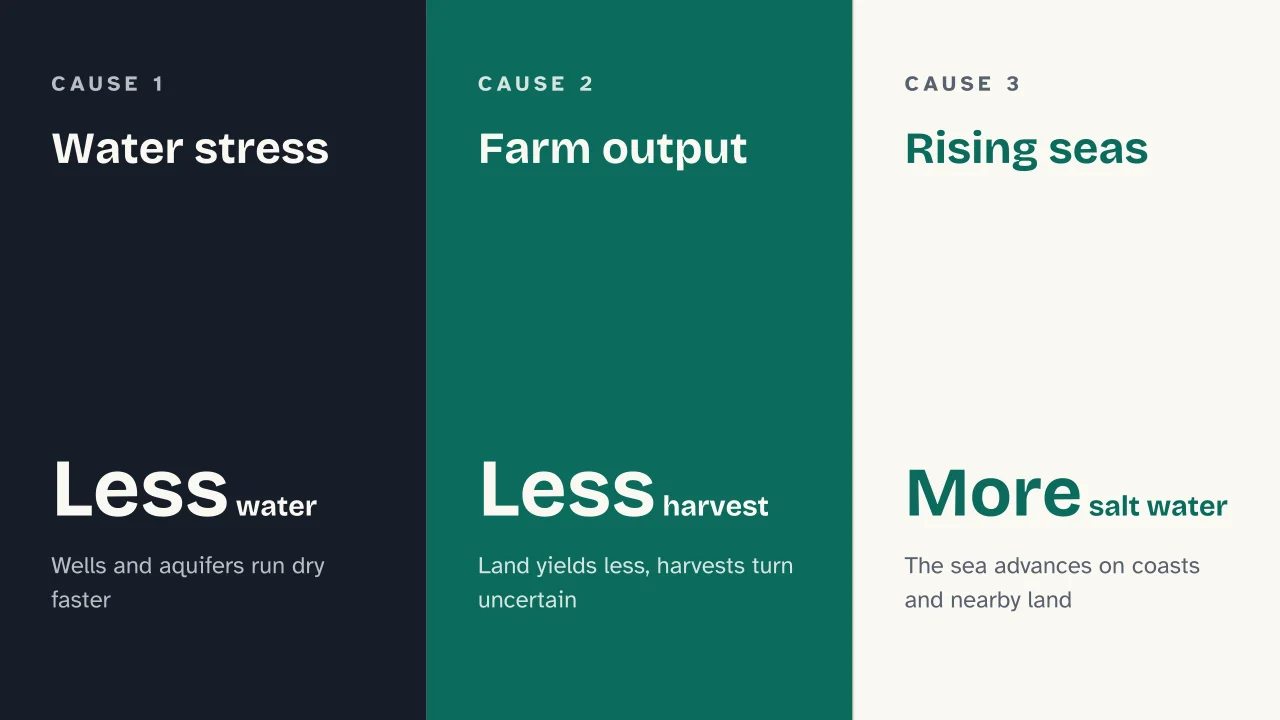  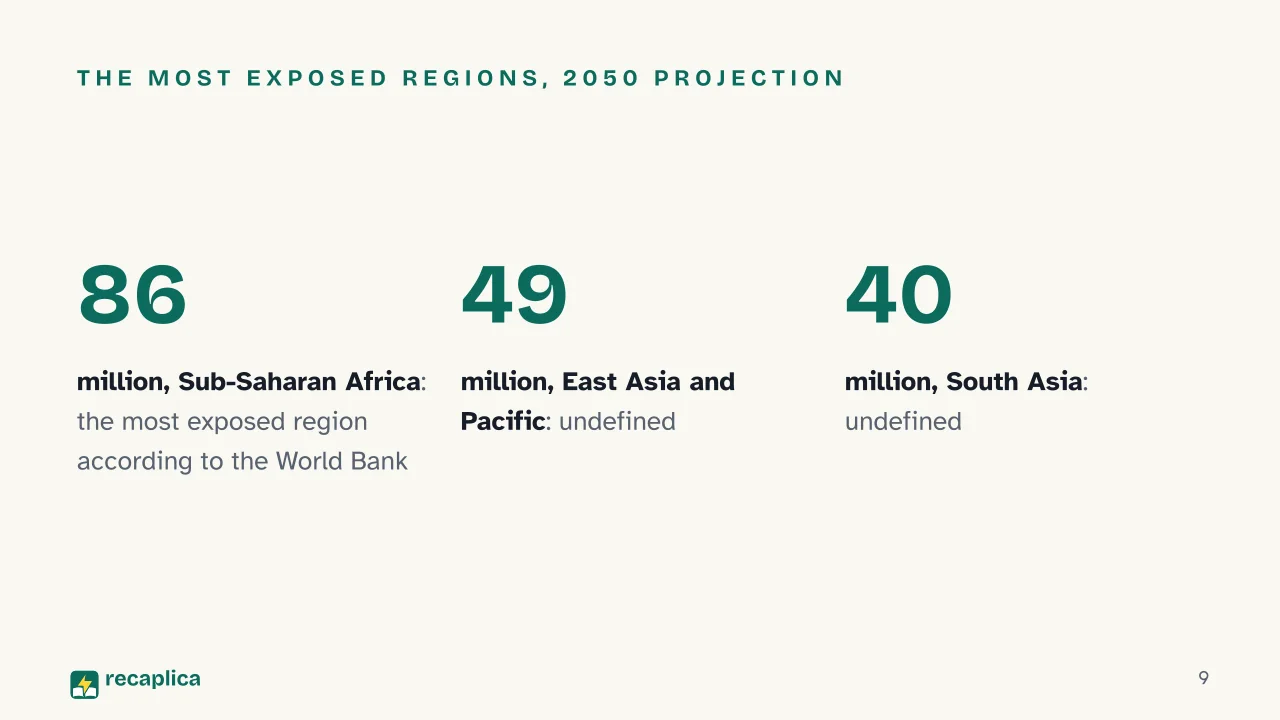  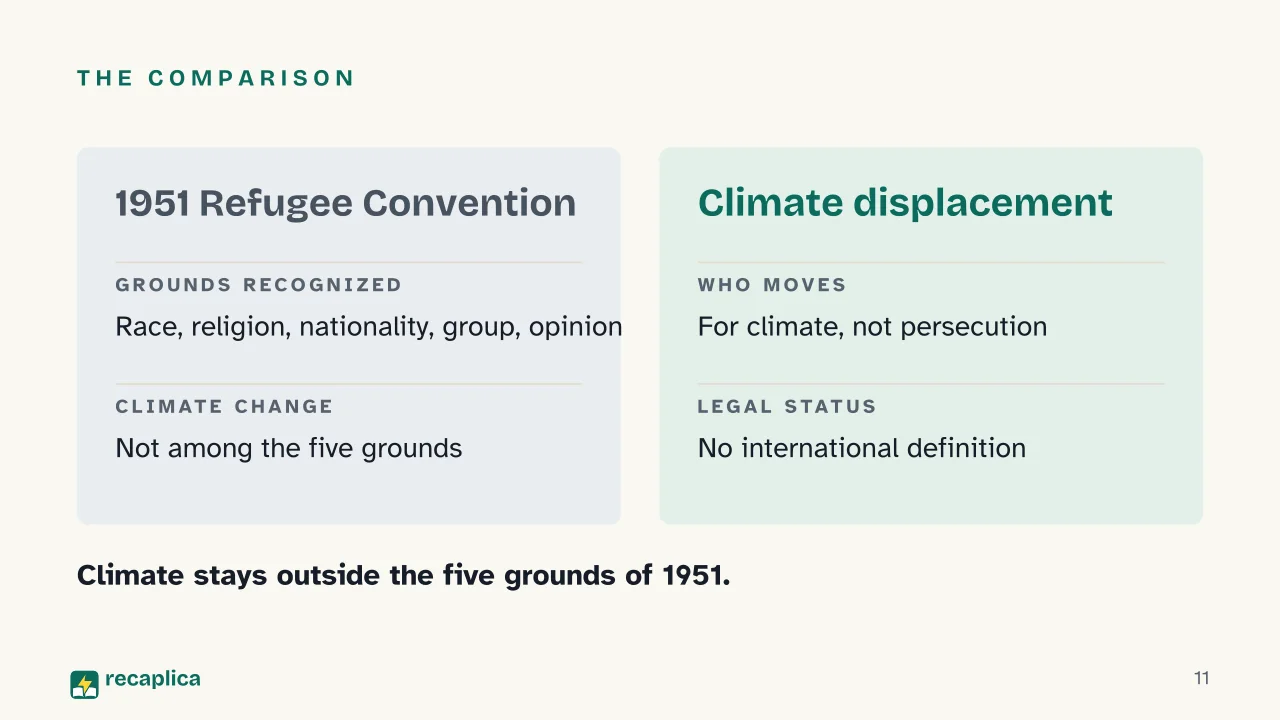 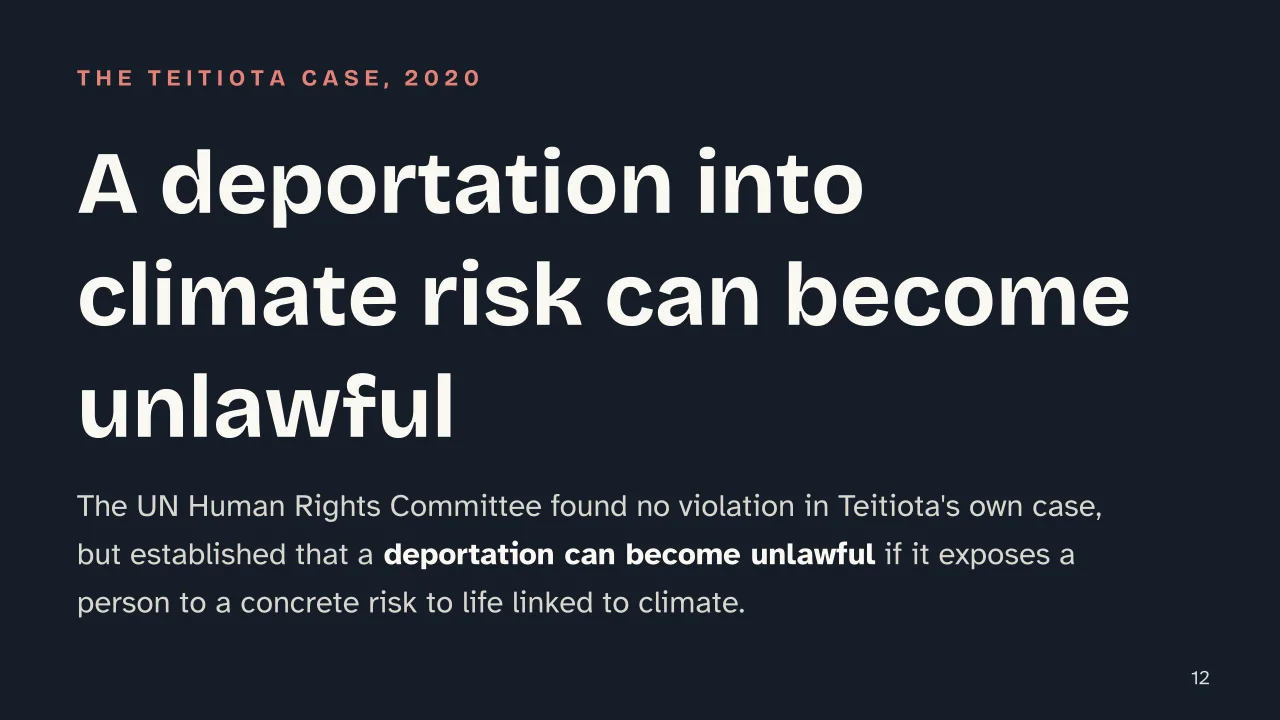   Common myths
Mind mapDrag the background to move around and the nodes to reposition them; use − and + to collapse and expand branches. 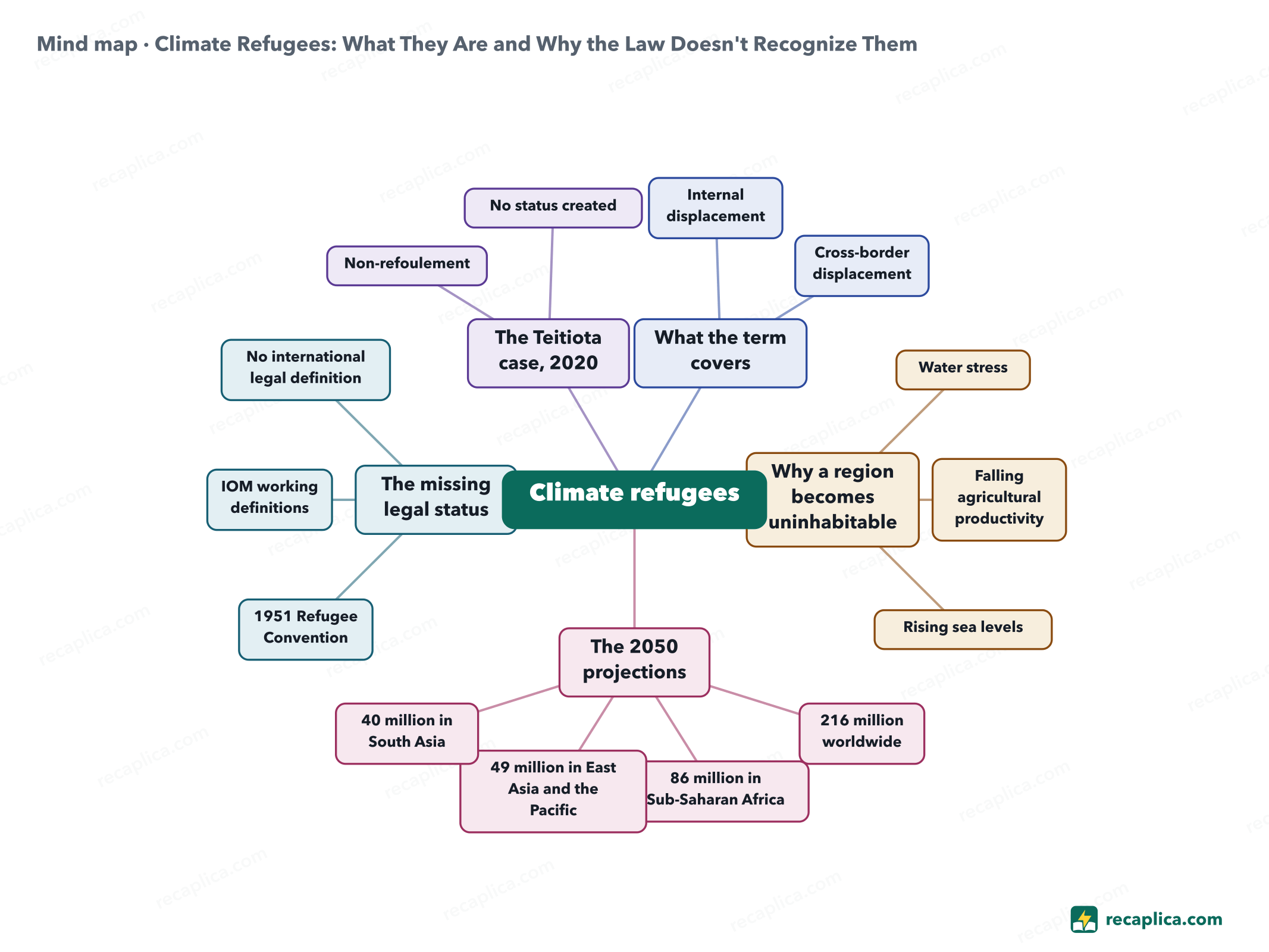
Quiz: test yourselfAnswer the questions to check what you have learned: you get instant feedback and a short explanation. Grade 0/10 0/5
FlashcardsTap the card to flip it and check whether you remember the answer, then move to the next one. 1 / 7 Explain it in your own wordsThe ultimate test: if you can explain it in simple words, you've truly understood it. Write your explanation, then compare it with the Recap. Your explanation is saved only on this device.
Frequently asked questionsDo climate refugees legally exist?No: there is no international legal definition for people who move for climate reasons. The 1951 Refugee Convention protects only those at risk of persecution for race, religion, nationality, social group or political opinion, and IOM and UNHCR avoid the term "climate refugee" because they consider it legally ungrounded. What is the difference between internal and cross-border climate migration?Internal migration happens within the borders of the same country; cross-border migration involves crossing an international frontier. The World Bank's projection of over 216 million people by 2050 covers only internal migration. What did the Teitiota v. New Zealand case establish?The UN Human Rights Committee found no violation in that specific case, but established that a deportation can become unlawful if it exposes a person to a concrete risk to life linked to climate, weighed on a case-by-case basis. Which regions are most at risk according to the World Bank's projections?Sub-Saharan Africa, with a projection of up to 86 million internal climate migrants by 2050, followed by East Asia and the Pacific (49 million) and South Asia (40 million). Why can a region become uninhabitable?Because of a combination of climate-linked factors: water scarcity, falling agricultural productivity and, in coastal and island areas, rising sea levels. Every Recap goes through an independent review before publication. |