Skip to content
recaplica

    One moment: security check

    Cloudflare wants to make sure you're not a robot. Tick the box below and your search will continue on its own.

    IT
    recaplica Keynesianism explained: the theory born from the Great Depression
    © 2026 Recaplica · recaplica.com — All rights reserved
    Home › Economics

    Keynesianism explained: the theory born from the Great Depression

    By Recaplica Newsroom · Updated on September 23, 2026

    What to print

    Page numbers appear when printing with default margins.

    Slides

    Choose a cut

    Flash10 slidesThe essential thread, to present in classFull15 slidesEvery chapter and the deeper detail

    Both come with speaker notes.

    Telegram channel
    recaplica Clear in 30 seconds, yours in 10 minutes.
    In 30 seconds Key points Deep dive Slides Myths Mind map Quiz Flashcards FAQ

    In 30 seconds quick read

    Keynesianism is the body of economic thinking named after John Maynard Keynes, the British economist who in the 1930s offered a different way of reading a slump. The IMF notes that when the Great Depression hit, the economic theory of the day could neither explain the collapse nor say how to restart production and employment. Keynes put aggregate demand at the centre — the total spending of households, businesses and government — and argued that full employment is a special case rather than something markets deliver on their own. That is where the idea comes from that public spending can step in when private demand stalls. Keynesianism guided economic policy from the end of the Second World War until the 1970s, then lost ground.

    Key Points

    • Keynesianism takes its name from John Maynard Keynes, who published "The General Theory of Employment, Interest and Money" in 1936.
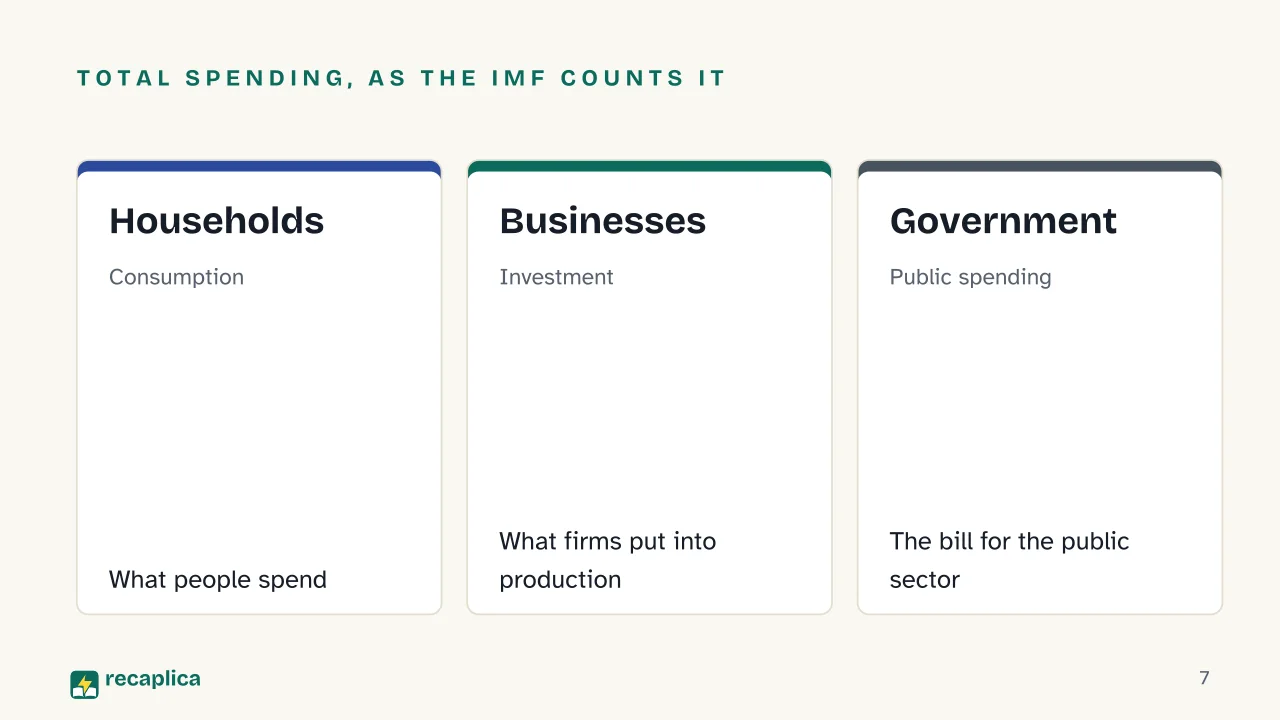
    • The core of the theory, as the IMF sums it up, is aggregate demand: the combined spending of households, businesses and government.
    • Keynes writes that full employment is a special case, reached only when the propensity to consume and the inducement to invest stand in a particular relationship.
    • Keynesians hold, in the account given by economist Alan Blinder, that prices and above all wages move slowly: the result is recurring shortages and surpluses, especially of labour.
    • Keynesian policies are countercyclical, meaning they push against the direction of the business cycle; among the tools the IMF cites is deficit spending on labour-intensive projects.
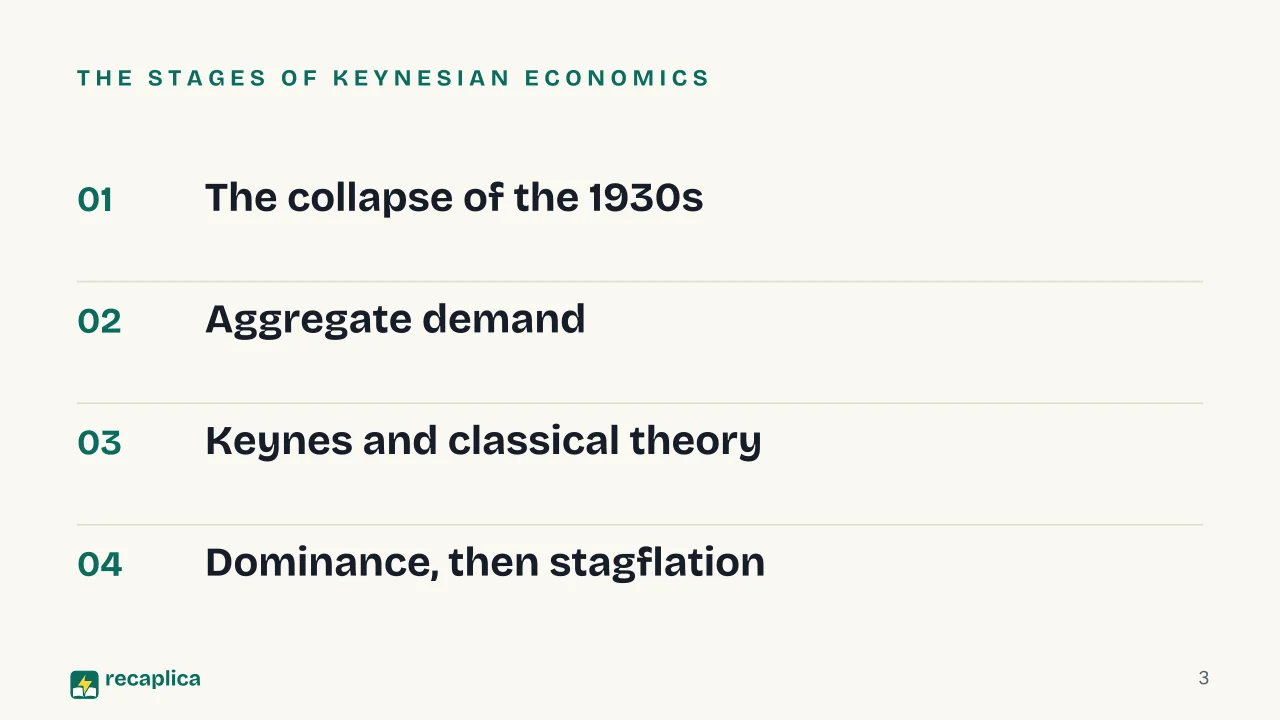
    • The IMF places the dominance of Keynesian economics over theory and policy between the end of the Second World War and the 1970s, when stagflation put it under strain.

    Deep Dive

    The collapse theory could not explain

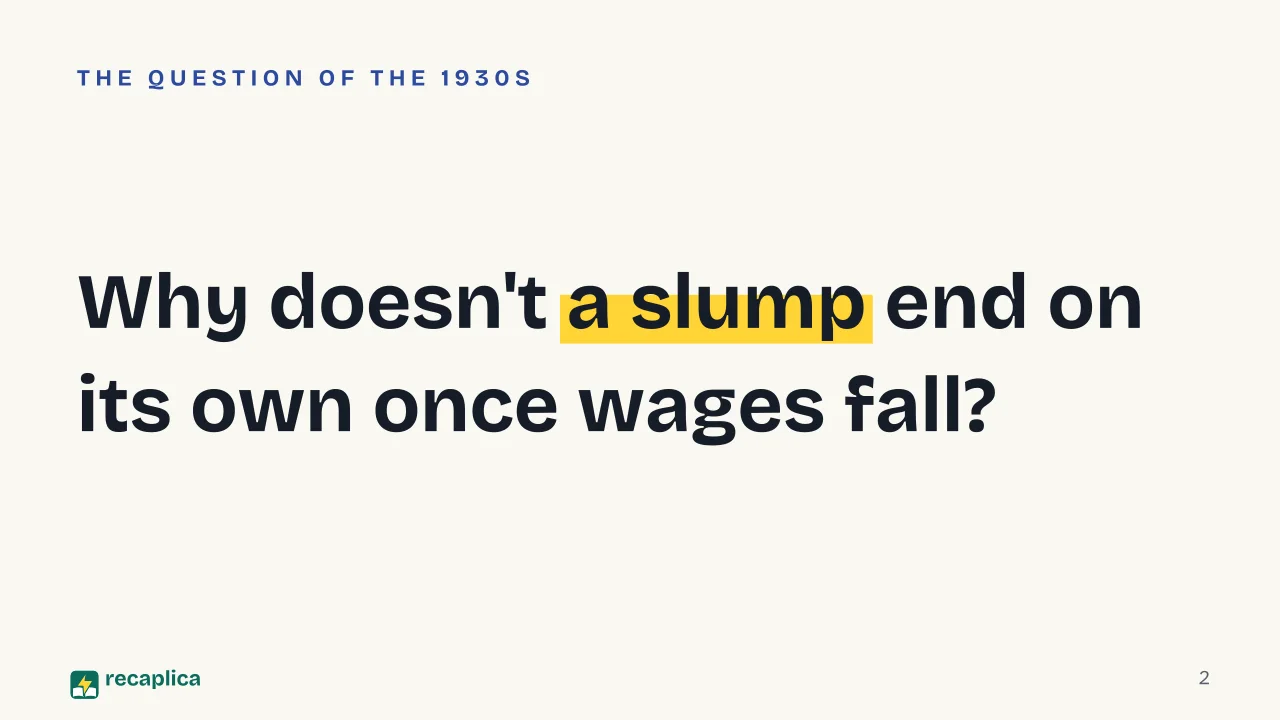
    In the 1930s the world economy stalled. According to the IMF, the economic theory that existed at the time could neither explain the causes of that collapse nor supply a public policy answer able to restart production and employment. John Maynard Keynes worked in that gap. The same source credits him with leading a reversal in economic thinking that overturned the then prevailing idea, namely that free markets would provide full employment on their own as long as workers stayed flexible about their wage demands.

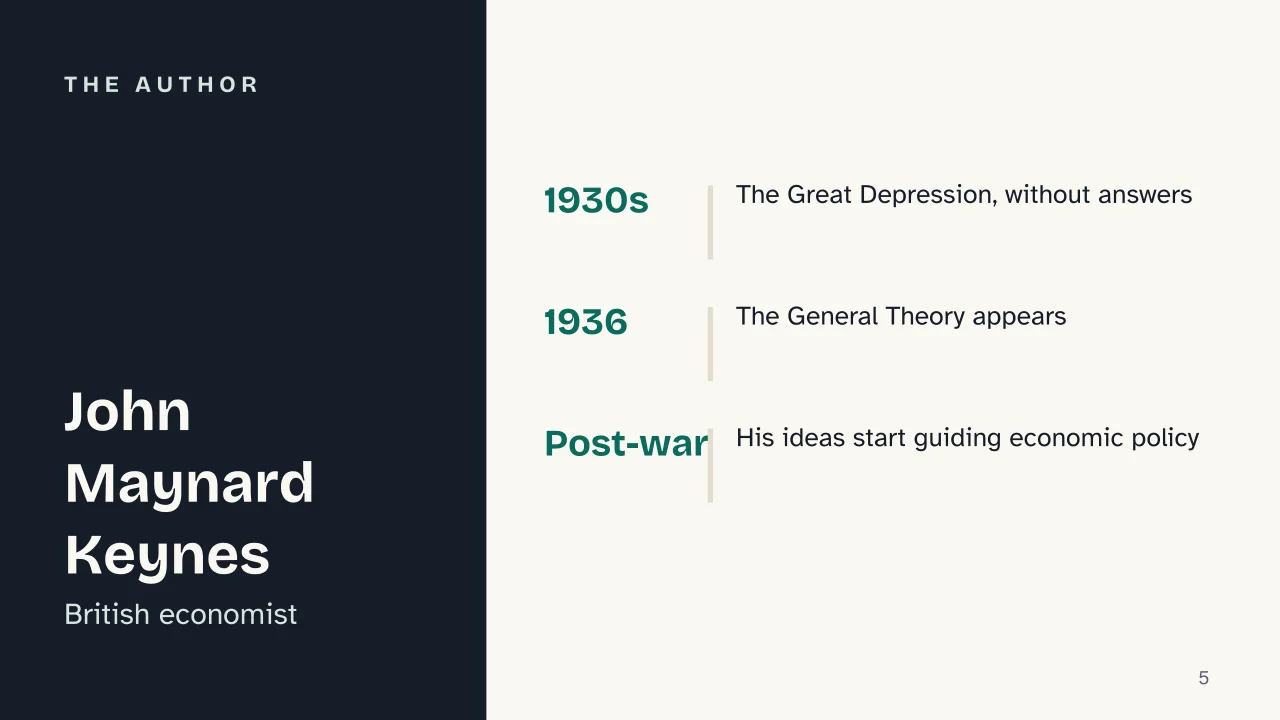
    The book that carries the reversal came out in 1936: “The General Theory of Employment, Interest and Money”. In its concluding notes Keynes names the outstanding faults of the economic society he lives in as its failure to provide full employment and its arbitrary and unequal distribution of wealth and incomes.

    Aggregate demand, the pivot of the theory

    The IMF sums up the main plank of the theory that came to bear Keynes’s name in one sentence: aggregate demand, measured as the sum of spending by households, businesses and government, is the most important driving force in an economy. It is close in spirit to the figure used to size an economy, the subject of the Recap on GDP, since both look at a total rather than at the choices of one shop or one family.

    Economist Alan Blinder, in the entry he wrote for the Concise Encyclopedia of Economics, defines Keynesian economics as a theory of total spending in an economy and of its effects on output and inflation.

    Keynes himself uses a sharper term. In chapter 3 of the General Theory he calls effective demand the value demand takes at the point where the aggregate demand function is crossed by the aggregate supply function. Then comes the sentence everything else rests on: the effective demand associated with full employment is a special case, realised only when the propensity to consume and the inducement to invest stand in a particular relationship to one another.

    Why the labour market does not clear by itself

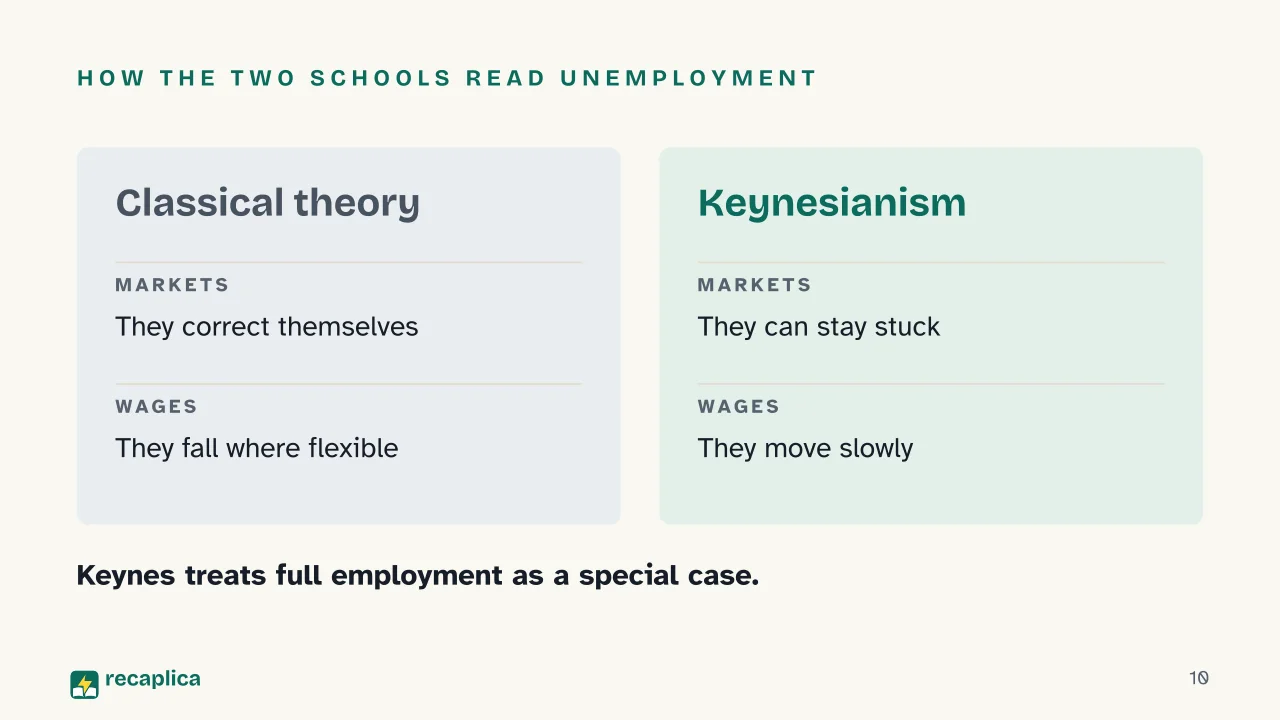
    Blinder points to the technical claim that separates Keynesians from their theoretical opponents. In the Keynesian view prices, and especially wages, respond slowly to changes in supply and demand, and the result is periodic shortages and surpluses, above all of labour. A surplus of labour is unemployment.

    If wages lag, a fall in demand is not absorbed by a quick adjustment in prices, so it lands instead on how much gets produced and how many people stay employed. That is the mechanism by which unemployment can persist during a recession. Blinder sets this stickiness against new classical theory, which stresses the ability of a market economy to cure recessions through downward adjustments in wages and prices.

    The multiplier, or what a dollar of spending returns

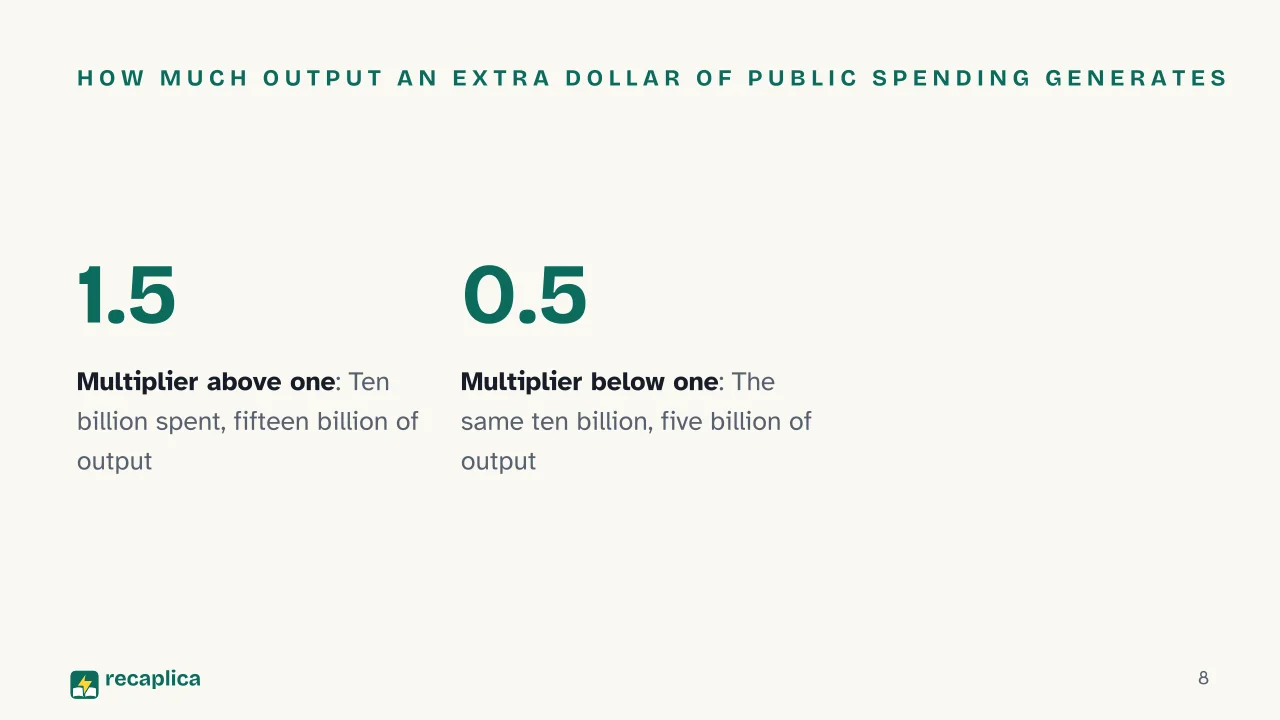
    If the government adds spending, how much does output rise? The answer sits in a single number, the fiscal multiplier. The IMF puts it directly: when the multiplier is greater than one, an extra dollar of government spending produces more than a dollar of extra output.

    Practical example: Blinder offers a purely illustrative calculation, tied to no historical episode. Ten billion dollars of extra government spending could raise total output by fifteen billion, which is a multiplier of 1.5. With a multiplier of 0.5, the same ten billion generate five. The outcome depends on the value the multiplier takes, and that value is what economists argue about.

    Countercyclical policies

    According to the IMF, Keynes advocated so-called countercyclical fiscal policies, which act against the direction of the business cycle. Among the measures the same source says Keynesian economists recommend is deficit spending on labour-intensive infrastructure projects, intended to stimulate employment. Deficit spending means paying out more than comes in, and the gap feeds into public debt, which is where this theoretical argument meets a government’s accounts.

    Keynesianism and classical economics, side by side

    The comparison below sticks to the two points the sources document directly. A fuller account of the classical school, and of the neoclassical school born from the late-19th-century marginalist revolution, belongs to separate Recaps.

    Classical economicsKeynesianism
    What a market left alone doesLeads to full employment (the prevailing idea before Keynes, per the IMF)May settle well short of full employment, which for Keynes is a special case
    Prices and wagesThey adjust, as long as workers are flexible on wage demandsThey respond slowly to supply and demand, leaving shortages and surpluses of labour (Blinder)
    The role of the stateNot the lever that restores full employmentCountercyclical fiscal policy, against the direction of the cycle (IMF)

    What Keynes asked of the state

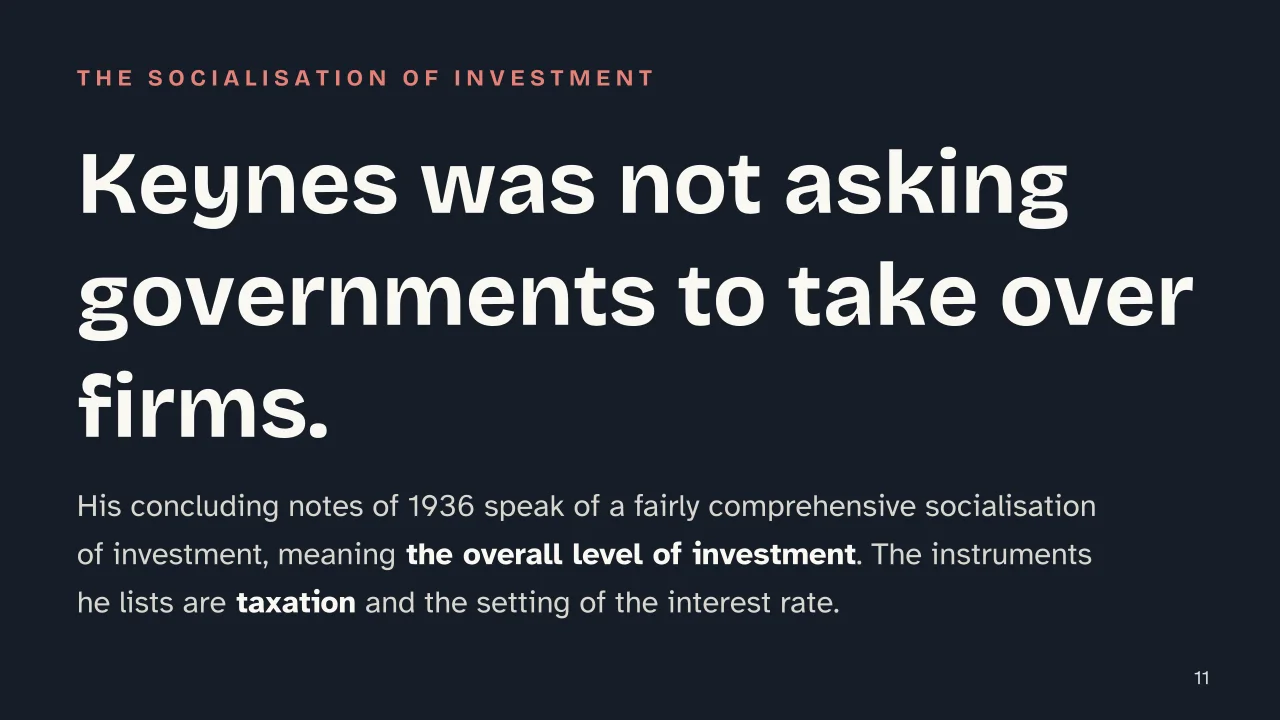
    Chapter 24 of the General Theory holds the most quoted and most misread line in the book: a fairly comprehensive socialisation of investment, Keynes writes, will prove the only means of securing an approximation to full employment. The wording is strong, and it has to be read together with what sits around it. Keynes specifies that the state will have to exercise a guiding influence on the propensity to consume, partly through its scheme of taxation and partly by fixing the interest rate — instruments that steer the decisions of private actors rather than transfer ownership of firms to the state.

    The same chapter also carries his explicit objection to accepted classical theory. Keynes does not accuse it of internal logical error. He accuses it of tacit assumptions that are seldom or never satisfied, with the consequence that the theory cannot solve the economic problems of the actual world.

    Thirty years at the centre, then stagflation

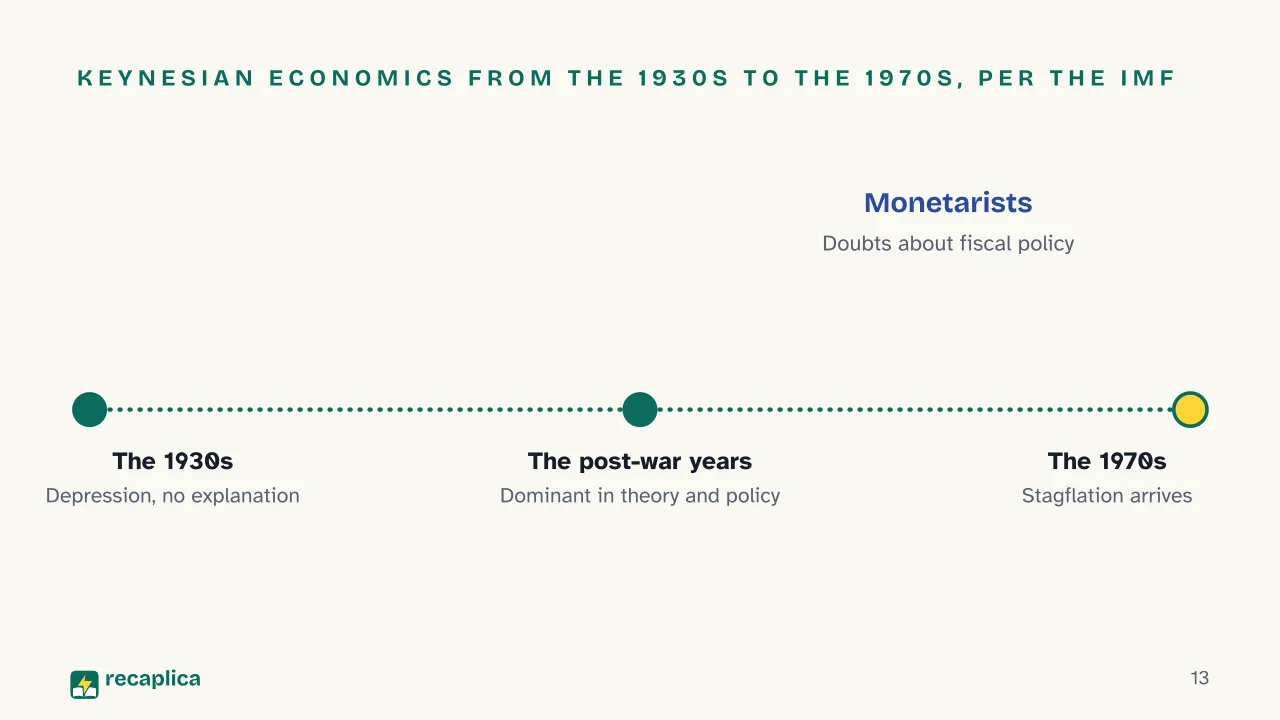
    According to the IMF, Keynesian economics dominated economic theory and policy from the end of the Second World War until the 1970s. Then its popularity fell, and the same source gives two reasons together. The first is stagflation, for which Keynesian theory at the time had no adequate policy response. The second is monetarist economists, who doubted the ability of governments to regulate the business cycle with fiscal policy.

    Slide deck

    Slides ready to download and make your own in PowerPoint or Google Slides, with speaker notes. Pick the Flash cut or the Full one.
    Slide 1 of the presentation on Keynesianism explained: KeynesianismSlide 2 of the presentation on Keynesianism explained: Why doesn't a slump end on its own once wages fall?Slide 3 of the presentation on Keynesianism explained: The stages of Keynesian economicsSlide 4 of the presentation on Keynesianism explained: Chapter 01: The collapse of the 1930sSlide 5 of the presentation on Keynesianism explained: The authorSlide 6 of the presentation on Keynesianism explained: Chapter 02: Aggregate demandSlide 7 of the presentation on Keynesianism explained: Total spending, as the IMF counts it: Households, Businesses, GovernmentSlide 8 of the presentation on Keynesianism explained: How much output an extra dollar of public spending generatesSlide 9 of the presentation on Keynesianism explained: Chapter 03: Keynes and classical theorySlide 10 of the presentation on Keynesianism explained: How the two schools read unemploymentSlide 11 of the presentation on Keynesianism explained: Keynes was not asking governments to take over firms.Slide 12 of the presentation on Keynesianism explained: Chapter 04: Dominance, then stagflationSlide 13 of the presentation on Keynesianism explained: Keynesian economics from the 1930s to the 1970s, per the IMFSlide 14 of the presentation on Keynesianism explained: What does it mean for fiscal policy to be countercyclical?Slide 15 of the presentation on Keynesianism explained: The full Recap
    Flash10 slidesThe essential thread, to present in classFull15 slidesEvery chapter and the deeper detail

    Common myths

    • ✗ Myth Keynesianism is another name for a planned economy.

      ✓ Reality In his concluding notes of 1936 Keynes writes that a fairly comprehensive socialisation of investment will be the only way to get close to full employment, and on its own that line reads like a call for nationalisation. What he points at is the overall level of investment. In the same chapter the levers he names are taxation and the setting of the interest rate, which steer decisions that stay in private hands.

    • ✗ Myth Keynes wanted governments to spend more and more.

      ✓ Reality The policies the IMF describes are countercyclical, so they act against the direction of the business cycle. The timing is part of the argument, because spending that props up demand while an economy is slowing does something different from the same spending while it is running fast.

    • ✗ Myth Stagflation in the 1970s disproved Keynesianism and ended it.

      ✓ Reality The IMF describes a loss of popularity rather than a refutation. Two things weigh on it. Keynesian theory as it stood had no adequate policy answer to stagflation, and monetarist economists doubted that governments could steer the business cycle with fiscal policy at all.

    Mind map

    Drag the background to move around and the nodes to reposition them; use − and + to collapse and expand branches.
    Customize
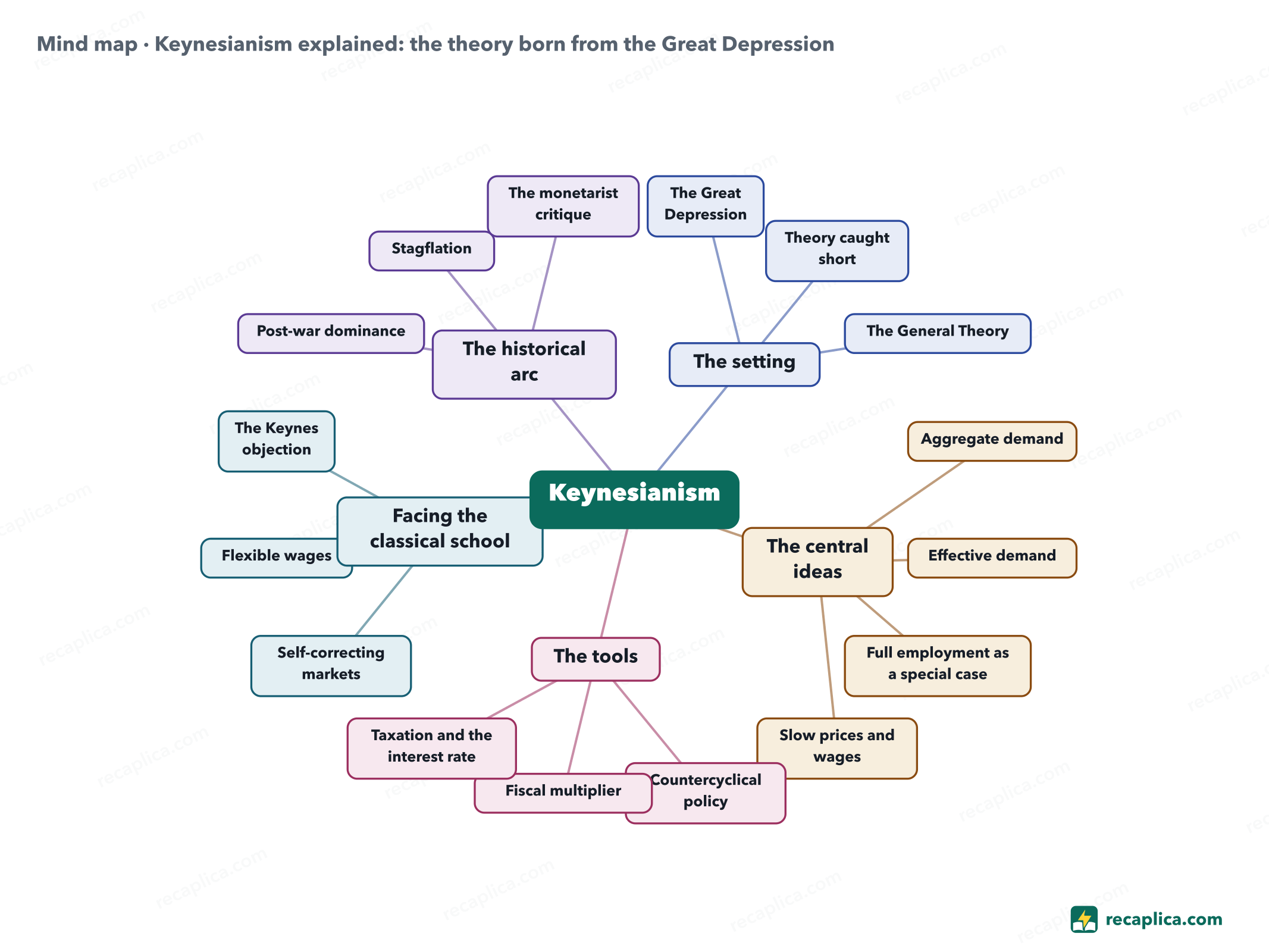
    Mind map: Keynesianism explained: the theory born from the Great Depression
    • Keynesianism
      • The setting Why the theory appeared in the 1930s
        • The Great Depression Output and employment collapsed worldwide
        • Theory caught short No explanation of the causes, no remedy
        • The General Theory Keynes publishes the book in 1936
      • The central ideas
        • Aggregate demand Spending by households, businesses and government
        • Effective demand Where aggregate demand and supply meet
        • Full employment as a special case
        • Slow prices and wages They adjust late to supply and demand
      • The tools
        • Countercyclical policy Acting against the direction of the cycle
        • Fiscal multiplier How much output a dollar of spending generates
        • Taxation and the interest rate The levers Keynes named in 1936
      • Facing the classical school
        • Self-correcting markets The prevailing view before Keynes
        • Flexible wages The condition said to secure full employment
        • The Keynes objection Tacit assumptions rarely satisfied
      • The historical arc
        • Post-war dominance From the end of WWII to the 1970s
        • Stagflation High inflation alongside high unemployment
        • The monetarist critique Doubts about fiscal policy as a steering wheel

    Quiz: test yourself

    Answer the questions to check what you have learned: you get instant feedback and a short explanation.

    Grade 0/10 0/5
    1 According to the IMF summary, what is the most important driving force in an economy under Keynes's theory?

    The IMF describes aggregate demand, measured as the sum of spending by households, businesses and government, as the most important driving force in an economy under Keynesian theory.

    2 In which year did Keynes publish "The General Theory of Employment, Interest and Money"?

    The book came out in London in 1936, with the Great Depression still fresh, and it is where Keynes sets out effective demand and his objection to classical theory.

    3 What does it mean for fiscal policy to be countercyclical?

    The countercyclical policies the IMF describes move opposite to the business cycle; one example it cites is deficit spending on labour-intensive infrastructure to stimulate employment.

    4 According to economist Alan Blinder, how do prices and wages behave in the Keynesian view?

    Blinder writes that Keynesians believe prices, and especially wages, respond slowly to changes in supply and demand, which produces periodic shortages and surpluses, above all in the labour market.

    5 What put Keynesian economics under strain in the 1970s, according to the IMF?

    The IMF says Keynesian theory lost popularity because it had no adequate response to stagflation, while monetarist economists questioned whether governments could regulate the business cycle with fiscal policy.

    Answers: 1-B · 2-C · 3-B · 4-B · 5-B

    Flashcards

    Tap the card to flip it and check whether you remember the answer, then move to the next one.

    1 / 7

    Explain it in your own words

    The ultimate test: if you can explain it in simple words, you've truly understood it. Write your explanation, then compare it with the Recap.

    Your explanation is saved only on this device.

    Keynesianism is the body of economic thinking named after John Maynard Keynes, the British economist who in the 1930s offered a different way of reading a slump. The IMF notes that when the Great Depression hit, the economic theory of the day could neither explain the collapse nor say how to restart production and employment. Keynes put aggregate demand at the centre — the total spending of households, businesses and government — and argued that full employment is a special case rather than something markets deliver on their own. That is where the idea comes from that public spending can step in when private demand stalls. Keynesianism guided economic policy from the end of the Second World War until the 1970s, then lost ground.

    Frequently asked questions

    What is Keynesianism in simple terms?

    It is the economic thinking of John Maynard Keynes, in which how an economy performs depends above all on how much is being spent in it overall. The IMF calls that total aggregate demand, the combined spending of households, businesses and government. When it falls, output and employment fall with it, and public spending can step in to support it.

    How does Keynesianism differ from classical economics?

    They start from opposite premises. The IMF writes that before Keynes the prevailing idea was that free markets would deliver full employment by themselves, as long as workers were flexible about their wage demands. Keynes instead treats full employment as a special case, and in 1936 his objection to classical theory is not that its logic fails but that its unstated assumptions are rarely met.

    Who was John Maynard Keynes?

    A British economist. The IMF credits him with leading a reversal in economic thinking during the Great Depression years. His best-known book, "The General Theory of Employment, Interest and Money", appeared in 1936 and contains both the theory of effective demand and his proposals on what the state should do.

    What is the Keynesian multiplier?

    It measures how much output extra government spending generates. The IMF states it plainly: if the fiscal multiplier is greater than one, one extra dollar of government spending raises output by more than a dollar. Alan Blinder's teaching example shows both cases, above and below one, because the outcome depends on the value the multiplier takes.

    How long did Keynesianism guide economic policy?

    The IMF places its dominance over economic theory and policy between the end of the Second World War and the 1970s. That is when its popularity fell: the theory as it stood had no adequate answer to stagflation, and monetarist economists doubted that governments could regulate the cycle with fiscal policy.

    Sources

    • Back to Basics: What Is Keynesian Economics? — IMF Finance & Development, September 2014
    • Keynesian Economics — Alan S. Blinder, The Concise Encyclopedia of Economics (Econlib)
    • J. M. Keynes, The General Theory of Employment, Interest and Money (1936), ch. 3 «The Principle of Effective Demand»
    • J. M. Keynes, The General Theory of Employment, Interest and Money (1936), ch. 24 «Concluding Notes»

    Every Recap goes through an independent review before publication.

    Every evening, the day's new Recaps on our Telegram channel. Join the channel →

    Keep learning

    • Economics Labor Market: How Supply, Demand and Unemployment Work The labor market is where businesses that need workers to produce goods and services meet the people willing to work for them. In the textbook model, that meeting sets wages and employment levels the way any other market would, but imperfect information, bargaining power and legal rules push the real market away from pure competition. Those gaps are where unemployment comes from, and economists split it into frictional, structural, cyclical and technological types depending on the cause. Official statistics, such as Italy's ISTAT, measure it against the labor force — people employed plus people actively looking for work — not the whole population. As of July 2026, Italy's unemployment rate stood at 5.8%, provisional, against 6.4% for the euro area. Read the Recap →
    • Economics Mercantilism: History, Examples, and Definition Mercantilism was the dominant economic doctrine in Western Europe from the 16th to the 18th century: a state grew powerful by selling more abroad than it bought, building up reserves of gold and silver. Britannica Money describes it as "an economic practice by which governments used their economies to augment state power at the expense of other countries." Colonies had one job under this system: supply raw materials to the mother country and buy finished goods back from it, while at home tariffs and monopolies shielded domestic industry. The name itself came later, from the doctrine's most famous critic: Adam Smith made it current in The Wealth of Nations, published in 1776. Read the Recap →
    • Economics CBDC: What Is a Central Bank Digital Currency and How Does It Work? A CBDC, or central bank digital currency, is digital money issued directly by a central bank rather than a private company. It is not a cryptocurrency: a CBDC carries the same backing as banknotes and coins, while an asset like Bitcoin or Ether has no institution standing behind it. The European Central Bank is building its own version, the digital euro, meant to sit alongside cash rather than replace it, with support for payments even without an internet connection. By 2024, more than nine in ten of the world's central banks were exploring a CBDC of some kind. Read the Recap →

    recaplica

    Clear in 30 seconds, yours in 10 minutes.

    Recaps Mind maps Request a Recap Telegram channel Mind map maker Our method About Privacy & cookies Legal notes & terms of use

    © 2026 Recaplica · A project by Curi S.r.l. — VAT IT05472000750

    Statistics, only if you say so

    To learn which Recaps help most we would use Google Analytics, with aggregate, anonymous data. It starts only with your OK, and you can change your mind anytime. Privacy policy