Skip to content
recaplica

    One moment: security check

    Cloudflare wants to make sure you're not a robot. Tick the box below and your search will continue on its own.

    IT
    recaplica Interest rates: what they are and how they move the economy
    © 2026 Recaplica · recaplica.com — All rights reserved
    Home › Economics

    Interest rates: what they are and how they move the economy

    By Recaplica Newsroom · Updated on August 31, 2026

    What to print

    Page numbers appear when printing with default margins.

    Slides

    Choose a cut

    Flash10 slidesThe essential thread, to present in classFull18 slidesEvery chapter and the deeper detail

    Both come with speaker notes.

    Telegram channel
    recaplica Clear in 30 seconds, yours in 10 minutes.
    In 30 seconds Key points Figures Deep dive Slides Myths Mind map Quiz Flashcards FAQ

    In 30 seconds quick read

    The interest rate is the price of money: what it costs to borrow it, or what you earn for lending it. Benchmark rates are set by central banks (the ECB in the euro area) and ripple out to mortgages, loans and savings accounts. High rates cool spending and inflation; low rates fuel consumption and investment. As of mid-2026 the ECB deposit rate stands at 2.25%.

    Key Points

    • The interest rate is the price of borrowed or lent money, expressed as a yearly percentage.
    • The ECB sets three official rates; the most watched today is the deposit rate (2.25% since June 2026).
    • From official rates, a chain reaction reaches mortgages, loans, savings accounts and bond yields.
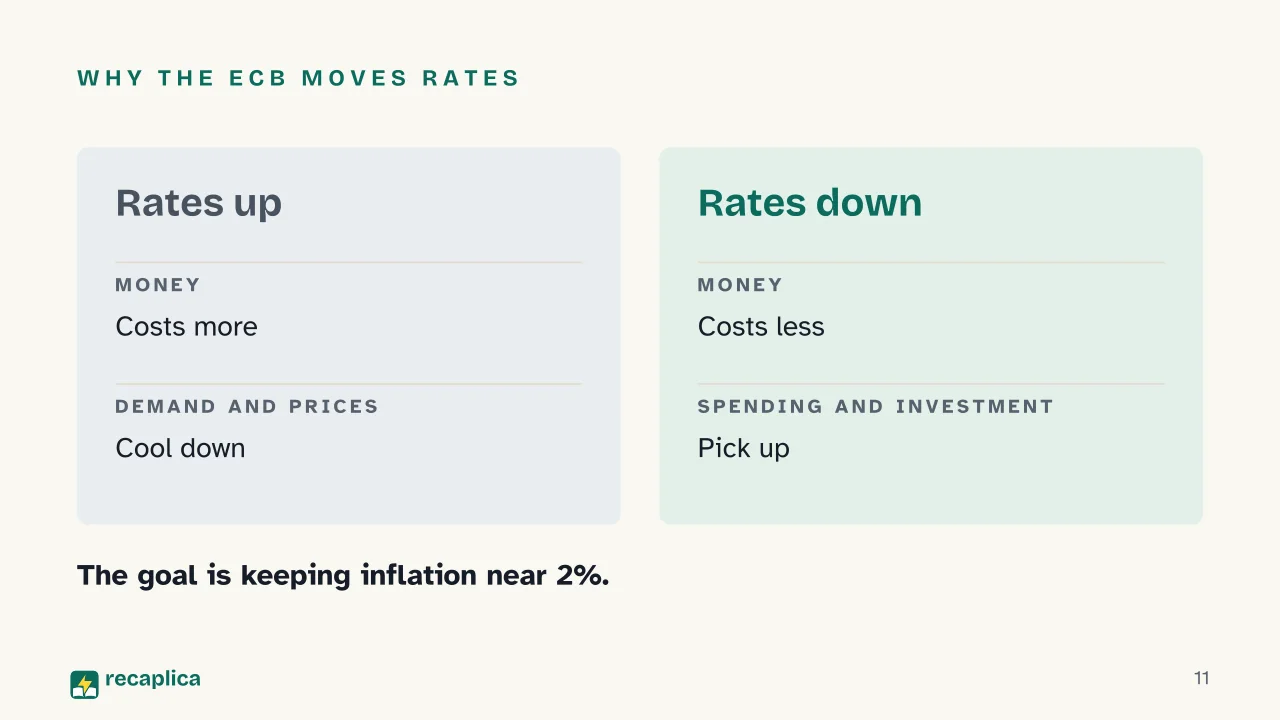
    • Rates up = pricier money = less spending, inflation cools. Rates down = the reverse.
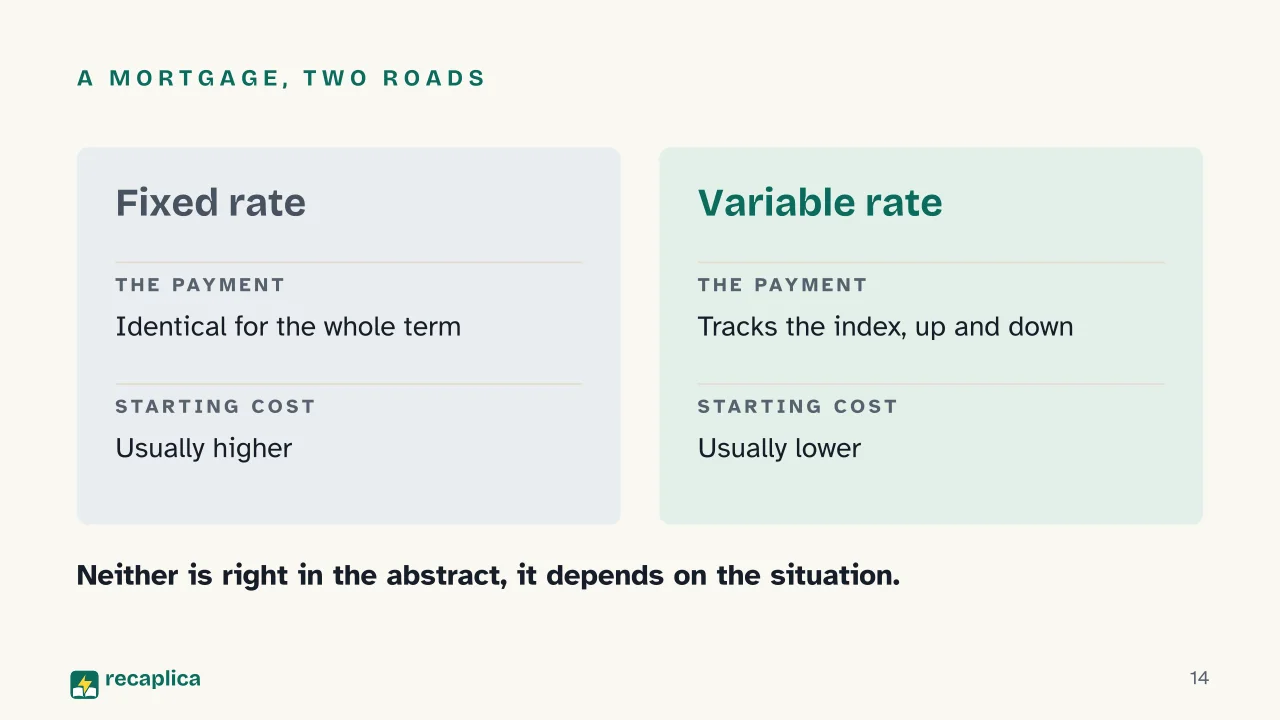
    • Fixed-rate mortgage: constant payment for the whole term. Variable: the payment follows market rates.
    • Compound interest makes amounts grow (or weigh) exponentially over time.

    Key figures

    • 2.25% the ECB deposit facility rate, in force since June 2026 Source: ECB, key interest rates
    • 2.40% the ECB main refinancing operations rate (June 2026) Source: ECB
    • 3 the official rates the ECB sets: deposit facility, main refinancing, marginal lending Source: ECB

    Deep Dive

    The price of money

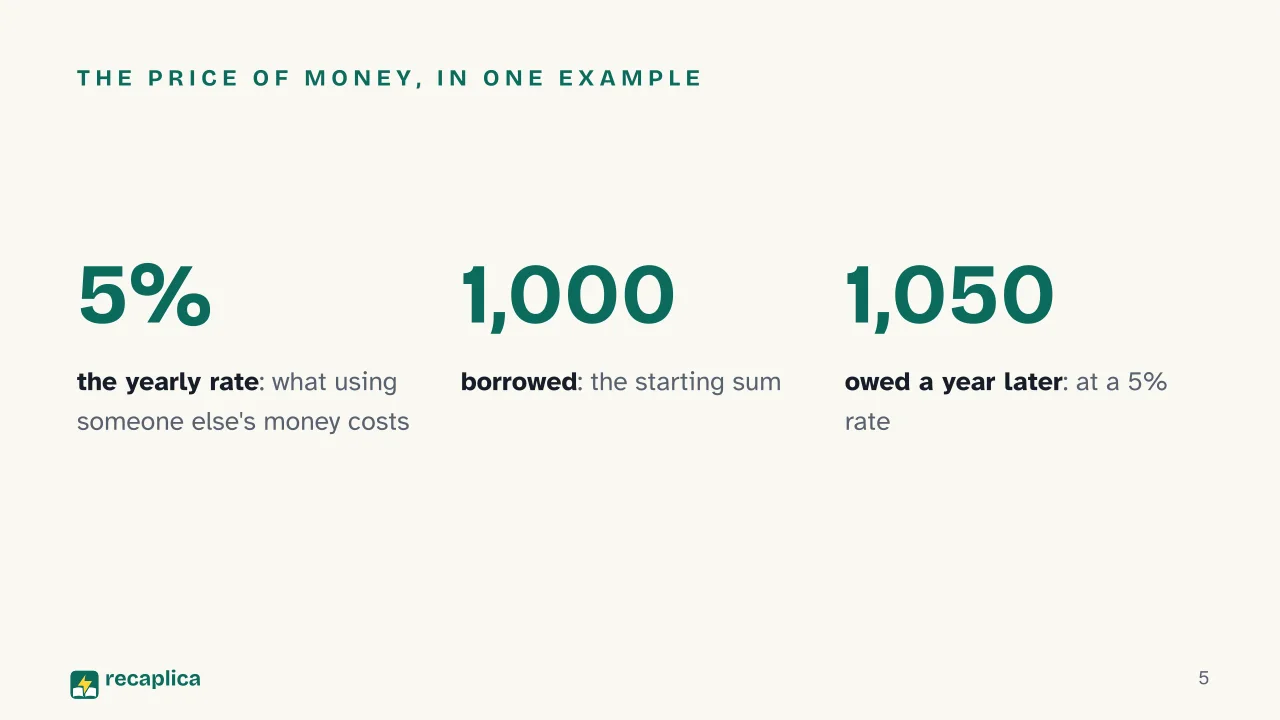
    Everything has a price — money included. When you take out a loan, the price you pay to use someone else’s money is the interest rate; when you’re the one lending — to a bank via a deposit, to a state via a bond — the rate is what you collect. It’s expressed as a yearly percentage: at 5%, borrow 1,000 and you owe 1,050 a year later.

    Understand this and you’ve understood half the economics in the headlines. The other half is understanding who moves this price.

    Who decides: the ECB and its three rates

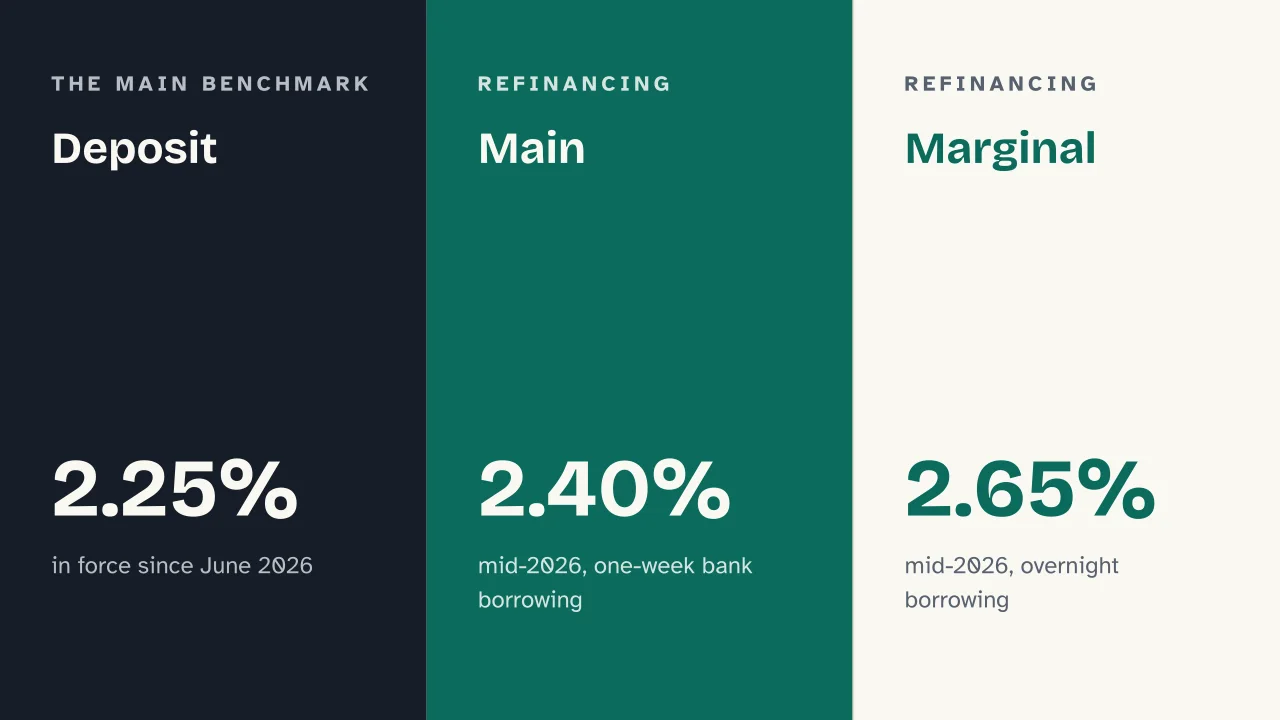
    In the euro area, benchmark rates are set by the European Central Bank. There are three: the deposit facility rate (today the one that matters most), the main refinancing rate and the marginal lending rate. As of mid-2026 they stand at 2.25%, 2.40% and 2.65% respectively (ECB).

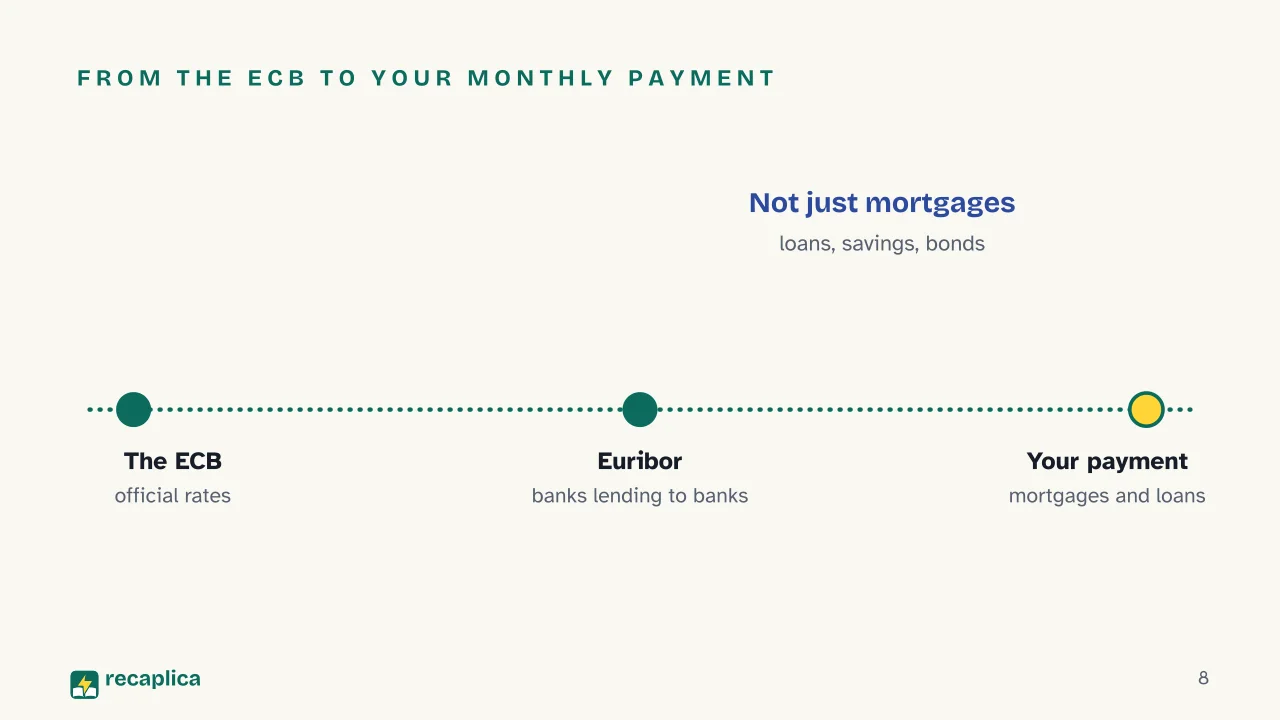
    None of us deposits money at the ECB, so these numbers don’t touch you directly. But a transmission chain starts there and runs straight to your bank account: official rates steer Euribor (the rate banks charge each other), Euribor moves variable mortgages, and the overall level of rates shapes personal loans, savings accounts and government bonds.

    Practical example: you pay 500 a month on a variable mortgage and the ECB hikes by half a point. Within months Euribor adjusts, and your monthly payment can rise noticeably. Nobody touched your contract: the price of money moved upstream.

    The lever that steers the economy

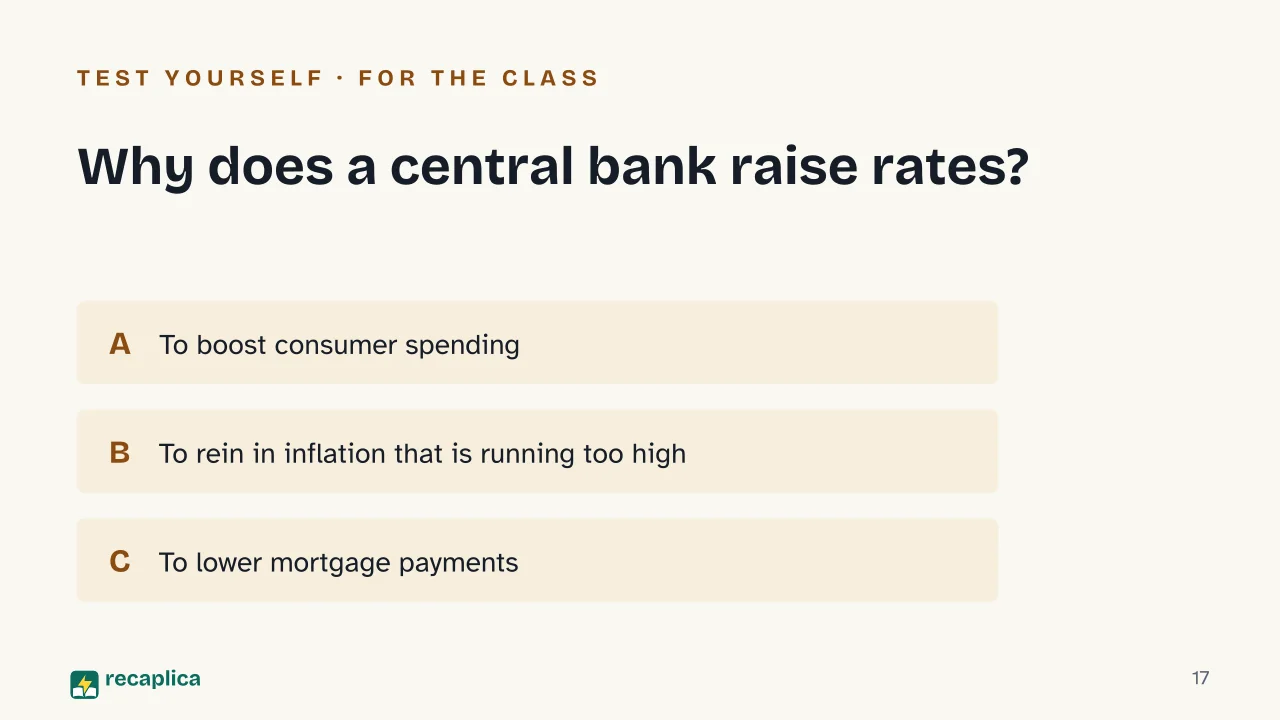
    Why does the ECB move rates at all? Because they’re its main lever for keeping inflation near 2%. The mechanism is intuitive. Pricier money means heavier mortgages and loans: households postpone purchases, firms delay investments, demand cools and prices slow down. Cheaper money does the exact opposite, and is used to revive a stalled economy or climb out of a recession.

    One detail most commentary misses: the lever works with a lag of months. A hike decided today cools next year’s prices. Central bankers drive like someone steering a heavy truck — braking well before the curve.

    Fixed or variable: the choice everyone eventually faces

    On a mortgage, rates become personal.

    Fixed rateVariable rate
    The paymentIdentical for the whole termTracks the index, up and down
    Starting costUsually higherUsually lower
    The riskNo surprisesCostlier payments if rates rise
    SuitsThose who want certaintyThose who tolerate swings

    There’s no universally right answer — only the right one for your situation, which deserves a professional’s advice. This is education, not financial advice.

    Compound interest: the quiet force

    One last concept, perhaps the most powerful: compound interest. If earned interest stays invested, next year it earns interest of its own. At first the difference is invisible; over twenty years the gap becomes enormous. It works for you when you save and reinvest, and against you when a debt compounds unpaid.

    Einstein almost certainly never called it “the eighth wonder of the world” — that quote circulates without a credible source — but the idea would deserve the title anyway. And the fact that a country’s GDP compounds year after year is precisely why a few extra decimals of growth, stacked over decades, add up to enormous gaps between countries.

    Slide deck

    Slides ready to download and make your own in PowerPoint or Google Slides, with speaker notes. Pick the Flash cut or the Full one.
    Slide 1 of the presentation on Interest rates: Interest ratesSlide 2 of the presentation on Interest rates: What does money cost?Slide 3 of the presentation on Interest rates: What we will coverSlide 4 of the presentation on Interest rates: Chapter 01: The price of moneySlide 5 of the presentation on Interest rates: The price of money, in one exampleSlide 6 of the presentation on Interest rates: Chapter 02: Who decides the ratesSlide 7 of the presentation on Interest rates: Deposit · Main · MarginalSlide 8 of the presentation on Interest rates: From the ECB to your monthly paymentSlide 9 of the presentation on Interest rates: Who raised your mortgage payment?Slide 10 of the presentation on Interest rates: Chapter 03: The lever on the economySlide 11 of the presentation on Interest rates: Why the ECB moves ratesSlide 12 of the presentation on Interest rates: Your bank does not set your mortgage rate.Slide 13 of the presentation on Interest rates: Chapter 04: In everyday lifeSlide 14 of the presentation on Interest rates: A mortgage, two roadsSlide 15 of the presentation on Interest rates: Rates reach people without a mortgage: Savers, Firms, The euroSlide 16 of the presentation on Interest rates: Interest earns interest of its own.Slide 17 of the presentation on Interest rates: Why does a central bank raise rates?Slide 18 of the presentation on Interest rates: And now, the review
    Flash10 slidesThe essential thread, to present in classFull18 slidesEvery chapter and the deeper detail

    Common myths

    • ✗ Myth Mortgage rates are decided by my own bank.

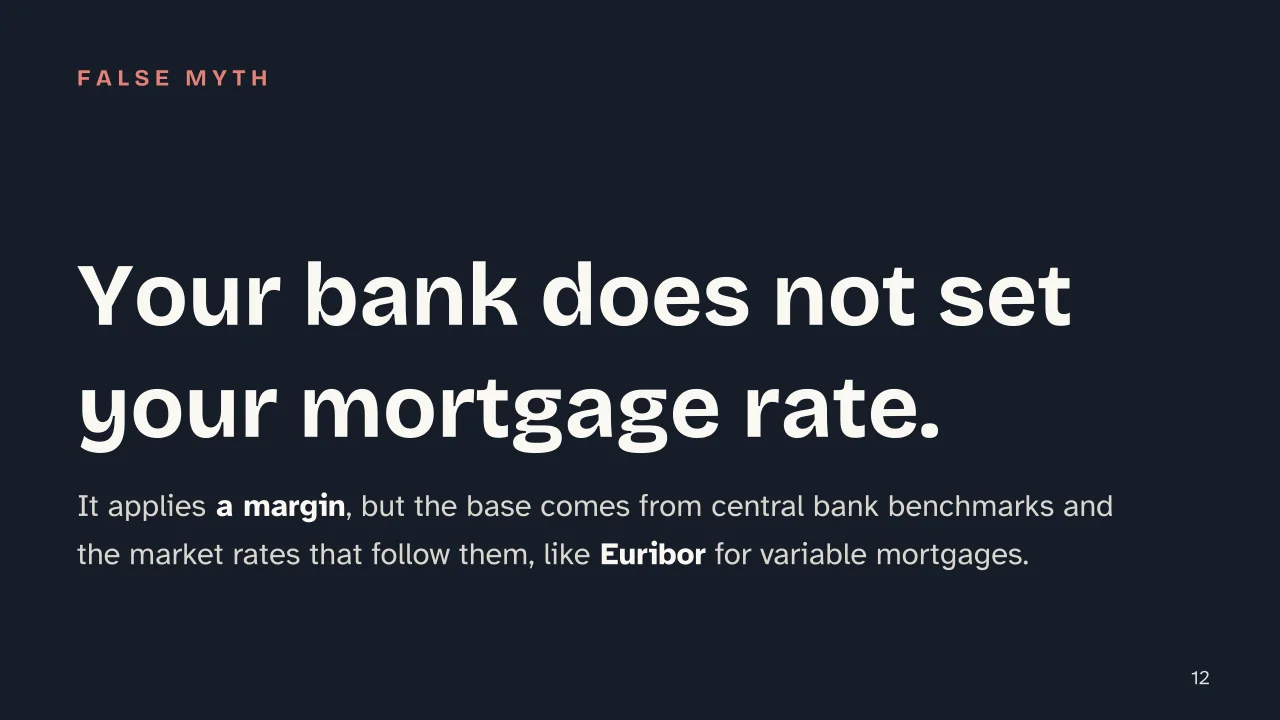
      ✓ Reality Your bank applies a margin, but the base comes from central bank benchmarks and the market rates that follow them (like Euribor for variable mortgages). When the central bank moves, sooner or later your payment moves too.

    • ✗ Myth Low rates are always good news.

      ✓ Reality For borrowers, yes; for savers, no — deposits and bonds yield less. And rates kept too low for too long can inflate the prices of houses and financial assets.

    • ✗ Myth Raising rates stops inflation overnight.

      ✓ Reality Monetary policy works with a lag of months: today's hike cools tomorrow's spending and the day after's prices. That's why central banks move ahead of the data, not behind it.

    Mind map

    Drag the background to move around and the nodes to reposition them; use − and + to collapse and expand branches.
    Customize
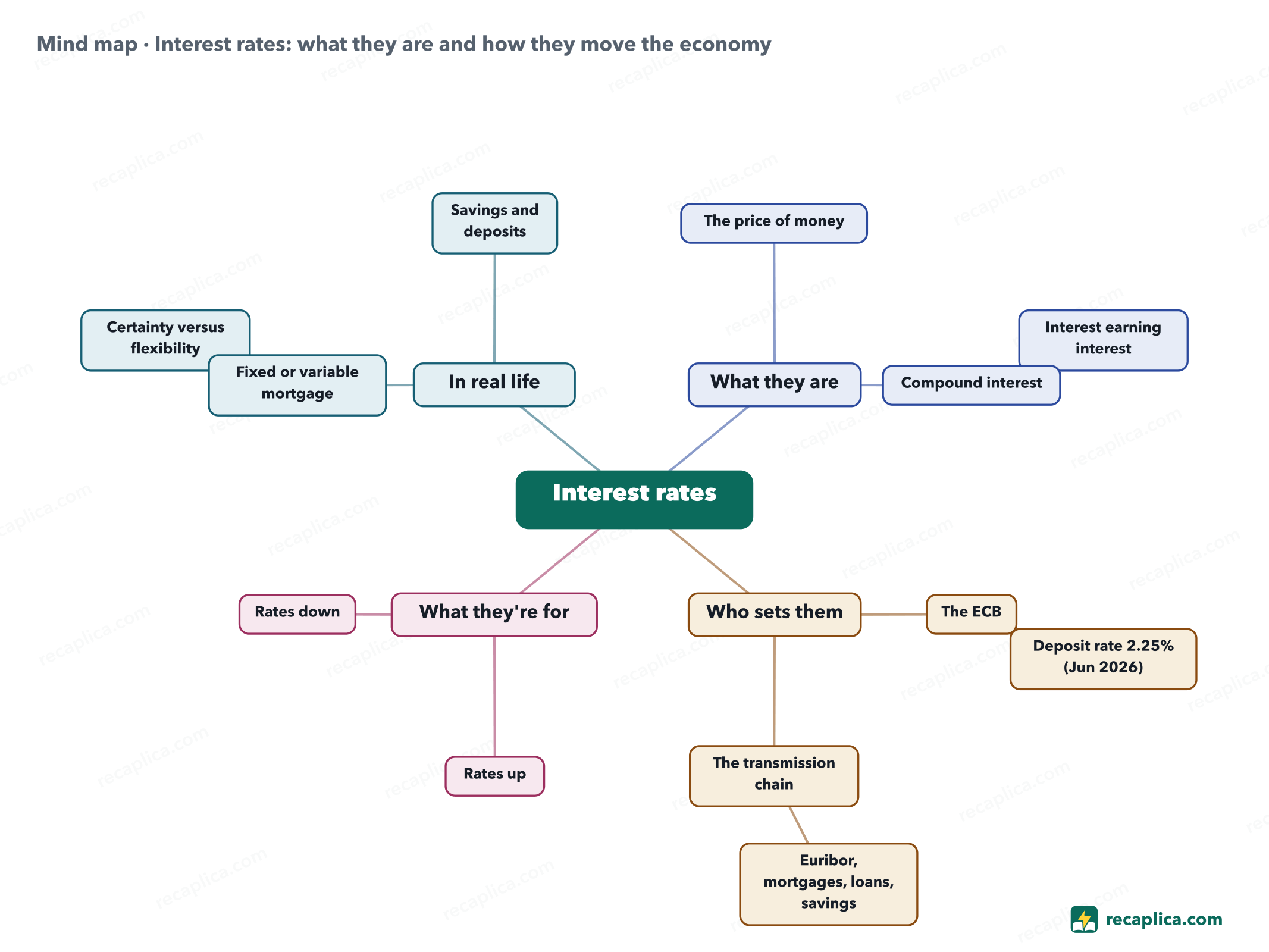
    Mind map: Interest rates: what they are and how they move the economy
    • Interest rates
      • What they are
        • The price of money What borrowing costs, what lending earns.
        • Compound interest
          • Interest earning interest
      • Who sets them
        • The ECB Three official rates for the euro area.
          • Deposit rate 2.25% (Jun 2026)
        • The transmission chain
          • Euribor, mortgages, loans, savings
      • What they're for
        • Rates up Cool spending and inflation.
        • Rates down Fuel consumption and investment.
      • In real life
        • Fixed or variable mortgage
          • Certainty versus flexibility
        • Savings and deposits

    Quiz: test yourself

    Answer the questions to check what you have learned: you get instant feedback and a short explanation.

    Grade 0/10 0/5
    1 In one sentence, what is an interest rate?

    It's what borrowing money costs (or what lending it earns), as a yearly percentage. It's not a tax, and stocks guarantee no return at all.

    2 Who sets the benchmark rates in the euro area?

    The ECB decides the three official rates for the whole euro area; governments and commercial banks adjust downstream.

    3 Why does a central bank raise rates?

    Pricier money means fewer loans, less spending and cooler demand: the classic lever against inflation. The other two options describe the effects of a cut, not a hike.

    4 Variable-rate mortgage: what happens if market rates rise?

    A variable rate tracks its benchmark index (typically Euribor in Europe): if the index rises, so does the payment. A locked payment is what fixed rates are for.

    5 True or false: with compound interest, interest is earned on previously earned interest.

    That's the definition: each period's base includes the interest already accrued. Over long horizons the gap versus simple interest becomes enormous.

    Answers: 1-A · 2-A · 3-A · 4-A · 5-A

    Flashcards

    Tap the card to flip it and check whether you remember the answer, then move to the next one.

    1 / 6

    Explain it in your own words

    The ultimate test: if you can explain it in simple words, you've truly understood it. Write your explanation, then compare it with the Recap.

    Your explanation is saved only on this device.

    The interest rate is the price of money: what it costs to borrow it, or what you earn for lending it. Benchmark rates are set by central banks (the ECB in the euro area) and ripple out to mortgages, loans and savings accounts. High rates cool spending and inflation; low rates fuel consumption and investment. As of mid-2026 the ECB deposit rate stands at 2.25%.

    Frequently asked questions

    What are the ECB's three official rates?

    The deposit facility rate (what banks earn parking money overnight at the ECB — today the main benchmark), the main refinancing rate (at which banks borrow for a week) and the marginal lending rate (overnight borrowing, the highest of the three).

    What is Euribor?

    The average rate at which major European banks lend to each other: the index most variable-rate mortgages in Europe are tied to. It closely follows ECB decisions.

    Fixed or variable: which is better?

    It depends on your risk tolerance and rate expectations: fixed buys certainty, variable often starts lower but can climb. It's a personal decision to weigh with a qualified advisor — this article is education, not a recommendation.

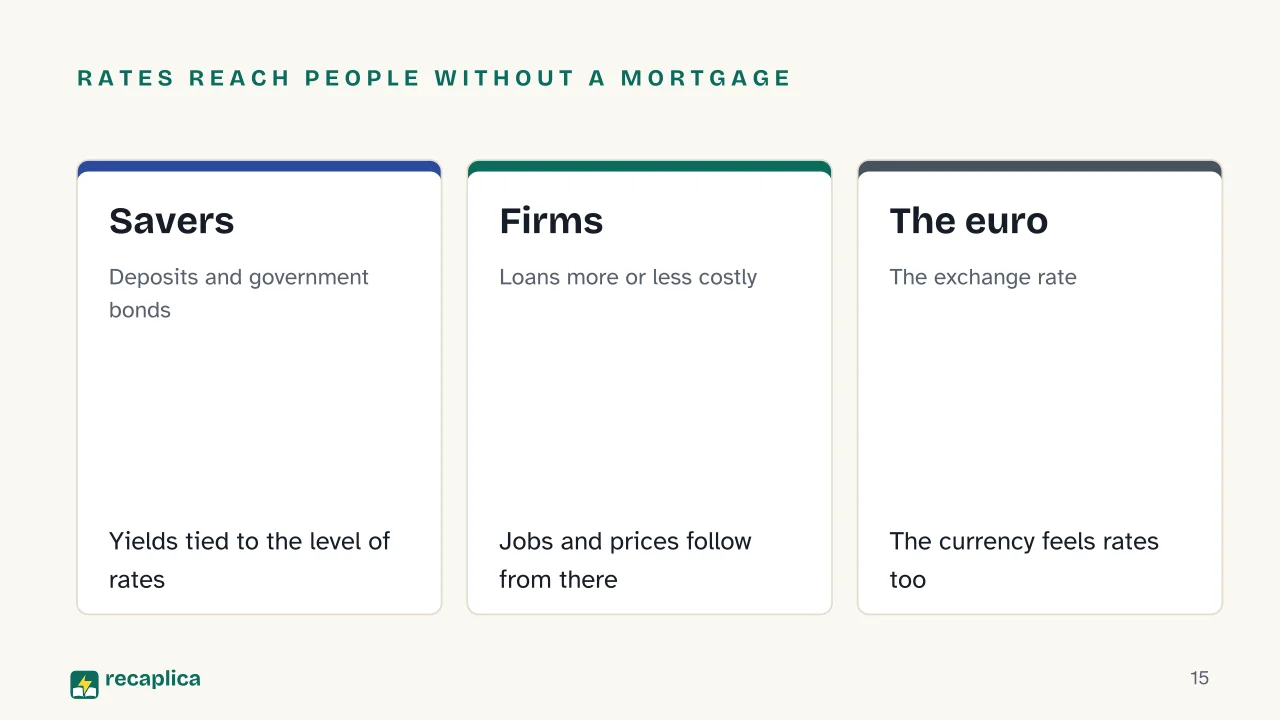
    Do rates affect people without mortgages?

    Very much so: they change the yields of savings accounts and government bonds, the cost of business loans (hence jobs and prices), even the currency's exchange rate. Monetary policy touches everyone, including those who never notice.

    Sources

    • ECB — Key ECB interest rates (current official rates)
    • ECB — The price stability objective (2%)

    Every Recap goes through an independent review before publication.

    Every evening, the day's new Recaps on our Telegram channel. Join the channel →

    Keep learning

    • Economics Bonds: what they are, how they pay and why their price changes A bond is a loan: whoever buys one gives money to a government, a bank or a company, which promises to repay the face value on a set date and, often, to pay interest along the way, called the coupon. The bondholder is a lender, not an owner. What you actually earn also depends on the price you paid, which can be higher or lower than the repayment value. When market interest rates rise, the price of fixed-rate bonds already in circulation falls, and vice versa. Bonds are usually less risky than stocks, but they are not free of risk. Read the Recap →
    • Economics Labor Market: How Supply, Demand and Unemployment Work The labor market is where businesses that need workers to produce goods and services meet the people willing to work for them. In the textbook model, that meeting sets wages and employment levels the way any other market would, but imperfect information, bargaining power and legal rules push the real market away from pure competition. Those gaps are where unemployment comes from, and economists split it into frictional, structural, cyclical and technological types depending on the cause. Official statistics, such as Italy's ISTAT, measure it against the labor force — people employed plus people actively looking for work — not the whole population. As of July 2026, Italy's unemployment rate stood at 5.8%, provisional, against 6.4% for the euro area. Read the Recap →
    • Economics Mercantilism: History, Examples, and Definition Mercantilism was the dominant economic doctrine in Western Europe from the 16th to the 18th century: a state grew powerful by selling more abroad than it bought, building up reserves of gold and silver. Britannica Money describes it as "an economic practice by which governments used their economies to augment state power at the expense of other countries." Colonies had one job under this system: supply raw materials to the mother country and buy finished goods back from it, while at home tariffs and monopolies shielded domestic industry. The name itself came later, from the doctrine's most famous critic: Adam Smith made it current in The Wealth of Nations, published in 1776. Read the Recap →

    recaplica

    Clear in 30 seconds, yours in 10 minutes.

    Recaps Mind maps Request a Recap Telegram channel Mind map maker Our method About Privacy & cookies Legal notes & terms of use

    © 2026 Recaplica · A project by Curi S.r.l. — VAT IT05472000750

    Statistics, only if you say so

    To learn which Recaps help most we would use Google Analytics, with aggregate, anonymous data. It starts only with your OK, and you can change your mind anytime. Privacy policy