|
recaplica
Public debt: what it is, how big Italy's is, and why it matters | ||||||||||||||||||||||||||||||||||||
| © 2026 Recaplica · recaplica.com — All rights reserved | ||||||||||||||||||||||||||||||||||||
Public debt: what it is, how big Italy's is, and why it mattersWhat to print Page numbers appear when printing with default margins. SlidesChoose a cut Flash10 slidesThe essential thread, to present in classFull18 slidesEvery chapter and the deeper detailBoth come with speaker notes. In 30 seconds quick readPublic debt is everything a government owes its creditors: bonds, loans and other liabilities built up over the years. Italy is one of the starkest examples of it: at the end of June 2026 its general government debt reached €3,207.2 billion, a new record according to Banca d'Italia, while its debt-to-GDP ratio stood at 138.9% at the end of March 2026 (Eurostat), the second-highest in the European Union after Greece. It makes headlines because that number weighs on public finances through the interest it costs to service — 3.8% of Italy's GDP in 2025, the highest share in the euro area — and because it shapes market confidence, tracked through indicators like bond spreads and sovereign credit ratings. Key Points
Key figures
Deep DiveA stock, not a bill to pay off in one goWhen people talk about public debt, they mean everything a government owes its creditors: bonds, loans and deposits built up over the years. Italy is a case in point. At the end of June 2026 the general government debt reached €3,207.2 billion, a new record according to Banca d’Italia. Compared with May 2026 (€3,181 billion), the increase was €26.2 billion in a single month; compared with June 2025 (€3,071.4 billion), it was about €135.9 billion over twelve months. Since January 2026 the monthly growth has continued almost without interruption, with increases of at least €20 billion a month, apart from a slight dip in April. It’s a textbook distinction that headlines often blur: the deficit is the difference between government revenue and spending in a single year, a flow; public debt is instead a stock, the accumulation over time of past deficits, plus other technical factors such as refinancing costs. A positive yearly deficit (spending exceeding revenue) increases the debt; a “primary surplus” (revenue exceeding spending, net of interest) can slow its growth, even if the total debt stays high. Italy’s 2025 budget deficit came to 3.1% of GDP, an improvement on 3.4% in 2024 (Eurostat); in the same year the euro area’s average deficit fell to 2.9% (from 3.0% in 2024), while the EU27’s held steady at 3.1%. Gross debt, net debt, Maastricht debtThe figure quoted on the news — the so-called “Maastricht debt” — is defined under the European ESA 2010 rules: it covers currency and deposits, debt securities and loans, valued at face value (not market value). It’s a gross measure: it doesn’t subtract the financial assets a government holds, such as cash reserves or equity stakes. A hypothetical net debt figure would be lower, but it isn’t the official measure used in European treaties or in comparisons between countries.
How the state borrowsItaly covers its financing needs by issuing government bonds through the Treasury Department of the MEF: BOTs (Treasury bills, maturity up to 12 months), BTPs (multi-year Treasury bonds, medium to long-term) and CCTeus (floating-rate Treasury certificates, indexed to Euribor). Alongside these are inflation-linked instruments, such as BTP€i and BTP Italia, and retail-focused bonds like BTP Valore, BTP Green (earmarked for environmental spending) and BTP Futura.
The total stock of government bonds outstanding was €2,712 billion as of 31 August 2026: a figure distinct from the total general government debt (€3,207.2 billion in June 2026), because it excludes loans and deposits. On that same date, the average residual maturity of all outstanding bonds was 6.93 years: in other words, the debt isn’t paid off all at once, but keeps getting refinanced as older bonds mature and get replaced by new issuance. How big it is versus GDPThe debt-to-GDP ratio is the most widely used measure for comparing countries of different sizes. At the end of March 2026, according to Eurostat, Italy’s debt-to-GDP ratio stood at 138.9%, up from 137.1% at the end of 2025 — a ratio that had already risen by 2.4 percentage points between the end of 2024 and the end of 2025.
Italy ranks second in the European Union, after Greece, with a ratio more than double Germany’s. The euro-area average, at 88.9%, was up from 87.7% at the end of 2025. Who holds the debt: domestic and foreignAnother useful distinction is between domestic debt (held by residents of Italy) and foreign debt (held by non-resident investors). As of May 2026, according to Banca d’Italia, 35.9% of the debt was held by non-resident investors, up from 35.7% in April 2026. The rest was held mostly by residents: Banca d’Italia held 17.2% in May 2026, down to 16.7% by the end of June, while “other residents” — mainly households and non-financial firms — held 14.5% (down from 14.7%). Overall, then, most of the debt remains in the hands of residents of Italy: a distinction that matters for understanding who receives the interest the government pays, part of it going to Italian savers and institutions, part to foreign investors. Why it makes headlines: interest, ratings and marketsHigh debt costs money. In 2025 Italy’s interest spending on public debt came to 3.8% of GDP, the highest share among euro-area countries — almost double France’s, Spain’s and the euro-area average, four times Germany’s — according to the CPI Observatory at Università Cattolica. The debt’s implicit cost — interest spending as a share of the total stock — was 3.0% in 2025; the average cost at which the Treasury issues new bonds rose from 2.75% to 2.93% between 2025 and 2026. How cheaply a government can borrow depends largely on how reliable markets consider it. The main rating agencies have tracked Italy’s sovereign debt closely: between 2025 and 2026, S&P, Moody’s, Fitch and Scope raised or confirmed with a positive outlook their assessments (Moody’s, for instance, raised its rating to Baa2 in November 2025, a first step after several years without an upgrade, according to the news coverage of the move). A higher rating signals lower perceived default risk and usually allows for cheaper borrowing; a lower one does the opposite. The BTP-Bund spread — the yield gap between 10-year Italian government bonds and the interest rates on equivalent German bonds — is the most closely watched market indicator of how much riskier investors see Italy than Germany, and it also spills over into stock prices and financial markets more broadly. A debt-to-GDP ratio that keeps rising makes a country more sensitive to higher interest rates or to a drop in market confidence. There isn’t, though, a fixed threshold beyond which a crisis or a recession automatically follows: what also matters is a country’s ability to keep finding, month after month, investors willing to buy its bonds on sustainable terms. Slide deckSlides ready to download and make your own in PowerPoint or Google Slides, with speaker notes. Pick the Flash cut or the Full one.     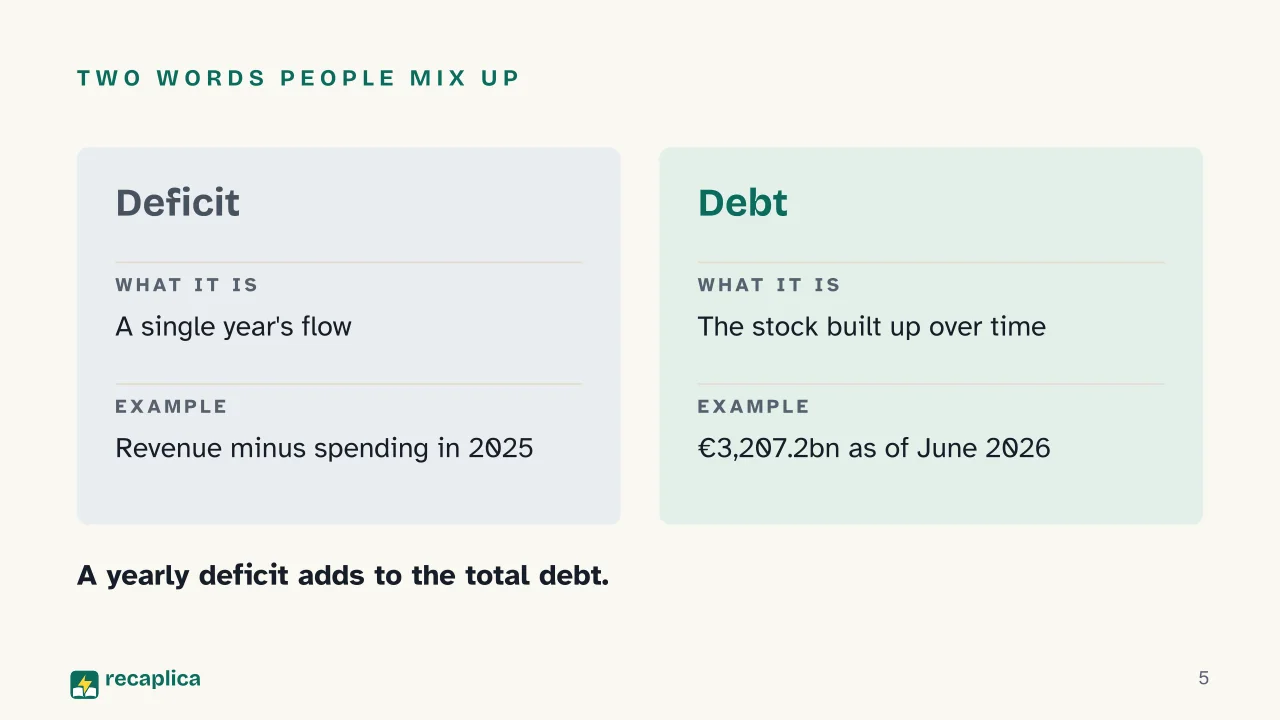 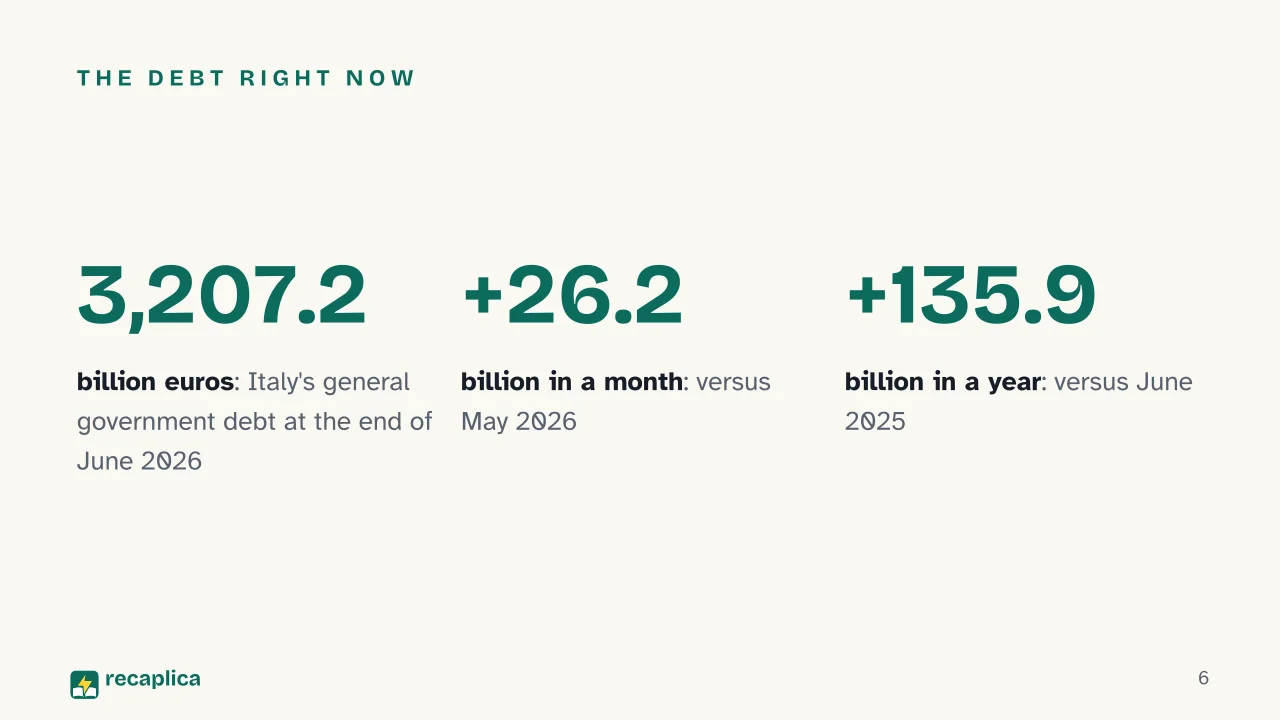  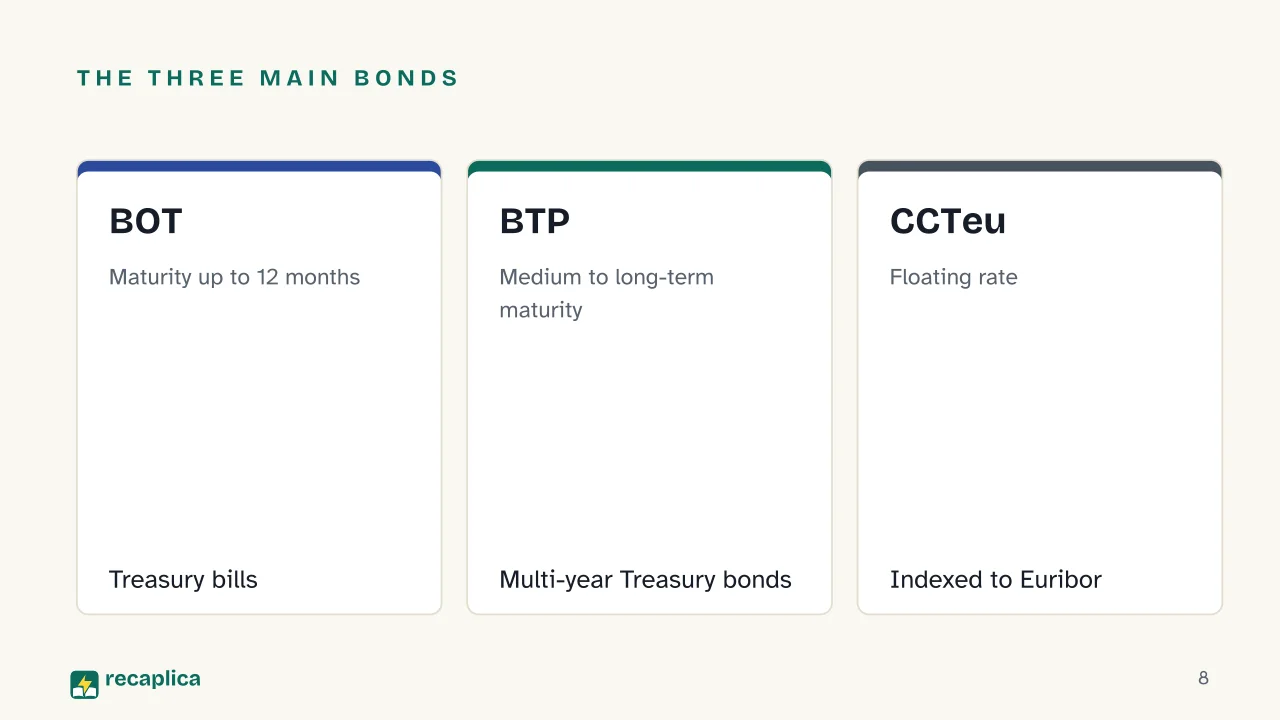 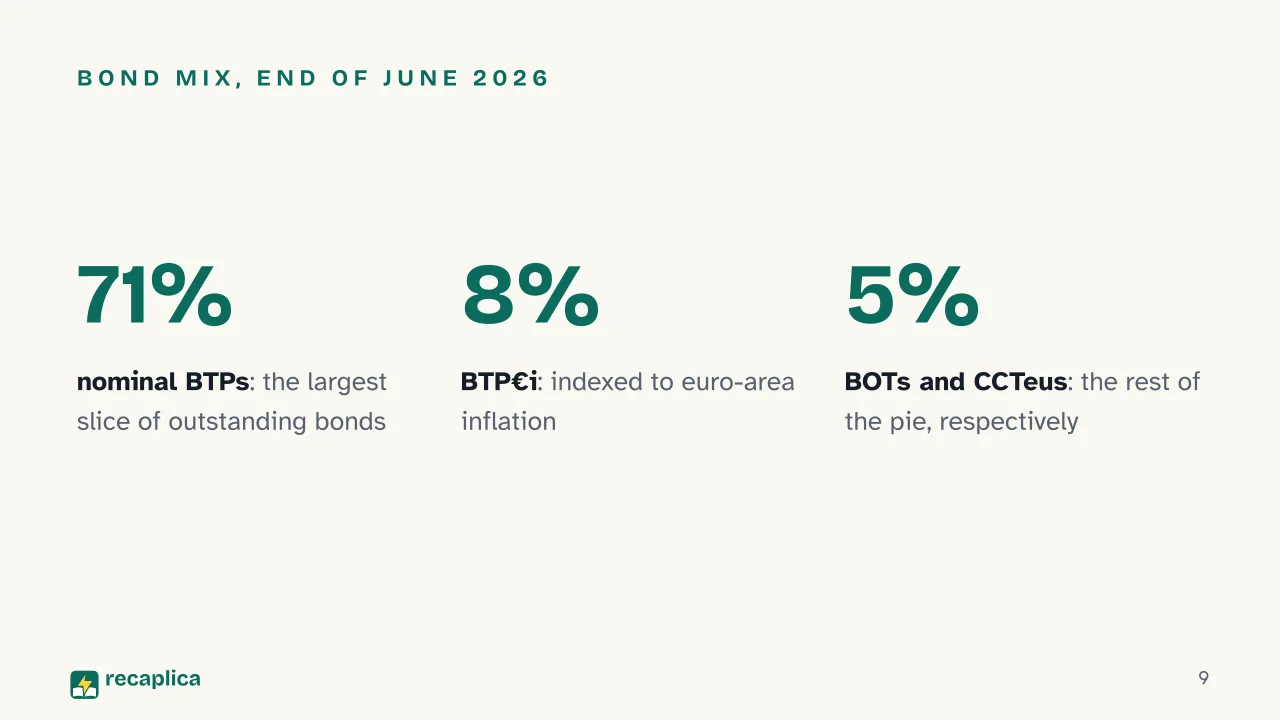  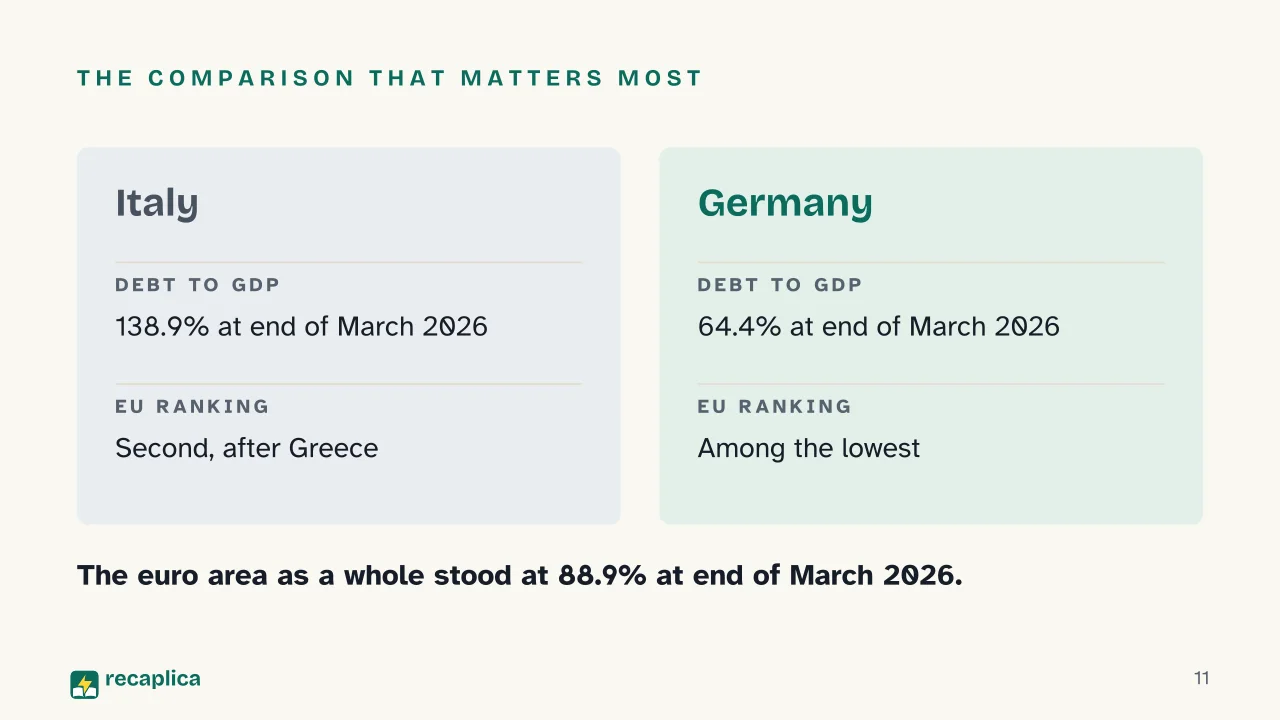 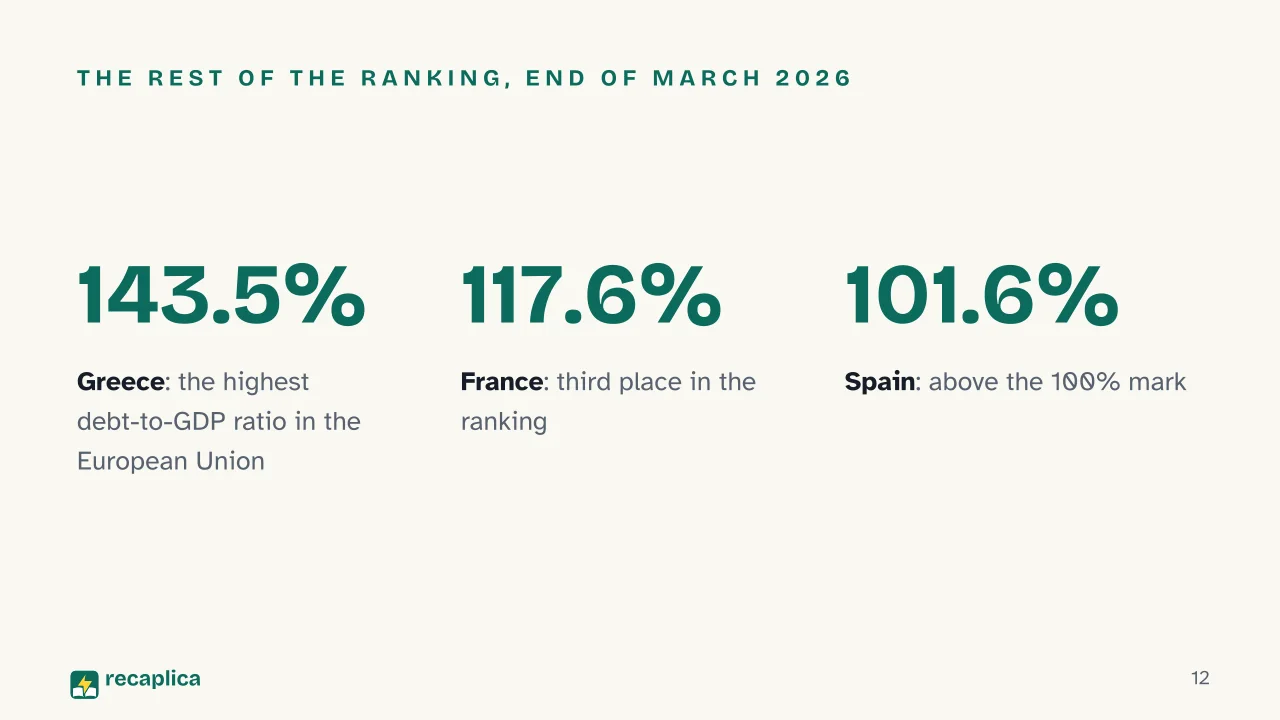  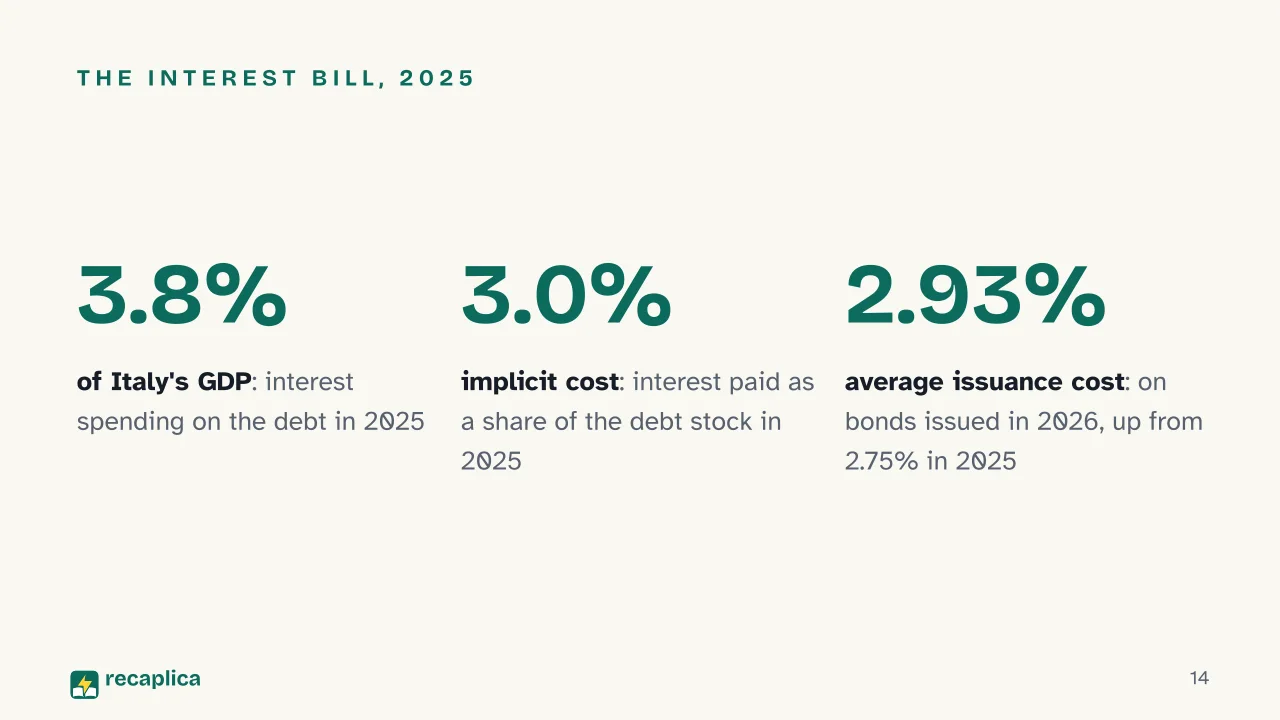 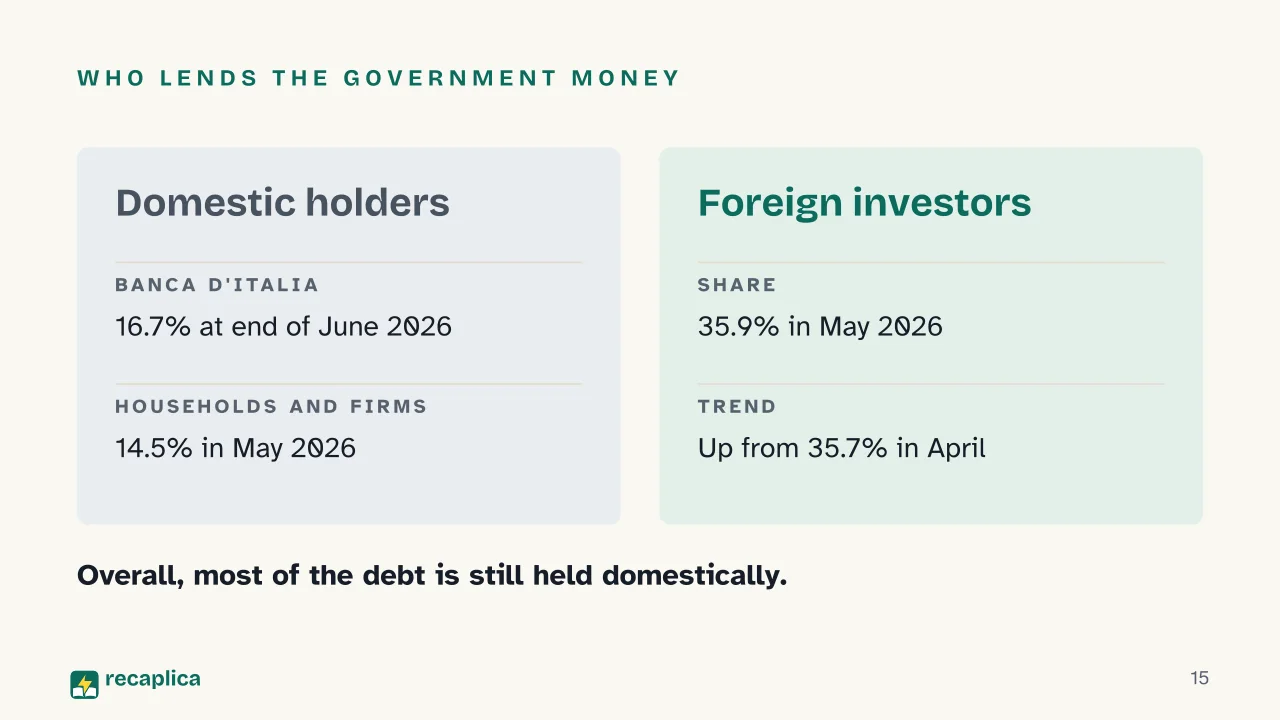 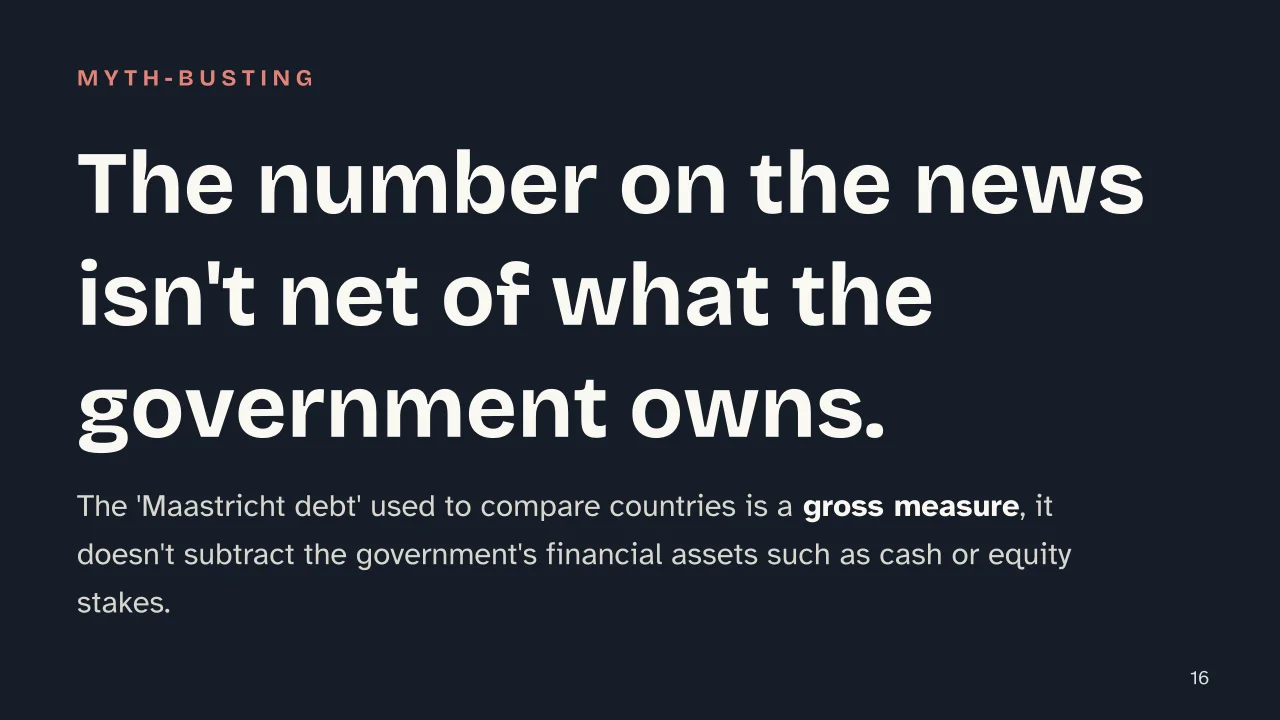   Common myths
Mind mapDrag the background to move around and the nodes to reposition them; use − and + to collapse and expand branches. 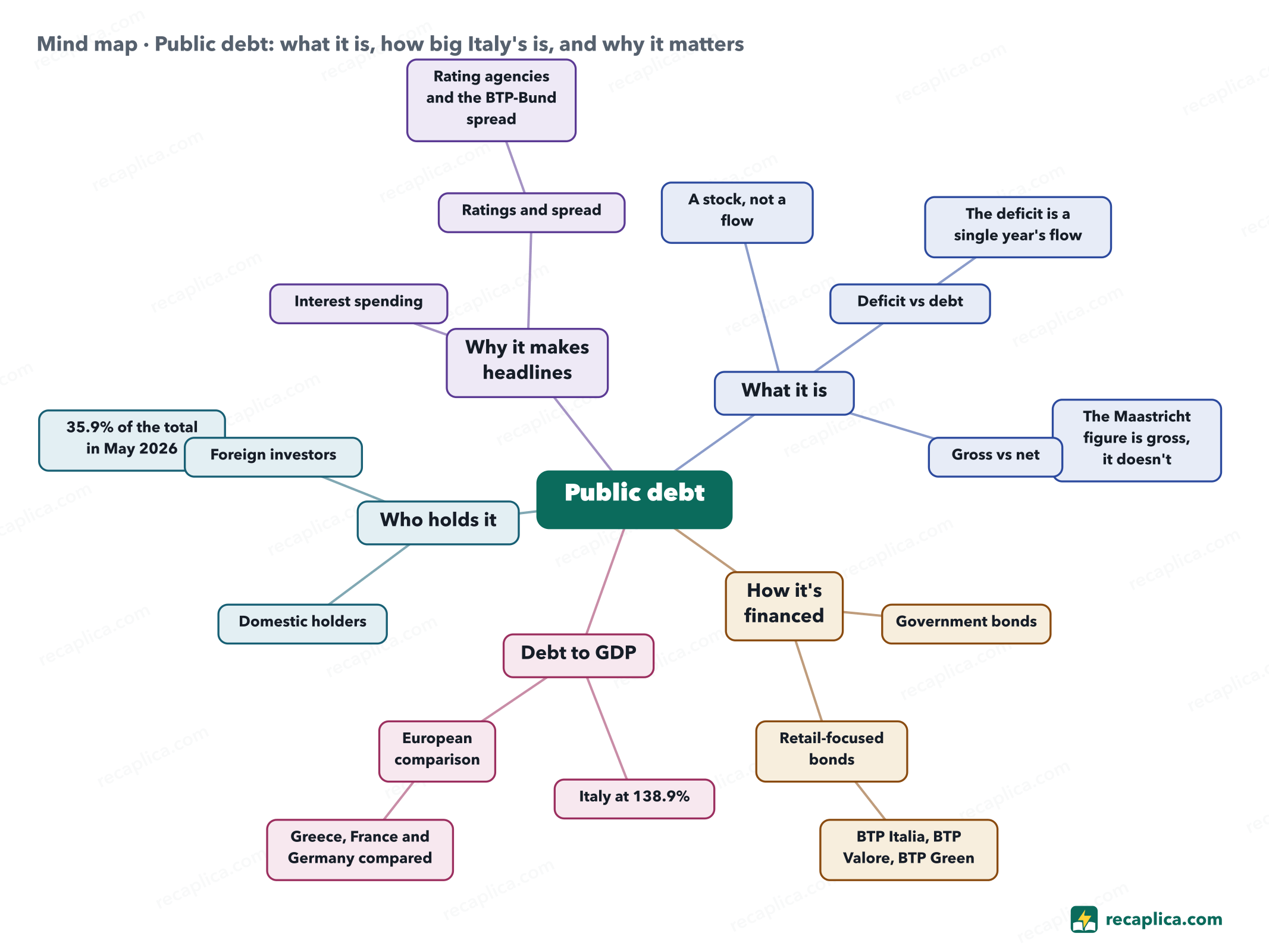
Quiz: test yourselfAnswer the questions to check what you have learned: you get instant feedback and a short explanation. Grade 0/10 0/5
FlashcardsTap the card to flip it and check whether you remember the answer, then move to the next one. 1 / 8 Explain it in your own wordsThe ultimate test: if you can explain it in simple words, you've truly understood it. Write your explanation, then compare it with the Recap. Your explanation is saved only on this device.
Frequently asked questionsDoes public debt need to be repaid all at once?No. A government doesn't pay off its debt in one lump sum: it continuously issues new bonds (BOTs, BTPs, CCTeus and other instruments) with different maturities, and the average residual maturity of all of Italy's outstanding bonds was 6.93 years as of 31 August 2026. When a bond matures it's mostly refinanced with new issuance, not paid off in full with new taxes in one go. Why is Italy's public debt higher than that of other European countries?The causes of a debt built up over decades are many and can't be pinned on a single factor; among the elements that weigh on the comparison with other countries are the level of interest spending, which in Italy came to 3.8% of GDP in 2025, almost double that of France, Spain and the euro-area average, and four times Germany's, and the sheer size of the stock accumulated over previous decades. What happens if the debt-to-GDP ratio keeps rising?A higher debt-to-GDP ratio makes a country more sensitive to changes in interest rates and to market sentiment, which shows up in indicators like the BTP-Bund spread and in rating agencies' judgments. There isn't a fixed threshold beyond which a crisis automatically follows, though: what also matters is a country's ability to keep finding investors willing to buy its bonds on sustainable terms. Who lends the Italian government money?Whoever buys its government bonds: as of May 2026, according to Banca d'Italia, 35.9% of the debt was held by non-resident (foreign) investors, while the majority remained with residents of Italy, including Banca d'Italia itself (17.2% in May 2026, down to 16.7% by the end of June) and households and non-financial firms (14.5%). What is the spread that gets mentioned alongside public debt?It's the yield gap between 10-year Italian BTPs and equivalent German Bunds, considered the most closely watched market indicator of how much riskier investors see Italy than Germany. It tends to move together with rating agencies' judgments on the sovereign debt. Every Recap goes through an independent review before publication. |