Skip to content
recaplica

    One moment: security check

    Cloudflare wants to make sure you're not a robot. Tick the box below and your search will continue on its own.

    IT
    recaplica CBDC: What Is a Central Bank Digital Currency and How Does It Work?
    © 2026 Recaplica · recaplica.com — All rights reserved
    Home › Economics

    CBDC: What Is a Central Bank Digital Currency and How Does It Work?

    By Recaplica Newsroom · Updated on September 19, 2026

    What to print

    Page numbers appear when printing with default margins.

    Slides

    Choose a cut

    Flash10 slidesThe essential thread, to present in classFull16 slidesEvery chapter and the deeper detail

    Both come with speaker notes.

    Telegram channel
    recaplica Clear in 30 seconds, yours in 10 minutes.
    In 30 seconds Key points Figures Deep dive Slides Myths Mind map Quiz Flashcards FAQ

    In 30 seconds quick read

    A CBDC, or central bank digital currency, is digital money issued directly by a central bank rather than a private company. It is not a cryptocurrency: a CBDC carries the same backing as banknotes and coins, while an asset like Bitcoin or Ether has no institution standing behind it. The European Central Bank is building its own version, the digital euro, meant to sit alongside cash rather than replace it, with support for payments even without an internet connection. By 2024, more than nine in ten of the world's central banks were exploring a CBDC of some kind.

    Key Points

    • A CBDC is central bank money, not a cryptocurrency like Bitcoin or Ether.
    • The digital euro, the ECB's own CBDC project, would not run on blockchain: the ECB describes borrowing only some design principles from distributed ledger technology, not the technology itself.
    • Technical tests explored a holding limit of up to 3,000 euros per person, a threshold still to be set by law.
    • In 2024, cash still ran close to cards by payment value in the euro area (39% versus 45%), even as it fell to 52% of point-of-sale transactions from 59% in 2022.
    • In 2024, 91% of the 93 central banks surveyed by the Bank for International Settlements were exploring a CBDC, retail or wholesale.
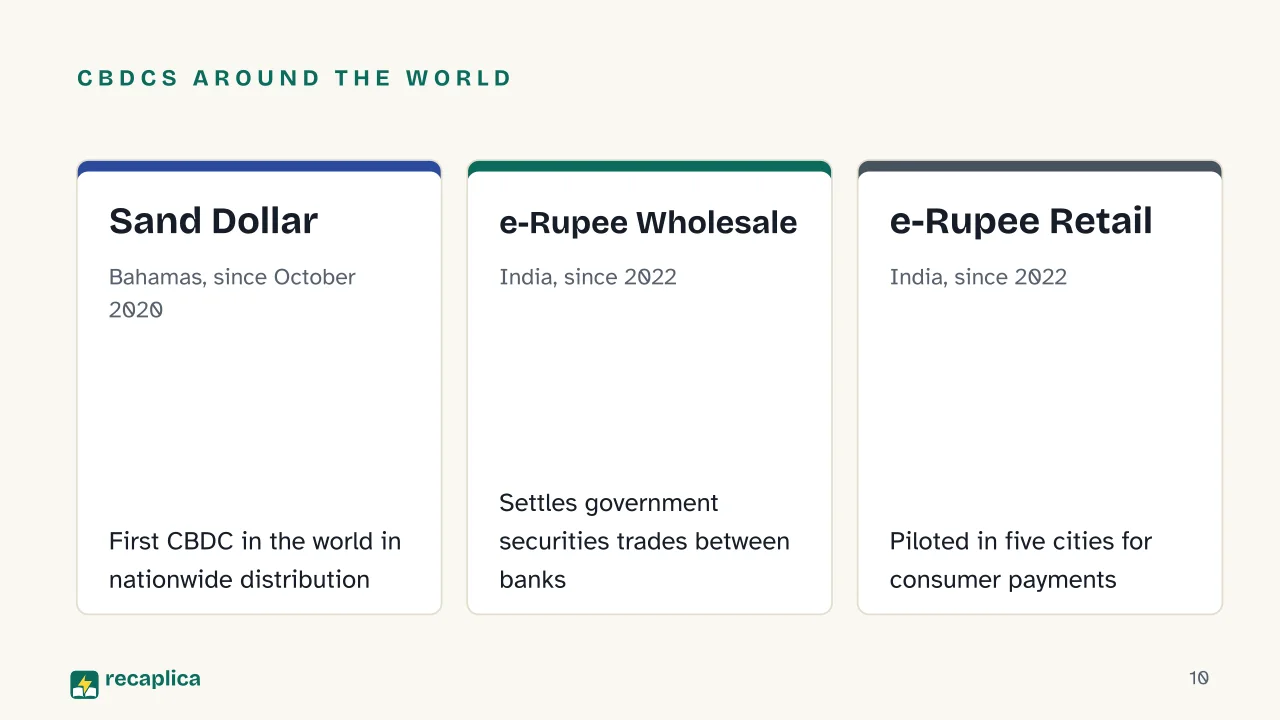
    • The world's first CBDC actually in circulation is the Bahamas' Sand Dollar, distributed nationwide since October 2020.

    Key figures

    • 52% Share of cash in point-of-sale transactions in the euro area in 2024, down from 59% in 2022. Source: European Central Bank, SPACE 2024 survey
    • 39% vs. 45% Share of cash and card payments by value in the euro area in 2024: the two remained close. Source: European Central Bank, SPACE 2024 survey
    • 91% Share of the 93 central banks surveyed in 2024 exploring a retail, wholesale, or both types of CBDC. Source: Bank for International Settlements, 2024

    Deep Dive

    A CBDC, short for central bank digital currency, is money issued directly by a central bank in digital form, rather than by a private company. The concept covers a whole family of projects around the world, and the European Central Bank has its own version under development: the digital euro, meant to give the euro area a digital counterpart to cash. According to the ECB, it “would be a digital form of cash, issued by the central bank and available to everyone” in the euro area, designed to sit alongside banknotes and coins rather than replace them. The detail that matters most is who stands behind it: because it would be backed by a central bank, a CBDC is not a crypto-asset.

    What a CBDC actually is

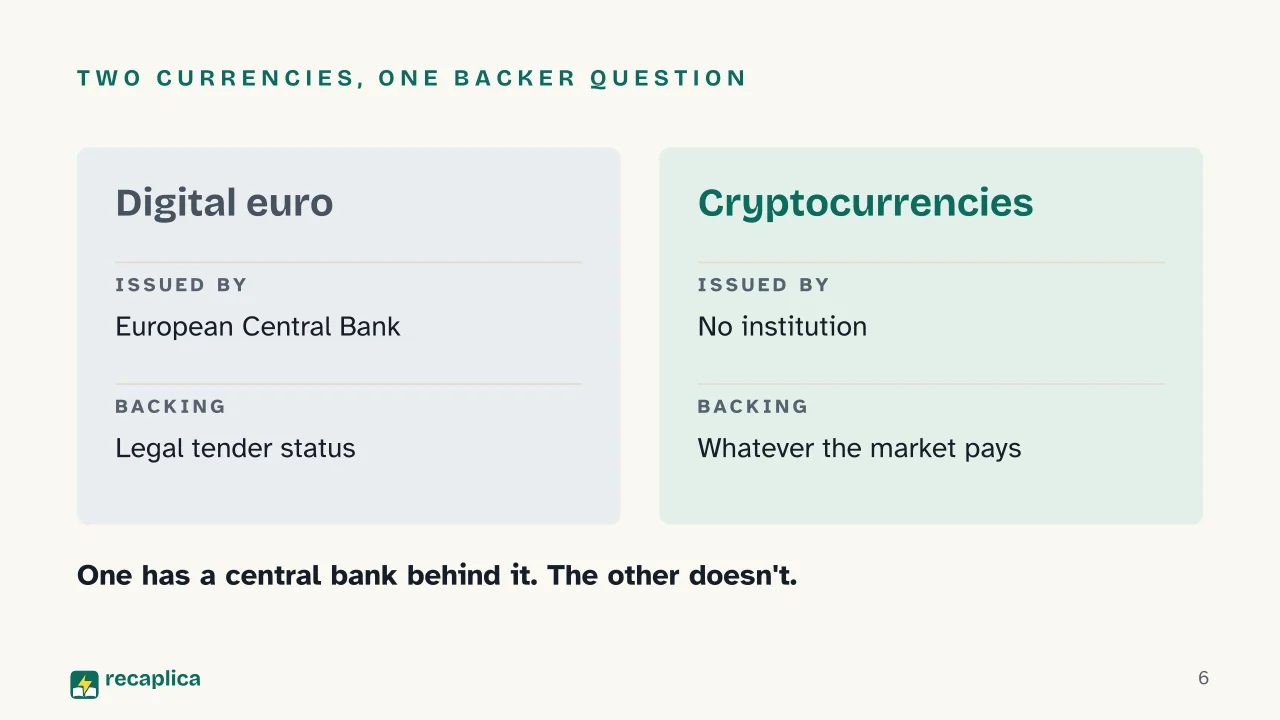
    The most common mix-up is treating a CBDC as a cryptocurrency, since both would live on a phone. The ECB, however, defines the digital euro as central bank money: it would be issued and guaranteed by the Eurosystem, and like banknotes and coins it would carry legal tender status. Bitcoin and Ether, by contrast, are not backed by any institution; their value depends on what the market will pay, not on a public guarantee.

    A second misunderstanding concerns the technology. The ECB states plainly that the digital euro would not be based on distributed ledger technology, the DLT that underpins many cryptocurrencies, even though it borrows “some key design principles” from it. Anyone searching for “CBDC blockchain” expecting a project built on a chain of blocks would find a different answer than expected; to see how that technology actually functions, it helps to read about how blockchain works.

    How a CBDC payment would work

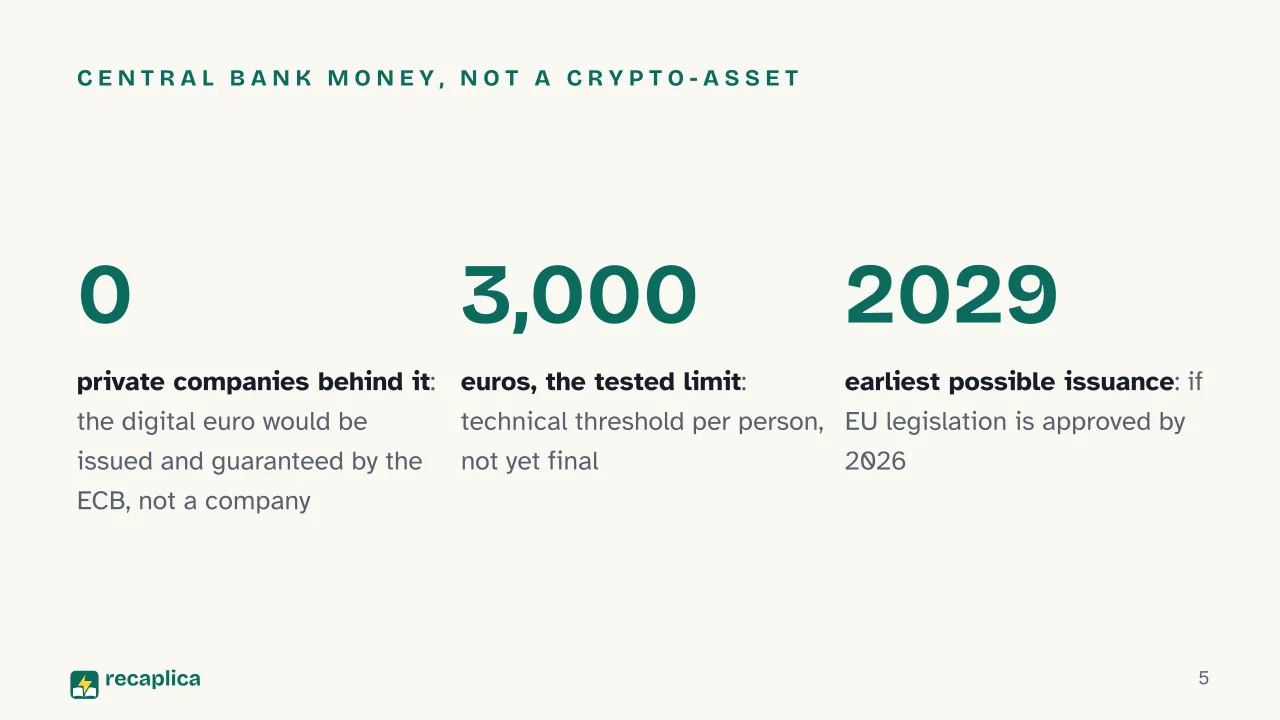
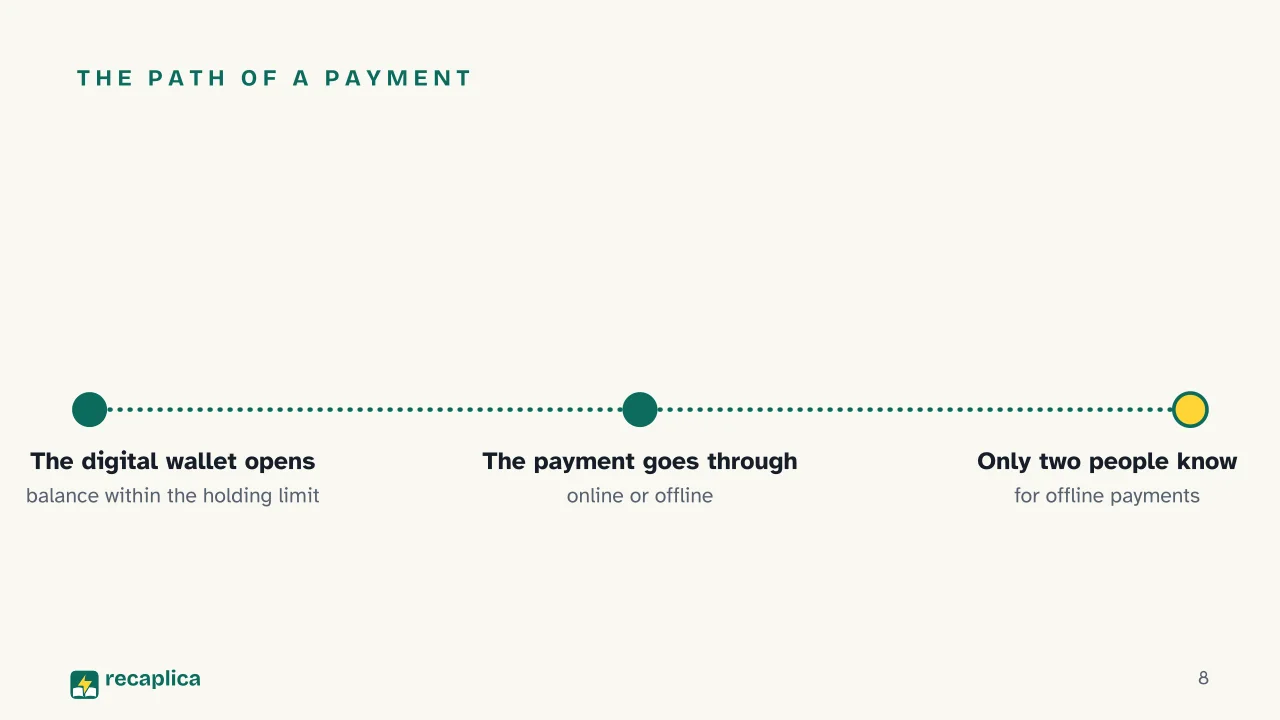
    In its technical tests, the ECB explored a holding limit of up to 3,000 euros per person: anything above that threshold would automatically move to a linked bank account, much like a savings account sweeping extra cash into a checking account it’s tied to. That figure is not yet a final legal limit; it would only become one once EU legislation is adopted.

    Practical example: You step into a tunnel with no signal and need to pay for a train ticket. With the digital euro, according to the ECB, you could still do it through an offline payment: only you and the ticket seller would know the transaction details, while your balance would stay within the holding limit set for each person.

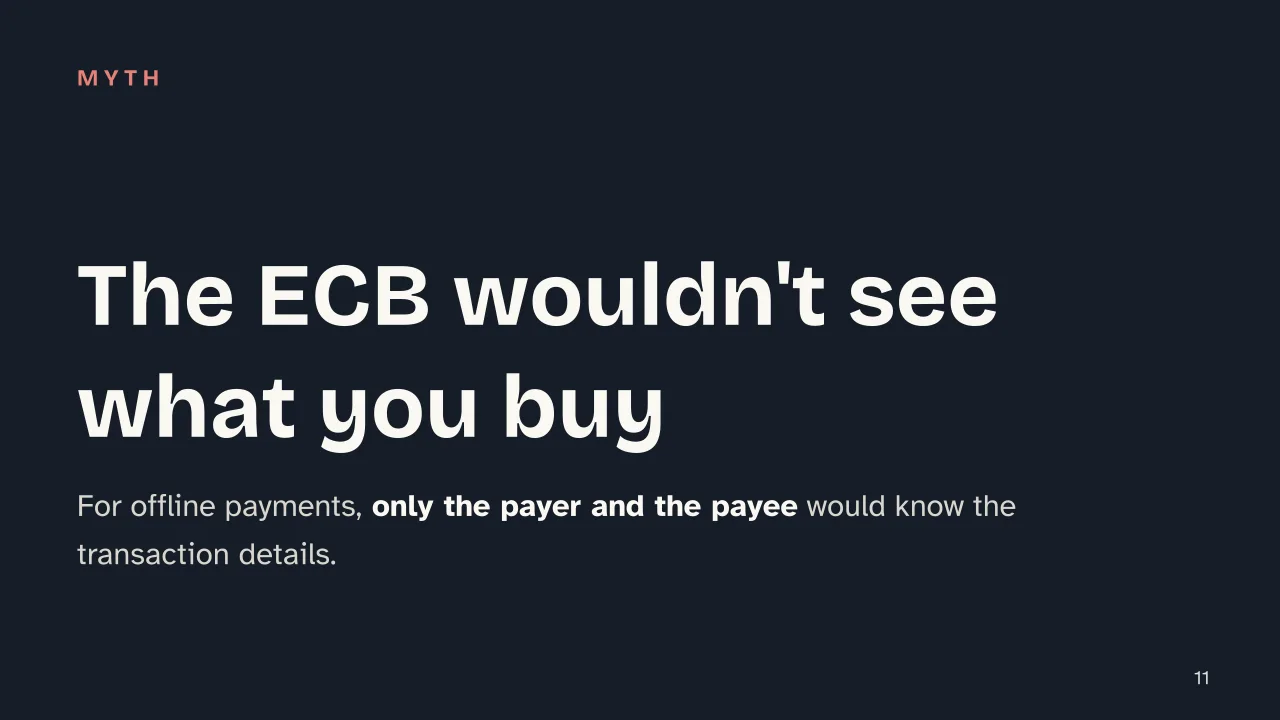
    Privacy is one point where the ECB has taken an especially firm stance. For online payments it says it could not identify who a user is or what they buy from the payment data it would receive; for offline payments it goes further, stating that only the two parties to a transaction would know its details.

    CBDC, cash and cryptocurrencies compared

    CashDigital euroCryptocurrencies
    Issued byEurosystem central banksEuropean Central BankNo institution
    Legal tenderYesYes, like banknotes and coinsNo
    Underlying technologyPhysical, noneNot blockchain, only DLT-inspired principlesOften public distributed ledgers
    Holding limitNoneThreshold tested up to 3,000 euros per personNone set by an institution
    Works offlineAlwaysPlanned, with privacy between the two partiesNot addressed by this source

    Why it is coming up now

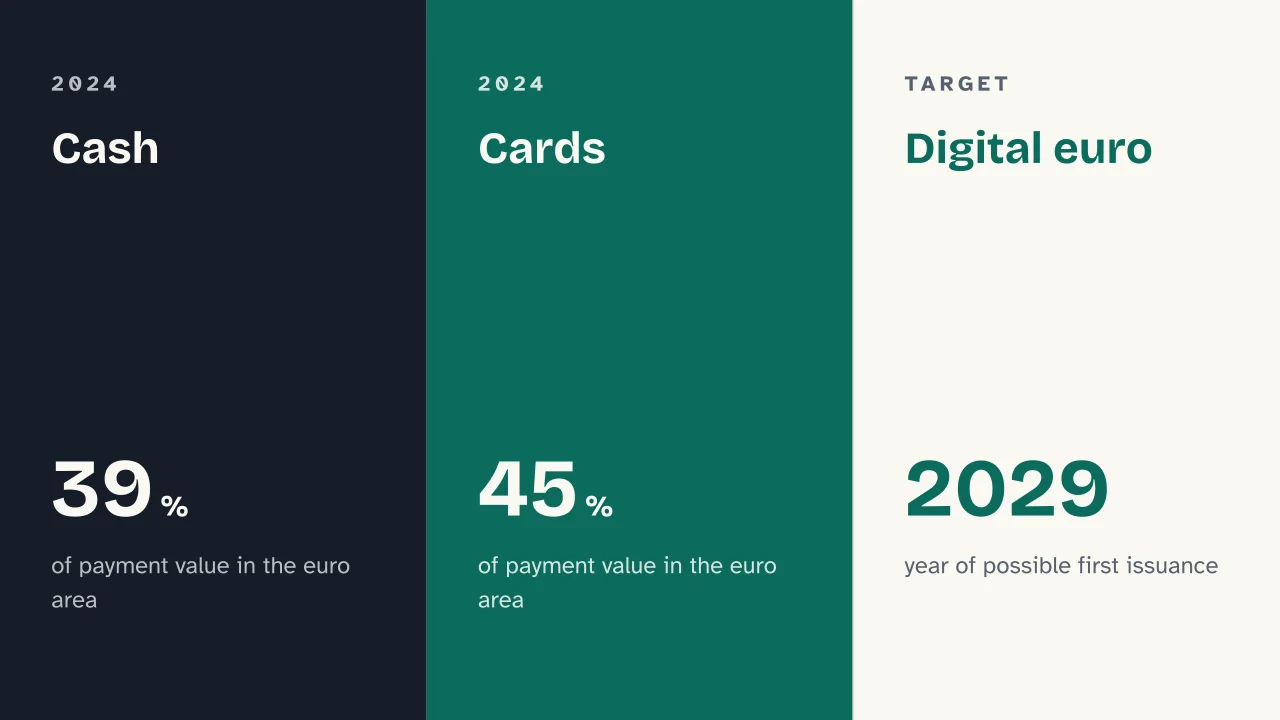
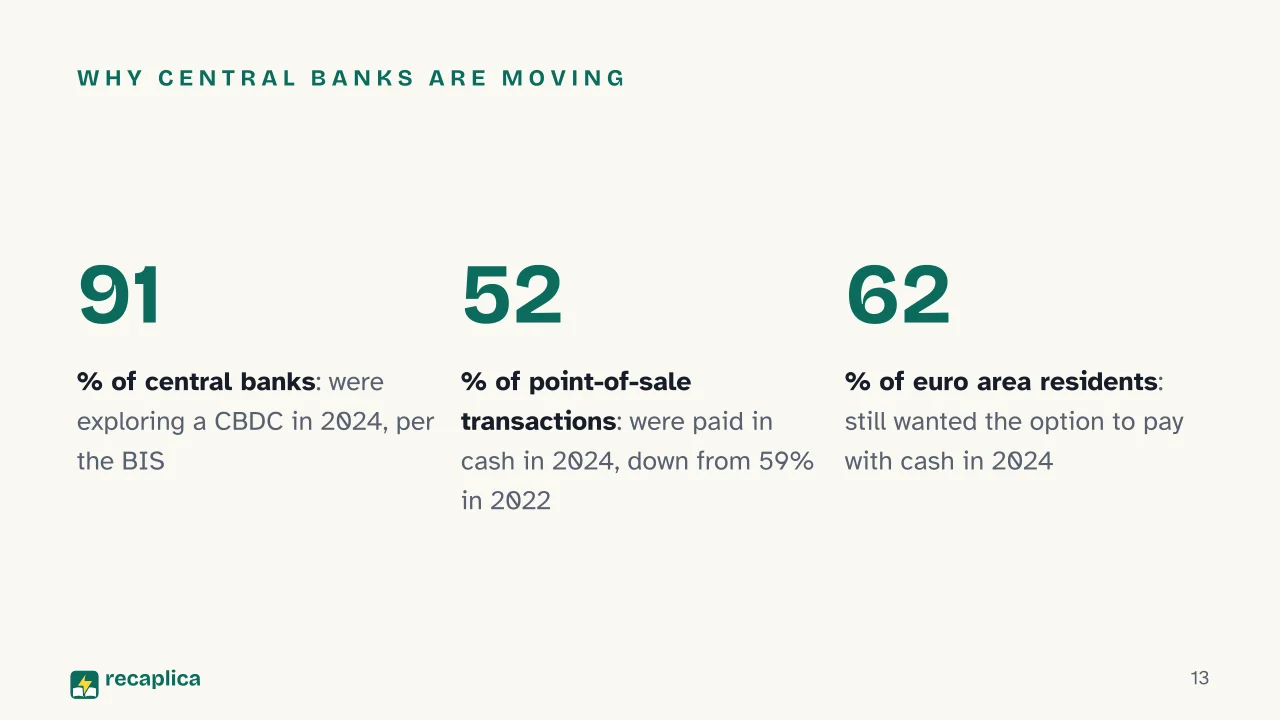
    The decline of cash is one factor behind the push for a CBDC, but not the only one. According to the ECB’s 2024 SPACE survey, cash fell from 59% to 52% of point-of-sale transactions between 2022 and 2024; by value, though, it stayed close to cards (39% versus 45%), and 62% of euro area residents considered it important or very important to keep the option of paying with cash. Over two years, the decline amounted to a few percentage points.

    Two more factors show up across the many central banks working on CBDCs, according to the Bank for International Settlements’ 2024 survey of 93 of them. More than one jurisdiction in three had accelerated its CBDC work in response to the spread of stablecoins and other crypto-assets, and many central banks pointed to wanting to preserve the role of central bank money as payment habits shift. In 2024, 91% of the 93 central banks surveyed were exploring a retail CBDC, a wholesale CBDC, or both; overall, wholesale projects, the ones used between banks, were further along than retail projects aimed at ordinary consumers.

    Outside the euro area, some CBDCs are already running. The Bahamas’ Sand Dollar has been in nationwide distribution since October 2020, making it the first CBDC actually in circulation anywhere. India took a different route, running two separate tracks: the Reserve Bank of India launched a wholesale digital rupee in 2022 to settle government securities trades between banks, alongside a retail digital rupee distributed through banks such as State Bank of India and ICICI Bank and piloted in five cities (Mumbai, New Delhi, Bengaluru, Bhubaneswar and Chandigarh).

    What it would cost, and who pays

    Cost estimates published by the ECB cover different scopes and should be read separately. For the Eurosystem itself, total development costs are estimated at around 1.3 billion euros, with annual running costs of about 320 million euros once issued. For Europe’s banking sector, which would need to adapt its own systems, the estimate is higher, between 4 and 5.8 billion euros. These figures come from different sources covering different scopes, and the ECB does not present them as figures that should be added together.

    When it might arrive

    The ECB is aiming to be ready for a first issuance of the digital euro during 2029, but it presents that as a conditional goal: the necessary EU legislation would need to be adopted by 2026 first. Without that law, the date slips. It is worth keeping that condition in mind, because the legislative process that decides Europe’s monetary rules runs through the same institutions that shape how the European Union works more broadly.

    Anyone reading about cryptocurrencies or inflation often finds CBDCs mentioned as part of the same broader conversation about money and payments. For a fuller picture of how cryptocurrencies work, or what happens to prices when inflation rises, those two related Recaps help place a project like the digital euro in context.

    Slide deck

    Slides ready to download and make your own in PowerPoint or Google Slides, with speaker notes. Pick the Flash cut or the Full one.
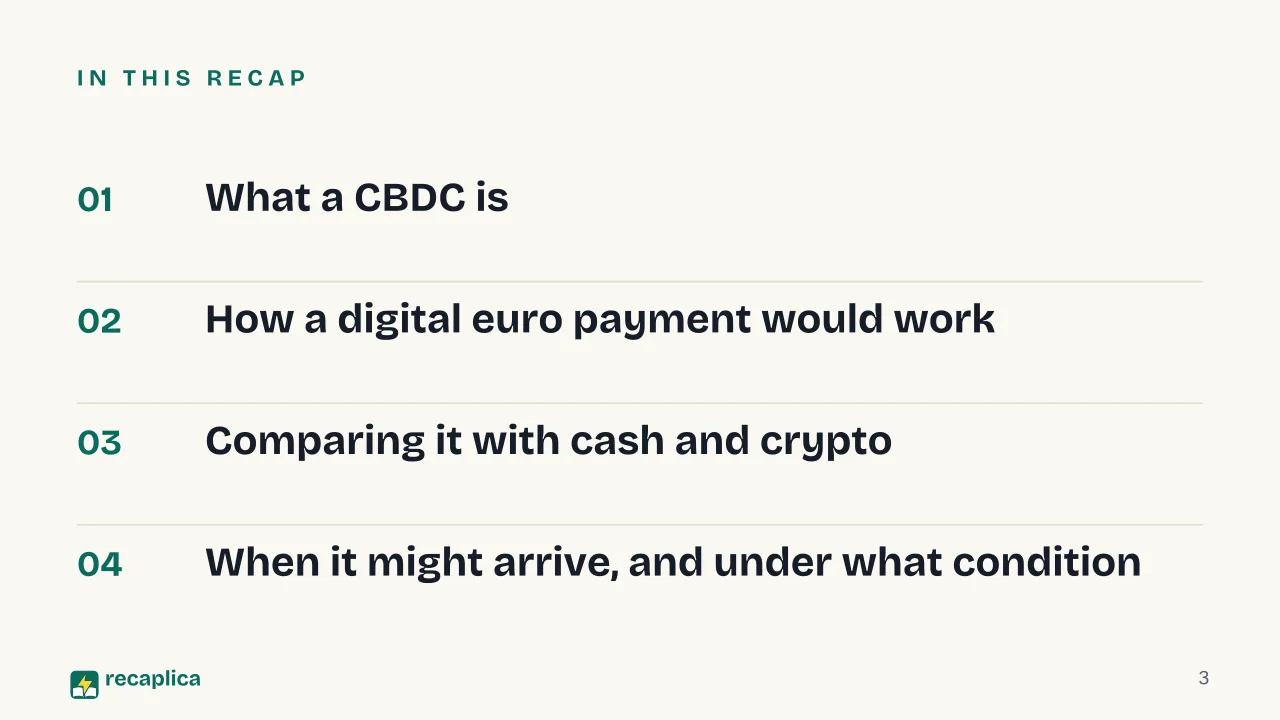
    Slide 1 of the presentation on CBDC: CBDCSlide 2 of the presentation on CBDC: Is cash about to vanish from how we pay?Slide 3 of the presentation on CBDC: In this RecapSlide 4 of the presentation on CBDC: Chapter 01: What it isSlide 5 of the presentation on CBDC: Central bank money, not a crypto-assetSlide 6 of the presentation on CBDC: Two currencies, one backer questionSlide 7 of the presentation on CBDC: Chapter 02: How it worksSlide 8 of the presentation on CBDC: The path of a paymentSlide 9 of the presentation on CBDC: Cash · Cards · Digital euroSlide 10 of the presentation on CBDC: CBDCs around the world: Sand Dollar, e-Rupee Wholesale, e-Rupee RetailSlide 11 of the presentation on CBDC: The ECB wouldn't see what you buySlide 12 of the presentation on CBDC: Chapter 03: Why nowSlide 13 of the presentation on CBDC: Why central banks are movingSlide 14 of the presentation on CBDC: Chapter 04: When it arrivesSlide 15 of the presentation on CBDC: Will a CBDC like the digital euro replace cash?Slide 16 of the presentation on CBDC: You understand CBDC now
    Flash10 slidesThe essential thread, to present in classFull16 slidesEvery chapter and the deeper detail

    Common myths

    • ✗ Myth A CBDC is just another cryptocurrency, similar to Bitcoin.

      ✓ Reality The mix-up is understandable, since both live inside a phone screen. But the ECB draws a hard line: central bank money is issued and guaranteed by a public institution, while an asset such as Bitcoin or Ether answers to no one, and its worth rests entirely on what the market will pay. The screen looks the same; the guarantee behind it does not.

    • ✗ Myth Once a CBDC like the digital euro launches, cash will disappear almost overnight.

      ✓ Reality Between 2022 and 2024, cash use at points of sale fell from 59% to 52%, yet by value it still ran close to cards (39% versus 45%), and 62% of euro area residents still called it an important payment option. The ECB itself frames the digital euro as an addition to the wallet, not a replacement for it.

    • ✗ Myth Once the digital euro exists, the ECB will be able to see everything people buy.

      ✓ Reality The ECB states it would be unable to identify who is paying or what they are buying from the payment data it receives, and for offline payments its position goes further still: only the two parties involved would know any of the transaction details.

    Mind map

    Drag the background to move around and the nodes to reposition them; use − and + to collapse and expand branches.
    Customize
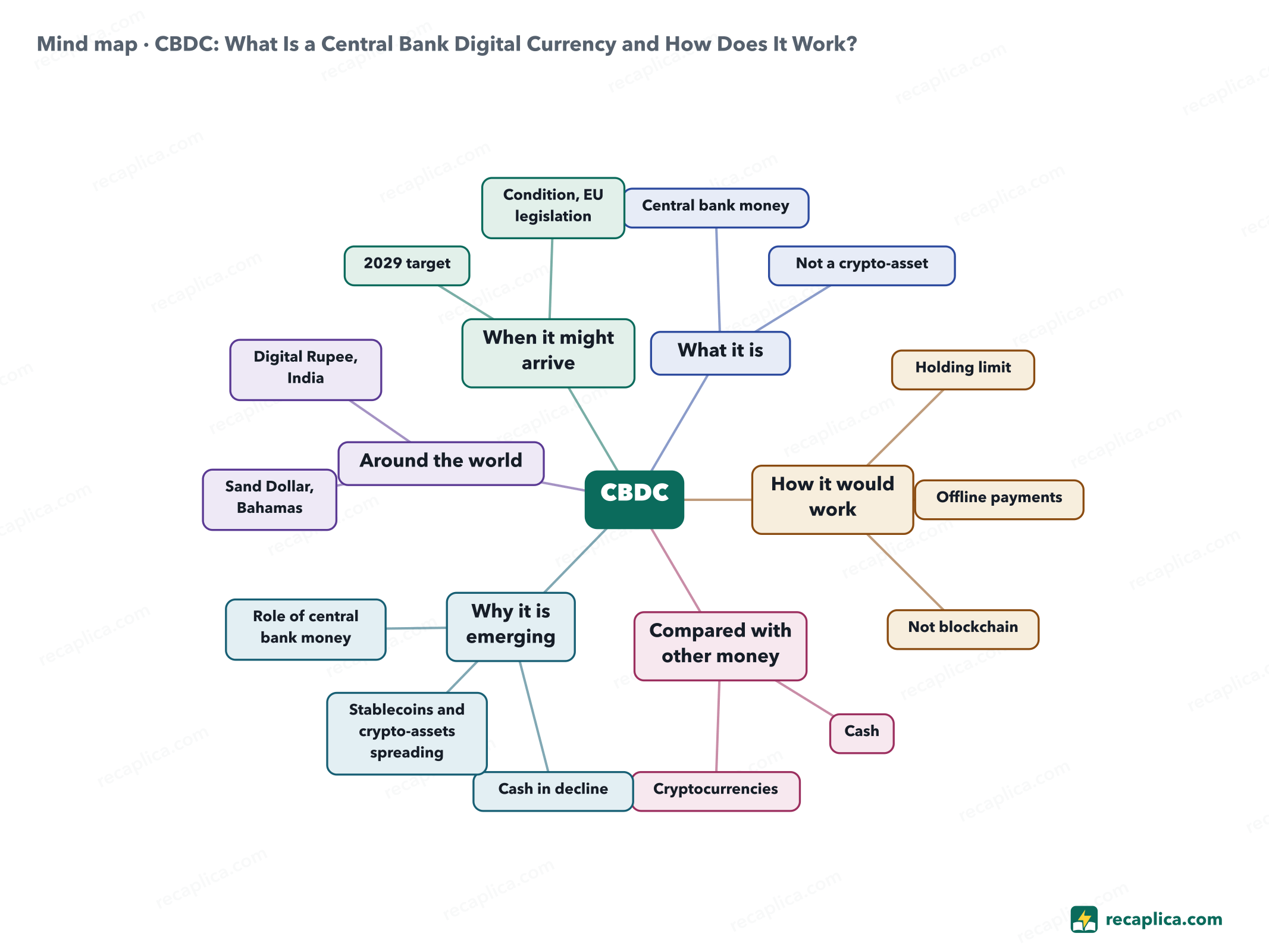
    Mind map: CBDC: What Is a Central Bank Digital Currency and How Does It Work?
    • CBDC
      • What it is
        • Central bank money Issued and guaranteed by a central bank, legal tender like banknotes
        • Not a crypto-asset Different from Bitcoin and Ether, which have no institution behind them
      • How it would work
        • Holding limit Threshold tested up to 3,000 euros per person
        • Offline payments Only payer and payee would know the details
        • Not blockchain Only some design principles borrowed from DLT
      • Compared with other money
        • Cash Still strong by value in 2024, slowly declining by transaction count
        • Cryptocurrencies No institution behind them, value set by the market
      • Why it is emerging
        • Cash in decline From 59% to 52% of point-of-sale transactions between 2022 and 2024
        • Stablecoins and crypto-assets spreading
        • Role of central bank money Preserving it as payment habits change
      • Around the world
        • Sand Dollar, Bahamas First CBDC launched nationally, October 2020
        • Digital Rupee, India Two separate pilots, wholesale and retail, since 2022
      • When it might arrive
        • 2029 target Earliest possible issuance according to the ECB
        • Condition, EU legislation Needs approval by 2026

    Quiz: test yourself

    Answer the questions to check what you have learned: you get instant feedback and a short explanation.

    Grade 0/10 0/5
    1 What is a CBDC?

    Central banks describe a CBDC as central bank money made available to the public: the institution behind it, not the app, is what sets it apart from a cryptocurrency.

    2 Would the digital euro, the ECB's CBDC project, run on blockchain technology?

    The ECB states the digital euro is not based on distributed ledger technology, even though it borrows a few of its design principles.

    3 In the ECB's technical tests, what holding limit per person was explored for the digital euro?

    Tests explored a threshold of up to 3,000 euros per person, but it is not yet a final legal limit: that would be set by EU legislation.

    4 According to the ECB's 2024 SPACE survey, how did cash use at points of sale change between 2022 and 2024?

    Cash fell from 59% of point-of-sale transactions in 2022 to 52% in 2024: a decline, but not a disappearance.

    5 Which was the first CBDC in the world to launch nationally?

    The Bahamas' Sand Dollar has been in nationwide distribution since October 2020, ahead of any comparable project.

    Answers: 1-B · 2-B · 3-B · 4-B · 5-C

    Flashcards

    Tap the card to flip it and check whether you remember the answer, then move to the next one.

    1 / 7

    Explain it in your own words

    The ultimate test: if you can explain it in simple words, you've truly understood it. Write your explanation, then compare it with the Recap.

    Your explanation is saved only on this device.

    A CBDC, or central bank digital currency, is digital money issued directly by a central bank rather than a private company. It is not a cryptocurrency: a CBDC carries the same backing as banknotes and coins, while an asset like Bitcoin or Ether has no institution standing behind it. The European Central Bank is building its own version, the digital euro, meant to sit alongside cash rather than replace it, with support for payments even without an internet connection. By 2024, more than nine in ten of the world's central banks were exploring a CBDC of some kind.

    Frequently asked questions

    What does CBDC mean?

    CBDC stands for central bank digital currency: digital money issued and guaranteed directly by a central bank, rather than by a private company. The European Central Bank's own project along these lines is the digital euro.

    How would a CBDC like the digital euro work?

    It would work like a digital wallet with a holding limit, tested up to 3,000 euros per person in the ECB's trials, and it would support offline payments too; according to the ECB it would not run on blockchain, only borrowing some of its design principles.

    Would a CBDC replace cash?

    No. The ECB expects the digital euro to sit alongside cash: in 2024 cash remained close to cards in payment value (39% versus 45%), and 62% of euro area residents still wanted to keep the option of paying in cash.

    When will CBDC launch?

    The ECB is aiming for a first issuance of the digital euro during 2029, but that goal depends on the required EU legislation being adopted by 2026: without that law, the date moves.

    What risks are being discussed about CBDCs?

    Discussion centers mainly on cost to the banking sector (ECB estimates cited include roughly 1.3 billion euros in Eurosystem development costs plus about 320 million euros a year to run, alongside several billion euros more estimated for commercial banks) and on privacy, where the ECB has taken explicit positions for offline payments.

    Sources

    • European Central Bank, Digital euro (overview)
    • European Central Bank, FAQs on the digital euro
    • European Central Bank, Study on the payment attitudes of consumers in the euro area (SPACE) 2024
    • Bank for International Settlements, Advancing in tandem: results of the 2024 BIS survey on central bank digital currencies and crypto (BIS Papers No. 159)
    • Reserve Bank of India / Press Information Bureau, releases on the Digital Rupee
    • Central Bank of The Bahamas, The Sand Dollar is on Schedule for Gradual National Release

    Every Recap goes through an independent review before publication.

    Every evening, the day's new Recaps on our Telegram channel. Join the channel →

    Keep learning

    • Economics Labor Market: How Supply, Demand and Unemployment Work The labor market is where businesses that need workers to produce goods and services meet the people willing to work for them. In the textbook model, that meeting sets wages and employment levels the way any other market would, but imperfect information, bargaining power and legal rules push the real market away from pure competition. Those gaps are where unemployment comes from, and economists split it into frictional, structural, cyclical and technological types depending on the cause. Official statistics, such as Italy's ISTAT, measure it against the labor force — people employed plus people actively looking for work — not the whole population. As of July 2026, Italy's unemployment rate stood at 5.8%, provisional, against 6.4% for the euro area. Read the Recap →
    • Economics Mercantilism: History, Examples, and Definition Mercantilism was the dominant economic doctrine in Western Europe from the 16th to the 18th century: a state grew powerful by selling more abroad than it bought, building up reserves of gold and silver. Britannica Money describes it as "an economic practice by which governments used their economies to augment state power at the expense of other countries." Colonies had one job under this system: supply raw materials to the mother country and buy finished goods back from it, while at home tariffs and monopolies shielded domestic industry. The name itself came later, from the doctrine's most famous critic: Adam Smith made it current in The Wealth of Nations, published in 1776. Read the Recap →
    • Economics Keynesianism explained: the theory born from the Great Depression Keynesianism is the body of economic thinking named after John Maynard Keynes, the British economist who in the 1930s offered a different way of reading a slump. The IMF notes that when the Great Depression hit, the economic theory of the day could neither explain the collapse nor say how to restart production and employment. Keynes put aggregate demand at the centre — the total spending of households, businesses and government — and argued that full employment is a special case rather than something markets deliver on their own. That is where the idea comes from that public spending can step in when private demand stalls. Keynesianism guided economic policy from the end of the Second World War until the 1970s, then lost ground. Read the Recap →

    recaplica

    Clear in 30 seconds, yours in 10 minutes.

    Recaps Mind maps Request a Recap Telegram channel Mind map maker Our method About Privacy & cookies Legal notes & terms of use

    © 2026 Recaplica · A project by Curi S.r.l. — VAT IT05472000750

    Statistics, only if you say so

    To learn which Recaps help most we would use Google Analytics, with aggregate, anonymous data. It starts only with your OK, and you can change your mind anytime. Privacy policy