|
recaplica
Universal Declaration of Human Rights: What It Is and How It Works, Explained | ||||||||||||
| © 2026 Recaplica · recaplica.com — All rights reserved | ||||||||||||
Universal Declaration of Human Rights: What It Is and How It Works, ExplainedWhat to print Page numbers appear when printing with default margins. SlidesChoose a cut Flash10 slidesThe essential thread, to present in classFull16 slidesEvery chapter and the deeper detailBoth come with speaker notes. In 30 seconds quick readThe Universal Declaration of Human Rights is the text the United Nations General Assembly adopted in Paris on 10 December 1948, after the Second World War. It is not a treaty: no state is legally bound to follow it, yet it has become the reference point for international human rights law. Drafted in under two years by an 18-member commission chaired by Eleanor Roosevelt, it lists 30 rights meant to apply to every human being, from personal freedom to education. Two legally binding covenants followed in 1966, turning much of that language into concrete obligations for the states that ratified them. Key Points
Key figures
Deep DiveWhy it followed the Second World WarAccording to the United Nations, the Universal Declaration of Human Rights grew directly out of the experience of the Second World War: once the fighting ended and the UN was founded, the international community pledged to never again allow atrocities like those of that conflict. The name, though, is often confused with a different document written more than a century and a half earlier, in revolutionary France: the Declaration of the Rights of Man and of the Citizen, the 1789 French text, adopted by a different assembly and never meant to be universal. To turn the postwar pledge into a shared text, the United Nations assigned the task to a Commission on Human Rights made up of 18 members, drawn from different political, cultural and religious backgrounds and from every region of the world. The Commission met for the first time in 1947 and finished the entire text in under two years. Who wrote the text, and howEleanor Roosevelt, widow of US President Franklin D. Roosevelt, chaired the drafting committee and is recognized by the United Nations as the driving force behind the Declaration’s adoption. The first draft of the text was written by the French jurist René Cassin. The Lebanese diplomat Charles Malik served as the committee’s rapporteur, the Chinese delegate Peng Chung Chang was vice-chairman, and the Canadian John Humphrey, director of the UN’s Human Rights Division, prepared the initial blueprint the others built on. A declaration, not a treatyA declaration is not a treaty: no state signs or ratifies the Universal Declaration of Human Rights, and no court can convict a government for violating it as such. The United Nations describes it as the widely recognized foundation of international human rights law, but on its own it does not impose legal obligations. The rights it lists only became genuine legal obligations through two International Covenants adopted in 1966 and in force since 1976: one on civil and political rights, the other on economic, social and cultural rights. Together with the Declaration, the United Nations refers to the two Covenants as the International Bill of Human Rights.
What the 30 articles sayThe text opens with a seven-clause preamble and continues with 30 numbered articles. Article 1 states that every human being is born free and equal in dignity and rights. Article 3 recognizes the right to life, liberty and security of person. Article 25 sets out the right to an adequate standard of living, covering food, clothing, housing and medical care, with special protection for motherhood and childhood. Article 26 recognizes the right to education, free and compulsory at least at the elementary level.
Many of these principles reappear, reworded, in national constitutions written after 1948: the Italian Constitution: Structure, Principles, and How It Works, for instance, devotes a substantial share of its articles to similar rights. The UN text’s final article, number 30, closes the Declaration by ruling out any reading of it as permission for a state, group or person to act toward destroying the very rights and freedoms it lists. From a 1948 text to an entire treaty systemAccording to the United Nations, the text has been translated into more than 500 languages, making it the most translated document in the world. It has also inspired more than 80 human rights treaties and declarations, along with numerous regional conventions, domestic laws and constitutional provisions — among them, in the European Union, the EU Charter of Fundamental Rights, proclaimed in 2000 and legally binding since 2009, when the Treaty of Lisbon entered into force. Even the way European institutions are organized, explained in How the European Union Works: Who Really Runs It, sits within this tradition of rights born in 1948. And more recent tensions between fundamental rights and new surveillance technologies, covered in Mass Surveillance: What It Is and How It Clashes With Human Rights, are measured against the same principles the 1948 text put into writing first. Slide deckSlides ready to download and make your own in PowerPoint or Google Slides, with speaker notes. Pick the Flash cut or the Full one.     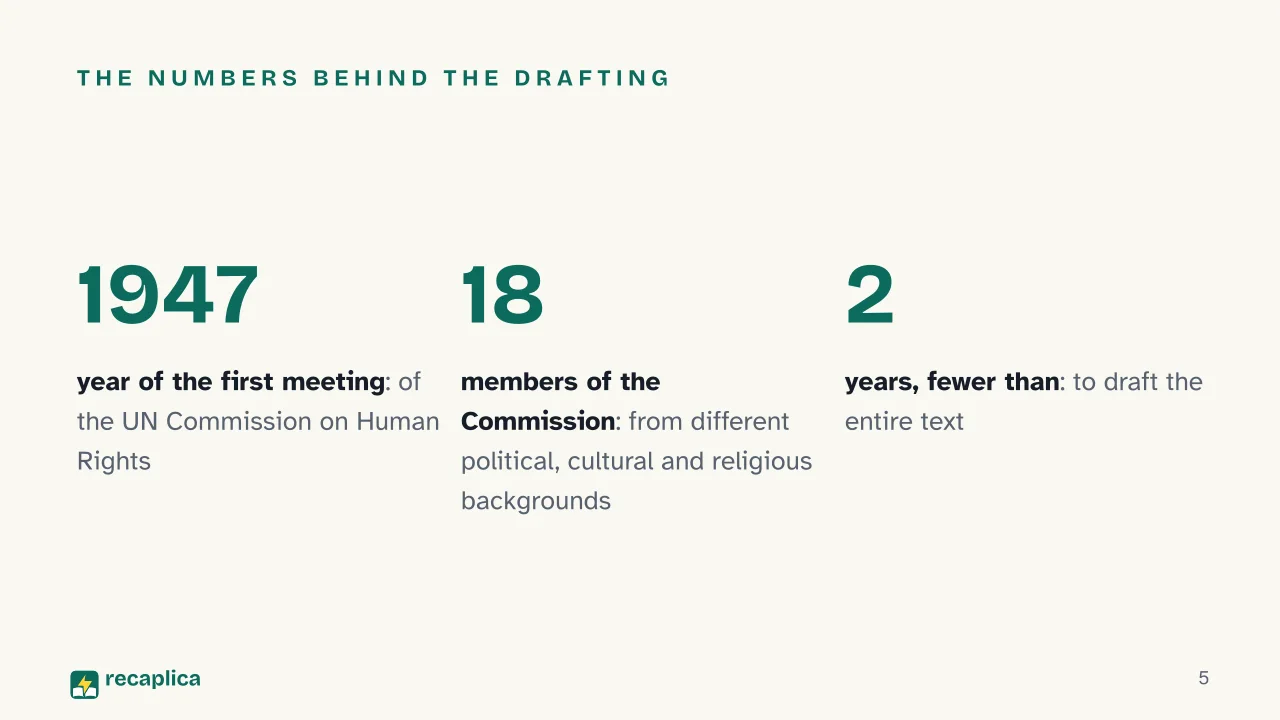 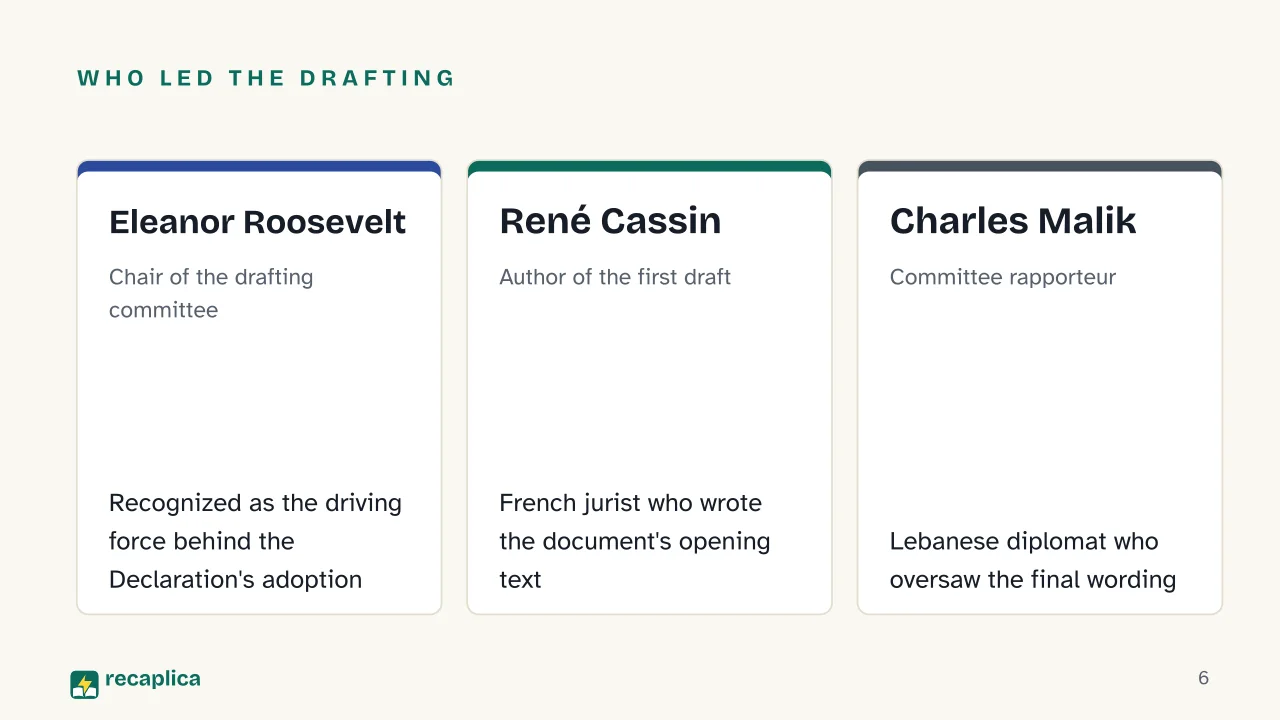  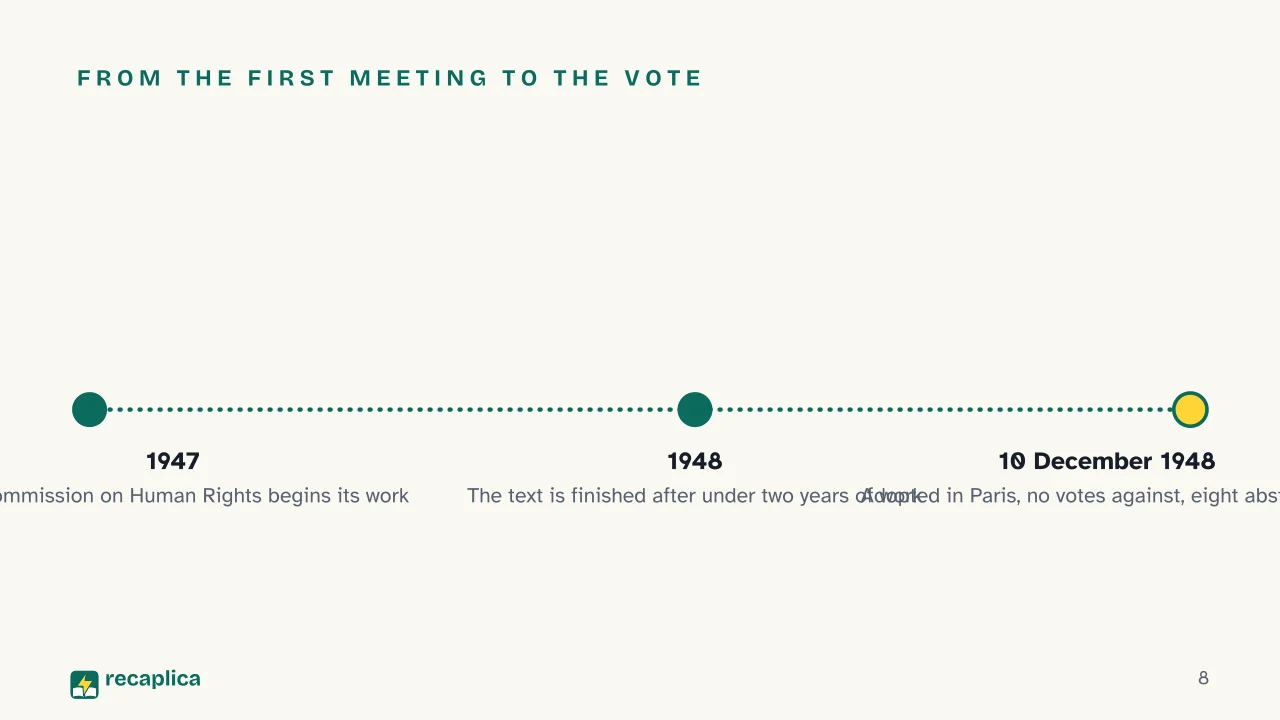 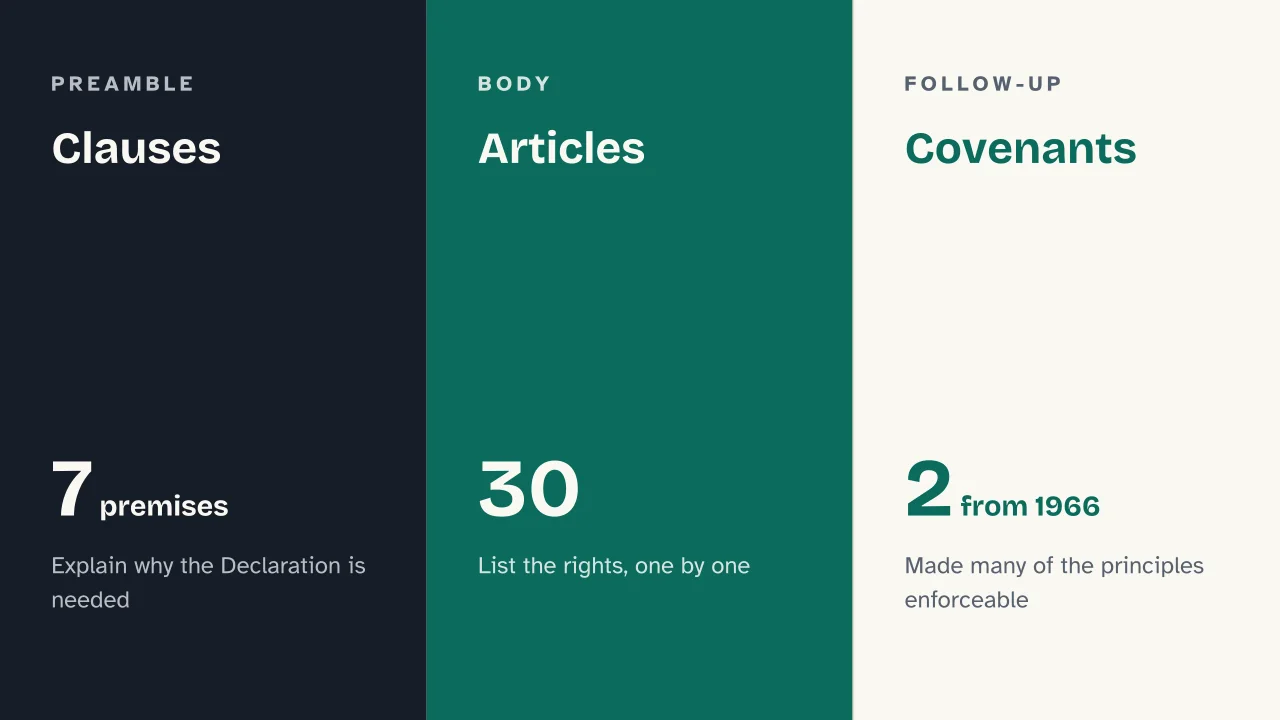  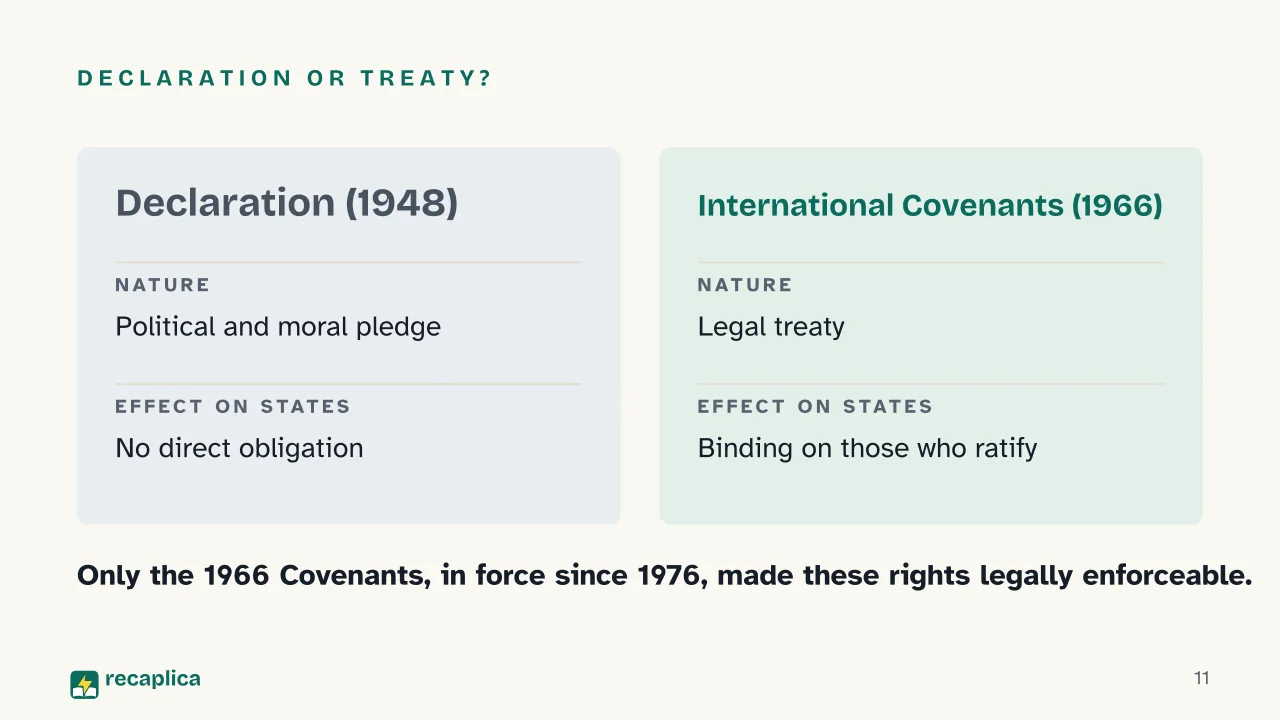 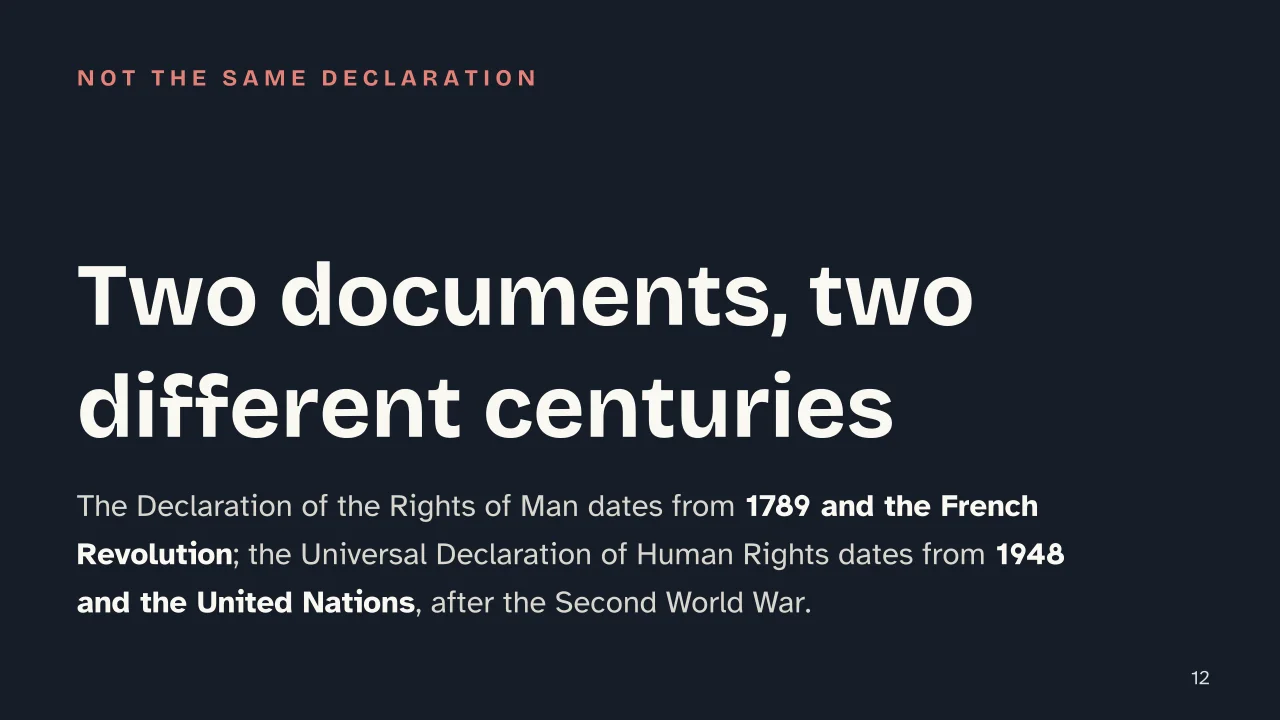  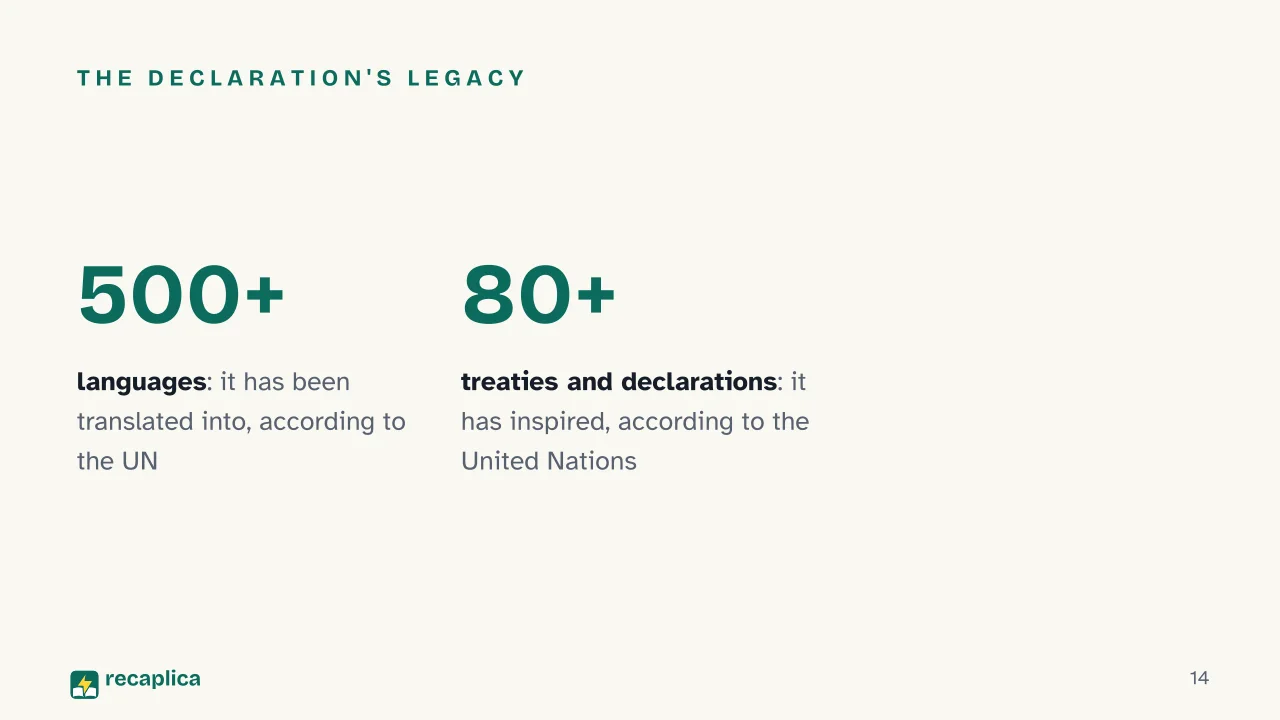 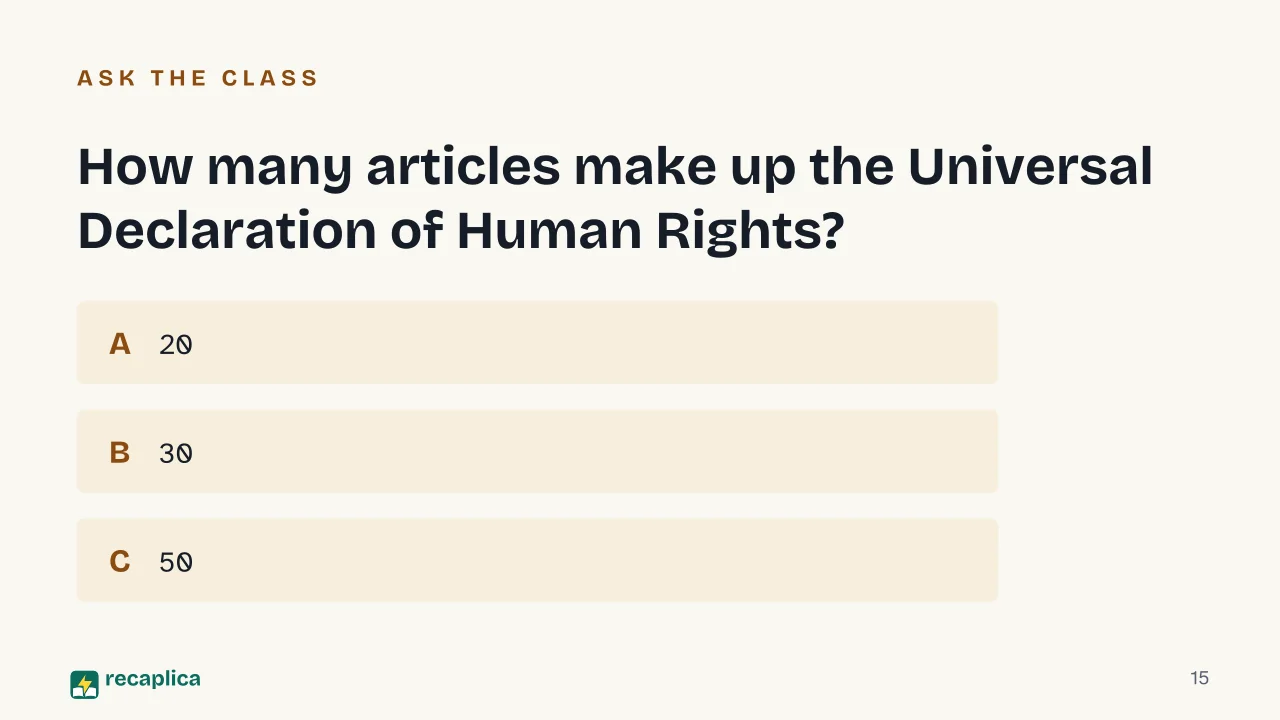  Common myths
Mind mapDrag the background to move around and the nodes to reposition them; use − and + to collapse and expand branches. 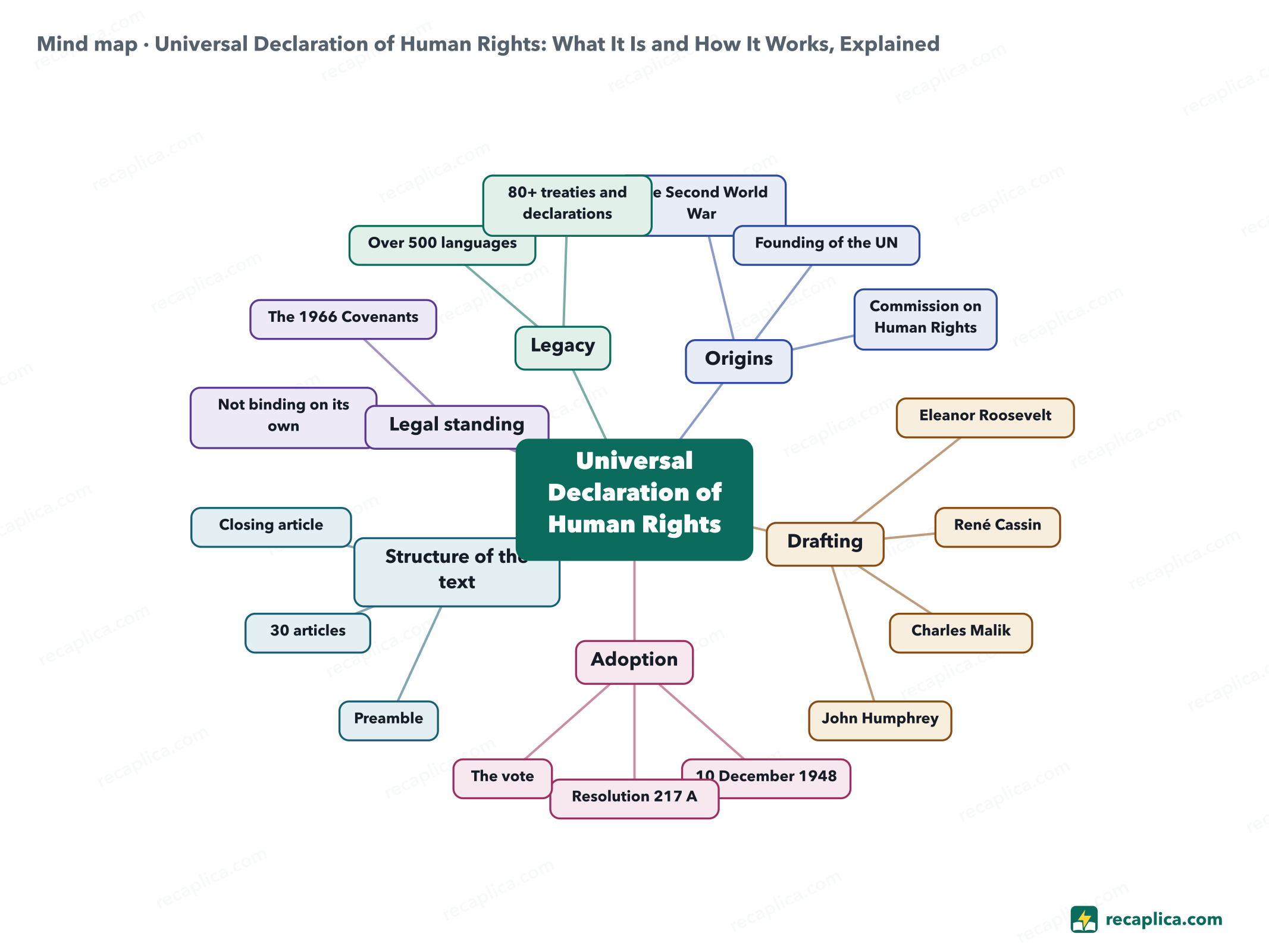
Quiz: test yourselfAnswer the questions to check what you have learned: you get instant feedback and a short explanation. Grade 0/10 0/5
FlashcardsTap the card to flip it and check whether you remember the answer, then move to the next one. 1 / 8 Explain it in your own wordsThe ultimate test: if you can explain it in simple words, you've truly understood it. Write your explanation, then compare it with the Recap. Your explanation is saved only on this device.
Frequently asked questionsIs the Universal Declaration of Human Rights the same as the 1789 Declaration of the Rights of Man?No. They are two different documents. The 1789 text was written during the French Revolution and applied to French citizens; the Universal Declaration of Human Rights was adopted by the United Nations in 1948, after the Second World War, with the goal of applying to every human being, in every country. What are the main articles of the Universal Declaration of Human Rights?Among the most cited: Article 1, which states that everyone is born free and equal in dignity; Article 3, on the right to life, liberty and security of person; Article 25, on the right to an adequate standard of living; Article 26, on the right to education; and Article 30, the closing article, which bars using the Declaration to justify destroying the rights it lists. Is the Universal Declaration of Human Rights legally binding on states?Not on its own: no state signs or ratifies it. The United Nations describes it as the widely recognized foundation of international human rights law, but most of its principles became binding through the two International Covenants of 1966, in force since 1976. Who wrote the Universal Declaration of Human Rights?A drafting committee chaired by Eleanor Roosevelt, with René Cassin writing the first draft, Charles Malik as rapporteur, Peng Chung Chang as vice-chairman, and John Humphrey preparing the initial blueprint. They worked within an 18-member Commission on Human Rights drawn from different political, cultural and religious backgrounds. Why was the Universal Declaration of Human Rights created?According to the United Nations, it grew out of the experience of the Second World War: once the war ended and the UN was founded, the international community pledged never to allow atrocities like those of that conflict to happen again, and set out a shared list of rights meant to apply to everyone. Every Recap goes through an independent review before publication. |