Skip to content
recaplica

    One moment: security check

    Cloudflare wants to make sure you're not a robot. Tick the box below and your search will continue on its own.

    IT
    recaplica Italian Constitution: Structure, Principles, and How It Works
    © 2026 Recaplica · recaplica.com — All rights reserved
    Home › Civics

    Italian Constitution: Structure, Principles, and How It Works

    By Recaplica Newsroom · Updated on September 15, 2026

    What to print

    Page numbers appear when printing with default margins.

    Slides

    Choose a cut

    Flash10 slidesThe essential thread, to present in classFull17 slidesEvery chapter and the deeper detail

    Both come with speaker notes.

    Telegram channel
    recaplica Clear in 30 seconds, yours in 10 minutes.
    In 30 seconds Key points Figures Deep dive Slides Myths Mind map Quiz Flashcards FAQ

    In 30 seconds quick read

    Italy's Constitution took effect on January 1, 1948, after the Constituent Assembly gave it final approval on December 22, 1947, and Enrico De Nicola signed it into law on December 27, 1947. The text runs to 139 articles, grouped into Fundamental Principles, Part I on the rights and duties of citizens, Part II on the structure of the Republic, plus 18 transitional and final provisions. It was drafted by 556 deputies elected on June 2, 1946, including 21 women. Amending it is possible but deliberately hard: Article 138 requires two votes in each chamber at least three months apart, with qualified majorities.

    Key Points

    • The Constitution took effect on January 1, 1948, four days after Enrico De Nicola signed it into law on December 27, 1947.
    • The text has four blocks: Fundamental Principles, Part I on the rights and duties of citizens, Part II on the structure of the Republic, and the transitional and final provisions.
    • Article 1 defines Italy as a democratic Republic founded on labor, with sovereignty resting in the people within the limits the Constitution sets.
    • Article 138 makes the Constitution rigid: it can only be changed through a reinforced procedure with two parliamentary votes.
    • 556 deputies drafted the text inside the Constituent Assembly, elected on June 2, 1946, including 21 women.
    • Three constitutional laws passed since 2022 have updated specific articles, including environmental protection under Article 9.

    Key figures

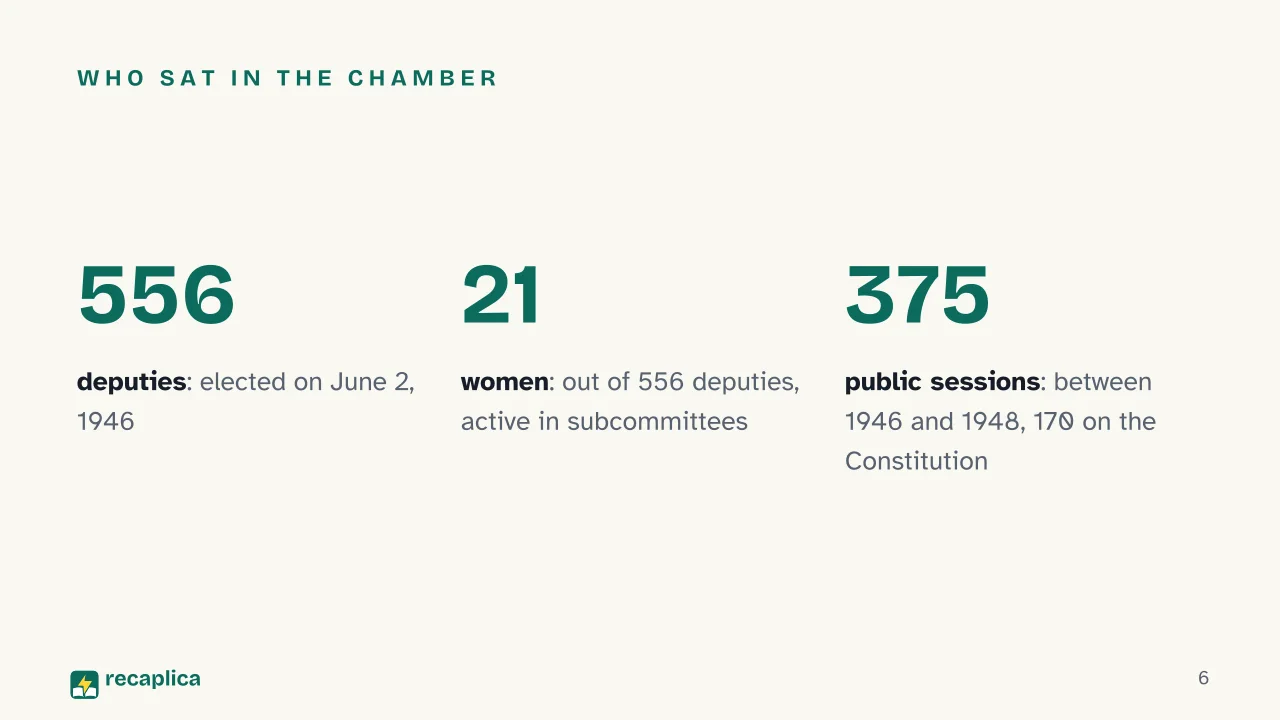
    • 556 deputies were elected to the Constituent Assembly on June 2, 1946, including 21 women Source: Chamber of Deputies, giovani.camera.it
    • 375 public sessions the Constituent Assembly held between 1946 and 1948, 170 of them dedicated specifically to the constitutional text Source: Historical Archive of the Chamber of Deputies
    • 453 votes in favor out of 515 members present approved the constitutional text on December 22, 1947, against 62 votes opposed Source: nascitacostituzione.it, produced by the Chamber, Senate, Prime Minister's Office and Constitutional Court

    Deep Dive

    On June 2, 1946, nearly 25 million Italians voted using two ballots at once: one for the referendum on whether to keep the monarchy or become a republic, one to elect the Constituent Assembly. The vote returned 556 deputies, who met for the first time on June 25, 1946 at Palazzo Montecitorio and chose Giuseppe Saragat as the Assembly’s first President.

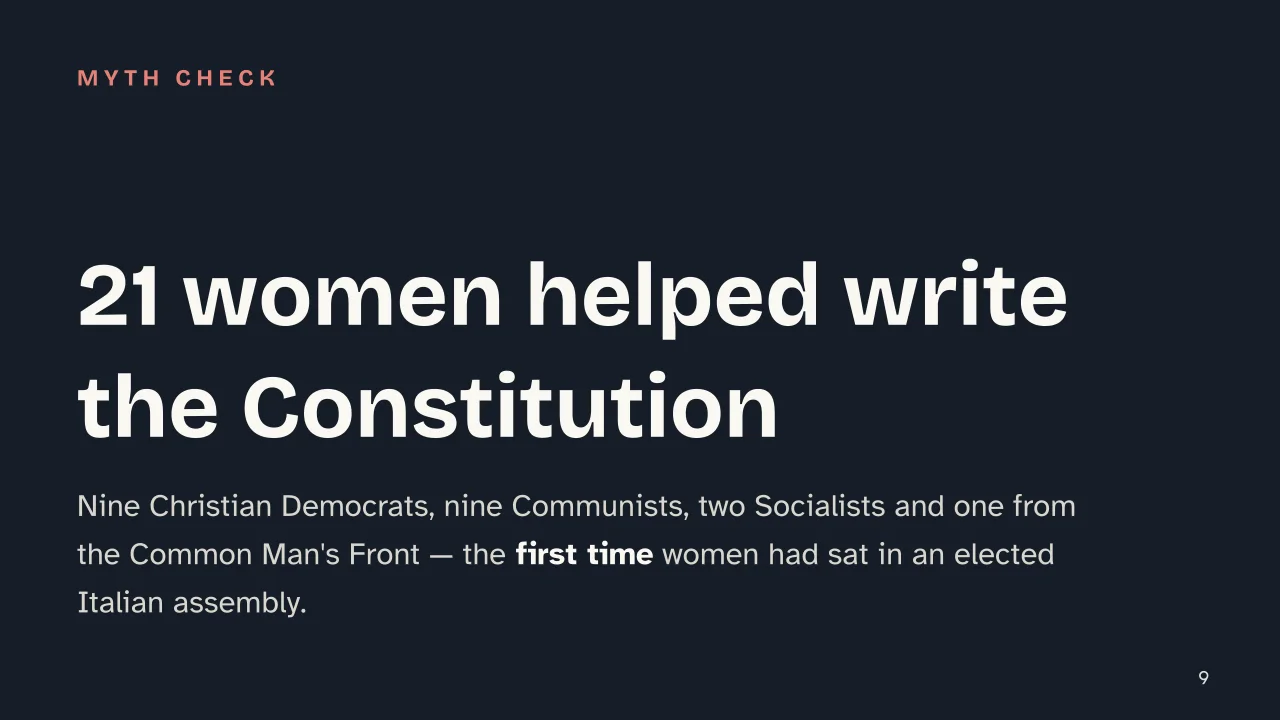
    Among those 556 deputies sat 21 women. It was the first time women had taken part in an elected Italian assembly, with nine Christian Democrats, nine Communists, two Socialists and one from the Common Man’s Front among them.

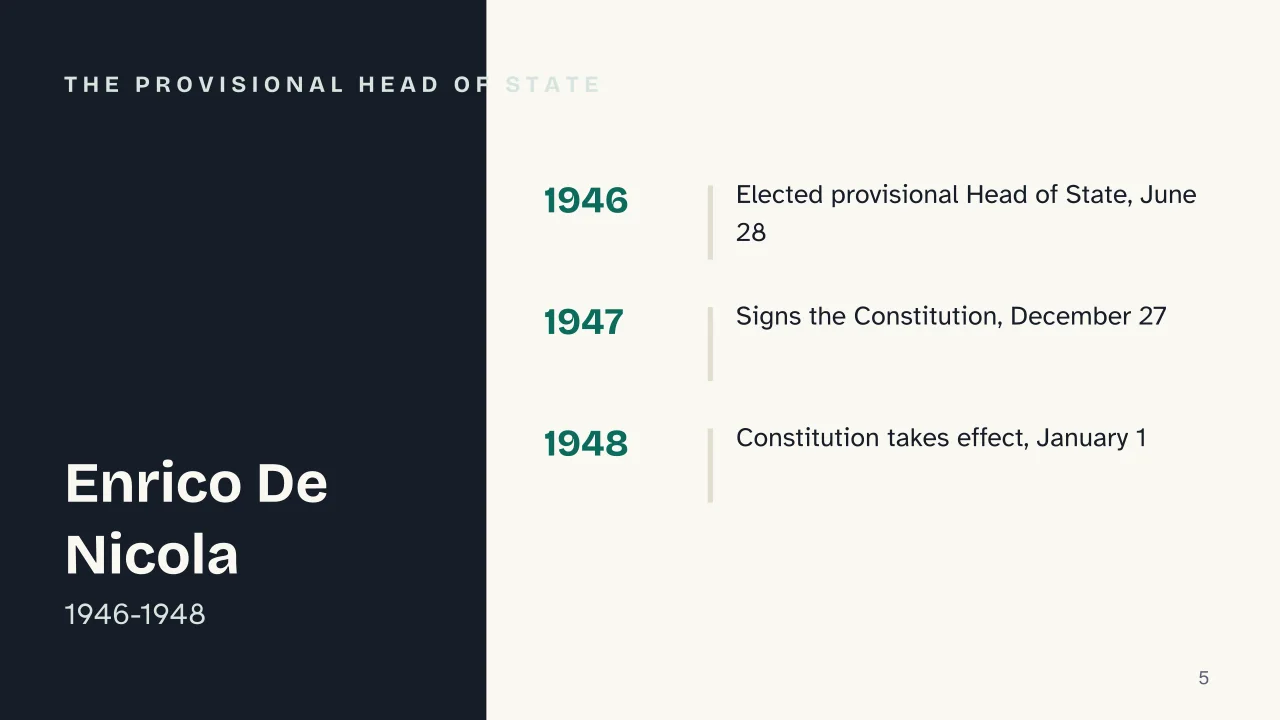
    On July 15, 1946, the Assembly set up the Committee for the Constitution, remembered as the “Committee of 75,” chaired by Meuccio Ruini. Drafting a first text fell to three subcommittees led by Umberto Tupini, Umberto Terracini and Gustavo Ghidini, covering civil and political rights, state organization, and economic and social relations respectively. The draft reached the full Assembly on March 4, 1947, which debated it until December 22, 1947, when 453 of 515 deputies present voted in favor against 62. Enrico De Nicola, elected provisional Head of State on June 28, 1946 and sworn in on July 1, signed the text into law on December 27, 1947; the Constitution took effect on January 1, 1948.

    Practical example: the gap between “signing into law” and “taking effect” is not a bureaucratic footnote. De Nicola signed the Constitution on December 27, 1947, and it was published in the Official Gazette, but its articles only became legally binding from January 1, 1948, the date from which its effects are counted.

    The Constituent Assembly took shape in the aftermath of World War II, after two decades in which the fascist regime had shut down Parliament and the political parties, the same rise and collapse of power told in the myth of Mussolini.

    The Founding Principles

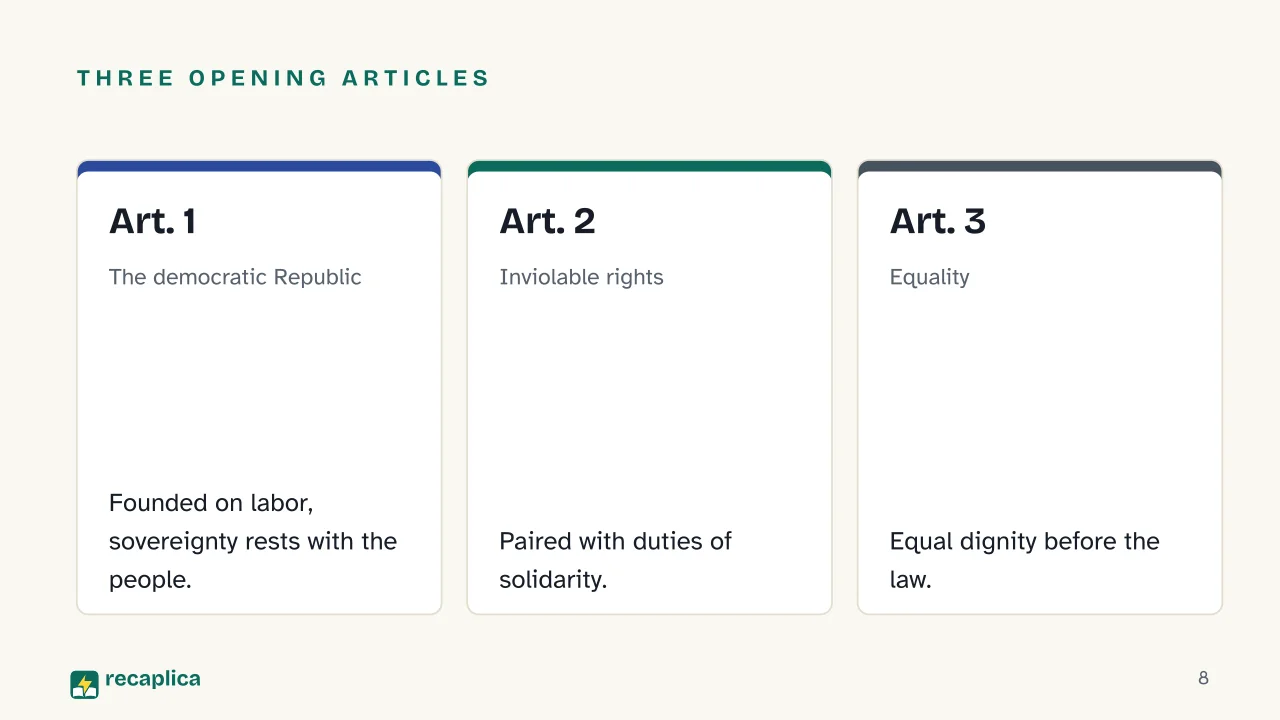
    Article 1 defines Italy as a democratic Republic founded on labor, with sovereignty resting in the people within the limits and forms the Constitution sets. Article 2 recognizes the inviolable rights of the individual, both alone and within social groups, and ties them to duties of political, economic and social solidarity; Article 3 establishes equal social dignity and equality before the law, regardless of sex, race, language, religion, political opinion, or personal and social condition.

    Article 5 reinforces that same unity by echoing the process that had built it at the state level, the unification of Italy, calling the Republic “one and indivisible” while promoting local autonomy through “the widest administrative decentralization.” Article 6 protects linguistic minorities. Articles 7 and 8 govern relations between the state and religious denominations: the state and the Catholic Church are “each independent and sovereign within its own order,” with their relationship set out in the Lateran Pacts, while every other faith stands equally free before the law.

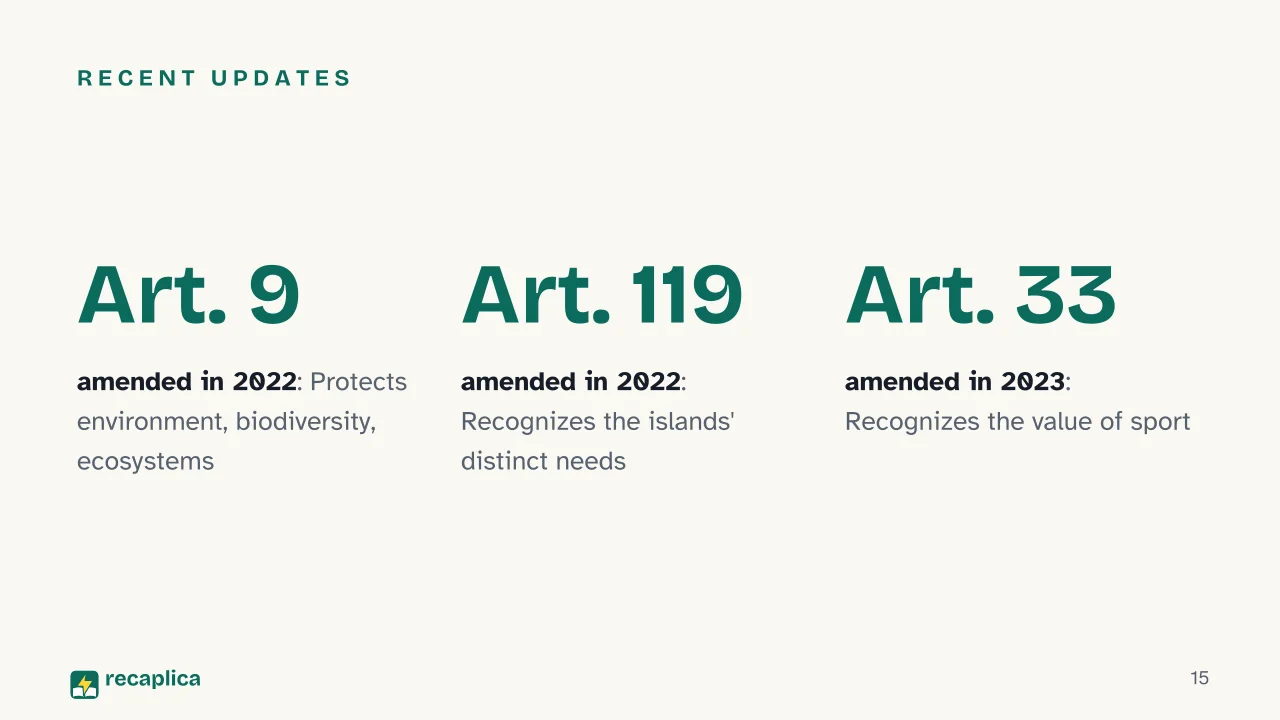
    Until February 11, 2022, Article 9 protected only the development of culture, scientific and technical research, the landscape, and the nation’s historical and artistic heritage. The constitutional law passed that day added a third paragraph protecting “the environment, biodiversity and ecosystems, also in the interest of future generations.”

    Articles 10 and 11 open the Republic to international law: Italian law “conforms to the generally recognized rules of international law,” and Italy “repudiates war as an instrument of aggression against the freedom of other peoples and as a means of settling international disputes,” accepting the limits on sovereignty needed for an order that ensures peace and justice among nations. On the institutional side, that commitment takes shape in the day-to-day work of the Ministry of Foreign Affairs. Article 12 sets the Republic’s flag, the green, white and red tricolor in three vertical bands of equal size.

    How the Text Is Organized

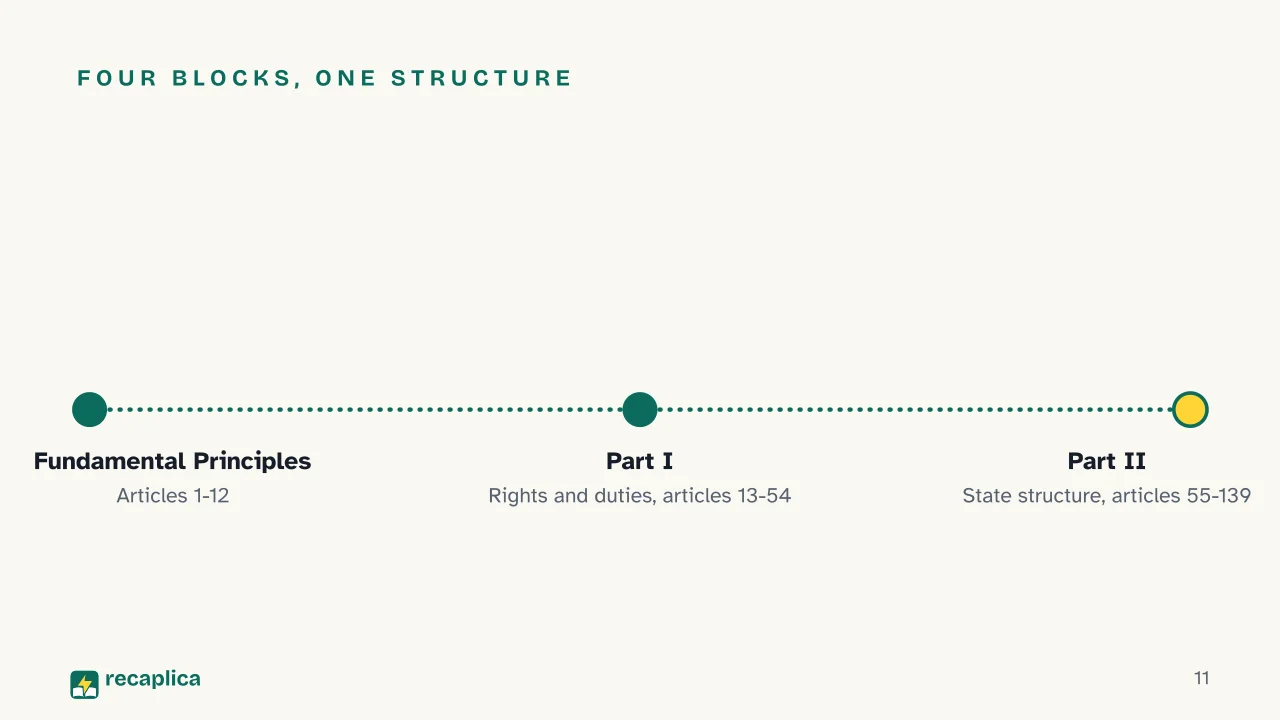
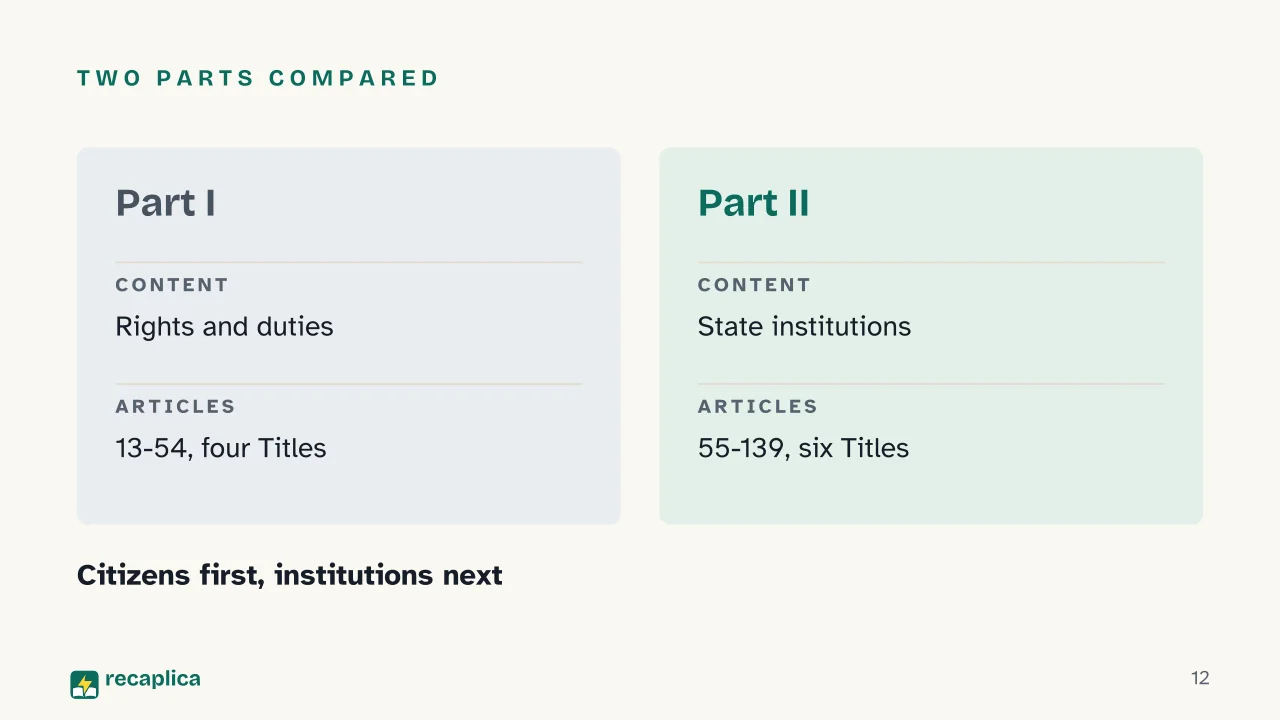
    The Constitution runs to 139 articles, plus 18 transitional and final provisions, arranged in four blocks: the Fundamental Principles (Articles 1-12), Part I on the rights and duties of citizens (Articles 13-54), Part II on the structure of the Republic (Articles 55-139), and the transitional and final provisions.

    Part I, Rights and Duties of CitizensPart II, Structure of the Republic
    Articles13-5455-139
    Titles4 (civil, ethical-social, economic, political relations)6 (Parliament, President of the Republic, Government, Judiciary, Regions-Provinces-Municipalities, constitutional safeguards)
    Central subjectWho the citizen is and what rights and duties they holdHow the organs of the state operate

    Part I splits into four Titles: civil relations (Articles 13-28), ethical and social relations (Articles 29-34), economic relations (Articles 35-47) and political relations (Articles 48-54). Part II covers six Titles: Parliament (Articles 55-82, split between the chambers and how laws are made), the President of the Republic (Articles 83-91), the Government (Articles 92-100), the Judiciary (Articles 101-113), the regions, provinces and municipalities (Articles 114-133), and constitutional safeguards (Articles 134-139), which include the Constitutional Court and the amendment procedure.

    A Rule Built to Resist Change

    Unlike the Statuto Albertino, a flexible constitution that could be amended by ordinary law, the 1948 Constitution is rigid: changing it takes a more demanding procedure than passing any ordinary law, one set out in Article 138.

    StageWhat it requires
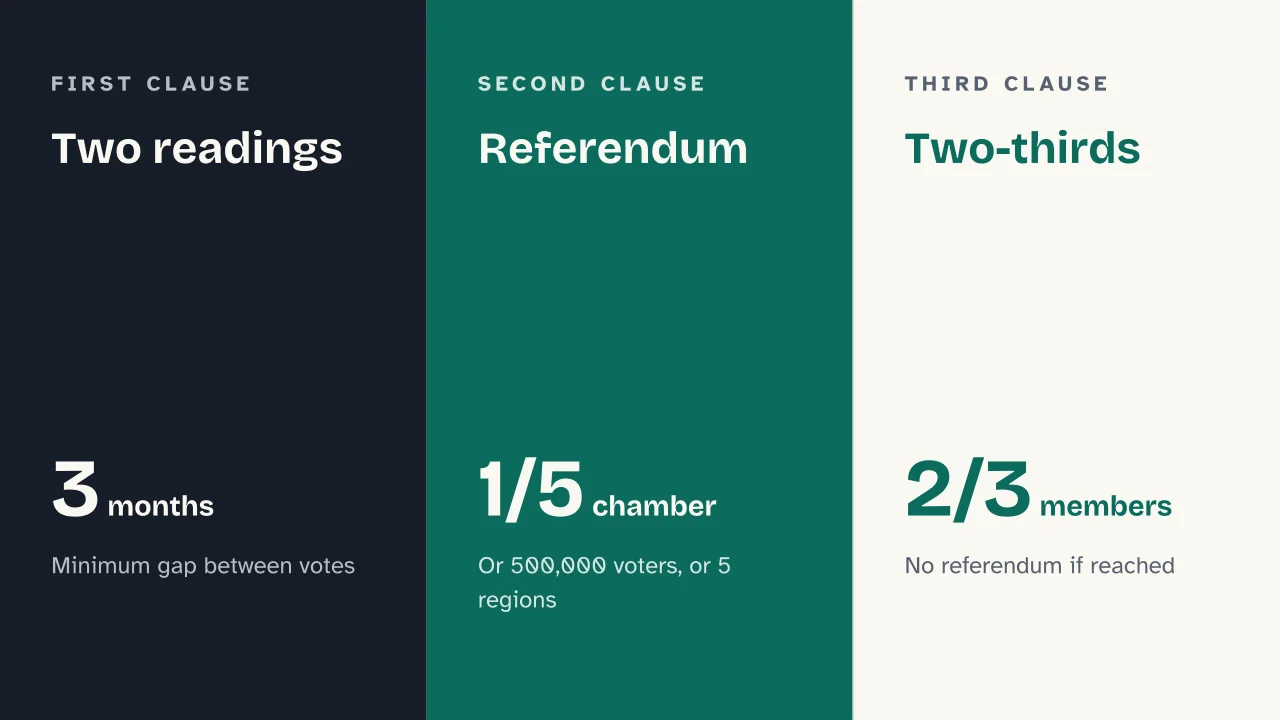
    Two readingsEach chamber votes on the same text twice, at least three months apart
    Majority on the second voteAn absolute majority of each chamber’s members
    Possible referendumTriggered if requested within three months by a fifth of a chamber’s members, 500,000 voters, or five regional councils
    No referendumSkipped if the second vote reached a two-thirds majority in both chambers

    Practical example: the constitutional laws of February 11, 2022 (environmental protection under Article 9), November 7, 2022 (recognition of the islands under Article 119) and September 26, 2023 (recognition of the value of sport under Article 33) all went through exactly this procedure, two readings and qualified majorities, before becoming part of the text.

    Between 1948 and 2023 this procedure has updated articles within the Fundamental Principles too, not just the more technical sections of the text.

    Slide deck

    Slides ready to download and make your own in PowerPoint or Google Slides, with speaker notes. Pick the Flash cut or the Full one.
    Slide 1 of the presentation on Italian Constitution: The Italian ConstitutionSlide 2 of the presentation on Italian Constitution: Who actually wrote Italy's Constitution?Slide 3 of the presentation on Italian Constitution: The route aheadSlide 4 of the presentation on Italian Constitution: Chapter 01: An assembly of 556Slide 5 of the presentation on Italian Constitution: The provisional Head of StateSlide 6 of the presentation on Italian Constitution: Who sat in the chamberSlide 7 of the presentation on Italian Constitution: Chapter 02: The founding principlesSlide 8 of the presentation on Italian Constitution: Three opening articles: Art. 1, Art. 2, Art. 3Slide 9 of the presentation on Italian Constitution: 21 women helped write the ConstitutionSlide 10 of the presentation on Italian Constitution: Chapter 03: How the text is organizedSlide 11 of the presentation on Italian Constitution: Four blocks, one structureSlide 12 of the presentation on Italian Constitution: Two parts comparedSlide 13 of the presentation on Italian Constitution: Chapter 04: A rule built to resist changeSlide 14 of the presentation on Italian Constitution: Two readings · Referendum · Two-thirdsSlide 15 of the presentation on Italian Constitution: Recent updatesSlide 16 of the presentation on Italian Constitution: When did the Italian Constitution take effect?Slide 17 of the presentation on Italian Constitution: To learn more
    Flash10 slidesThe essential thread, to present in classFull17 slidesEvery chapter and the deeper detail

    Common myths

    • ✗ Myth Many people assume Article 9 already protected the environment back in 1948.

      ✓ Reality Article 9 only gained a third paragraph on protecting the environment, biodiversity and ecosystems with the constitutional law of February 11, 2022, seventy-four years after the text took effect; until then the article covered only culture, scientific research and historical and artistic heritage.

    • ✗ Myth A common assumption is that women had no part in writing the Constitution.

      ✓ Reality Among the 556 deputies of the Constituent Assembly were 21 women, nine Christian Democrats, nine Communists, two Socialists and one from the Common Man's Front, also active in the subcommittees that drafted the text; it was the first time women had sat in an elected Italian assembly.

    • ✗ Myth It's a widespread idea that the Italian Constitution cannot be changed.

      ✓ Reality Article 138 makes amending it harder than passing an ordinary law, with two votes, a three-month gap and qualified majorities, but it does not rule amendments out; the constitutional laws of 2022 and 2023 on the environment, the islands and sport are concrete proof.

    Mind map

    Drag the background to move around and the nodes to reposition them; use − and + to collapse and expand branches.
    Customize
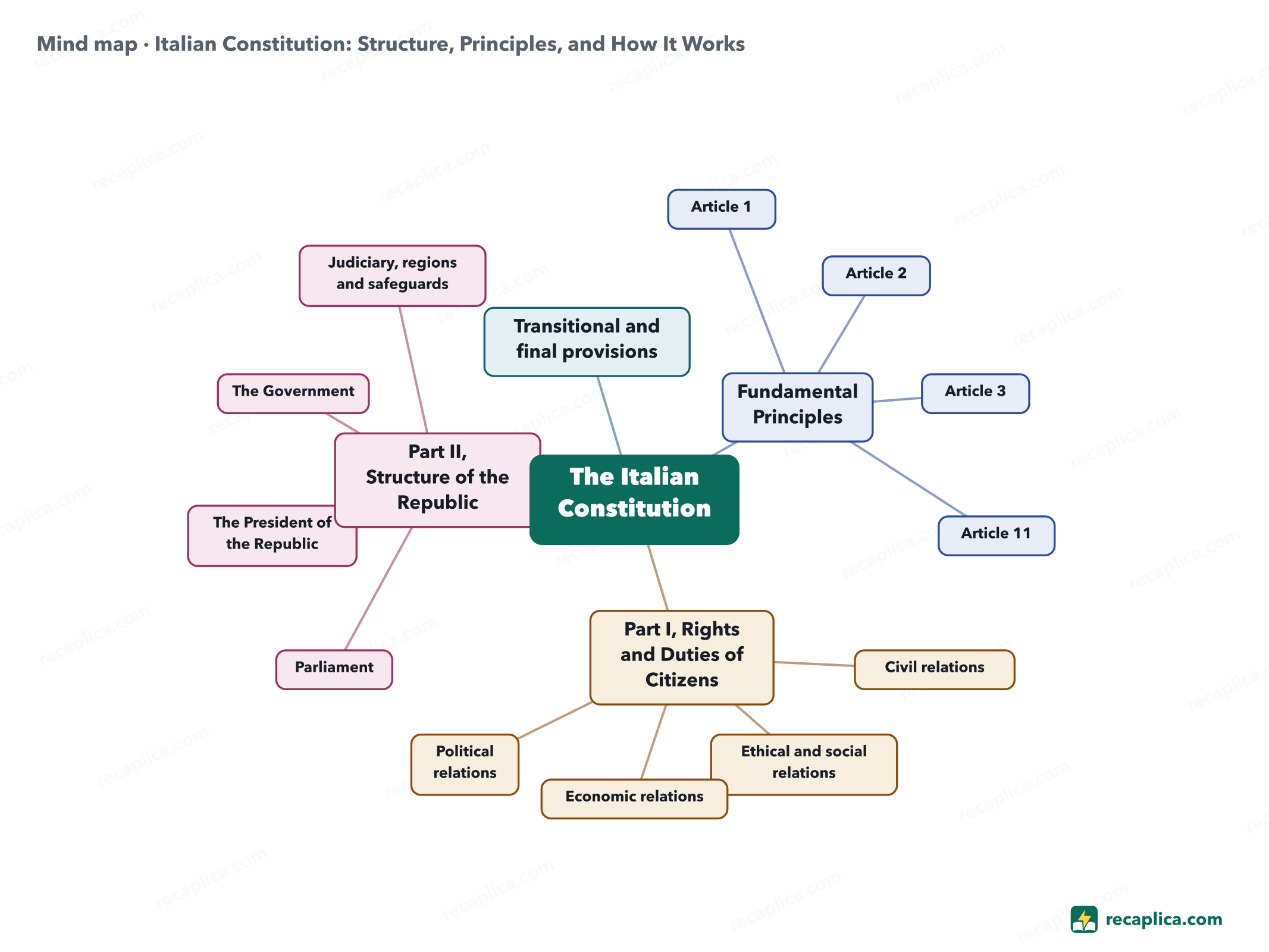
    Mind map: Italian Constitution: Structure, Principles, and How It Works
    • The Italian Constitution
      • Fundamental Principles Articles 1-12, the Republic's core values
        • Article 1 Democratic Republic founded on labor
        • Article 2 Inviolable rights and duties of solidarity
        • Article 3 Equality before the law
        • Article 11 Repudiation of war
      • Part I, Rights and Duties of Citizens Articles 13-54, in four Titles
        • Civil relations Articles 13-28
        • Ethical and social relations Articles 29-34
        • Economic relations Articles 35-47
        • Political relations Articles 48-54
      • Part II, Structure of the Republic Articles 55-139, in six Titles
        • Parliament Articles 55-82
        • The President of the Republic Articles 83-91
        • The Government Articles 92-100
        • Judiciary, regions and safeguards Articles 101-139
      • Transitional and final provisions 18 provisions

    Quiz: test yourself

    Answer the questions to check what you have learned: you get instant feedback and a short explanation.

    Grade 0/10 0/5
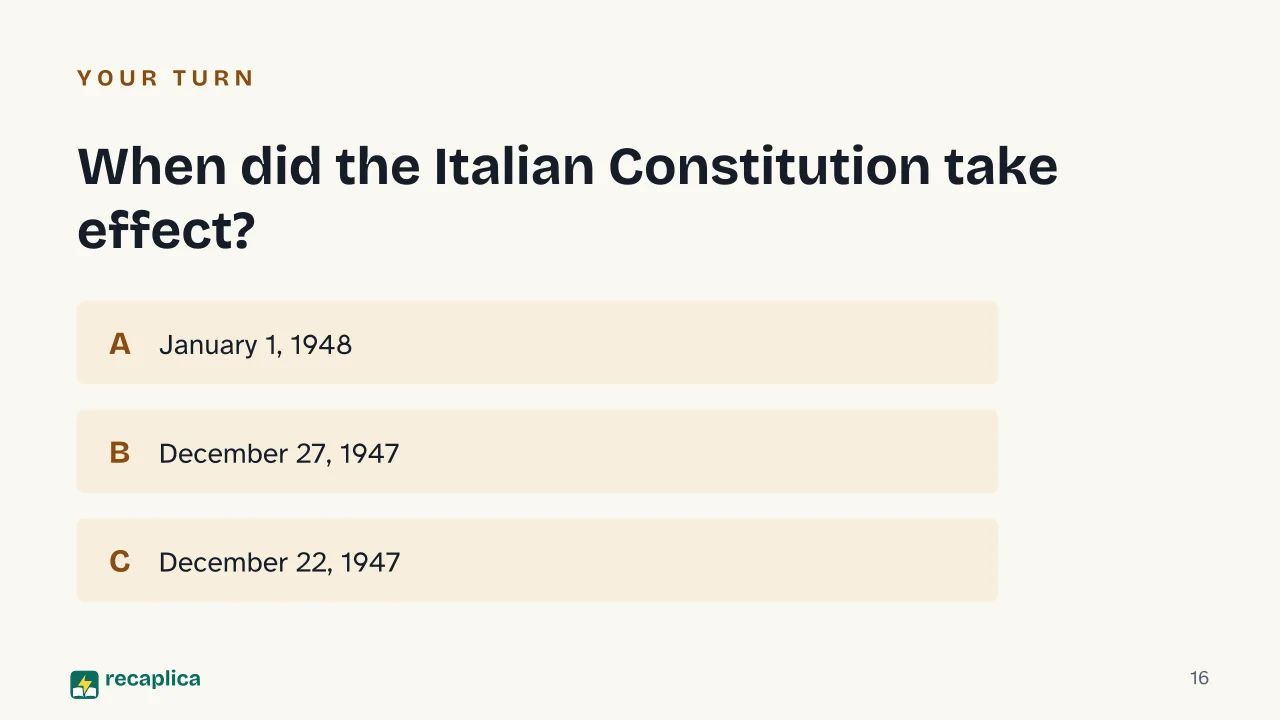
    1 When did the Italian Constitution take effect?

    Enrico De Nicola signed the text into law on December 27, 1947, and the Assembly had given it final approval on December 22, 1947, but the Constitution only became legally binding on January 1, 1948.

    2 How many articles make up the Italian Constitution, not counting the transitional and final provisions?

    According to the Research Service of the Constitutional Court, the text has 139 articles plus 18 transitional and final provisions.

    3 What does Article 138 require to amend the Constitution?

    Article 138 requires two votes in each chamber at least three months apart, an absolute majority on the second vote, and a referendum only if one is requested and a two-thirds majority was not reached.

    4 True or false, explicit environmental protection was already written into Article 9 in 1948.

    Until February 11, 2022, Article 9 protected only culture, scientific research, the landscape and historical and artistic heritage; protection for the environment, biodiversity and ecosystems was added by the constitutional law passed that day.

    5 How many women were among the 556 deputies of the Constituent Assembly elected on June 2, 1946?

    There were 21: nine Christian Democrats, nine Communists, two Socialists and one from the Common Man's Front — the first time women had sat in an elected Italian assembly.

    Answers: 1-A · 2-A · 3-A · 4-B · 5-A

    Flashcards

    Tap the card to flip it and check whether you remember the answer, then move to the next one.

    1 / 7

    Explain it in your own words

    The ultimate test: if you can explain it in simple words, you've truly understood it. Write your explanation, then compare it with the Recap.

    Your explanation is saved only on this device.

    Italy's Constitution took effect on January 1, 1948, after the Constituent Assembly gave it final approval on December 22, 1947, and Enrico De Nicola signed it into law on December 27, 1947. The text runs to 139 articles, grouped into Fundamental Principles, Part I on the rights and duties of citizens, Part II on the structure of the Republic, plus 18 transitional and final provisions. It was drafted by 556 deputies elected on June 2, 1946, including 21 women. Amending it is possible but deliberately hard: Article 138 requires two votes in each chamber at least three months apart, with qualified majorities.

    Frequently asked questions

    When did the Italian Constitution take effect?

    The Constitution took effect on January 1, 1948, after Enrico De Nicola signed it into law on December 27, 1947, a few days after the Constituent Assembly's final approval on December 22, 1947.

    How many articles does the Italian Constitution have?

    The text has 139 articles, organized into Fundamental Principles, Part I and Part II, plus 18 transitional and final provisions that accompanied its entry into force.

    How is the Italian Constitution amended?

    It requires the Article 138 procedure: two votes by the same chamber at least three months apart, an absolute majority on the second vote and, in some cases, a popular referendum, which is why it is called a rigid constitution.

    What are the fundamental principles of the Italian Constitution?

    They are the first 12 articles of the text, from defining Italy as a democratic Republic founded on labor (Article 1) to equality before the law (Article 3) and the repudiation of war as a means of settling international disputes (Article 11).

    Who wrote the Italian Constitution?

    It was written by the Constituent Assembly, 556 deputies elected on June 2, 1946, working through the Committee of 75 chaired by Meuccio Ruini and its three subcommittees on rights, state organization and economic and social relations.

    Sources

    • Fundamental Principles - Italian Constitution (governo.it)
    • Constituent Assembly (06.02.1946 - 05.07.1948) - Historical Archive of the Chamber of Deputies
    • The Birth of the Constitution - nascitacostituzione.it
    • The Constitution of the Italian Republic - giovani.camera.it
    • Article 138 - Historical Archive of the Chamber of Deputies, dossier on constitutional reform
    • Constitution of the Italian Republic - Research Service of the Constitutional Court (PDF)

    Every Recap goes through an independent review before publication.

    Every evening, the day's new Recaps on our Telegram channel. Join the channel →

    Keep learning

    • Civics Italian Government Structure: Which Bodies Do What The Italian state rests on five bodies that the Constitution sets up and regulates directly: Parliament makes the laws, the Government carries them out, the President of the Republic represents national unity, the judiciary applies the law to individual cases, and the Constitutional Court checks that laws respect the Constitution. Alongside them sit four bodies of constitutional relevance — the High Council of the Judiciary, the Court of Auditors, the CNEL and the Council of State — auxiliary bodies the Constitution sets up but keeps in a separate category from the five essential ones. Knowing who does what, and which bodies the system cannot run without, is the fastest way into how Italy is actually governed. Read the Recap →
    • Civics Carabinieri Ranks: The Four-Role Hierarchy of the Corps Every member of the Carabinieri sits inside one of four legally defined roles, in force since a 2000 law: Officers, Inspectors, Supervisors, and Corporals and Privates. Promotion happens inside a role first, and the four roles themselves run from the most operational to the most senior. The lowest rank is Carabiniere; the highest is Generale di Corpo d'Armata, in the Officer role. Two abbreviations, Q.S. and C.S., show up next to a handful of ranks — they aren't extra rungs on the ladder, just a qualification attached to the top rank already sitting there. Read the Recap →
    • Civics Codice Fiscale: What It Is, Structure and Everyday Uses The codice fiscale is the code that uniquely identifies a person in every dealing with Italian public bodies and administrations, from healthcare to official paperwork. It is made up of 16 alphanumeric characters derived from the holder's personal data. Only the Agenzia delle Entrate, Italy's tax agency, can issue a valid one: any code generated by an outside tool has no official standing. The system dates back to 1973, created by the same decree that set up Italy's taxpayer register. It is a different thing from the partita IVA, which identifies an economic activity. Read the Recap →

    recaplica

    Clear in 30 seconds, yours in 10 minutes.

    Recaps Mind maps Request a Recap Telegram channel Mind map maker Our method About Privacy & cookies Legal notes & terms of use

    © 2026 Recaplica · A project by Curi S.r.l. — VAT IT05472000750

    Statistics, only if you say so

    To learn which Recaps help most we would use Google Analytics, with aggregate, anonymous data. It starts only with your OK, and you can change your mind anytime. Privacy policy