|
recaplica
Treaty of Lisbon: What It Is and How It Reshaped the EU | |||||||||||||||
| © 2026 Recaplica · recaplica.com — All rights reserved | |||||||||||||||
Treaty of Lisbon: What It Is and How It Reshaped the EUWhat to print Page numbers appear when printing with default margins. SlidesChoose a cut Flash10 slidesThe essential thread, to present in classFull16 slidesEvery chapter and the deeper detailBoth come with speaker notes. In 30 seconds quick readThe Treaty of Lisbon is the treaty that reformed how the European Union works, signed on 13 December 2007 and in force since 1 December 2009, without replacing the treaties already in place. It draws heavily on the failed EU Constitution, rejected by French and Dutch voters in 2005, but it is not a constitution: it amends the Treaty on European Union and the Treaty establishing the European Community, the same technique already used by the Amsterdam and Nice treaties. It gives the European Parliament more legislative power, creates a permanent presidency of the European Council and the post of High Representative for foreign affairs, and makes the Charter of Fundamental Rights of the European Union legally binding. It also introduces the European Citizens' Initiative and a new double-majority voting system in the Council, which only took full effect on 1 November 2014. Key Points
Key figures
Deep DiveAn amending treaty, not a constitutionThe Treaty of Lisbon grew out of the failure of a more ambitious project. In 2005, referendums in France and the Netherlands rejected the Treaty establishing a Constitution for Europe, the text that was meant to replace the EU’s founding treaties with a single constitution. According to the official summary published on EUR-Lex, the Treaty of Lisbon is “largely inspired by” that project: it draws on much of its content, but takes a different route from the rejected constitution. The intergovernmental conference that produced the new text opened on 23 July 2007. The treaty was signed in Lisbon on 13 December 2007 and entered into force on 1 December 2009, after being ratified by all 27 member states of the time. Technically, it amends the Treaty on European Union (TEU) and the Treaty establishing the European Community, renamed the Treaty on the Functioning of the European Union (TFEU): it does not create a single unified text and does not repeal the earlier ones, exactly as the Treaties of Amsterdam (1997) and Nice (2001) had already done. To see how the institutions reformed by the treaty work today, see How the European Union Works: Who Really Runs It. The institutions it reformedThe Treaty of Lisbon changes how the Union’s institutions operate and how decisions get made. The European Parliament gains new legislative powers: co-decision with the Council, already used for some policy areas, is extended and becomes the ordinary legislative procedure, putting Parliament on equal footing with the Council in areas where it previously had none — notably in setting the EU budget, in agricultural policy, and in justice and home affairs. Parliament also gains the right to elect the President of the Commission, based on a proposal from the European Council. The European Council, the body that brings together heads of state and government, gets a permanent presidency: a president elected by majority vote for a 30-month term, renewable once, replacing the previous six-month rotating presidency among member states. The treaty also creates the post of High Representative of the Union for Foreign Affairs and Security Policy, who is at the same time a vice-president of the European Commission: a role designed to give the Union a more coherent voice in foreign policy.
National parliaments of individual member states also gain a greater role in the Union’s decision-making process under the Treaty of Lisbon, with the chance to weigh in on EU legislative proposals before they are adopted. Citizens’ rights and the binding CharterThe Treaty of Lisbon gives the Charter of Fundamental Rights of the European Union the same legal value as the treaties, making it binding for the first time: it turns from a political declaration into a legal norm in its own right. Protecting fundamental rights in the European Union also connects to the debate over mass surveillance and human rights. The treaty also introduces the European Citizens’ Initiative: a tool that lets one million EU citizens, with minimum thresholds collected in at least 7 member states, invite the European Commission to put forward a legislative proposal on a matter within its powers. On the policy side, the treaty moves border controls, asylum, immigration, and judicial and police cooperation under EU competence. And for the first time, an EU treaty sets out a formal procedure for a member state to voluntarily withdraw: it is Article 50 of the Treaty on European Union. Voting in the Council: double majority, from 2014The Treaty of Lisbon set out a new qualified-majority voting system in the Council of the European Union, based on what is known as the double majority: to pass a proposal, at least 55% of member states, representing at least 65% of the EU’s population, must vote in favour; to block it, at least 4 states voting against are enough. This system did not take effect alongside the rest of the treaty, in 2009. According to the EUR-Lex glossary entry on qualified majority, the double-majority rule was introduced on 1 November 2014, with a transitional period running until 31 March 2017, during which any member state could still request that a decision be taken under the rules in force before that date. Between 2009 and 2014, the Council kept voting under the weighted voting system inherited from earlier treaties. Slide deckSlides ready to download and make your own in PowerPoint or Google Slides, with speaker notes. Pick the Flash cut or the Full one.     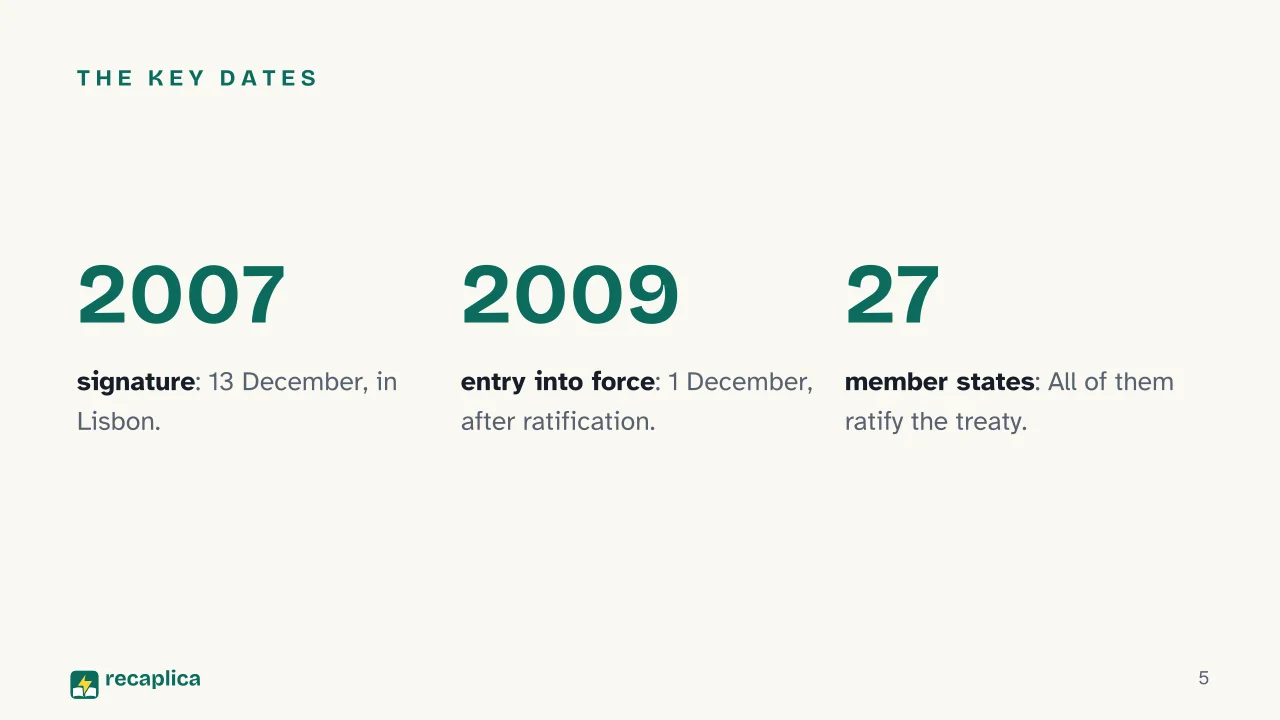 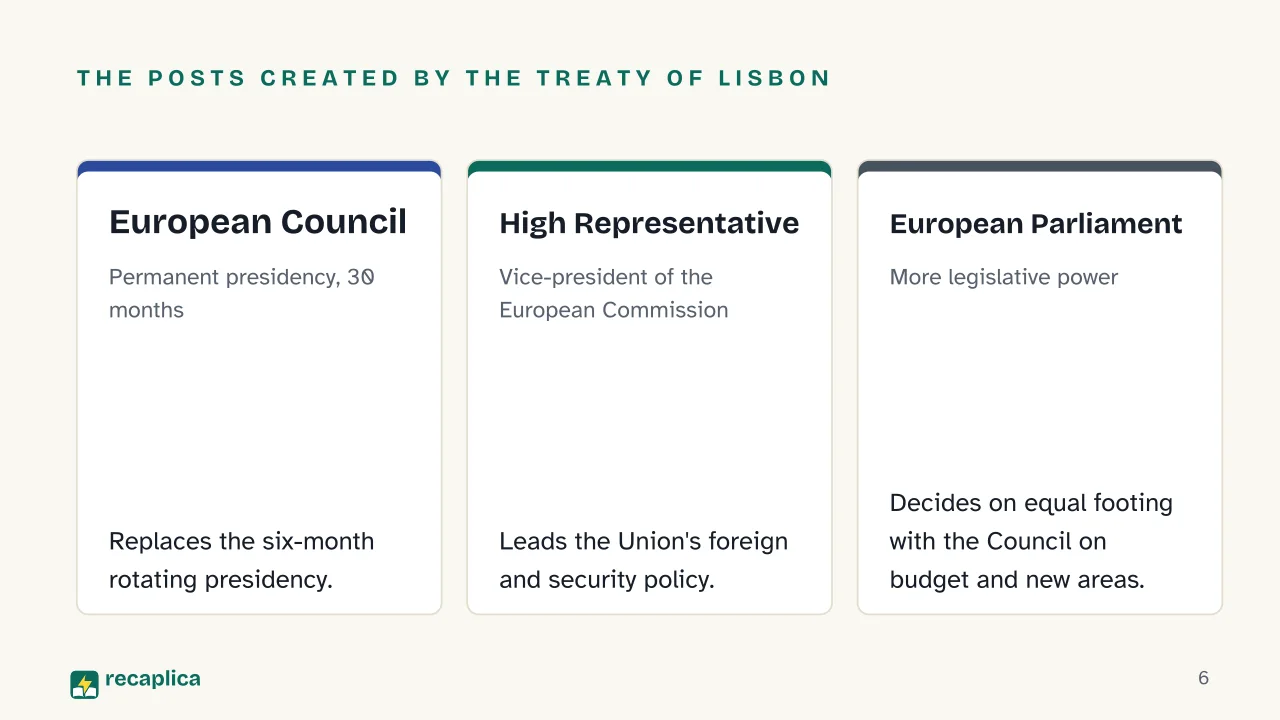  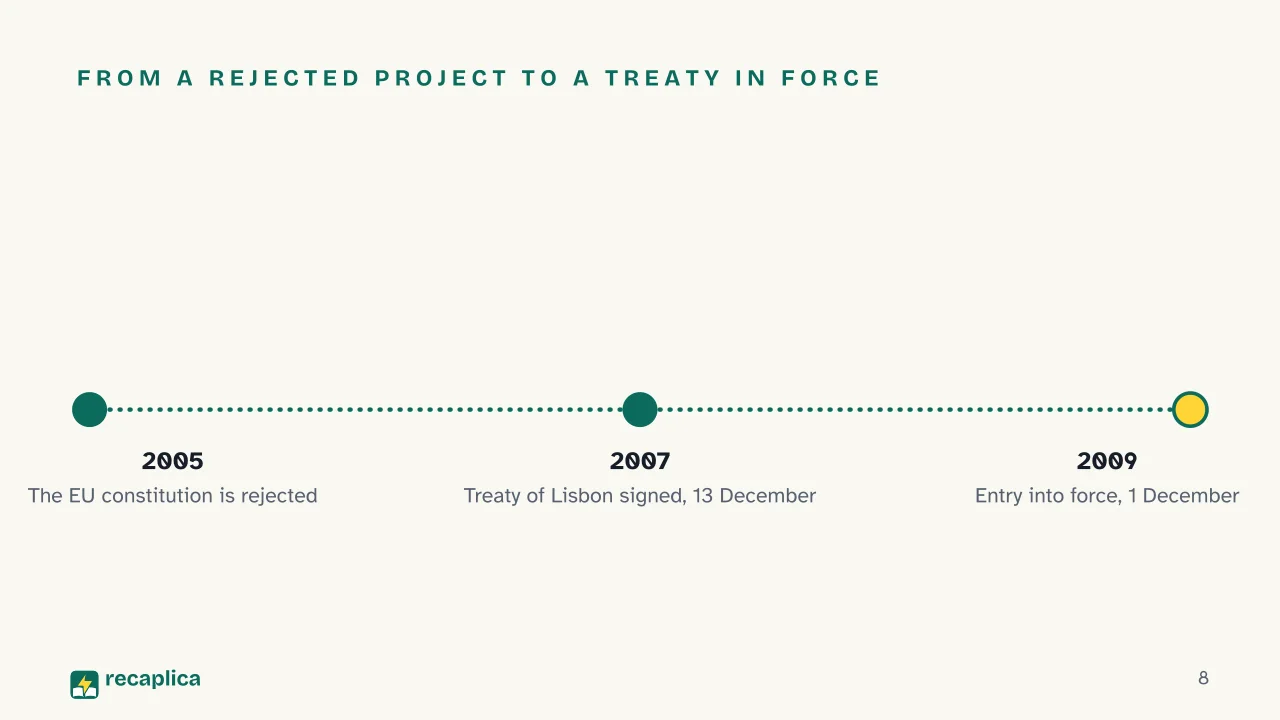  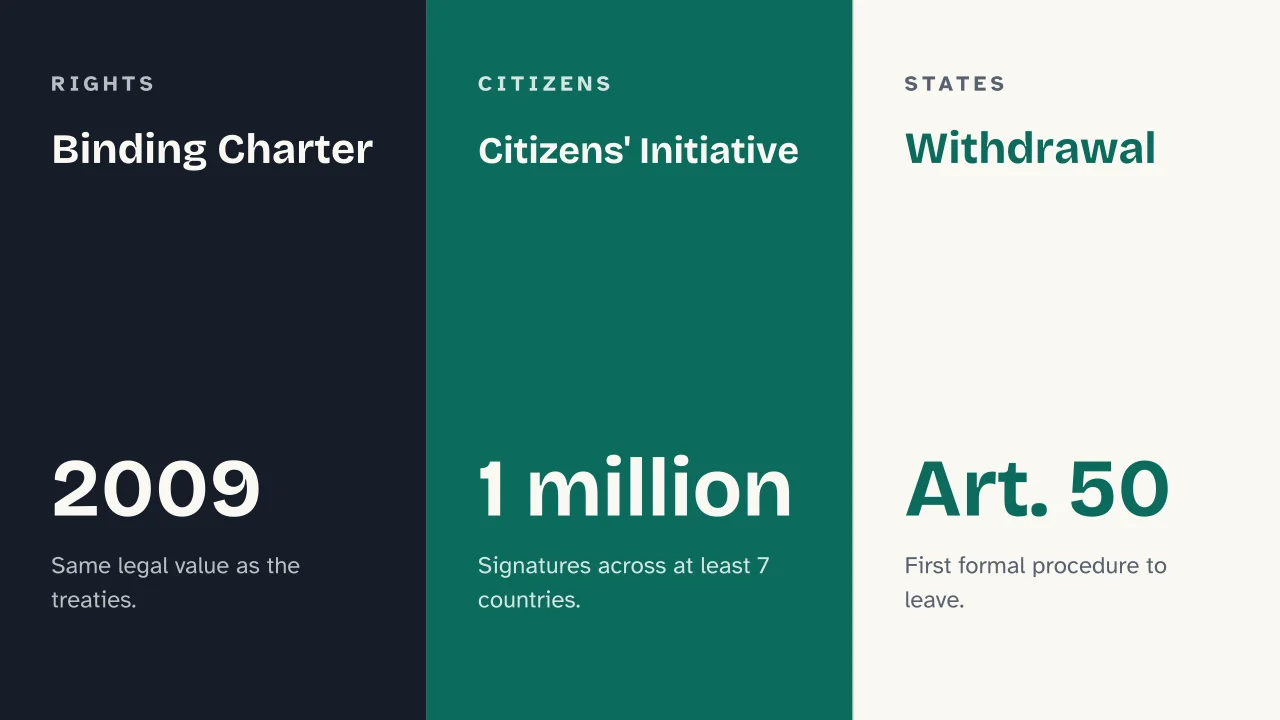  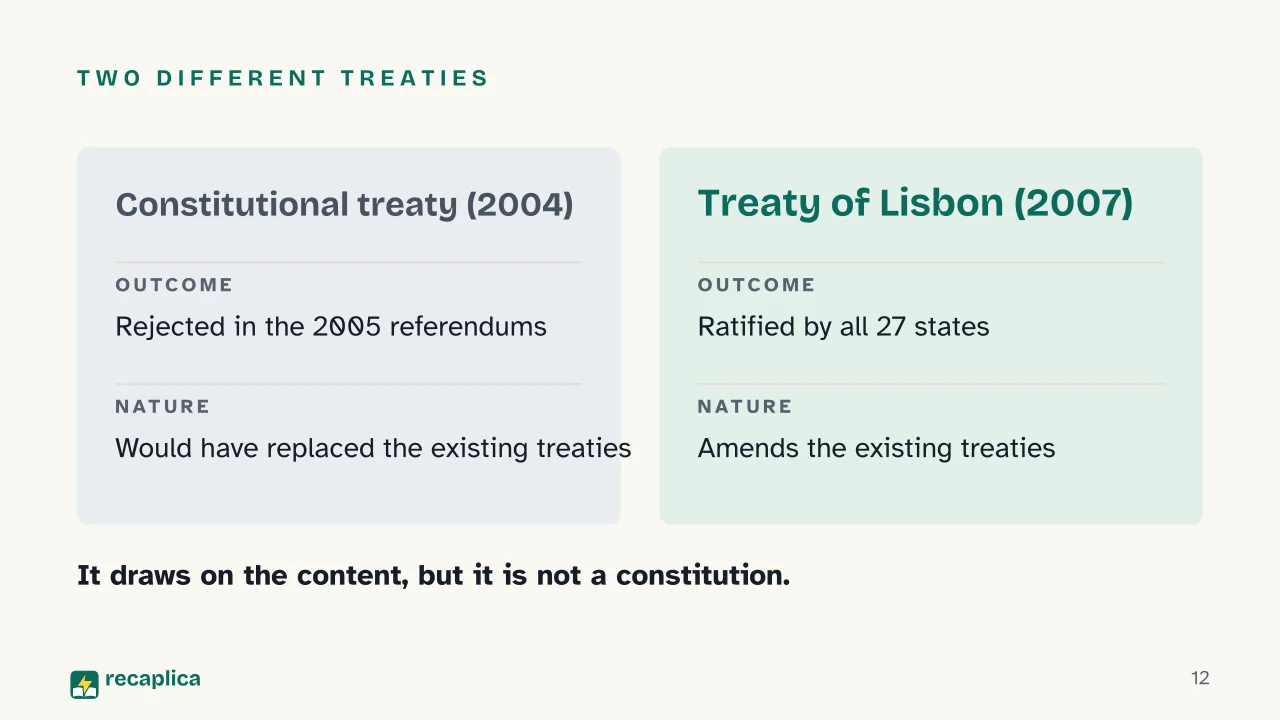 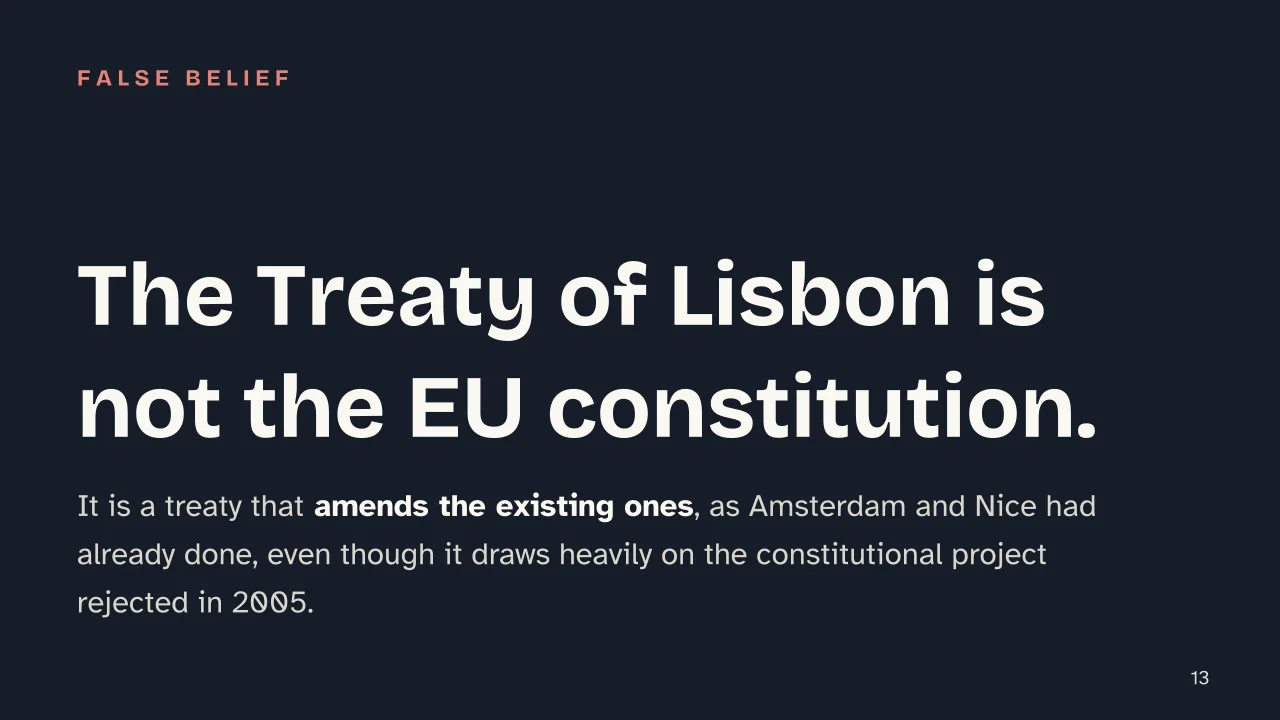 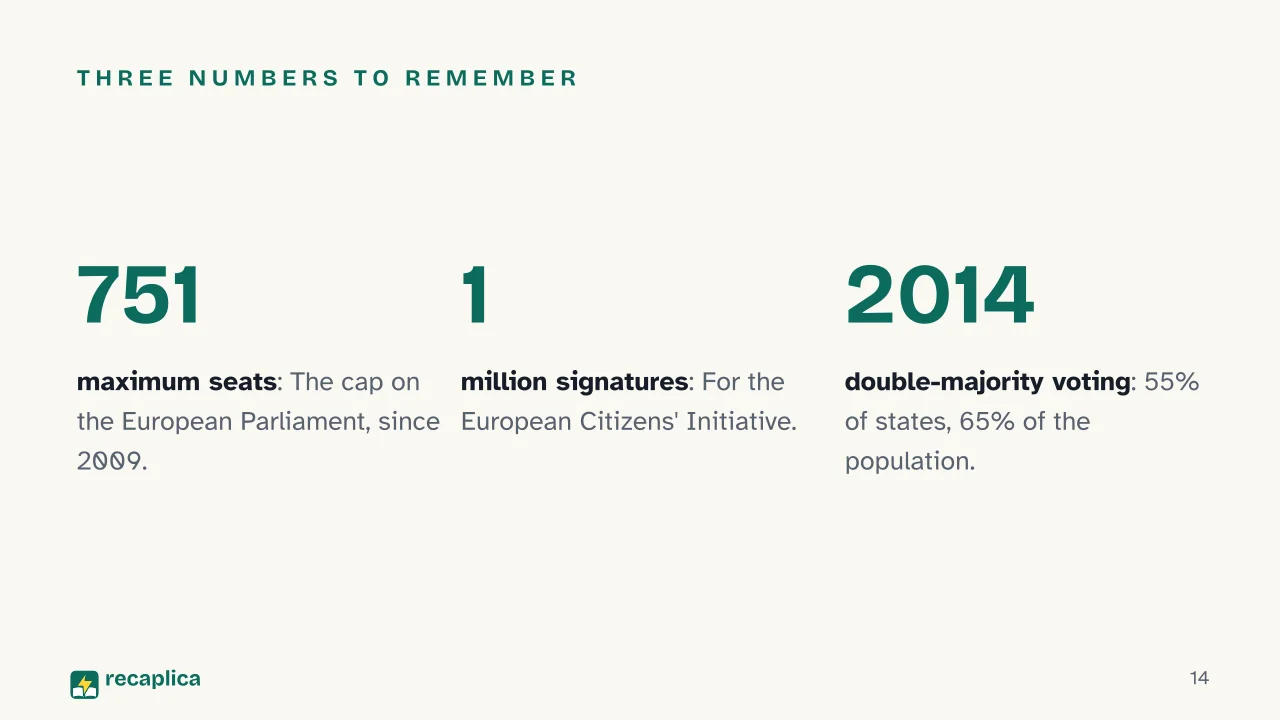 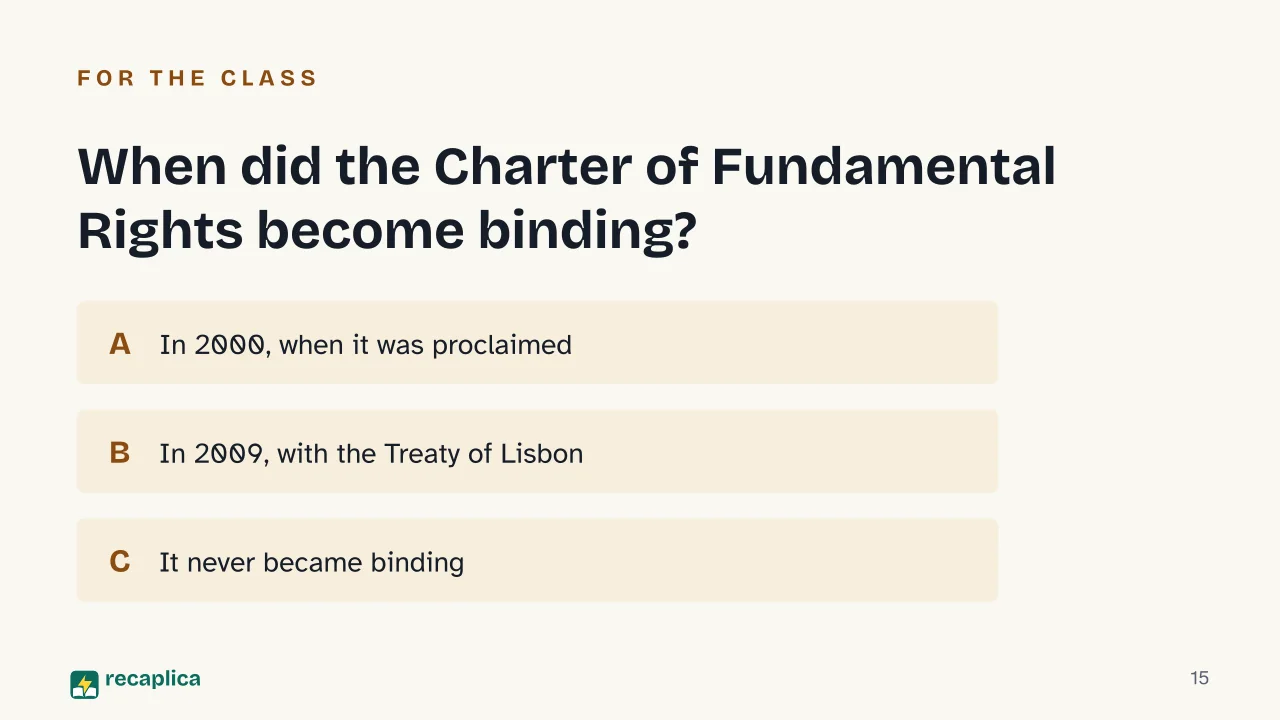  Common myths
Mind mapDrag the background to move around and the nodes to reposition them; use − and + to collapse and expand branches. 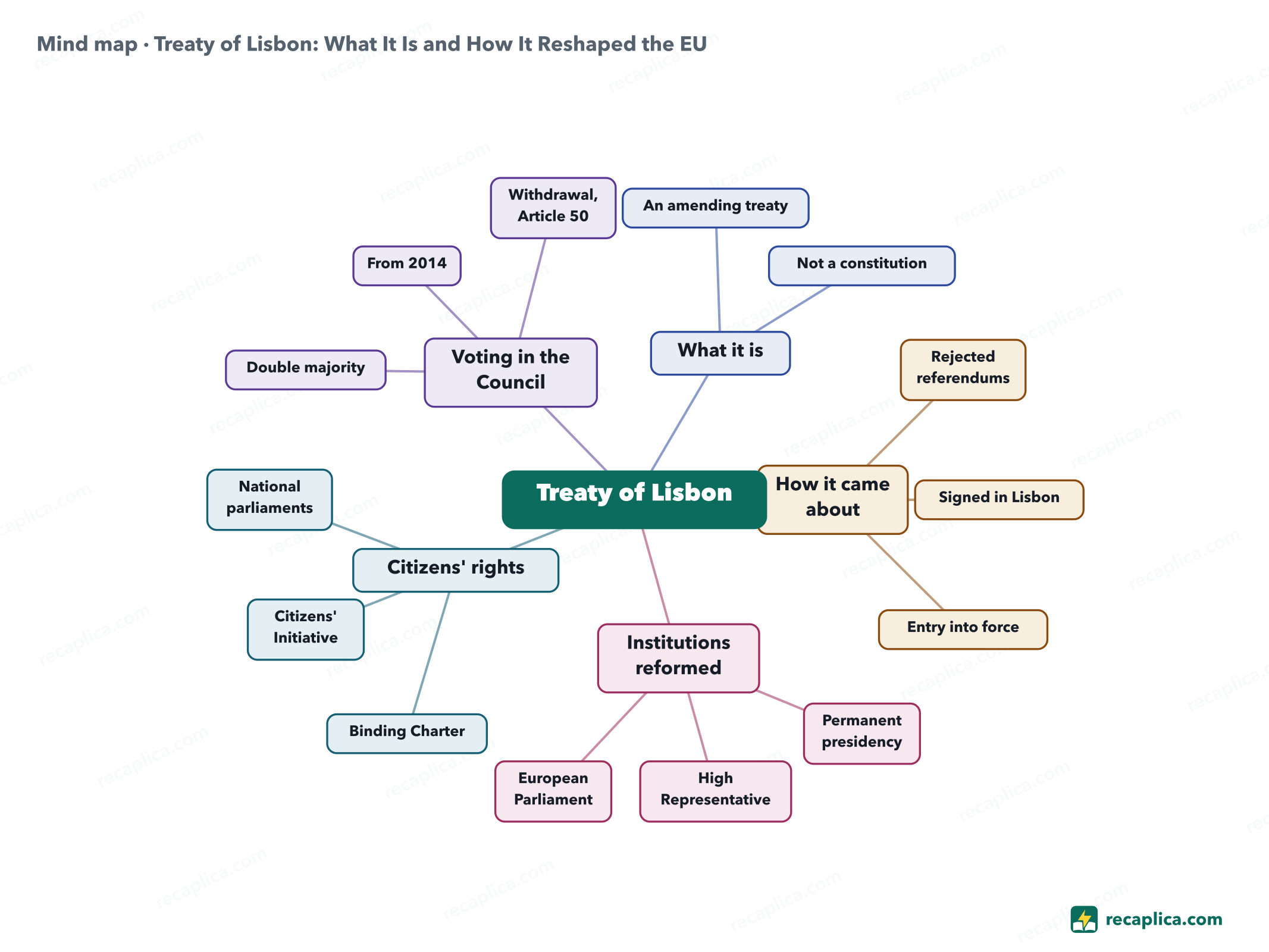
Quiz: test yourselfAnswer the questions to check what you have learned: you get instant feedback and a short explanation. Grade 0/10 0/5
FlashcardsTap the card to flip it and check whether you remember the answer, then move to the next one. 1 / 8 Explain it in your own wordsThe ultimate test: if you can explain it in simple words, you've truly understood it. Write your explanation, then compare it with the Recap. Your explanation is saved only on this device.
Frequently asked questionsWhat is the Treaty of Lisbon?It is the treaty, signed on 13 December 2007 and in force since 1 December 2009, that reformed how EU institutions operate by amending the Treaty on European Union and the Treaty on the European Community, without replacing them with a new text. Is the Treaty of Lisbon the European constitution?No. It draws heavily on the Treaty establishing a Constitution for Europe, rejected by referendums in France and the Netherlands in 2005, but it does not declare itself a constitution: it remains a treaty that amends the existing ones, as the Amsterdam and Nice treaties had already done. What did the Treaty of Lisbon change in the European Union?It expanded the European Parliament's legislative powers, created a permanent presidency of the European Council and the post of High Representative for foreign affairs, made the Charter of Fundamental Rights binding, introduced the European Citizens' Initiative and a new Council voting system, and added the first formal procedure for a member state to withdraw. When did double-majority qualified voting under the Treaty of Lisbon take effect?On 1 November 2014, with a transitional period running until 31 March 2017, during which any member state could still request a vote under the previous rules. This should not be confused with the treaty's own entry into force, in 2009. What is the European Citizens' Initiative introduced by the Treaty of Lisbon?A tool that lets one million EU citizens, with minimum thresholds collected in at least 7 member states, invite the European Commission to put forward a legislative proposal on a matter within its powers. Every Recap goes through an independent review before publication. |