|
recaplica
World War 2: Causes, Turning Points and Consequences | |||||||||||||||
| © 2026 Recaplica · recaplica.com — All rights reserved | |||||||||||||||
World War 2: Causes, Turning Points and ConsequencesWhat to print Page numbers appear when printing with default margins. SlidesChoose a cut Flash10 slidesThe essential thread, to present in classFull19 slidesEvery chapter and the deeper detailBoth come with speaker notes. In 30 seconds quick readWorld War 2 was the conflict that between 1939 and 1945 set the Allies — Britain, France, the United States and the Soviet Union — against the Axis powers of Germany, Italy and Japan. It opened on 1 September 1939 with the German invasion of Poland, but its roots lie in the previous two decades: the terms imposed on Germany after World War 1, the economic collapse of the early 1930s, the Nazi seizure of power and a run of territorial expansions the other powers accepted without resisting. In 1941 the war became truly global, with the German attack on the Soviet Union and the Japanese attack on Pearl Harbor. It ended with the German surrender in May 1945 and the Japanese surrender signed on 2 September 1945. Estimates of the dead run past 50 million, most of them civilians. Key Points
Key figures
Deep DiveNot one day, but twenty yearsOn 1 September 1939 Germany attacked Poland. On 3 September Britain and France declared war. That date opens the conflict; to see how Europe got there you have to go back twenty years, to the peace that closed World War 1. The Treaty of Versailles imposed terms on Germany that, as Treccani puts it, Germans could not accept in the long run, and that became the breeding ground for a revival of militarism and nationalism. Resentment was compounded by economic collapse: the Great Depression reached Germany in late 1929, unemployment climbed fast, and many Germans concluded that their government could not handle the crisis. It was a crisis far longer and deeper than an ordinary recession, and it changed the political picture. The election results tell the rest. In May 1928 the Nazi Party took 2.6% of the vote. In September 1930 it rose to 18% and became the second largest party in parliament; in July 1932 it reached 37% and became the largest. On 30 January 1933 President Hindenburg appointed Hitler chancellor, after backroom negotiations with conservative politicians who believed they could control him. From there democracy was dismantled from within: the Reichstag fire in late February opened the way to emergency powers, the last multi-party election was held on 5 March 1933, and the Enabling Act of 23 March let the government legislate without parliament. Unlike a revolution such as the French Revolution, this regime installed itself through elections and laws. Foreign policy followed the same method, and each request granted produced the next one. Germany left the League of Nations, restored conscription and rearmed openly; in 1936 it remilitarised the Rhineland; in March 1938 it annexed Austria.
The last step came in August 1939, when Germany and the Soviet Union signed a non-aggression pact with a secret protocol dividing Poland between them. Days later, Poland was attacked. The years when the Axis seemed to be winningThe opening phase moved very fast. The Wehrmacht defeated Poland in a matter of weeks; in the spring of 1940 it was Western Europe’s turn, and on 22 June France signed an armistice. Italy entered the war on 10 June 1940 against France and Britain. It fought on the Alpine border between 21 and 23 June and stopped with the armistice of the 24th. On 28 October 1940 it attacked Greece, where the campaign turned into a substantial failure: after an initial push into Epirus, Italian forces had to fall back. In North Africa the war was a sequence of advances and retreats, from the occupation of Sidi Barrani on 12 September 1940 to the last Axis offensive between 27 May and 30 June 1942, which reached El Alamein. On 22 June 1941 Germany attacked the Soviet Union in Operation Barbarossa, breaking the pact signed less than two years earlier and opening the front on which the Soviet Union would suffer the highest toll in the National WWII Museum’s tally. 7 December 1941: the war becomes genuinely globalJapanese forces bombed the US fleet at Pearl Harbor. In under two hours the Pacific Fleet was devastated and more than 3,500 Americans were killed or wounded. The next day President Roosevelt went before Congress: the Senate voted for war unanimously, and in the House the single dissenting vote came from the Montana pacifist Jeannette Rankin, who twenty-four years earlier had also voted against American entry into World War 1. The declaration was signed at four o’clock that afternoon, 8 December 1941. The European and Asian conflicts joined up three days later. On 11 December 1941 German foreign minister Ribbentrop announced that Germany considered itself at war with the United States, and Italy did the same; Congress approved declarations against both that same day. The Tripartite Pact of September 1940, which bound Germany, Italy and Japan and was later joined by Hungary, Romania and Slovakia, did not require it: Article 3 provided for mutual assistance only if a signatory was attacked, and at Pearl Harbor Japan was the aggressor. From that point the United States could fully mobilise its economic and military resources against the whole Axis alliance, including the productive capacity we now summarise as GDP. The turning points of 1942-43From 4 to 7 June 1942 the American and Japanese navies fought at Midway. According to the National WWII Museum that battle turned the tide of the Pacific war in favour of the Americans: Japan lost four aircraft carriers and a heavy cruiser against one American carrier and one destroyer, and its navy, until then one of the strongest in the world, was permanently weakened. Between 1942 and 1943 the battle of Stalingrad marked, in Treccani’s words, the end of the German offensive drive. And on 9-10 July 1943 the Allies landed in Sicily; the island fell on 17 August. The Italian front changed fastest of all. Fascism fell on 25 July 1943. The armistice with the Allies was signed in secret on 3 September and announced on the 8th. What followed was the most harrowing phase of the war fought on Italian soil: German forces occupied the centre and north, where the Italian Social Republic was set up at Salò under German control, while resistance movements spread. Rome was liberated on 4 June 1944, and the German front in Italy collapsed only between 9 and 24 April 1945. The HolocaustWhile the fighting went on, Nazi Germany carried out the systematic murder of Europe’s Jews. The United States Holocaust Memorial Museum documents six million Jewish victims, broken down as follows: around 2.7 million killed in the killing centres of Chełmno, Belzec, Sobibor, Treblinka II and Auschwitz-Birkenau; around 2 million in mass shootings carried out at more than 1,500 locations across occupied Eastern Europe; between 800,000 and one million who died in camps and ghettos from starvation, disease and violence; and more than 250,000 in executions, pogroms and forced deportations. The regime also murdered millions of non-Jewish people: some 3.3 million Soviet prisoners of war, around 1.8 million ethnic Poles, between 250,000 and 500,000 Roma, more than 310,000 Serb civilians, between 250,000 and 300,000 people with disabilities, along with political opponents, Jehovah’s Witnesses and other groups. The museum also explains how these figures are arrived at: no single German document accounts for every death, and the numbers come from cross-referencing surviving Nazi records, demographic studies, testimony and archives. How it endedOn 6 June 1944 the Allies landed in Normandy, opening the western front that, together with the Soviet advance from the east, forced Germany to fight on two sides. The German surrender was signed at Reims, in France, at 2.41 a.m. on 7 May 1945: General Alfred Jodl signed for Germany, Lieutenant General Walter Bedell Smith for the Allies on Eisenhower’s behalf. The document set the end of active operations at 11.01 p.m. Central European time on 8 May. Because Soviet leaders feared the Reims signing might look like a separate peace with the Western powers, a second document was signed in Berlin on 8 May, and it is that one which stands as the official legal surrender of the Third Reich. In the Pacific the war ran on for another three months. On 6 August 1945 the United States dropped an atomic bomb on Hiroshima, and on 9 August on Nagasaki. Japan announced its surrender on 15 August; the formal instrument was signed at 9.04 a.m. on 2 September in Tokyo Bay, aboard the American battleship Missouri, by Foreign Minister Mamoru Shigemitsu and General Yoshijiro Umezu, and accepted by General Douglas MacArthur for the Allied powers. What it costHere, as with the previous war, the figures have to be read for what they are: estimates, with wide margins and different methods behind them. Treccani gives over 50 million dead, 30 million in Europe alone, more than two thirds of them civilians. The National WWII Museum, which counts the two categories separately, arrives at 15 million battle deaths, 25 million battle wounded and 45 million civilian deaths.
The museum itself warns that estimates vary widely between sources, and that Chinese civilian deaths alone might well exceed 50 million. Many entries are given as ranges: at this scale, exact numbers do not exist. The world that came out of itWhile fighting continued in Europe, representatives of fifty countries met in San Francisco from 25 April to 26 June 1945 to draft the Charter of the United Nations. Ratified by the five permanent members — China, France, the Soviet Union, the United Kingdom and the United States — and by a majority of the other signatories, it came into force on 24 October 1945, still marked every year as UN Day. In terms of the balance of power, the outcome was a world split into two blocs led by the United States and the Soviet Union, with Germany itself divided and reunified only in 1990. The conflict that ended in 1945 went on shaping Europe’s political geography for nearly half a century. Slide deckSlides ready to download and make your own in PowerPoint or Google Slides, with speaker notes. Pick the Flash cut or the Full one.     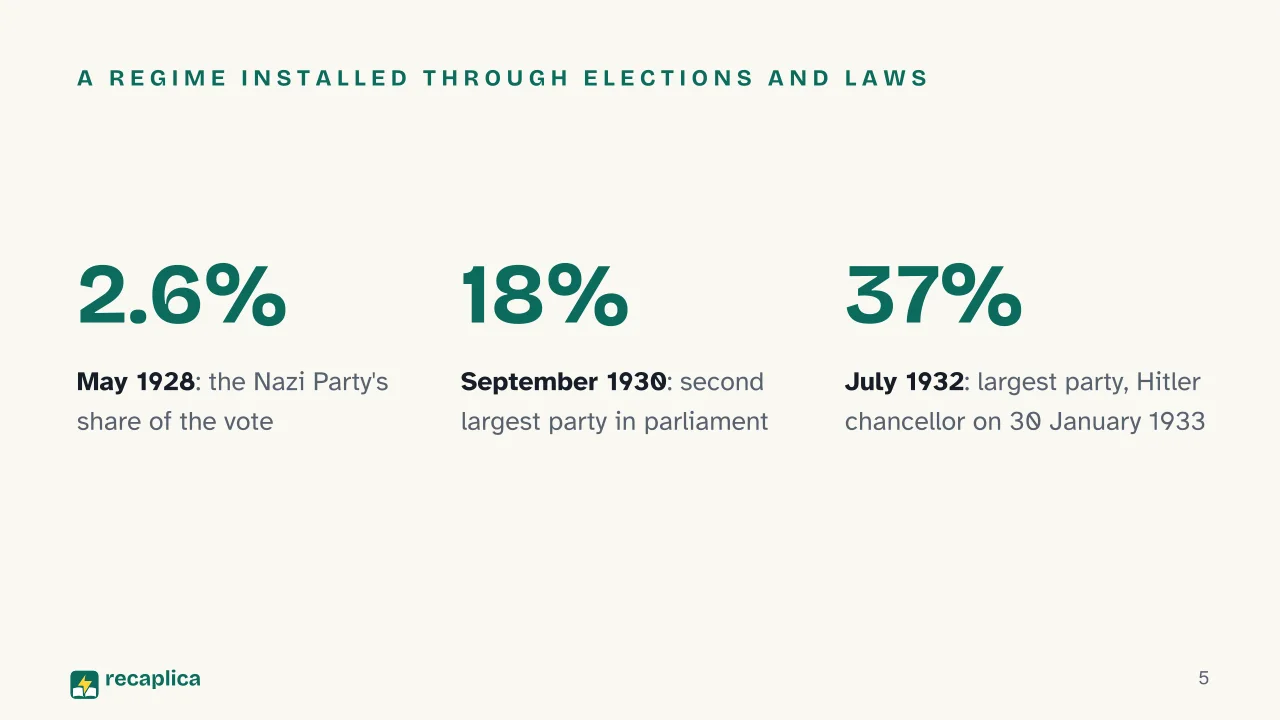 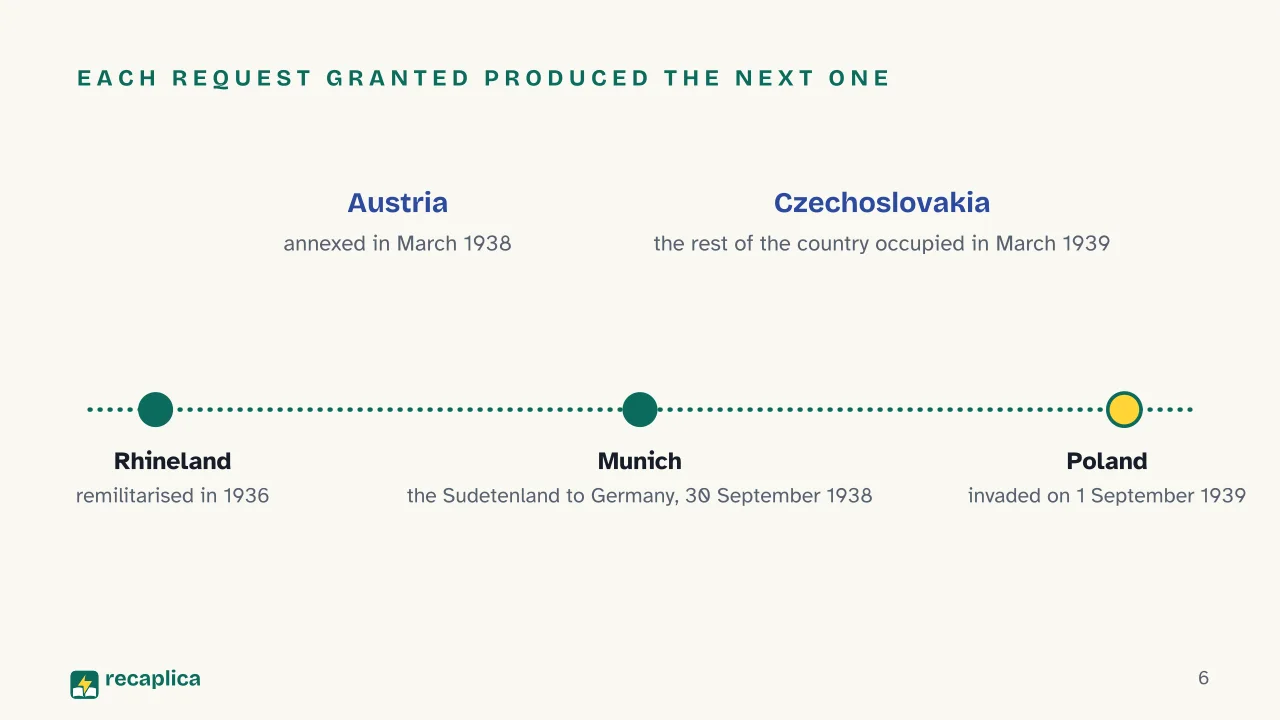  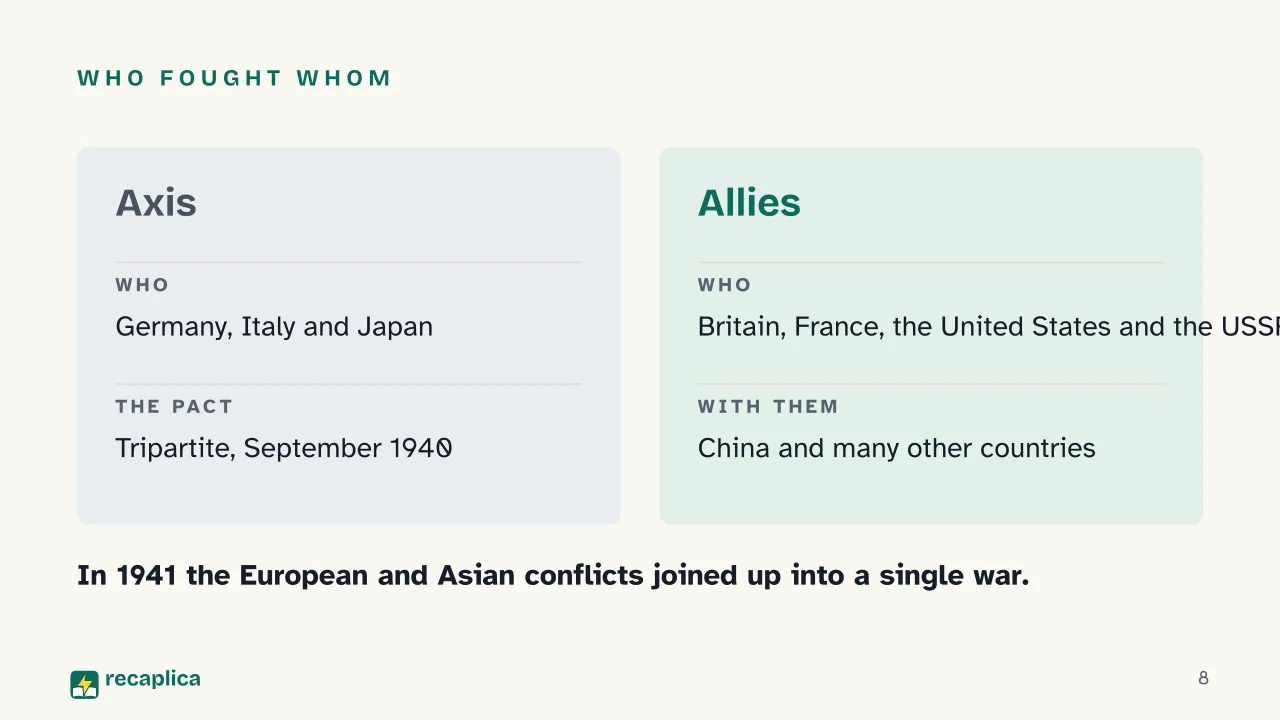 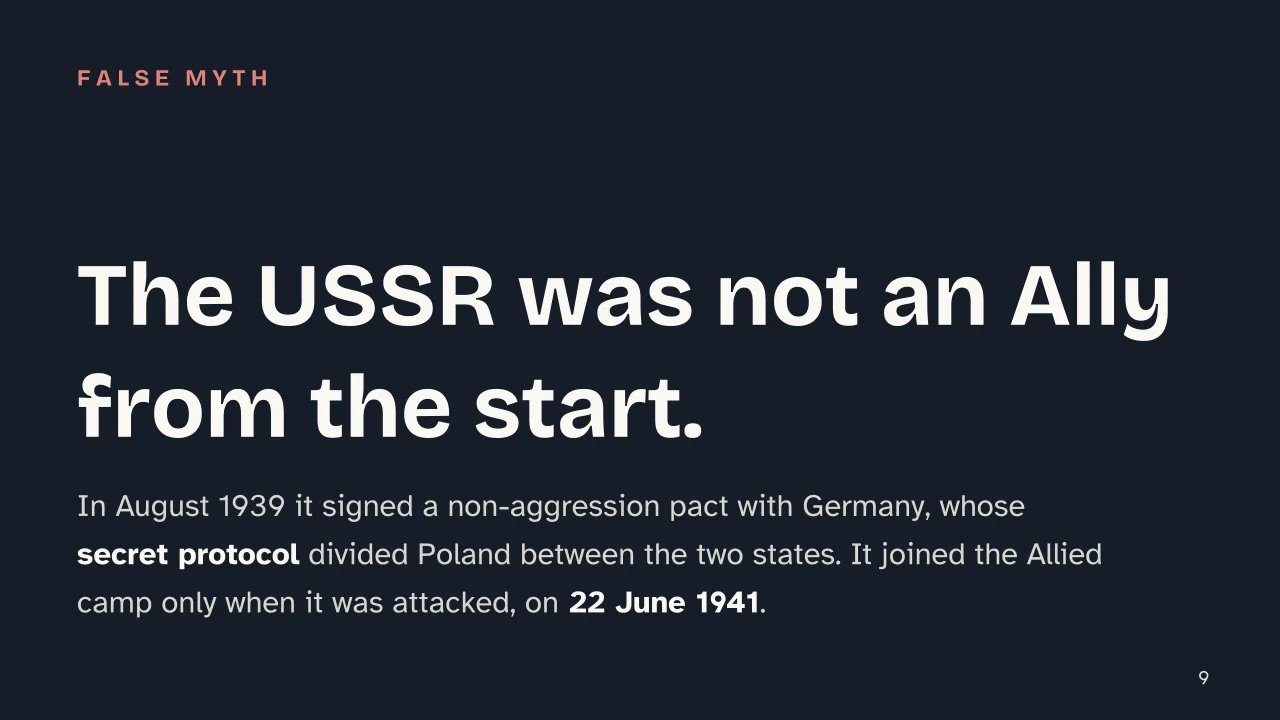 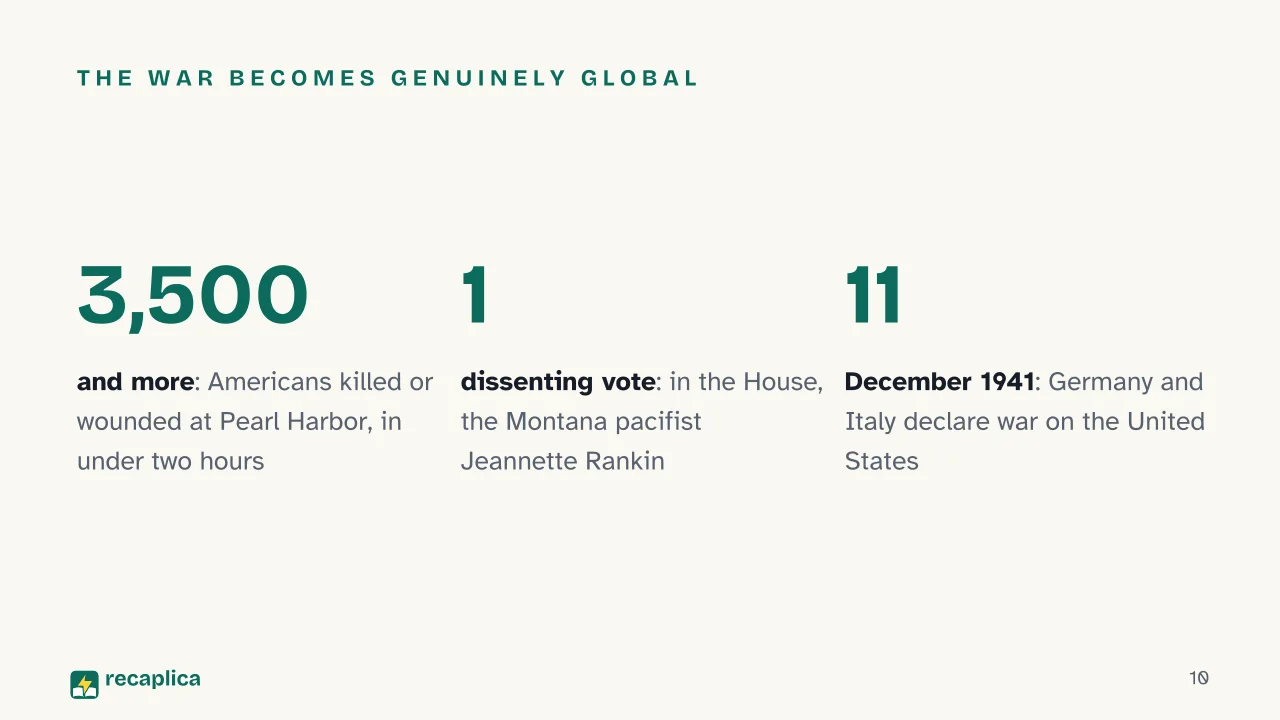  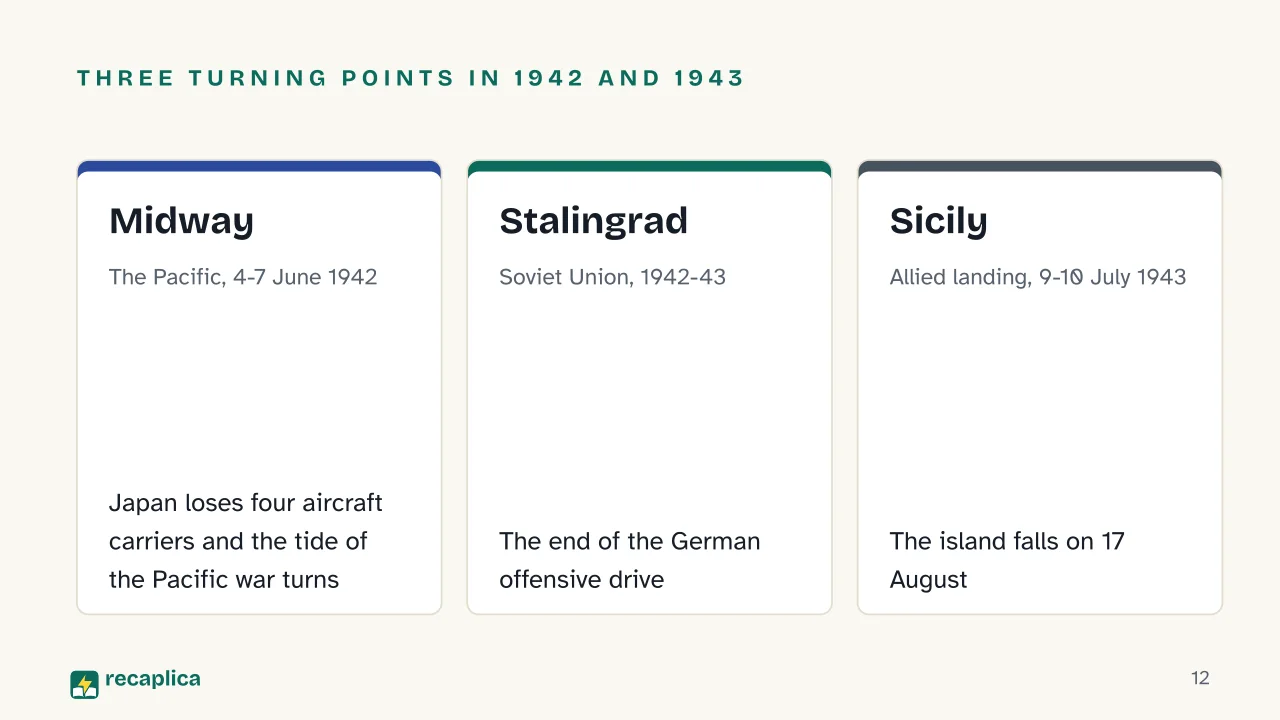 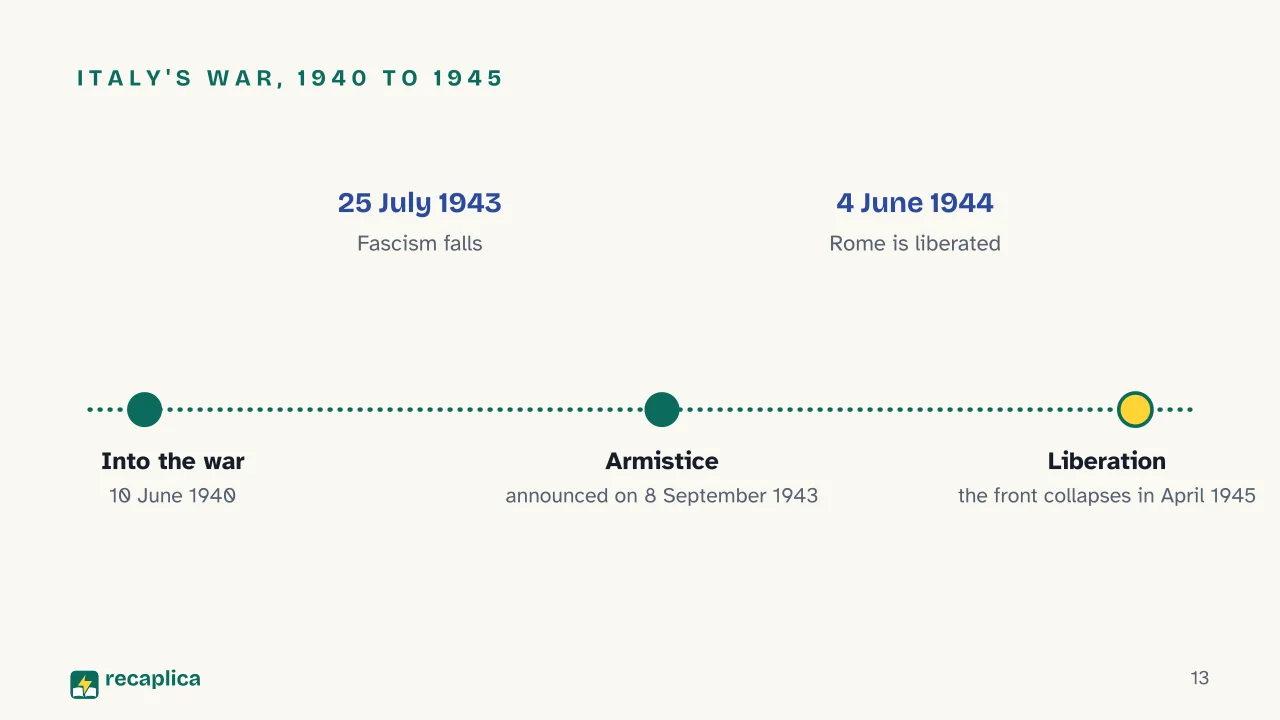  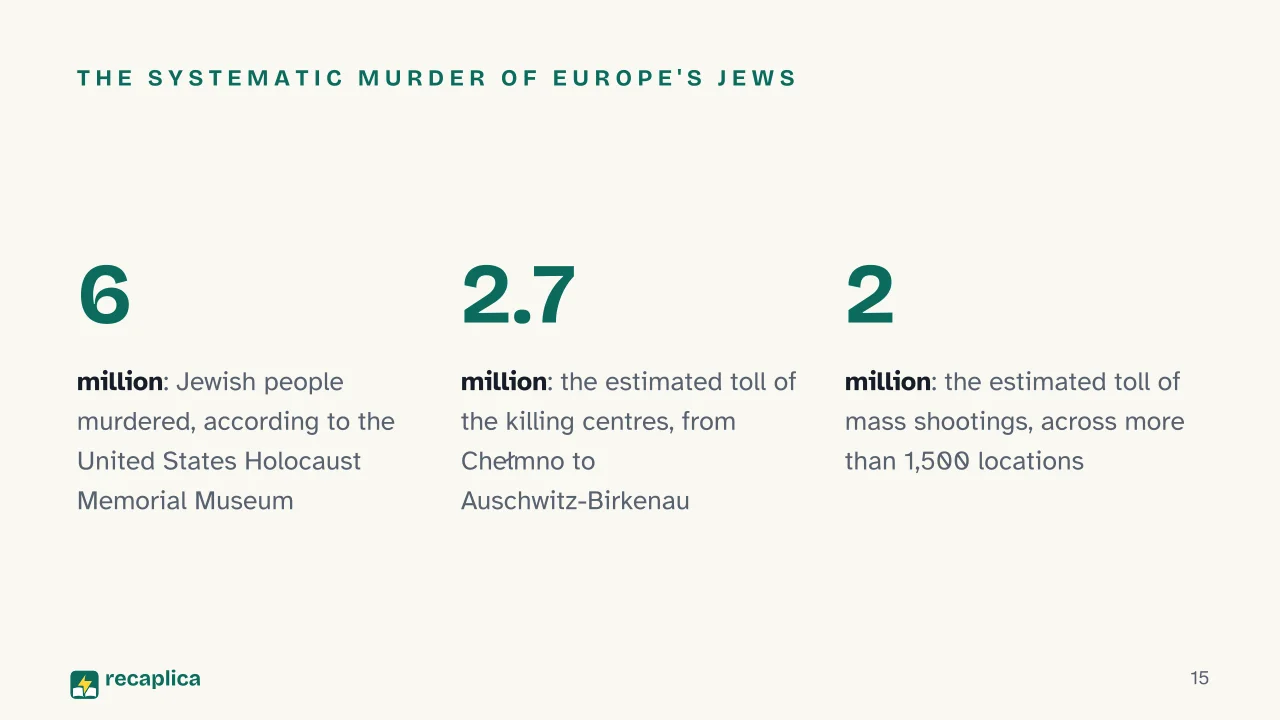 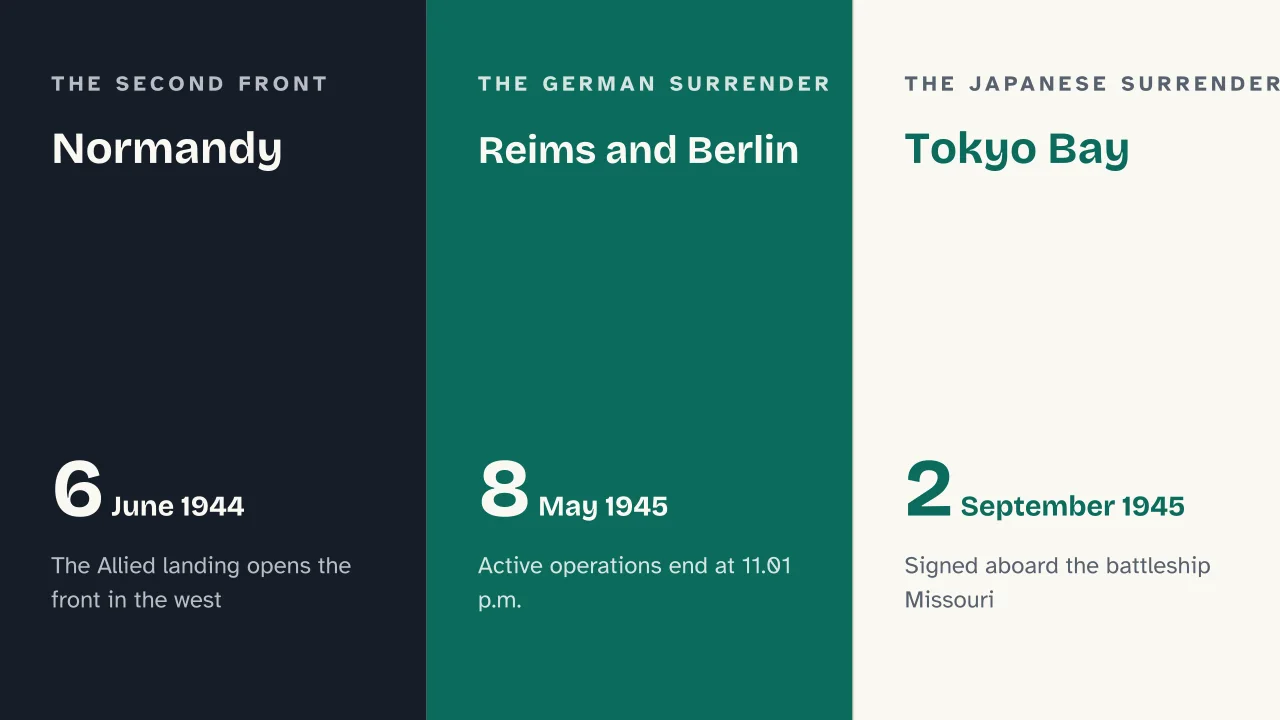 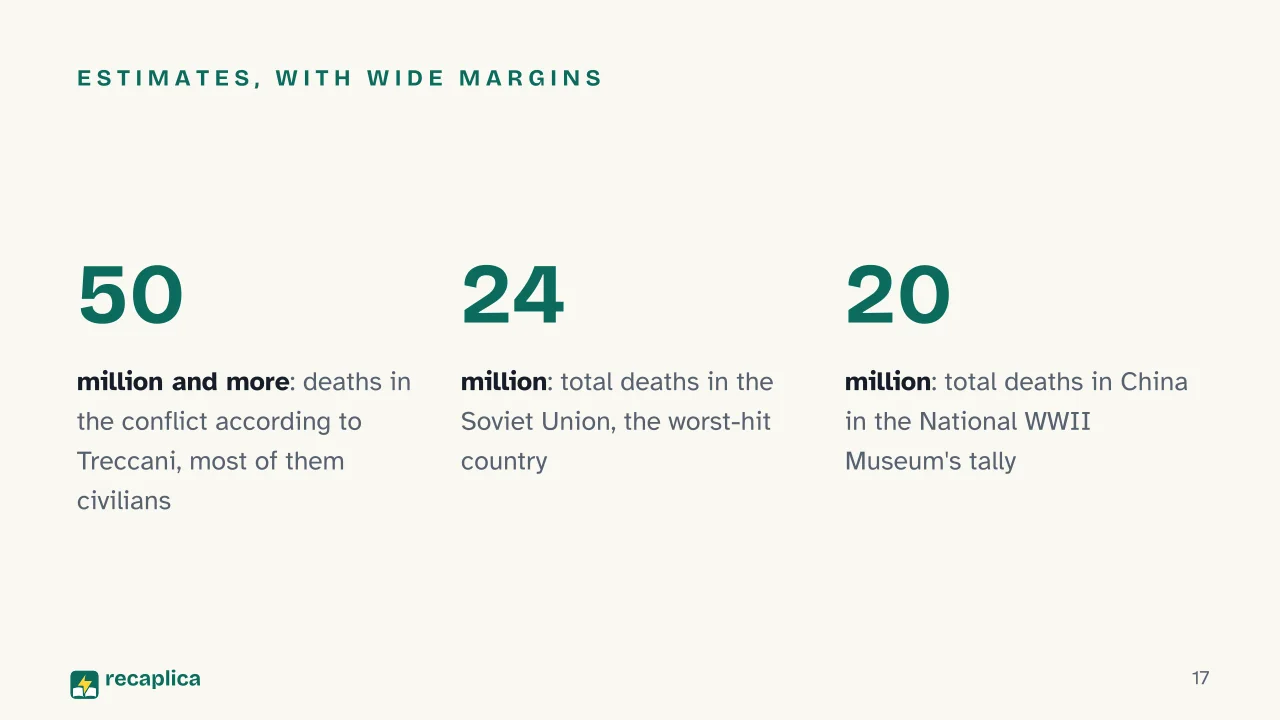 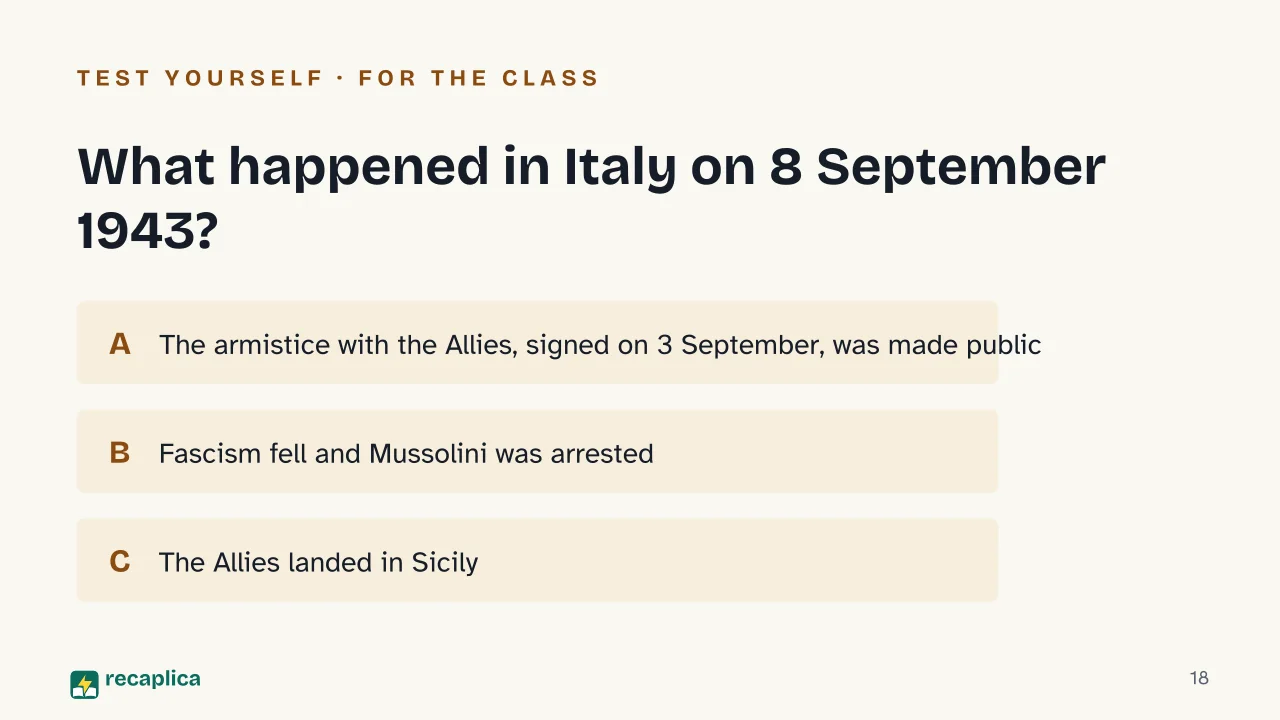  Common myths
Mind mapDrag the background to move around and the nodes to reposition them; use − and + to collapse and expand branches. 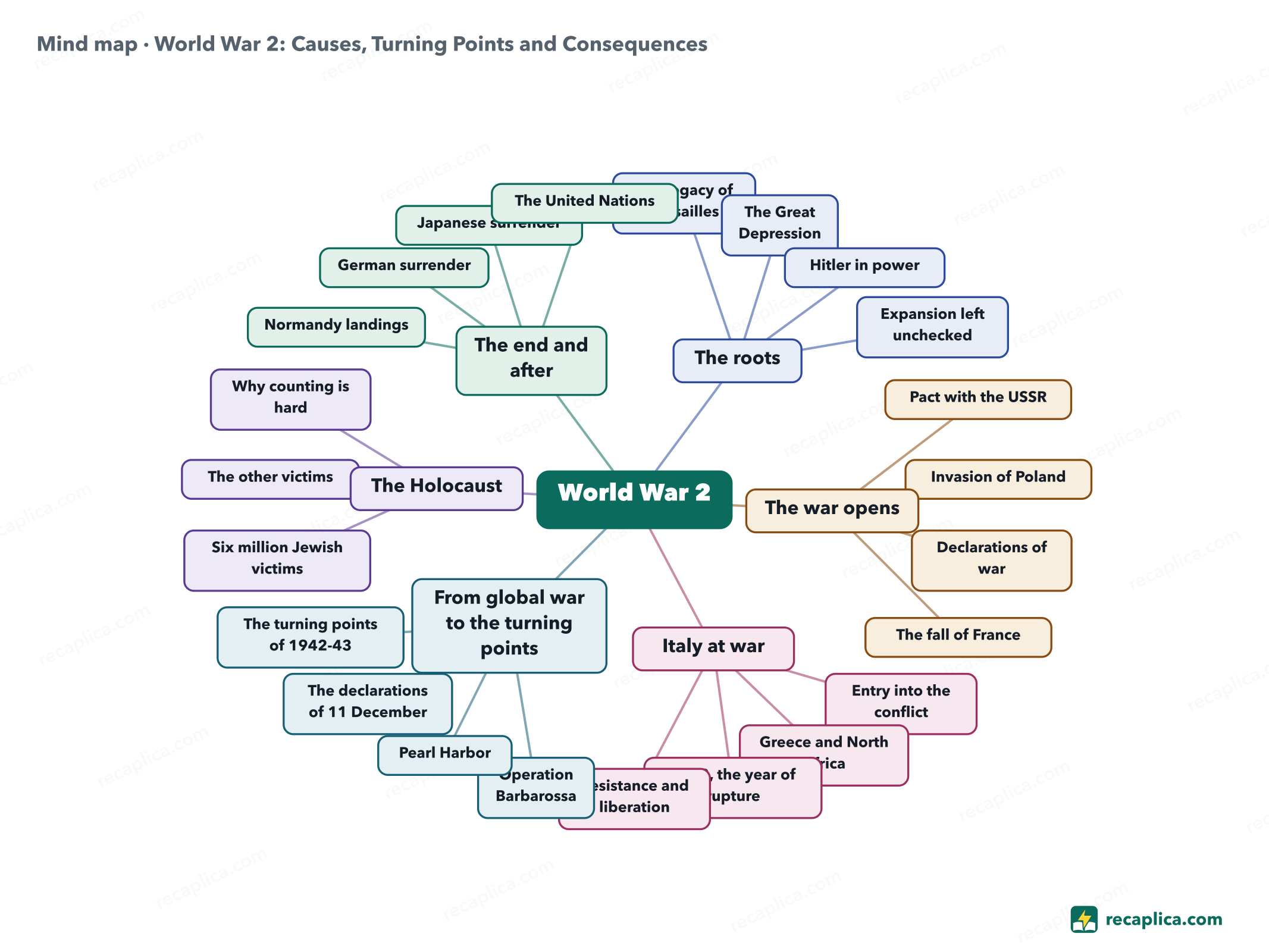
Quiz: test yourselfAnswer the questions to check what you have learned: you get instant feedback and a short explanation. Grade 0/10 0/5
FlashcardsTap the card to flip it and check whether you remember the answer, then move to the next one. 1 / 8 Explain it in your own wordsThe ultimate test: if you can explain it in simple words, you've truly understood it. Write your explanation, then compare it with the Recap. Your explanation is saved only on this device.
Frequently asked questionsWhen did World War 2 start and when did it end?It began on 1 September 1939 with the German invasion of Poland, followed on 3 September by the British and French declarations of war. In Europe it ended with the German surrender signed at Reims on 7 May 1945, which took effect at 11.01 p.m. Central European time on 8 May. In the Pacific, Japan announced its surrender on 15 August 1945 and signed the formal instrument on 2 September in Tokyo Bay. Who fought whom?On one side the Allies — Britain, France, the United States and the Soviet Union, along with China and many other countries. On the other the Axis powers, Germany, Italy and Japan, bound by the Tripartite Pact of September 1940 and later joined by Hungary, Romania and Slovakia. The Soviet Union only joined the Allied camp after the German attack of 22 June 1941: until then it was tied to Germany by a non-aggression pact. How many people died in World War 2?There is no single figure, and serious sources say so openly. Treccani gives over 50 million dead, 30 million in Europe alone, more than two thirds of them civilians. The National WWII Museum counts 15 million battle deaths, 25 million battle wounded and 45 million civilian deaths, with the Soviet Union at 24 million total deaths and China at 20 million, and warns that estimates vary widely: Chinese civilian deaths alone might exceed 50 million. Why is World War 2 said to grow out of World War 1?Because the terms imposed on Germany by the Treaty of Versailles in 1919 were not accepted by Germans in the long run and became, in Treccani's phrase, the breeding ground for a revival of German militarism and nationalism. Nazi foreign policy was openly revisionist: withdrawal from the League of Nations, rearmament and the return of conscription, remilitarisation of the Rhineland in 1936, and the annexation of Austria in March 1938. What was the Holocaust?The systematic murder of Europe's Jews by Nazi Germany and its collaborators: six million people killed, according to the United States Holocaust Memorial Museum, of whom roughly 2.7 million died in killing centres, around 2 million in mass shootings across more than 1,500 locations in occupied Eastern Europe, and between 800,000 and one million in camps and ghettos through starvation, disease and violence. The regime also murdered millions of non-Jewish people, including some 3.3 million Soviet prisoners of war and around 1.8 million ethnic Poles. Every Recap goes through an independent review before publication. |