|
recaplica
Labor Union: Definition, How Unions Began and What They Do |
| © 2026 Recaplica · recaplica.com — All rights reserved |
Labor Union: Definition, How Unions Began and What They DoWhat to print Page numbers appear when printing with default margins. SlidesChoose a cut Flash10 slidesThe essential thread, to present in classFull16 slidesEvery chapter and the deeper detailBoth come with speaker notes. In 30 seconds quick readA labor union is an association of workers who join together to defend the interests they share at work. The first unions appeared in the mid-1800s in the factories of the Industrial Revolution, at a time when the owner alone decided wages and hours. Their main job is negotiating collective agreements with employers, which set pay, working hours, holidays and leave; when talks stall, they can call a strike. In Italy, Article 39 of the Constitution guarantees everyone the freedom to found a union or join one, and Article 40 recognizes striking as a right. Key Points
Key figures
Deep DiveWhat is a labor unionA labor union is an association of workers formed to defend the work interests they have in common. Treccani, the Italian encyclopedia, puts employers’ associations under the same definition, since they sit on the other side of the table when an agreement is signed. To compare countries, the OECD uses a practical test: an organization of employees that negotiates wages and working conditions counts as a union. Its analyses describe unions as voluntary organizations, present in every member country. Unions can also band together. Convention No. 87 of the International Labour Organization (ILO), adopted in 1948, recognizes the right to form federations and confederations and to affiliate with international organizations. Italy’s main confederations, the CGIL, CISL and UIL, were founded between 1944 and 1950. Each contains sector unions: FILT CGIL, FIT CISL and UILTRASPORTI UIL, for instance, signed the national logistics agreement, whose renewal was filed with the CNEL in the first half of 2025 and which applied to more than 560,000 workers. Next to the confederations stand the grassroots unions (Cobas), organized from below and rooted mainly in the public sector. How labor unions beganThe first unions appeared in the mid-19th century, with the Industrial Revolution. In Aris Accornero’s account for Treccani’s encyclopedia for young readers, factories had filled with workers, and the owner alone set hours and wages. In Britain strikes, workers’ combinations and collections of funds were banned by law, and employers would not recognize anyone speaking for the workforce. The first British organizations, the trade unions, were craft unions: people joined according to the trade they practiced, whatever firm employed them. The Trade Union Act, enacted on 29 June 1871, established that a union’s purposes could no longer be treated as unlawful merely because they restrained trade, and it lifted the threat of conspiracy charges from its members. In 1900 British unions founded a party of their own, the Labour Party. In the United States recognition came with the Wagner Act of 1935, and the two big federations, the AFL and the CIO, merged in 1955. In Italy, once the old craft guilds were gone, 19th-century workers first organized in mutual aid societies. From the 1880s, amid an agrarian crisis and industrialization, leagues for improvement and resistance sprang up, and they used the strike as an ordinary tool. The following decade brought the Chambers of Labour, organized by territory, and in 1906 the General Confederation of Labour (CGdL), the first national confederation. Then came Fascism. Law No. 563 of 3 April 1926 laid down the legal framework for collective labor relations, with one chapter on recognizing unions and collective agreements and another on lockouts and strikes. In 1927 the CGdL’s leaders were pressed into declaring it dissolved. From that point there was one union, the Fascist one: compulsory, run by leaders appointed from above and with no right to strike. After the regime fell, in June 1944, Giuseppe Di Vittorio (a Communist), Achille Grandi (a Catholic) and Emilio Canevari (a Socialist) signed the Pact of Rome, which gave birth to a united CGIL. According to the Di Vittorio Foundation it was signed on 4 June, but the document carries the date of the 3rd in tribute to Bruno Buozzi’s work in rebuilding the union. Its acronym gained an “I”, for “Italiana”, which the pre-Fascist CGL had not carried. The CGIL held Catholics, Communists, Socialists, anarchists and independents together until the split of 1948, after which only the Communist and Socialist currents remained. The CISL, Catholic in inspiration, was founded in 1950; the UIL traces its own birth to 5 March 1950. In 1972 the three confederations created a United Federation, which broke up in 1984 over the Craxi government’s cut of some points of automatic wage indexation, the scala mobile. How do unions work? Bargaining, politics and servicesThe first task is negotiating pay and the rules of employment with companies: hours, holidays and leave, wages and job grades, probation, disciplinary measures. What comes out of the talks is the collective agreement, a deal between one or more employers and a union that individual contracts have to match. A collective agreement has two parts. One sets the rules of the employment relationship itself. The other governs relations between the parties that signed it, for example through peace clauses. An individual employee’s contract may improve on the terms of the collective agreement, and any clause that makes them worse is void.
Italian agreements are filed in a national archive kept by the CNEL (the National Council for Economics and Labour), under Law 936 of 1986. On 31 December 2025 it held 1,015 national agreements for private-sector employees. The 97 agreements applied to more than 10,000 employees each covered 97.2% of the non-managerial private employees recorded by the INPS, Italy’s social security agency, while 626 applied to fewer than 500 people each and between them reached 0.4%. According to the CNEL, on 30 June 2025 expired agreements had been waiting for renewal for 19 months on average. The level of bargaining varies between countries. In the picture Accornero drew in 2006, Germany bargained at regional and company level, Japan at company and inter-confederal level, and the United States within the company only. Then there is politics. In Italy, unions sit down with the government and the regions to discuss economic and social choices, a practice called concertation; in the European Union the equivalent is known as social dialogue. Unions also run walk-in offices, where they help people fill in tax returns and deal with pension paperwork. Article 39 of the Italian ConstitutionThe Italian Constitution, in force since 1 January 1948, deals with unions in Article 39. Its first paragraph, the only one fully in force, declares union organization free: anyone can found a union or join one. The other three paragraphs sketch a precise system. The one obligation the state may place on unions is registration with public offices, on condition that their statutes give them democratic internal rules. Registered unions become legal persons. Negotiating jointly, each with a weight proportional to its membership, they sign agreements valid for every worker in the sector, members and non-members alike, the effect lawyers call erga omnes. That system has stayed on paper. As the labor-law scholar Edoardo Ghera noted in 2014, paragraphs 2, 3 and 4 have never been implemented by law. There were attempts: as late as 1988 a bill to implement Articles 39 and 40 was tabled in the Senate, and its sponsors recalled a Liberal proposal from 1958-1963 that never passed. In 1959 the government, under enabling Law No. 741, had made many sector agreements binding on everyone by turning them into legislative decrees. In 1962 the Constitutional Court, in ruling No. 103, held that a law cannot extend collective agreements to all workers by any route other than the one laid out in Article 39. The upshot is that an Italian collective agreement is a private-law contract, governed by ordinary law. Formally it binds only the members of the organizations that signed it. Judges have widened its reach, though, by using its minimum rates to measure the fair pay that Article 36 of the Constitution guarantees: pay proportionate to the work and enough for a free and dignified life. With no implementing law, the parties have built the rules themselves through agreements. The Consolidated Act on Representation, signed in 2014 by Confindustria for the employers and by the CGIL, CISL and UIL, admits to national bargaining any union with at least 5% representativeness. The CNEL calculates that figure as the average of a union’s share of members and its share of votes in workplace representative elections. Under the same text, an agreement signed by unions that together exceed 50% and approved by workers in a consultation is effective and enforceable. Freedom to organize also protects those who stay out. Italy’s Workers’ Statute voids any arrangement that ties hiring to joining a union, to not joining or to leaving one. At international level, ILO Convention No. 87 rules out prior authorization for founding a union, bars the authorities from interfering in its internal affairs and forbids dissolving it by administrative order. Strikes: a right with rulesA strike is a decision taken together by a group of workers to stop work in defense of shared interests. Article 40 of the Constitution recognizes it as a right and leaves its regulation to the law. Italy has never passed a general strike law. There are sector rules instead, and the main ones concern essential public services. The strike is called by a collective body, which need not be a union. Taking part is a right of each worker, who decides individually whether to join. Strikers are not paid for the hours they stop, and the employer may not prevent or obstruct participation. A strike can bring a company to a halt for a time; permanent damage to its plant falls outside the right. In 2004 Italy’s Court of Cassation, in ruling No. 16515, also held lawful the economic-political strike, which asks the government for measures or laws that protect workers. Essential public services fall under Law 146 of 1990. The law picks them out by the rights they protect, from health to freedom of movement. Health care and civil protection are on the list, as are waste collection and local public transport. Trains and planes count too, along with the ships that serve the islands. Strikes are allowed here as long as the “indispensable services” set for that sector are guaranteed. A strike must also be called at least 10 days ahead, in a written notice explaining why it is being held, how long it will last and what form it will take. A Guarantee Commission oversees the rules: nine experts in law and industrial relations, proposed by the presidents of the two chambers of Parliament and appointed by the President of the Republic. When there is a serious and imminent danger to people’s rights, the government authority can restrict a strike with a back-to-work order.
RSA and RSU: unions inside the workplaceItaly’s Workers’ Statute, Law No. 300 of 20 May 1970, brought unions into the workplace. The idea goes back to the CGIL congress held in Naples in November 1952, when Di Vittorio called for a “Statute of Workers’ Rights”. Treccani regards it as the most important law in Italian labor law after the Constitution. The Statute protects every worker’s freedom to found or join a union and to be active in it, at the workplace as well. A dismissal is void, like any other harm such as a transfer or a disciplinary penalty, if it targets someone for being a member, for union activity or for having gone on strike. Article 17 bans company unions, also called “yellow” unions: an employer may neither create nor fund one among its own staff. The rules on union activity at work apply to production units of industrial and commercial firms with more than 15 employees, and of farms with more than 5. There, workers can set up RSAs, union bodies at company level (Article 19). Since a 1995 referendum, RSAs have been formed within the unions that signed the collective agreements applied in that unit. The Constitutional Court later broadened the right: in ruling No. 231 of 2013 to unions that took part in the negotiations even if they did not sign, and in ruling No. 156 of 2025 to those that are comparatively the most representative nationally. RSUs, unified union bodies, come from an inter-confederal agreement of 20 December 1993, later taken up and updated by the 2014 Consolidated Act. They can be set up in units with more than 15 employees, and they work differently from RSAs: all workers elect them by secret ballot, choosing among competing lists. They have at least 3 members in units of up to 200 employees, grow with the size of the unit and serve three-year terms, with the same rights and paid leave as RSA officers. Workers may hold meetings during working hours, up to 10 hours a year paid as normal, and collective agreements can allow more. RSA officers get paid leave for union duties, and unions may collect dues and recruit members on site as long as work is not disrupted. If an employer obstructs union freedom or the right to strike, Article 28 on “anti-union conduct” comes into play. When a union applies, the judge decides within two days and, on finding a violation, orders the employer to stop at once and undo its effects. Disobeying the order is a crime. According to Treccani, there is no need to prove that the employer meant to harm the union: what counts is the conduct and what it produces.
How many workers belong to a unionThe OECD measures union density, the share of employees who belong to a union. From the membership figures supplied by unions it removes retirees, the unemployed and the self-employed, who often appear in them. In 2024, 30.2% of Italian employees were members, close to double the OECD average, estimated at 15.2%. In the Italian series from 1960 to 2000, density stood at 29.1% in 1969 and climbed to 33.8% in 1970, the year of the Workers’ Statute; the peak came in 1978, at 48.1%. Across the OECD the average fell from 30% in 1985 to 15% in 2024, and over the same years the share of employees covered by a collective agreement dropped from 47% to 33.6%. The gaps between countries are wide. In 2024 union members made up 9.9% of employees in the United States, 14.1% in Germany, 22% in the United Kingdom and 65.9% in Sweden, and Iceland reached 90.6% in 2023. According to the OECD, in 2024 rates near or above 50% were found only in Norway and in countries where unemployment benefits are paid through union-linked bodies, the arrangement known as the Ghent system. On the 2024 OECD average, 41.3% of public-sector employees were members, against 10.1% in the private sector. In every OECD country except Greece and Mexico, more workers are covered by a collective agreement than carry a union card. In most countries, the OECD explains, agreements signed by employers’ associations apply to all employees of the member firms, whether or not they belong to a union. For 2024 the OECD estimates that 100% of Italian employees entitled to bargaining were covered. Slide deckSlides ready to download and make your own in PowerPoint or Google Slides, with speaker notes. Pick the Flash cut or the Full one.     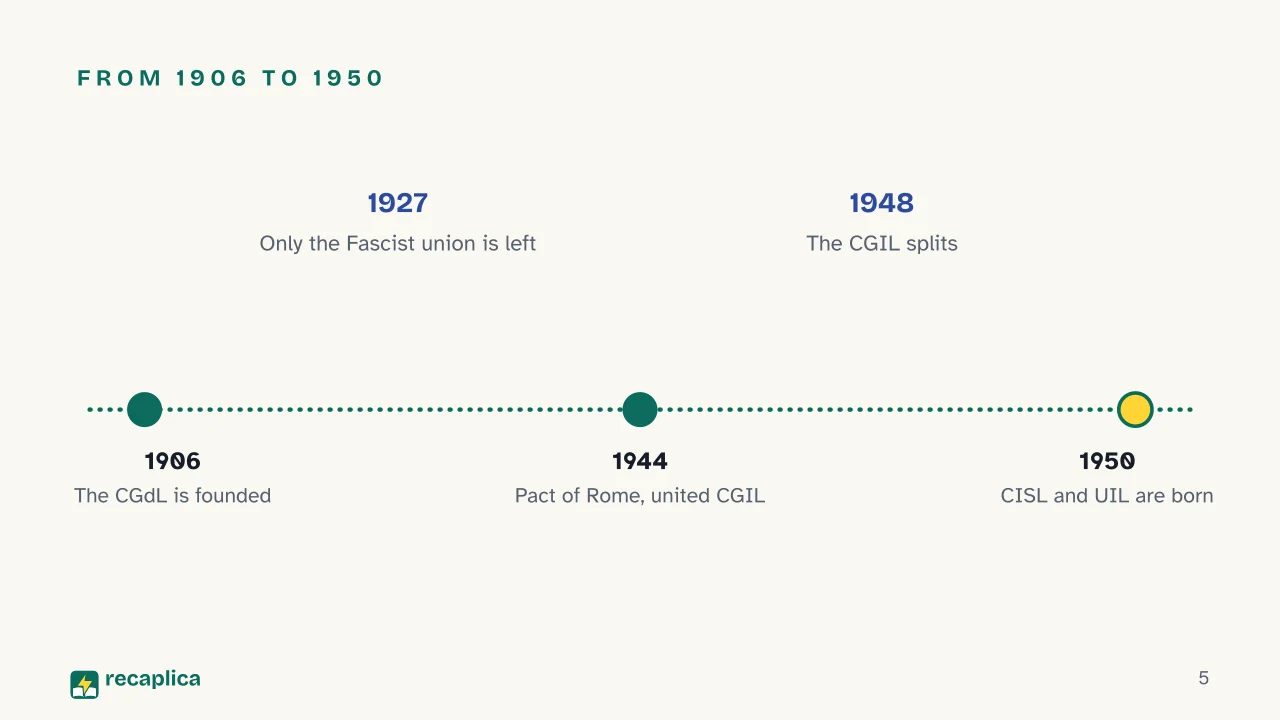  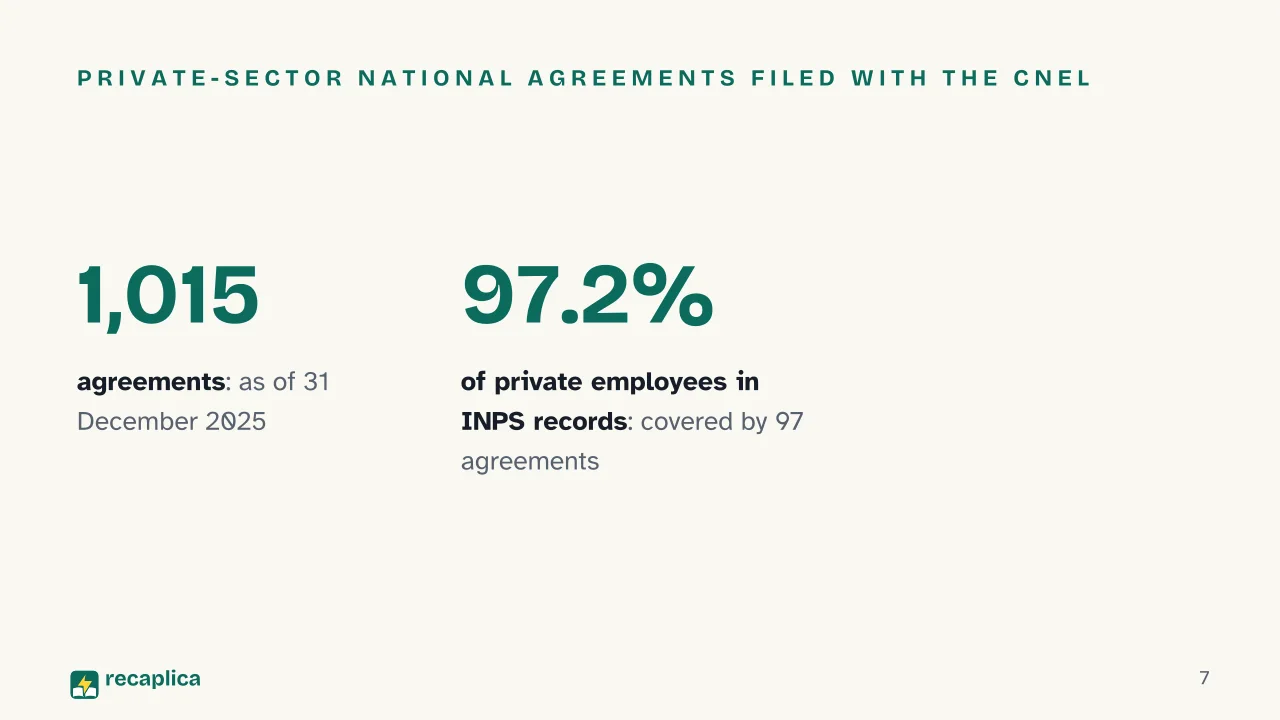 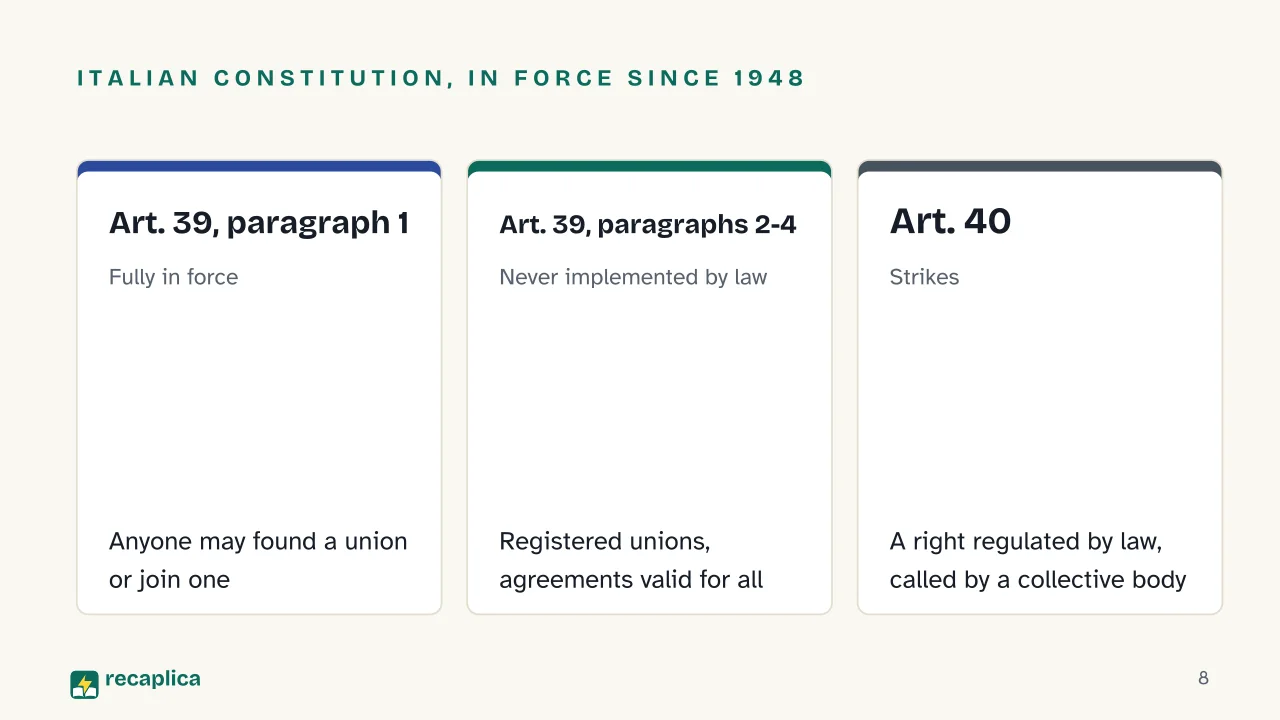  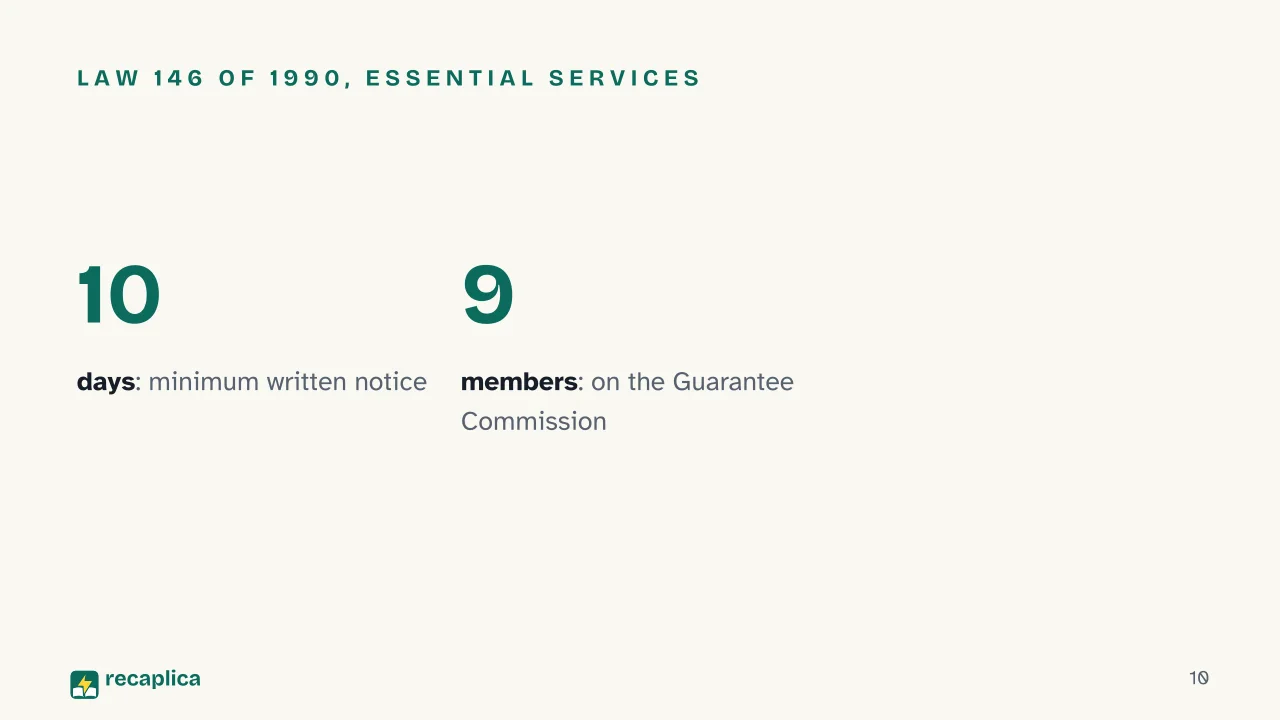  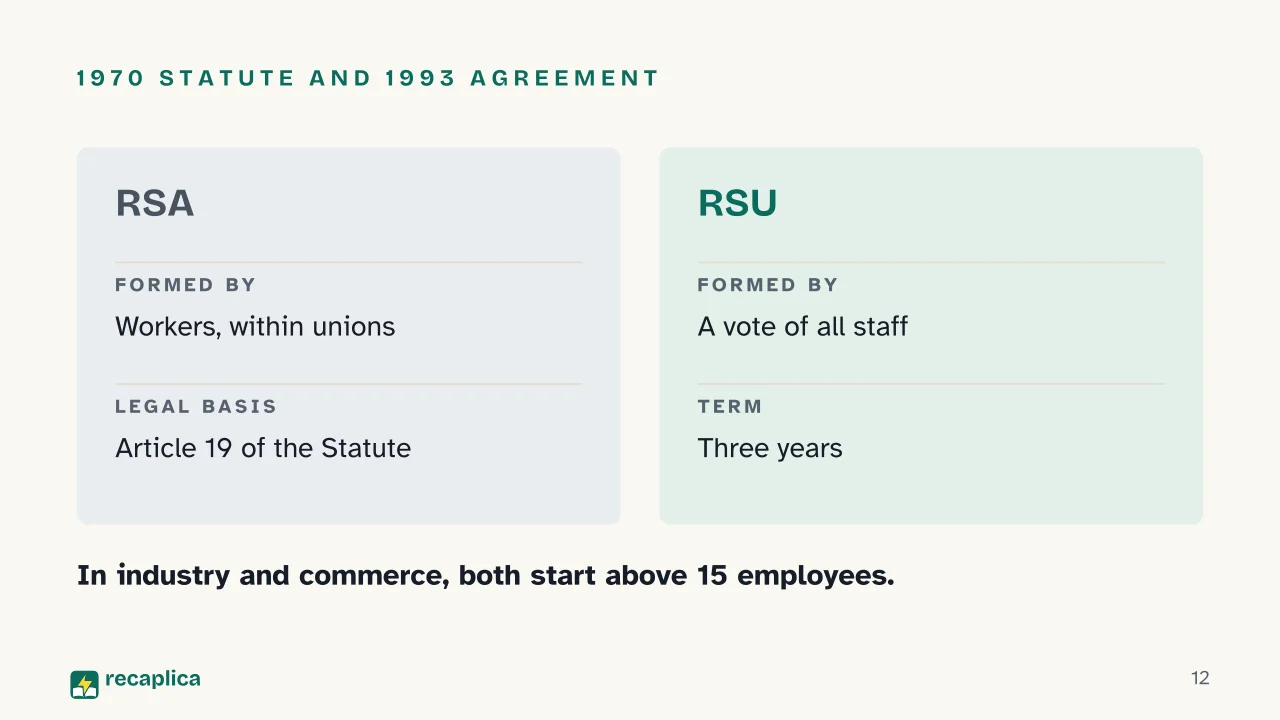 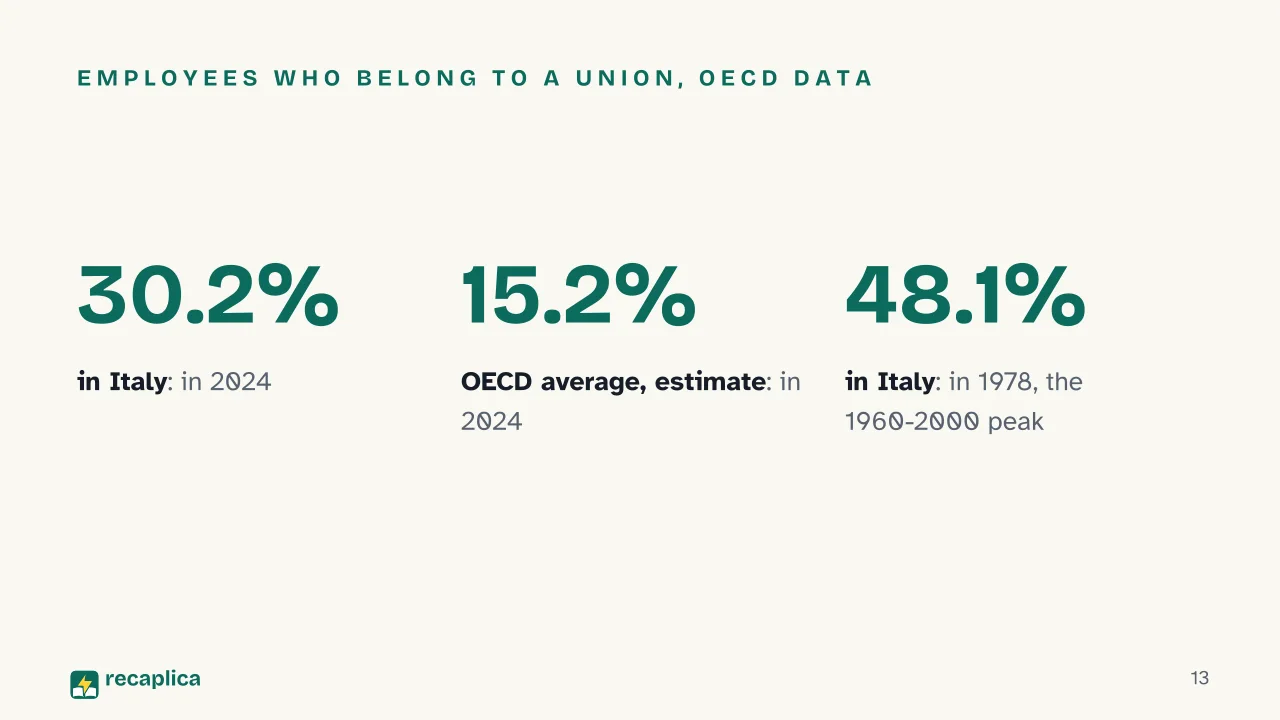 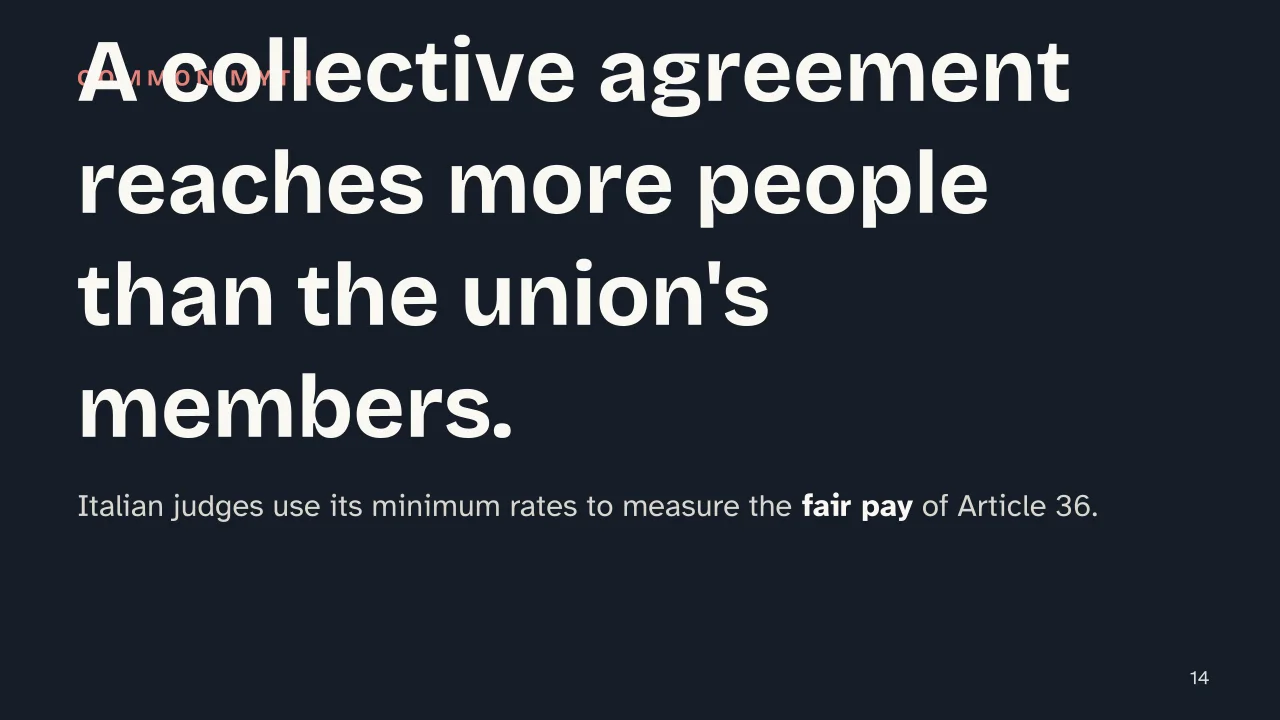 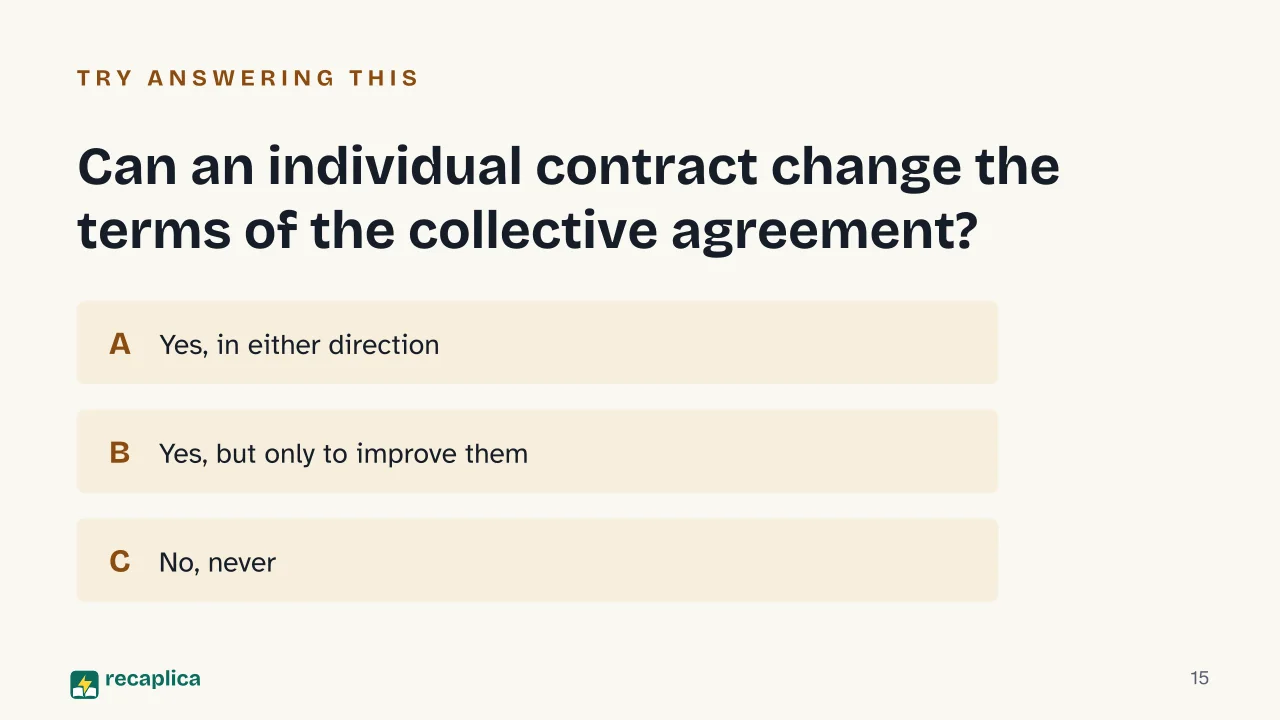  Common myths
Mind mapDrag the background to move around and the nodes to reposition them; use − and + to collapse and expand branches. 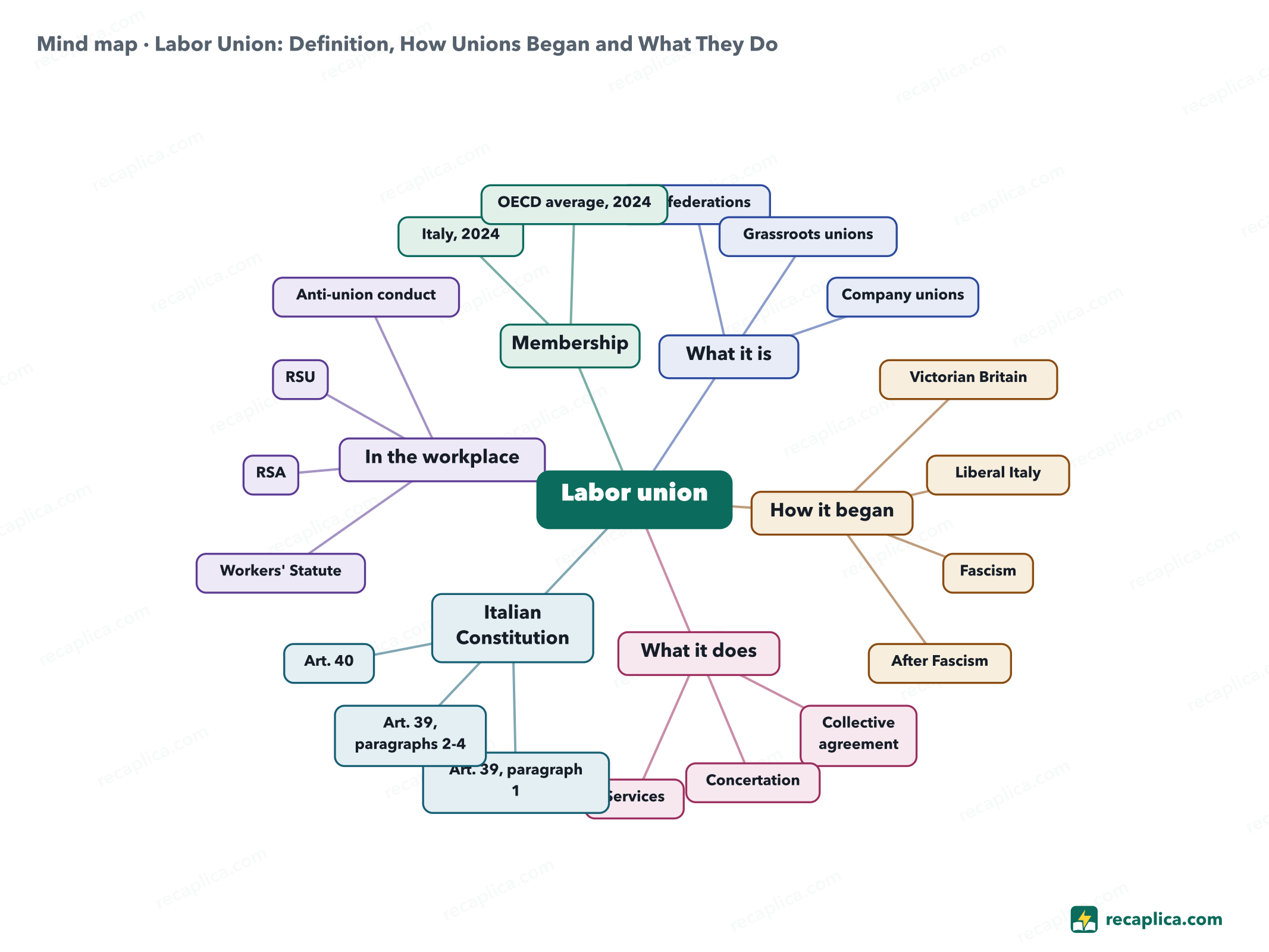
Quiz: test yourselfAnswer the questions to check what you have learned: you get instant feedback and a short explanation. Grade 0/10 0/5
FlashcardsTap the card to flip it and check whether you remember the answer, then move to the next one. 1 / 7 Explain it in your own wordsThe ultimate test: if you can explain it in simple words, you've truly understood it. Write your explanation, then compare it with the Recap. Your explanation is saved only on this device.
Frequently asked questionsHow do unions work?Mostly through bargaining with employers. The talks produce collective agreements on pay and working conditions, and if they break down a union can call a strike. In Italy unions also discuss economic and social policy with the government and the regions, and their local offices help individuals with tax returns and pension paperwork. What is the difference between an RSA and an RSU in Italy?An RSA is a company-level union body provided for by Article 19 of the Workers' Statute, formed within the unions linked to the collective agreements applied in the company. An RSU comes from a 1993 agreement, later taken up by the 2014 Consolidated Act on Representation, and is elected by all employees by secret ballot. In industry and commerce, both require a unit with more than 15 employees, and their members have the same paid leave and protections. Does a collective agreement apply to workers who are not union members?In Italy it binds the members of the signing organizations, because Article 39 of the Constitution, which would have made it valid for everyone, has never been implemented. Its rules reach other workers through the courts: judges use the minimum rates to decide what counts as fair pay under Article 36. For 2024 the OECD estimates that 100% of Italian employees with bargaining rights were covered by an agreement. What does Article 39 of the Italian Constitution say?Its first paragraph declares that union organization is free. The following paragraphs provide for unions to register with public offices, with democratic statutes, to become legal persons and to sign joint agreements valid for every worker in the sector. A law putting those paragraphs into effect has never been passed. Every Recap goes through an independent review before publication. |