|
recaplica
Mass Media: What They Are |
| © 2026 Recaplica · recaplica.com — All rights reserved |
Mass Media: What They AreWhat to print Page numbers appear when printing with default margins. SlidesChoose a cut Flash10 slidesThe essential thread, to present in classFull14 slidesEvery chapter and the deeper detailBoth come with speaker notes. In 30 seconds quick readMass society is a type of society where ordinary people carry real weight in political and social life, but at a cost: more conformity, less individual autonomy, greater exposure to manipulation. The Treccani encyclopedia places its rise between the late 19th and early 20th century, when population growth, urbanization, mass schooling, wider voting rights and industrial organization converge. Mass media, radio and film first, then satellites and the internet, make it possible on a scale never seen before. The Frankfurt School and Ortega y Gasset turned it into an object of criticism, from two different angles: a culture industry that standardizes, and a mass man who blends into the average. Key Points
Key figures
Deep DiveA definition with a price tagAccording to Treccani, in mass society ordinary people come to carry real weight in public and political life. That weight has a cost, a growing conformity: less individual autonomy, more exposure to manipulation. The entry places the rise of the phenomenon between the late 19th and early 20th century, pointing to a precise precedent: in 1895 Gustave Le Bon publishes The Crowd. Working out who shapes public opinion, and with what tools, is also the job of media literacy: telling a credible source apart from propaganda grows directly out of the questions this phenomenon raises. A convergence of causesTreccani is clear that mass society does not come from a single factor. Population growth, urbanization, the spread of schooling, wider voting rights and Taylorist-Fordist industrial organization are concurrent, intertwined factors. Mass schooling in particular also changes how people learn to live within a group, a process that starts in childhood and is covered in full in the Recap on socialization.
When radio and film go massTreccani’s entry on mass communication theory, from the History of European Civilization edited by Umberto Eco, traces a precise timeline. Radio and film spread in the 1920s. Satellites and the internet arrive much later, in the 1990s. In between lies a century of media that, according to the entry, are institutions involved in producing, reproducing and distributing knowledge within society: they give meaning to people’s experience of the world, shaping the perception of whoever watches and listens. Who uses the mass mediaTreccani cites the use of film and radio by the Nazi and fascist regimes as a historical example of how they were put to work within mass society, in the period between the two world wars. A regime that controls the media also controls how millions of people see themselves and their own place in society, a dynamic the Recap on the Mussolini myth traces in detail for the Italian case. The same entry links the spread of mass media more broadly, the press and television in particular, to a higher risk of manipulating public opinion and collective behavior. From the hypodermic needle to what people do with the mediaResearch into media effects has shifted its question over time. The hypodermic needle theory, also known as the bullet theory, pictured every member of the audience struck directly and personally by the message, an audience of isolated individuals, easy to sway one by one. Paul Lazarsfeld proposed a different model, the two-step flow: media do not speak straight to the audience but pass through the selection and mediation of so-called opinion leaders. Later, the functionalist view, known as the uses and gratifications approach, shifted the research question again: no longer what media do to people, but what people do with media. The Frankfurt School’s culture industryMax Horkheimer lays out the Frankfurt School’s research program in his 1931 inaugural address as director of the Institute for Social Research in Frankfurt. Together with Theodor Adorno he writes Dialectic of Enlightenment, a text that begins circulating in 1944 and is published in 1947. The two authors prefer the term “culture industry” to “mass culture” for a precise reason: that culture, according to their analysis as reported by the Stanford Encyclopedia of Philosophy, does not grow spontaneously out of the masses themselves. Film, radio and magazines are produced with the same standardized, profit-driven methods as any industrial output; the technical rationality behind that production becomes, in their reading, a form of domination over individuals. In a 1967 text, Adorno goes so far as to say that the products of the culture industry are not merely commodities “too”: they are commodities through and through, entirely equivalent to consumer goods. From this reading follows the claim that entertainment replaces direct experience, dulls the audience’s critical capacity, and leads it to accept the status quo. Ortega y Gasset’s mass manJosé Ortega y Gasset is born and dies in Madrid, in 1883 and 1955. A professor of metaphysics at the University of Madrid from 1910 to 1936, he publishes The Revolt of the Masses (in the original, La rebelión de las masas) in 1930. In the book he subjects Western society to a sharp critique: the masses, he writes, have taken over the role once held by cultural elites. A precise distinction matters here, one that is often misread: for Ortega y Gasset, masses does not mean the working class but the average man, the person who does not stand out from others and simply repeats the generic type. It is on this same axis, who holds a distinct place in society and who blends into the average, that the Recap on social status and role also moves. The mass man Ortega y Gasset describes is an inert, conformist figure, with no far-reaching ambitions and no capacity to question things. Slide deckSlides ready to download and make your own in PowerPoint or Google Slides, with speaker notes. Pick the Flash cut or the Full one.     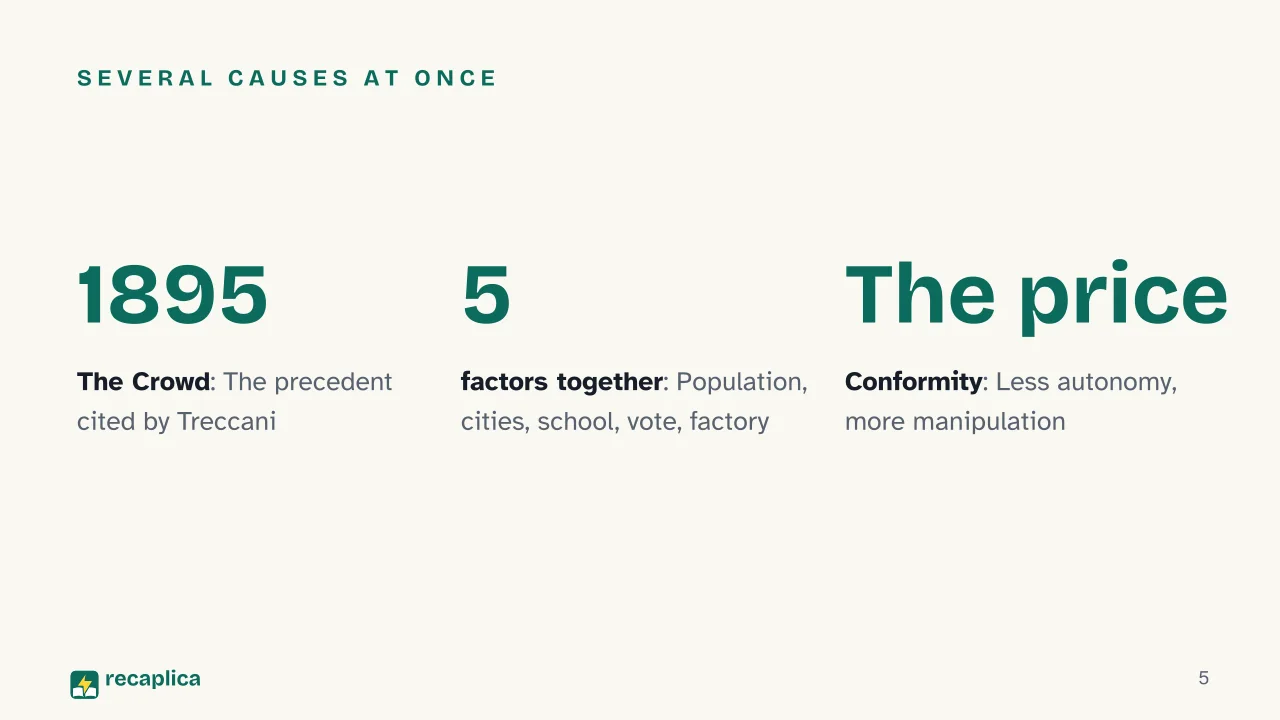  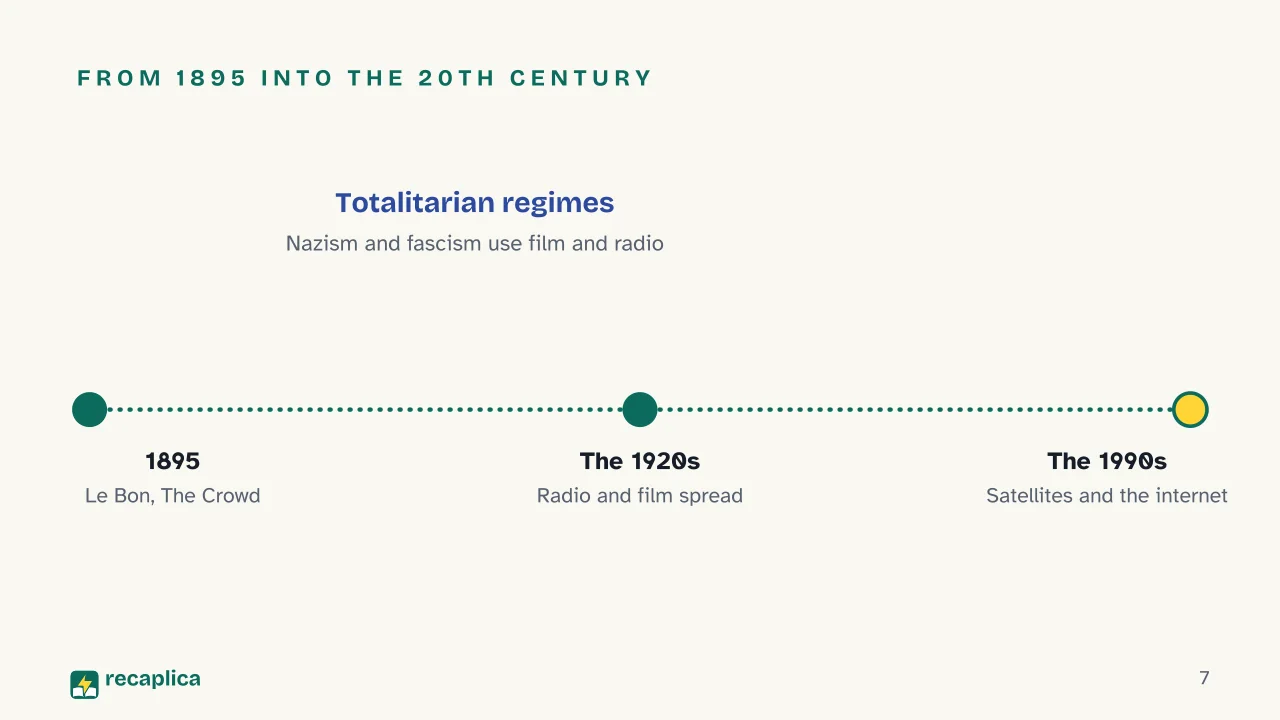  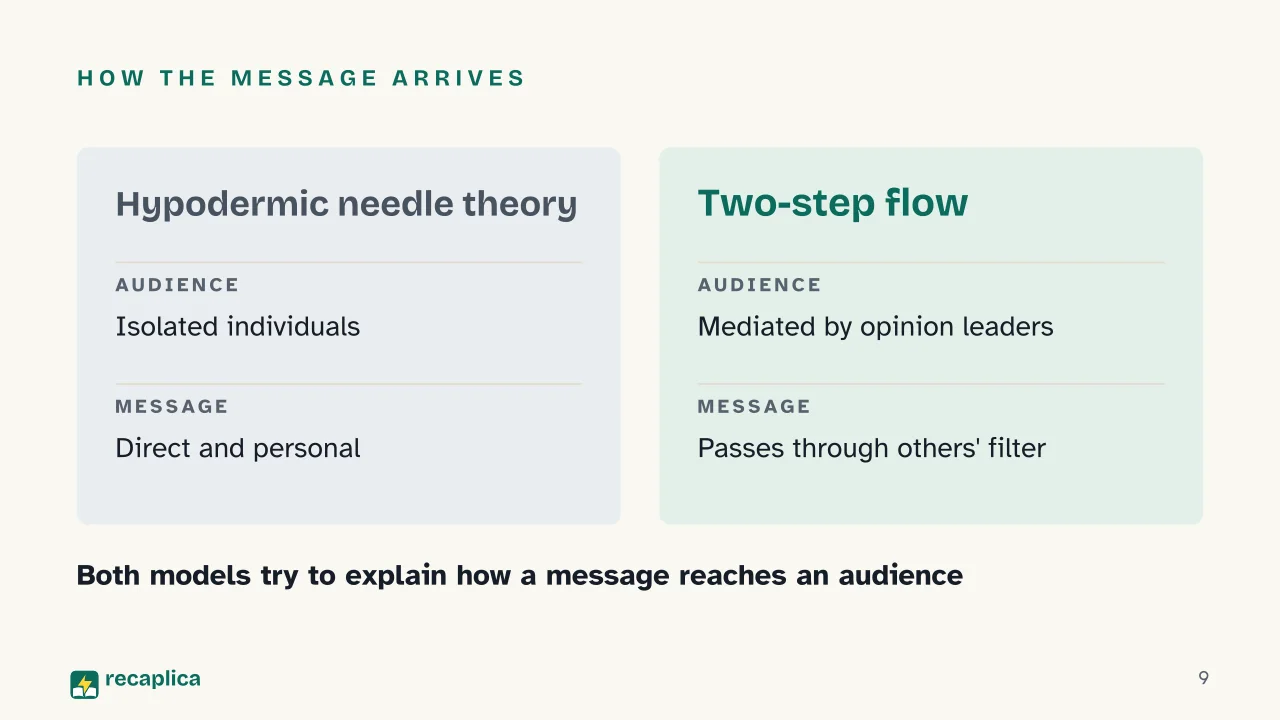  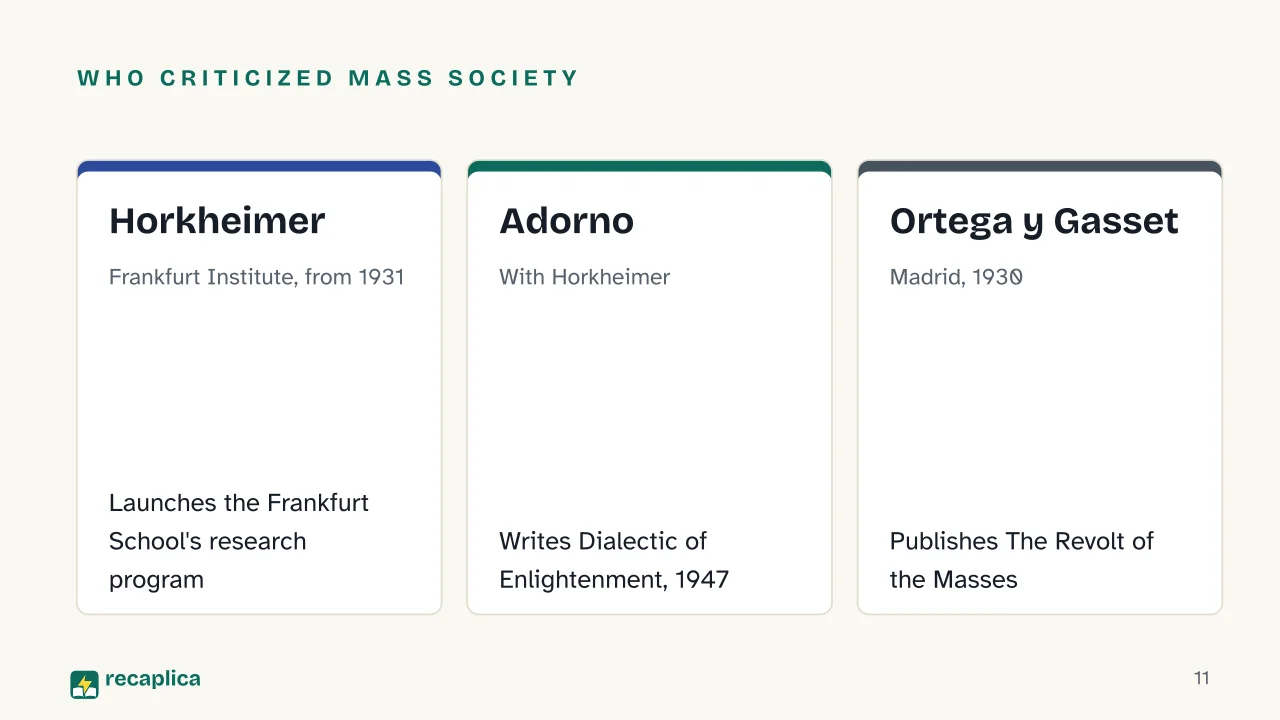 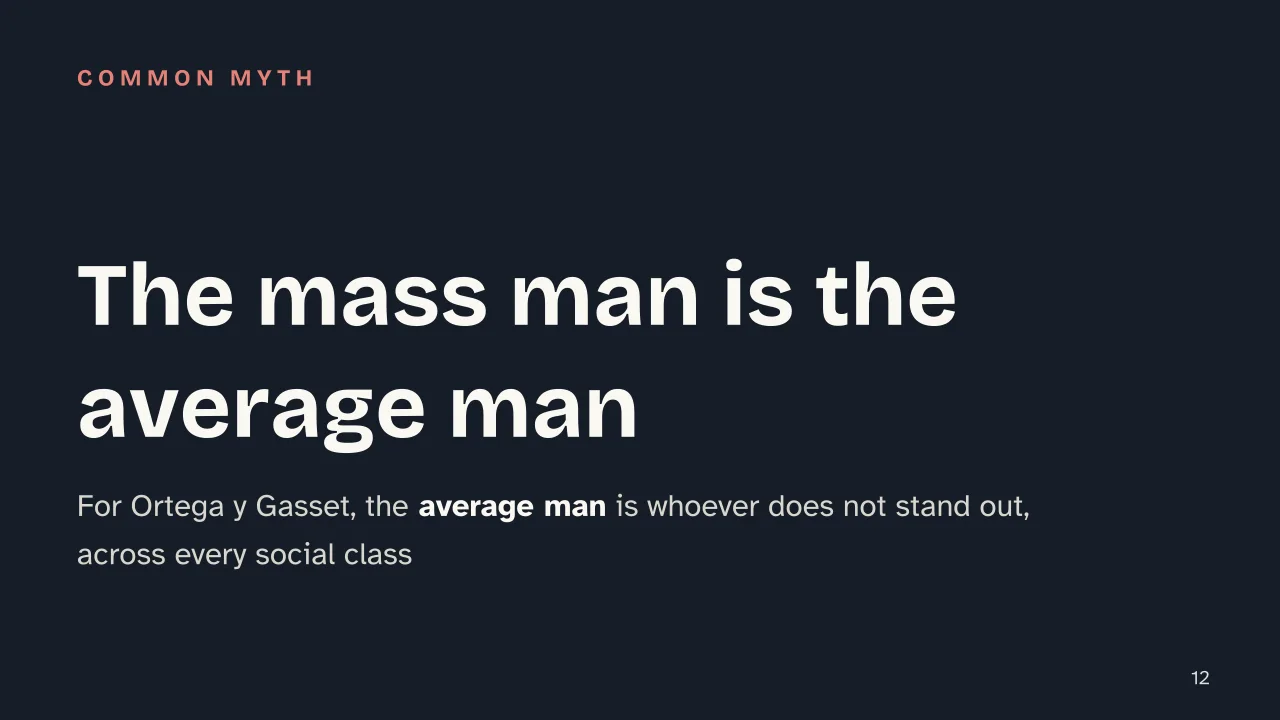 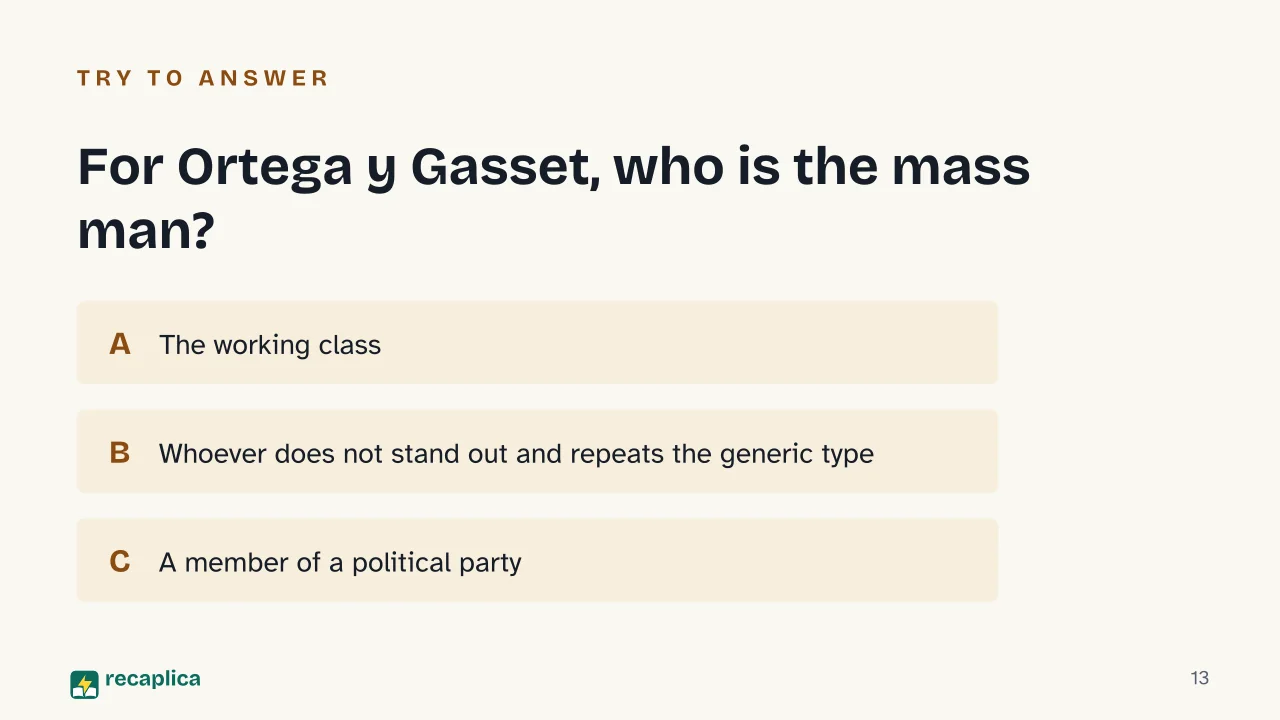  Common myths
Mind mapDrag the background to move around and the nodes to reposition them; use − and + to collapse and expand branches. 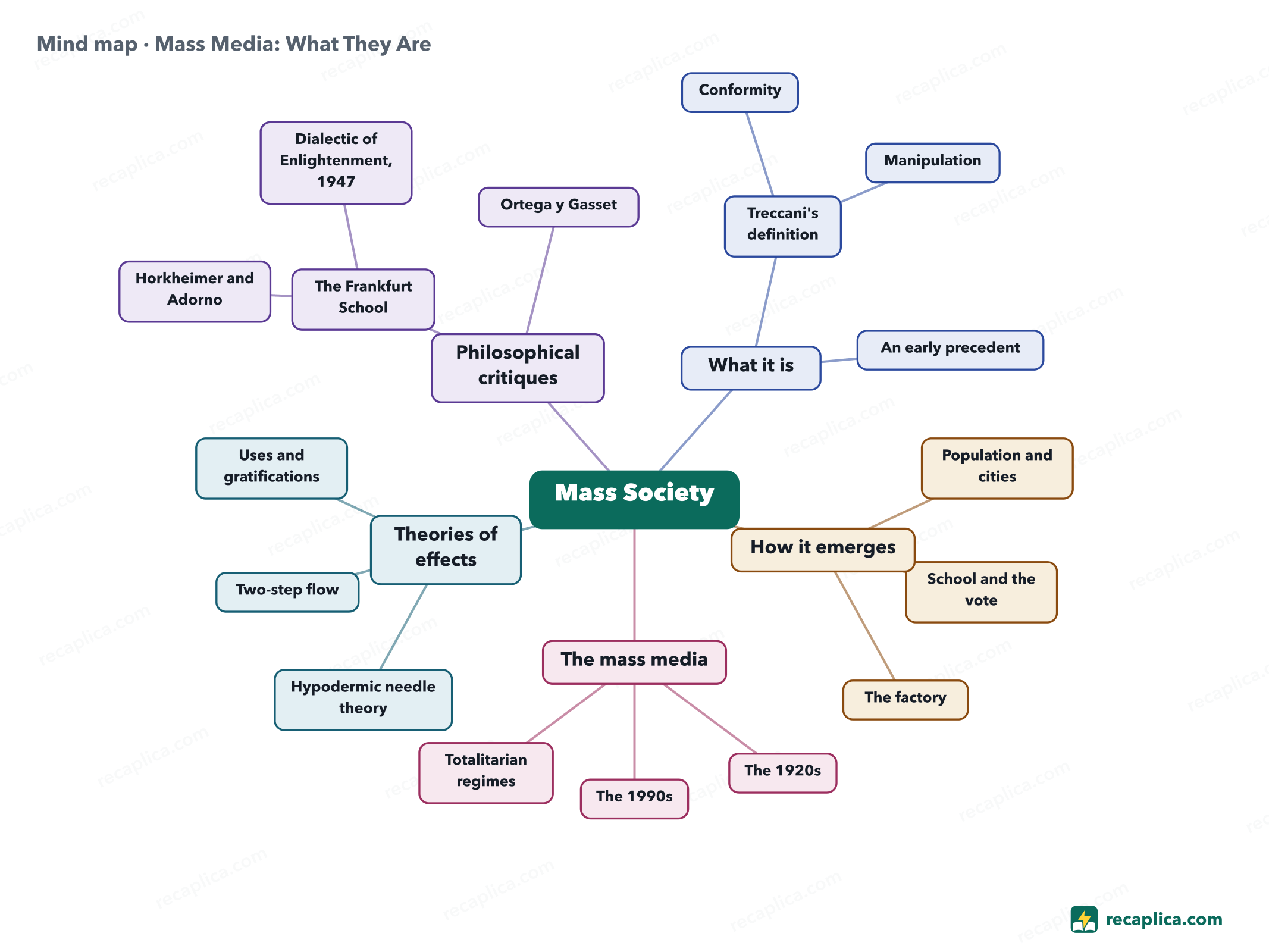
Quiz: test yourselfAnswer the questions to check what you have learned: you get instant feedback and a short explanation. Grade 0/10 0/5
FlashcardsTap the card to flip it and check whether you remember the answer, then move to the next one. 1 / 7 Explain it in your own wordsThe ultimate test: if you can explain it in simple words, you've truly understood it. Write your explanation, then compare it with the Recap. Your explanation is saved only on this device.
Frequently asked questionsWhat is the difference between mass society and pre-industrial society?In pre-industrial society, ordinary people carry little weight in public life; they become central, according to Treccani, once a larger population, growing cities, widespread schooling, broader voting rights and factories organized on Taylorist-Fordist lines add up together, between the late 19th and early 20th century. Does masses mean working class in Ortega y Gasset?No. Ortega y Gasset uses masses to mean the average man, whoever repeats the generic type instead of standing out: the concept cuts across every social class without tying to any one economic category. What is the difference between mass culture and culture industry?Adorno and Horkheimer pick two different words on purpose: they prefer culture industry to mass culture because that output follows the same rules as any industry, designed for profit rather than to express the masses themselves. What are the main theories about the effects of mass media?Three different moments in effects research: first the hypodermic needle theory, which pictures the audience as isolated individuals struck one by one; then Lazarsfeld's model, where the message passes through opinion leaders before reaching people; finally the functionalist view, the uses and gratifications approach, which focuses on how people actually use the media. Every Recap goes through an independent review before publication. |