Skip to content
recaplica

    One moment: security check

    Cloudflare wants to make sure you're not a robot. Tick the box below and your search will continue on its own.

    IT
    recaplica EU Charter of Fundamental Rights: What It Is and What It Protects
    © 2026 Recaplica · recaplica.com — All rights reserved
    Home › Civics

    EU Charter of Fundamental Rights: What It Is and What It Protects

    By Recaplica Newsroom · Updated on September 27, 2026

    What to print

    Page numbers appear when printing with default margins.

    Slides

    Choose a cut

    Flash10 slidesThe essential thread, to present in classFull16 slidesEvery chapter and the deeper detail

    Both come with speaker notes.

    Telegram channel
    recaplica Clear in 30 seconds, yours in 10 minutes.
    In 30 seconds Key points Figures Deep dive Slides Myths Mind map Quiz Flashcards FAQ

    In 30 seconds quick read

    The Charter of Fundamental Rights of the European Union, often called the Nice Charter for the city where it was signed, brings civil, political, economic and social rights together in a single text for anyone living in the EU. It was proclaimed on 7 December 2000, but only gained legal force on 1 December 2009, when the Treaty of Lisbon entered into force. The document runs to 54 articles across seven titles, from human dignity to justice. It should not be confused with the European Convention on Human Rights (ECHR), an older treaty from a different organization, or with the United Nations' Universal Declaration of Human Rights, which predates it by more than five decades.

    Key Points

    • The Charter gathers civil, political, economic and social rights in one document, covering EU citizens and anyone else living in the Union.
    • It was proclaimed in Nice on 7 December 2000 by the European Parliament, the Council and the Commission, after a mandate the European Council set at Cologne in 1999.
    • It stayed a solemn but non-binding text for nine years, until the Treaty of Lisbon gave it legal force on 1 December 2009.
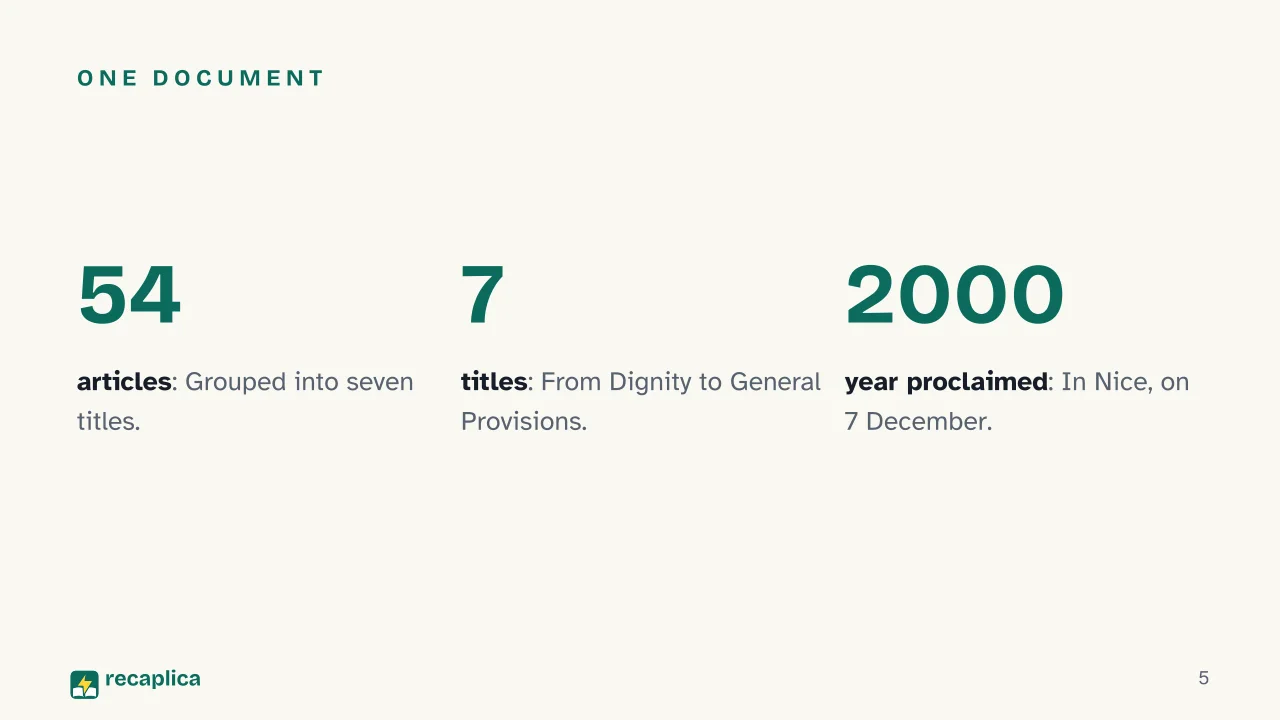
    • It has 54 articles across seven titles: Dignity, Freedoms, Equality, Solidarity, Citizens' Rights, Justice, and General Provisions.
    • It is not the European Convention on Human Rights: that treaty belongs to the Council of Europe and dates to 1950, and the EU as an institution has not joined it yet.
    • Nor is it the UN's Universal Declaration of Human Rights from 1948, a separate and earlier document.

    Key figures

    • 54 articles in the Charter of Fundamental Rights, proclaimed in Nice in 2000 Source: European Parliament
    • 2009 the year the Charter became legally binding, when the Treaty of Lisbon entered into force on 1 December Source: FRA, European Union Agency for Fundamental Rights
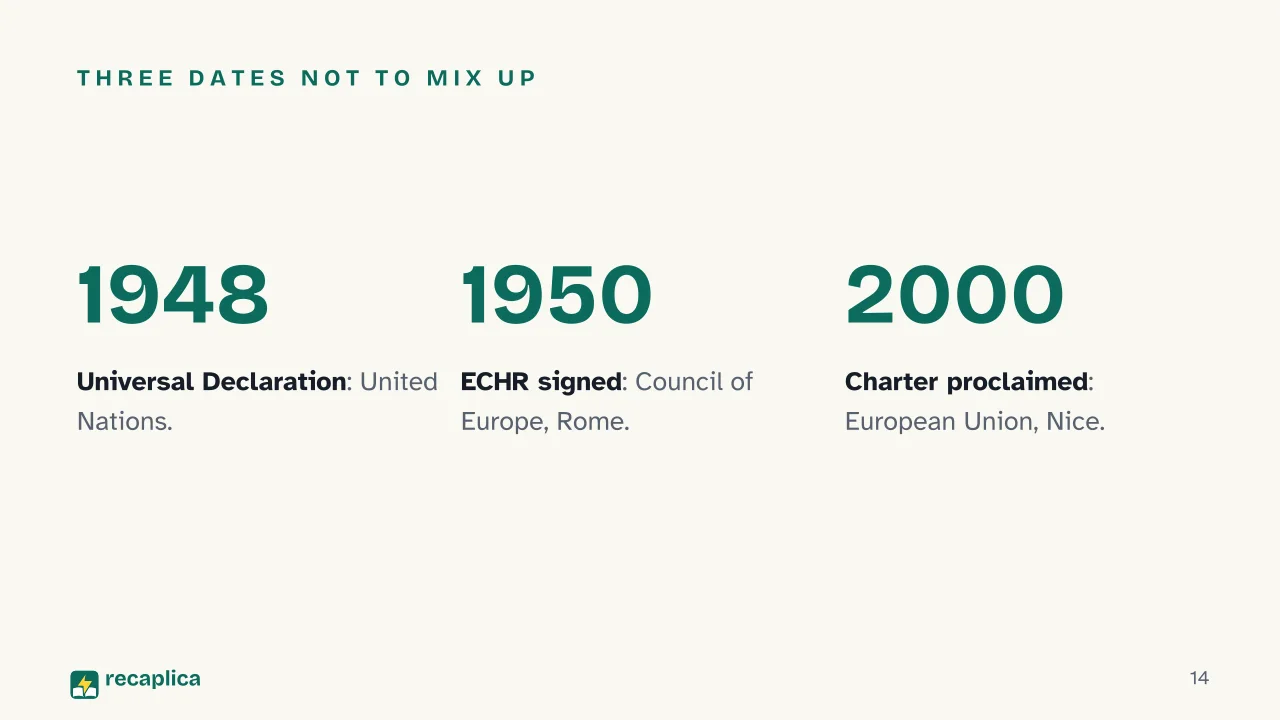
    • 1950 the year the European Convention on Human Rights (ECHR) was signed in Rome, the Council of Europe treaty often mixed up with the EU Charter Source: European Court of Human Rights

    Deep Dive

    One text, born from a 1999 mandate

    The Charter of Fundamental Rights of the European Union brings together civil, political, economic and social rights that used to be scattered across different treaties. It covers EU citizens, but also anyone else living in the Union’s territory: no member-state passport is required to be protected by its text.

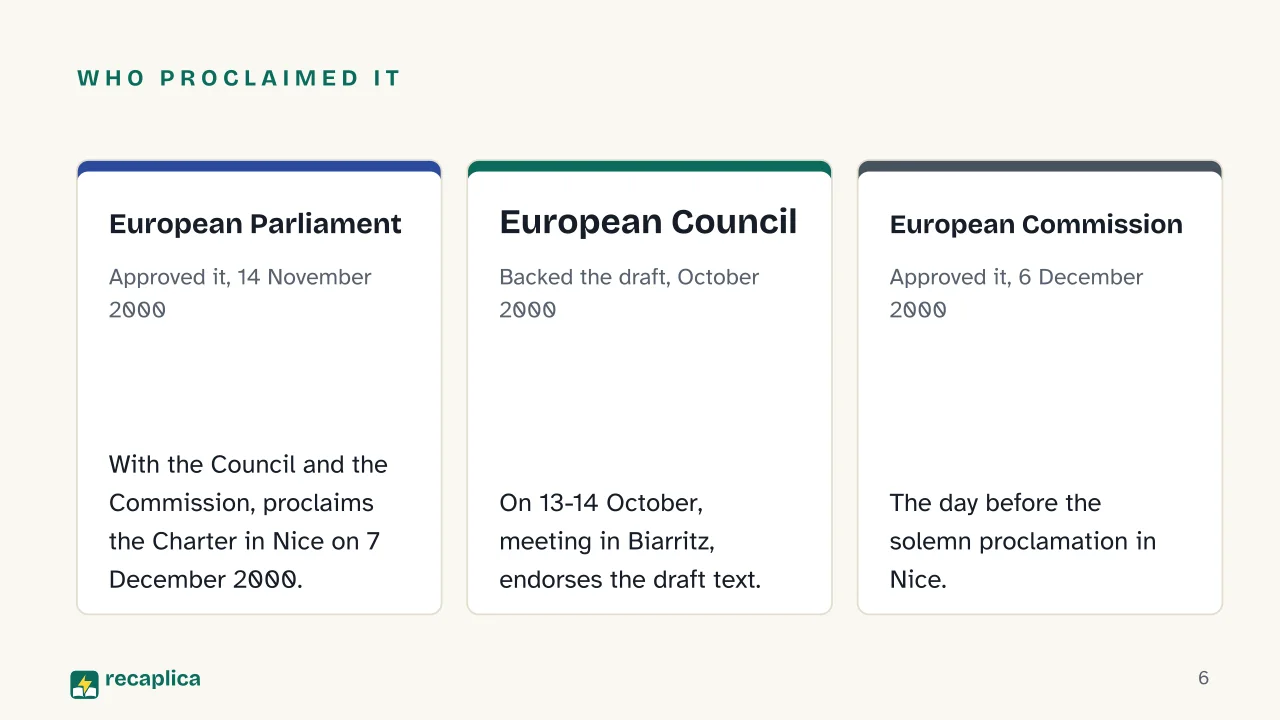
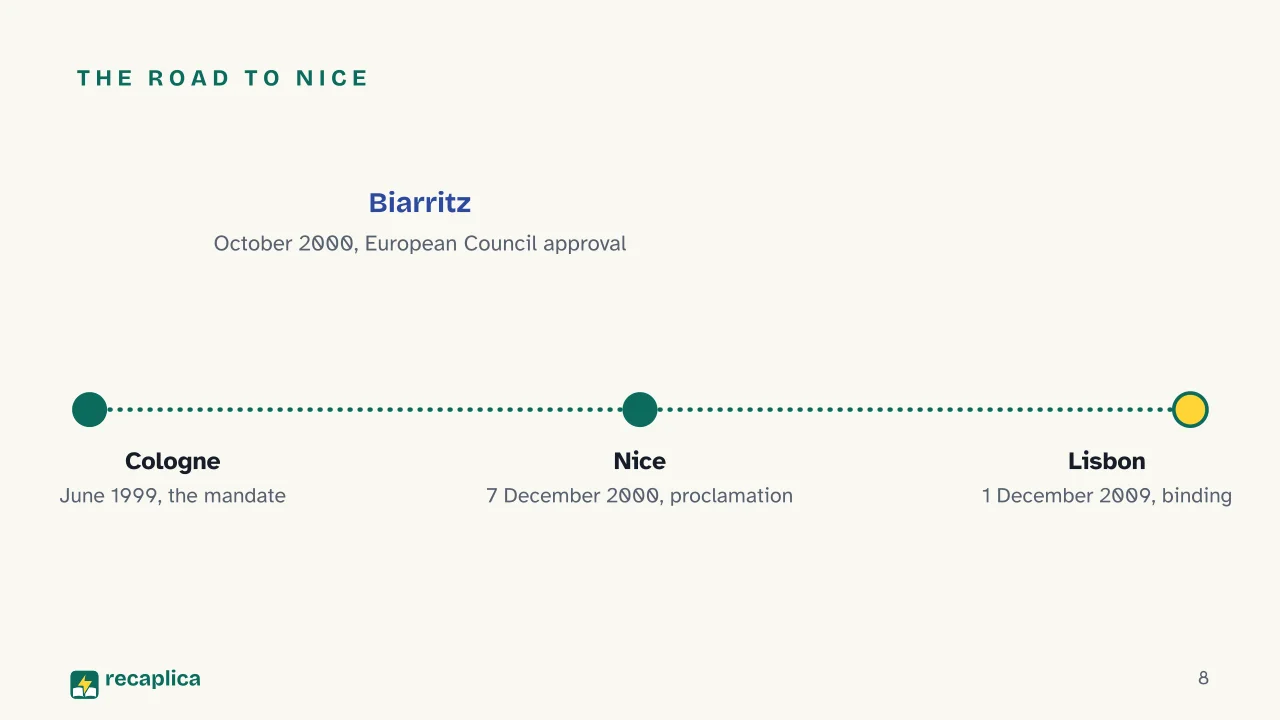
    The process starts in June 1999, when the European Council meeting in Cologne hands a Convention the task of drafting it. The work takes a year and a half: the draft text is approved on 2 October 2000, the European Council in Biarritz backs it on 13-14 October, the European Parliament approves it on 14 November, and the Commission does the same on 6 December. On 7 December 2000 the three institutions sign and solemnly proclaim the Charter in Nice — the source of the name many still use for it, the Nice Charter.

    These are the same three institutions that run the European Union day to day: how power is divided between them is explained in how the European Union works.

    Seven titles, 54 articles

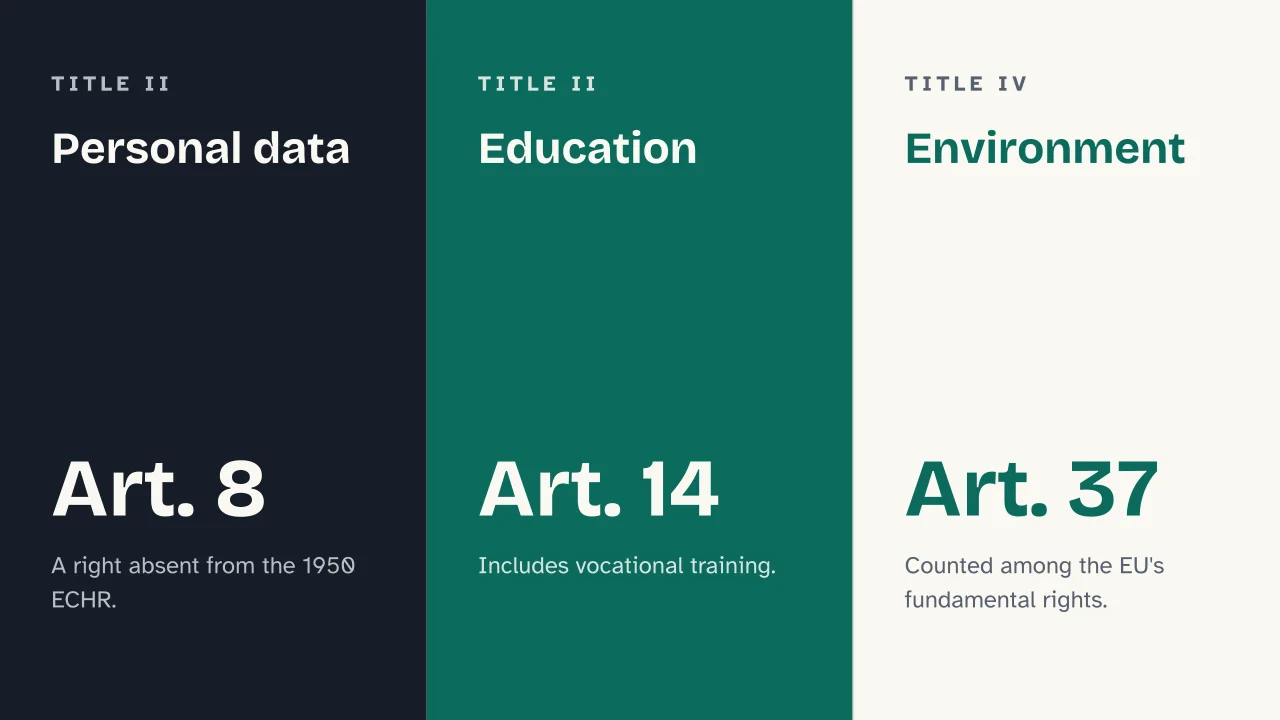
    The Charter runs to 54 articles, grouped into seven titles: Dignity, Freedoms, Equality, Solidarity, Citizens’ Rights, Justice, and a seventh title of general provisions (Articles 51-54) that governs how it applies. The first title, Dignity, opens with Article 1 on human dignity and Article 2 on the right to life; the second, Freedoms, runs through to Article 8 on the protection of personal data; the fourth, Solidarity, includes Article 35 on health protection and Article 37 on environmental protection.

    The Charter draws on the European Convention on Human Rights, on the constitutional traditions of the member states (in Italy, it’s the opening articles of the Italian Constitution that set out the founding principles), on the European Social Charter and on other international conventions.

    Real-world example: Article 8 of the Charter protects personal data. The European Convention on Human Rights, written in 1950, has no equivalent article — a right missing from the older text, useful for understanding what the Charter adds when the subject turns to mass surveillance and human rights.

    Binding only since 2009

    Proclaiming a text isn’t enough to make it law. For nine years, from 2000 to 2009, the Charter remains without binding force of its own. It’s re-proclaimed in Strasbourg in 2007, in an adapted version; the change comes with the Treaty of Lisbon, which enters into force on 1 December 2009: Article 6(1) of the Treaty on European Union has since given the Charter the same legal value as the Treaties. The Charter doesn’t become a treaty in its own right — it stays a text another treaty points to, a concrete example of what separates a binding legal norm from a political declaration.

    Nice Charter, ECHR and Universal Declaration: three different documents

    The phrase “European charter of rights” and the acronym ECHR come up together often, but they point to different documents, from two different organizations, from different eras.

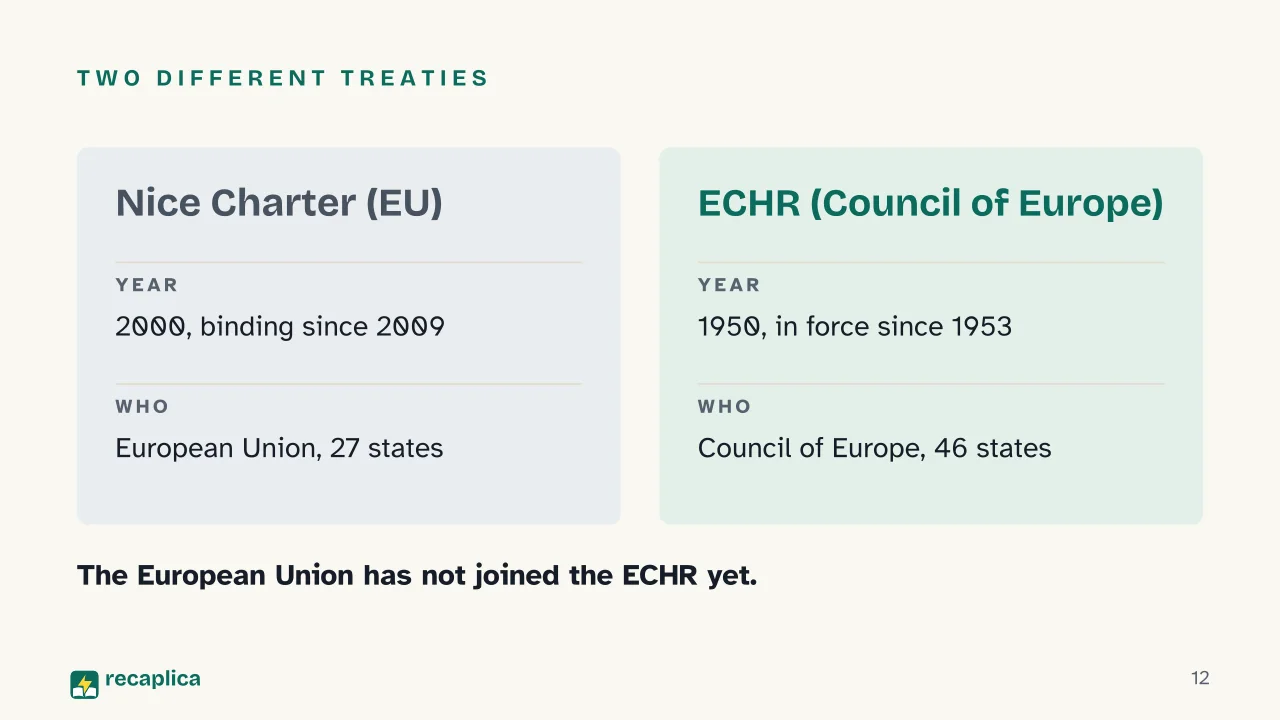
    Universal Declaration of Human RightsECHRNice Charter
    Year19481950 (signed), 1953 (in force)2000 (proclaimed), 2009 (binding)
    Adopted byUN General AssemblyCouncil of EuropeEuropean Union
    States involvedUN member states46 Council of Europe states27 EU member states
    Legal forcea declaration, not a binding treaty on its ownbinding treaty for the states that ratify itsame legal value as the EU Treaties, since 2009

    According to the official page of the European Court of Human Rights in Strasbourg, the ECHR was the first binding instrument to give legal effect to some of the rights listed in the 1948 Universal Declaration, told in full in the Recap on the Universal Declaration of Human Rights: it bridges the UN’s statement of principle and the binding treaties that followed, the Nice Charter included.

    The European Union, as an institution, has not joined the ECHR yet. Accession has been underway since 2023: the final draft agreement got preliminary approval in March 2023, and in November 2025 the European Commission asked the Court of Justice of the EU for an opinion, the last step before ratification can begin.

    The Charter and the ECHR remain two parallel instruments, not one nested inside the other. The courts that apply them, the Court of Justice of the EU and the European Court of Human Rights in Strasbourg, are also two separate bodies.

    Slide deck

    Slides ready to download and make your own in PowerPoint or Google Slides, with speaker notes. Pick the Flash cut or the Full one.
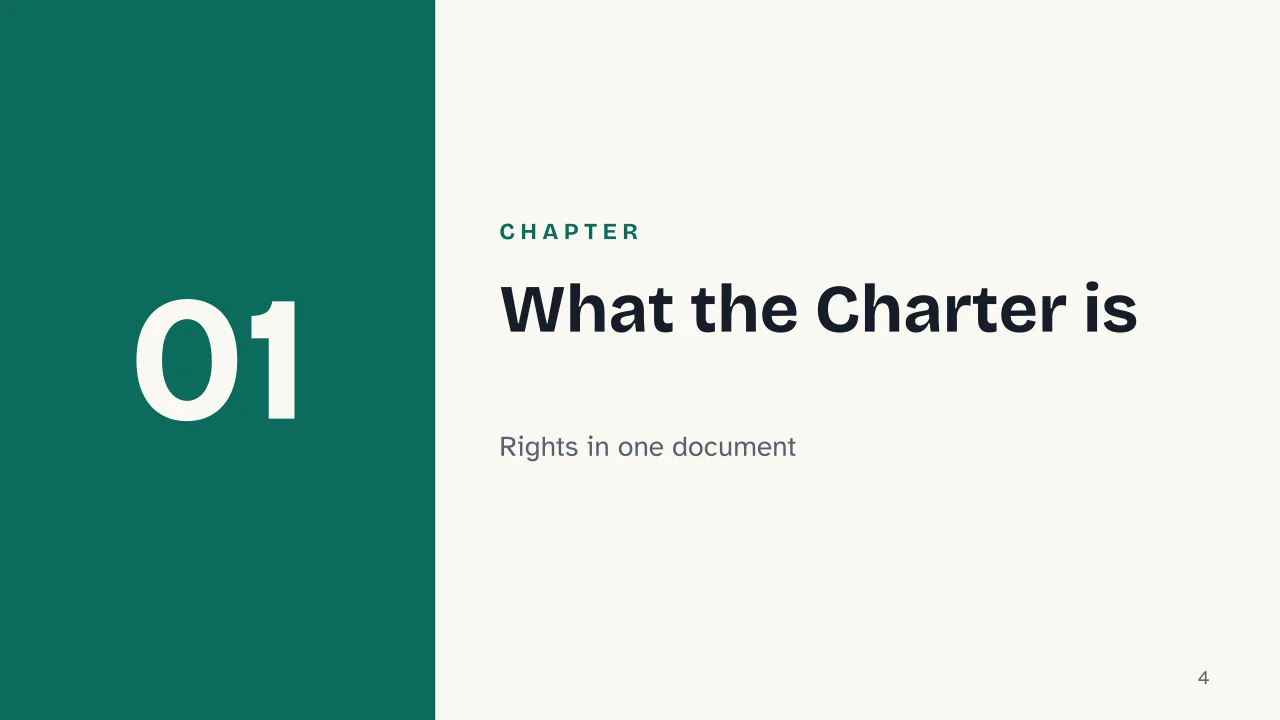
    Slide 1 of the presentation on EU Charter of Fundamental Rights: EU Charter of Fundamental RightsSlide 2 of the presentation on EU Charter of Fundamental Rights: Is the Nice Charter the same as the ECHR?Slide 3 of the presentation on EU Charter of Fundamental Rights: What's aheadSlide 4 of the presentation on EU Charter of Fundamental Rights: Chapter 01: What the Charter isSlide 5 of the presentation on EU Charter of Fundamental Rights: One documentSlide 6 of the presentation on EU Charter of Fundamental Rights: Who proclaimed it: European Parliament, European Council, European CommissionSlide 7 of the presentation on EU Charter of Fundamental Rights: Chapter 02: How it came aboutSlide 8 of the presentation on EU Charter of Fundamental Rights: The road to NiceSlide 9 of the presentation on EU Charter of Fundamental Rights: Chapter 03: What it coversSlide 10 of the presentation on EU Charter of Fundamental Rights: Personal data · Education · EnvironmentSlide 11 of the presentation on EU Charter of Fundamental Rights: Chapter 04: Why it isn't the ECHRSlide 12 of the presentation on EU Charter of Fundamental Rights: Two different treatiesSlide 13 of the presentation on EU Charter of Fundamental Rights: The Nice Charter and the ECHR are not the same treaty.Slide 14 of the presentation on EU Charter of Fundamental Rights: Three dates not to mix upSlide 15 of the presentation on EU Charter of Fundamental Rights: Which organization adopted the ECHR?Slide 16 of the presentation on EU Charter of Fundamental Rights: Read more
    Flash10 slidesThe essential thread, to present in classFull16 slidesEvery chapter and the deeper detail

    Common myths

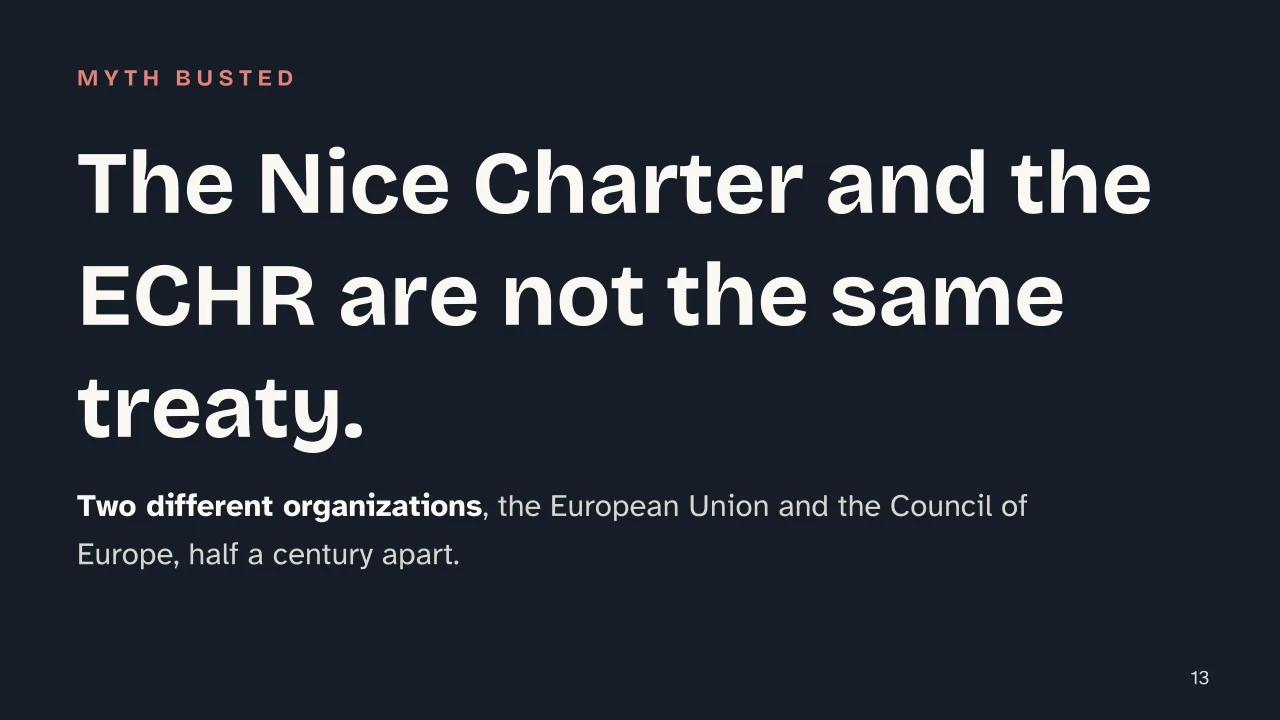
    • ✗ Myth A common assumption is that the EU Charter of Fundamental Rights and the European Convention on Human Rights are the same document.

      ✓ Reality They are two separate treaties from two separate organizations. The Charter belongs to the European Union, proclaimed in 2000 and binding since 2009; the ECHR belongs to the Council of Europe, which counts 46 member states rather than the EU's 27, and was signed in Rome in 1950. The EU itself has not joined the ECHR yet — accession talks have been underway since 2023.

    • ✗ Myth Some treat the Nice Charter as just another name for the UN's Universal Declaration of Human Rights.

      ✓ Reality The two texts come from different organizations, 52 years apart. The Universal Declaration dates to 1948 and is a United Nations act; the Nice Charter was drafted in 2000 as the European Union's own document, through its own procedure and approval process.

    • ✗ Myth It's easy to assume the Charter became law the moment it was proclaimed in Nice in 2000.

      ✓ Reality The 2000 proclamation didn't give the text legal force. That happened only on 1 December 2009, when the Treaty of Lisbon entered into force: Article 6 of the Treaty on European Union has given the Charter the same legal value as the Treaties ever since.

    Mind map

    Drag the background to move around and the nodes to reposition them; use − and + to collapse and expand branches.
    Customize
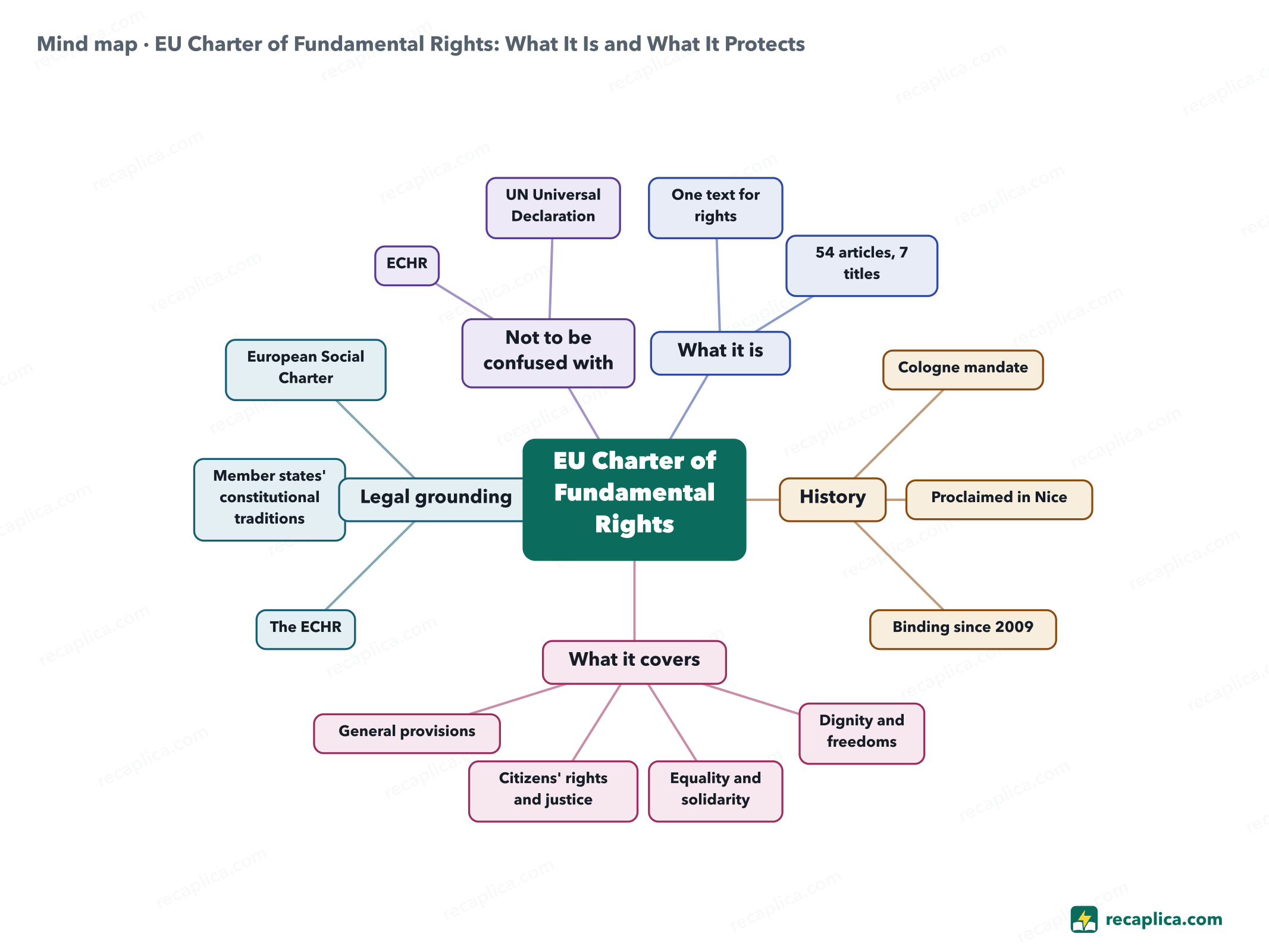
    Mind map: EU Charter of Fundamental Rights: What It Is and What It Protects
    • EU Charter of Fundamental Rights
      • What it is
        • One text for rights Civil, political, economic and social, in a single document
        • 54 articles, 7 titles
      • History
        • Cologne mandate European Council, June 1999
        • Proclaimed in Nice 7 December 2000
        • Binding since 2009 Treaty of Lisbon enters into force
      • What it covers
        • Dignity and freedoms Life, personal integrity, data protection
        • Equality and solidarity Children's rights, health protection
        • Citizens' rights and justice
        • General provisions Articles 51-54, govern how the Charter applies
      • Legal grounding
        • The ECHR
        • Member states' constitutional traditions
        • European Social Charter
      • Not to be confused with
        • ECHR Council of Europe, 1950
        • UN Universal Declaration United Nations, 1948

    Quiz: test yourself

    Answer the questions to check what you have learned: you get instant feedback and a short explanation.

    Grade 0/10 0/5
    1 In what year was the Charter of Fundamental Rights of the European Union proclaimed in Nice?

    The Charter was proclaimed in Nice on 7 December 2000, closing a process that had started the year before with the mandate the European Council set at Cologne.

    2 When did the Charter become legally binding?

    For nine years the Charter remained a solemn text without binding force of its own. It became legally binding only on 1 December 2009, when the Treaty of Lisbon entered into force.

    3 How many articles make up the EU Charter of Fundamental Rights?

    The Charter has 54 articles, organized into seven titles: Dignity, Freedoms, Equality, Solidarity, Citizens' Rights, Justice, and General Provisions.

    4 True or false: the EU Charter of Fundamental Rights and the European Convention on Human Rights are the same document.

    False: they are two separate treaties from two different organizations. The ECHR belongs to the Council of Europe and dates to 1950; the Charter belongs to the European Union and dates to 2000. The EU itself has not joined the ECHR yet.

    5 Which organization adopted the European Convention on Human Rights?

    The ECHR is a Council of Europe treaty, signed in Rome on 4 November 1950 — a different organization from the European Union, with 46 member states against the EU's 27.

    Answers: 1-B · 2-C · 3-C · 4-B · 5-B

    Flashcards

    Tap the card to flip it and check whether you remember the answer, then move to the next one.

    1 / 8

    Explain it in your own words

    The ultimate test: if you can explain it in simple words, you've truly understood it. Write your explanation, then compare it with the Recap.

    Your explanation is saved only on this device.

    The Charter of Fundamental Rights of the European Union, often called the Nice Charter for the city where it was signed, brings civil, political, economic and social rights together in a single text for anyone living in the EU. It was proclaimed on 7 December 2000, but only gained legal force on 1 December 2009, when the Treaty of Lisbon entered into force. The document runs to 54 articles across seven titles, from human dignity to justice. It should not be confused with the European Convention on Human Rights (ECHR), an older treaty from a different organization, or with the United Nations' Universal Declaration of Human Rights, which predates it by more than five decades.

    Frequently asked questions

    Is the EU Charter of Fundamental Rights the same as the ECHR?

    No. They are two separate treaties: the Charter belongs to the European Union (27 states), proclaimed in 2000 and binding since 2009; the European Convention on Human Rights (ECHR) belongs to the Council of Europe (46 states), signed in Rome in 1950. The EU as an institution has not joined the ECHR yet — accession has been underway since 2023.

    How does the Nice Charter relate to the UN's Universal Declaration of Human Rights?

    There's no direct line between them: they're two texts from two different organizations, 52 years apart. The Universal Declaration, from 1948, is a United Nations act; the Nice Charter was drafted in 2000 as the European Union's own document.

    Why is it also called the Nice Charter?

    Because it was proclaimed in Nice on 7 December 2000, by the European Parliament, the Council and the European Commission.

    What rights does the EU Charter of Fundamental Rights set out?

    Civil, political, economic and social rights, grouped into seven titles — Dignity, Freedoms, Equality, Solidarity, Citizens' Rights, Justice, and General Provisions — covering everything from personal data protection (Article 8) to environmental protection (Article 37).

    Does the Charter apply to people who aren't citizens of an EU member state?

    Yes: the Charter covers both EU citizens and anyone else living in the territory of the Union, not just nationals of a member state.

    Sources

    • European Parliament, Fundamental rights (history and text of the EU Charter of Fundamental Rights)
    • FRA, European Union Agency for Fundamental Rights, EU Charter and Charter resources
    • FRA, What does the EU accession to the European Convention on Human Rights mean in theory and practice?
    • European Court of Human Rights, European Convention on Human Rights
    • Legislation.gov.uk, consolidated text of the Treaty on European Union, Article 6 (ex Article 6 TEU)

    Every Recap goes through an independent review before publication.

    Every evening, the day's new Recaps on our Telegram channel. Join the channel →

    Keep learning

    • Civics Treaty of Lisbon: What It Is and How It Reshaped the EU The Treaty of Lisbon is the treaty that reformed how the European Union works, signed on 13 December 2007 and in force since 1 December 2009, without replacing the treaties already in place. It draws heavily on the failed EU Constitution, rejected by French and Dutch voters in 2005, but it is not a constitution: it amends the Treaty on European Union and the Treaty establishing the European Community, the same technique already used by the Amsterdam and Nice treaties. It gives the European Parliament more legislative power, creates a permanent presidency of the European Council and the post of High Representative for foreign affairs, and makes the Charter of Fundamental Rights of the European Union legally binding. It also introduces the European Citizens' Initiative and a new double-majority voting system in the Council, which only took full effect on 1 November 2014. Read the Recap →
    • Civics Passport Requirements for International Travel: When an ID Card Is Enough Which document you need to enter another country depends on where you're going. Inside the Schengen area, plus Iceland, Liechtenstein, Norway and Switzerland, a valid national ID card or a passport is enough. Outside that area, most countries require a passport, often with a minimum validity beyond the travel dates, and sometimes an additional visa. Children always need their own travel document, never an entry on a parent's. Read the Recap →
    • Civics How the European Union Works: Who Really Runs It The European Union does not have one government; it runs on seven institutions with different jobs. The European Parliament, elected directly by citizens, and the Council of the European Union, where national ministers sit, jointly pass almost every EU law, but only after the European Commission has proposed it. The European Council, made up of heads of state and government, sets the broad political direction but never votes on legislation. The toughest calls at the Council of the EU go through qualified majority voting: at least 15 of the 27 member states have to say yes, and together they must represent 65% of the EU population. Read the Recap →

    recaplica

    Clear in 30 seconds, yours in 10 minutes.

    Recaps Mind maps Request a Recap Telegram channel Mind map maker Our method About Privacy & cookies Legal notes & terms of use

    © 2026 Recaplica · A project by Curi S.r.l. — VAT IT05472000750

    Statistics, only if you say so

    To learn which Recaps help most we would use Google Analytics, with aggregate, anonymous data. It starts only with your OK, and you can change your mind anytime. Privacy policy