Skip to content
recaplica

    One moment: security check

    Cloudflare wants to make sure you're not a robot. Tick the box below and your search will continue on its own.

    IT
    recaplica I Hate the Indifferent: Antonio Gramsci's 1917 Text, and Why It's Still Quoted
    © 2026 Recaplica · recaplica.com — All rights reserved
    Home › Civics

    I Hate the Indifferent: Antonio Gramsci's 1917 Text, and Why It's Still Quoted

    By Recaplica Newsroom · Updated on October 2, 2026

    What to print

    Page numbers appear when printing with default margins.

    Slides

    Choose a cut

    Flash10 slidesThe essential thread, to present in classFull14 slidesEvery chapter and the deeper detail

    Both come with speaker notes.

    Telegram channel
    recaplica Clear in 30 seconds, yours in 10 minutes.
    In 30 seconds Key points Deep dive Slides Myths Mind map Quiz Flashcards FAQ

    In 30 seconds quick read

    I Hate the Indifferent is a youthful essay Antonio Gramsci wrote in February 1917 to open La città futura, a one-off special issue he edited for the Piedmont young socialist federation. The text treats indifference as a public stance: for Gramsci, staying out of the fight does not exempt anyone from its outcome. It is a short piece, written in the middle of the First World War, often mixed up with L'Ordine Nuovo, the paper Gramsci founded only in 1919, or with Alberto Moravia's novel Gli Indifferenti, published twelve years later. People still quote it today, including in schools and cultural projects, as a direct statement on indifference and civic participation.

    Key Points

    • Gramsci wrote I Hate the Indifferent in 1917, to open a special issue he edited entirely for the Piedmont young socialist federation of the Italian Socialist Party.
    • The text treats indifference as a withdrawal from public life: for Gramsci, to live is to take a side.
    • It describes indifference through two images, a lead weight and a marsh, forces that slow change without ever driving it.
    • It should not be confused with L'Ordine Nuovo, the paper Gramsci would found only in 1919, two years after La città futura.
    • It is a separate work from Alberto Moravia's Gli Indifferenti, a 1929 novel where indifference shows up as the quiet discomfort inside a well-off family.
    • The text is still quoted today in teaching and cultural projects, including a 2017 exhibition by the Fondazione Gramsci in Florence.

    Deep Dive

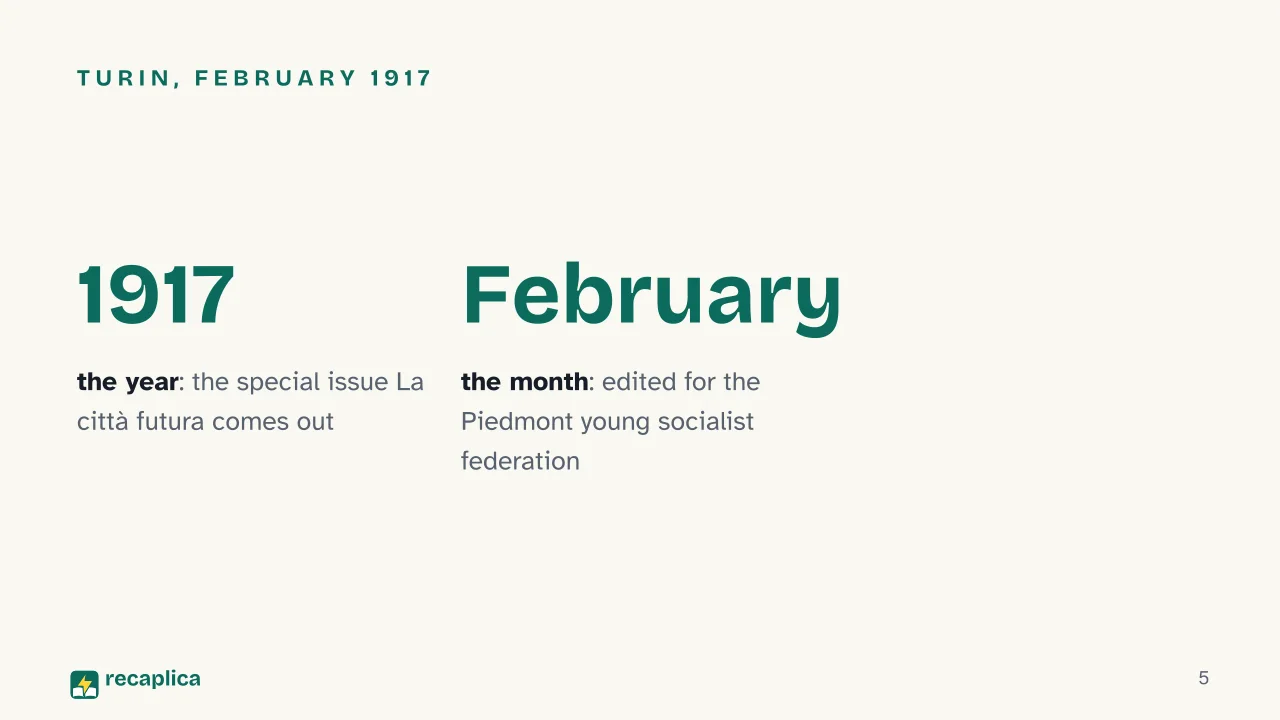
    In February 1917, La città futura came out in Turin: a one-off special issue Antonio Gramsci edited from cover to cover for the Piedmont young socialist federation of the Italian Socialist Party. It opens with a short piece, now known by the line that starts it: “I Hate the Indifferent.” Its target is a behaviour, not a group of people: whoever refuses to take a side, Gramsci argues, still ends up carrying the weight of what history decides without them.

    Context: 1917, in the middle of a war

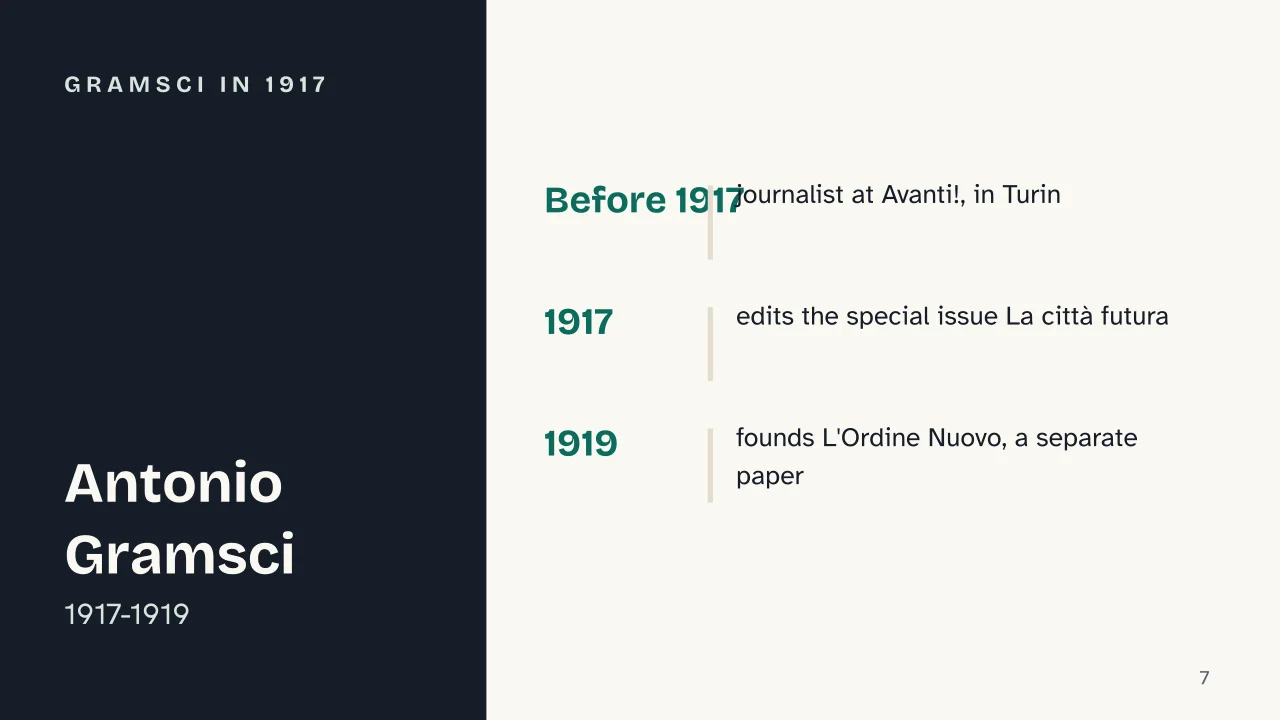
    The special issue came out while the First World War was still going on, which places the text at a precise moment. Before editing La città futura, Gramsci had already been a working journalist at the Turin desk of Avanti! since December 1915, the Italian Socialist Party’s paper. In the special issue he paired his own writing with pieces by Benedetto Croce, Gaetano Salvemini and Carlini, aimed at the political education of the federation’s young members.

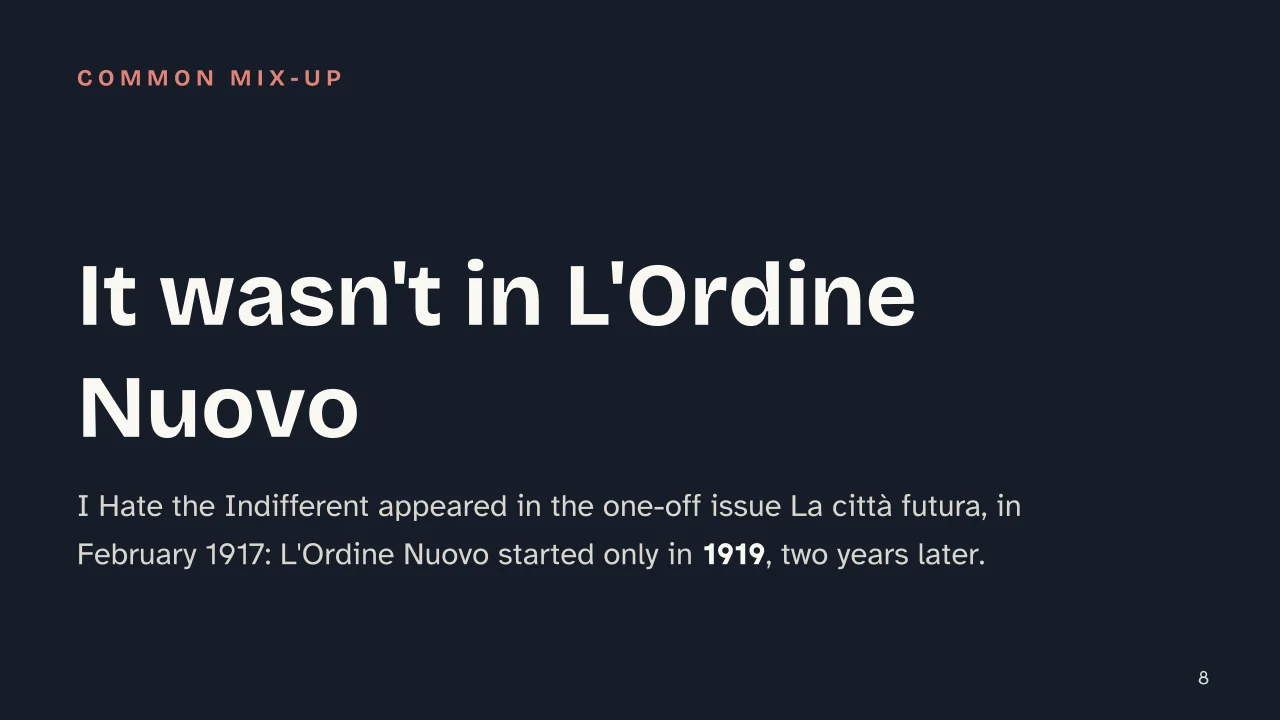
    The text is often mixed up, mistakenly, with another paper carrying Gramsci’s name: L’Ordine Nuovo, which only began in 1919, first as a weekly, then as a daily from 1921. The confusion is understandable: both papers bear Gramsci’s name, but in two distinct stretches of his career, two years apart.

    From a dictionary word to a civic fault

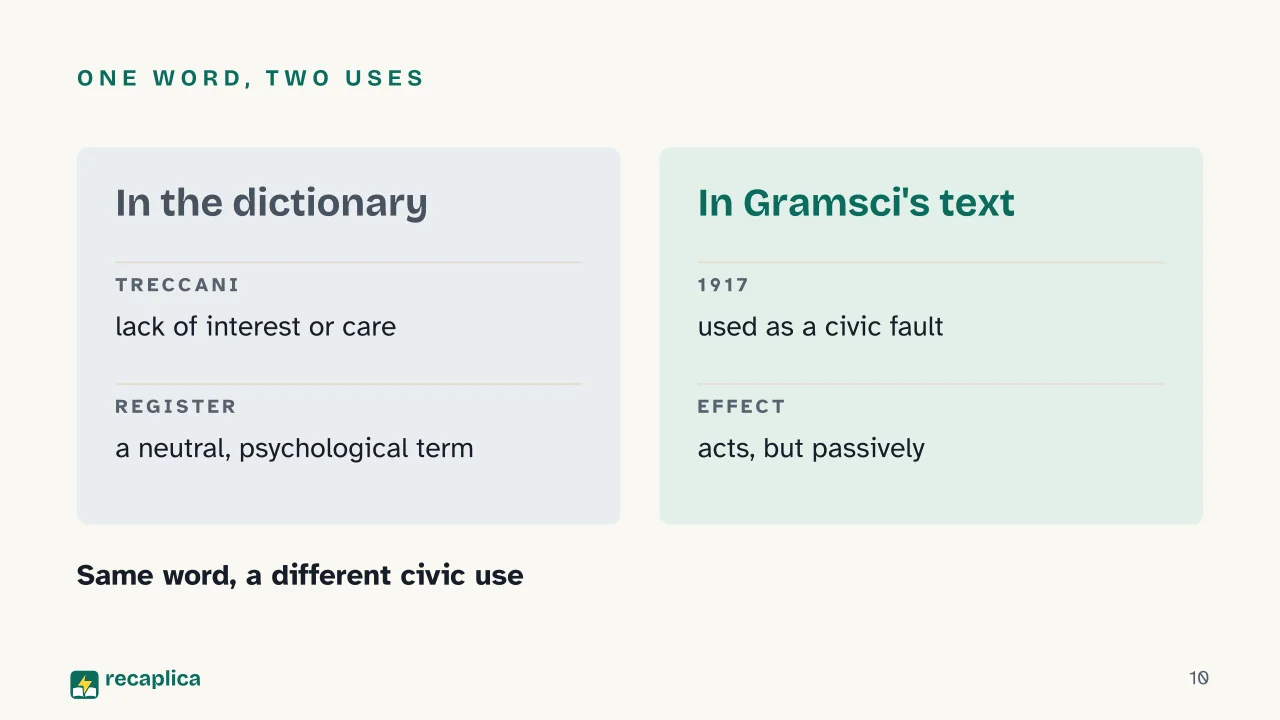
    In everyday Italian, as the Treccani dictionary defines it, indifference means a lack of interest or emotional involvement in something. It’s ordinarily a private word, for a mood or a reaction. Gramsci keeps that register and moves it onto public ground. In the text, indifference gets described through two images: a lead weight, then the marsh that surrounds the old city, dead weight that holds back anyone who might want to move. Indifference, he writes, still produces effects in history by staying passive, letting events settle wherever they settle. In the text’s terms, whoever stayed out shares the responsibility for what happens alongside whoever acted directly.

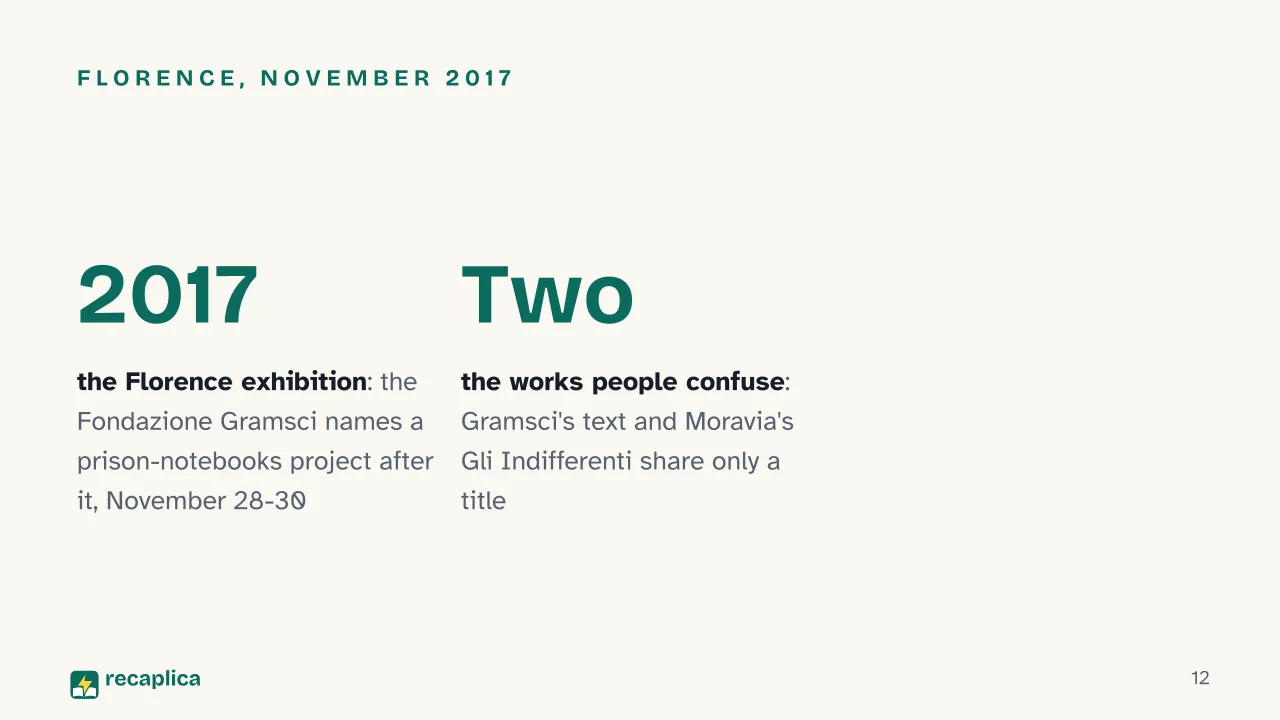
    Worked example: in November 2017 the Fondazione Gramsci named a project linked to an exhibition on the prison notebooks, held in Florence from the 28th to the 30th, after “I Hate the Indifferent” — a sign that the phrase is still put to work, a century later, to talk to younger audiences about civic participation.

    Why it’s still quoted today

    The text closes by tying hatred of indifference to the idea of a “future city” built by citizens who consciously take part, set against chance and fate. It’s this closing move, more than the 1917 polemic around it, that keeps the quote alive: an appeal to take part that needs no background in wartime Turin or socialist politics to land. The same thread, approached with different tools, runs through the Recaps on popular sovereignty and citizenship and on the principles the Italian Constitution hands to citizens, not only to institutions; for the historical backdrop the text grew out of, World War 1 is the direct setting.

    It should stay separate from another title that only resembles it in its keyword: Alberto Moravia’s Gli Indifferenti, a 1929 novel published in English as The Time of Indifference. Moravia tells indifference as the private unease of a middle-class family, in a novel far from Gramsci’s themes and form.

    Common misconceptions

    The most common mix-up is about the paper: the text ran in La città futura in 1917, before L’Ordine Nuovo existed. The word “hate” trips people up too, but it targets a behaviour, not a person.

    Slide deck

    Slides ready to download and make your own in PowerPoint or Google Slides, with speaker notes. Pick the Flash cut or the Full one.
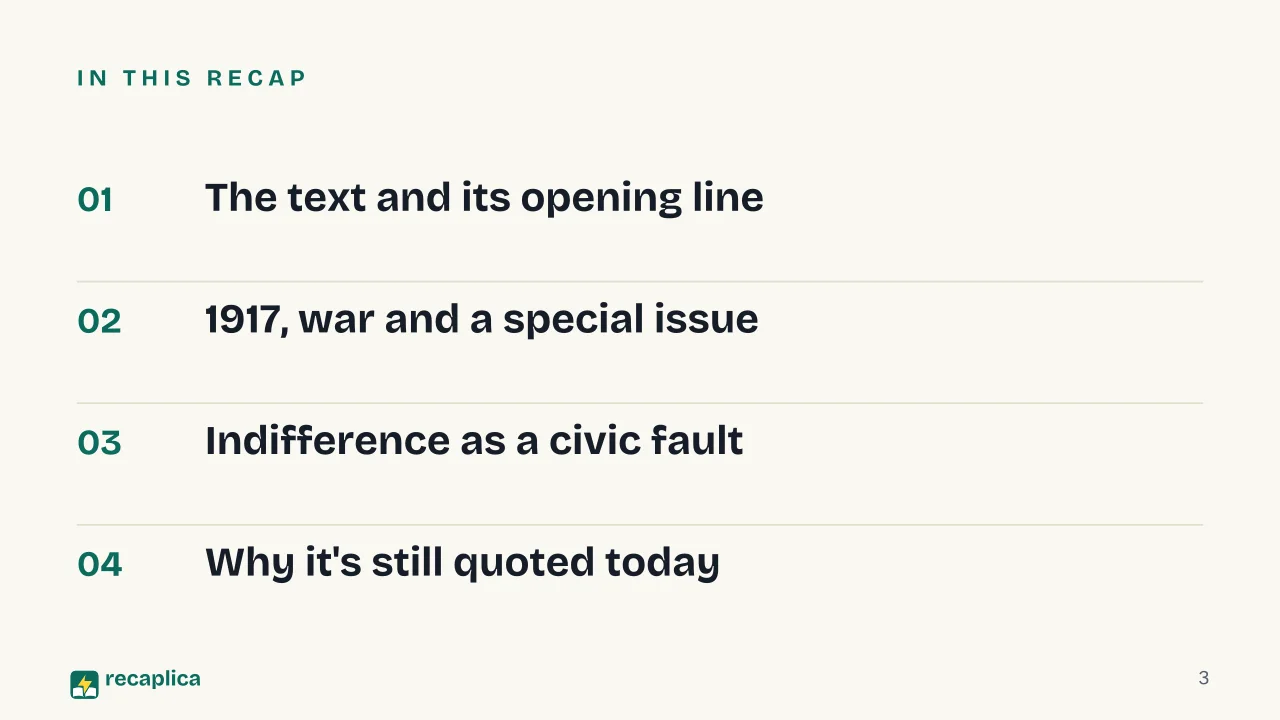
    Slide 1 of the presentation on I Hate the Indifferent: I Hate the IndifferentSlide 2 of the presentation on I Hate the Indifferent: If you don't pick a side, are you still responsible?Slide 3 of the presentation on I Hate the Indifferent: In this RecapSlide 4 of the presentation on I Hate the Indifferent: Chapter 01: The text and its opening lineSlide 5 of the presentation on I Hate the Indifferent: Turin, February 1917Slide 6 of the presentation on I Hate the Indifferent: Chapter 02: 1917, war and a special issueSlide 7 of the presentation on I Hate the Indifferent: Gramsci in 1917Slide 8 of the presentation on I Hate the Indifferent: It wasn't in L'Ordine NuovoSlide 9 of the presentation on I Hate the Indifferent: Chapter 03: Indifference as a civic faultSlide 10 of the presentation on I Hate the Indifferent: One word, two usesSlide 11 of the presentation on I Hate the Indifferent: Chapter 04: Why it's still quoted todaySlide 12 of the presentation on I Hate the Indifferent: Florence, November 2017Slide 13 of the presentation on I Hate the Indifferent: Which publication first carried I Hate the Indifferent?Slide 14 of the presentation on I Hate the Indifferent: Now, time to review
    Flash10 slidesThe essential thread, to present in classFull14 slidesEvery chapter and the deeper detail

    Common myths

    • ✗ Myth I Hate the Indifferent appeared in L'Ordine Nuovo, Gramsci's newspaper.

      ✓ Reality It actually appeared in the one-off issue La città futura, in February 1917: L'Ordine Nuovo only started in 1919, as a separate paper.

    • ✗ Myth I Hate the Indifferent calls for hating people who stay out of politics.

      ✓ Reality The text rejects a behaviour, not a person: Gramsci ties the hatred to civic withdrawal, a judgment on the missing action more than on whoever fails to take it.

    Mind map

    Drag the background to move around and the nodes to reposition them; use − and + to collapse and expand branches.
    Customize
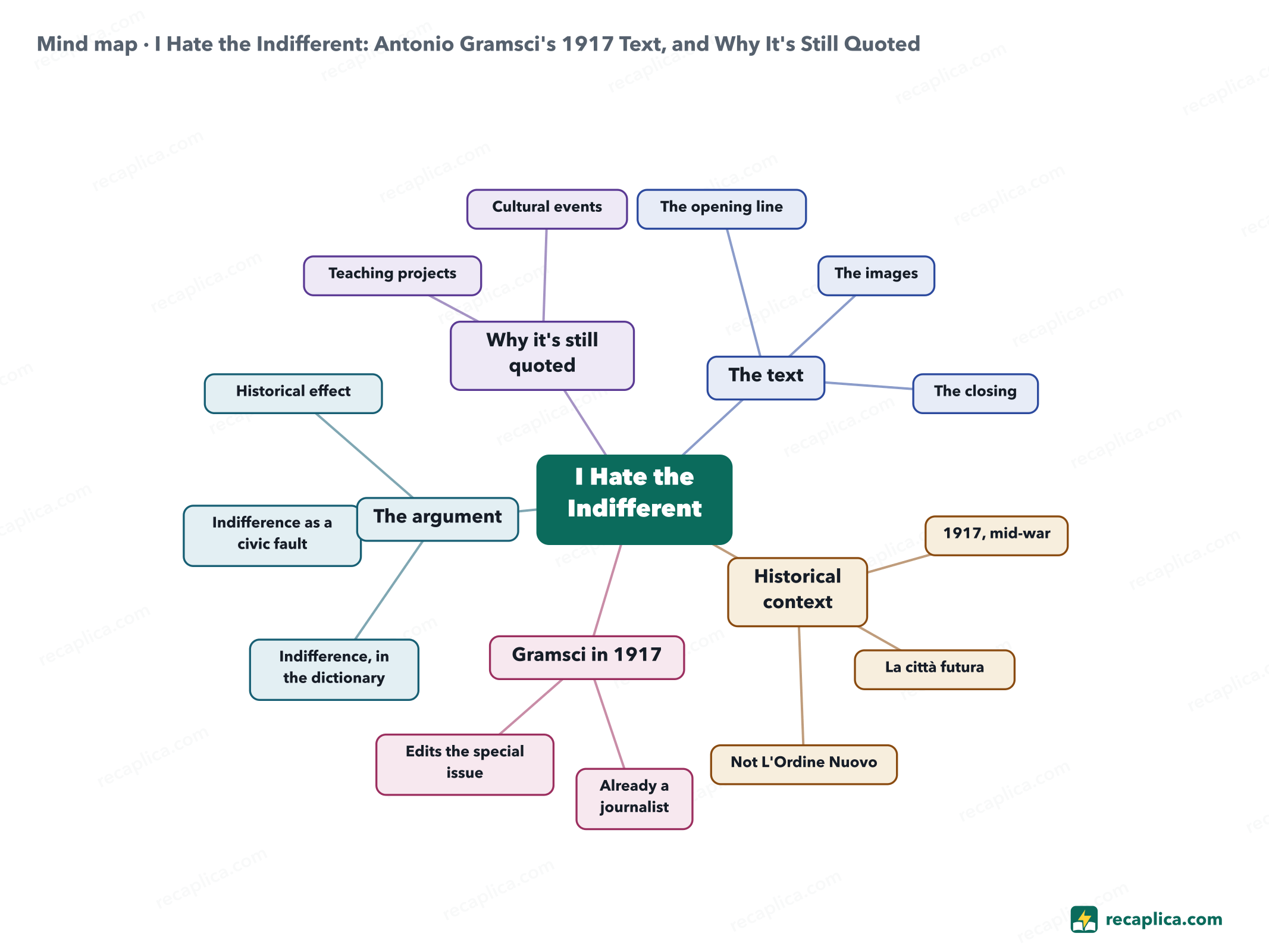
    Mind map: I Hate the Indifferent: Antonio Gramsci's 1917 Text, and Why It's Still Quoted
    • I Hate the Indifferent
      • The text
        • The opening line the statement that gives the essay its title
        • The images the lead weight and the marsh, forces that hold things back
        • The closing hatred of indifference tied to the future city
      • Historical context
        • 1917, mid-war
        • La città futura the special issue edited by Gramsci
        • Not L'Ordine Nuovo a separate paper, started in 1919
      • Gramsci in 1917
        • Already a journalist working at the Turin desk of Avanti!
        • Edits the special issue for the Piedmont young socialist federation
      • The argument
        • Indifference, in the dictionary lack of interest or involvement
        • Indifference as a civic fault for Gramsci, a refusal to take a side
        • Historical effect the text calls it a force that acts by staying passive
      • Why it's still quoted
        • Teaching projects
        • Cultural events the Fondazione Gramsci exhibition, Florence 2017

    Quiz: test yourself

    Answer the questions to check what you have learned: you get instant feedback and a short explanation.

    Grade 0/10 0/5
    1 In what year was I Hate the Indifferent published?

    The text opens the one-off issue La città futura, which came out in February 1917.

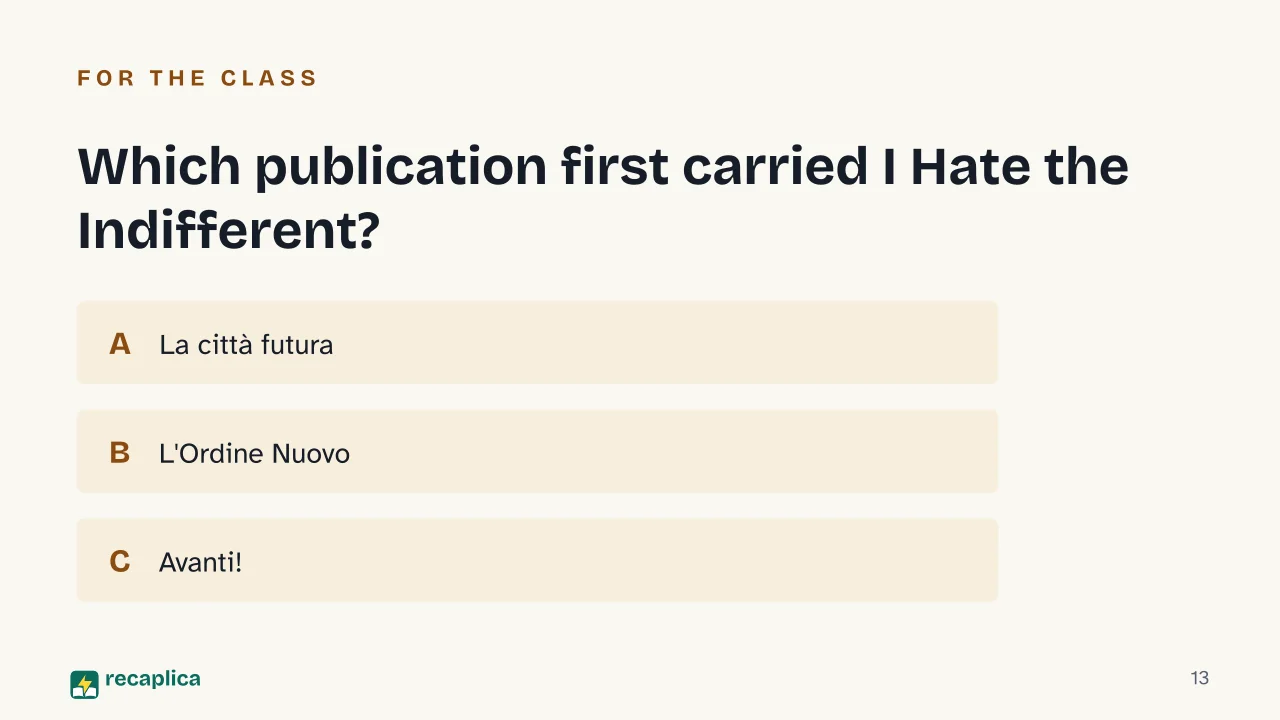
    2 Which publication first carried I Hate the Indifferent?

    It appeared in the special issue La città futura; L'Ordine Nuovo is a later paper, founded by Gramsci only in 1919.

    3 Who edited the special issue La città futura?

    Gramsci edited the whole issue, pairing his own pieces with writing by Croce, Salvemini and Carlini, for the Piedmont young socialist federation.

    4 True or false: according to the text, indifference has no effect on history.

    False: the text argues indifference does act on history, just passively, not that it has no effect at all.

    5 What idea does the text close on?

    In its closing lines, Gramsci puts conscious civic participation at the centre of how a collective future gets built, ahead of chance or fate.

    Answers: 1-A · 2-A · 3-A · 4-B · 5-A

    Flashcards

    Tap the card to flip it and check whether you remember the answer, then move to the next one.

    1 / 7

    Explain it in your own words

    The ultimate test: if you can explain it in simple words, you've truly understood it. Write your explanation, then compare it with the Recap.

    Your explanation is saved only on this device.

    I Hate the Indifferent is a youthful essay Antonio Gramsci wrote in February 1917 to open La città futura, a one-off special issue he edited for the Piedmont young socialist federation. The text treats indifference as a public stance: for Gramsci, staying out of the fight does not exempt anyone from its outcome. It is a short piece, written in the middle of the First World War, often mixed up with L'Ordine Nuovo, the paper Gramsci founded only in 1919, or with Alberto Moravia's novel Gli Indifferenti, published twelve years later. People still quote it today, including in schools and cultural projects, as a direct statement on indifference and civic participation.

    Frequently asked questions

    Where can I read the full text of I Hate the Indifferent?

    It is a 1917 newspaper piece, so it is in the public domain: it can be found in public digital archives dedicated to Gramsci's writing (one is listed among the sources at the bottom of this page).

    Is I Hate the Indifferent the same as Alberto Moravia's Gli Indifferenti?

    No, they are different works: Gramsci's is a political essay from 1917, Moravia's is a novel from 1929. They only share the theme of indifference, handled in opposite ways.

    Who was the Piedmont young socialist federation?

    The youth wing of the Italian Socialist Party in Piedmont, for which Gramsci edited the 1917 special issue La città futura, aimed at the political education of its young members.

    Was I Hate the Indifferent published in L'Ordine Nuovo?

    No, that's a common mix-up. L'Ordine Nuovo is a paper Gramsci founded in 1919, well after the text appeared in the special issue La città futura.

    Sources

    • Antonio Gramsci, "La città futura" (1917) — Gramsci Archive, Marxists Internet Archive (in Italian)
    • Gramsci, Antonio — Treccani Encyclopedia (in Italian)
    • Antonio Gramsci — Fondazione Gramsci onlus (in Italian)
    • Indifferènza — Treccani Dictionary (in Italian)

    Every Recap goes through an independent review before publication.

    Every evening, the day's new Recaps on our Telegram channel. Join the channel →

    Keep learning

    • History Dialogue Concerning the Two Chief World Systems Dialogue Concerning the Two Chief World Systems is the book in which Galileo Galilei, in 1632, weighs the Copernican system against the Aristotelian-Ptolemaic one through three characters who talk across four days. Salviati argues for Copernicus, Simplicio defends the Aristotelian tradition, and Sagredo referees with the common sense of an outside observer. The book reaches bookshops with every authorization in order, yet a year later it puts Galileo in front of the Inquisition: the trial closes in 1633 with his abjuration, and in 1634 the work lands on the Index of banned books. Read the Recap →
    • History Palladian Architecture: What It Is and Why It Spread Worldwide Palladian architecture is the style associated with Andrea Palladio, an architect who lived from 1508 to 1580 and shaped his approach from years spent studying the buildings of ancient Rome. Working mainly in Vicenza and the surrounding Veneto, he designed villas and public buildings built on symmetry, porticoes and classical orders drawn straight from antiquity. In 1570 he published "The Four Books of Architecture", a treatise that spread his approach across Europe. According to UNESCO, his buildings left an exceptional mark on European and global architecture and urban planning, and gave rise to a movement, Palladianism, that lasted roughly three centuries. Read the Recap →
    • History Bernini and Borromini: The Rivalry That Shaped Roman Baroque Roman Baroque grew out of a rivalry between two architects working in seventeenth-century Rome, Gian Lorenzo Bernini and Francesco Borromini. Bernini built the Baldachin and colonnade of St. Peter's, the Fountain of the Four Rivers and the church of Sant'Andrea al Quirinale, favoring curves and theatrical effect. Borromini, who spent years working right next to Bernini on the St. Peter's building site, later signed works such as San Carlo alle Quattro Fontane and Sant'Ivo alla Sapienza, built on calculated geometry instead. The rivalry built up over the years and broke into the open in 1645, when a commission rejected a bell tower of Bernini's — still one of the most retold chapters in Roman art. Read the Recap →

    recaplica

    Clear in 30 seconds, yours in 10 minutes.

    Recaps Mind maps Request a Recap Telegram channel Mind map maker Our method About Privacy & cookies Legal notes & terms of use

    © 2026 Recaplica · A project by Curi S.r.l. — VAT IT05472000750

    Statistics, only if you say so

    To learn which Recaps help most we would use Google Analytics, with aggregate, anonymous data. It starts only with your OK, and you can change your mind anytime. Privacy policy