Skip to content
recaplica

    One moment: security check

    Cloudflare wants to make sure you're not a robot. Tick the box below and your search will continue on its own.

    IT
    recaplica Bernini and Borromini: The Rivalry That Shaped Roman Baroque
    © 2026 Recaplica · recaplica.com — All rights reserved
    Home › History

    Bernini and Borromini: The Rivalry That Shaped Roman Baroque

    By Recaplica Newsroom · Updated on October 2, 2026

    What to print

    Page numbers appear when printing with default margins.

    Slides

    Choose a cut

    Flash10 slidesThe essential thread, to present in classFull18 slidesEvery chapter and the deeper detail

    Both come with speaker notes.

    Telegram channel
    recaplica Clear in 30 seconds, yours in 10 minutes.
    In 30 seconds Key points Figures Deep dive Slides Myths Mind map Quiz Flashcards FAQ

    In 30 seconds quick read

    Roman Baroque grew out of a rivalry between two architects working in seventeenth-century Rome, Gian Lorenzo Bernini and Francesco Borromini. Bernini built the Baldachin and colonnade of St. Peter's, the Fountain of the Four Rivers and the church of Sant'Andrea al Quirinale, favoring curves and theatrical effect. Borromini, who spent years working right next to Bernini on the St. Peter's building site, later signed works such as San Carlo alle Quattro Fontane and Sant'Ivo alla Sapienza, built on calculated geometry instead. The rivalry built up over the years and broke into the open in 1645, when a commission rejected a bell tower of Bernini's — still one of the most retold chapters in Roman art.

    Key Points

    • Gian Lorenzo Bernini (Naples 1598 - Rome 1680) and Francesco Borromini (Bissone 1599 - Rome 1667) were the two leading figures of Roman Baroque in the seventeenth century.
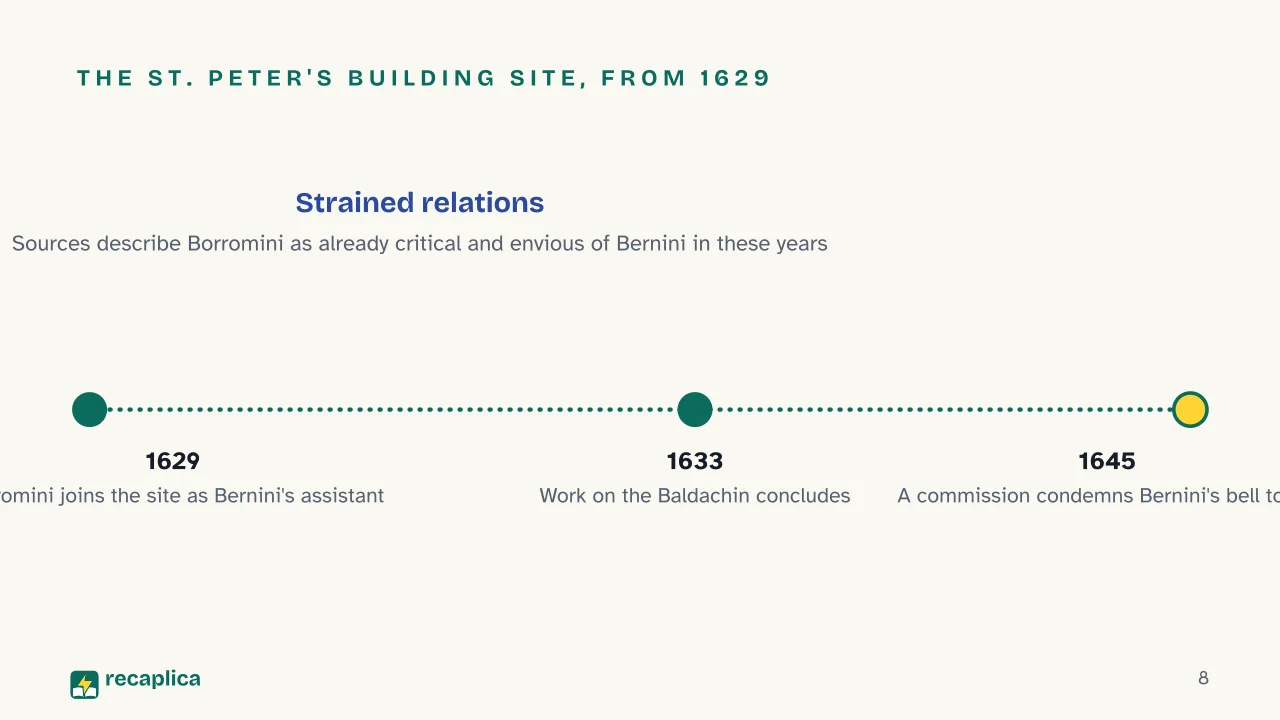
    • Borromini worked as Bernini's assistant on the St. Peter's building site between 1629 and 1633, before becoming his fiercest rival.
    • Bernini built the Baldachin and colonnade of St. Peter's, the Fountain of the Four Rivers and Sant'Andrea al Quirinale.
    • Borromini signed San Carlo alle Quattro Fontane and Sant'Ivo alla Sapienza, with forms very different from Bernini's.
    • The conflict became public in 1645, when a commission condemned a bell tower Bernini had designed.
    • Borromini took his own life in 1667, after a life the sources describe as solitary and anxious.

    Key figures

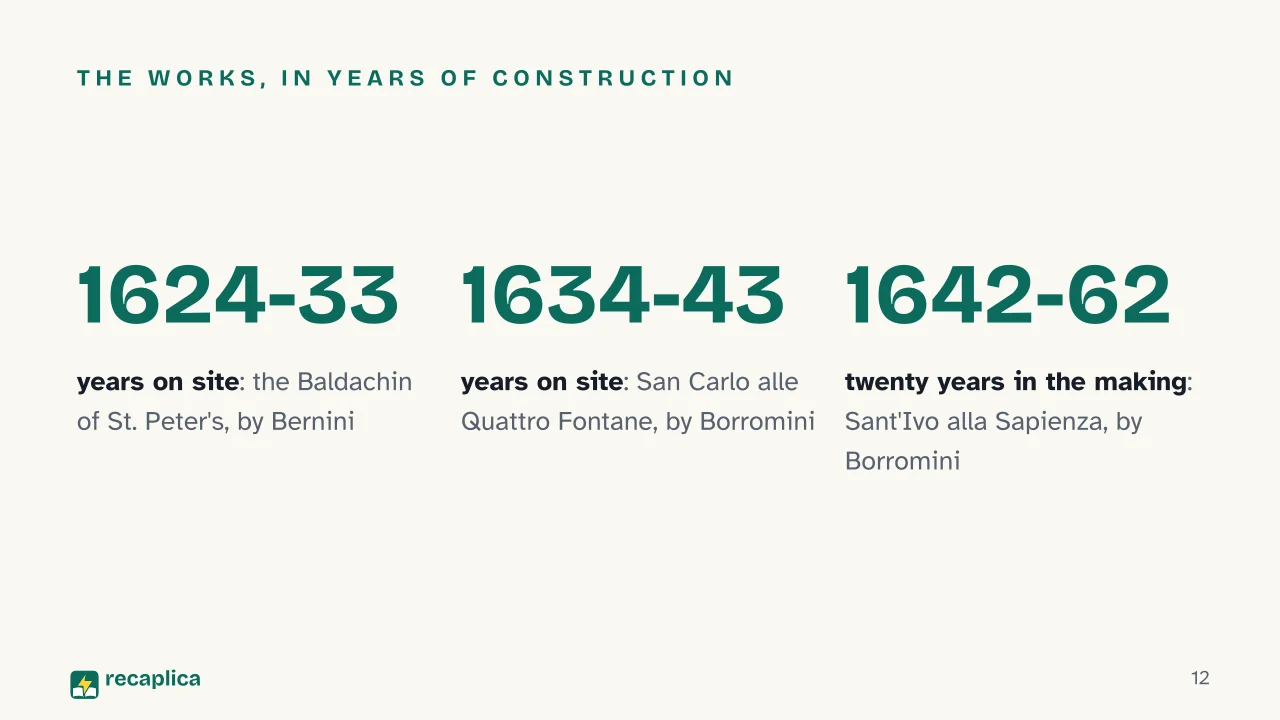
    • 1624-1633 years in which Bernini built the Baldachin of St. Peter's, the first work to fuse architecture and sculpture Source: Treccani
    • 1651 year in which Bernini completed the Fountain of the Four Rivers in Piazza Navona Source: Treccani
    • 1634-1643 years in which Borromini built the monastery of San Carlo alle Quattro Fontane in Rome Source: Encyclopedia.com

    Deep Dive

    Seventeenth-century Rome did not get its Baroque from a single plan. It came from a running contest between two architects who worked almost side by side and who, within a few years, became declared rivals. The century follows the Renaissance and the Florentine Renaissance, the age of artists like Botticelli and his Birth of Venus. Roman Baroque went looking for something else: movement, staging, an effect on whoever walked into a church or crossed a piazza.

    Two parallel lives, two opposite styles

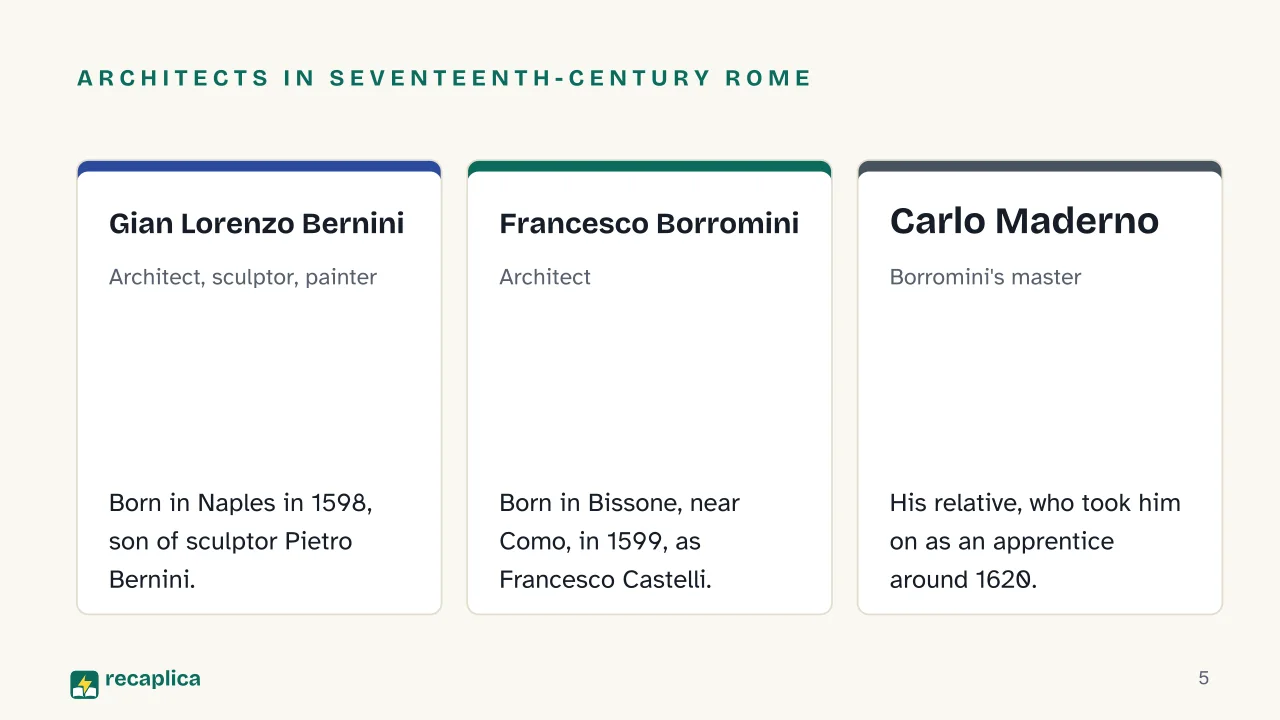
    Gian Lorenzo Bernini was born in Naples in 1598, son of the sculptor Pietro Bernini, and died in Rome in 1680. He worked as architect, sculptor and painter at once, and his career spans nearly the whole century.

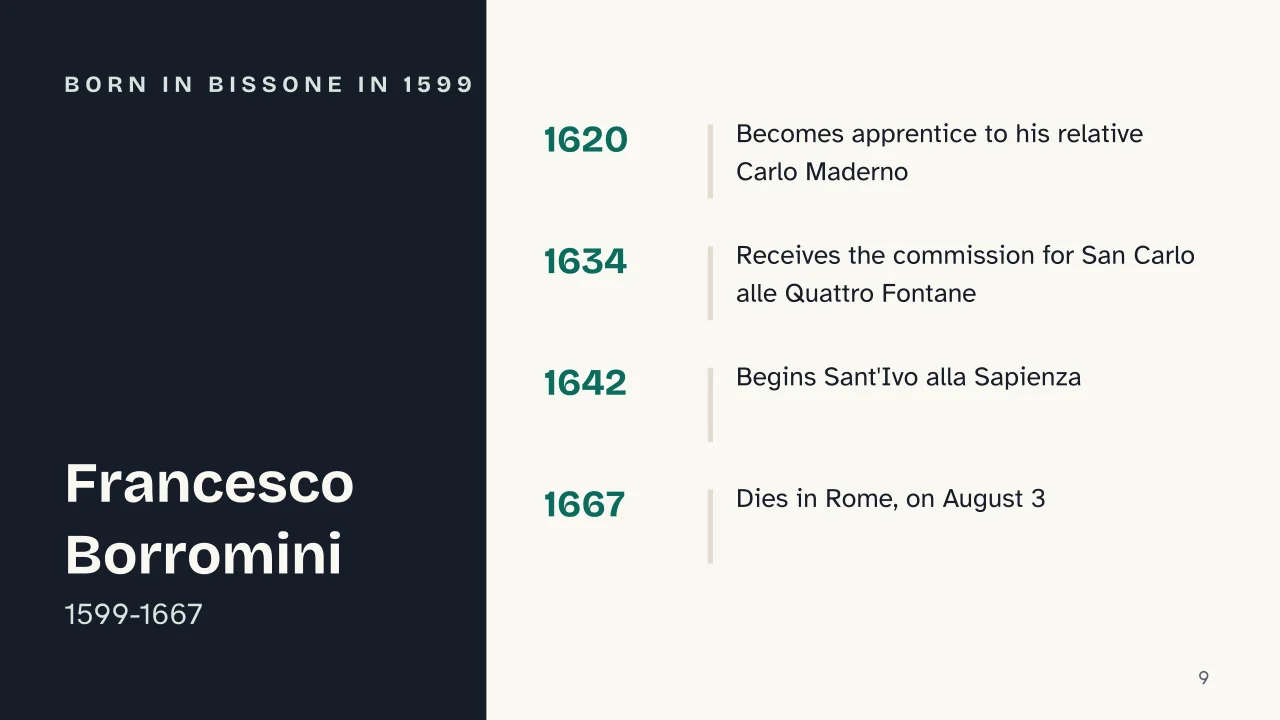
    Francesco Borromini was born a year later, in 1599, in Bissone, near Como, under the name Francesco Castelli. He studied sculpture in Milan, where he likely came into contact with the stonecutters working on the late Gothic forms of the Duomo, and moved to Rome in 1619, according to TheArtStory. In Rome he became apprentice to his relative Carlo Maderno starting around 1620.

    The two men worked closely together between 1629 and 1633, when Borromini assisted Bernini at the St. Peter’s building site. One academic source (Encyclopedia.com) describes Borromini, already in those years, as critical and jealous of Bernini: rather than bringing them closer, the collaboration seems to have widened the gap between them.

    Practical example: set a photo of the Baldachin of St. Peter’s next to one of the interior of San Carlo alle Quattro Fontane and the split becomes visible at a glance. In the first, twisted columns seem to be in motion, dark bronze catching light from every angle. In the second, the walls bend into calculated, almost mathematical curves, with none of Bernini’s gold or theatrical flourish.

    The works that defined Rome

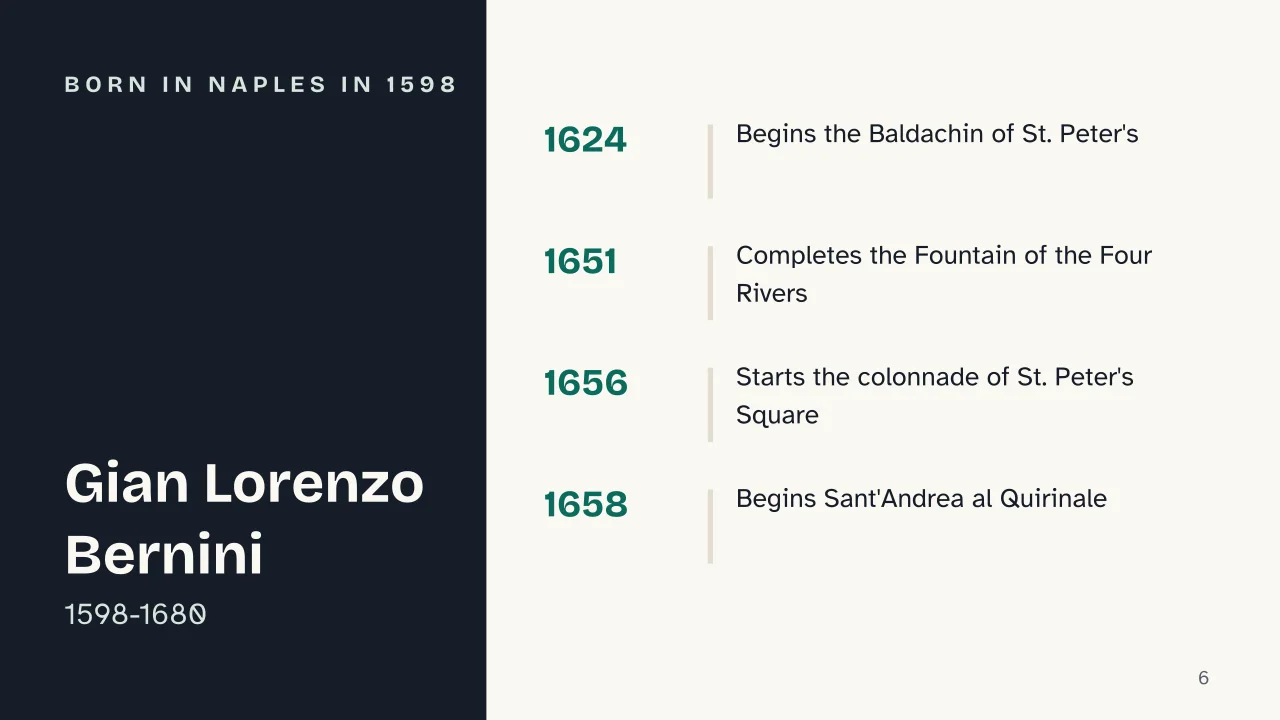
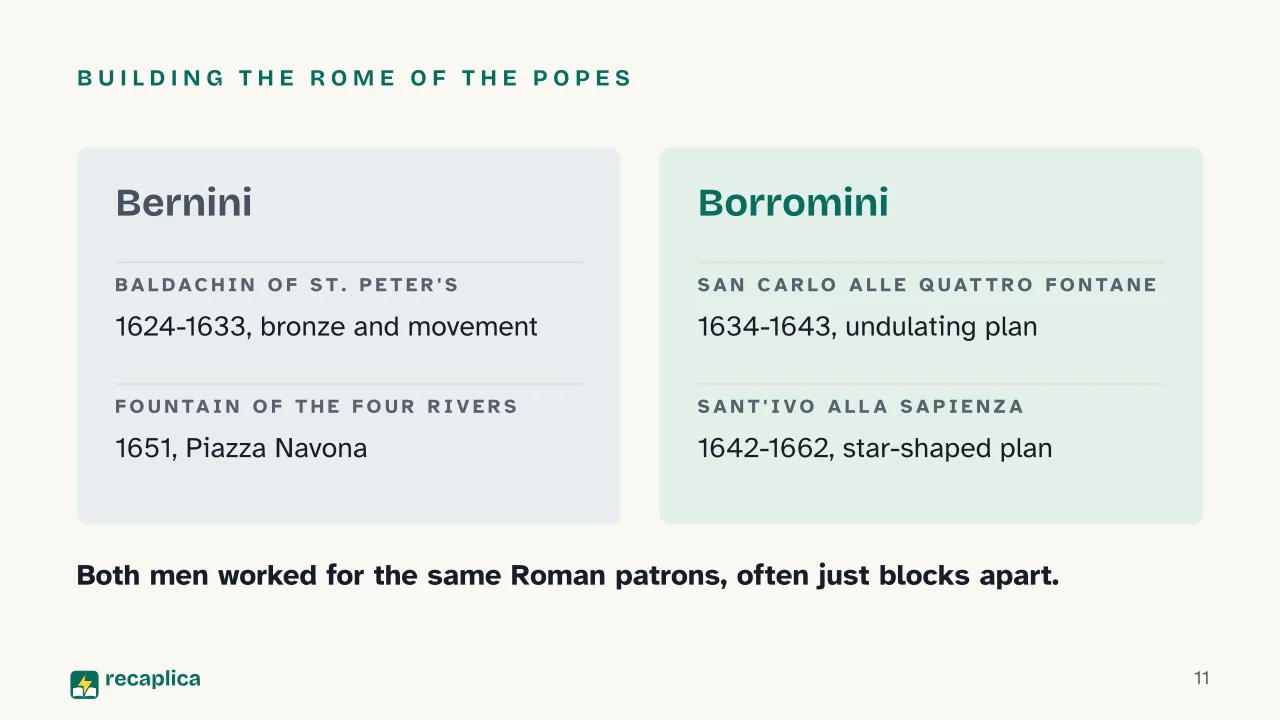
    Bernini built some of the most recognizable images of Baroque Rome. Between 1624 and 1633 he produced the Baldachin of St. Peter’s, the first major work to merge architecture and sculpture into a single bronze structure. In 1647 he was commissioned to decorate the basilica’s piers and naves, and in 1656 he began the colonnade of St. Peter’s Square. Outside St. Peter’s he signed the Fountain of the Four Rivers, completed in 1651 in Piazza Navona — Treccani cautiously ranks it among the high points of Baroque art — and, from 1658, the church of Sant’Andrea al Quirinale.

    Borromini worked on a smaller scale, but no less ambitiously. Between 1634 and 1643 he built the monastery of San Carlo alle Quattro Fontane in Rome. Between 1642 and 1662 he designed the plan of Sant’Ivo alla Sapienza, one of the most unusual shapes in seventeenth-century Roman architecture.

    BerniniBorromini
    BornNaples, 1598Bissone, 1599
    DiedRome, 1680Rome, 1667
    Work at St. Peter’sBaldachin (1624-1633), colonnade (from 1656)Bernini’s assistant (1629-1633)
    Own worksFountain of the Four Rivers (1651), Sant’Andrea al Quirinale (from 1658)San Carlo alle Quattro Fontane (1634-1643), Sant’Ivo alla Sapienza (1642-1662)

    Why they were rivals

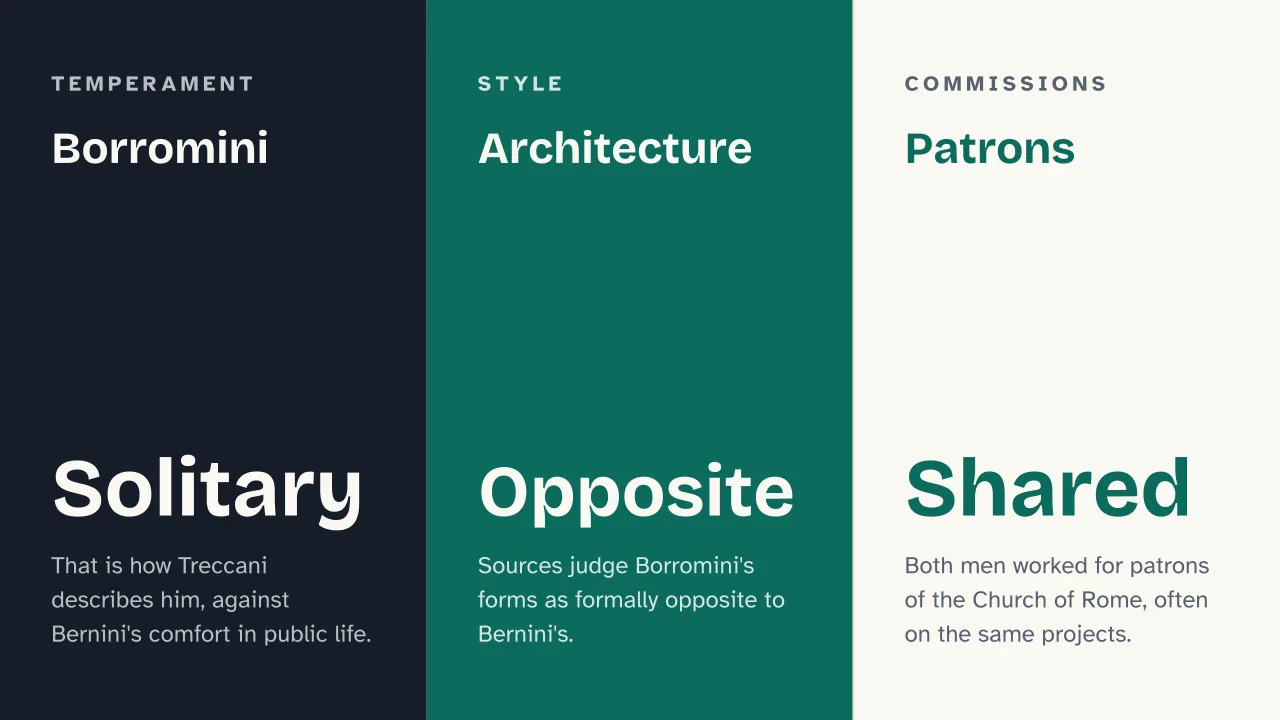
    No single reason explains the conflict. Treccani describes Borromini’s architecture as formally opposite to Bernini’s; the same source portrays Borromini as solitary and anxious, while Bernini moved comfortably among papal commissions and the public life of Rome. On top of that came direct competition for the same jobs, since both men worked for the building sites of the Roman Church.

    The dispute went public in 1645. One of the bell towers of St. Peter’s, completed in 1641 to Bernini’s design, turned out to be structurally unsound, and a commission ordered its removal. Borromini used the episode to publicly criticize Bernini’s competence, according to TheArtStory.

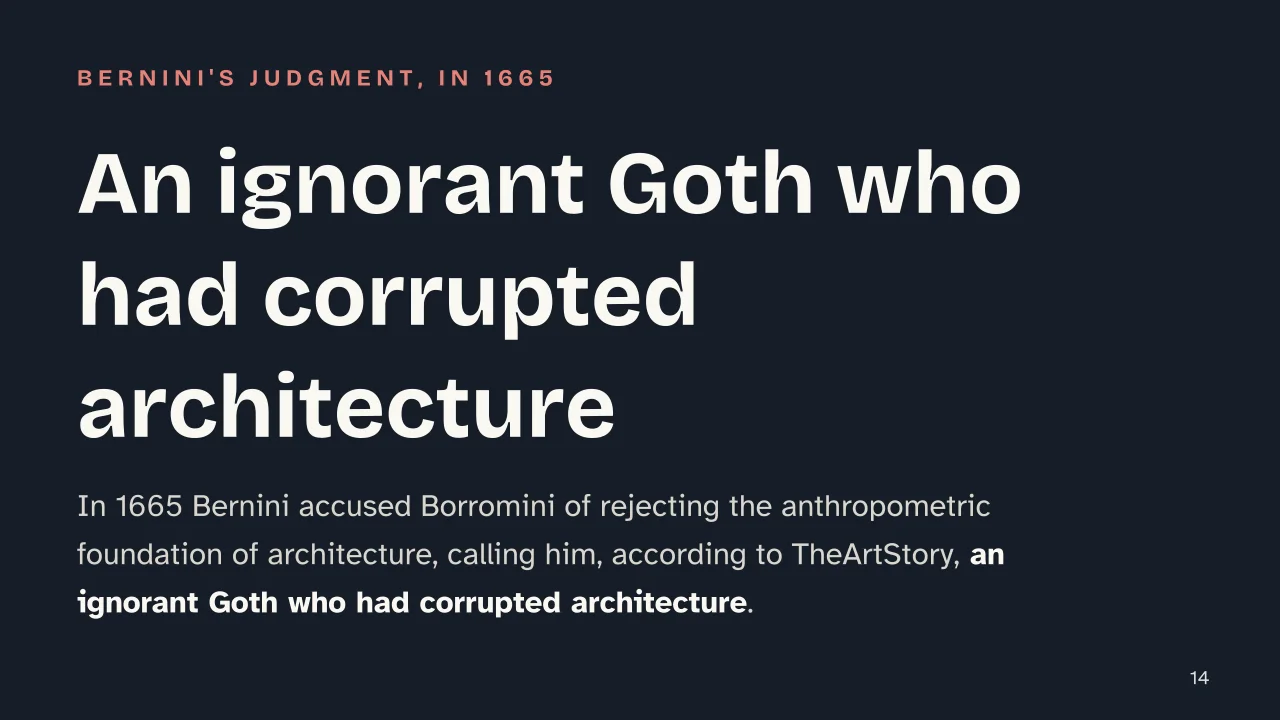
    Twenty years later, in 1665, Bernini accused Borromini of rejecting the anthropometric foundation of architecture — the idea that a building’s proportions should mirror the human body — and called him, in TheArtStory’s words, “an ignorant Goth who had corrupted architecture.” It is a harsh judgment, reported by the source as exactly that: not a verdict from art history, but the voice of a rival.

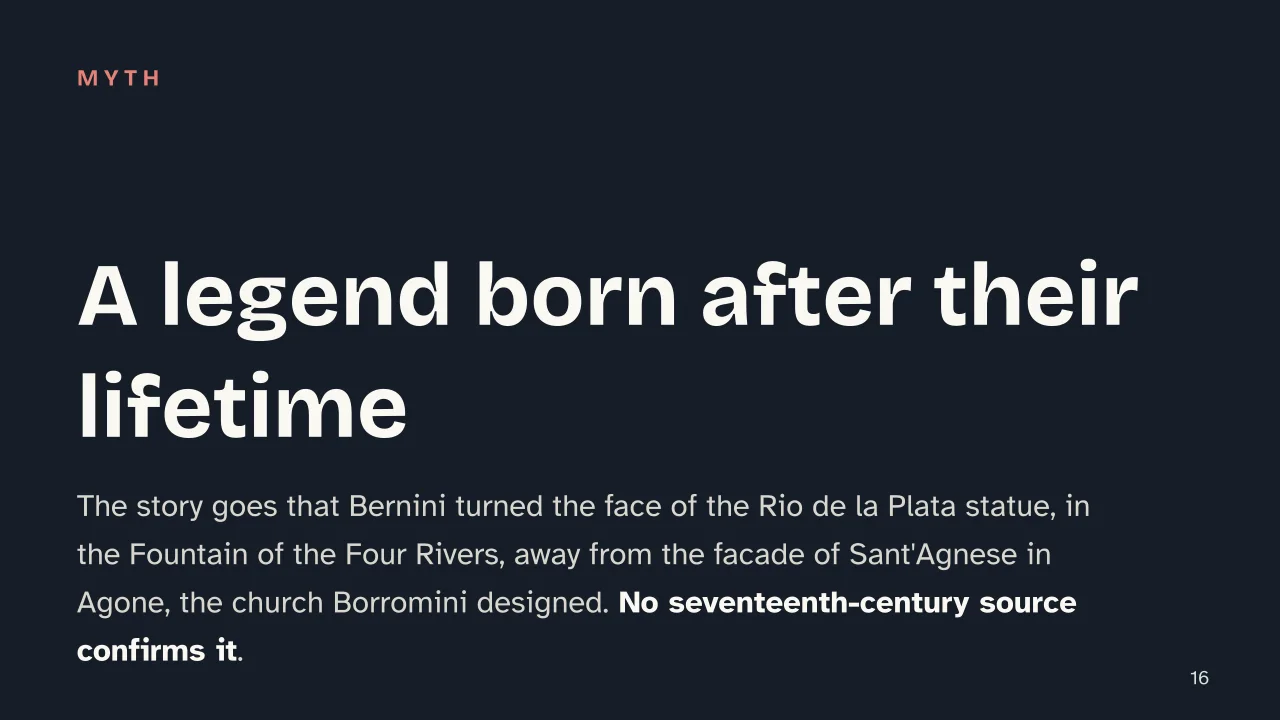
    Around this rivalry a legend also grew, often told as though it were fact. According to this story, reported by TheArtStory, Bernini had the face of the Rio de la Plata statue, in the Fountain of the Four Rivers, turned away so it would not have to face the facade of Sant’Agnese in Agone, the church Borromini designed; Borromini, the story adds, answered by turning one of his own statues elsewhere. No seventeenth-century source confirms any of it happened. It stands as a later legend, useful for telling the story of how famous the rivalry became, not a documented episode from their own time.

    Opposite characters, uneven fame

    TheArtStory describes Borromini as a solitary, stubborn man who dressed in austere Spanish fashion. It also judges him probably celibate and chaste, and often quarrelsome in his working relationships. Treccani sums up his life as anxious, ending in suicide: in the summer of 1667, with his servant briefly looking away, Borromini turned his own sword on himself. He still had time to repent and leave a will before he died on August 3, 1667.

    Borromini’s architecture was regarded with suspicion for a long time.

    Treccani notes it was harshly criticized by neoclassical critics, and only reassessed later on. Bernini, by contrast, stayed the name most associated with Roman Baroque for centuries. Today the two careers read side by side, as two different answers to the same question of how to build Rome.

    Slide deck

    Slides ready to download and make your own in PowerPoint or Google Slides, with speaker notes. Pick the Flash cut or the Full one.
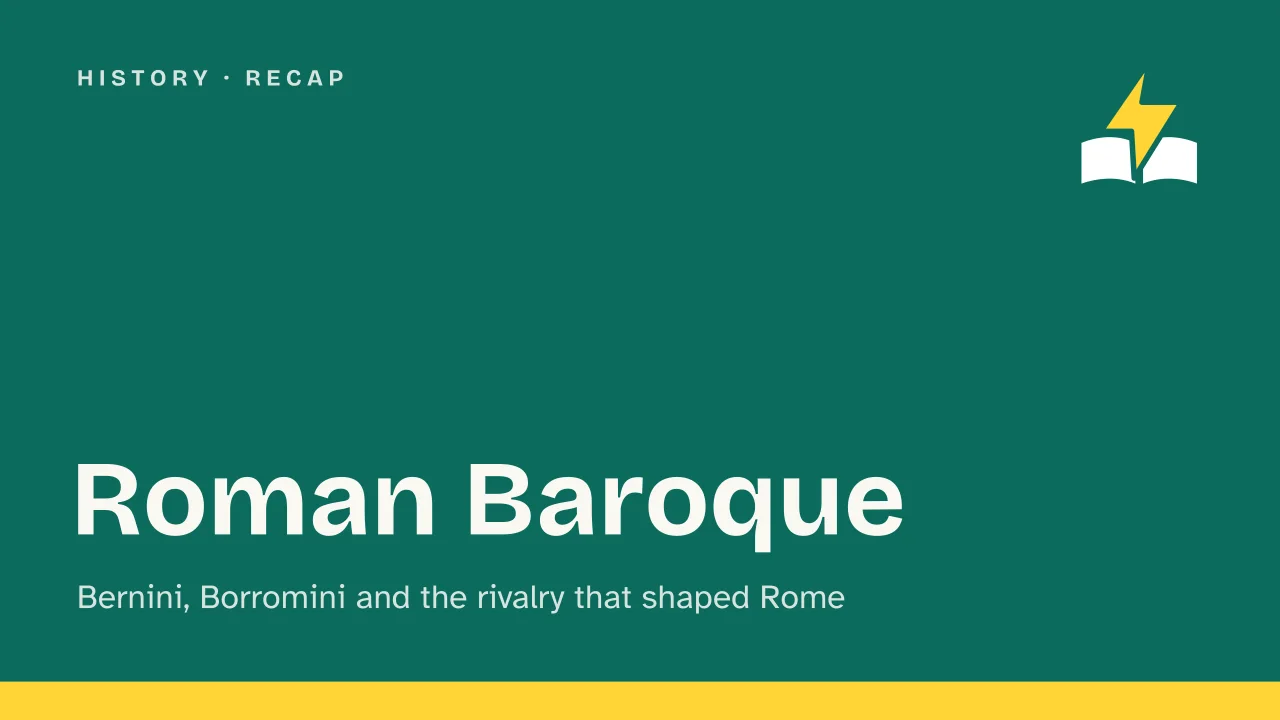
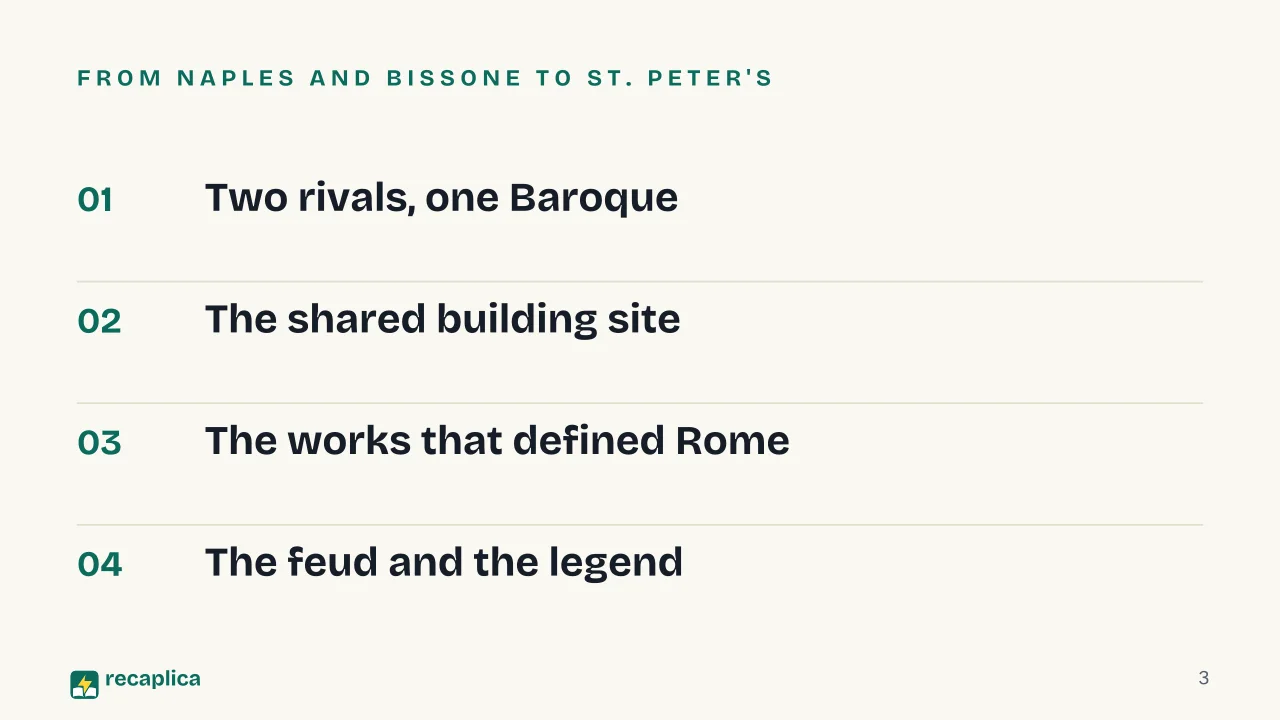
    Slide 1 of the presentation on Bernini and Borromini: Roman BaroqueSlide 2 of the presentation on Bernini and Borromini: Can two rivals build one style?Slide 3 of the presentation on Bernini and Borromini: From Naples and Bissone to St. Peter'sSlide 4 of the presentation on Bernini and Borromini: Chapter 01: Two rivals, one BaroqueSlide 5 of the presentation on Bernini and Borromini: Architects in seventeenth-century Rome: Gian Lorenzo Bernini, Francesco Borromini, Carlo MadernoSlide 6 of the presentation on Bernini and Borromini: Born in Naples in 1598Slide 7 of the presentation on Bernini and Borromini: Chapter 02: The shared building siteSlide 8 of the presentation on Bernini and Borromini: The St. Peter's building site, from 1629Slide 9 of the presentation on Bernini and Borromini: Born in Bissone in 1599Slide 10 of the presentation on Bernini and Borromini: Chapter 03: The works that defined RomeSlide 11 of the presentation on Bernini and Borromini: Building the Rome of the popesSlide 12 of the presentation on Bernini and Borromini: The works, in years of constructionSlide 13 of the presentation on Bernini and Borromini: Chapter 04: The feud and the legendSlide 14 of the presentation on Bernini and Borromini: An ignorant Goth who had corrupted architectureSlide 15 of the presentation on Bernini and Borromini: Borromini · Architecture · PatronsSlide 16 of the presentation on Bernini and Borromini: A legend born after their lifetimeSlide 17 of the presentation on Bernini and Borromini: Which work belongs to Borromini?Slide 18 of the presentation on Bernini and Borromini: Bernini, Borromini and Rome
    Flash10 slidesThe essential thread, to present in classFull18 slidesEvery chapter and the deeper detail

    Common myths

    • ✗ Myth Many believe Bernini really did turn the Rio de la Plata statue away so it would not have to face Borromini's church.

      ✓ Reality It is a legend, presented as such by the sources that tell it, not a fact documented at the time. No seventeenth-century record describes the gesture as real.

    • ✗ Myth Borromini is often pictured as little more than Bernini's helper, a minor figure left in his shadow.

      ✓ Reality He was in fact an independent architect, author of works like San Carlo alle Quattro Fontane and Sant'Ivo alla Sapienza. Sources already describe him as critical of Bernini during their years together at St. Peter's, between 1629 and 1633.

    • ✗ Myth The rivalry between Bernini and Borromini is often reduced to plain personal envy.

      ✓ Reality Sources describe a longer story — the relationship between the two soured on the St. Peter's building site, years before the public bell tower dispute of 1645.

    Mind map

    Drag the background to move around and the nodes to reposition them; use − and + to collapse and expand branches.
    Customize
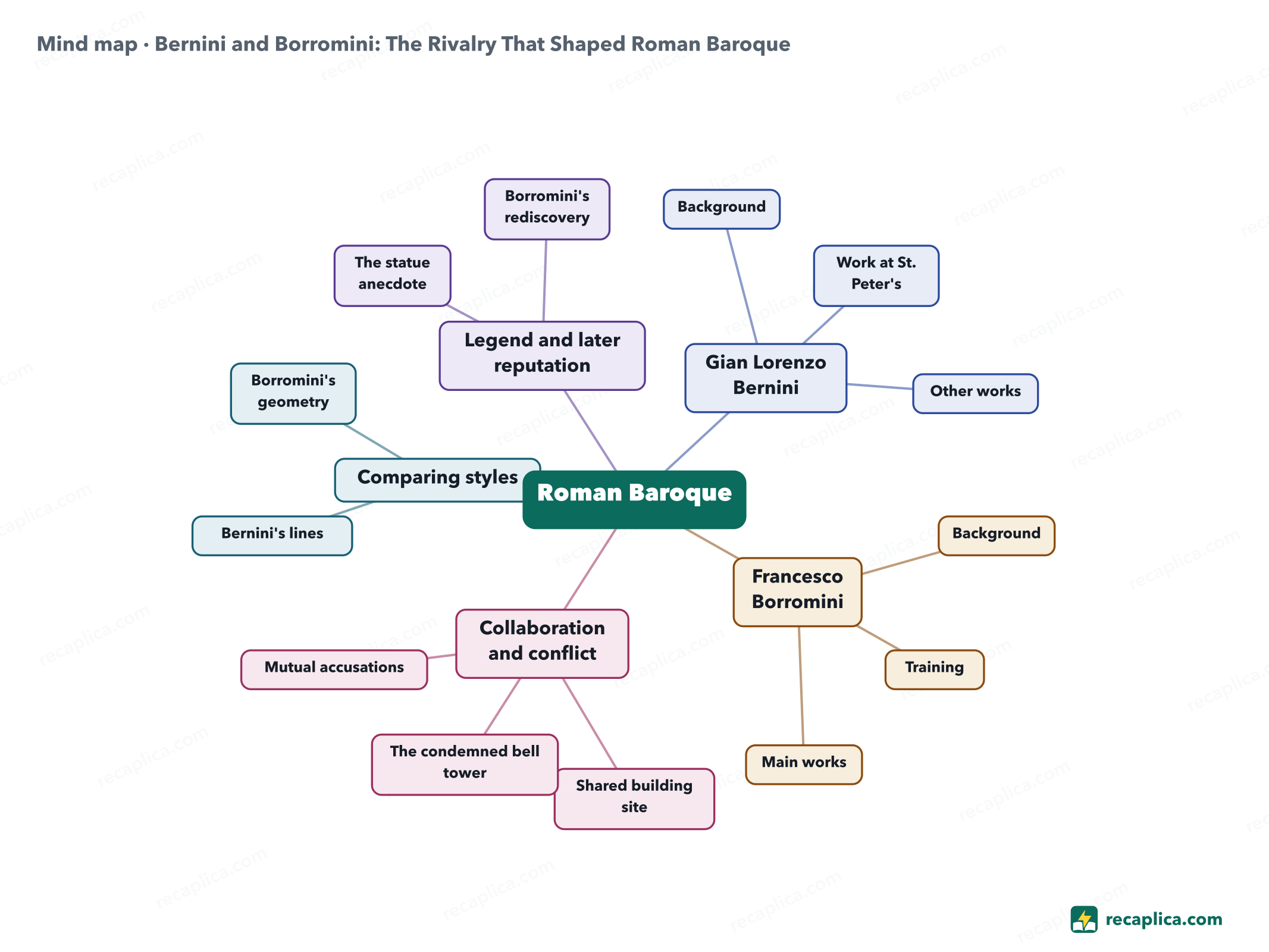
    Mind map: Bernini and Borromini: The Rivalry That Shaped Roman Baroque
    • Roman Baroque
      • Gian Lorenzo Bernini
        • Background born in Naples in 1598, son of sculptor Pietro Bernini
        • Work at St. Peter's Baldachin 1624-1633, colonnade from 1656
        • Other works Fountain of the Four Rivers 1651, Sant'Andrea al Quirinale from 1658
      • Francesco Borromini
        • Background born in Bissone in 1599 as Francesco Castelli
        • Training studied in Milan, then apprenticed to relative Carlo Maderno from 1620
        • Main works San Carlo alle Quattro Fontane 1634-1643, Sant'Ivo alla Sapienza 1642-1662
      • Collaboration and conflict
        • Shared building site St. Peter's, between 1629 and 1633
        • The condemned bell tower a commission orders its removal in 1645
        • Mutual accusations Bernini's harsh judgment of Borromini, in 1665
      • Comparing styles
        • Bernini's lines curves, movement, theatrical effect
        • Borromini's geometry calculated plans, unusual shapes
      • Legend and later reputation
        • The statue anecdote a legend, not a documented fact
        • Borromini's rediscovery criticized by neoclassical critics, reassessed later

    Quiz: test yourself

    Answer the questions to check what you have learned: you get instant feedback and a short explanation.

    Grade 0/10 0/5
    1 Where was Francesco Borromini born?

    According to Treccani, Borromini was born in Bissone, near Como, in 1599.

    2 On which building site did Borromini work as Bernini's assistant?

    Between 1629 and 1633 Borromini assisted Bernini at the St. Peter's building site, before becoming his rival.

    3 True or false. The Fountain of the Four Rivers was built by Borromini.

    False. The Fountain of the Four Rivers, in Piazza Navona, was completed by Bernini in 1651.

    4 Which of these works is by Francesco Borromini?

    Sant'Ivo alla Sapienza, with its unusual plan, was designed by Borromini between 1642 and 1662. The other three works are Bernini's.

    5 What happened in 1645 to a bell tower Bernini had designed for St. Peter's?

    The bell tower, completed in 1641, turned out to be structurally unsound; in 1645 a commission ordered its removal, and Borromini publicly criticized the episode.

    Answers: 1-B · 2-A · 3-B · 4-A · 5-B

    Flashcards

    Tap the card to flip it and check whether you remember the answer, then move to the next one.

    1 / 8

    Explain it in your own words

    The ultimate test: if you can explain it in simple words, you've truly understood it. Write your explanation, then compare it with the Recap.

    Your explanation is saved only on this device.

    Roman Baroque grew out of a rivalry between two architects working in seventeenth-century Rome, Gian Lorenzo Bernini and Francesco Borromini. Bernini built the Baldachin and colonnade of St. Peter's, the Fountain of the Four Rivers and the church of Sant'Andrea al Quirinale, favoring curves and theatrical effect. Borromini, who spent years working right next to Bernini on the St. Peter's building site, later signed works such as San Carlo alle Quattro Fontane and Sant'Ivo alla Sapienza, built on calculated geometry instead. The rivalry built up over the years and broke into the open in 1645, when a commission rejected a bell tower of Bernini's — still one of the most retold chapters in Roman art.

    Frequently asked questions

    Who were Bernini and Borromini?

    Gian Lorenzo Bernini (Naples 1598 - Rome 1680) and Francesco Borromini (Bissone 1599 - Rome 1667) were the two architects who defined Roman Baroque in the seventeenth century, with very different styles.

    Why were Bernini and Borromini rivals?

    Sources don't point to a single cause. They describe a professional rivalry that began at the St. Peter's building site, between 1629 and 1633, when Borromini worked as Bernini's assistant, and came to a head in the public 1645 dispute over a bell tower Bernini had designed.

    What are Bernini's main works in Rome?

    The Baldachin of St. Peter's (1624-1633), the Fountain of the Four Rivers in Piazza Navona (1651), the colonnade of St. Peter's Square (from 1656) and the church of Sant'Andrea al Quirinale (from 1658).

    What are Borromini's main works in Rome?

    The monastery of San Carlo alle Quattro Fontane (1634-1643) and the church of Sant'Ivo alla Sapienza, with its unusual plan (1642-1662).

    How did Francesco Borromini die?

    Borromini wounded himself with his own sword in the summer of 1667; he survived long enough to repent, receive the sacraments and write his will, and died on August 3, 1667.

    What is Baroque sculpture, and where does Bernini fit in?

    Baroque sculpture favors movement, emotion and dramatic effect over the calm balance of earlier styles; Bernini is its leading figure in Rome, from the bronze of the Baldachin to the marble groups he carved across his career.

    Sources

    • Treccani, Francesco Borromini
    • Treccani, Gian Lorenzo Bernini
    • Encyclopedia.com, Francesco Borromini
    • TheArtStory, Francesco Borromini
    • St. Peter's Basilica in the Vatican, The Baldachin

    Every Recap goes through an independent review before publication.

    Every evening, the day's new Recaps on our Telegram channel. Join the channel →

    Keep learning

    • History Dialogue Concerning the Two Chief World Systems Dialogue Concerning the Two Chief World Systems is the book in which Galileo Galilei, in 1632, weighs the Copernican system against the Aristotelian-Ptolemaic one through three characters who talk across four days. Salviati argues for Copernicus, Simplicio defends the Aristotelian tradition, and Sagredo referees with the common sense of an outside observer. The book reaches bookshops with every authorization in order, yet a year later it puts Galileo in front of the Inquisition: the trial closes in 1633 with his abjuration, and in 1634 the work lands on the Index of banned books. Read the Recap →
    • History Palladian Architecture: What It Is and Why It Spread Worldwide Palladian architecture is the style associated with Andrea Palladio, an architect who lived from 1508 to 1580 and shaped his approach from years spent studying the buildings of ancient Rome. Working mainly in Vicenza and the surrounding Veneto, he designed villas and public buildings built on symmetry, porticoes and classical orders drawn straight from antiquity. In 1570 he published "The Four Books of Architecture", a treatise that spread his approach across Europe. According to UNESCO, his buildings left an exceptional mark on European and global architecture and urban planning, and gave rise to a movement, Palladianism, that lasted roughly three centuries. Read the Recap →
    • History The Birth of Venus by Botticelli: What It Shows and What It Means The Birth of Venus is one of Sandro Botticelli's best-known paintings: a tempera on canvas measuring roughly 172.5 by 278.5 centimeters, made around 1485 and now held at the Uffizi Galleries in Florence. It shows the goddess of love just arrived on shore, standing on a giant shell, blown toward land by the wind of Zephyr and welcomed by a figure offering her a cloak. The patron is not documented, though several clues point to the Medici family, and for centuries art historians have also read the painting as an image of Florentine Neoplatonic philosophy, which held that contemplating physical beauty could draw the mind closer to the divine. Read the Recap →

    recaplica

    Clear in 30 seconds, yours in 10 minutes.

    Recaps Mind maps Request a Recap Telegram channel Mind map maker Our method About Privacy & cookies Legal notes & terms of use

    © 2026 Recaplica · A project by Curi S.r.l. — VAT IT05472000750

    Statistics, only if you say so

    To learn which Recaps help most we would use Google Analytics, with aggregate, anonymous data. It starts only with your OK, and you can change your mind anytime. Privacy policy