|
recaplica
World War 1: Causes, Fronts and Consequences | ||||||||||||||||||
| © 2026 Recaplica · recaplica.com — All rights reserved | ||||||||||||||||||
World War 1: Causes, Fronts and ConsequencesWhat to print Page numbers appear when printing with default margins. SlidesChoose a cut Flash10 slidesThe essential thread, to present in classFull18 slidesEvery chapter and the deeper detailBoth come with speaker notes. In 30 seconds quick readWorld War 1 was the conflict that between 1914 and 1918 drew in the major European powers and their empires, mobilising roughly 65 million men. The trigger was the assassination of Archduke Franz Ferdinand in Sarajevo on 28 June 1914; in a little over five weeks, a system of opposing alliances turned a quarrel between Austria-Hungary and Serbia into a continental war. The German plan for a quick victory stalled on the Marne, and the western front settled for years into a line of trenches running from Belgium to Switzerland. The balance shifted in 1917: the United States came in, Russia pulled out. It ended with the armistice of 11 November 1918 and with peace treaties that redrew the map of Europe while leaving plenty of questions unanswered. Key Points
Key figures
Deep DiveOne assassination, and five weeks later Europe is at warOn 28 June 1914, in Sarajevo, a Serbian patriotic organisation killed Archduke Franz Ferdinand, heir to the Austro-Hungarian throne. Anyone who reads that date as “the cause” of World War 1 stops too early: a full month separates the assassination from the first declaration of war, and everything is decided in that month. Austria-Hungary, backed by Germany, sent Serbia an ultimatum on 23 July. On 28 July it declared war. From there the sequence ran fast: Germany declared war on Russia on 1 August and on France on 3 August, and between 1 and 4 August it violated the neutrality of Luxembourg and Belgium. That violation is what brought Britain into the conflict. Japan joined on 23 August; the Ottoman Empire sided with the Central Powers on 12 November 1914. The real cause lies deeper: a system of alliances in which each power was bound to follow its ally, inside an imperial rivalry built up over the preceding years. Serbia, having gained territory from the Ottoman Empire and sure of Russian backing, had its eye on the Habsburg provinces; Austria intended neither to make territorial concessions nor to tolerate Russian interference. On that ground, a political murder was enough to set the whole mechanism going. The line that stopped movingThe German plan had been drawn up in 1905 by General von Schlieffen and later entrusted to von Moltke. It called for a quick victory in the west: break through via Belgium and Luxembourg and knock France out in a few weeks. On the ground it stopped. The Battle of the Marne, from 5 to 10 September 1914, reversed the course of events, and the operations that followed fixed the front along a trench line cutting across the continent from the Belgian coast to neutral Switzerland. That line is the image that best sums up the whole war in the west: through three years of attrition it moved only a few kilometres, back and forth, at an enormous cost in lives. Behind that stillness lies a technical reason. The spread of automatic weapons made the defender far stronger than the attacker, and attacking in the open cost losses out of all proportion to the ground gained. This was the shift from a war of movement to a war of position, or attrition, and World War 1 is the textbook case.
Societies at war had to reorganise completely. Around 65 million men were mobilised in all, and national economies were converted to war production, from factories to transport. It is a conflict in which what we now measure as GDP, the value of what a country produces in a year, becomes a weapon in its own right. The Italian front: from the Isonzo to the PiaveItaly was tied to Germany and Austria-Hungary by the Triple Alliance, but stayed out in 1914. It renounced the alliance on 3 May 1915, having signed the Treaty of London with the Entente on 26 April, and declared war on Austria on 24 May. The main front was the Isonzo, where General Luigi Cadorna launched four offensives in 1915 alone, between 23 June and 5 December. In August 1916 the sixth battle took Gorizia; in the eleventh, between 17 August and 15 September 1917, the advance reached ten kilometres. Eleven offensives for ten kilometres: that was the ratio of effort to result on that front. On 24 October 1917 an Austro-German attack broke the Italian lines at Caporetto. The retreat halted on the river Piave, where command passed to Armando Diaz. In the Battle of the Piave, from 15 to 19 June 1918, the Italians lost 90,000 men and the Austrians 150,000. The final offensive set out on 24 October 1918: Vittorio Veneto was taken on the 29th, and the troops went on to reach Trento and Trieste. 1917 changes the balanceTwo opposite events fall in the same year, and between them they settle the war. On one side, the United States. The sinkings of the British liners Lusitania and Arabic had cost the lives of 131 American citizens; after the steamer Sussex was torpedoed in March 1916, Germany accepted the so-called Sussex pledge on 4 May. On 31 January 1917 it announced the resumption of unrestricted submarine warfare. Meanwhile, on 19 January, the British had intercepted the telegram in which Arthur Zimmermann, the German Foreign Secretary, proposed that Mexico make war and peace together with Germany, with generous financial support and the prospect of reconquering the lost territory of Texas, New Mexico and Arizona. They passed it to President Wilson on 24 February, and on 1 March the story became public. Wilson requested a declaration of war on 2 April: the Senate voted in favour on 4 April, the House on 6 April 1917. On 7 December the United States also declared war on Austria-Hungary. On the other side, Russia, overwhelmed by revolution, left the conflict: an armistice on 15 December 1917, the Treaty of Brest-Litovsk on 3 March 1918. The Central Powers freed up troops in the east, but too late to offset the arrival of American resources. The collapse came in the autumn, one armistice after another: Bulgaria on 29 September 1918, the Ottoman Empire on 30 October, Austria-Hungary with Italy on 3 November, Germany on 11 November. What it costThis is where the sources disagree most, so a caveat first. Treccani gives roughly 8 million dead and 20 million wounded. The International Encyclopedia of the First World War, which rebuilt the counts nation by nation, arrives instead at 10,057,600 military deaths: 5,647,600 among the Allies and 4,410,000 among the Central Powers.
Those same authors warn that the figures remain problematic: definitions of a war death vary from one country to the next, wounded men evacuated and later returned to duty were sometimes counted more than once, and some national statistics carry political bias. Estimates of civilian deaths diverge even more widely, from a few tens of thousands to several million depending on the method. A peace that left questions openThe peace conference opened in January 1919 at Versailles, just outside Paris, with nearly thirty nations, but the decisions were taken by the “Big Four”: Britain, France, the United States and Italy. The Treaty of Versailles, signed on 28 June 1919, dealt with Germany alone, which gave up about 10 per cent of its prewar European territory and all of its overseas possessions; Danzig and the Saarland passed under League of Nations administration. Article 231 assigned it responsibility for the conflict and the liability to pay reparations, later set at 132 billion gold marks, equal to 32 billion US dollars at the time, on top of an initial payment of 5 billion dollars. Those reparations were denominated in gold marks, not in paper currency. A debt denominated in paper money can be eroded by inflation, that is, by the currency losing purchasing power; tying it to gold was meant precisely to prevent that. Which is why the real weight of those sums could not be lightened by printing banknotes. And for any debtor, the headline amount is not the whole story: what it costs to refinance the debt matters too, and that depends on interest rates. The other defeated empires required separate treaties: Saint-Germain with Austria (10 September 1919), Neuilly with Bulgaria (27 November 1919), Trianon with Hungary (4 June 1920), Sèvres with Turkey (10 August 1920). Out of the dissolution of the empires came Poland, Czechoslovakia, Yugoslavia, Finland, Lithuania, Latvia, Estonia and Albania, while many borders were redrawn. One detail explains a good deal of what followed: the United States never ratified Versailles. The Senate objected above all to Article 10 of the League of Nations covenant, arguing that it handed an international body the power to commit the country to war; the vote of 19 March 1920 fell seven short of ratification. Washington later signed a separate peace with Germany, the Treaty of Berlin, on 25 August 1921. The League of Nations, founded in 1919 to build a new system of international relations, proved largely ineffective. Politically, the outcome is clear-cut: Europe came out weakened, the United States rose on the world stage — only to withdraw again after the isolationist victory of 1920 — and 1919 saw the founding of the Communist International. Europe emerged from the conflict with fewer men, less capital and less productive capacity: the conditions under which economic activity contracts, what we now call a recession. Many questions, though, were simply postponed: Italy obtained its Alpine border but no settlement of the Adriatic question with the new Yugoslav state, and none of the colonial compensation it had expected. Twenty years later, many of those questions were still unresolved. Slide deckSlides ready to download and make your own in PowerPoint or Google Slides, with speaker notes. Pick the Flash cut or the Full one.     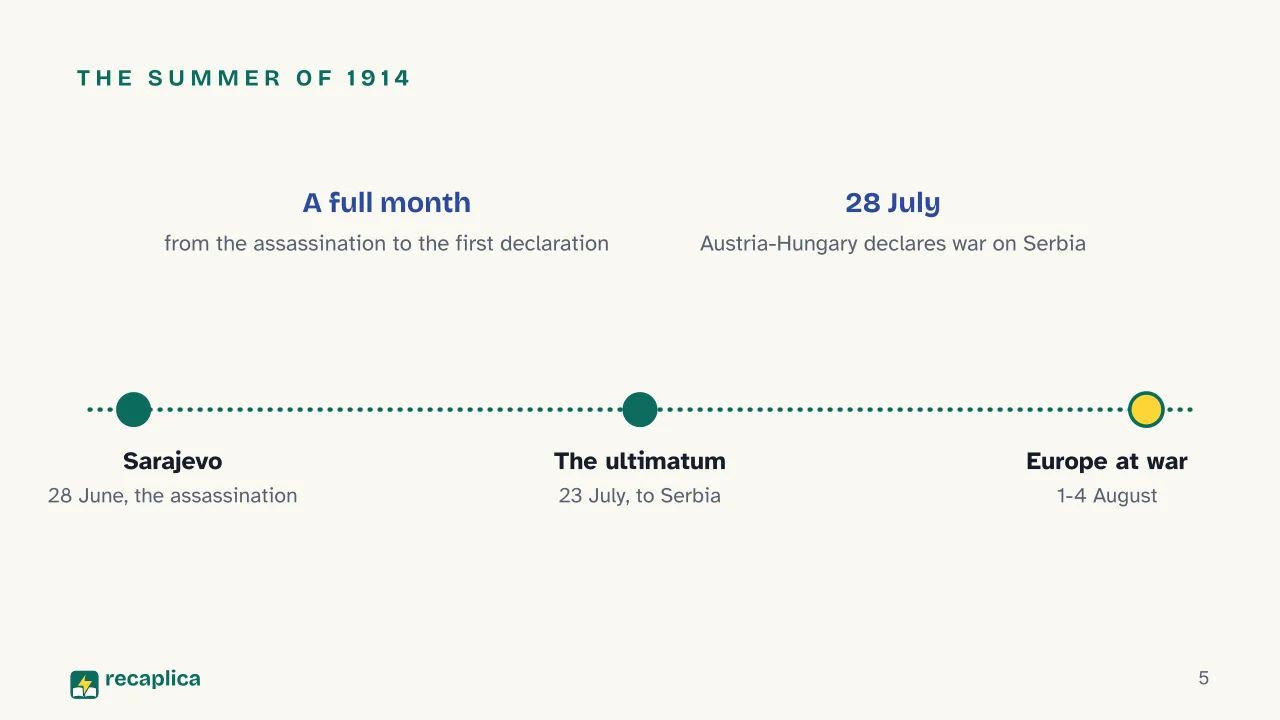 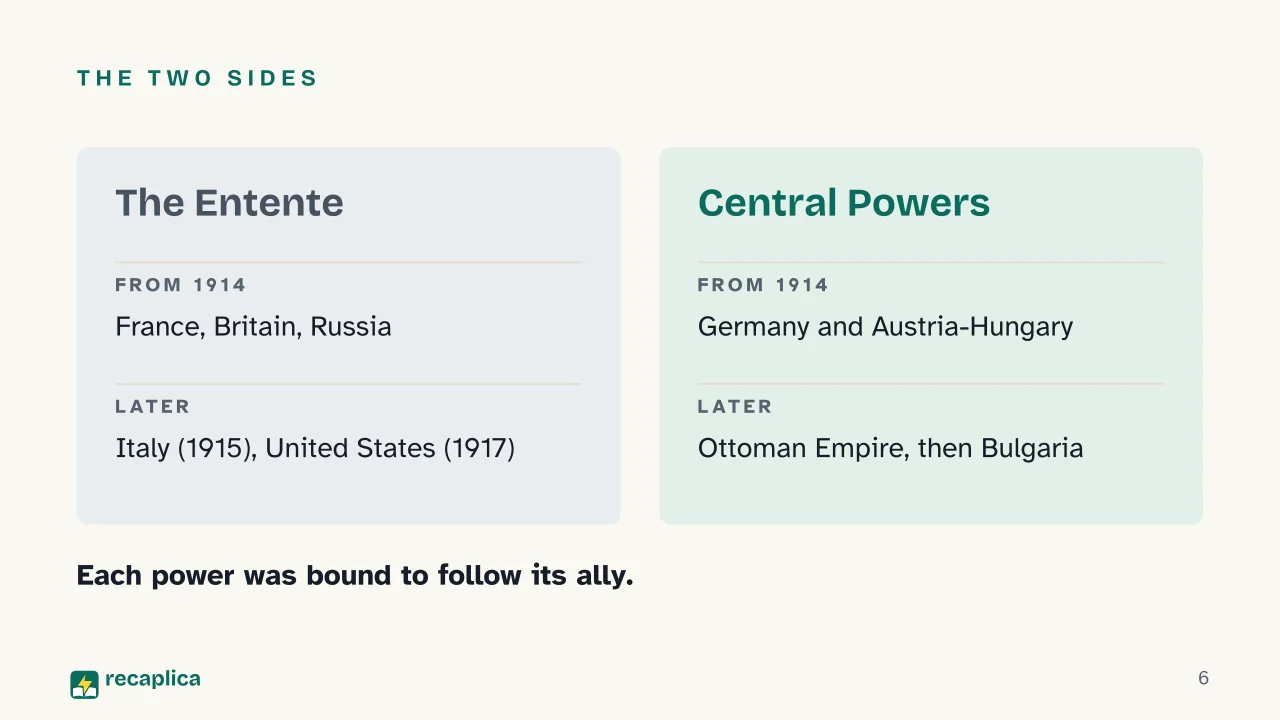  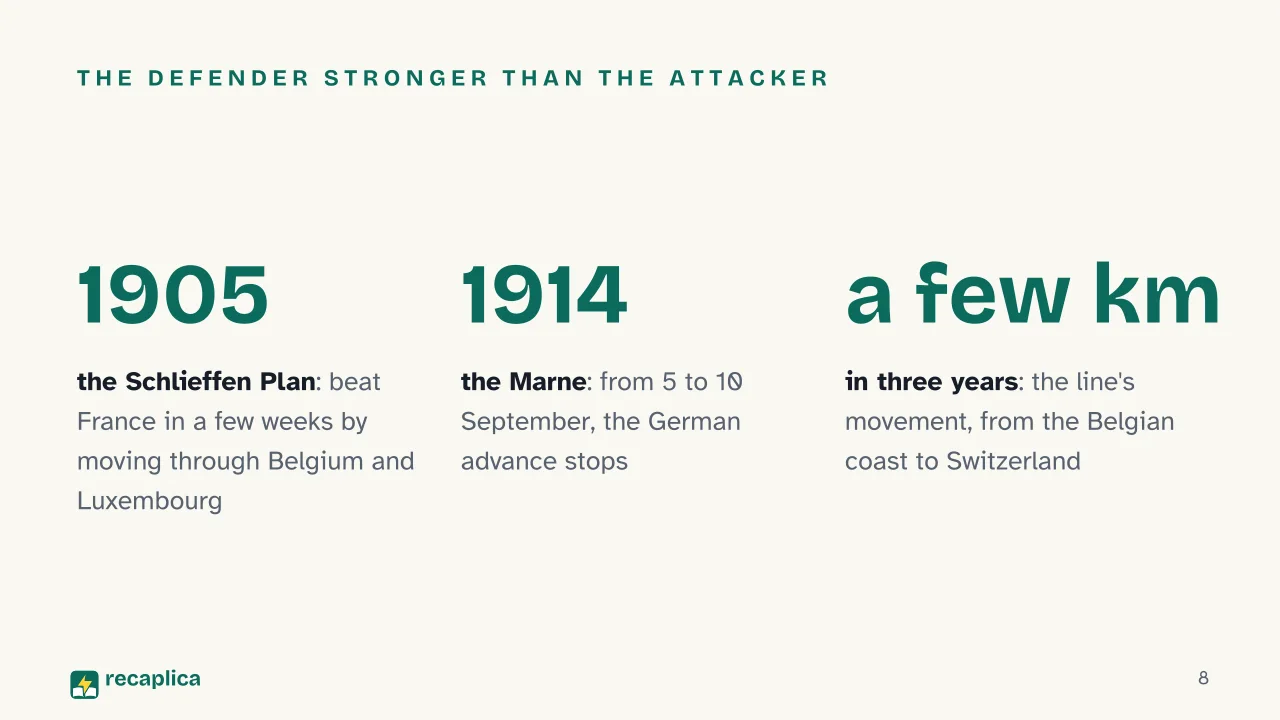 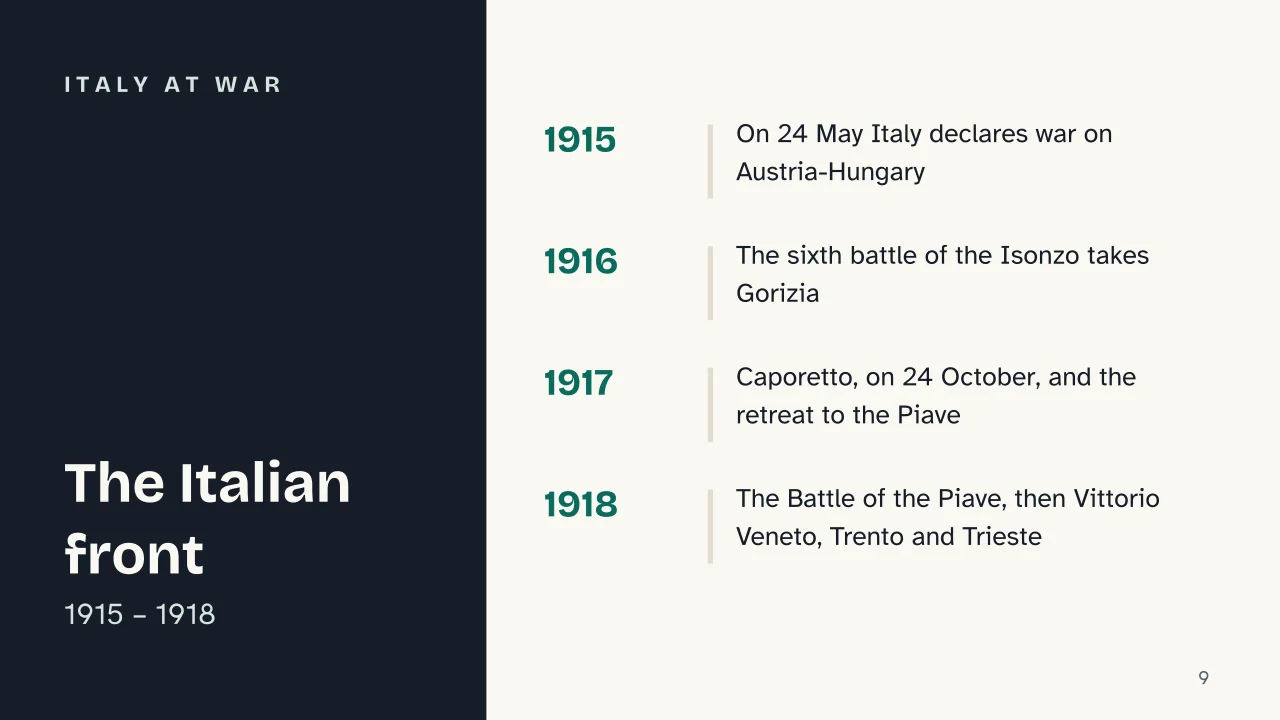  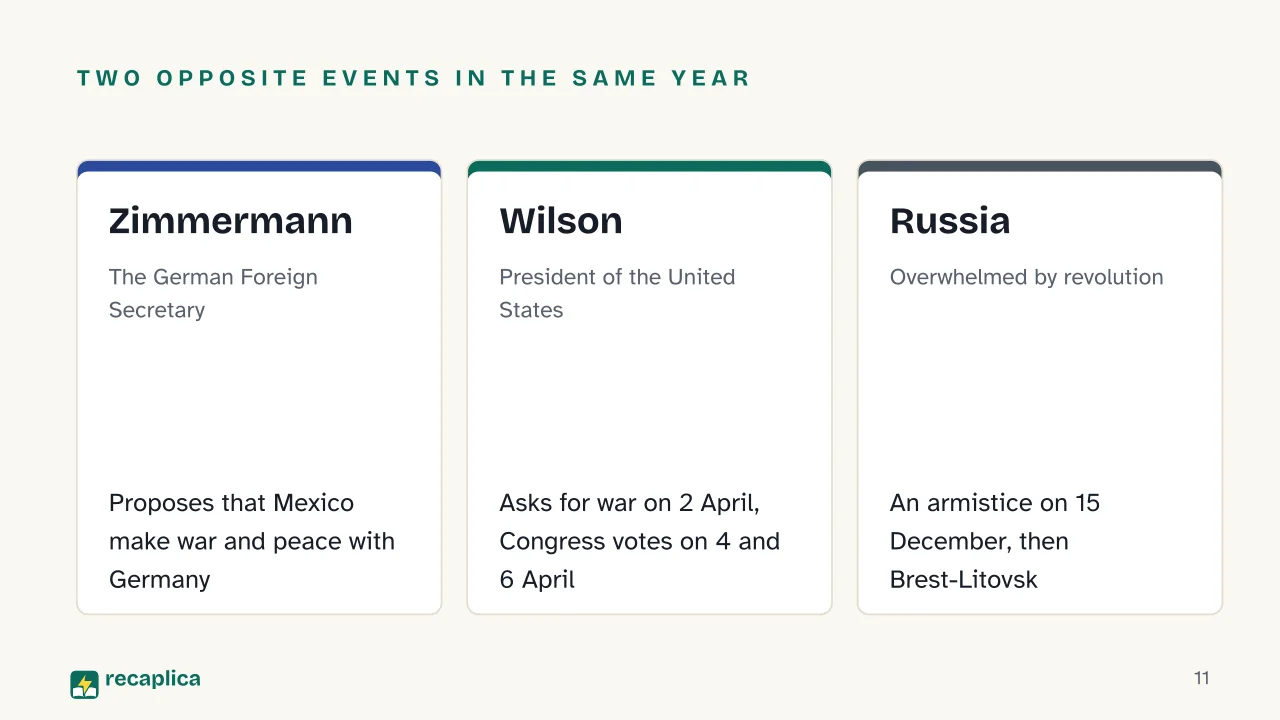 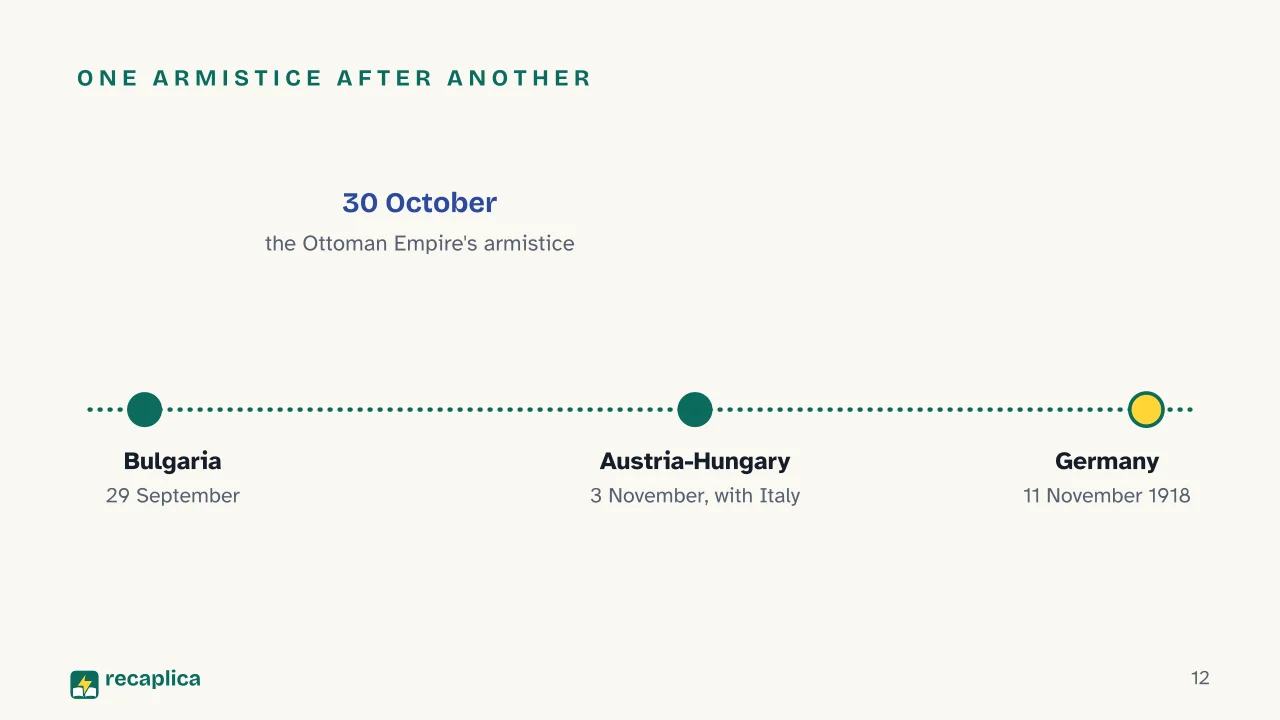  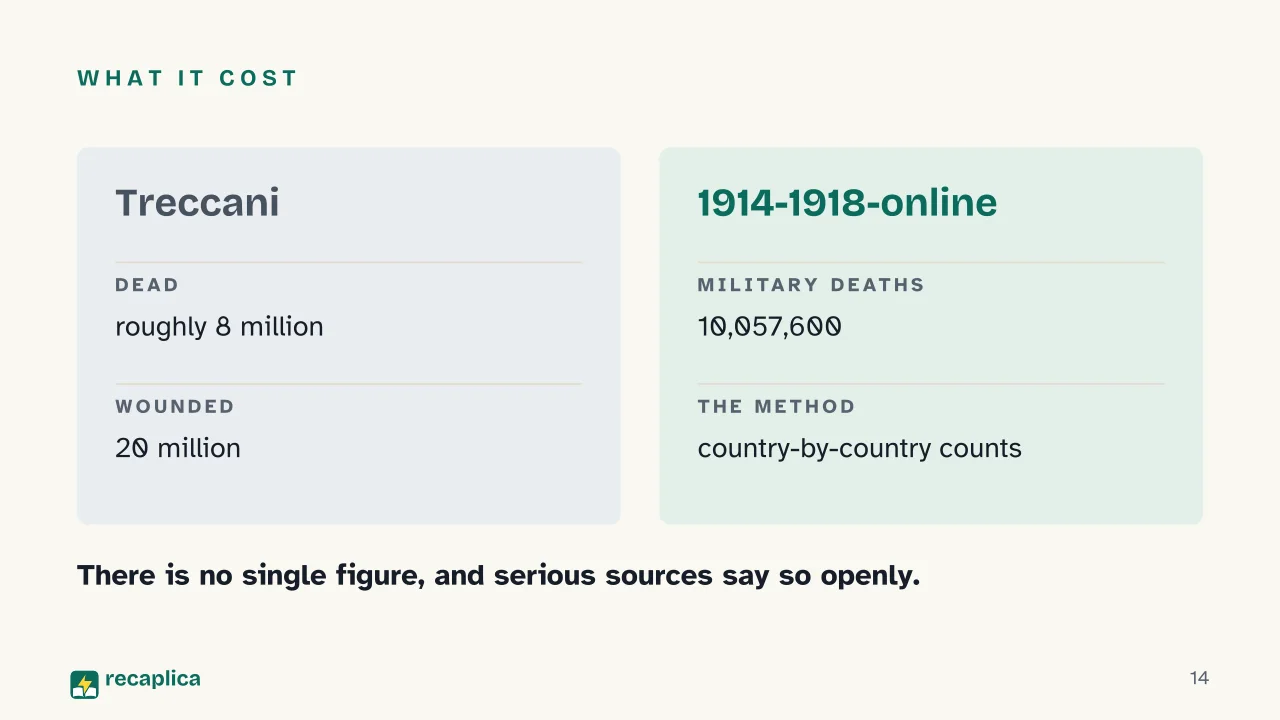 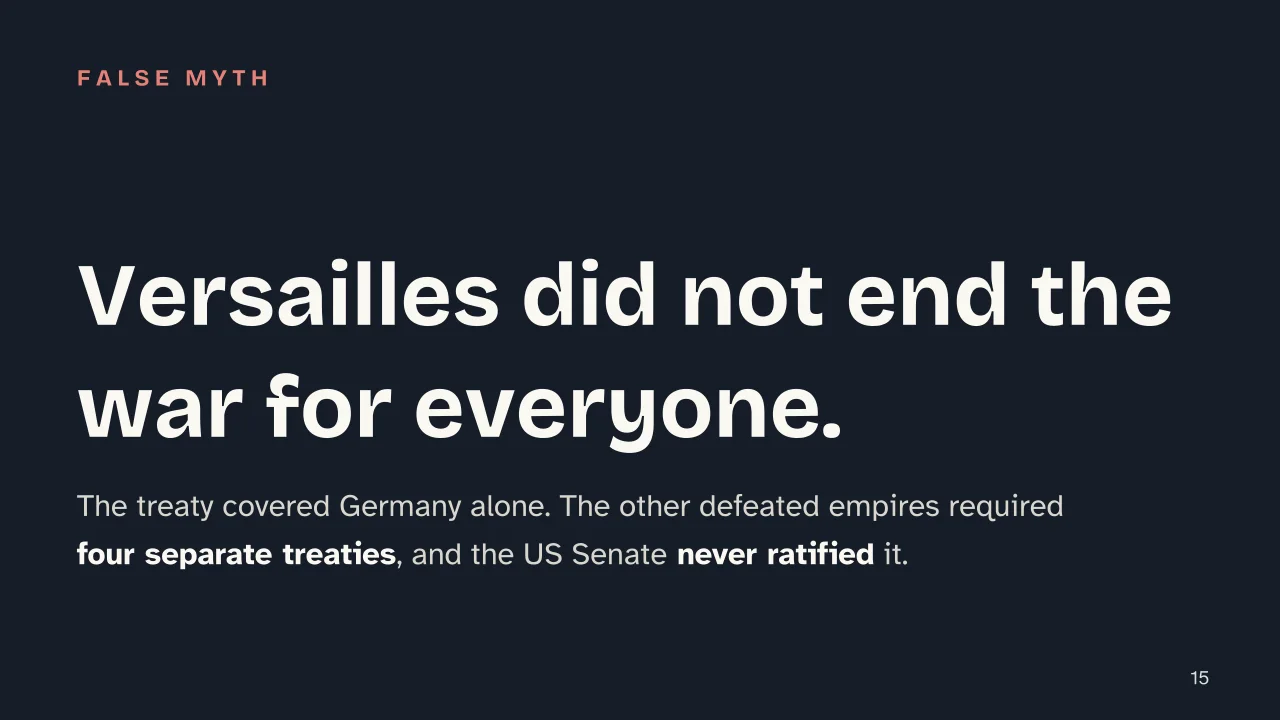 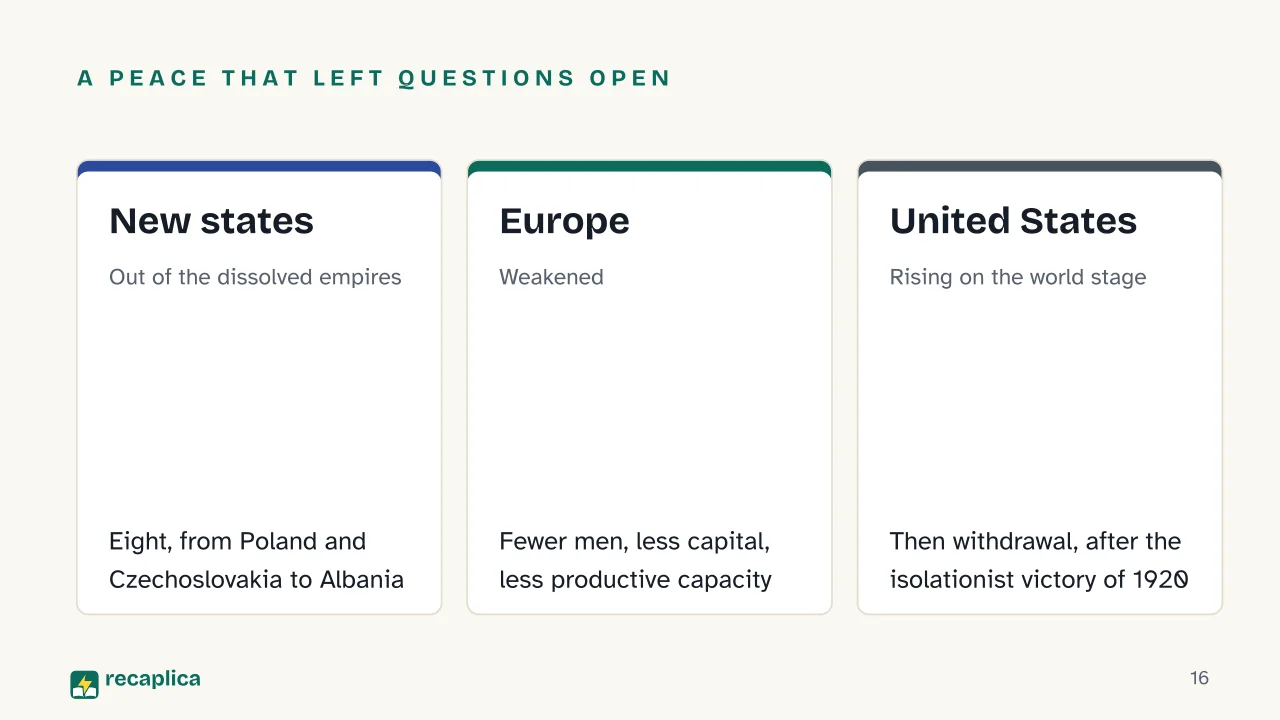 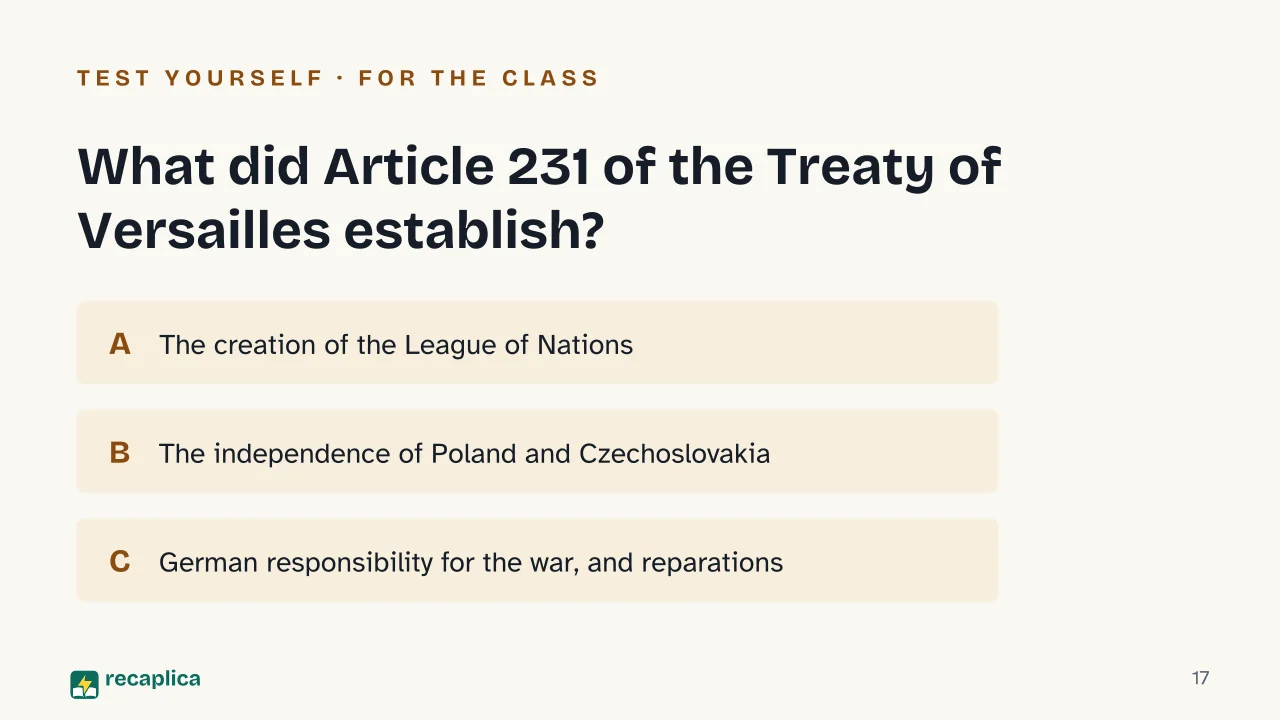  Common myths
Mind mapDrag the background to move around and the nodes to reposition them; use − and + to collapse and expand branches. 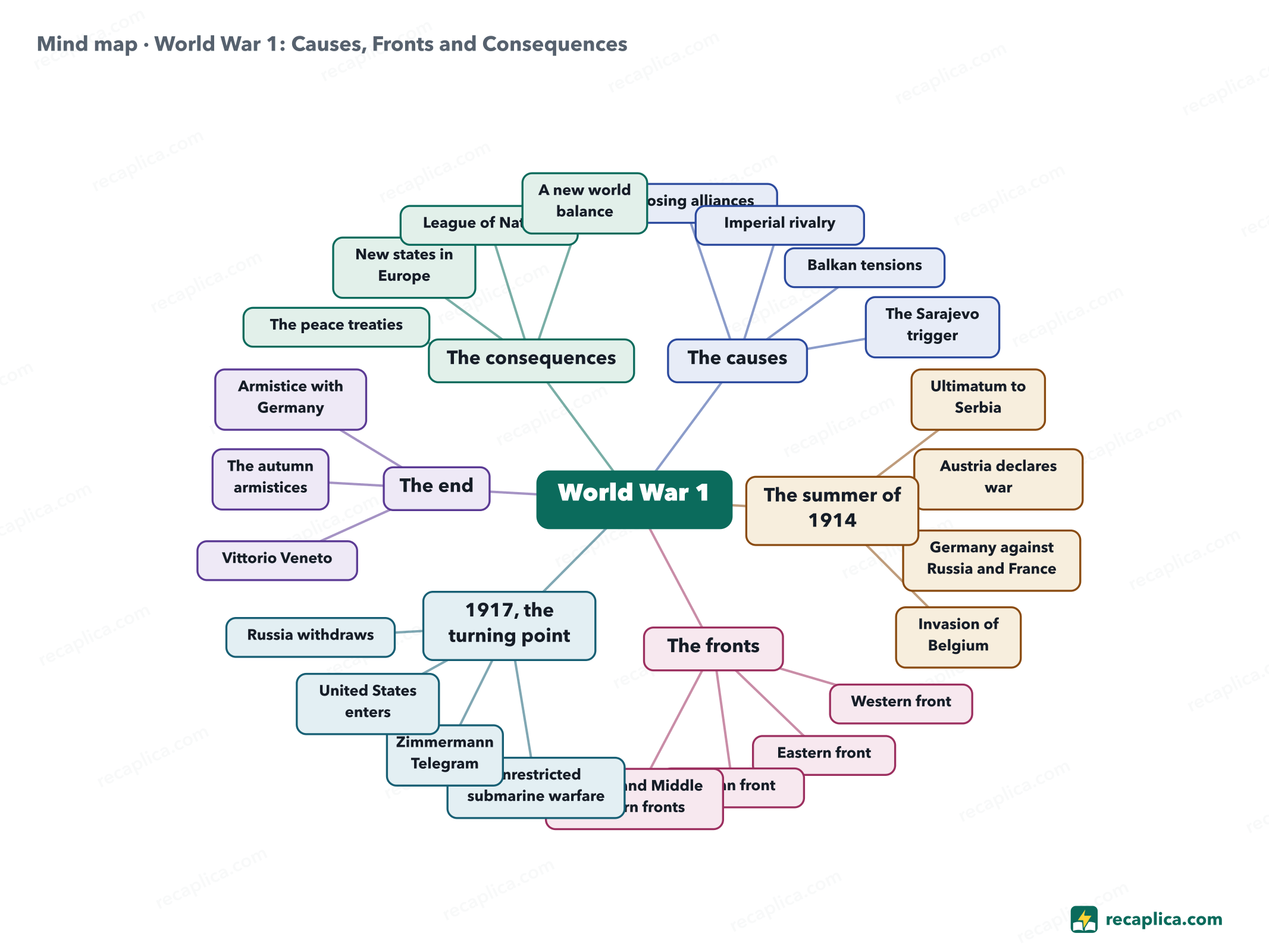
Quiz: test yourselfAnswer the questions to check what you have learned: you get instant feedback and a short explanation. Grade 0/10 0/5
FlashcardsTap the card to flip it and check whether you remember the answer, then move to the next one. 1 / 8 Explain it in your own wordsThe ultimate test: if you can explain it in simple words, you've truly understood it. Write your explanation, then compare it with the Recap. Your explanation is saved only on this device.
Frequently asked questionsWhen did World War 1 start and when did it end?Hostilities opened in the summer of 1914: Austria-Hungary declared war on Serbia on 28 July, Germany on Russia on 1 August and on France on 3 August, then invaded Luxembourg and Belgium. It closed with a run of armistices in the autumn of 1918: Bulgaria on 29 September, the Ottoman Empire on 30 October, Austria-Hungary (with Italy) on 3 November, and Germany on 11 November 1918. Who fought on each side?On one side the Entente, with France, Britain and Russia, joined by Italy in 1915, the United States in 1917 and others; on the other the Central Powers, meaning Germany and Austria-Hungary, alongside the Ottoman Empire from November 1914 and later Bulgaria. Japan joined the Entente on 23 August 1914. How many people died in World War 1?There is no single figure, and serious sources say so openly. Treccani gives roughly 8 million dead and 20 million wounded; the International Encyclopedia of the First World War, which rebuilt the counts country by country, arrives at 10,057,600 military deaths, including 2,037,000 Germans, 1,997,500 Russians, 1,513,500 Austro-Hungarians, 1,400,000 French and colonial troops, 959,000 from Britain and its Empire, 772,000 Ottomans, 600,000 Italians and 87,900 Americans. The gaps come from different definitions of a war death and from national records built on inconsistent criteria. Why is the Treaty of Versailles said to have prepared the way for World War 2?Because it imposed harsh terms on Germany — the loss of about 10 per cent of its prewar European territory and of all its overseas possessions, responsibility for the war under Article 231, and reparations of 132 billion gold marks — without building an international order sturdy enough to hold. The League of Nations was founded in 1919 but proved largely ineffective, and the United States never joined it. What was the defeat at Caporetto?The Austro-German breakthrough on the Italian front that began on 24 October 1917. The Italian army was forced into a long retreat to the river Piave, where the new commander Armando Diaz reorganised the defence. Exactly a year later, from the Piave line, the final offensive set out: Vittorio Veneto was taken on 29 October 1918, and the troops went on to reach Trento and Trieste. Every Recap goes through an independent review before publication. |