Skip to content
recaplica

    One moment: security check

    Cloudflare wants to make sure you're not a robot. Tick the box below and your search will continue on its own.

    IT
    recaplica Popular Sovereignty and Citizenship: What They Mean
    © 2026 Recaplica · recaplica.com — All rights reserved
    Home › Civics

    Popular Sovereignty and Citizenship: What They Mean

    By Recaplica Newsroom · Updated on September 25, 2026

    What to print

    Page numbers appear when printing with default margins.

    Slides

    Choose a cut

    Flash10 slidesThe essential thread, to present in classFull16 slidesEvery chapter and the deeper detail

    Both come with speaker notes.

    Telegram channel
    recaplica Clear in 30 seconds, yours in 10 minutes.
    In 30 seconds Key points Deep dive Slides Myths Mind map Quiz Flashcards FAQ

    In 30 seconds quick read

    Popular sovereignty is the principle, written into Article 1 of Italy's Constitution, that state power belongs to the people, who exercise it within the forms and limits the Constitution itself sets, through Parliament, elections, and the tools it provides, not through a direct vote on every law. Citizenship is a different matter: the legal status that ties a person to a state, together with the rights and duties that relationship carries, as the Enciclopedia Treccani defines it. In Italy, Law No. 91 of February 5, 1992 makes a person a citizen at birth mainly through jus sanguinis, at least one citizen parent, reserving birth on Italian soil for cases where both parents are unknown or stateless. The idea that power comes from the people themselves, rather than from a sovereign standing above them, traces back to Jean-Jacques Rousseau and his 1762 Social Contract, and it is, according to the Stanford Encyclopedia of Philosophy, the version of sovereignty most widespread in contemporary constitutional governments around the world.

    Key Points

    • Article 1 of the Constitution assigns sovereignty to the people, but has them exercise it within the forms and limits the Constitution sets, not without constraints.
    • Citizenship is the legal status of belonging to a state, defined by the Enciclopedia Treccani as the condition that carries rights and duties.
    • Jus sanguinis is the main rule in Italy: Law No. 91 of February 5, 1992 makes a person a citizen at birth if at least one parent is a citizen.
    • Jus soli applies in Italy only as a residual case, for someone born on Italian territory to parents who are both unknown or stateless.
    • According to Treccani, Italian citizenship can be lost through explicit renunciation or in two cases tied to holding public office or military service for a foreign state.
    • According to the Stanford Encyclopedia of Philosophy, Jean-Jacques Rousseau proposed, in the 1762 Social Contract, the people as a collective sovereign, an alternative to the models of Bodin and Hobbes.

    Deep Dive

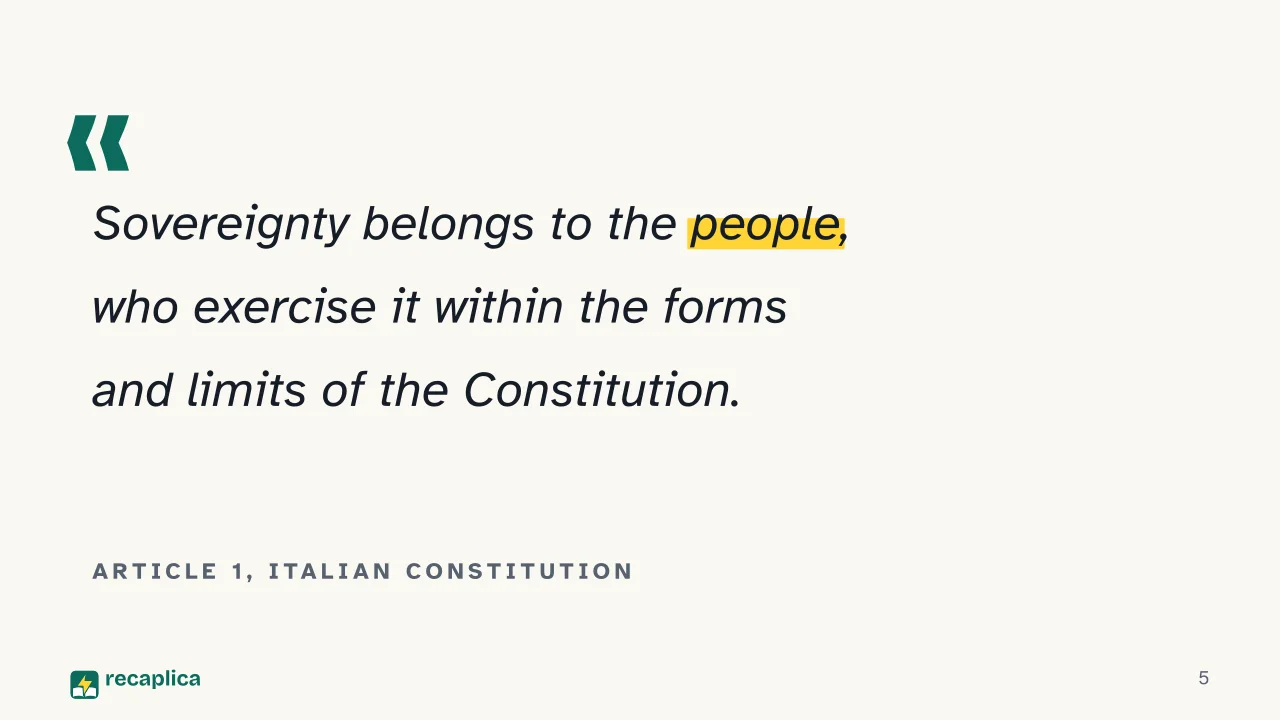
    Article 1 of the Italian Constitution holds two short statements together. The first defines the form of the state: “Italy is a democratic Republic founded on labor.” The second says where its power comes from: “Sovereignty belongs to the people, who exercise it within the forms and limits of the Constitution.” These are two different claims: one describes what kind of state Italy is, the other explains who ultimately holds its authority.

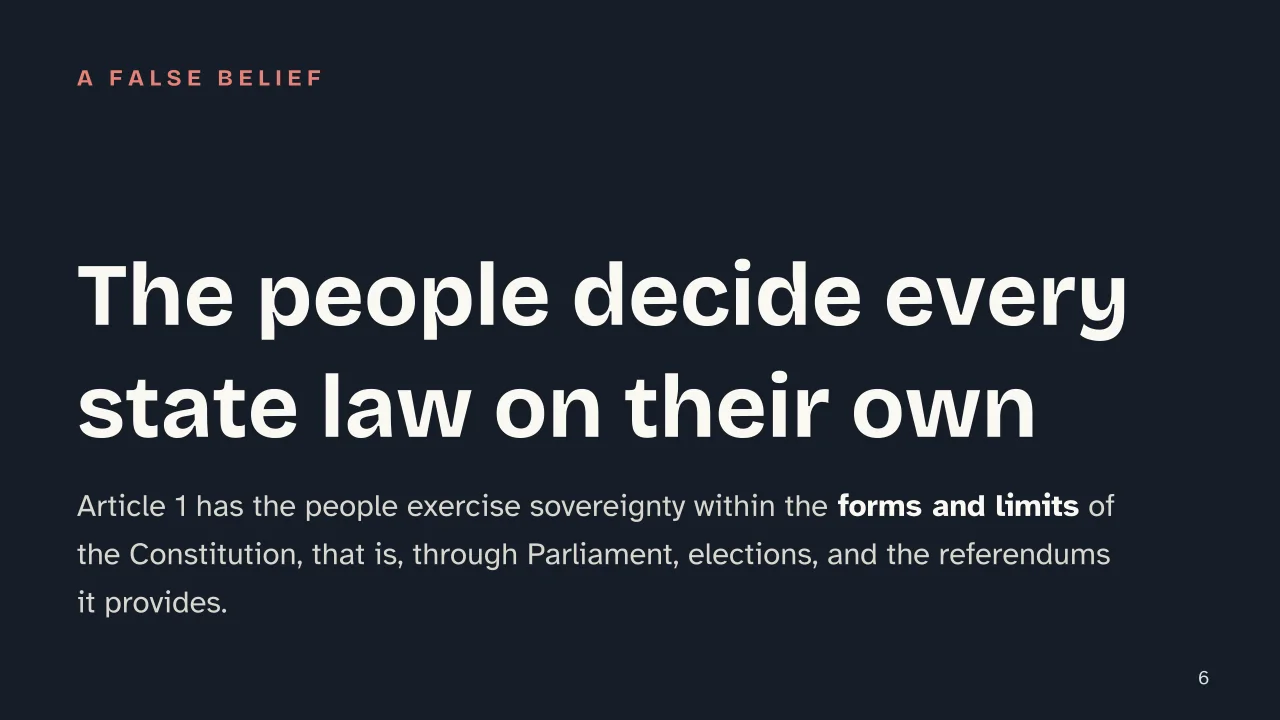
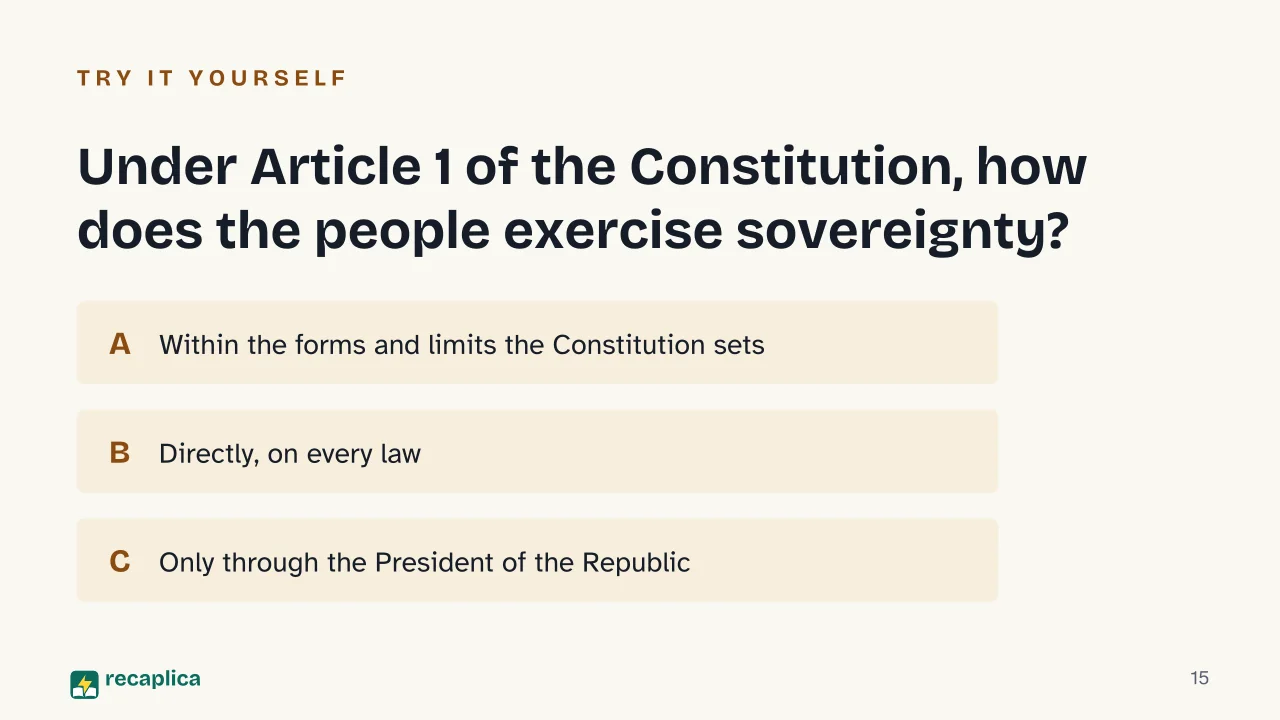
    The delicate part sits in the second half of that sentence. The text does not say the people govern without intermediaries; it says they do so “within the forms and limits of the Constitution.” The forms are the elected Parliament, periodic elections, and the referendums the text itself provides; the limits are the rules those same forms must respect, starting with the rights the Constitution recognizes. For anyone studying the full structure of the Italian Constitution, this is the point that matters: the people’s power passes through the institutions the Constitution itself entrusts with it.

    Practical example: when a citizen votes in a political election, they are exercising popular sovereignty through one of the “forms” the Constitution provides, not governing directly; the actual decision on a law still passes through the Parliament that vote elected.

    The forms and limits Article 1 refers to are themselves written into legal rules, not simple customs: the difference between a rule that binds the state and a habit that does not is exactly what a legal norm is about.

    What citizenship means

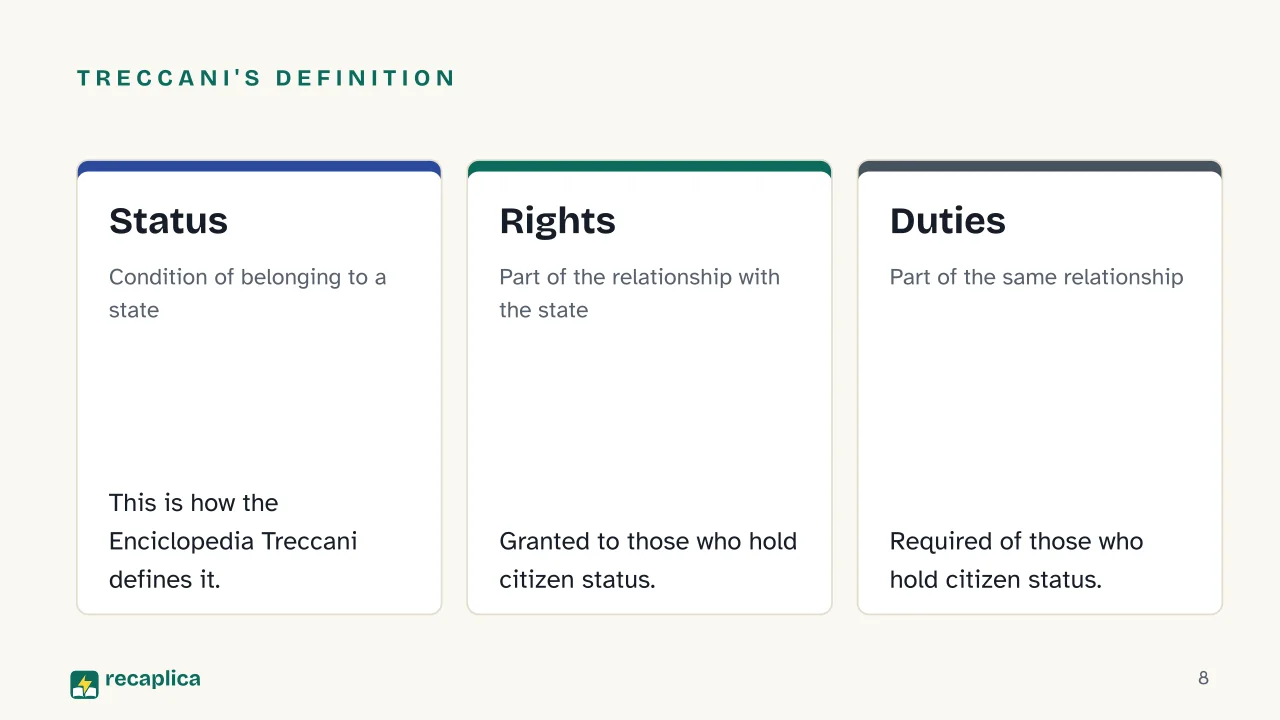
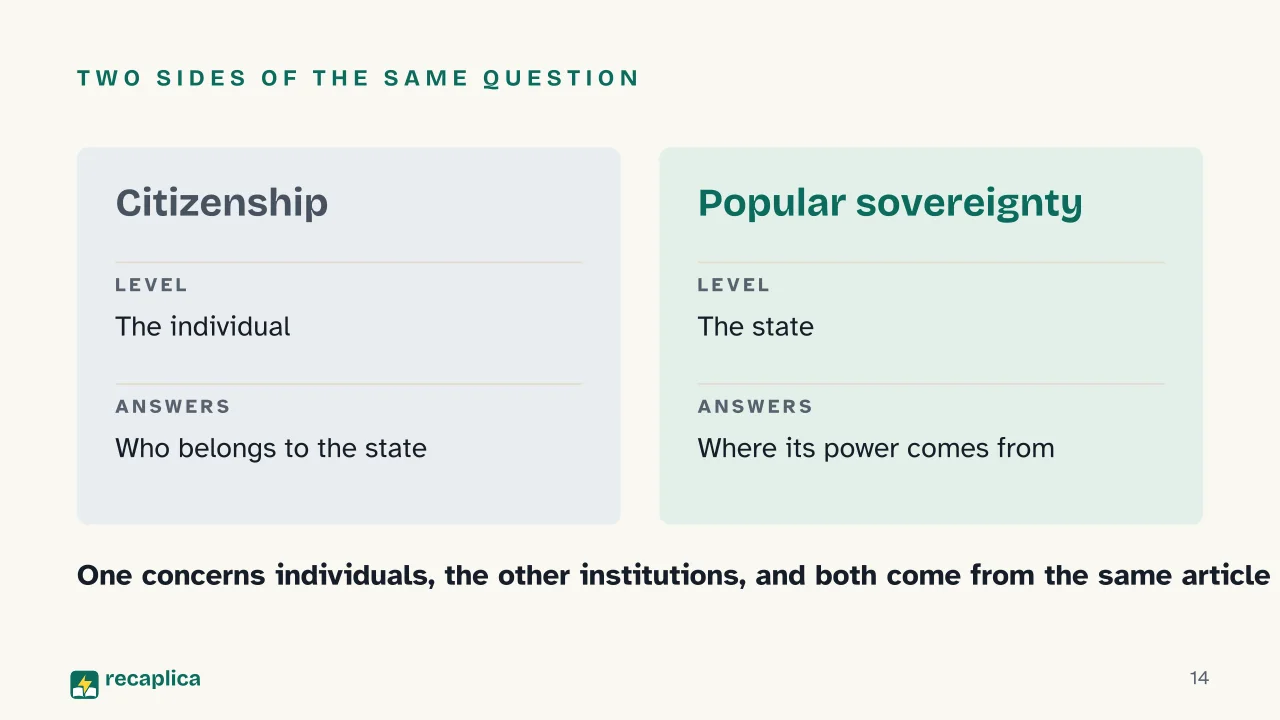
    Citizenship is a distinct concept from popular sovereignty, even though Article 1 touches on both in the same sentence when it mentions “the people.” Sovereignty concerns the state as a whole, while citizenship concerns the individual person. The Enciclopedia Treccani defines citizenship as the condition of an individual’s belonging to a state, together with the rights and duties that relationship carries.

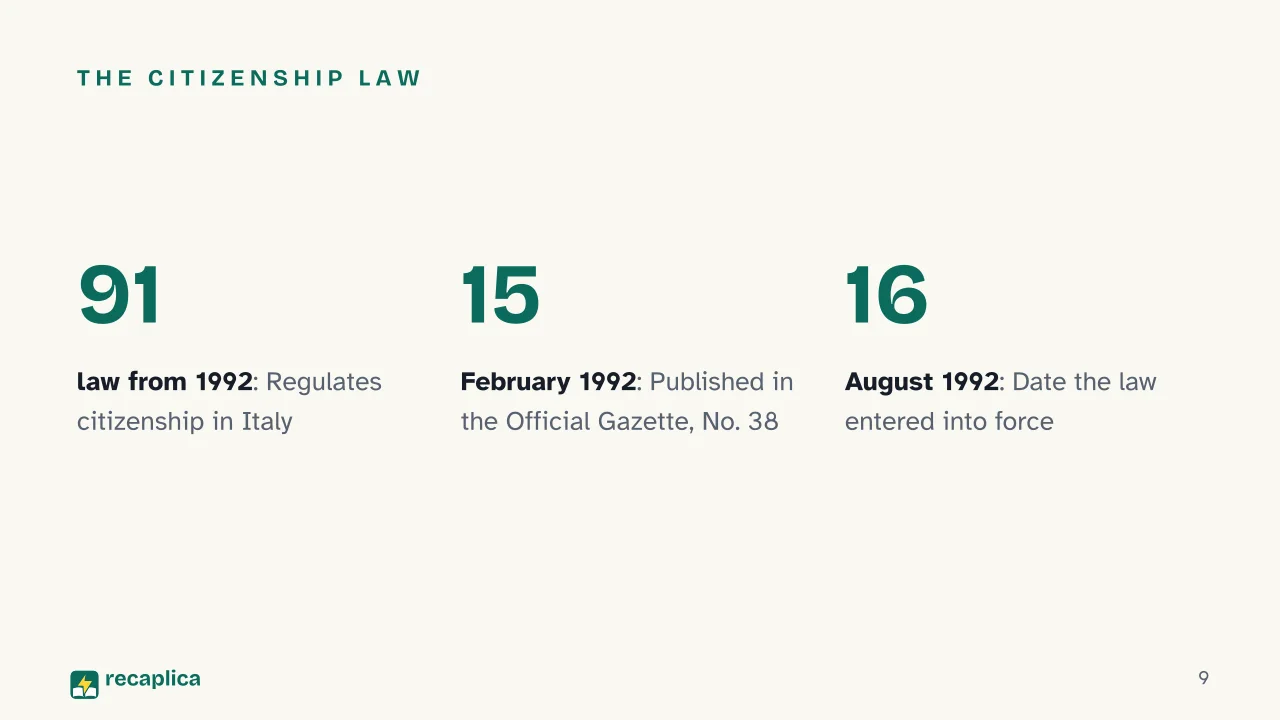
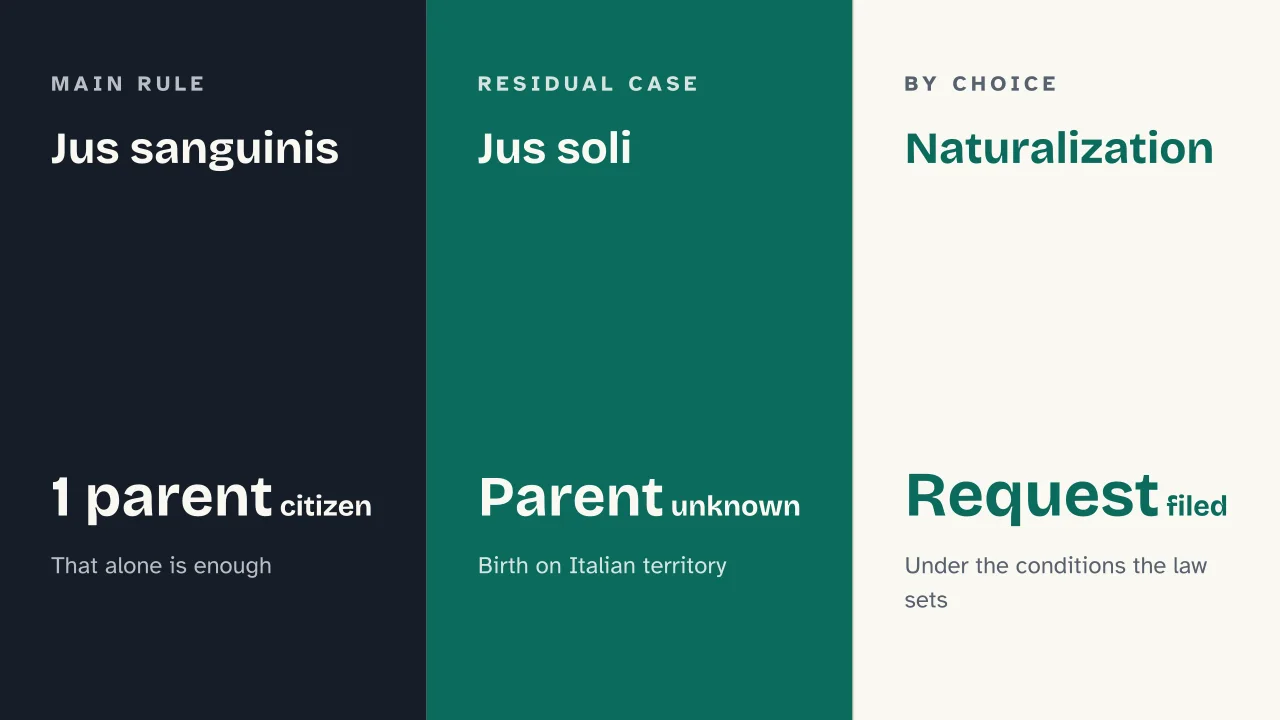
    In Italy, how a person becomes a citizen is regulated by Law No. 91 of February 5, 1992, published in the Official Gazette on February 15, 1992 and in force since August 16, 1992. Article 1 of that law establishes that a child of a citizen father or mother is a citizen by birth, the criterion known as jus sanguinis. A second criterion, jus soli, applies in Italy only as a residual case: someone born on the territory of the Republic becomes a citizen by birth if both parents are unknown or stateless. There is also a third route, naturalization, which Treccani describes as acquiring citizenship at the applicant’s own request, once that person meets the conditions the law sets.

    CriterionWho becomes a citizenSource
    Jus sanguinisAnyone with at least one citizen parentLaw No. 91/1992, Art. 1
    Jus soli (residual)Anyone born in Italy to parents who are both unknown or statelessLaw No. 91/1992, Art. 1
    NaturalizationAnyone who applies while meeting the conditions setTreccani

    Practical example: a child born in Italy to two Italian parents is a citizen by jus sanguinis from birth, regardless of where the birth took place; had the child been born abroad, they would still be an Italian citizen under the same criterion.

    On losing citizenship, Treccani notes that forfeiting Italian citizenship is limited to two specific cases, tied to taking on public office or serving in the military for a foreign state, and that Italian citizenship can also be lost through explicit renunciation. These are defined cases, not a status that fades simply through the passage of time or a move abroad.

    Where the idea of popular sovereignty comes from

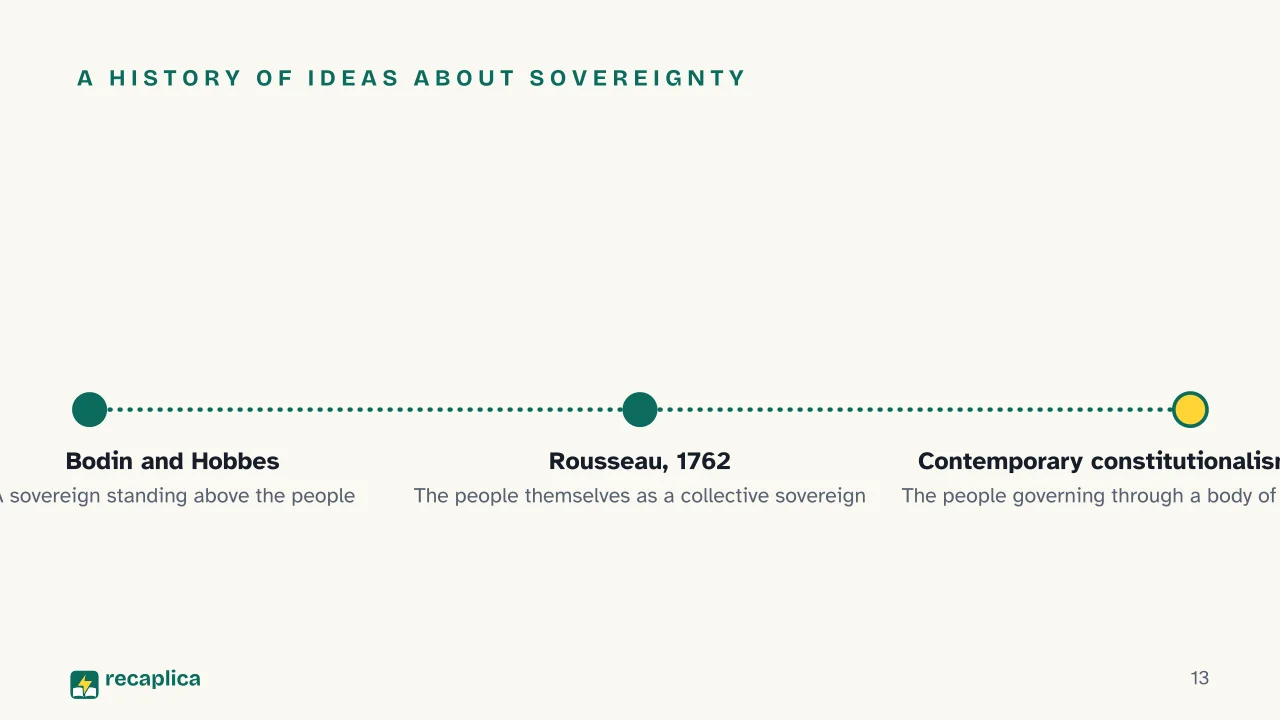
    The idea that state power belongs to the people themselves, rather than to a sovereign set apart from them, has a longer history than Italy’s twentieth-century Constitution. According to the Stanford Encyclopedia of Philosophy, the earlier models of Jean Bodin and Thomas Hobbes placed sovereignty in a sovereign standing above the population. Jean-Jacques Rousseau proposed an alternative: in the Social Contract, a work from 1762, he described “the collective people within a state as the sovereign, ruling through their general will,” meaning the people themselves, as a whole, as the sovereign governing through their own general will.

    That shift is the conceptual root of what Article 1 of the Italian Constitution states. The same Stanford Encyclopedia of Philosophy notes that, in contemporary constitutional government, it is the people ruling through a body of law that is sovereign, “the version that commands legitimacy most commonly in the world today.” It is the same pattern found in Italy’s Article 1: not a people acting without constraints, but a people governing inside a body of law that they themselves, through their institutions, have helped shape.

    No state, for that matter, exercises its sovereignty in complete isolation. By joining treaties and international organizations, states accept agreed limits on their own power, as happens in the everyday workings of the European Union. “Sovereignty” is, after all, a word used in other fields too, not only the constitutional one: food sovereignty, for instance, refers to a territory’s ability to decide over its own food, a different use of the same word applied to another domain.

    Citizenship and popular sovereignty, two sides of the same question

    Citizenship and popular sovereignty answer two different but connected questions. The first asks who belongs to the state, and with what rights and duties; the second asks where that same state’s power comes from. Article 1 of the Constitution holds them together in a single sentence, while Law No. 91 of 1992 works out the details only of the first question, establishing precisely who is an Italian citizen and how one becomes one.

    Understanding the difference also helps in reading the rest of the Constitution more carefully: whenever the text mentions “the people,” it is referring, depending on context, either to the body of citizens holding sovereignty or to the sum of individual persons who have been granted that status.

    Slide deck

    Slides ready to download and make your own in PowerPoint or Google Slides, with speaker notes. Pick the Flash cut or the Full one.
    Slide 1 of the presentation on Popular Sovereignty and Citizenship: Popular Sovereignty and CitizenshipSlide 2 of the presentation on Popular Sovereignty and Citizenship: Where does the state's power come from?Slide 3 of the presentation on Popular Sovereignty and Citizenship: The path aheadSlide 4 of the presentation on Popular Sovereignty and Citizenship: Chapter 01: The principle in Article 1Slide 5 of the presentation on Popular Sovereignty and Citizenship: Article 1, Italian ConstitutionSlide 6 of the presentation on Popular Sovereignty and Citizenship: The people decide every state law on their ownSlide 7 of the presentation on Popular Sovereignty and Citizenship: Chapter 02: Who counts as a citizenSlide 8 of the presentation on Popular Sovereignty and Citizenship: Treccani's definition: Status, Rights, DutiesSlide 9 of the presentation on Popular Sovereignty and Citizenship: The citizenship lawSlide 10 of the presentation on Popular Sovereignty and Citizenship: Chapter 03: How citizenship is acquiredSlide 11 of the presentation on Popular Sovereignty and Citizenship: Jus sanguinis · Jus soli · NaturalizationSlide 12 of the presentation on Popular Sovereignty and Citizenship: Chapter 04: Where the idea comes fromSlide 13 of the presentation on Popular Sovereignty and Citizenship: A history of ideas about sovereigntySlide 14 of the presentation on Popular Sovereignty and Citizenship: Two sides of the same questionSlide 15 of the presentation on Popular Sovereignty and Citizenship: Under Article 1 of the Constitution, how does the people exercise sovereignty?Slide 16 of the presentation on Popular Sovereignty and Citizenship: To learn more
    Flash10 slidesThe essential thread, to present in classFull16 slidesEvery chapter and the deeper detail

    Common myths

    • ✗ Myth Many people think popular sovereignty means the people decide every state law directly, on their own.

      ✓ Reality Article 1 of the Constitution has the people exercise sovereignty within the forms and limits the Constitution sets, that is, through Parliament, elections, and tools such as the referendum, because the text chooses power channeled through the institutions the Constitution provides.

    • ✗ Myth It is often assumed that being born on Italian soil automatically makes someone an Italian citizen.

      ✓ Reality Under Law No. 91 of February 5, 1992, jus soli in Italy is residual: it applies only to someone born to parents who are both unknown or stateless, because the main rule in the Italian legal system is jus sanguinis, having at least one citizen parent.

    • ✗ Myth Many believe that once obtained, Italian citizenship can never be lost.

      ✓ Reality According to Treccani, it can be lost through explicit renunciation, or in two cases tied to taking on public office or serving in the military for a foreign state, because the law sets out specific cases rather than a permanent bond.

    Mind map

    Drag the background to move around and the nodes to reposition them; use − and + to collapse and expand branches.
    Customize
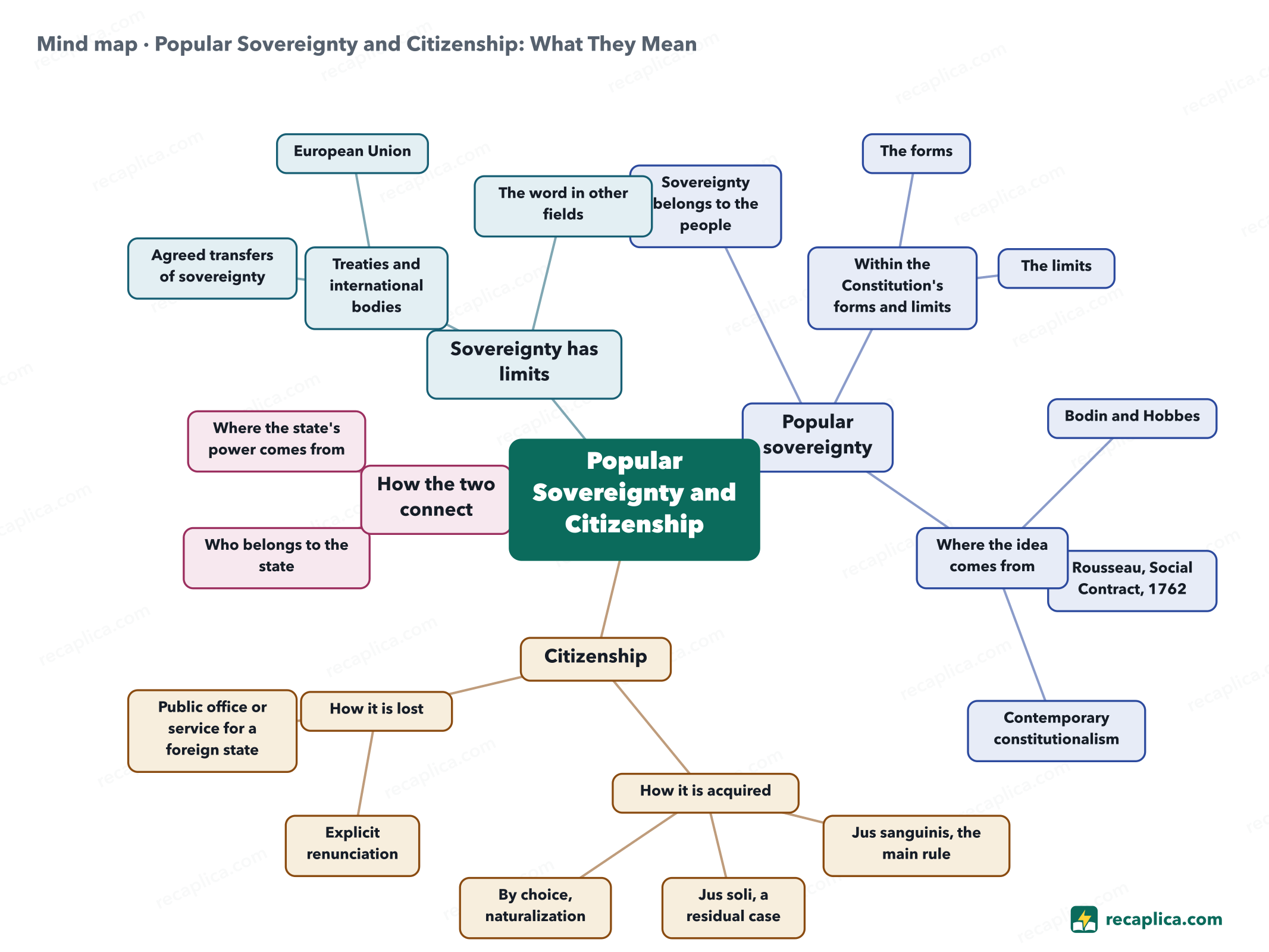
    Mind map: Popular Sovereignty and Citizenship: What They Mean
    • Popular Sovereignty and Citizenship
      • Popular sovereignty Article 1 of the Constitution
        • Sovereignty belongs to the people The principle in Article 1
        • Within the Constitution's forms and limits
          • The forms Parliament, elections, referendums
          • The limits Rights the Constitution recognizes
        • Where the idea comes from
          • Bodin and Hobbes A sovereign above the people
          • Rousseau, Social Contract, 1762
          • Contemporary constitutionalism The people governing through a body of law
      • Citizenship Legal status of belonging to a state
        • How it is acquired
          • Jus sanguinis, the main rule
          • Jus soli, a residual case
          • By choice, naturalization
        • How it is lost
          • Explicit renunciation
          • Public office or service for a foreign state
      • How the two connect Two different questions, one article
        • Who belongs to the state
        • Where the state's power comes from
      • Sovereignty has limits No state stands alone
        • Treaties and international bodies
          • Agreed transfers of sovereignty
          • European Union An example of agreed limits
        • The word in other fields Food sovereignty, a different use

    Quiz: test yourself

    Answer the questions to check what you have learned: you get instant feedback and a short explanation.

    Grade 0/10 0/5
    1 According to Article 1 of the Italian Constitution, who holds sovereignty?

    Article 1 states that sovereignty belongs to the people, who exercise it within the forms and limits of the Constitution, not to a single state body.

    2 True or false: in Italy, citizenship by birth is based mainly on place of birth (jus soli).

    False. Law No. 91 of February 5, 1992 makes a person a citizen at birth mainly through jus sanguinis, having at least one citizen parent; jus soli applies only to someone born in Italy to parents who are both unknown or stateless.

    3 How does the Enciclopedia Treccani define citizenship?

    Treccani defines citizenship as the condition of an individual's belonging to a state, together with the rights and duties that relationship carries.

    4 Which law regulates the acquisition of Italian citizenship by birth?

    It is Law No. 91 of February 5, 1992, published in the Official Gazette on February 15, 1992 and in force since August 16, 1992.

    5 According to the Stanford Encyclopedia of Philosophy, which philosopher proposed the people as a collective sovereign governing through their general will?

    Rousseau proposed this idea in the 1762 Social Contract, as an alternative to the models of Bodin and Hobbes, built around a sovereign separate from the people.

    Answers: 1-A · 2-B · 3-A · 4-A · 5-A

    Flashcards

    Tap the card to flip it and check whether you remember the answer, then move to the next one.

    1 / 8

    Explain it in your own words

    The ultimate test: if you can explain it in simple words, you've truly understood it. Write your explanation, then compare it with the Recap.

    Your explanation is saved only on this device.

    Popular sovereignty is the principle, written into Article 1 of Italy's Constitution, that state power belongs to the people, who exercise it within the forms and limits the Constitution itself sets, through Parliament, elections, and the tools it provides, not through a direct vote on every law. Citizenship is a different matter: the legal status that ties a person to a state, together with the rights and duties that relationship carries, as the Enciclopedia Treccani defines it. In Italy, Law No. 91 of February 5, 1992 makes a person a citizen at birth mainly through jus sanguinis, at least one citizen parent, reserving birth on Italian soil for cases where both parents are unknown or stateless. The idea that power comes from the people themselves, rather than from a sovereign standing above them, traces back to Jean-Jacques Rousseau and his 1762 Social Contract, and it is, according to the Stanford Encyclopedia of Philosophy, the version of sovereignty most widespread in contemporary constitutional governments around the world.

    Frequently asked questions

    What does it mean that sovereignty belongs to the people?

    It means that, under Article 1 of the Constitution, state power originates with the people, who exercise it within the forms and limits the Constitution itself sets, that is, through Parliament, elections, and the tools it provides.

    What is the difference between citizenship and popular sovereignty?

    Citizenship is an individual's legal status, the relationship with rights and duties that ties a person to a state, as Treccani defines it; popular sovereignty is the principle behind who holds the state's power as a whole. Article 1 of the Constitution holds the two together in a single sentence.

    How does someone become an Italian citizen?

    Mainly through jus sanguinis, having at least one citizen parent, under Article 1 of Law No. 91 of February 5, 1992. Jus soli applies only as a residual case, for someone born on Italian territory to parents who are both unknown or stateless; there is also naturalization, for someone who applies while meeting the conditions the law sets.

    Can Italian citizenship be lost?

    Yes. According to Treccani, Italian citizenship can be lost through explicit renunciation, or in two specific cases tied to taking on public office or serving in the military for a foreign state.

    Where does the idea of popular sovereignty come from?

    According to the Stanford Encyclopedia of Philosophy, it traces back to Jean-Jacques Rousseau, who in the 1762 Social Contract proposed the people themselves as a collective sovereign, governed by their own general will, as an alternative to the models of Bodin and Hobbes built around a sovereign separate from the people; it is the version that commands the widest legitimacy in contemporary constitutional governments.

    Sources

    • Constitution of the Italian Republic, Article 1 (Normattiva)
    • Citizenship (Enciclopedia Treccani, legal section)
    • Law No. 91 of February 5, 1992, New Rules on Citizenship (Normattiva)
    • Sovereignty (Stanford Encyclopedia of Philosophy)

    Every Recap goes through an independent review before publication.

    Every evening, the day's new Recaps on our Telegram channel. Join the channel →

    Keep learning

    • Civics Italian Government Structure: Which Bodies Do What The Italian state rests on five bodies that the Constitution sets up and regulates directly: Parliament makes the laws, the Government carries them out, the President of the Republic represents national unity, the judiciary applies the law to individual cases, and the Constitutional Court checks that laws respect the Constitution. Alongside them sit four bodies of constitutional relevance — the High Council of the Judiciary, the Court of Auditors, the CNEL and the Council of State — auxiliary bodies the Constitution sets up but keeps in a separate category from the five essential ones. Knowing who does what, and which bodies the system cannot run without, is the fastest way into how Italy is actually governed. Read the Recap →
    • Civics Italian Constitution: Structure, Principles, and How It Works Italy's Constitution took effect on January 1, 1948, after the Constituent Assembly gave it final approval on December 22, 1947, and Enrico De Nicola signed it into law on December 27, 1947. The text runs to 139 articles, grouped into Fundamental Principles, Part I on the rights and duties of citizens, Part II on the structure of the Republic, plus 18 transitional and final provisions. It was drafted by 556 deputies elected on June 2, 1946, including 21 women. Amending it is possible but deliberately hard: Article 138 requires two votes in each chamber at least three months apart, with qualified majorities. Read the Recap →
    • Civics Italian Legal System: How Courts and Judges Are Organized The Italian legal system has two branches: the ordinary judiciary, staffed by career magistrates, and special jurisdictions for public administration, public accounts, and military offenses. A case can move through up to three levels of judgment: a first instance, an appeal, and the Court of Cassation, which does not re-examine the facts but checks only whether the law was applied correctly. Magistrates are also split by function rather than rank: those who judge, and public prosecutors, who are required by law to bring criminal charges. The independence of the judiciary from every other branch of the state is safeguarded by the Superior Council of the Judiciary, chaired by the President of the Republic. Read the Recap →

    recaplica

    Clear in 30 seconds, yours in 10 minutes.

    Recaps Mind maps Request a Recap Telegram channel Mind map maker Our method About Privacy & cookies Legal notes & terms of use

    © 2026 Recaplica · A project by Curi S.r.l. — VAT IT05472000750

    Statistics, only if you say so

    To learn which Recaps help most we would use Google Analytics, with aggregate, anonymous data. It starts only with your OK, and you can change your mind anytime. Privacy policy