Skip to content
recaplica

    One moment: security check

    Cloudflare wants to make sure you're not a robot. Tick the box below and your search will continue on its own.

    IT
    recaplica The Time of Indifference by Alberto Moravia: Plot, Characters and Themes
    © 2026 Recaplica · recaplica.com — All rights reserved
    Home › Literature

    The Time of Indifference by Alberto Moravia: Plot, Characters and Themes

    By Recaplica Newsroom · Updated on October 2, 2026

    What to print

    Page numbers appear when printing with default margins.

    Slides

    Choose a cut

    Flash10 slidesThe essential thread, to present in classFull14 slidesEvery chapter and the deeper detail

    Both come with speaker notes.

    Telegram channel
    recaplica Clear in 30 seconds, yours in 10 minutes.
    In 30 seconds Key points Figures Deep dive Slides Myths Mind map Quiz Flashcards FAQ

    In 30 seconds quick read

    "The Time of Indifference" is Alberto Moravia's debut novel, published in 1929. Over a handful of days, it follows the Ardengo siblings, Carla and Michele, two young members of the middle class who cannot feel anything real about what happens to them. Around them move their mother Mariagrazia, her lover Leo Merumeci, and Lisa, who has feelings for Michele. The book is a stark, realistic portrait of a middle-class family's hypocrisies, and it remains a reference point of twentieth-century Italian fiction.

    Key Points

    • The novel came out in 1929; Moravia began writing it at eighteen, between Bressanone and Rome.
    • The protagonists are the siblings Carla and Michele Ardengo, unable to respond to events with real feeling.
    • On Carla's birthday, Leo Merumeci tries to get her drunk to take advantage of her; the plan fails because she falls ill.
    • The title names the book's central theme: characters who never pass judgment on what happens to them.
    • Moravia paid to have the book printed himself, through the publisher Alpes, after a first publisher turned it down.
    • A review by Giuseppe Antonio Borgese in the Corriere della Sera, on 21 July 1929, decided the novel's success.

    Key figures

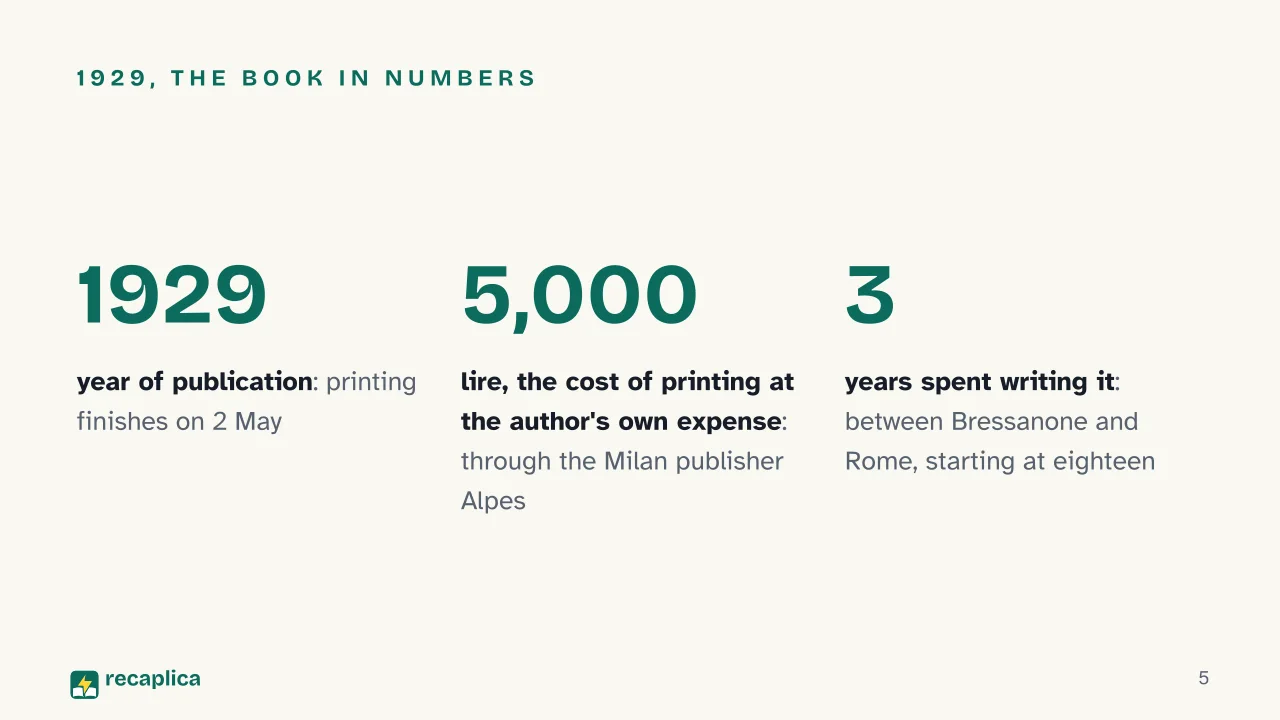
    • 1929 Year the novel was published; printing was finished on 2 May. Source: Dizionario Biografico degli Italiani, Treccani
    • 5,000 lire The cost of printing the book at the author's own expense, through the Milan publisher Alpes, in 1929. Source: Dizionario Biografico degli Italiani, Treccani

    Deep Dive

    The plot of “The Time of Indifference”

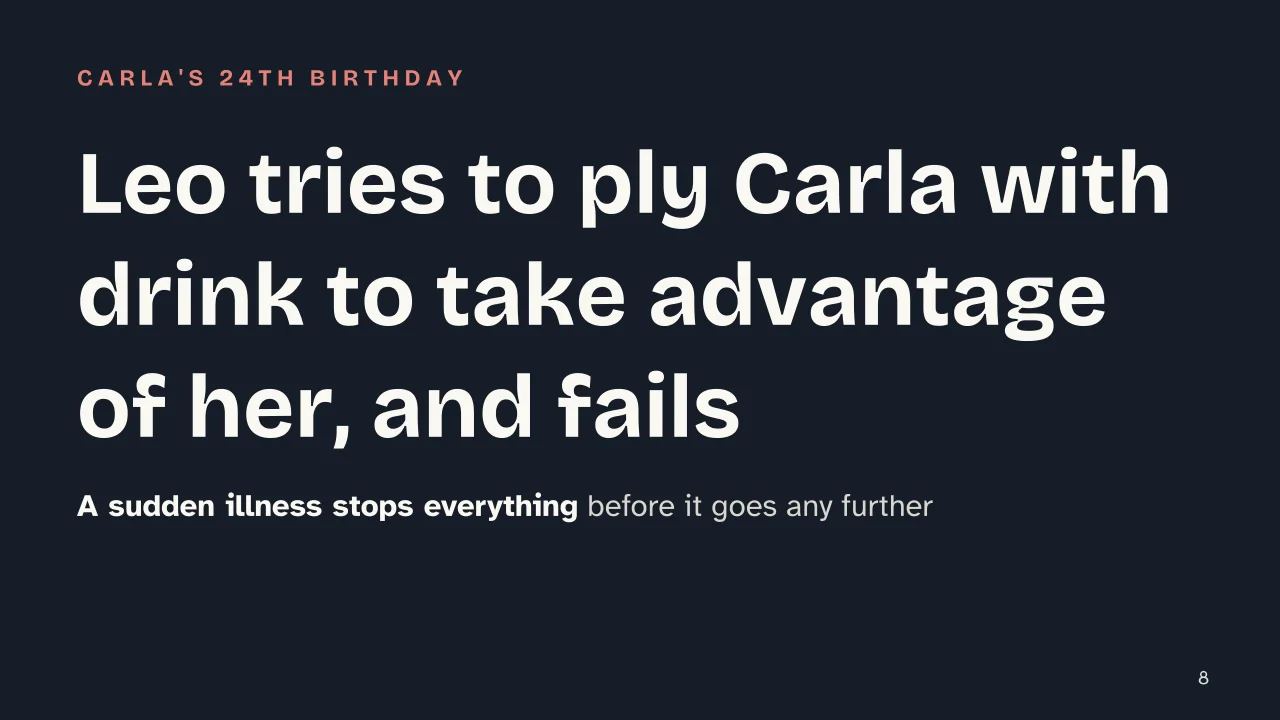
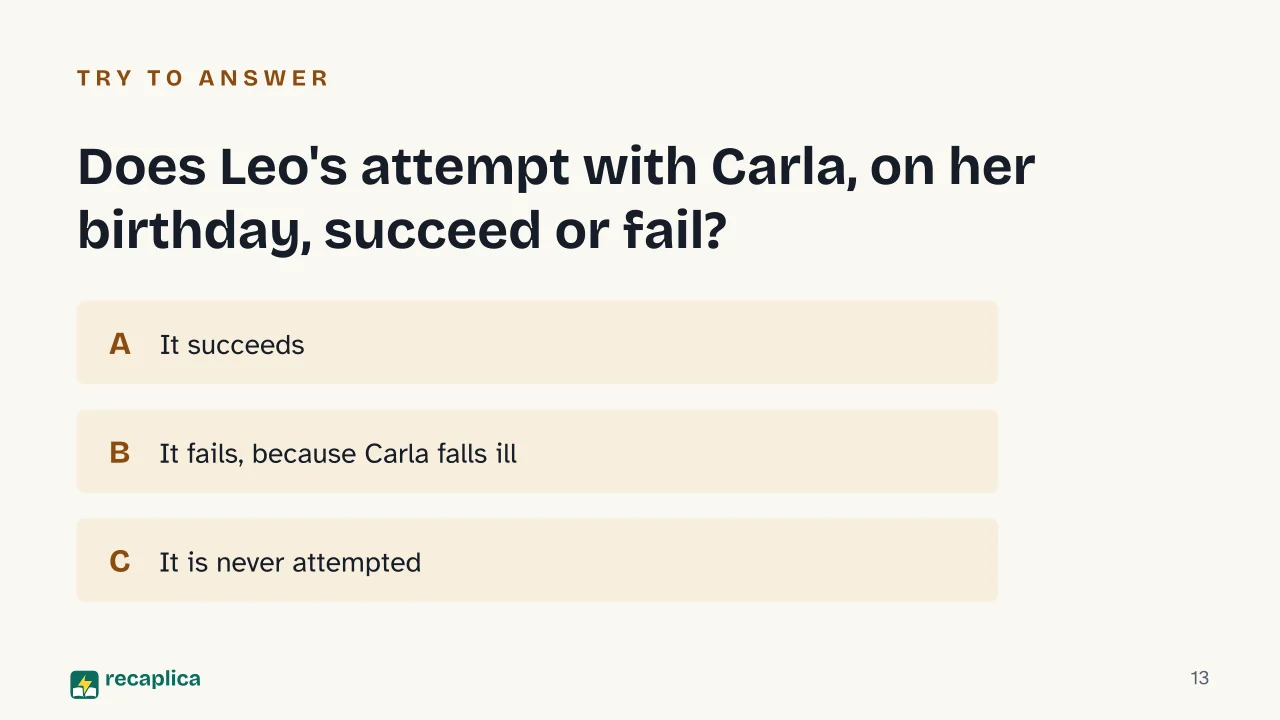
    The novel covers a few days in the life of the Ardengo family, in Rome. Mariagrazia, the widowed mother of Carla and Michele, has taken up with Leo Merumeci. On Carla’s twenty-fourth birthday, Leo tries to take advantage of her by getting her drunk. The attempt fails: Carla falls ill and vomits, and the scene stops there. Michele, Carla’s brother, and Lisa, a woman smitten with him, move around this episode.

    Practical example: the scene of Carla’s birthday shows the theme of indifference in action. Leo tries to take advantage of her by getting her drunk, the plan falls apart when Carla falls ill, and none of those present draws a conclusion of their own: the episode simply happens, and the family goes back to its routine life.

    The characters: the Ardengo family and the others

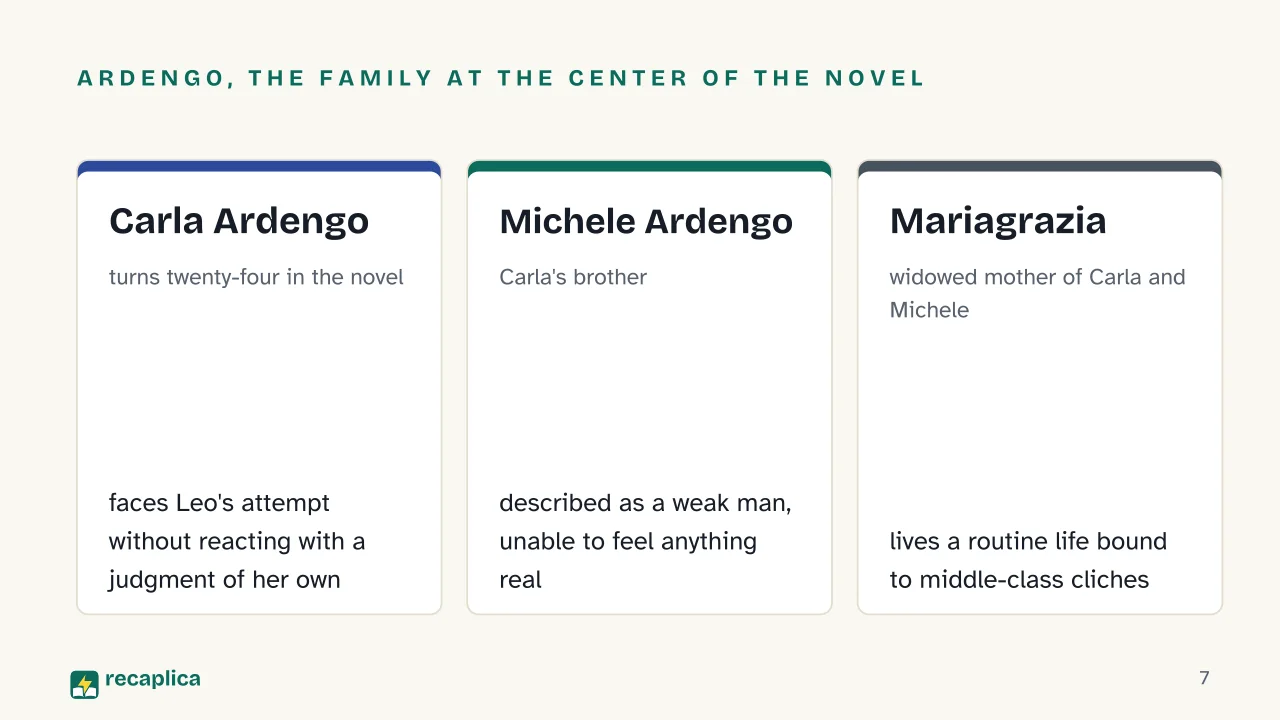
    For the two siblings, Carla and Michele Ardengo, nothing in the novel ever provokes a genuine moral reaction. Michele, in particular, is described as a weak man, much like his sister Carla. Mariagrazia, their mother, lives a routine life bound to the moral cliches of the middle class. Leo Merumeci is her lover; Lisa is smitten with Michele.

    For Moravia’s full biography, the Recap on Alberto Moravia: life and the novel of existential unease covers the writer’s entire story. The same period of Italian fiction is also covered in the Recaps on Italo Svevo and Luigi Pirandello.

    Behind the scenes: self-funded publication

    According to the Dizionario Biografico degli Italiani, published by Treccani, Moravia began writing the novel in Bressanone, where he was recovering from Pott’s disease, a form of bone tuberculosis. In 1925, at eighteen, he left the sanatorium and moved to Bressanone; over the following three years, between Bressanone and Rome, he wrote “The Time of Indifference”.

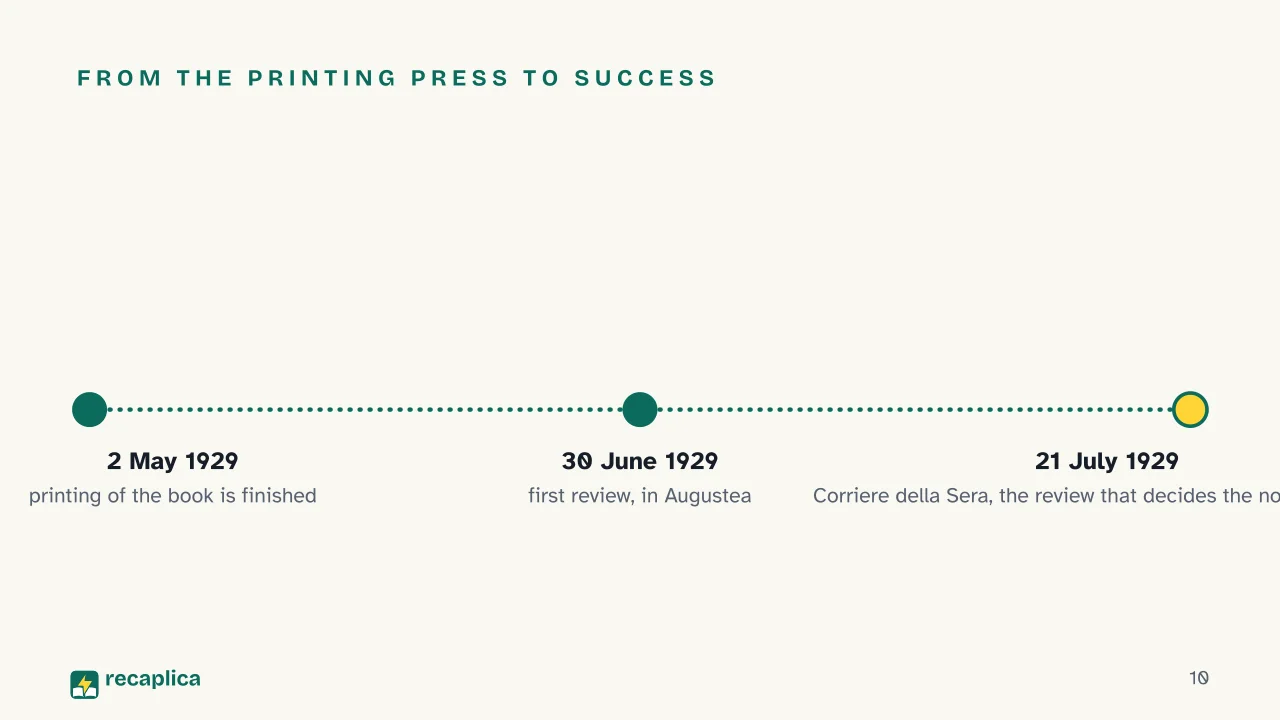
    A first publisher rejected the manuscript. Moravia then paid to publish it himself, at a cost of 5,000 lire of the time, through the Milan publisher Alpes, thanks to its director Cesare Giardini and with financial help from his father. The title “Gli indifferenti” was the final one chosen, not the first Moravia had considered for the book. Printing of the volume finished on 2 May 1929.

    The backlash: from critics to the fascist regime

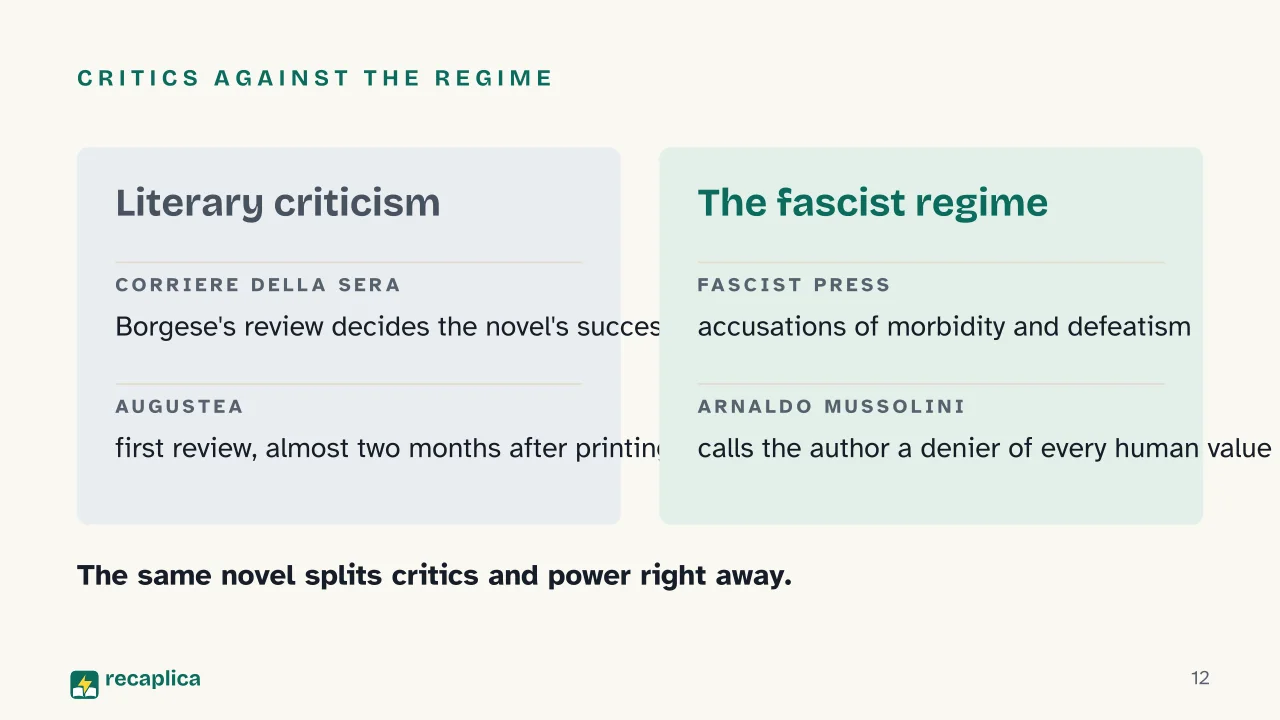
    The first review appeared almost two months after printing had finished, on 30 June 1929, in the fortnightly magazine Augustea, edited by Franco Ciarlantini (the founder of Alpes) and signed by A. R. Ferrarin. Two more reviews followed on 21 July 1929, in L’Italia letteraria (Cesare Zavattini) and in the Corriere della Sera (Giuseppe Antonio Borgese); the latter decided the novel’s success.

    Not every reaction was favorable. Beyond objections to structural flaws and to how unfinished the characters felt as artistic creations, the more hardline fascist press accused the novel of morbidity and defeatism. On 31 October 1929, in a speech at the Casa del Fascio in Milan, Arnaldo Mussolini, brother of Benito Mussolini, called Moravia a “denier of every human value”. Through the 1930s and 1940s, to avoid the regime’s censors, Moravia wrote mostly in a surreal, allegorical style.

    Style and themes: indifference as a moral refusal

    The novel’s style has been described as a singular realism, marked by a provocative objectivity. A detached observer portrays the decline of a humanity unable to reach for any ideal; sex and money, in the novel, work as substitutes for it and turn out to be interchangeable with one another. The prose stays sharp and precise, close to things as they are.

    The title puts the book’s underlying theme on the cover: characters who watch what happens to them without drawing any judgment of their own. Alongside it sits incommunicability: the members of the Ardengo family live under the same roof without ever truly understanding one another. The novel is a realistic study of the moral decline of a middle-class mother and two of her children, and through this family story it ends up describing the middle class under fascism. Critics of the time described it as a notable example of contemporary Italian fiction; later, the book came to be seen as a landmark for the realist turn it set in motion, one that anticipated the narrative direction of the 1930s.

    Slide deck

    Slides ready to download and make your own in PowerPoint or Google Slides, with speaker notes. Pick the Flash cut or the Full one.
    Slide 1 of the presentation on The Time of Indifference by Alberto Moravia: The Time of IndifferenceSlide 2 of the presentation on The Time of Indifference by Alberto Moravia: What happens when two siblings stop feeling anything?Slide 3 of the presentation on The Time of Indifference by Alberto Moravia: From the plot to the backlashSlide 4 of the presentation on The Time of Indifference by Alberto Moravia: Chapter 01: The plotSlide 5 of the presentation on The Time of Indifference by Alberto Moravia: 1929, the book in numbersSlide 6 of the presentation on The Time of Indifference by Alberto Moravia: Chapter 02: The Ardengo familySlide 7 of the presentation on The Time of Indifference by Alberto Moravia: Ardengo, the family at the center of the novel: Carla Ardengo, Michele Ardengo, MariagraziaSlide 8 of the presentation on The Time of Indifference by Alberto Moravia: Leo tries to ply Carla with drink to take advantage of her, and failsSlide 9 of the presentation on The Time of Indifference by Alberto Moravia: Chapter 03: PublicationSlide 10 of the presentation on The Time of Indifference by Alberto Moravia: From the printing press to successSlide 11 of the presentation on The Time of Indifference by Alberto Moravia: Chapter 04: The backlashSlide 12 of the presentation on The Time of Indifference by Alberto Moravia: Critics against the regimeSlide 13 of the presentation on The Time of Indifference by Alberto Moravia: Does Leo's attempt with Carla, on her birthday, succeed or fail?Slide 14 of the presentation on The Time of Indifference by Alberto Moravia: Moravia's debut, 1929
    Flash10 slidesThe essential thread, to present in classFull14 slidesEvery chapter and the deeper detail

    Common myths

    • ✗ Myth Many assume that Mussolini's regime welcomed "The Time of Indifference", as it did with much fiction of the period.

      ✓ Reality The regime attacked it instead: part of the fascist press accused it of morbidity and defeatism, and on 31 October 1929, at the Casa del Fascio in Milan, Arnaldo Mussolini — brother of Benito Mussolini — branded the author a "denier of every human value".

    • ✗ Myth Many assume the novel was an instant success as soon as it reached bookshops.

      ✓ Reality Printing finished on 2 May 1929, and the first review appeared almost two months later, on 30 June, in the magazine Augustea; it was Giuseppe Antonio Borgese's review in the Corriere della Sera, on 21 July, that decided the novel's success.

    • ✗ Myth Many assume "The Time of Indifference" was the title Moravia had in mind from the start.

      ✓ Reality It was the final title chosen at publication, not the first the author had considered: what that first title was is not recorded.

    Mind map

    Drag the background to move around and the nodes to reposition them; use − and + to collapse and expand branches.
    Customize
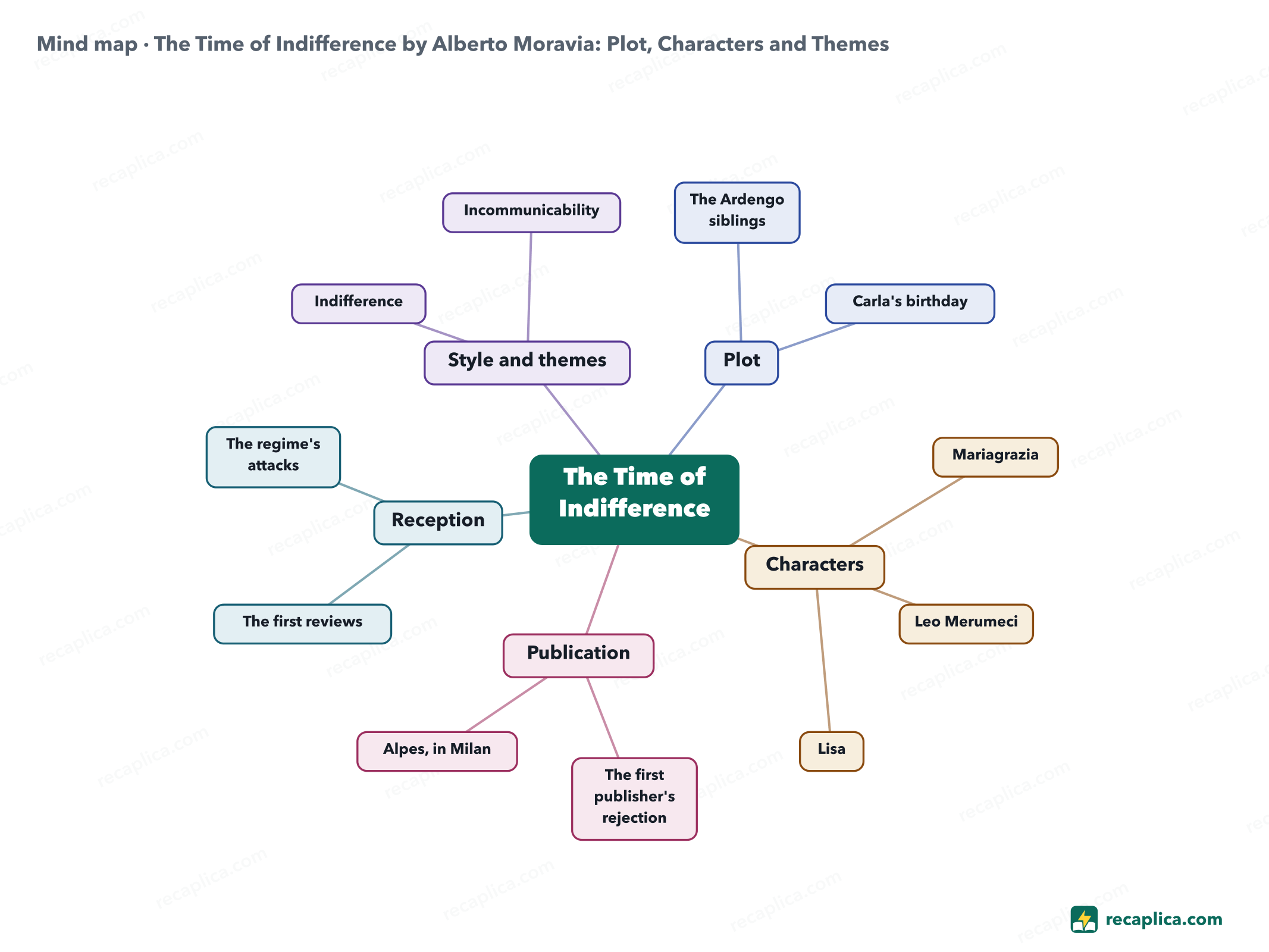
    Mind map: The Time of Indifference by Alberto Moravia: Plot, Characters and Themes
    • The Time of Indifference
      • Plot
        • The Ardengo siblings Carla and Michele, unable to feel anything real
        • Carla's birthday Leo attempts to take advantage of her, the attempt fails
      • Characters
        • Mariagrazia widowed mother, a life bound to middle-class cliches
        • Leo Merumeci Mariagrazia's lover, attempts to take advantage of Carla
        • Lisa smitten with Michele, described as a weak man
      • Publication
        • The first publisher's rejection the novel is turned down before finding a publishing house
        • Alpes, in Milan published at the author's own expense, 5,000 lire, with his father's financial help
      • Reception
        • The first reviews Augustea on 30 June, then Corriere della Sera and L'Italia letteraria on 21 July 1929
        • The regime's attacks Arnaldo Mussolini brands the author a denier of every human value
      • Style and themes
        • Indifference the refusal of any moral judgment
        • Incommunicability among the members of the Ardengo family

    Quiz: test yourself

    Answer the questions to check what you have learned: you get instant feedback and a short explanation.

    Grade 0/10 0/5
    1 In what year was Alberto Moravia's "The Time of Indifference" published?

    The novel was published in 1929, by the Milan publisher Alpes, after a first publisher had turned it down.

    2 Who are the novel's protagonists?

    The protagonists are the siblings Carla and Michele Ardengo, two young people unable to feel anything real.

    3 True or false: Leo Merumeci succeeds in taking advantage of Carla on her birthday.

    False: Leo's plan is stopped by Carla falling ill, not by any moral reaction on her part.

    4 How did the fascist regime react to "The Time of Indifference"?

    On 31 October 1929, at the Casa del Fascio in Milan, Arnaldo Mussolini called Moravia a "denier of every human value".

    5 Which review decided the novel's success?

    Borgese's review, published on 21 July 1929 in the Corriere della Sera, was the one that decided the novel's success.

    Answers: 1-B · 2-A · 3-B · 4-A · 5-B

    Flashcards

    Tap the card to flip it and check whether you remember the answer, then move to the next one.

    1 / 7

    Explain it in your own words

    The ultimate test: if you can explain it in simple words, you've truly understood it. Write your explanation, then compare it with the Recap.

    Your explanation is saved only on this device.

    "The Time of Indifference" is Alberto Moravia's debut novel, published in 1929. Over a handful of days, it follows the Ardengo siblings, Carla and Michele, two young members of the middle class who cannot feel anything real about what happens to them. Around them move their mother Mariagrazia, her lover Leo Merumeci, and Lisa, who has feelings for Michele. The book is a stark, realistic portrait of a middle-class family's hypocrisies, and it remains a reference point of twentieth-century Italian fiction.

    Frequently asked questions

    What is the plot of The Time of Indifference by Moravia?

    The book follows the siblings Carla and Michele Ardengo over a few days of their life in Rome. Leo Merumeci, romantically involved with their mother Mariagrazia, tries to get Carla drunk to take advantage of her on her birthday, and the plan fails because she falls ill. Michele and Lisa, a woman with feelings for him, also move around this episode.

    Who are the main characters of The Time of Indifference?

    Carla and Michele Ardengo, two siblings unable to feel anything real; their mother Mariagrazia, a widow bound to middle-class cliches; Leo Merumeci, her lover; and Lisa, who is smitten with Michele.

    Why is the novel called The Time of Indifference?

    Because the characters, faced with what happens to them, refuse any moral judgment: they watch events unfold without ever reacting with a view of their own, and this indifference is the trait that describes all of them.

    How did critics react to The Time of Indifference?

    Not right away. Printing finished on 2 May 1929, and readers had to wait until 30 June for a first verdict, in the magazine Augustea. On 21 July two more opinions arrived, in L'Italia letteraria and in the Corriere della Sera; it was the latter, written by Giuseppe Antonio Borgese, that decided the novel's fortunes.

    Why did the fascist regime attack Moravia over this novel?

    The more hardline fascist press judged the book morbid and defeatist. Arnaldo Mussolini, brother of Benito Mussolini, went further: in a public speech in Milan, on 31 October 1929, he called the author a man who denies "every human value".

    Sources

    • Pincherle, Alberto (Moravia) — Dizionario Biografico degli Italiani, Treccani
    • Moràvia, Alberto — Treccani, Enciclopedia
    • Gli indifferenti — Wikipedia
    • Alberto Moravia — Wikipedia (EN)

    Every Recap goes through an independent review before publication.

    Every evening, the day's new Recaps on our Telegram channel. Join the channel →

    Keep learning

    • Literature Best Dark Romance Books: A List for Every Subgenre A selection of dark romance books sorted by subgenre, for readers who already know what the genre is and just want a place to start. Dark mafia romance books cover forced marriages and warring crime families, as in Ruthless People and Killing Sarai. Dark fantasy romance books and paranormal romance move the same pull between desire and threat into worlds with gods, vampires and power struggles. Dark academia romance sets it among visions and fairy tales, while spicy dark romance books and stalker romance push the premise to the edge of real obsession. Read the Recap →
    • Literature Best Stephen King Books: 10 Novels and the Case for Each One Stephen King has written novels across several genres, from Carrie in 1974 to The Institute in 2019, and Wikipedia credits his books with more than 400 million copies sold overall. This list lines up ten titles that come up often in recommendations, with a reason for each pick, from horror staples like It and The Shining to novels that step outside the genre, such as 11/22/63 and The Green Mile. Every book comes with its publication year, its publisher and, where one exists, the award it won or was nominated for. There's no single agreed ranking: Hans-Åke Lilja, interviewed by Five Books as someone who has followed King's career for over 40 years, leaves well-known titles such as Carrie and The Shining out of his own personal picks. Read the Recap →
    • Literature Horror Story Ideas: Everyday Details, Old Fears and a Twist That Lands Writing a horror story often starts with a blank page more uncomfortable than the story itself. This Recap collects starting situations, recurring fears and ways to build a twist, with concrete examples to work from. It doesn't cover the techniques that build tension on the page — those live in the parent Recap on how to write a horror story. The sturdiest ideas tend to start with an everyday detail that stops behaving the way it should, or an old fear dressed in a setting readers recognize. Read the Recap →

    recaplica

    Clear in 30 seconds, yours in 10 minutes.

    Recaps Mind maps Request a Recap Telegram channel Mind map maker Our method About Privacy & cookies Legal notes & terms of use

    © 2026 Recaplica · A project by Curi S.r.l. — VAT IT05472000750

    Statistics, only if you say so

    To learn which Recaps help most we would use Google Analytics, with aggregate, anonymous data. It starts only with your OK, and you can change your mind anytime. Privacy policy