|
recaplica
Employment Contract in Italy: What the Constitution Requires |
| © 2026 Recaplica · recaplica.com — All rights reserved |
Employment Contract in Italy: What the Constitution RequiresWhat to print Page numbers appear when printing with default margins. SlidesChoose a cut Flash10 slidesThe essential thread, to present in classFull14 slidesEvery chapter and the deeper detailBoth come with speaker notes. In 30 seconds quick readAn employment contract doesn't exist in a vacuum: in Italy it sits inside guarantees the Constitution of 1947 fixes directly, starting with the very first article. Work there is both a right every citizen holds and a duty to contribute to the country's progress, and articles 35 through 38 turn that principle into concrete floors on pay, hours, rest and welfare. The Civil Code then narrows the focus to a single working relationship: article 2094 defines a subordinate employee through three precise elements, the point where the constitutional principle meets the contract an employer and a worker actually sign. Key Points
Deep DiveAn employment contract is, on paper, a private agreement between two parties. In Italy, that agreement sits inside a frame the state set decades before most of today’s contracts were ever drafted. The Constitution of the Italian Republic, approved in 1947, opens its first article with labor: not as one value among several, but as the foundation of the republican form of state. Everything that follows in the constitutional text, including the structure built around popular sovereignty and the republic’s organs, is read against that opening choice. Article 4 gives the principle its working content. The Constitution recognizes every citizen’s right to work and commits the Republic to creating the conditions for that right to become real in practice. The same article asks something back from the citizen: to contribute, through an activity chosen freely, to the material or spiritual progress of society. Right and duty are born in the same sentence. From general principles, Title III of the Constitution, on economic relations, moves to firmer ground. The protection articles 35 through 38 set out covers work in every form and application: not only dependent employment but self-employment too, and it extends to workers’ vocational training. The same protection follows Italian citizens who work abroad.
On pay, the Constitution sets two criteria that work together. Compensation must be proportionate to the quantity and quality of the work performed. It must also be sufficient to guarantee the worker and their family a free and dignified existence. Legal scholars read these two criteria together as the principle of a constitutionally guaranteed minimum wage: a floor a salary can’t fall below, whatever a given contract might say. The law sets the maximum length of the working day, and within that limit a worker is entitled, on top of ordinary pay, to a weekly rest day and to annual leave that still counts as paid time away from work. The Constitution goes a step further and adds that neither one of those two rights can be waived, not even if the worker themselves wanted to: both stay non-waivable, no matter what a single employment contract might otherwise try to provide for. The same part of the constitutional text establishes equal rights and equal pay for women and men carrying out the same job, requires that working conditions be made compatible with family responsibilities, and sets a special layer of protection for mothers and for children. Child labor receives, in turn, a reinforced form of protection under the same Title III, carrying the same right to equal pay whenever the work a minor performs matches, task for task, that of an adult worker in the same role. Article 38 covers people who cannot work: social assistance where means of support are missing, plus welfare coverage for injury, illness, disability, old age and involuntary unemployment. Up to this point, the Constitution speaks of principles and guarantees. The place where those principles turn into an actual working relationship, between an employer and a worker, is the Civil Code. Under article 2094, a subordinate employee is someone who agrees, in exchange for pay, to collaborate within a business by working under the authority and direction of the employer. Subordination is exactly that bond of dependency and direction. A contract sets out the agreement between the parties; article 2094 defines what specifically turns that agreement into a subordinate employment relationship. Cliclavoro, the Italian Ministry of Labor’s portal, citing this article directly, describes subordination as the employer’s power to give instructions to the worker, oversee the activity, check it and, when needed, apply disciplinary measures.
Among the forms a subordinate employment relationship can take, Cliclavoro names the open-ended contract as the reference one, the ordinary form. Alongside it sit other contract types built for different needs, such as a fixed-term contract, a zero-hours contract for work tied to occasional on-call shifts, or a co.co.co, the coordinated and continuous collaboration contract: each one, when the same elements are present, still traces back to the definition in article 2094. People working in Italy’s public sector follow their own rules, set out in the collective agreements of the public sector (ARAN); the underlying constitutional principle, though, stays the same one that governs private employment. And the broader frame holding a worker’s rights and duties together is the one built around popular sovereignty and citizenship, of which work, under article 1, is the foundation. Slide deckSlides ready to download and make your own in PowerPoint or Google Slides, with speaker notes. Pick the Flash cut or the Full one.   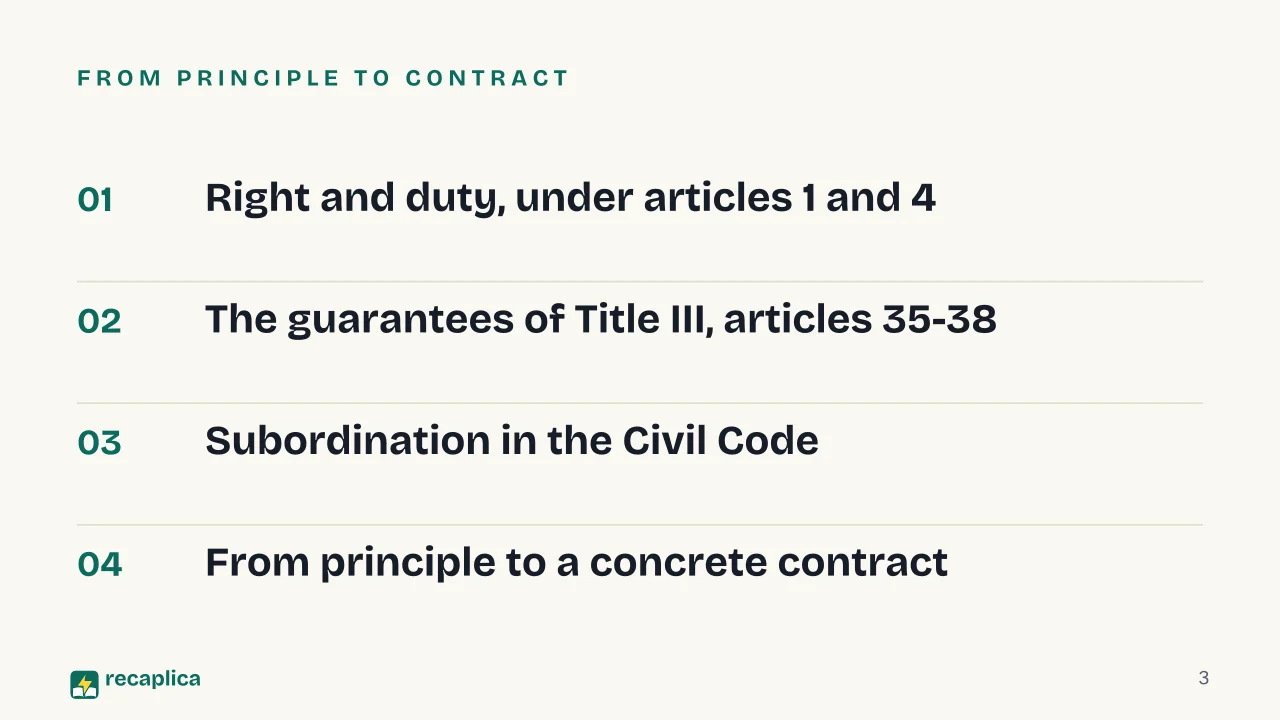  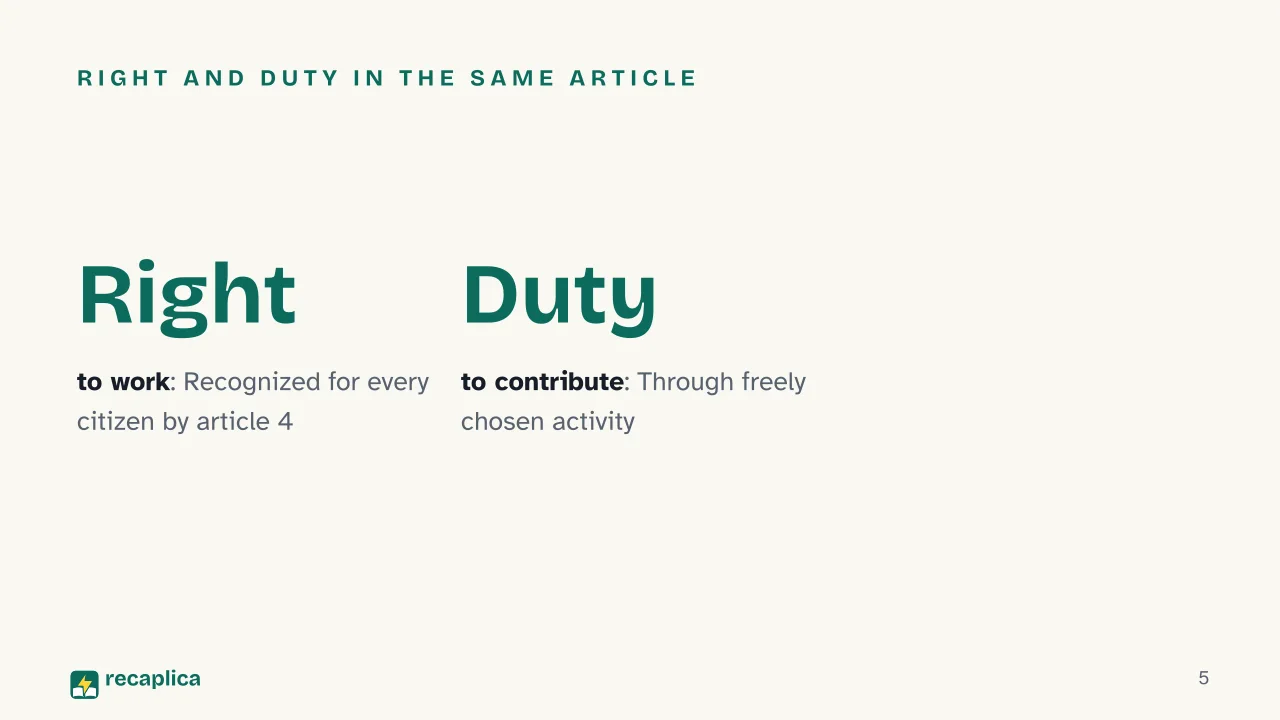  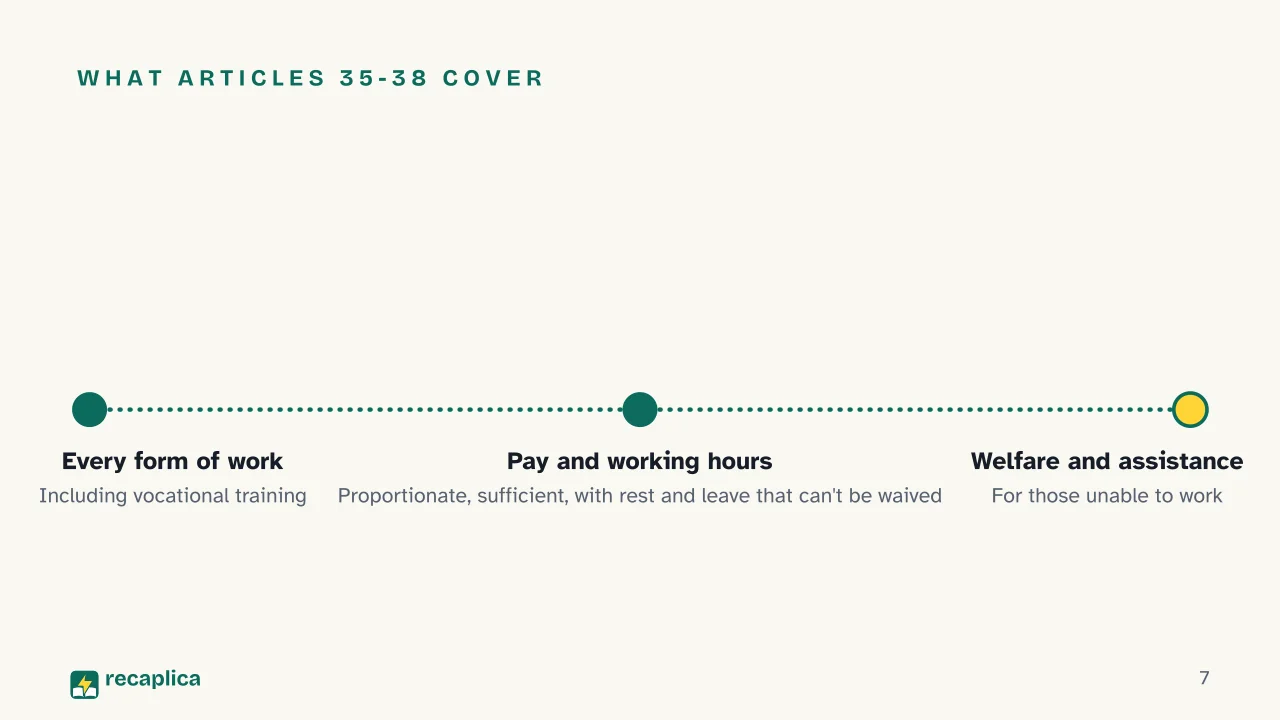 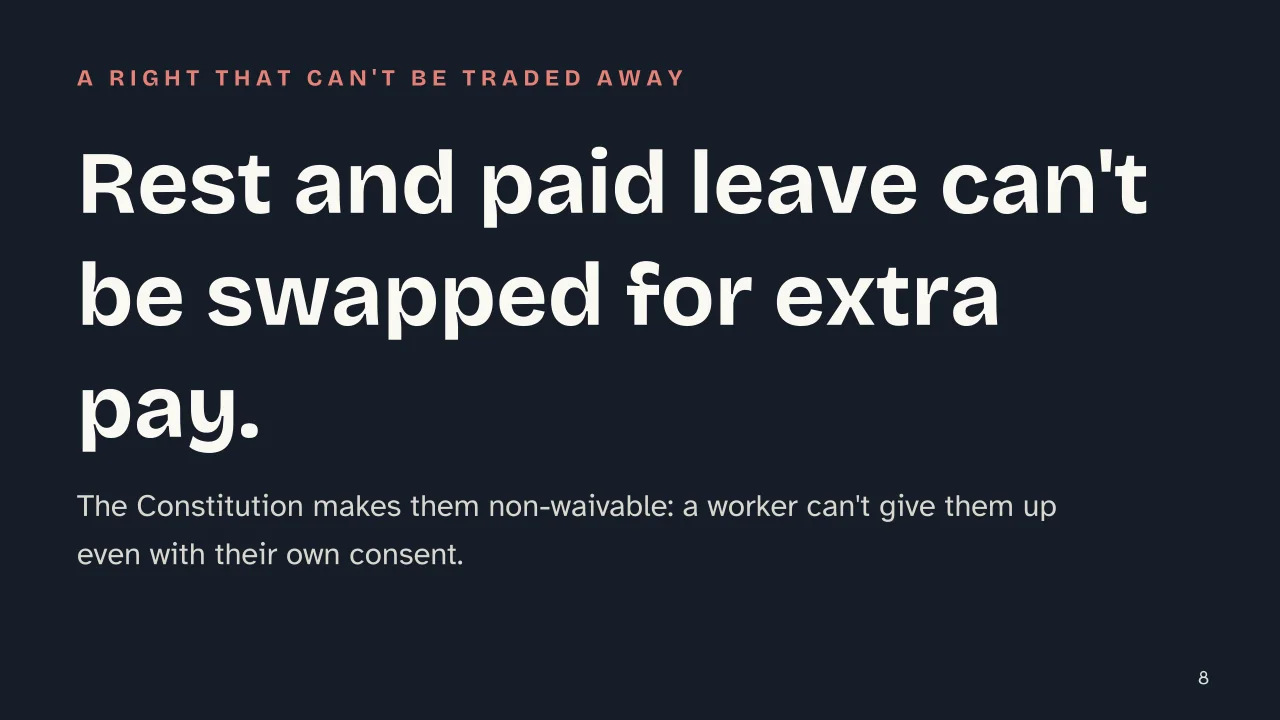  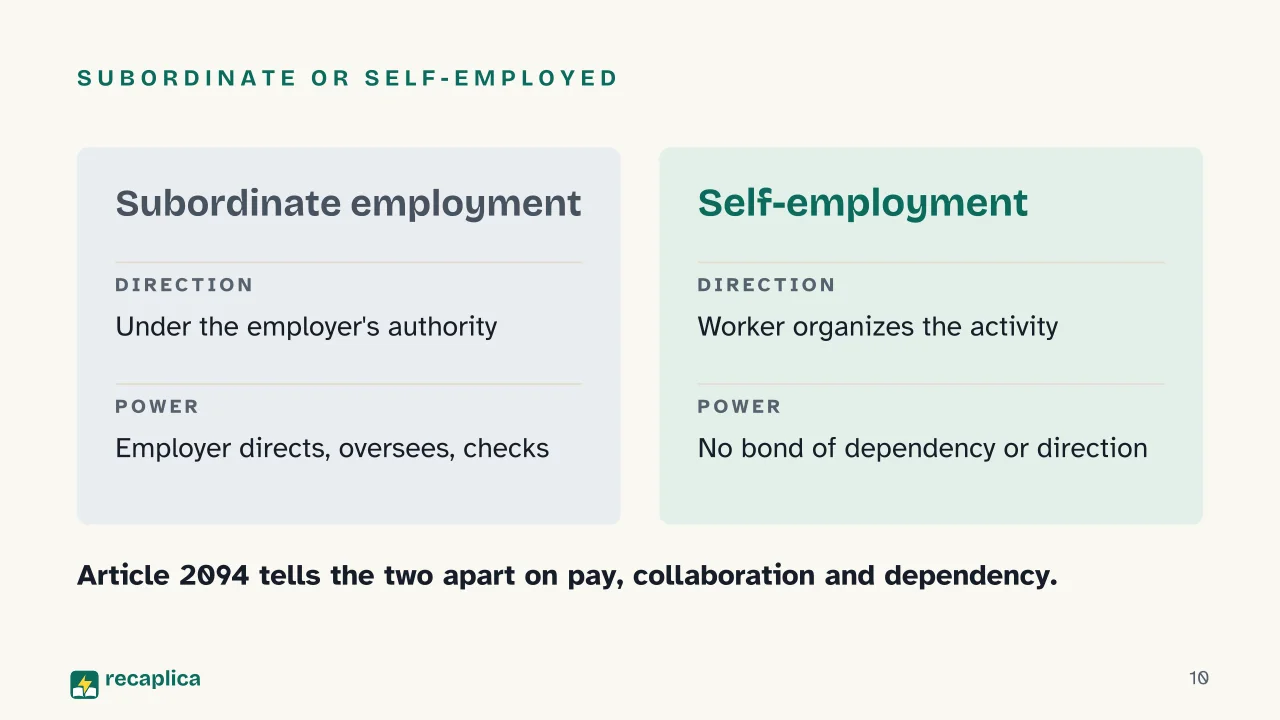 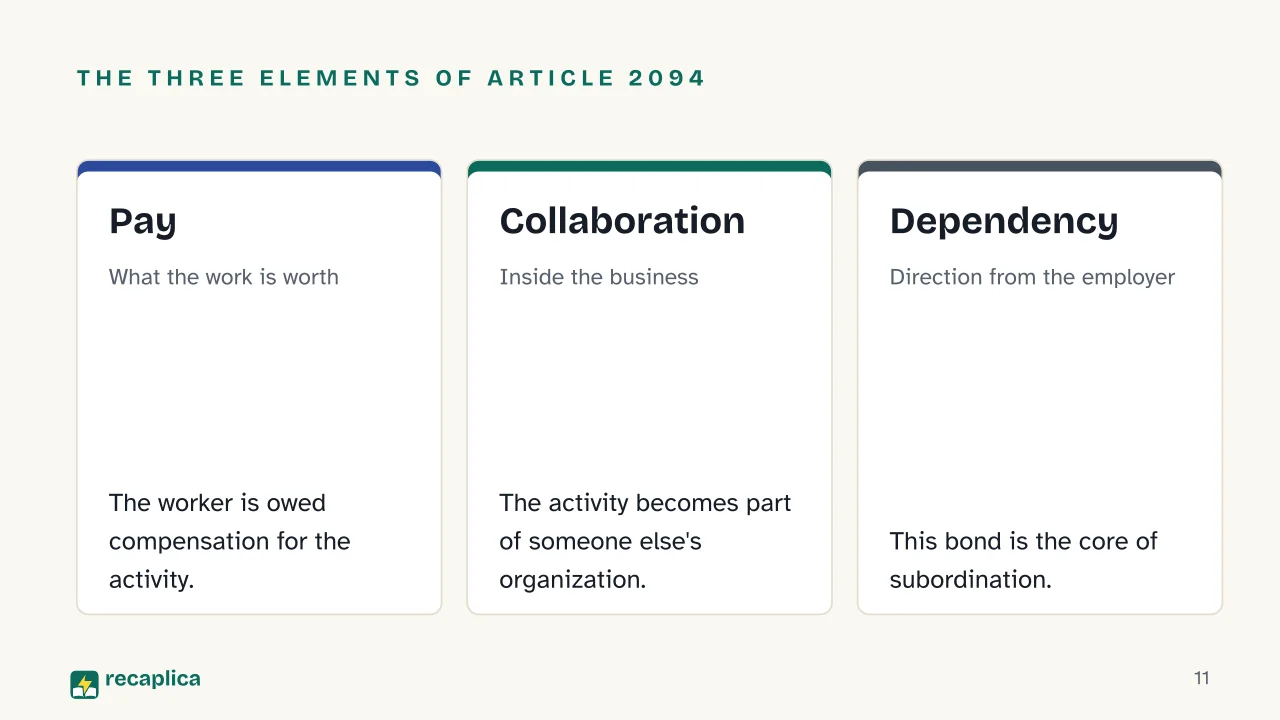 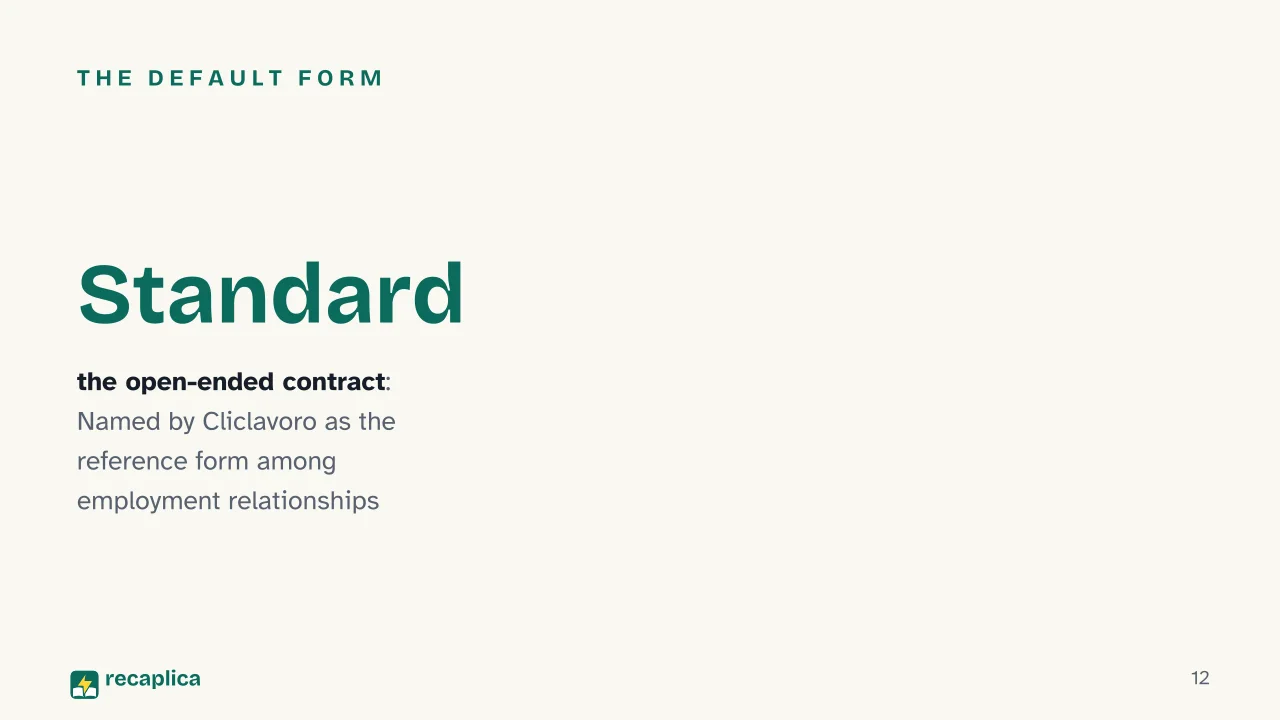 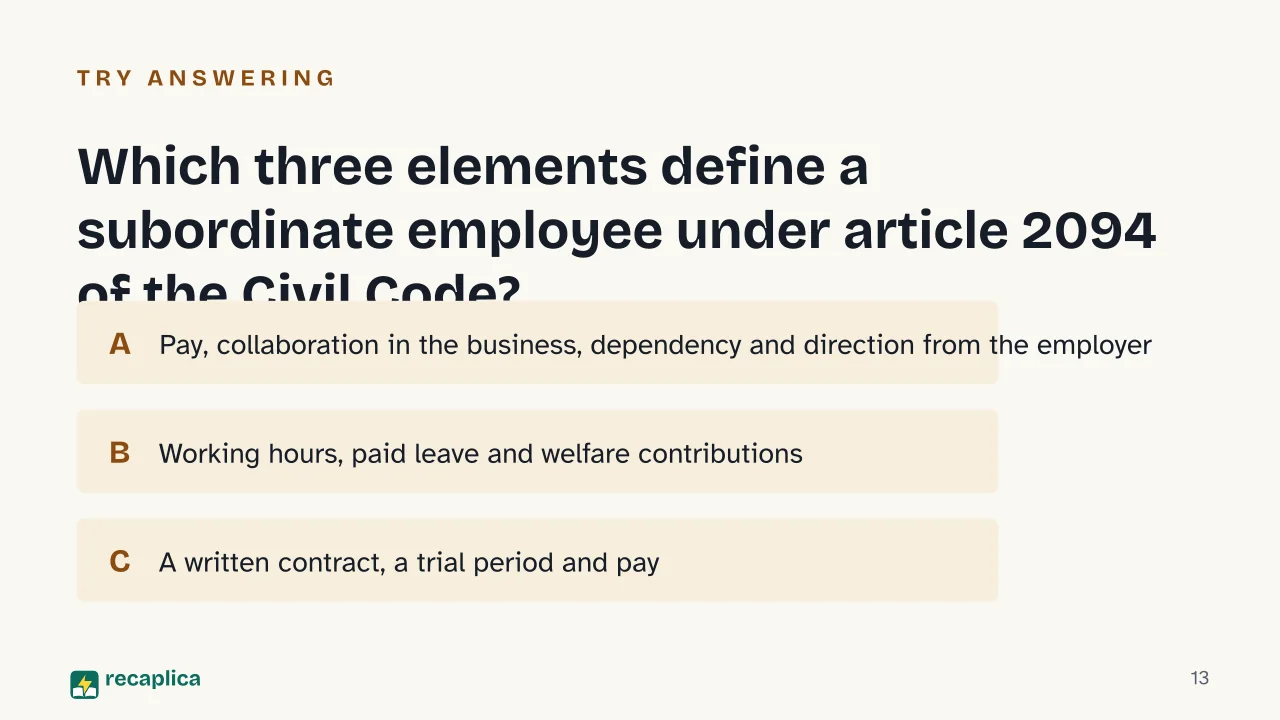  Common myths
Mind mapDrag the background to move around and the nodes to reposition them; use − and + to collapse and expand branches. 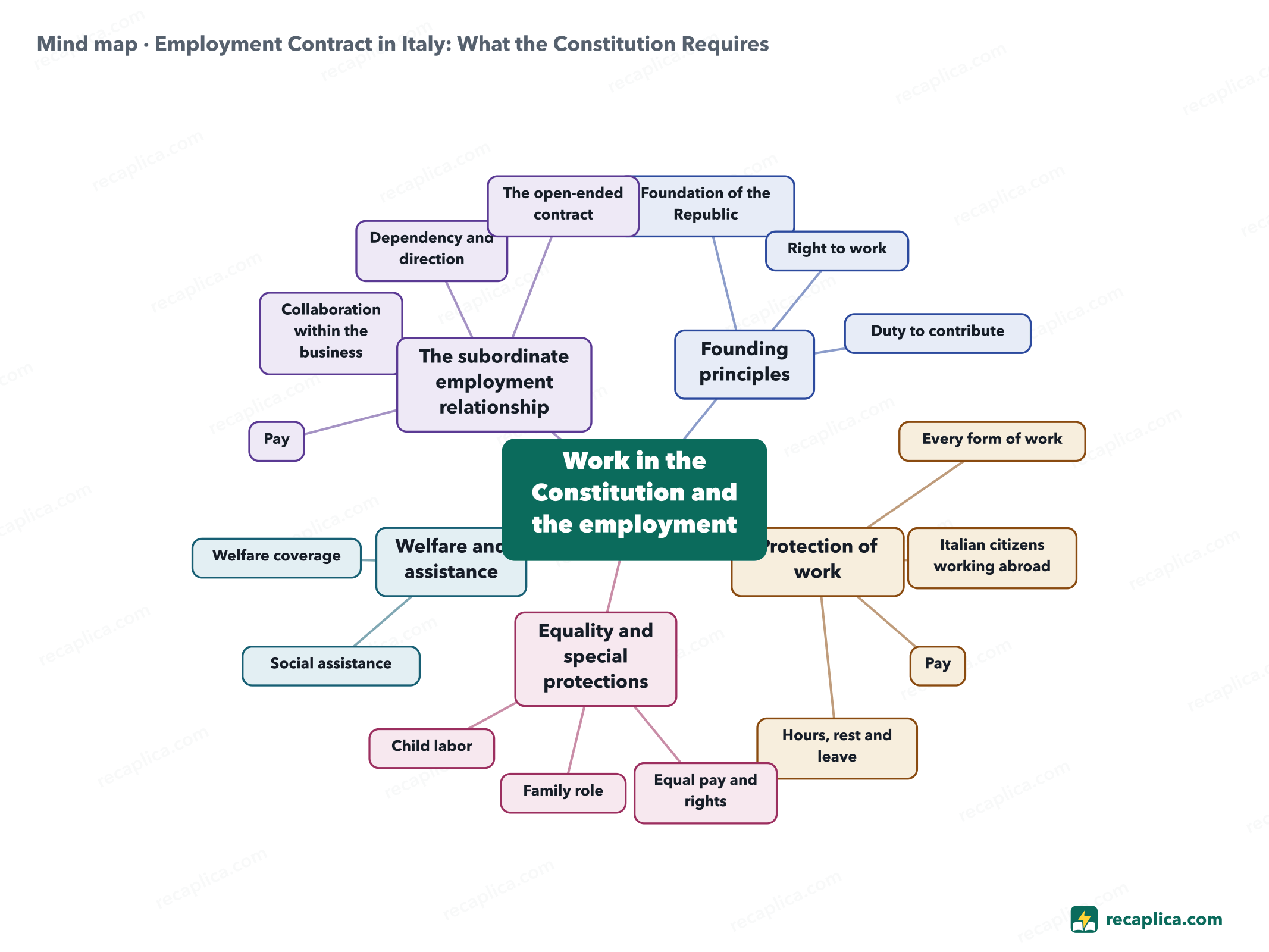
Quiz: test yourselfAnswer the questions to check what you have learned: you get instant feedback and a short explanation. Grade 0/10 0/5
FlashcardsTap the card to flip it and check whether you remember the answer, then move to the next one. 1 / 8 Explain it in your own wordsThe ultimate test: if you can explain it in simple words, you've truly understood it. Write your explanation, then compare it with the Recap. Your explanation is saved only on this device.
Frequently asked questionsWhat does the Italian Constitution say about employment contracts?The Constitution doesn't address the contract itself, but it sets the limits any contract must stay within: pay that's proportionate and sufficient for a dignified life, a legal cap on working hours, and weekly rest plus paid leave a worker can't give up. What's the difference between an employment relationship and an employment contract?The contract is the agreement that sets conditions and pay; the employment relationship is the ongoing bond that comes from it, shaped together by the contract, the law and, for subordinate work, article 2094 of the Civil Code. What does subordinate employment mean?It means the worker performs activity in exchange for pay, collaborating within the business, under the authority and direction of the employer, who can give instructions, oversee the work, check it and apply disciplinary measures. Does the Italian Constitution protect people who aren't employees?Yes: the protection in article 35 isn't limited to dependent employment, it also covers self-employment and extends to workers' vocational training. What happens if a worker can't work and has no means of support?The Constitution grants a right to social assistance; if the inability to work instead comes from injury, illness, disability, old age or involuntary unemployment, workers are entitled to welfare and insurance coverage. Every Recap goes through an independent review before publication. |