Skip to content
recaplica

    One moment: security check

    Cloudflare wants to make sure you're not a robot. Tick the box below and your search will continue on its own.

    IT
    recaplica Zero-Hours Contract in Italy: What It Is and How It Works
    © 2026 Recaplica · recaplica.com — All rights reserved
    Home › Civics

    Zero-Hours Contract in Italy: What It Is and How It Works

    By Recaplica Newsroom · Updated on October 4, 2026

    What to print

    Page numbers appear when printing with default margins.

    Slides

    Choose a cut

    Flash10 slidesThe essential thread, to present in classFull14 slidesEvery chapter and the deeper detail

    Both come with speaker notes.

    Telegram channel
    recaplica Clear in 30 seconds, yours in 10 minutes.
    In 30 seconds Key points Figures Deep dive Slides Myths Mind map Quiz Flashcards FAQ

    In 30 seconds quick read

    A zero-hours contract, called "lavoro intermittente" in Italy, is a form of employment with no guaranteed hours: the worker stays available, and the employer calls them in only when needed. Under Italian law, it is open mainly to workers under 24 and over 55, plus people doing a short list of irregular jobs set out in an old royal decree. If no call comes, the worker earns nothing, unless they agreed to stay on standby: in that case a collective agreement sets an on-call allowance. The employer must notify each shift before it starts, and skipping that notice carries a fine.

    Key Points

    • A zero-hours contract is a fixed-term or open-ended employment relationship built around availability to answer the employer's calls.
    • Without any other requirement, workers under 24 (if the job ends before they turn 25) and over 55 can sign one, along with people doing the irregular jobs listed in the Ministerial Decree of 23 October 2004.
    • With the same employer, the contract converts into a full-time, open-ended job once a worker passes 400 days worked over three calendar years; tourism, public venues, and entertainment have no such cap.
    • Without a standby obligation, the worker has no pay or rights during periods with no calls; with it, they earn the on-call allowance set out in Article 16 of Legislative Decree 81/2015.
    • The employer must notify the relevant local labour office before each shift starts: skipping that notice costs a fine of €400 to €2,400 per worker.
    • Someone receiving NASpI unemployment benefit can keep a zero-hours contract as long as the expected yearly income from it stays under €8,000, reported to INPS within 30 days of applying.

    Key figures

    • €8,000 yearly income threshold below which someone with a zero-hours contract can keep receiving NASpI unemployment benefit, cited in an INPS message from 2018. Source: INPS, Message no. 1162/2018
    • €400–2,400 administrative fine per worker when an employer fails to notify a shift in advance, in force since 2015. Source: Legislative Decree 81/2015, Art. 15
    • 400 workdays the cap over three calendar years beyond which a zero-hours job with the same employer becomes open-ended, in force since 2015. Source: Legislative Decree 81/2015, Art. 13

    Deep Dive

    Who Can Work Under a Zero-Hours Contract

    A zero-hours contract — “lavoro intermittente” in Italian law — is a standard employment relationship, fixed-term or open-ended. The worker makes themselves available to the employer, who calls them in only when needed, following the cases set by the relevant collective bargaining agreement or, failing that, by a ministerial decree.

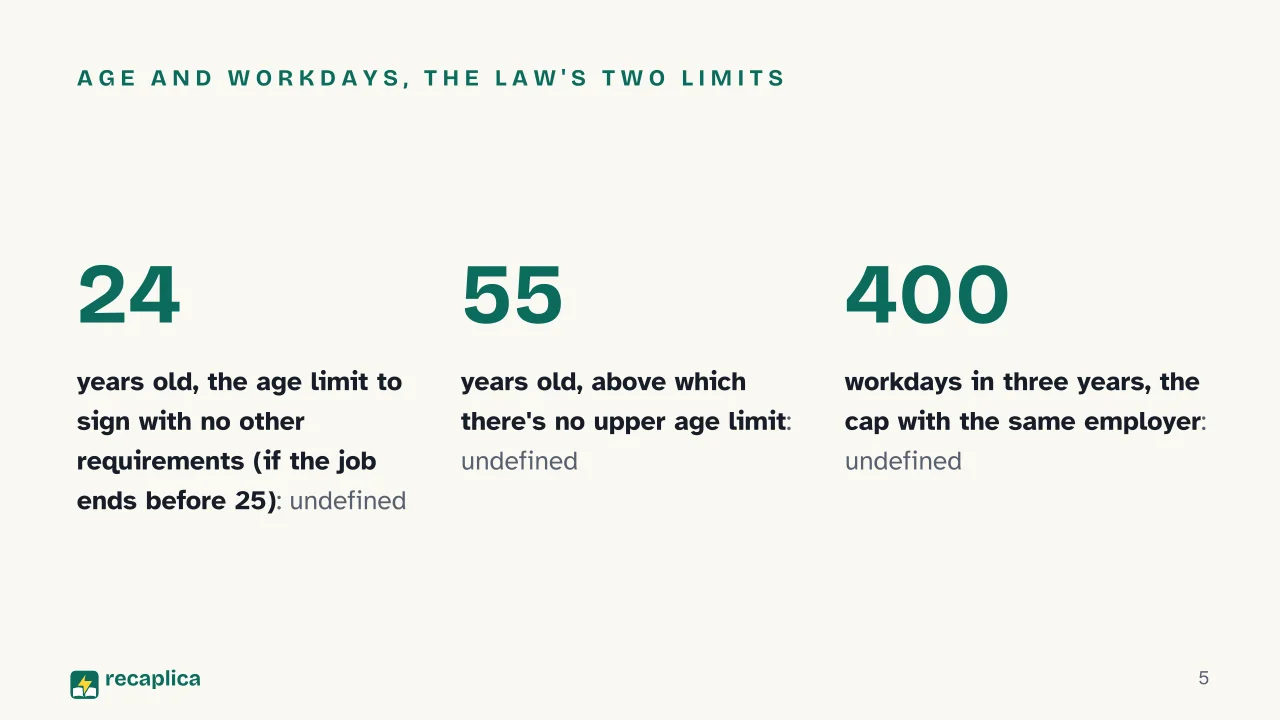
    Two paths lead to signing one. The first is age-based: under Legislative Decree 81/2015, a zero-hours contract is always permitted with someone under 24, provided the job ends before they turn 25, or with someone over 55, with no upper limit. The second depends on the type of job: the irregular activities listed in the table attached to Royal Decree no. 2657 of 6 December 1923 remain eligible, now identified by the Ministerial Decree of 23 October 2004 — a historical list that includes jobs such as caretaking and concierge work. Law no. 56 of 7 April 2025 repealed that royal decree, but the Ministry of Labour, in a note dated 27 August 2025, clarified that the listed activities remain in force because they were incorporated into the 2004 ministerial decree, so the table stays usable for zero-hours contracts. The general rules that govern any contract of this kind are covered in Contract: Definition, Requirements, and Why the Law Enforces It.

    There’s one firm exception: the rules on intermittent work do not apply to public-sector employees. A public administration agency cannot cover an unstaffed shift with this kind of contract, no matter how urgent.

    With the same employer, there’s also a cap of 400 actual workdays within three calendar years. The rule leaves out tourism, public venues, and entertainment, where no such limit exists. Cross the line anywhere else, and the relationship converts on its own into a full-time, open-ended contract.

    On-Call Pay and Rights When There’s No Work

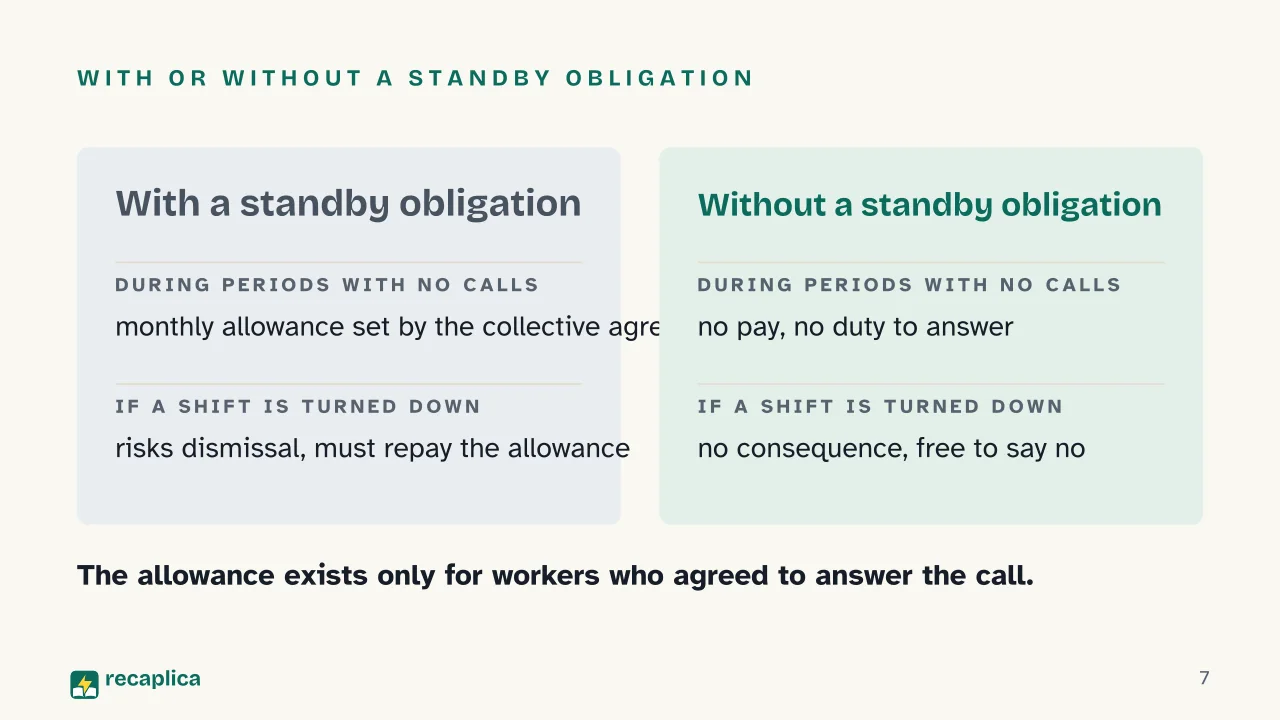
    This is where the zero-hours contract is most often misunderstood. If the worker hasn’t agreed to stay available for the employer’s calls, they receive no pay or other benefits during periods with no work. Nothing stops them from taking another job or saying no to a call, and the contract stays perfectly regular either way.

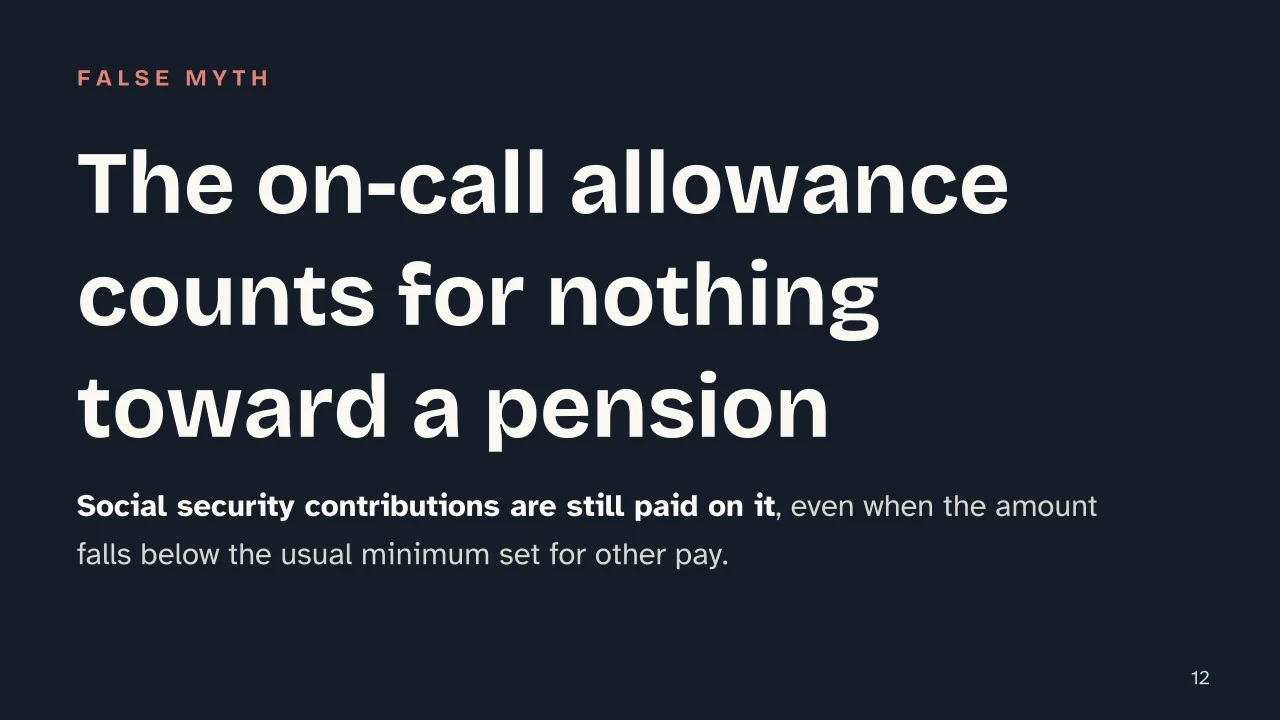
    It’s different if the worker commits to staying ready. Article 16 of Legislative Decree 81/2015 then entitles them to a standby allowance: a monthly amount, payable also in hourly instalments, fixed by the collective bargaining agreement, with a minimum set by a decree of the Ministry of Labour — the law itself names no fixed euro figure. That allowance is excluded from the calculation of the year-end bonus, severance pay, and other pay-related entitlements, because the law expressly leaves it out; social security contributions, however, are still due, even when the amount falls below the usual minimum set for other pay.

    The commitment to answer calls comes with a cost on the other side too. If the worker is sick or otherwise unable to work, they must notify the employer right away: the allowance doesn’t accrue for that period, and failing to notify costs 15 days of the allowance, unless the individual contract says otherwise. Turning down a call without a valid reason, once availability has been agreed, can lead to dismissal and requires repaying the allowance for the period following the refusal.

    Practical example: Marco has a zero-hours contract with a standby obligation at a venue that opens only on weekends. In November, he’s called in for two shifts. His payslip shows pay for the two shifts he actually worked, plus the on-call allowance for every other day of the month when he stayed ready to answer without being called.

    Mandatory Notice and Penalties

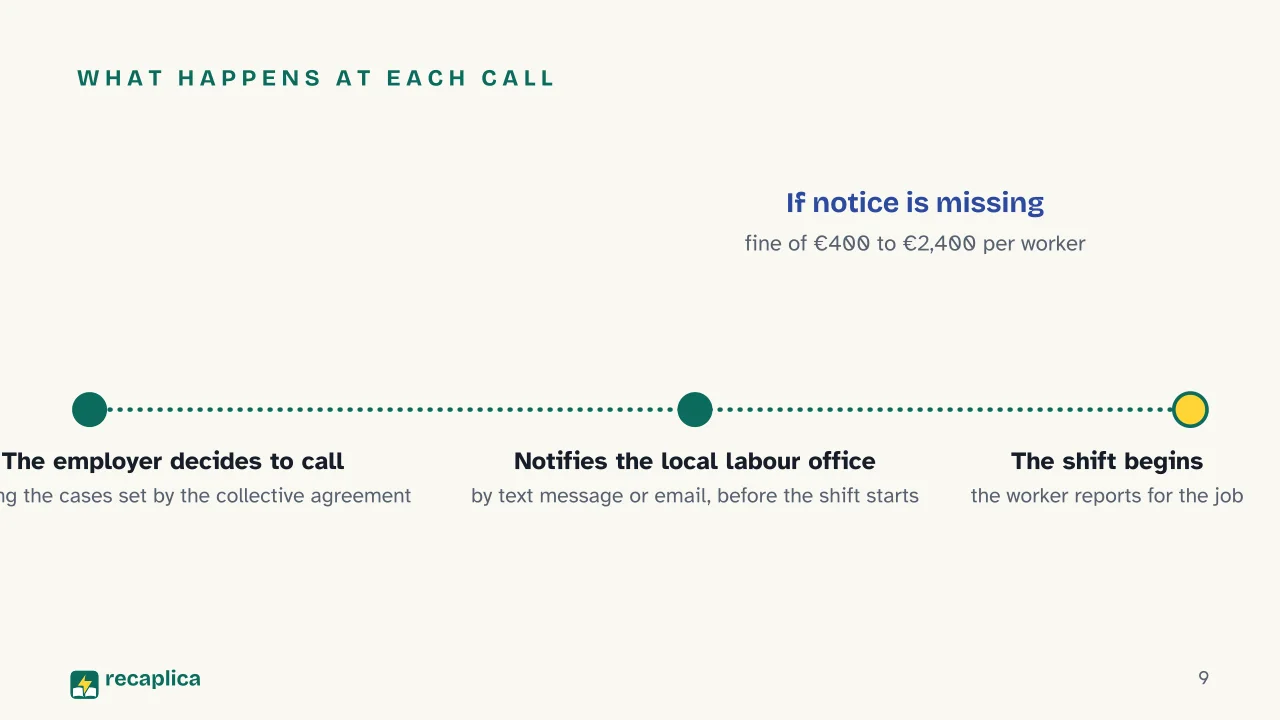
    Every time the employer decides to call the worker in, they must first notify the relevant local labour office: reporting the length of the single call, or of a cycle of shifts spanning up to 30 days, by text message or email. This is confirmed both by Legislative Decree 81/2015 and by the websites of the Ministry of Labour and Cliclavoro, which point to the operating rules set by an interministerial decree of 27 March 2013, still in force.

    Skipping the notice triggers an administrative fine of €400 to €2,400 for each worker it applies to, a fixed amount set by law.

    Contributions, NASpI, and Losing the Job

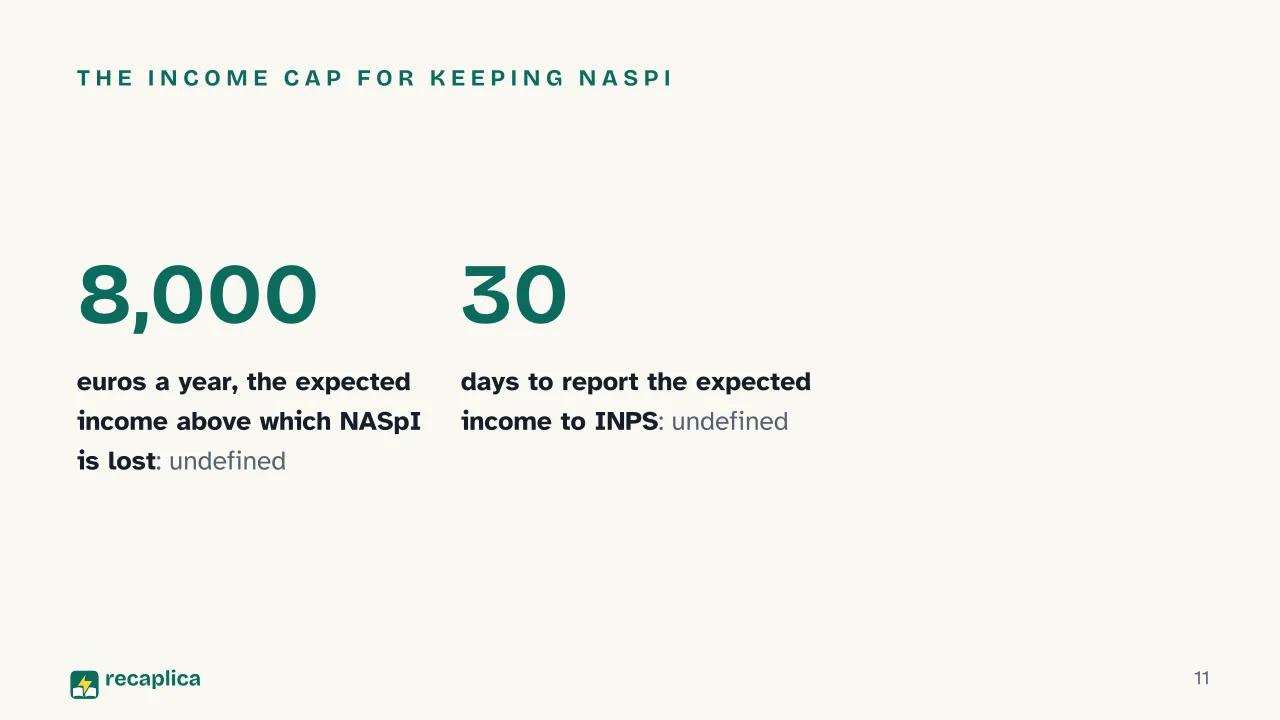
    A zero-hours contract doesn’t rule out NASpI unemployment benefit, but it does condition it. Under INPS Message no. 1162 of 16 March 2018, anyone receiving NASpI who signs an intermittent contract must report to INPS, within 30 days of applying, the expected yearly income from it, adding together hours worked and, where it applies, the on-call allowance. As long as that income stays under €8,000 a year, NASpI continues; anyone who misses the reporting deadline loses the right to the benefit.

    NASpI is part of Italy’s welfare state, which also includes other social safety nets designed for people who lose their job or hold an irregular one.

    Slide deck

    Slides ready to download and make your own in PowerPoint or Google Slides, with speaker notes. Pick the Flash cut or the Full one.
    Slide 1 of the presentation on Zero-Hours Contract in Italy: Zero-Hours ContractSlide 2 of the presentation on Zero-Hours Contract in Italy: Does a worker who never gets a call still get paid?Slide 3 of the presentation on Zero-Hours Contract in Italy: The zero-hours contract: who signs it, what it pays, what the state checksSlide 4 of the presentation on Zero-Hours Contract in Italy: Chapter 01: Who can work on-callSlide 5 of the presentation on Zero-Hours Contract in Italy: Age and workdays, the law's two limitsSlide 6 of the presentation on Zero-Hours Contract in Italy: Chapter 02: The on-call allowanceSlide 7 of the presentation on Zero-Hours Contract in Italy: With or without a standby obligationSlide 8 of the presentation on Zero-Hours Contract in Italy: Chapter 03: Mandatory noticeSlide 9 of the presentation on Zero-Hours Contract in Italy: What happens at each callSlide 10 of the presentation on Zero-Hours Contract in Italy: Chapter 04: Contributions and NASpISlide 11 of the presentation on Zero-Hours Contract in Italy: The income cap for keeping NASpISlide 12 of the presentation on Zero-Hours Contract in Italy: The on-call allowance counts for nothing toward a pensionSlide 13 of the presentation on Zero-Hours Contract in Italy: At most, how many days can a zero-hours worker work for the same employer over three calendar years (outside tourism, public venues, and entertainment)?Slide 14 of the presentation on Zero-Hours Contract in Italy: Now, time to review
    Flash10 slidesThe essential thread, to present in classFull14 slidesEvery chapter and the deeper detail

    Common myths

    • ✗ Myth Many assume that a worker who never gets called still works for free, since they are technically employed.

      ✓ Reality Without a standby obligation, the worker owes the employer nothing during periods with no calls: they can take another job or turn down a shift, because the contract carries no duty of continuity.

    • ✗ Myth It's often assumed that zero-hours work is only for very young people.

      ✓ Reality The age rule cuts both ways: besides workers under 24, people over 55 can also sign a zero-hours contract, with no upper age limit at all.

    • ✗ Myth Some think a public agency can hire someone on a zero-hours contract to cover an unstaffed shift.

      ✓ Reality Public-sector employees fall outside this scheme entirely: in public administration, a zero-hours contract never replaces the ordinary hiring procedure, no matter how urgent the shift.

    Mind map

    Drag the background to move around and the nodes to reposition them; use − and + to collapse and expand branches.
    Customize
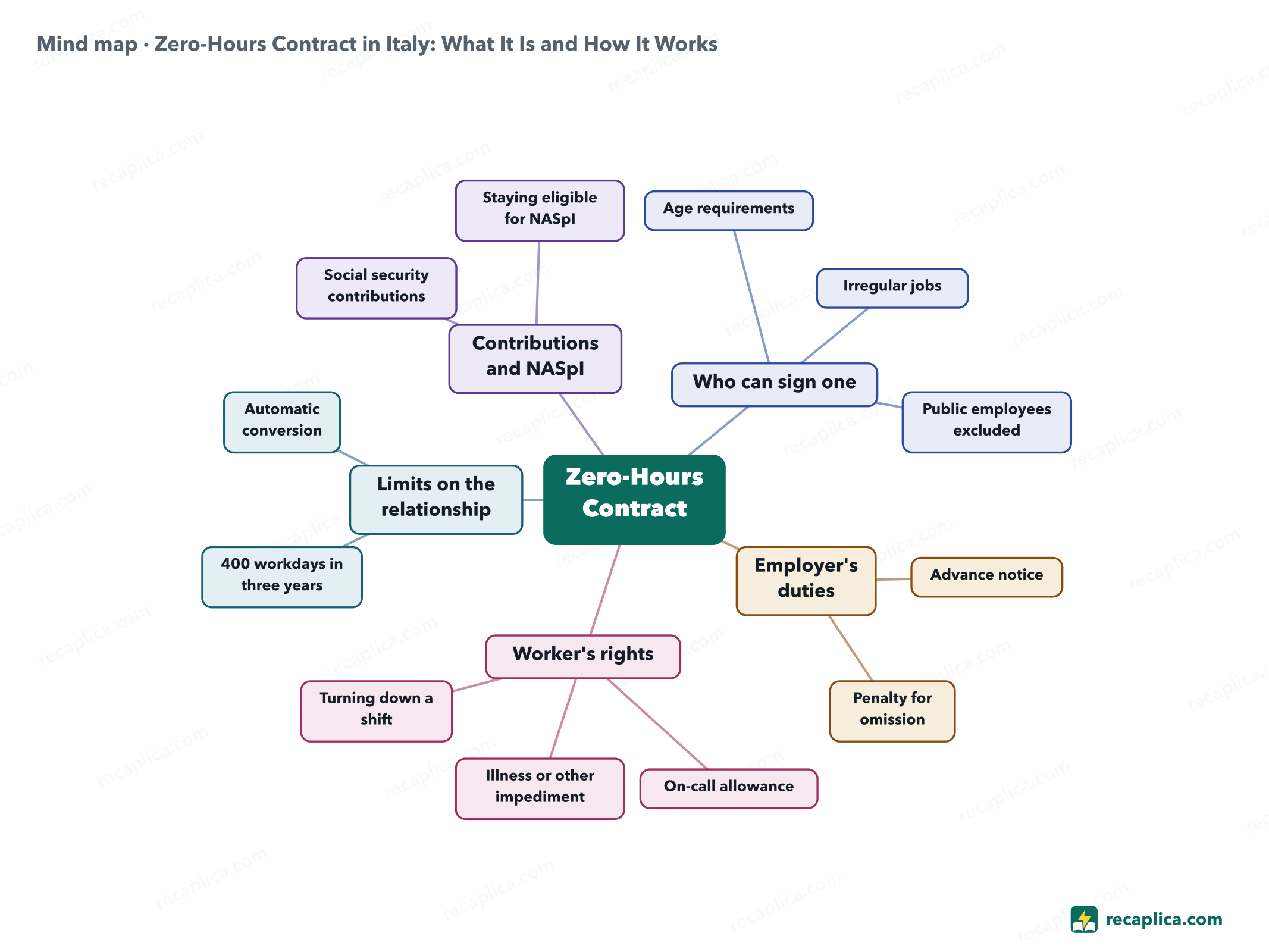
    Mind map: Zero-Hours Contract in Italy: What It Is and How It Works
    • Zero-Hours Contract
      • Who can sign one
        • Age requirements Under 24, if the job ends before turning 25, or over 55 with no upper limit
        • Irregular jobs Roles listed in the Ministerial Decree of 23 October 2004, table from a 1923 royal decree repealed in 2025 but still operative
        • Public employees excluded
      • Employer's duties
        • Advance notice Before the shift starts, by text message or email
        • Penalty for omission €400 to €2,400 per worker
      • Worker's rights
        • On-call allowance Due only with a standby obligation
        • Illness or other impediment Must be reported right away, or the allowance is lost for 15 days
        • Turning down a shift Without a valid reason, it can lead to dismissal
      • Limits on the relationship
        • 400 workdays in three years With the same employer, except in tourism, public venues, and entertainment
        • Automatic conversion Past the cap, it becomes a full-time, open-ended contract
      • Contributions and NASpI
        • Social security contributions Still paid on the on-call allowance, even below the usual minimum
        • Staying eligible for NASpI Expected yearly income under €8,000, reported to INPS within 30 days

    Quiz: test yourself

    Answer the questions to check what you have learned: you get instant feedback and a short explanation.

    Grade 0/10 0/5
    1 What kind of employment relationship is a zero-hours contract?

    Intermittent work ties the worker to the employer through a standard employment relationship, not a freelance arrangement: it's a job with no fixed schedule, not an assignment taken case by case.

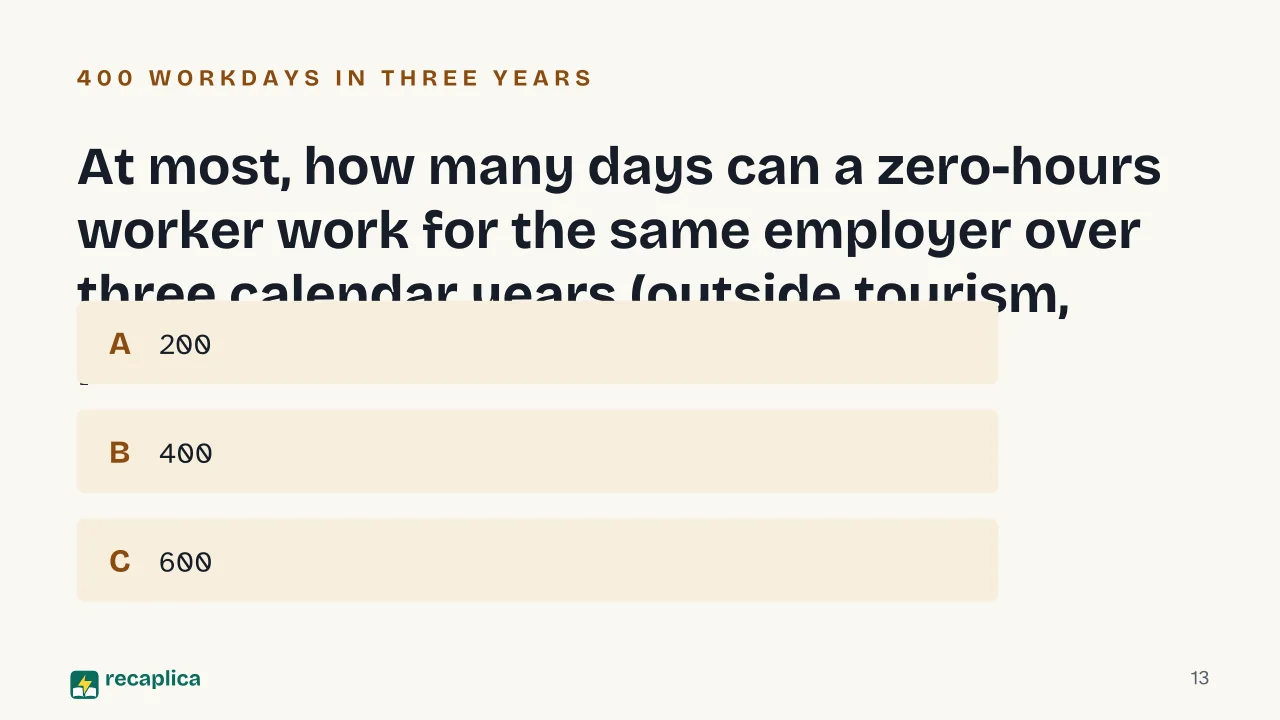
    2 At most, how many days can a zero-hours worker work for the same employer over three calendar years (outside tourism, public venues, and entertainment)?

    The cap is 400 days actually worked over three calendar years: past that threshold, the contract automatically becomes full-time and open-ended.

    3 A zero-hours worker who receives no calls is always entitled to pay.

    Without a standby obligation, no pay is owed during periods with no calls; the on-call allowance exists only for workers who have agreed to answer the employer's calls.

    4 What must the employer do before each shift?

    Advance notice, by text message or email, is mandatory: skipping it triggers an administrative fine of €400 to €2,400 per worker.

    5 To keep receiving NASpI with a zero-hours contract, what must the worker do?

    INPS Message no. 1162/2018 cites the threshold of €8,000 of expected yearly income, to be reported within 30 days of the NASpI application.

    Answers: 1-A · 2-B · 3-B · 4-A · 5-B

    Flashcards

    Tap the card to flip it and check whether you remember the answer, then move to the next one.

    1 / 8

    Explain it in your own words

    The ultimate test: if you can explain it in simple words, you've truly understood it. Write your explanation, then compare it with the Recap.

    Your explanation is saved only on this device.

    A zero-hours contract, called "lavoro intermittente" in Italy, is a form of employment with no guaranteed hours: the worker stays available, and the employer calls them in only when needed. Under Italian law, it is open mainly to workers under 24 and over 55, plus people doing a short list of irregular jobs set out in an old royal decree. If no call comes, the worker earns nothing, unless they agreed to stay on standby: in that case a collective agreement sets an on-call allowance. The employer must notify each shift before it starts, and skipping that notice carries a fine.

    Frequently asked questions

    Who can be hired under a zero-hours contract?

    With no other requirements, workers under 24 (if the job ends before turning 25) and over 55, with no upper age limit. Anyone can also be hired for the irregular jobs listed in the Ministerial Decree of 23 October 2004. Public employees are excluded.

    What happens if the employer doesn't notify a shift in advance?

    An administrative fine of €400 to €2,400 applies for each worker whose shift wasn't notified, a fixed amount set by law.

    Can zero-hours work qualify for NASpI unemployment benefit?

    Yes, as long as the expected yearly income from the contract (hours worked plus, where it applies, the on-call allowance) stays under €8,000, reported to INPS within 30 days of the application.

    What changes in pay during a month with few shifts?

    With a standby agreement in place, the payslip adds the on-call allowance for the days spent ready and waiting to the pay for shifts actually worked. Without that agreement, only the hours worked show up.

    Is there a limit to how long someone can work on a zero-hours contract?

    The cap is 400 days actually worked over three calendar years with the same employer. In tourism, public venues, and entertainment, that limit doesn't apply.

    Sources

    • Legislative Decree 81/2015, Art. 13 — Definition and grounds for intermittent work (Brocardi.it)
    • Legislative Decree 81/2015, Art. 15 — Form and notice requirements (Brocardi.it)
    • Legislative Decree 81/2015, Art. 16 — On-call allowance (Brocardi.it)
    • INPS, Message no. 1162 of 16/03/2018 — NASpI and compatibility with intermittent work
    • Italian Ministry of Labour — Intermittent work (employment relationships focus)
    • Cliclavoro — Intermittent work (types of employment relationships)
    • Italian Ministry of Labour — clarification on the irregular jobs under R.D. 2657/1923
    • Italian Ministry of Labour, note on intermittent work, 27 August 2025 (Circular no. 15/2025) — repeal of R.D. 2657/1923

    Every Recap goes through an independent review before publication.

    Every evening, the day's new Recaps on our Telegram channel. Join the channel →

    Keep learning

    • Civics What Is Pi Day? Why It Falls on March 14 Pi Day is a yearly observance on March 14, chosen because the US date format writes that day as 3/14, matching pi's first digits. Larry Shaw, a physicist at San Francisco's Exploratorium, came up with it in 1988 during a staff retreat at the museum. What started as a small party among coworkers grew into a public celebration with a parade, pie, and a 2009 resolution from the US Congress. Today it's mostly marked in schools and science museums, with digit-memorization contests and discounts at pizza and dessert shops. Read the Recap →
    • Civics Mass Media: What They Are Mass society is a type of society where ordinary people carry real weight in political and social life, but at a cost: more conformity, less individual autonomy, greater exposure to manipulation. The Treccani encyclopedia places its rise between the late 19th and early 20th century, when population growth, urbanization, mass schooling, wider voting rights and industrial organization converge. Mass media, radio and film first, then satellites and the internet, make it possible on a scale never seen before. The Frankfurt School and Ortega y Gasset turned it into an object of criticism, from two different angles: a culture industry that standardizes, and a mass man who blends into the average. Read the Recap →
    • Civics Secularization: Definition, Theories, and How It Shapes Society Secularization is the process through which religious institutions, practices, and beliefs lose social weight, as a society leans more on reason and science, according to EBSCO Research Starters. It shows up on three different levels: institutions, a country's shared culture, and the religious choices each person makes. Max Weber described it as the disenchantment of the world, the modern rationalization that pushed religion and metaphysics outside the boundaries of legitimate knowledge; Émile Durkheim linked it, in 1912, to the split between the sacred and the profane. Pew Research Center data from 2024 show how unevenly the process plays out: in India, Israel, Nigeria, and Thailand, 95% or more of adults still belong to the religion they grew up in, while in South Korea half of adults have left theirs behind. Read the Recap →

    recaplica

    Clear in 30 seconds, yours in 10 minutes.

    Recaps Mind maps Request a Recap Telegram channel Mind map maker Our method About Privacy & cookies Legal notes & terms of use

    © 2026 Recaplica · A project by Curi S.r.l. — VAT IT05472000750

    Statistics, only if you say so

    To learn which Recaps help most we would use Google Analytics, with aggregate, anonymous data. It starts only with your OK, and you can change your mind anytime. Privacy policy