recaplica
Clear in 30 seconds, yours in 10 minutes.
In 30 seconds quick read
The Italian abbreviation co.co.co stands for contratto di collaborazione coordinata e continuativa, a relationship in which someone works steadily for one client while staying self-employed in formal terms. Since 1 January 2016, Article 2(1) of Legislative Decree 81/2015 has applied the rules of subordinate employment to collaborations that are at once predominantly personal, continuous over time and organised by the client as to how the work gets done. Italy's National Labour Inspectorate reads this as an extension of employee protections, while the contractual type stays a collaboration. Paragraph 2 of the same article leaves several categories out of that presumption, from professions on a public register to mountain rescue. In 2026, contributions to the INPS Gestione separata on a co.co.co come to 35.03% of the fee, and the client pays them over.
Key Points
In a co.co.co the person doing the work stays self-employed in formal terms; in the genuine form set out by Article 409 of the Italian code of civil procedure, the two sides agree together on timing and methods.
From 1 January 2016, Article 2(1) of Legislative Decree 81/2015 applies employment law to collaborations that are mainly personal in nature, repeated over time and organised by the client.
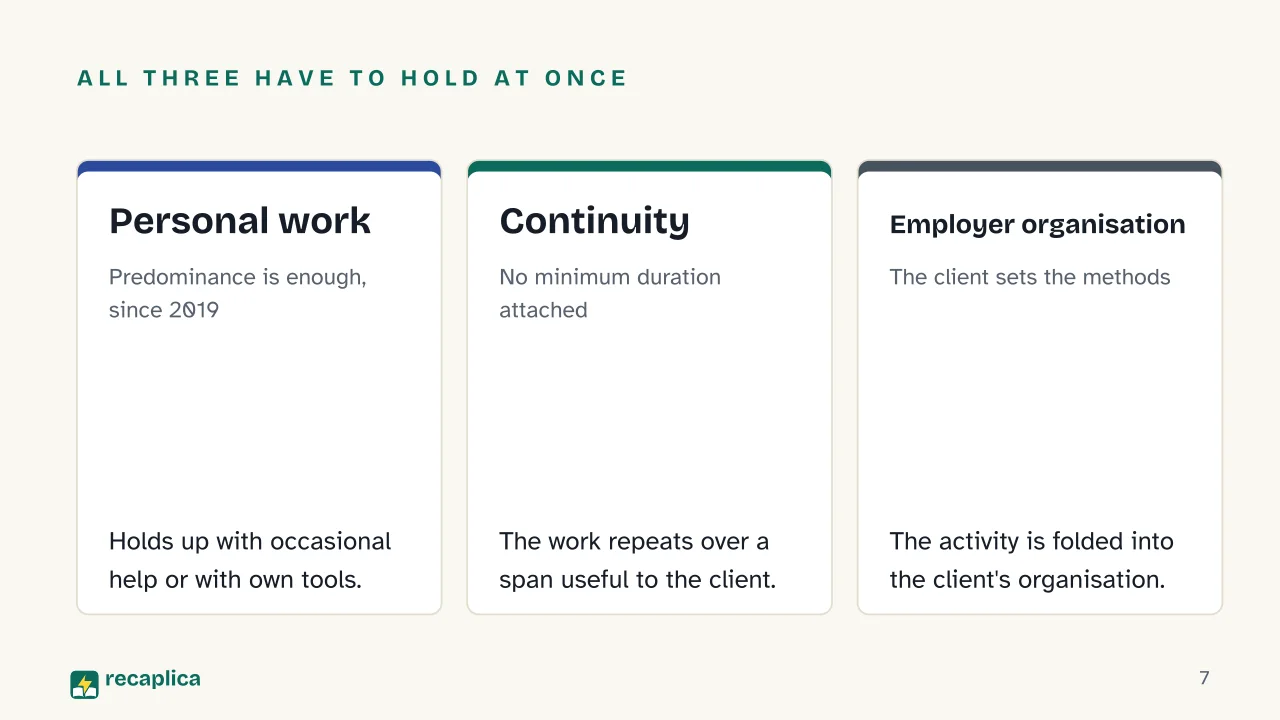
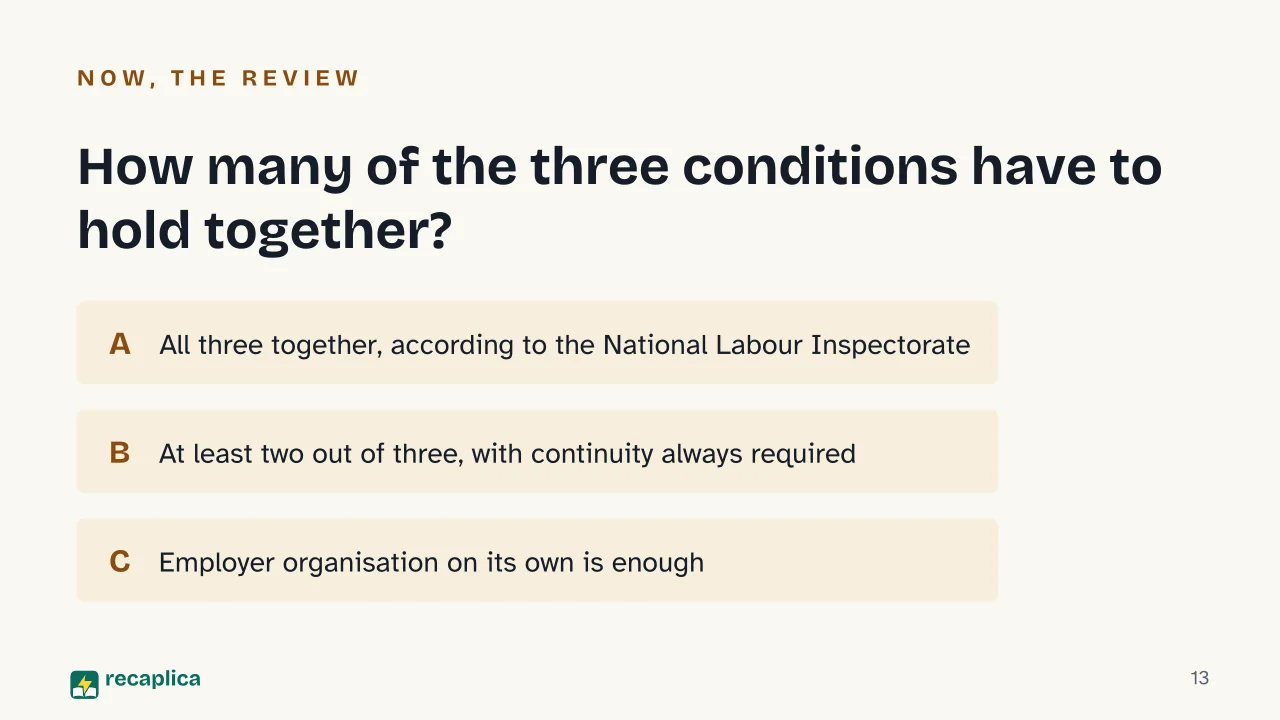
The National Labour Inspectorate requires all three conditions at once, and since 2019 the work has to be predominantly personal, no longer exclusively so.
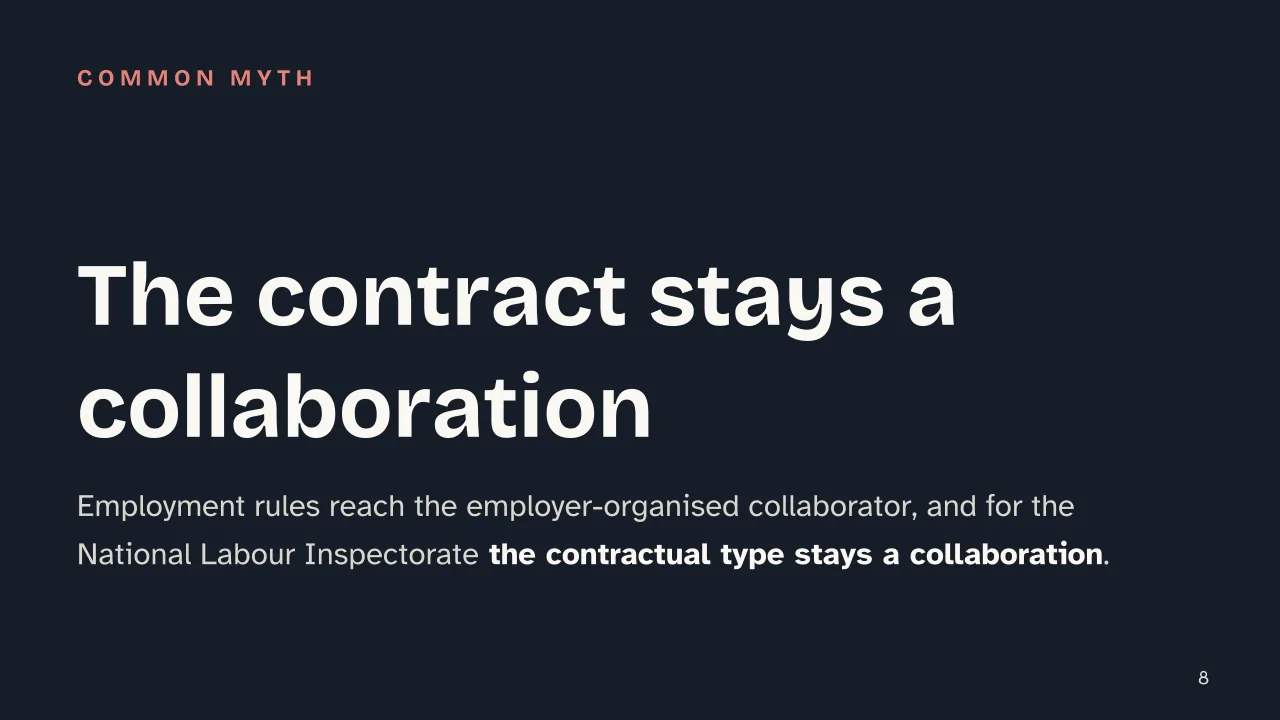
An employer-organised collaborator is covered for pay, hours and pension contributions, and protected against unlawful dismissal, while the contractual type stays a collaboration, unless genuine employer direction comes into play.
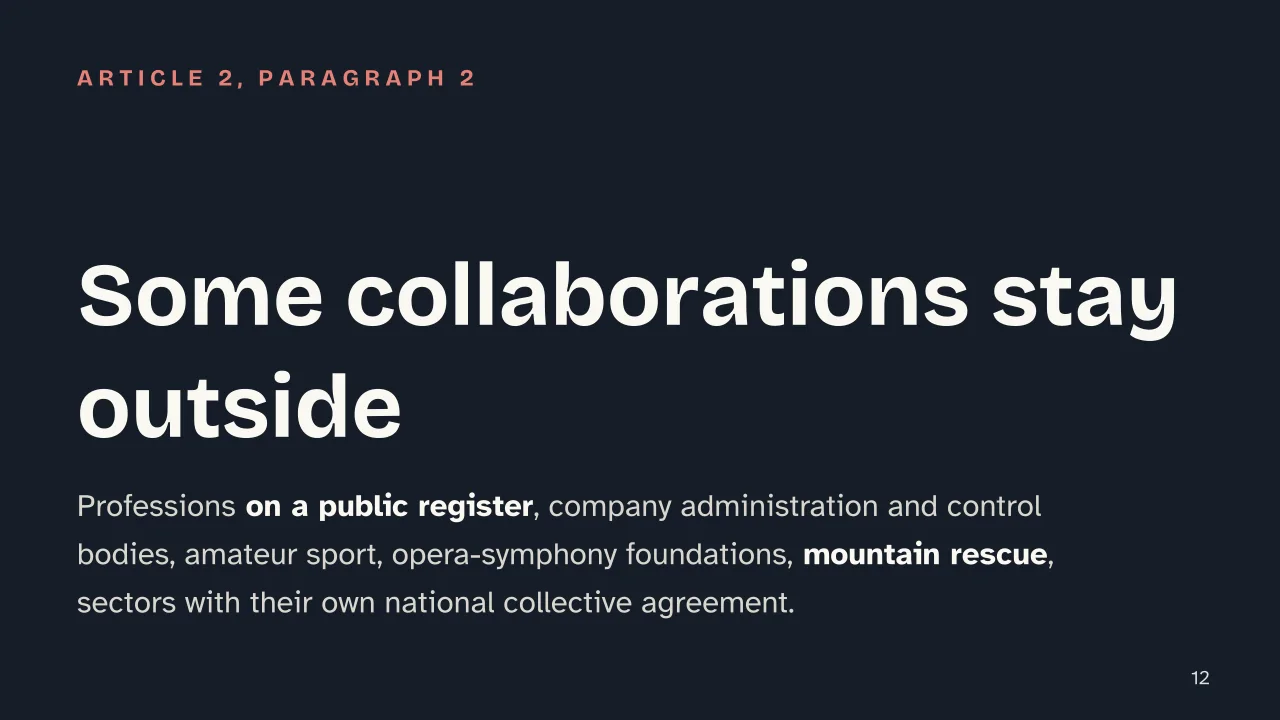
Paragraph 2 excludes from the presumption anyone enrolled on a professional register, company directors and auditors, amateur sport, opera-symphony foundations, mountain and cave rescue, and sectors with their own national collective agreement.
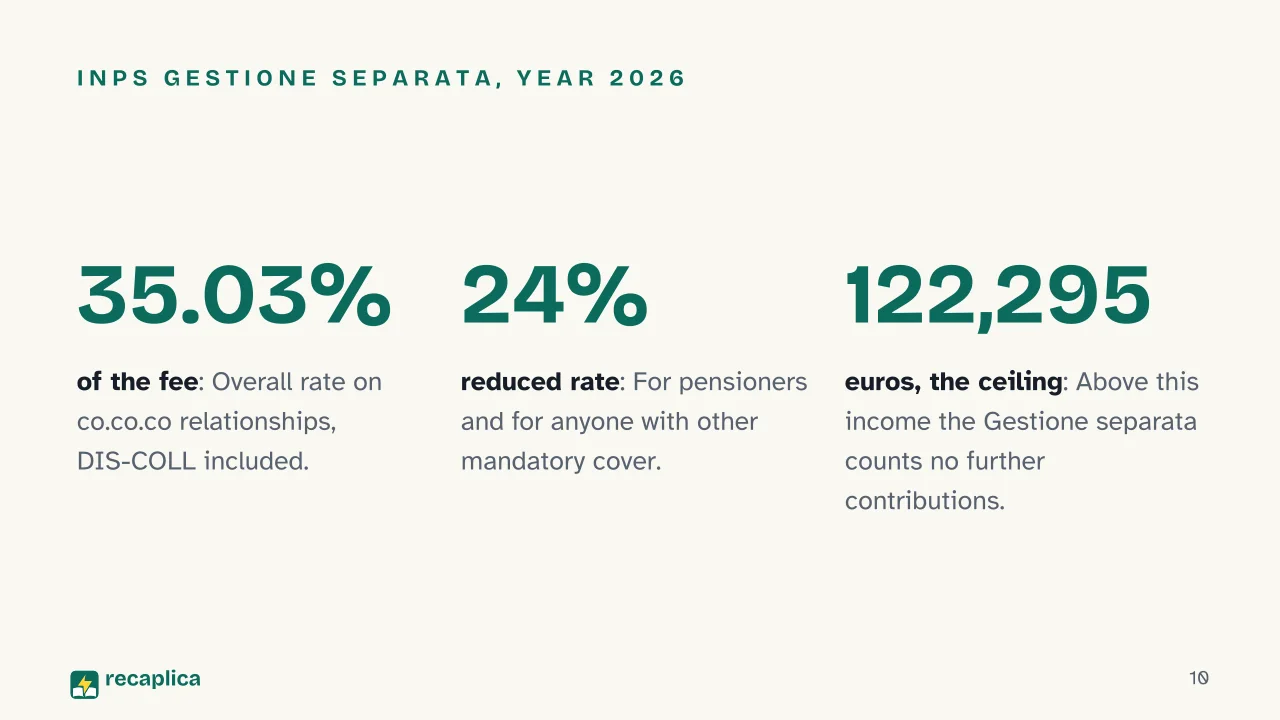
In 2026 the overall contribution rate on co.co.co relationships is 35.03%; one third falls on the collaborator and the rest on the client, who pays INPS by the 16th of the month after the fee is paid.
Key figures
35.03% Overall contribution rate on co.co.co relationships for 2026, DIS-COLL included. Source: INPS, Circular no. 8 of 3 February 2026
€122,295 Income ceiling of the Gestione separata for 2026, above which no further contributions are calculated. Source: INPS, Circular no. 8 of 3 February 2026
€18,808 Income that credits a full year of contributions in the Gestione separata in 2026. Source: INPS, Circular no. 8 of 3 February 2026
Deep Dive
What a coordinated and continuous collaboration is
Co.co.co is short for contratto di collaborazione coordinata e continuativa,
the contract under which a person agrees to carry out an activity for one
client on a continuing basis while remaining, in formal terms, self-employed. The genuine version of this relationship is the
one described in Article 409 of the Italian code of civil procedure, where
the two sides coordinate, meaning that they agree on the timing and the
methods of the work. Circular no. 7 of 30 October 2020 from the National
Labour Inspectorate puts the dividing line at how far the client steps into
those methods.
The three conditions that extend employment protections
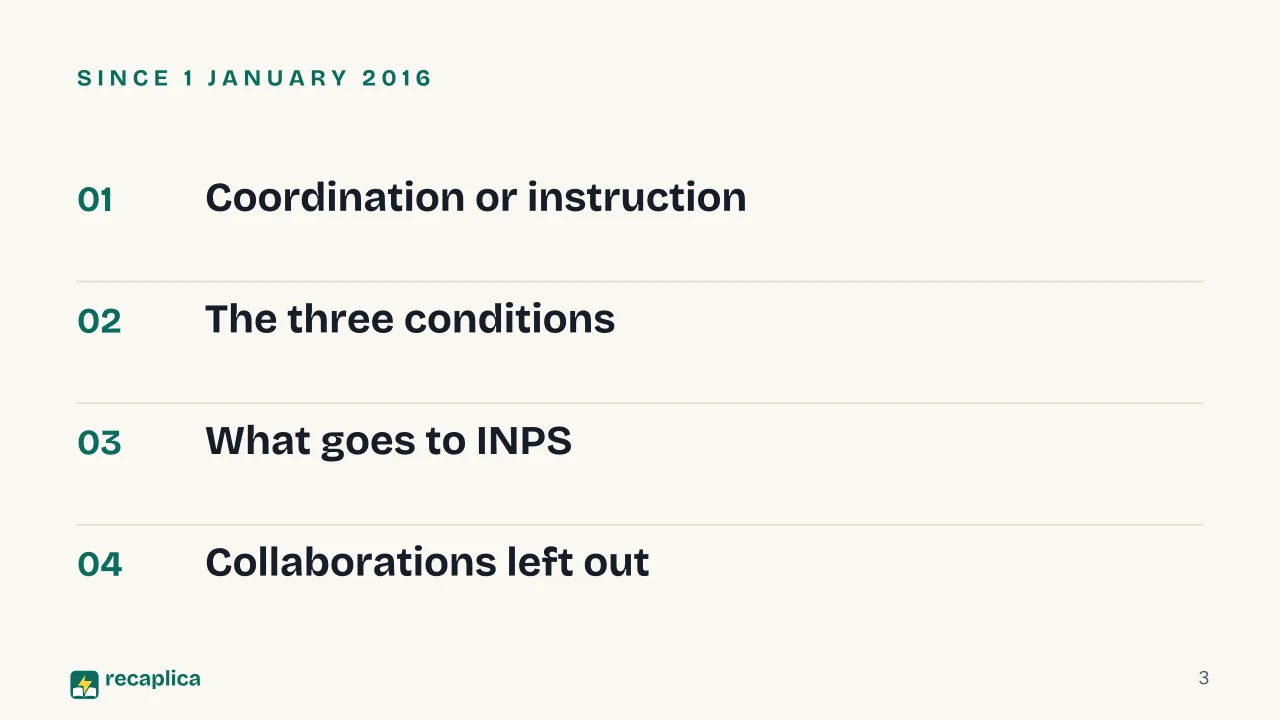
Since 1 January 2016, Article 2(1) of Legislative Decree 81/2015 has applied
the rules of subordinate employment to employer-organised collaborations,
meaning the ones where the work is personal in the main, repeats over time
and has its methods set by the client. The
National Labour Inspectorate is explicit that all three conditions have to
hold at the same time: when one of them is missing, the presumption stays
idle.
The first condition changed along the way. Up to 2019 the work had to be
exclusively personal; since Decree-Law 101/2019 it is enough that it be
predominantly personal, which brings in collaborations carried out with
occasional help from other people or with equipment belonging to the
collaborator.
Continuity has no minimum duration attached to it. What counts for the
Inspectorate is that the work repeats over a span of time that is appreciable
and useful to the client.
Then there is employer organisation, the third condition. Circular no. 7/2020
finds it where the collaborator’s activity is fully
folded into the client’s organisation, to the point of being indispensable
for carrying the work out.
Practical example: an online newsroom hands one person the job of
putting together the weekly newsletter. The newsroom fixes the sending day,
the graphic template and the internal review step, and the newsletter does
not go out if that work is left undone. The job is personal, it repeats
every week and the client decides the methods, so under Article 2(1) the
rules of subordinate employment apply to the collaborator. Where the two
sides only agree on deadlines and the collaborator organises their own
work, the relationship stays inside Article 409 of the code of civil
procedure.
Protections extended, contractual type unchanged
Where Article 2(1) bites, the whole body of employment law reaches the
collaborator: pay, working hours, pension cover and protection against
unlawful dismissal, apart from the rules that a formally self-employed
arrangement cannot carry. The National Labour Inspectorate notes that a
collaboration remains the contractual type of the relationship. The contract
does not turn automatically into subordinate
employment in the technical sense, unless genuine employer direction appears,
that is the power to direct the work itself.
The Court of Cassation confirmed this reading in judgment 1663/2020: an
employer-organised collaborator remains formally self-employed and in
substance receives the same protections as an employee on safety, pay,
holidays, hours and pension cover.
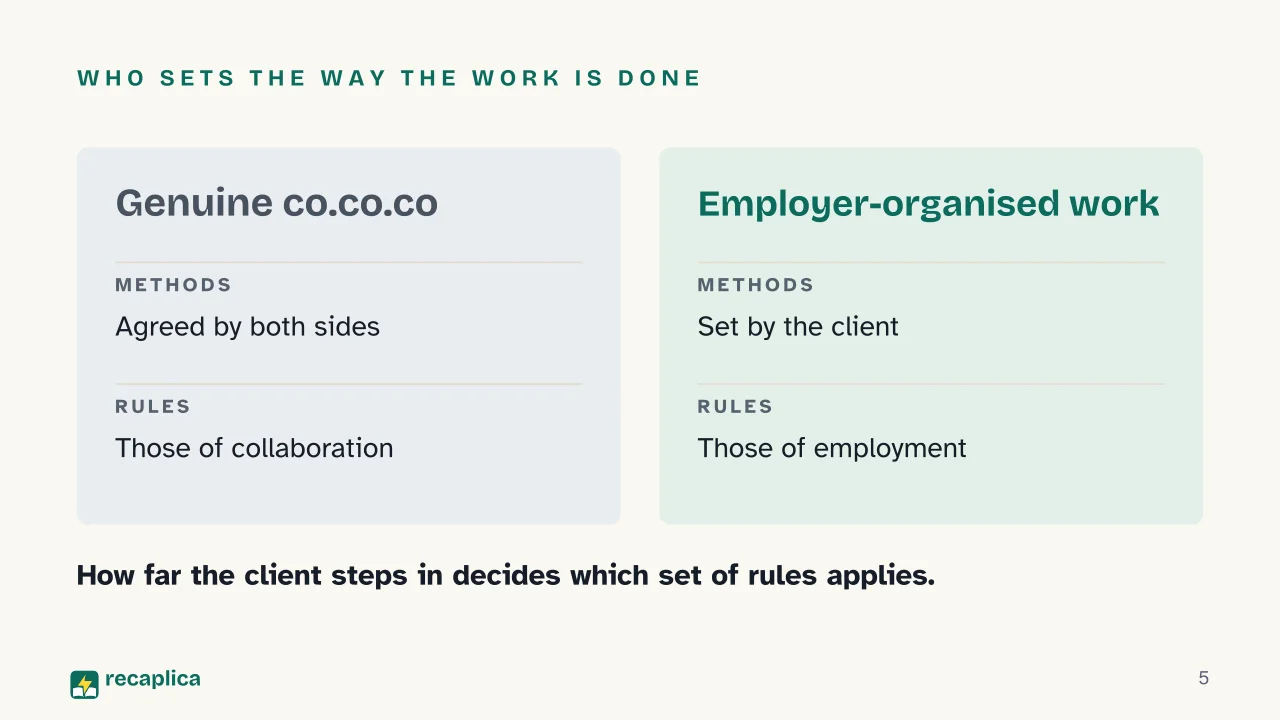
Genuine co.co.co
Employer-organised collaboration
Methods of performance
Coordinated between the parties
Set by the client
Rules applied
Those of collaboration
Those of subordinate employment
Contractual type
Collaboration
Collaboration
Subordinate employment in the technical sense
No
Only with genuine employer direction
The collaborations paragraph 2 leaves out
Paragraph 2 of Article 2 lists the cases where the presumption of paragraph 1
does not apply:
collaborations covered by a national sector collective agreement that sets
their pay and terms;
registered intellectual professions, so anyone enrolled on a professional
register, lawyers and accountants among them;
company administration and control bodies, that is directors, statutory
auditors and external auditors, together with members of boards and
commissions;
collaborations in the production of shows by opera-symphony foundations;
mountain and cave rescue operators under Law 74/2001.
What a co.co.co costs in contributions
The collaborator is enrolled in the INPS Gestione separata, and a circular
updates the rates every year. For 2026, circular no. 8 of 3 February 2026
sets the pension rate at 33% for people enrolled on an exclusive basis; on
top of that base come 0.50% for maternity, sickness and household allowance,
0.22% introduced by the ministerial decree of 12 July 2007 and 1.31% for
DIS-COLL, the unemployment benefit of collaborators. The table in the circular brings the total to 35.03% for
co.co.co. contracts. Anyone who already holds other mandatory pension
cover, or who already draws a pension, pays a reduced rate of 24% in 2026.
The contribution splits between the two sides: one third falls on the person
collaborating, the remaining two thirds on the party commissioning the work.
The client is also the one who
pays it over to INPS, by the 16th of the month after the fee is paid. That is one of the practical differences with self-employment run
through a partita IVA, where whoever works
looks after their own payments, as happens under the flat-rate
regime.
Two thresholds complete the 2026 picture. The ceiling of income on which the
Gestione separata calculates contributions is €122,295, and nothing further
is due above that figure. The minimum, the income that credits a full year of
contributions, is €18,808.
Slide deck
Slides ready to download and make your own in PowerPoint or Google Slides, with speaker notes. Pick the Flash cut or the Full one.
✗ Myth Once a collaboration is found to be employer-organised, the contract becomes an employment contract.
✓ Reality Circular no. 7 of 30 October 2020 from the National Labour Inspectorate explains that the collaborator receives the treatment of an employee, from the pay packet to hours, pension cover and protection against dismissal, while the contract itself remains a collaboration. The shift to subordinate employment in the technical sense happens only where genuine employer direction appears, and the Court of Cassation in judgment 1663/2020 confirmed that an employer-organised collaborator stays formally self-employed.
✗ Myth Contributions on a co.co.co are paid by the collaborator, the way a partita IVA holder pays their own.
✓ Reality Under INPS circular no. 8 of 3 February 2026 the contribution is split, one third charged to the collaborator and two thirds to the party commissioning the work, and the money reaches INPS through the client, by the 16th of the month following payment of the fee.
✗ Myth A lawyer or an accountant who collaborates with a company for years risks having the collaboration treated as employment.
✓ Reality Paragraph 2 of Article 2 of Legislative Decree 81/2015 keeps registered intellectual professions outside the presumption of paragraph 1, so for anyone enrolled on a professional register that presumption never kicks in. The ordinary assessment of the relationship still applies where the signs of employer direction show up.
Mind map
Drag the background to move around and the nodes to reposition them; use − and + to collapse and expand branches.
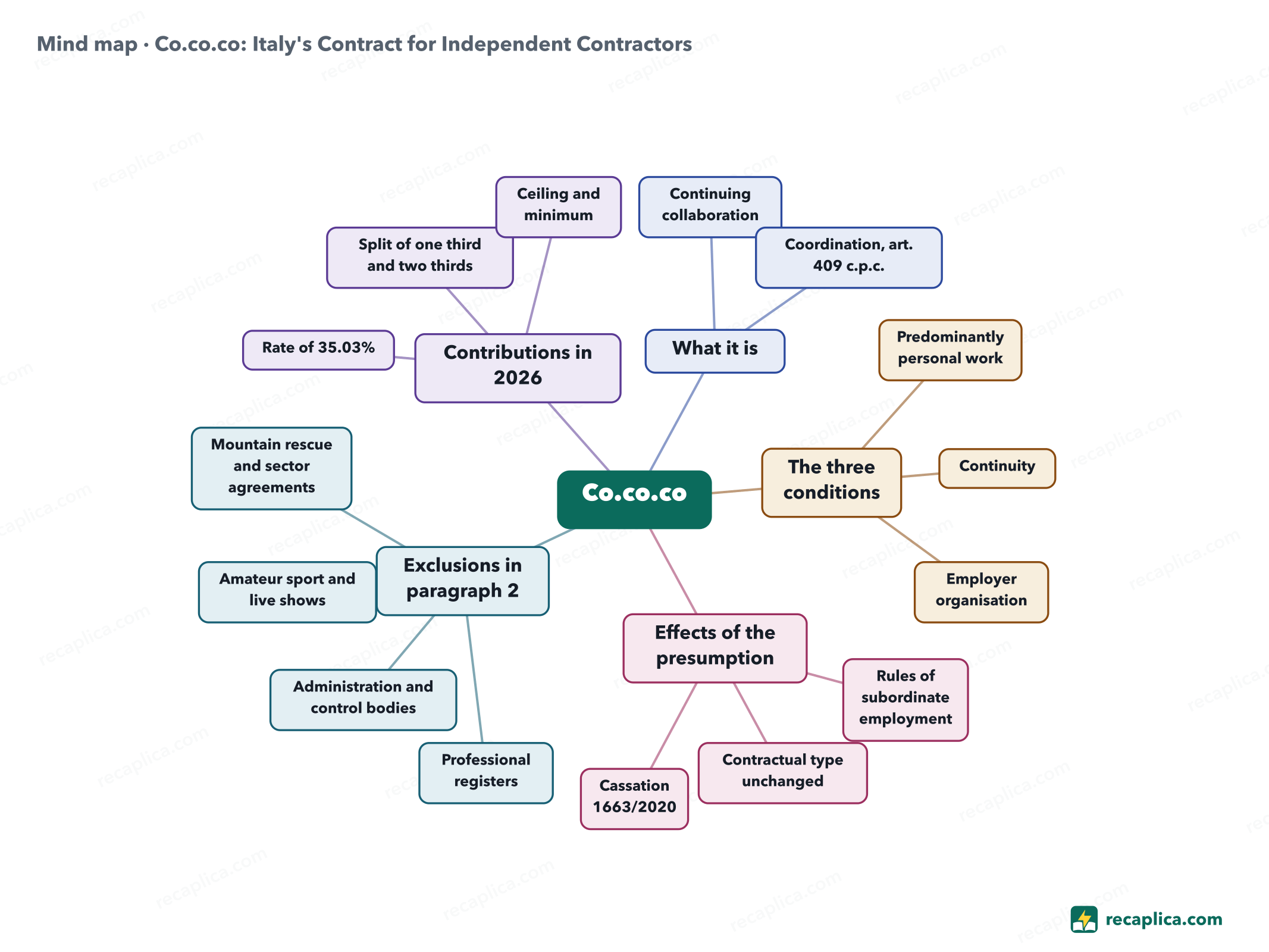
Continuing collaborationthe worker stays self-employed in formal terms
Coordination, art. 409 c.p.c.the parties agree on timing and methods
The three conditionsthey have to hold all at once
Predominantly personal worksince 2019, no longer exclusively
Continuityrepetition over an appreciable span of time
Employer organisationthe client sets the methods
Effects of the presumption
Rules of subordinate employmentpay, hours, pension cover, dismissal
Contractual type unchanged
Cassation 1663/2020
Exclusions in paragraph 2
Professional registers
Administration and control bodies
Amateur sport and live shows
Mountain rescue and sector agreements
Contributions in 2026
Rate of 35.03%24% with other mandatory cover
Split of one third and two thirds
Ceiling and minimum122,295 and 18,808 euros
Quiz: test yourself
Answer the questions to check what you have learned: you get instant feedback and a short explanation.
Grade0/100/5
Answers: 1-A · 2-A · 3-A · 4-A · 5-A
Flashcards
Tap the card to flip it and check whether you remember the answer, then move to the next one.
1 / 8
Explain it in your own words
The ultimate test: if you can explain it in simple words, you've truly understood it. Write your explanation, then compare it with the Recap.
Your explanation is saved only on this device.
The Italian abbreviation co.co.co stands for contratto di collaborazione coordinata e continuativa, a relationship in which someone works steadily for one client while staying self-employed in formal terms. Since 1 January 2016, Article 2(1) of Legislative Decree 81/2015 has applied the rules of subordinate employment to collaborations that are at once predominantly personal, continuous over time and organised by the client as to how the work gets done. Italy's National Labour Inspectorate reads this as an extension of employee protections, while the contractual type stays a collaboration. Paragraph 2 of the same article leaves several categories out of that presumption, from professions on a public register to mountain rescue. In 2026, contributions to the INPS Gestione separata on a co.co.co come to 35.03% of the fee, and the client pays them over.
Frequently asked questions
Is a co.co.co worth it?
It depends on how far the client steps into the way the work is done. Where the relationship falls under Article 2(1) of Legislative Decree 81/2015, the collaborator gains the employment rules on pay, hours, pension cover and unlawful dismissal, and most of the contribution burden sits with the client, because in 2026 the 35.03% splits one third on the collaborator and two thirds on the client, who is also the party paying it over. Where the collaboration is genuine, with only the coordination set out in Article 409 of the code of civil procedure, those protections do not apply. The comparison with a partita IVA also covers the mechanics of payment, since there the worker handles the contributions.
Does a co.co.co collaborator qualify for NASpI?
NASpI is the benefit designed for employees. Collaborators have DIS-COLL instead, funded by a slice of the contribution rate that INPS circular no. 8 of 3 February 2026 sets at 1.31% for 2026, inside the overall 35.03%. Eligibility and the application itself are handled on the INPS website.
Who pays the contributions on a co.co.co?
The client. INPS receives the payment by the 16th of the month that follows payment of the fee. The burden splits into two shares, though, one share on the person collaborating and two on the party commissioning the work.
Can someone enrolled on a professional register work under a co.co.co?
Yes. Paragraph 2 of Article 2 of Legislative Decree 81/2015 names people practising a registered intellectual profession among the cases excluded from the rule in paragraph 1. For a lawyer or an accountant, then, collaborating for a long stretch with the same client does not by itself trigger employee treatment.
What is the difference between a co.co.co and an employer-organised collaboration?
The degree to which the client interferes. In the genuine collaboration of Article 409 of the code of civil procedure the parties coordinate; in an employer-organised collaboration the client imposes the way the work is carried out, and for the National Labour Inspectorate that is what triggers the rules of subordinate employment.
Every Recap goes through an independent review before publication.
Statistics, only if you say so
To learn which Recaps help most we would use Google Analytics, with aggregate, anonymous data. It starts only with your OK, and you can change your mind anytime. Privacy policy