Skip to content
recaplica

    One moment: security check

    Cloudflare wants to make sure you're not a robot. Tick the box below and your search will continue on its own.

    IT
    recaplica Fixed-Term Contract: Definition and Rules Under Italian Law
    © 2026 Recaplica · recaplica.com — All rights reserved
    Home › Civics

    Fixed-Term Contract: Definition and Rules Under Italian Law

    By Recaplica Newsroom · Updated on October 4, 2026

    What to print

    Page numbers appear when printing with default margins.

    Slides

    Choose a cut

    Flash10 slidesThe essential thread, to present in classFull15 slidesEvery chapter and the deeper detail

    Both come with speaker notes.

    Telegram channel
    recaplica Clear in 30 seconds, yours in 10 minutes.
    In 30 seconds Key points Figures Deep dive Slides Myths Mind map Quiz Flashcards FAQ

    In 30 seconds quick read

    A fixed-term contract is an employment contract with an end date fixed in advance, unlike an open-ended contract, which has no end date. Under Italian law, Legislative Decree 81/2015 sets a standard maximum duration of 12 months, extendable up to 24 months only with a specific justified reason, and allows at most 4 extensions within 24 months of the overall relationship. Going beyond these limits, or renewing the contract without respecting the minimum gap between one term and the next, automatically converts the relationship into an open-ended contract. Employers cannot hire more than 20% of their stable workforce on fixed-term contracts, except for smaller companies.

    Key Points

    • A fixed-term contract already states its end date when signed; an open-ended contract does not (Ministry of Labour).
    • The standard maximum duration is 12 months; beyond that, and up to 24, a specific justified reason is required (art. 19, Legislative Decree 81/2015).
    • Up to 4 extensions are allowed, counted over the 24 months of the overall relationship rather than the single contract (art. 21); a fifth extension turns the relationship into an open-ended contract.
    • Without a written end date the contract counts as open-ended from the start; the only exception is a relationship lasting no more than 12 days.
    • A new contract with the same worker requires a minimum gap of 10 or 20 days from the previous one, depending on its length.
    • No more than 20% of the stable workforce can be on fixed-term contracts, except for exemptions granted to smaller companies (art. 23).

    Key figures

    • 12 months Standard maximum duration of a fixed-term contract without a justified reason, set by article 19 of Legislative Decree 81/2015. Source: Legislative Decree 81/2015
    • 4 Cap on extensions for a fixed-term contract: no more than 4, counted over the entire 24 months of the relationship, regardless of how many contracts followed one another (art. 21, Legislative Decree 81/2015). Source: Legislative Decree 81/2015
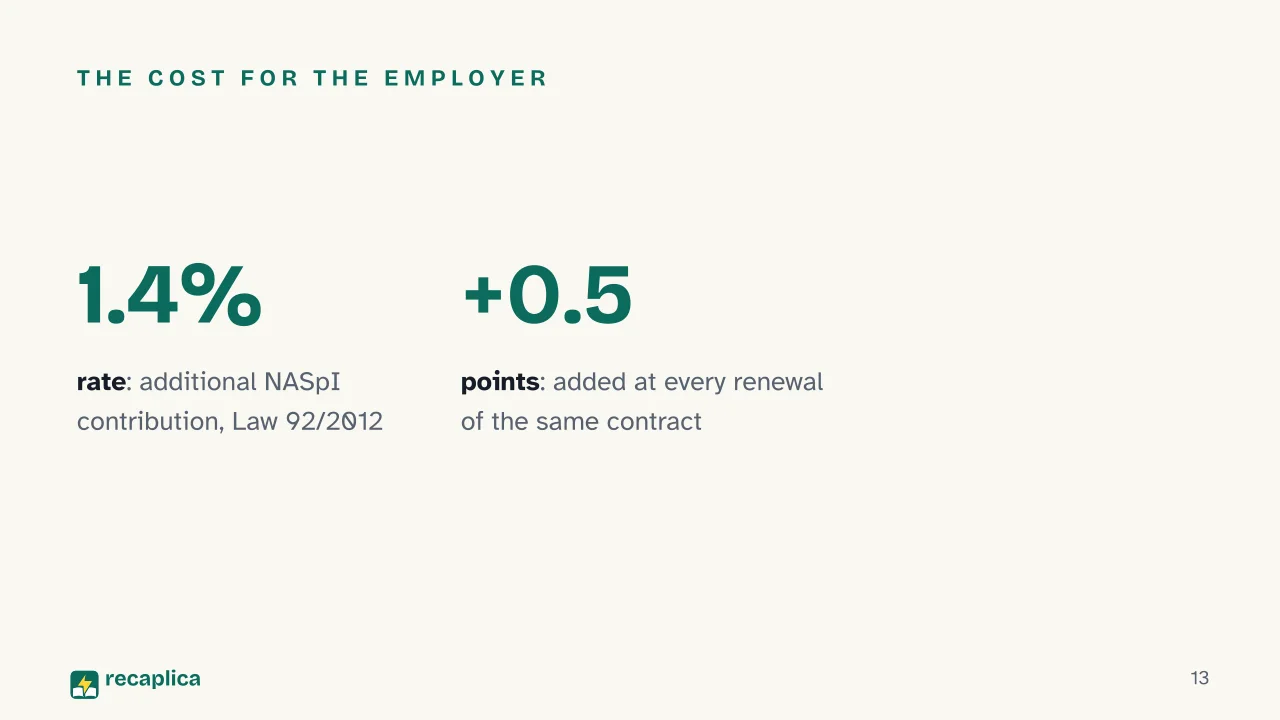
    • 1.4% Rate of the additional NASpI contribution the employer pays on fixed-term contracts, set by article 2, paragraph 28, of Law 92/2012; it rises by a further 0.5 points at every renewal of the same contract. Source: INPS, circular no. 56/2024

    Deep Dive

    What a Fixed-Term Contract Is

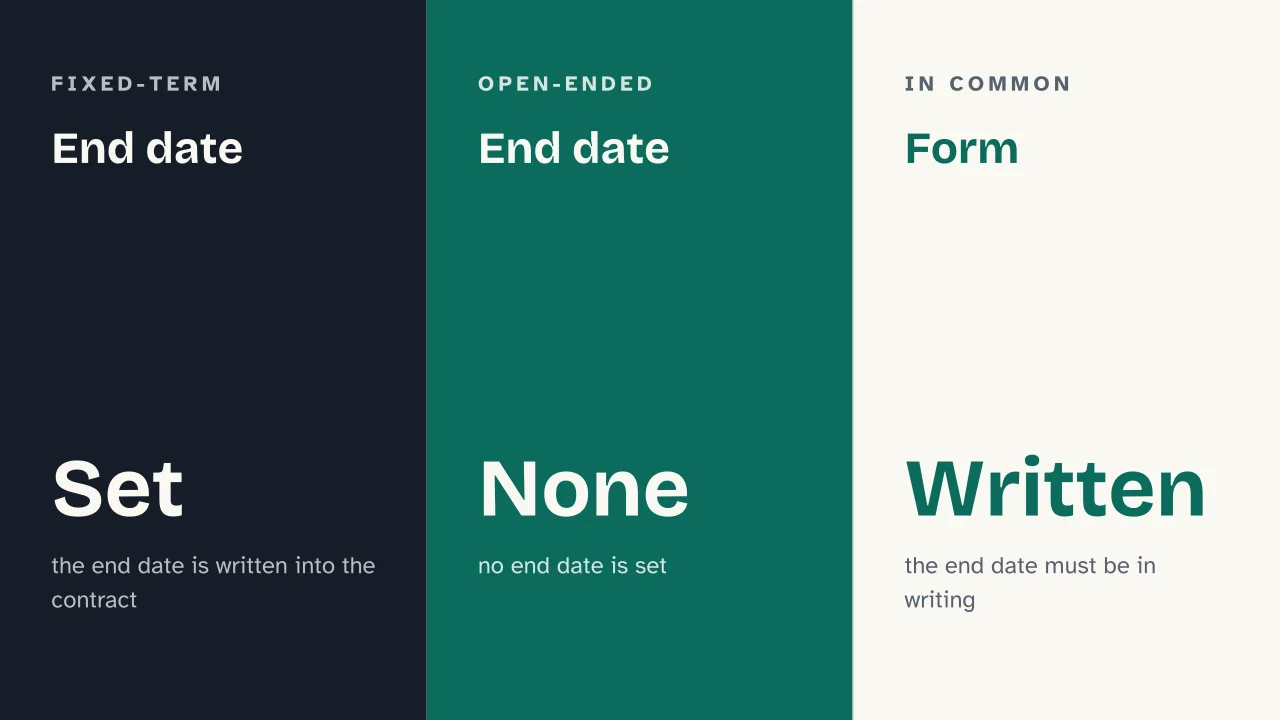
    The Italian Ministry of Labour defines a fixed-term contract as an employment contract with a duration fixed in advance by an end date; an open-ended contract, by contrast, has no end date set beforehand.

    The end date must be put in writing: without it, the contract counts as having no end date, meaning open-ended, from the very start. There is only one exception, noted by the same ministry page: relationships that do not go beyond 12 days.

    Practical example: a company hires a warehouse worker to cover a spike in activity ahead of the holiday season. The contract states a start date and an end date: when that date arrives, unless extended, the relationship ends on its own, with no need for a dismissal.

    Anyone who signs a fixed-term employment contract therefore accepts, from day one, a known end date. It is one of the main differences from an open-ended employment relationship, which stays open until one of the two parties decides to end it.

    Maximum Duration and Justified Reasons: How Long It Can Last

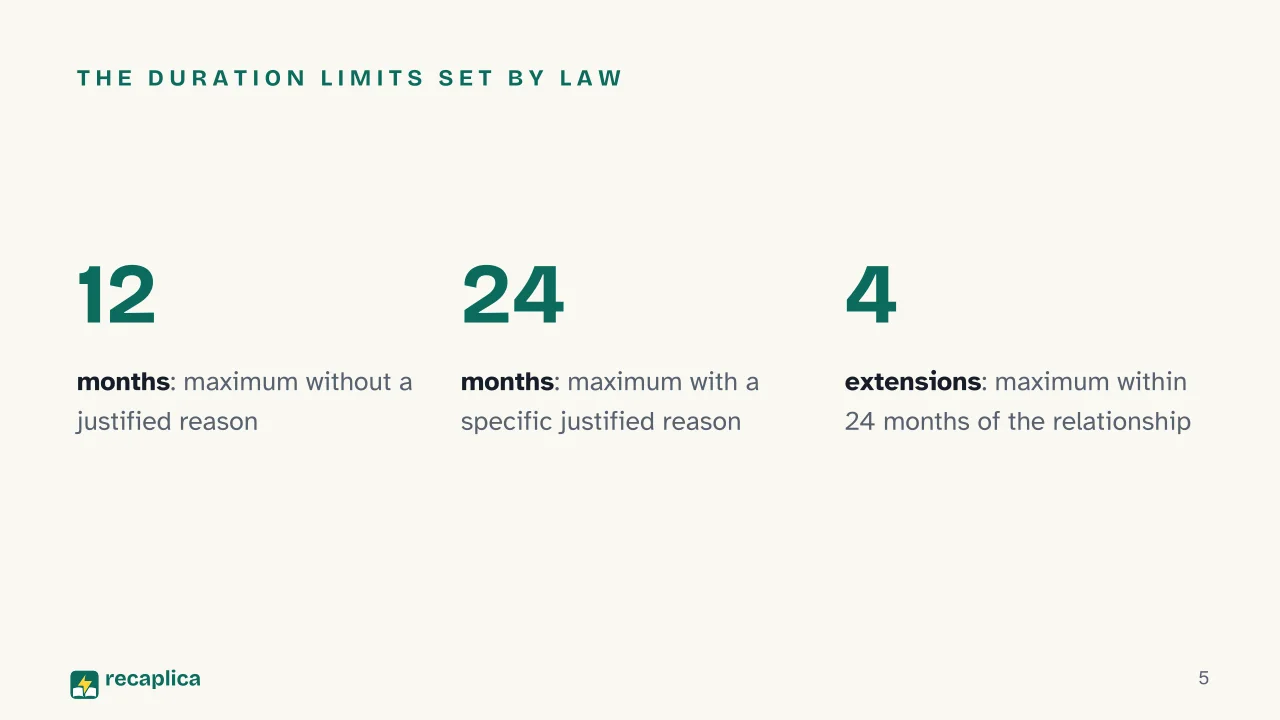
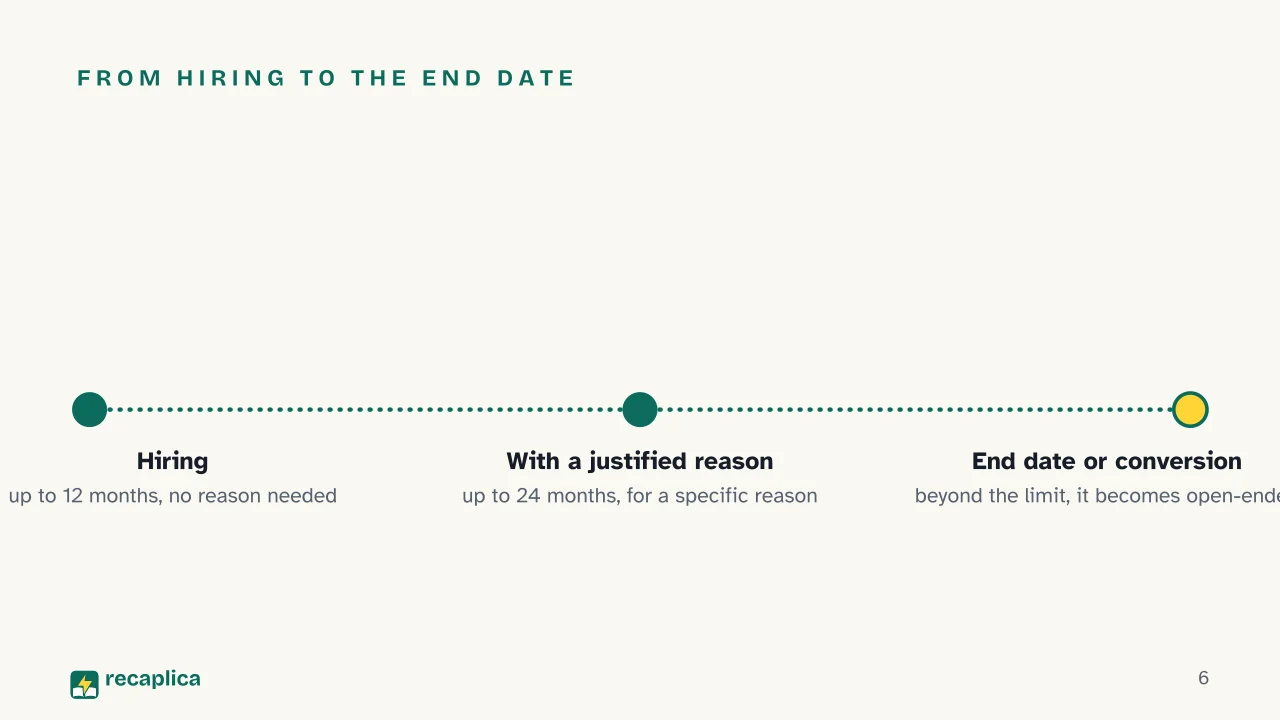
    Legislative Decree 81/2015, in article 19, sets a standard maximum duration of 12 months. An employer can go beyond that limit, up to a maximum of 24 months, only if one of the reasons set out in the same law applies: temporary needs unrelated to ordinary activity, replacing other employees, or a temporary and significant increase in ordinary activity.

    If the employer goes past 12 months without a justified reason, the contract is not voided: it automatically converts into an open-ended contract, starting from the day the thirteenth month begins.

    Extensions and Renewals: The Limits Set by Legislative Decree 81/2015

    Extending or renewing within the first year needs no justified reason; after 12 months it does, drawn from the same reasons already seen for going past the standard duration.

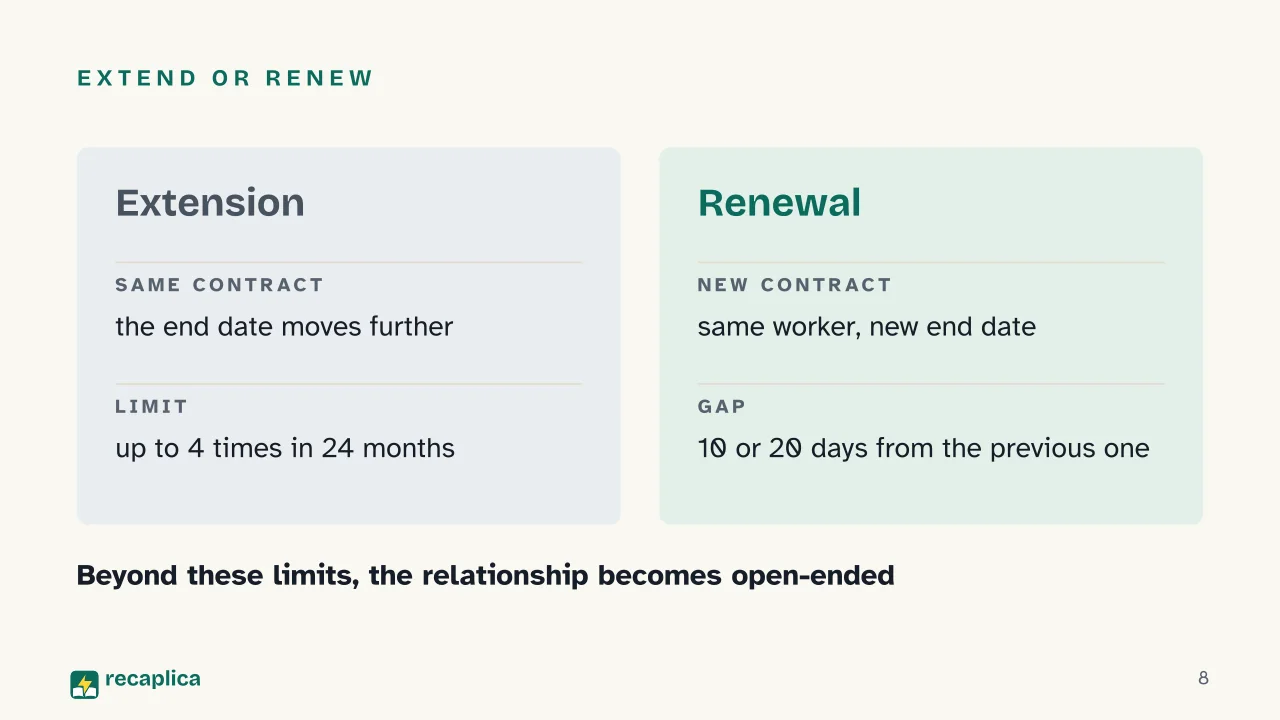
    The law allows at most 4 extensions, counted over the entire 24 months of the relationship rather than the single contract; this only applies if the initial duration stays under 24 months. A fifth extension is not simply void: it converts the relationship into an open-ended contract from the day it begins.

    Renewing the contract with the same worker, once the previous one has expired, also requires a minimum gap: 10 days if the expired contract lasted up to 6 months, 20 days if it lasted longer. An employer who rehires before these deadlines sees the new contract convert into an open-ended one from day one.

    The 20% Cap on Staff

    Beyond the duration limits, article 23 of Legislative Decree 81/2015 sets a quantitative cap: fixed-term contracts cannot exceed 20% of the open-ended employees on a company’s payroll, unless a collective agreement provides otherwise. Companies with up to 5 employees can still hire one fixed-term worker, even beyond this share.

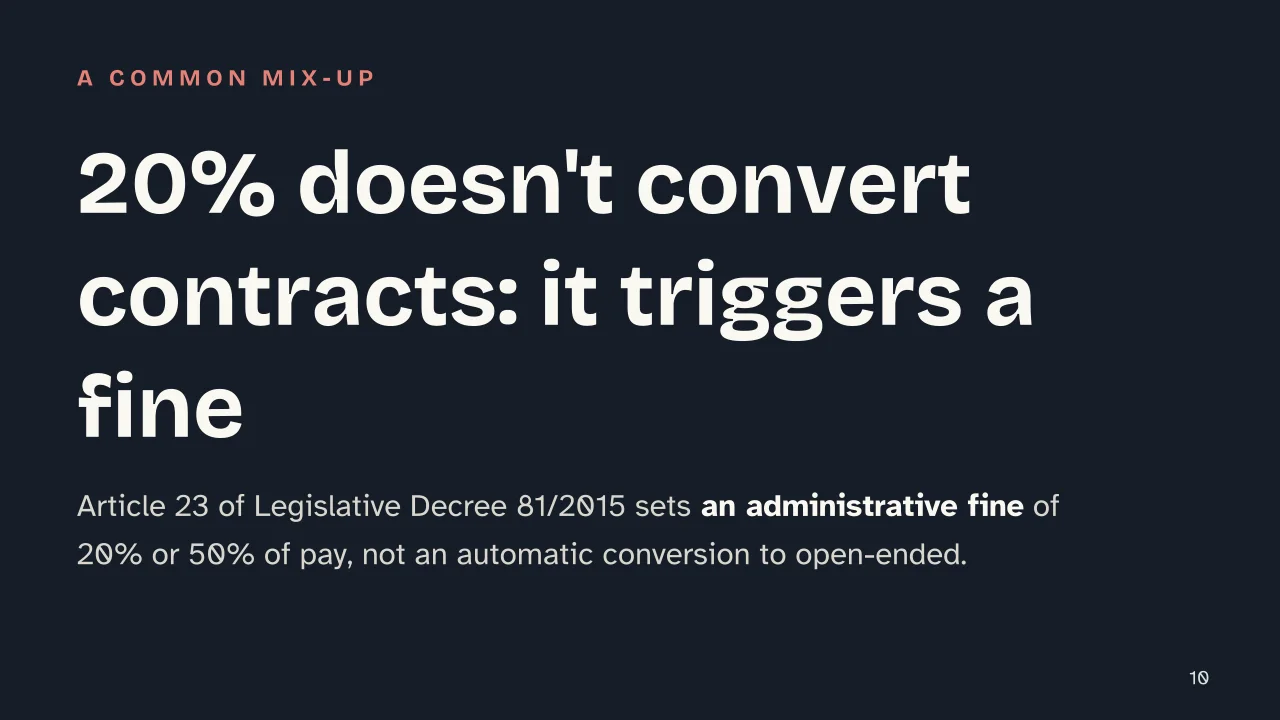
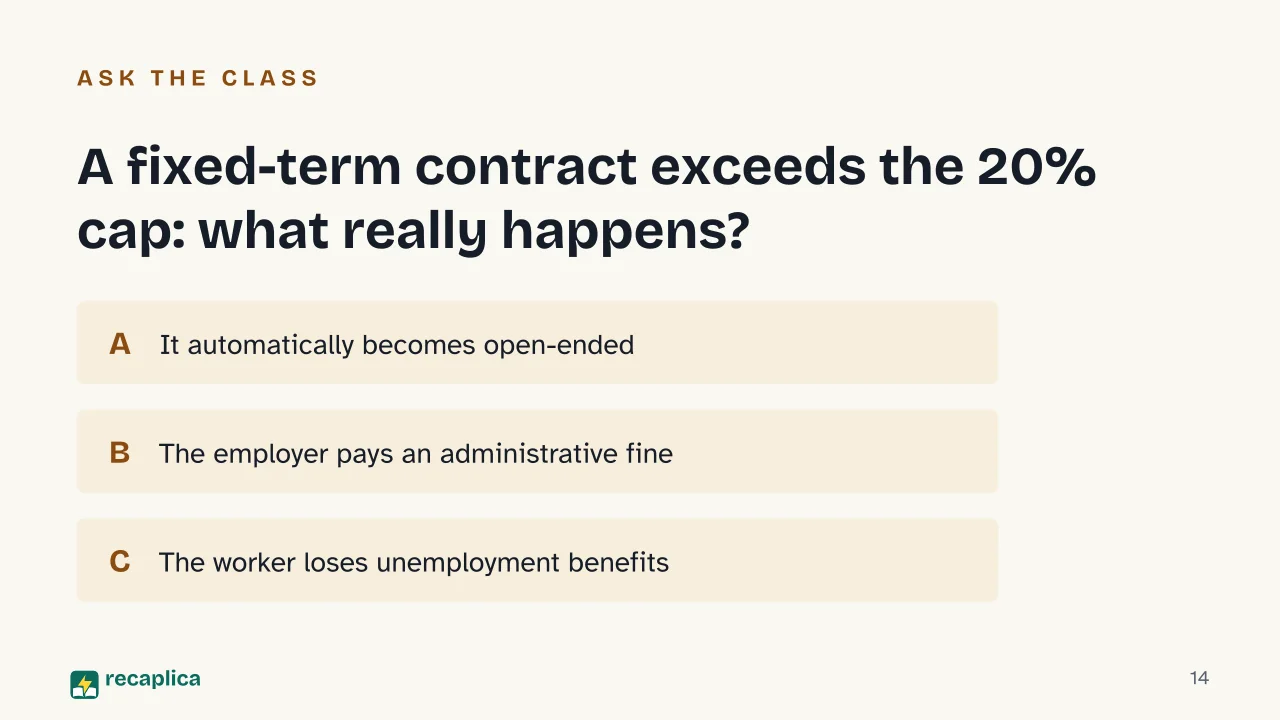
    Exceeding the 20% cap does not convert the excess contracts into open-ended ones: it exposes the employer to an administrative fine. The fine equals 20% of pay if only one worker is in excess, or 50% if there is more than one, calculated for each month or fraction of a month beyond 15 days.

    The Cost for the Employer: The NASpI Contribution

    Hiring on a fixed-term basis also costs more on the contributions side. Law 92/2012, article 2, paragraph 28, imposes an additional contribution on fixed-term contracts to fund NASpI, Italy’s unemployment benefit, set at 1.4% of taxable pay. The same article raises that contribution by a further 0.5 percentage points at every renewal of the same contract.

    At every renewal, even through a staffing agency, the additional contribution rises by a further 0.5 points; an open-ended contract carries none of it.

    Fixed-Term or Open-Ended: The Difference That Matters

    The main difference lies in the end date, known in advance in a fixed-term contract and absent in an open-ended one, which continues until the employer or the worker decides to end it. Anyone weighing whether to accept a fixed-term contract, or whether to work as a freelancer instead, can compare the two paths by also looking at the labor market as a whole. The choice between salaried work and self-employment often runs through a VAT number for those without a subordinate relationship to an employer.

    How a Fixed-Term Contract Is Activated

    Hiring on a fixed-term basis requires, as with an open-ended hire, a written contract stating the end date; once the 12-month limit is crossed, the applicable justified reason must also be specified in the contract. If the relationship ends at the agreed date, the worker has access to NASpI, funded in part by the additional contribution described above.

    Slide deck

    Slides ready to download and make your own in PowerPoint or Google Slides, with speaker notes. Pick the Flash cut or the Full one.
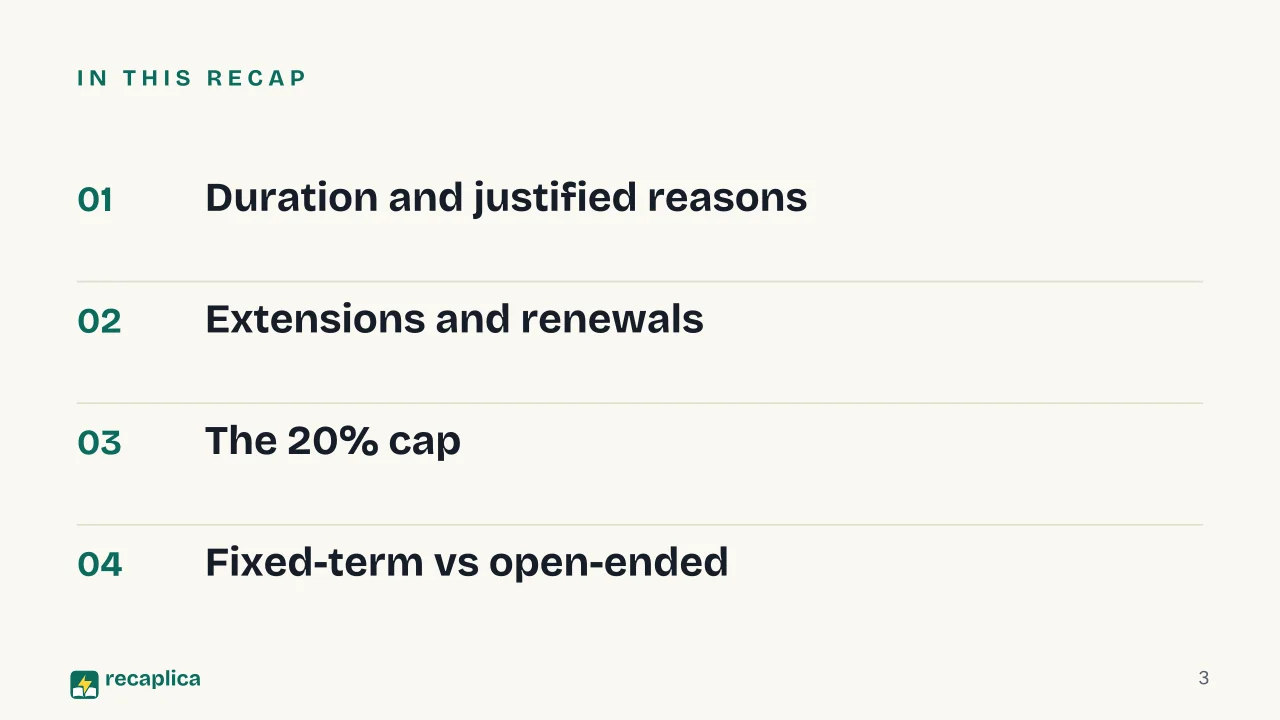
    Slide 1 of the presentation on Fixed-Term Contract: Fixed-Term ContractSlide 2 of the presentation on Fixed-Term Contract: How long can a fixed-term contract last?Slide 3 of the presentation on Fixed-Term Contract: In this RecapSlide 4 of the presentation on Fixed-Term Contract: Chapter 01: Duration and justified reasonsSlide 5 of the presentation on Fixed-Term Contract: The duration limits set by lawSlide 6 of the presentation on Fixed-Term Contract: From hiring to the end dateSlide 7 of the presentation on Fixed-Term Contract: Chapter 02: Extensions and renewalsSlide 8 of the presentation on Fixed-Term Contract: Extend or renewSlide 9 of the presentation on Fixed-Term Contract: Chapter 03: The 20% capSlide 10 of the presentation on Fixed-Term Contract: 20% doesn't convert contracts: it triggers a fineSlide 11 of the presentation on Fixed-Term Contract: Chapter 04: Fixed-term vs open-endedSlide 12 of the presentation on Fixed-Term Contract: End date · End date · FormSlide 13 of the presentation on Fixed-Term Contract: The cost for the employerSlide 14 of the presentation on Fixed-Term Contract: A fixed-term contract exceeds the 20% cap: what really happens?Slide 15 of the presentation on Fixed-Term Contract: To find out more
    Flash10 slidesThe essential thread, to present in classFull15 slidesEvery chapter and the deeper detail

    Common myths

    • ✗ Myth An employer can extend a fixed-term contract as many times as they like, as long as the total stays under 24 months.

      ✓ Reality Legislative Decree 81/2015 allows at most 4 extensions in 24 months, regardless of how many contracts are involved: a fifth extension converts the relationship into an open-ended one even if the total stays under 24 months.

    • ✗ Myth If a company exceeds the 20% cap on fixed-term contracts, those contracts automatically become open-ended.

      ✓ Reality Under article 23 of Legislative Decree 81/2015 the consequence isn't conversion but an administrative fine: 20% of pay for one worker in excess, 50% for more than one.

    • ✗ Myth A fixed-term contract without a written end date is still valid as fixed-term.

      ✓ Reality According to the Ministry of Labour the end date must be in writing, except for relationships up to 12 days: without it, the contract counts as open-ended from the start.

    Mind map

    Drag the background to move around and the nodes to reposition them; use − and + to collapse and expand branches.
    Customize
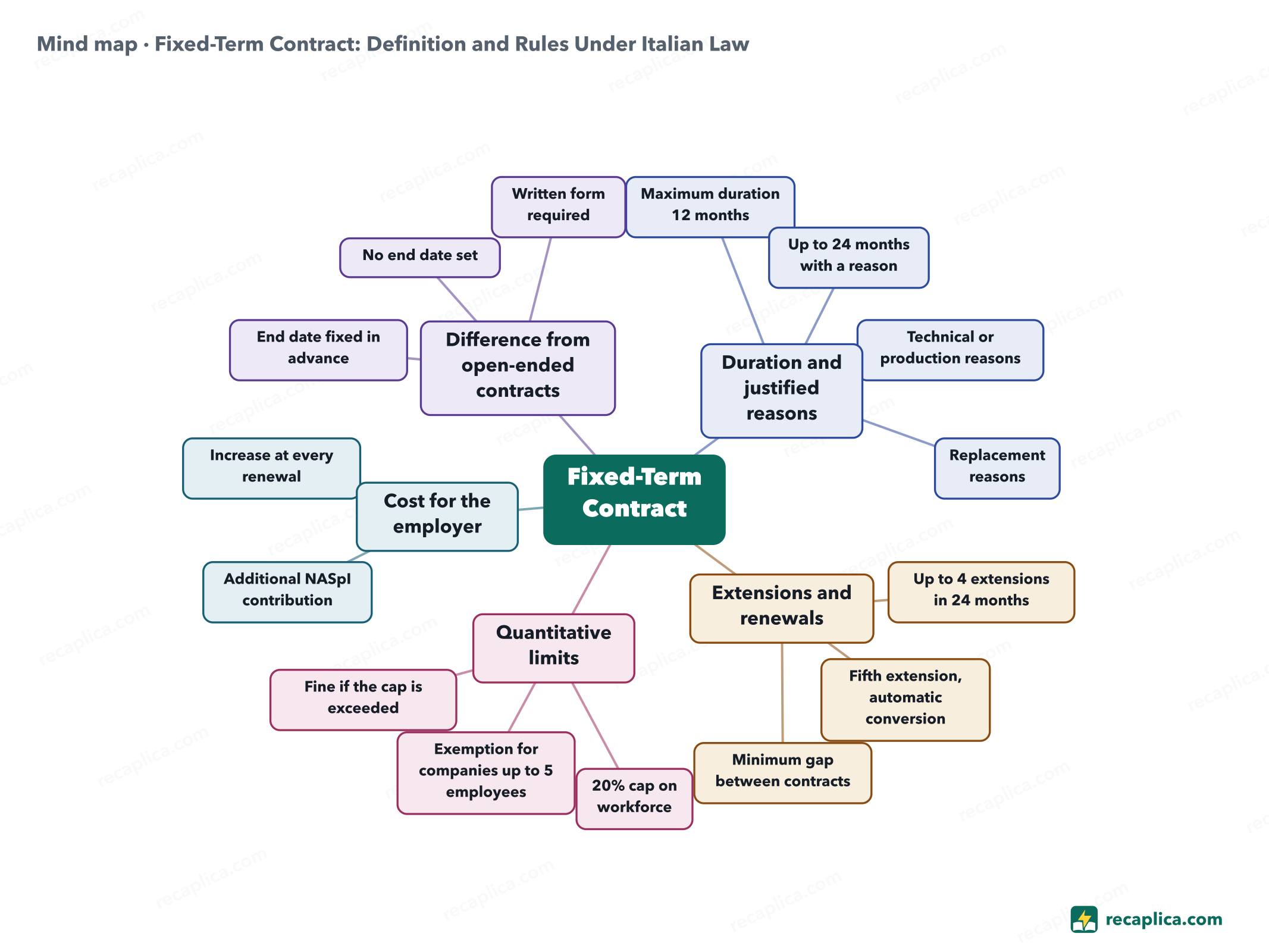
    Mind map: Fixed-Term Contract: Definition and Rules Under Italian Law
    • Fixed-Term Contract
      • Duration and justified reasons
        • Maximum duration 12 months
        • Up to 24 months with a reason
        • Technical or production reasons
        • Replacement reasons
      • Extensions and renewals
        • Up to 4 extensions in 24 months
        • Fifth extension, automatic conversion
        • Minimum gap between contracts
      • Quantitative limits
        • 20% cap on workforce
        • Exemption for companies up to 5 employees
        • Fine if the cap is exceeded
      • Cost for the employer
        • Additional NASpI contribution
        • Increase at every renewal
      • Difference from open-ended contracts
        • End date fixed in advance
        • No end date set
        • Written form required

    Quiz: test yourself

    Answer the questions to check what you have learned: you get instant feedback and a short explanation.

    Grade 0/10 0/5
    1 What is the standard maximum duration of a fixed-term contract without a justified reason?

    Article 19 of Legislative Decree 81/2015 sets the standard maximum duration at 12 months; beyond that, up to 24, a justified reason is required.

    2 How many extensions can a fixed-term contract have at most within 24 months of the overall relationship?

    Article 21 of Legislative Decree 81/2015 sets this limit over the entire relationship, 24 months, regardless of how many times the contract was renewed: from the fifth extension on, the relationship is no longer fixed-term.

    3 True or false: if a company exceeds the 20% cap on fixed-term contracts, those contracts automatically become open-ended.

    False: article 23 of Legislative Decree 81/2015 provides for an administrative fine (20% or 50% of pay), not an automatic conversion of the contract.

    4 What happens if an employer rehires the same worker on a fixed-term basis without respecting the minimum gap between contracts?

    According to the Ministry of Labour, failing to respect the minimum gap (10 or 20 days) converts the new contract into an open-ended one from day one.

    5 What is a key difference between a fixed-term contract and an open-ended contract?

    The Ministry of Labour lists exactly this feature as what sets a fixed-term contract apart from one with no end date.

    Answers: 1-B · 2-C · 3-B · 4-B · 5-B

    Flashcards

    Tap the card to flip it and check whether you remember the answer, then move to the next one.

    1 / 7

    Explain it in your own words

    The ultimate test: if you can explain it in simple words, you've truly understood it. Write your explanation, then compare it with the Recap.

    Your explanation is saved only on this device.

    A fixed-term contract is an employment contract with an end date fixed in advance, unlike an open-ended contract, which has no end date. Under Italian law, Legislative Decree 81/2015 sets a standard maximum duration of 12 months, extendable up to 24 months only with a specific justified reason, and allows at most 4 extensions within 24 months of the overall relationship. Going beyond these limits, or renewing the contract without respecting the minimum gap between one term and the next, automatically converts the relationship into an open-ended contract. Employers cannot hire more than 20% of their stable workforce on fixed-term contracts, except for smaller companies.

    Frequently asked questions

    How long can a fixed-term contract last under Italian law?

    Ordinarily 12 months. It can reach up to 24 months when the employer can point to a temporary need, a replacement, or a temporary spike in workload, under article 19 of Legislative Decree 81/2015.

    How many extensions are allowed for a fixed-term contract?

    No more than 4. The count covers the entire relationship, not each individual contract, so it resets only when 24 months of fixed-term work with the same employer have passed. Beyond that number, the contract changes nature and becomes open-ended.

    What happens if a fixed-term contract goes beyond the legal limits?

    It depends on which limit is crossed. Beyond 12 months without a justified reason, or beyond the fourth extension, the contract automatically becomes open-ended. If a company only exceeds the 20% staffing cap, there is no conversion, just an administrative fine (art. 23, Legislative Decree 81/2015).

    What is the difference between a fixed-term and an open-ended contract?

    In a fixed-term contract the end date is already written in when it is signed; an open-ended contract has no end date fixed in advance.

    How many fixed-term contracts can a company have?

    No more than 20% of its open-ended employees, though a collective agreement can set a different percentage; a company with up to 5 employees can still hire one fixed-term worker regardless (art. 23, Legislative Decree 81/2015).

    Sources

    • Legislative Decree no. 81 of 15 June 2015, art. 19 (Normattiva)
    • Legislative Decree no. 81 of 15 June 2015, art. 21 (Normattiva)
    • Legislative Decree no. 81 of 15 June 2015, art. 23 (Normattiva)
    • Italian Ministry of Labour and Social Policies — Fixed-term contract
    • INPS, circular no. 56 of 8 April 2024

    Every Recap goes through an independent review before publication.

    Every evening, the day's new Recaps on our Telegram channel. Join the channel →

    Keep learning

    • Civics What Is Pi Day? Why It Falls on March 14 Pi Day is a yearly observance on March 14, chosen because the US date format writes that day as 3/14, matching pi's first digits. Larry Shaw, a physicist at San Francisco's Exploratorium, came up with it in 1988 during a staff retreat at the museum. What started as a small party among coworkers grew into a public celebration with a parade, pie, and a 2009 resolution from the US Congress. Today it's mostly marked in schools and science museums, with digit-memorization contests and discounts at pizza and dessert shops. Read the Recap →
    • Civics Mass Media: What They Are Mass society is a type of society where ordinary people carry real weight in political and social life, but at a cost: more conformity, less individual autonomy, greater exposure to manipulation. The Treccani encyclopedia places its rise between the late 19th and early 20th century, when population growth, urbanization, mass schooling, wider voting rights and industrial organization converge. Mass media, radio and film first, then satellites and the internet, make it possible on a scale never seen before. The Frankfurt School and Ortega y Gasset turned it into an object of criticism, from two different angles: a culture industry that standardizes, and a mass man who blends into the average. Read the Recap →
    • Civics Secularization: Definition, Theories, and How It Shapes Society Secularization is the process through which religious institutions, practices, and beliefs lose social weight, as a society leans more on reason and science, according to EBSCO Research Starters. It shows up on three different levels: institutions, a country's shared culture, and the religious choices each person makes. Max Weber described it as the disenchantment of the world, the modern rationalization that pushed religion and metaphysics outside the boundaries of legitimate knowledge; Émile Durkheim linked it, in 1912, to the split between the sacred and the profane. Pew Research Center data from 2024 show how unevenly the process plays out: in India, Israel, Nigeria, and Thailand, 95% or more of adults still belong to the religion they grew up in, while in South Korea half of adults have left theirs behind. Read the Recap →

    recaplica

    Clear in 30 seconds, yours in 10 minutes.

    Recaps Mind maps Request a Recap Telegram channel Mind map maker Our method About Privacy & cookies Legal notes & terms of use

    © 2026 Recaplica · A project by Curi S.r.l. — VAT IT05472000750

    Statistics, only if you say so

    To learn which Recaps help most we would use Google Analytics, with aggregate, anonymous data. It starts only with your OK, and you can change your mind anytime. Privacy policy