|
recaplica
What Is Fiscal Federalism? Who Raises the Money and Who Gets It | ||||||||||||
| © 2026 Recaplica · recaplica.com — All rights reserved | ||||||||||||
What Is Fiscal Federalism? Who Raises the Money and Who Gets ItWhat to print Page numbers appear when printing with default margins. SlidesChoose a cut Flash10 slidesThe essential thread, to present in classFull15 slidesEvery chapter and the deeper detailBoth come with speaker notes. In 30 seconds quick readFiscal federalism is the system that lets municipalities, provinces, metropolitan cities and regions in Italy pay for schools, roads and healthcare without relying only on money handed down from the State. Article 119 of the Italian Constitution names three sources: own-source taxes each level of government sets for itself, a share of national tax revenue such as VAT, and an equalization fund that helps territories with less fiscal capacity. Law 42/2009 turned that principle into practice, replacing the old benchmark of historical spending with a standard-needs calculation. At the municipal level the equalization tool is called the Municipal Solidarity Fund, partly financed by a share of property-tax revenue. The system is still a work in progress: the essential service levels, the yardstick for full equalization, have not been defined yet. Key Points
Key figures
Deep DiveWhat article 119 of the Italian Constitution establishesArticle 119 of the Italian Constitution grants municipalities, provinces, metropolitan cities and regions financial autonomy over revenue and spending, within a balanced-budget requirement. Having a responsibility to carry out is not enough on its own: a government body also needs a way to pay for it, and that is the terrain fiscal federalism covers. The article names three sources of resources. The first is own-source taxes: each body sets and applies its own taxes and revenue, in line with the Constitution and the coordination principles that govern Italy’s public finances and tax system. The second is revenue sharing: bodies receive a share of national tax revenue tied to their territory — a slice of a tax the State collects across the whole country. The third is the equalization fund: national law establishes a fund, with no restrictions on how it can be spent, for territories with less fiscal capacity per resident.
Resources and responsibilities: two different questionsFiscal federalism is often confused with the subsidiarity principle, but the two answer different questions. Subsidiarity, set out in article 118 of the Constitution, decides which level of government is responsible for a task: whether it falls to the municipality, the region or the State. Fiscal federalism, set out in article 119, decides which resources that level of government uses once the task has been assigned to it. The two are connected — a body with no resources cannot really carry out a responsibility — yet they remain two separate articles, and two separate questions. Putting it into practice: law 42/2009For years, article 119 stayed a constitutional principle without concrete implementation. Law no. 42 of 5 May 2009, a delegation to the government on fiscal federalism that implements article 119, changed that: it set out the principles for putting the article into practice. At the centre are autonomy over revenue and spending, together with greater accountability of every level of government on the administrative, financial and accounting side. One of the law’s most significant changes is the gradual phase-out, across every level of government, of the historical-spending criterion — funding a body based on how much it has always spent, regardless of what it would actually need. In its place, the law introduces standard needs: the cost and need that, by accounting for efficiency and effectiveness, becomes the benchmark for comparing and assessing public action. For regions, the same law gives priority to VAT among the shares of national tax revenue they receive. According to Openpolis, though, law 42/2009 is not self-executing: it needs implementing decrees, and 11 have been adopted so far. Municipalities’ resources: the Municipal Solidarity FundAt municipal level, the tool that puts article 119’s equalization principle into practice is called the Municipal Solidarity Fund. It is the fund that finances Italian municipalities, partly fed by a share of property-tax (IMU) revenue owed to the municipalities themselves: in 2026 that share amounts to 22% of standard-rate IMU revenue. Equalization criteria — based on the gap between fiscal capacity and standard needs — began being applied in 2015, with gradually rising shares, aiming for 100% equalization by 2030. For 2026, the traditional component of the Fund is split 80% by the equalization criterion and the remaining 20% by the compensation criterion. The Fund’s overall endowment is worth 6,887.7 million euros for 2026, 6,933.7 million for 2027, 6,984.9 million for 2028, 8,260.7 million for 2029, 8,214.7 million for 2030, and 8,978.6 million from 2031 onward. This fund is separate from the one article 119 provides for regions, which is tied to shares of national tax revenue rather than to a slice of property-tax (IMU) revenue. Regions’ resources: revenue sharing and own-source taxesFor regions, law 42/2009 gives priority to a share of VAT revenue: the State collects the tax across the whole country, then passes a share to the region where it was generated. Alongside revenue sharing, regions also have their own-source taxes.
A system still under constructionFiscal federalism is not a mechanism that runs on its own once it is written into law. Local and regional bodies can borrow only to fund investment spending, with defined repayment plans and within a balanced-budget requirement that applies to all the bodies of each region combined — a constraint that echoes the same logic behind public debt, where sustainability matters at the national level too. One piece is still missing: the definition of essential service levels (LEP), the minimum standards of services — from healthcare to education — every territory should guarantee its residents. Without the LEP, Openpolis warns, equalization of resources stays partial, because there is no yardstick for measuring what a territory receives against what it would actually need. Slide deckSlides ready to download and make your own in PowerPoint or Google Slides, with speaker notes. Pick the Flash cut or the Full one.     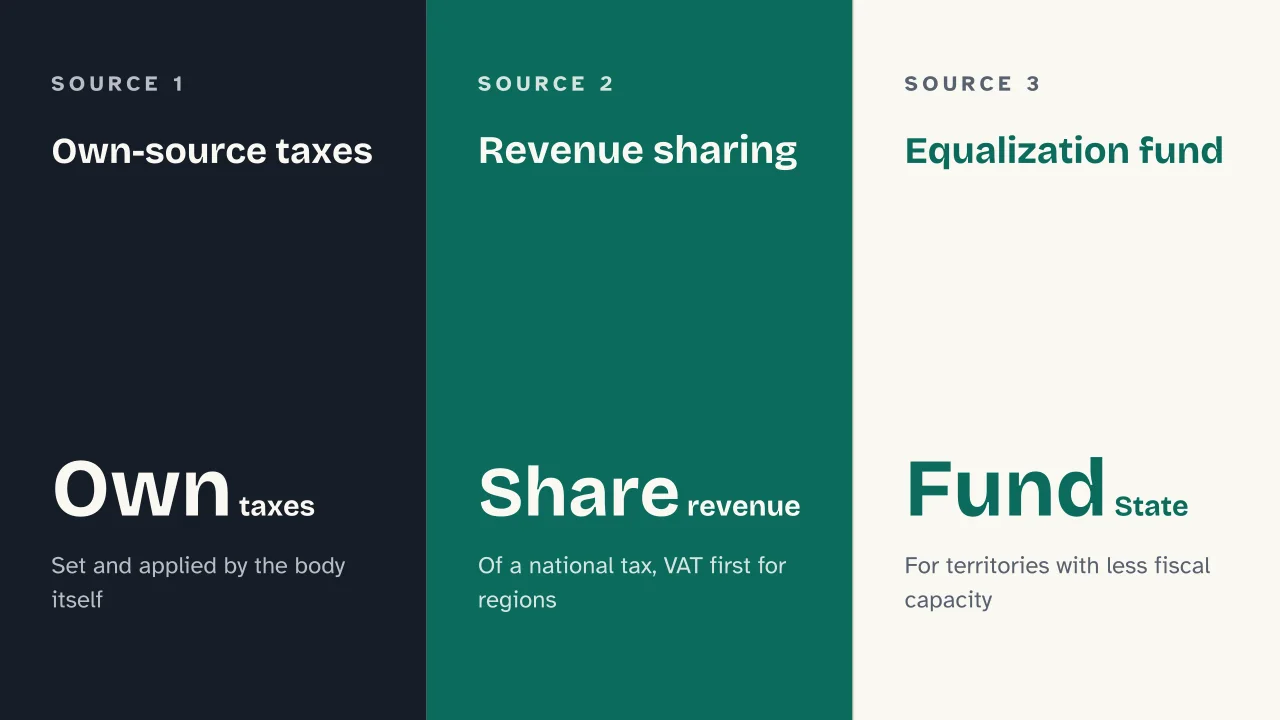  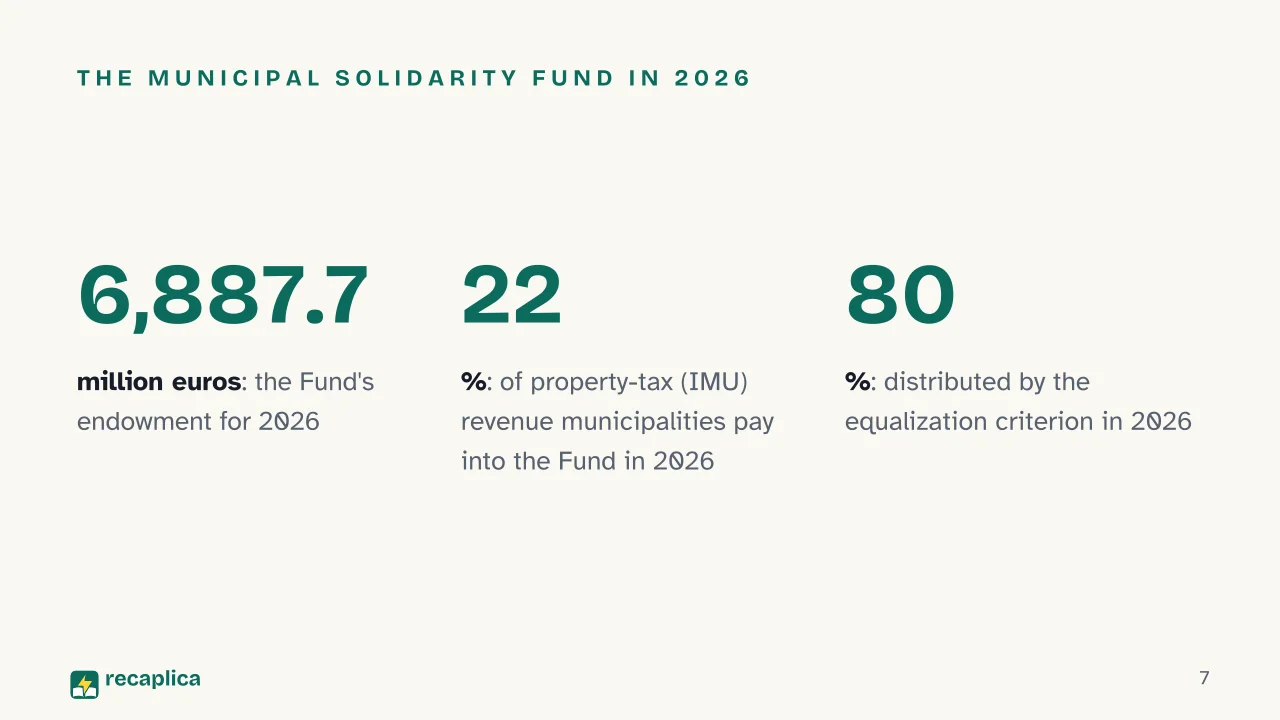 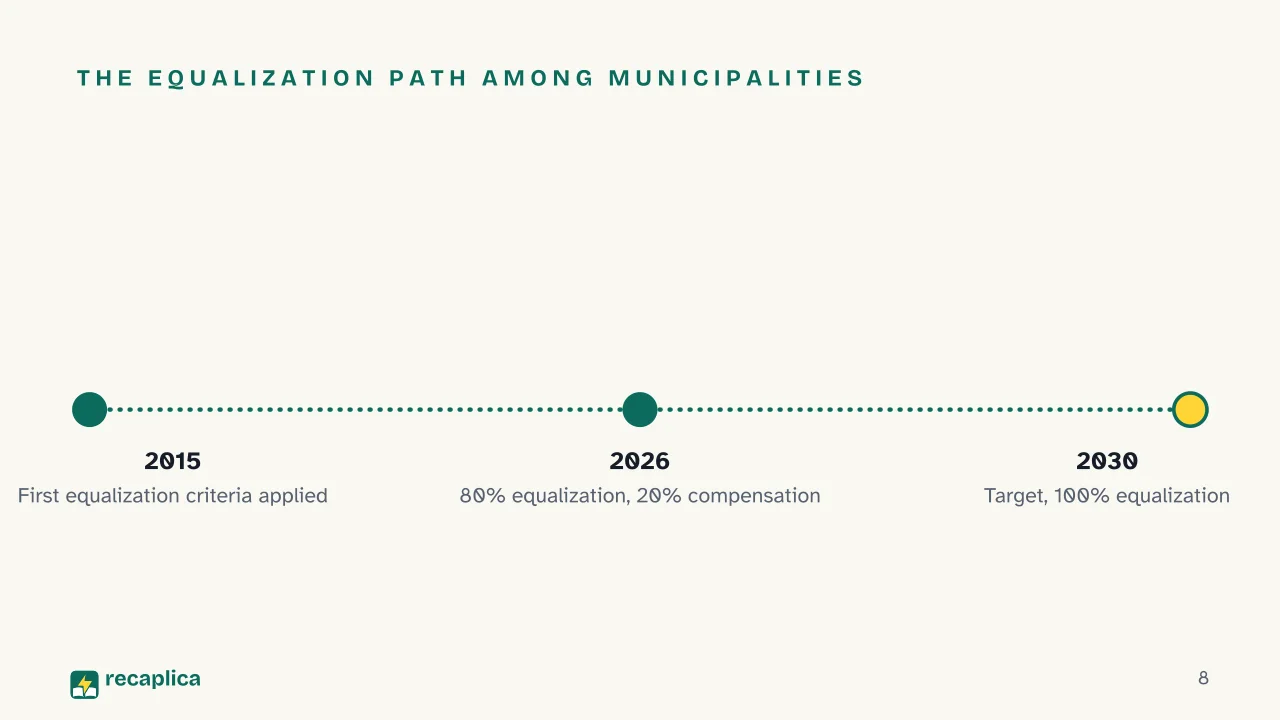  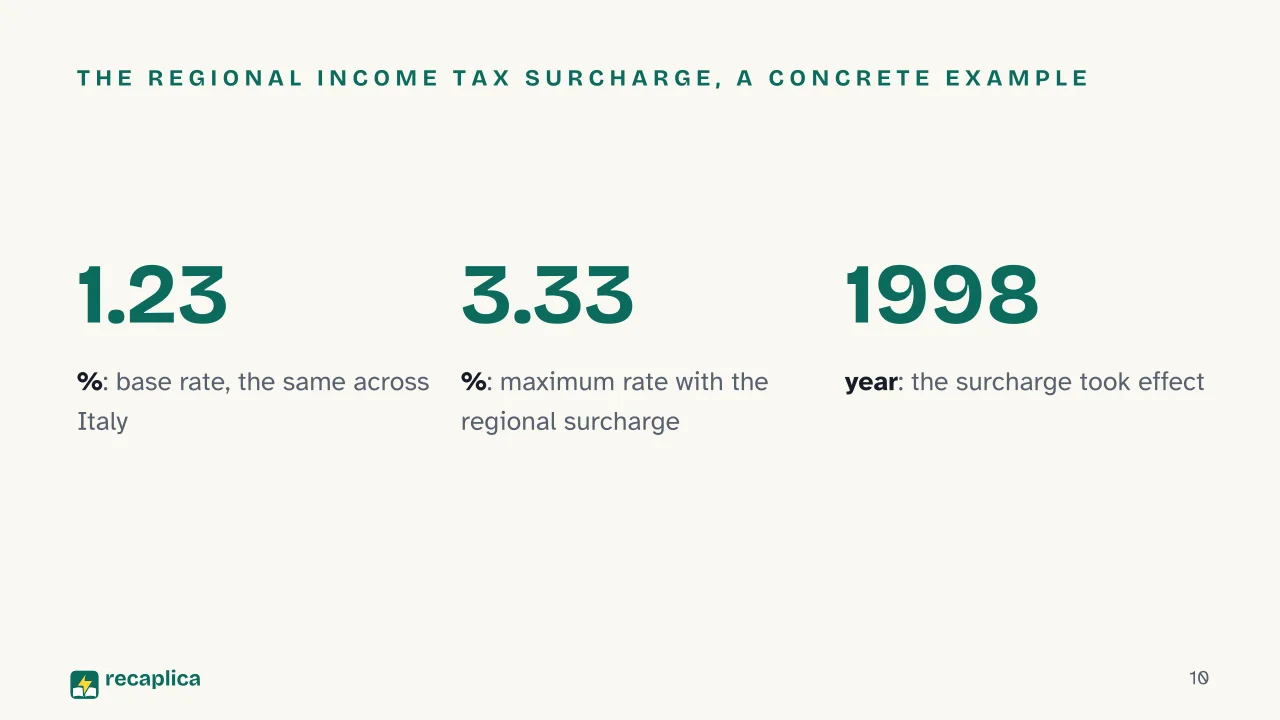  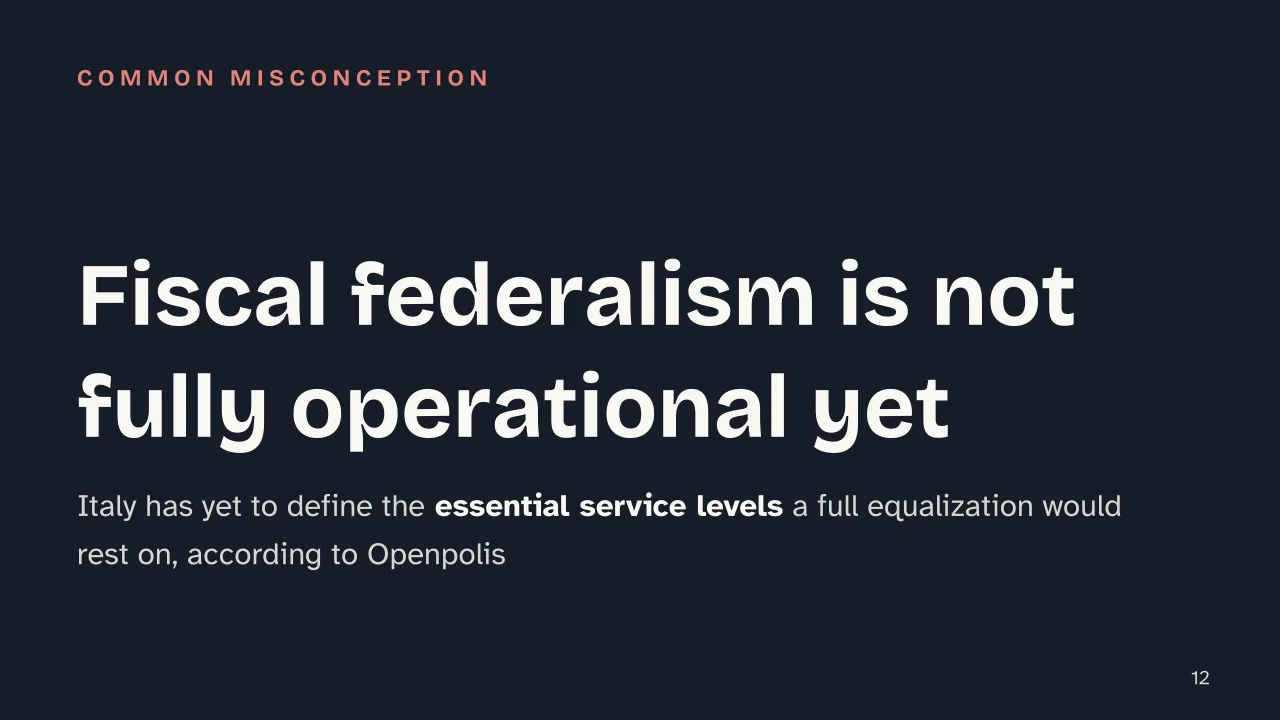 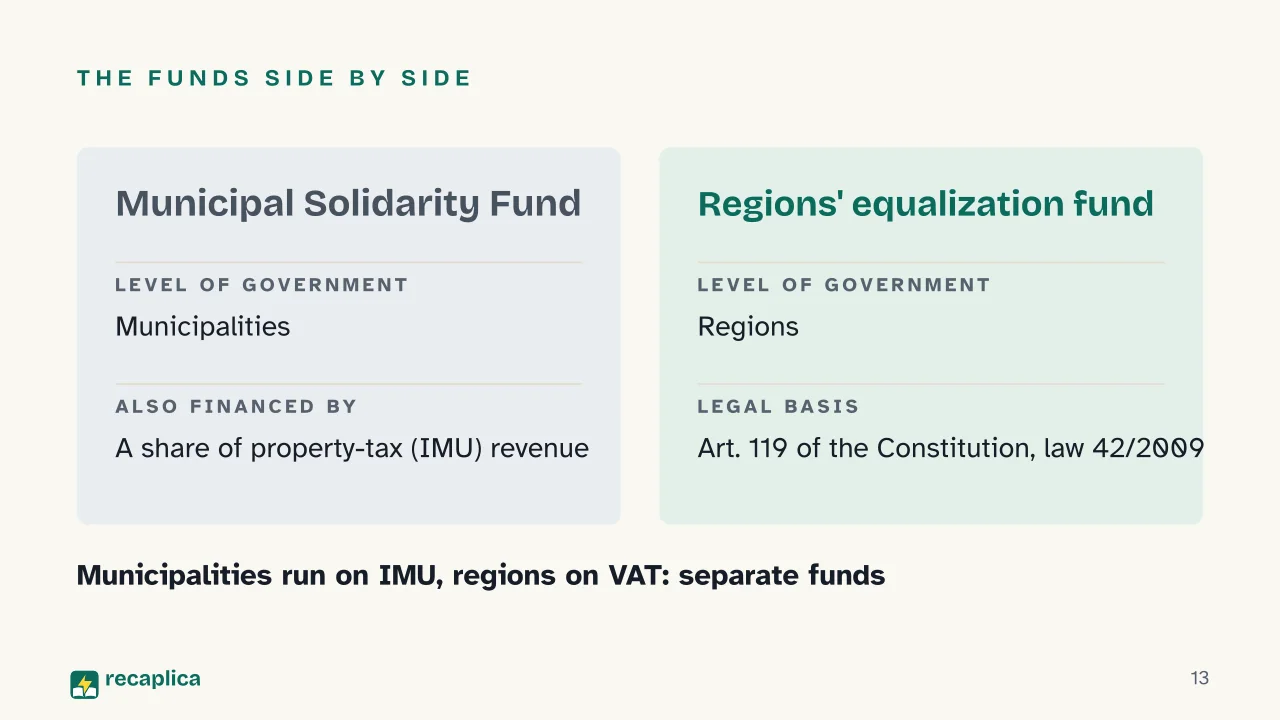 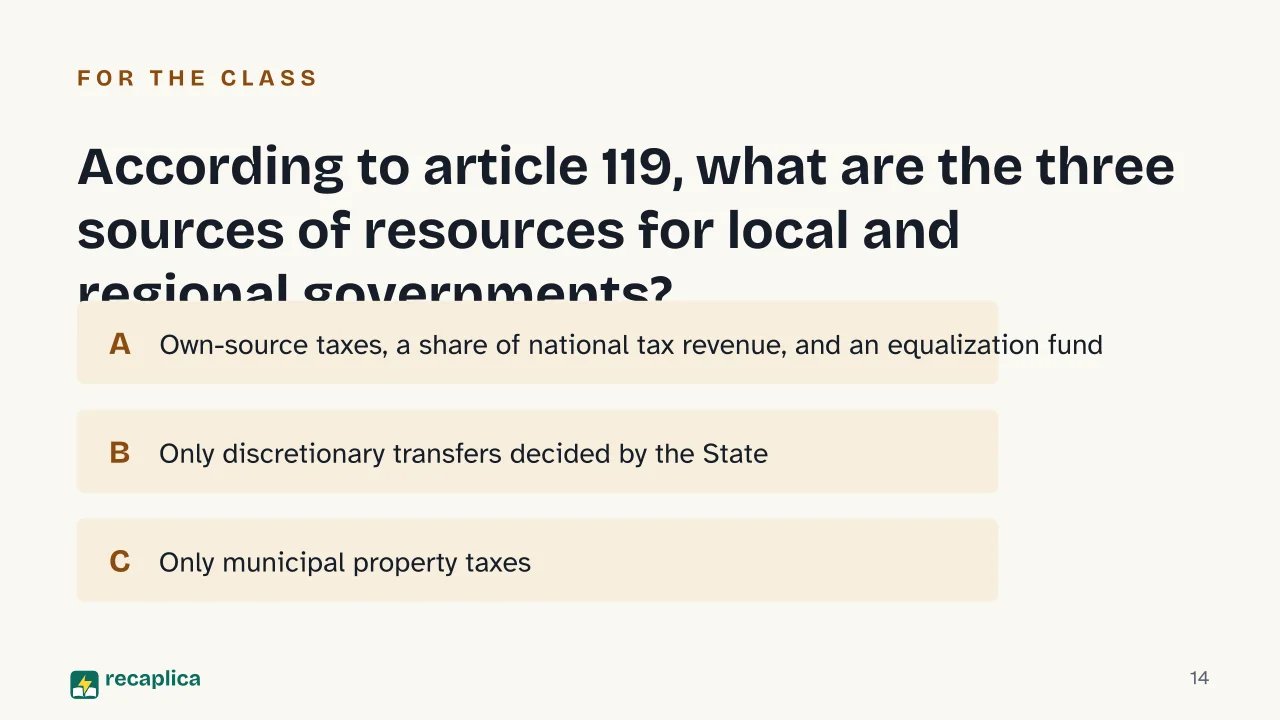  Common myths
Mind mapDrag the background to move around and the nodes to reposition them; use − and + to collapse and expand branches. 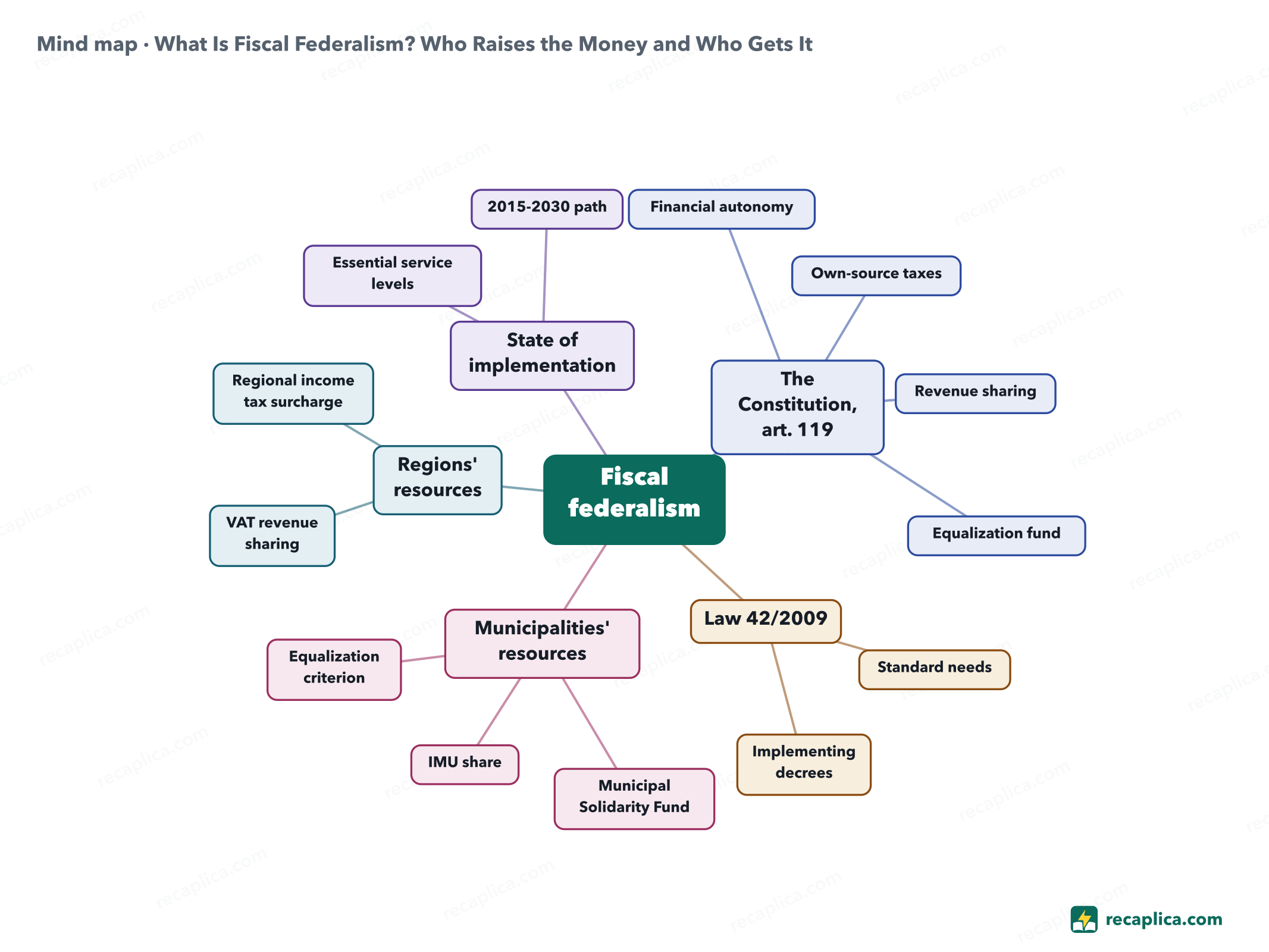
Quiz: test yourselfAnswer the questions to check what you have learned: you get instant feedback and a short explanation. Grade 0/10 0/5
FlashcardsTap the card to flip it and check whether you remember the answer, then move to the next one. 1 / 8 Explain it in your own wordsThe ultimate test: if you can explain it in simple words, you've truly understood it. Write your explanation, then compare it with the Recap. Your explanation is saved only on this device.
Frequently asked questionsWhat is fiscal federalism?It is the system, set out in article 119 of the Italian Constitution, through which municipalities, provinces, metropolitan cities and regions fund their own responsibilities: through own-source taxes, a share of national tax revenue, and an equalization fund for territories with less fiscal capacity. What's the difference between own-source taxes and revenue sharing, and what's an example of each?Own-source taxes are revenue a government body sets and applies on its own, like the regional income tax surcharge; revenue sharing is instead a share of a national tax tied to the territory, like the regional share of VAT revenue. Is the Municipal Solidarity Fund the same as the regions' equalization fund?No. The Municipal Solidarity Fund serves municipalities, draws part of its money from property-tax (IMU) revenue and is worth 6,887.7 million euros in 2026. The regions' equalization fund, the one in article 119, is a separate tool tied to shares of national tax revenue. Is fiscal federalism fully implemented in Italy yet?Not yet: according to Openpolis, as of 2019 law 42/2009 remained partly unimplemented, and Italy still has not defined the essential service levels that a full equalization would be based on. What's the difference between fiscal federalism and the subsidiarity principle?Subsidiarity (art. 118) settles which body is in charge of a task; fiscal federalism (art. 119) settles what resources that body funds it with. Every Recap goes through an independent review before publication. |