recaplica
Clear in 30 seconds, yours in 10 minutes.
In 30 seconds quick read
Under article 1321 of the Italian Civil Code, a contract is what two or more parties agree to in order to create, change or end a relationship involving property or money. Article 1325 then sets four conditions for that agreement to count as a valid contract: the parties must consent, there must be a cause and a subject matter and — only when the law says so — a specific form such as writing. Once it exists, article 1372 treats a contract as binding on its signers the way a statute would: ending it needs everyone's agreement, or one of the exceptions the law spells out, such as a party failing to deliver on its promises.
Key Points
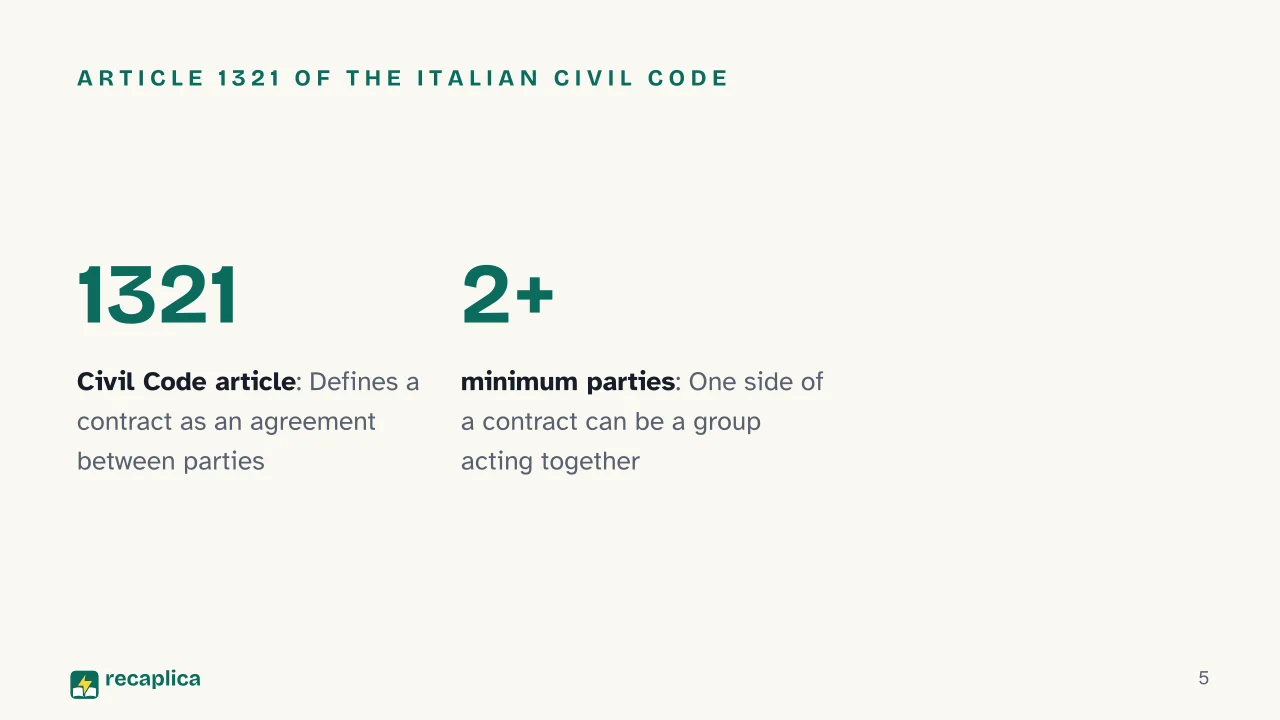
A contract is the agreement between two or more parties that creates, changes or ends a legal relationship over property (art. 1321, Italian Civil Code)
Under the Civil Code a "party" is a center of interests, not necessarily one person: several people can form a single party together
Four elements turn an agreement into a contract: consent, cause, subject matter and, only when the law requires it, a specific form (art. 1325)
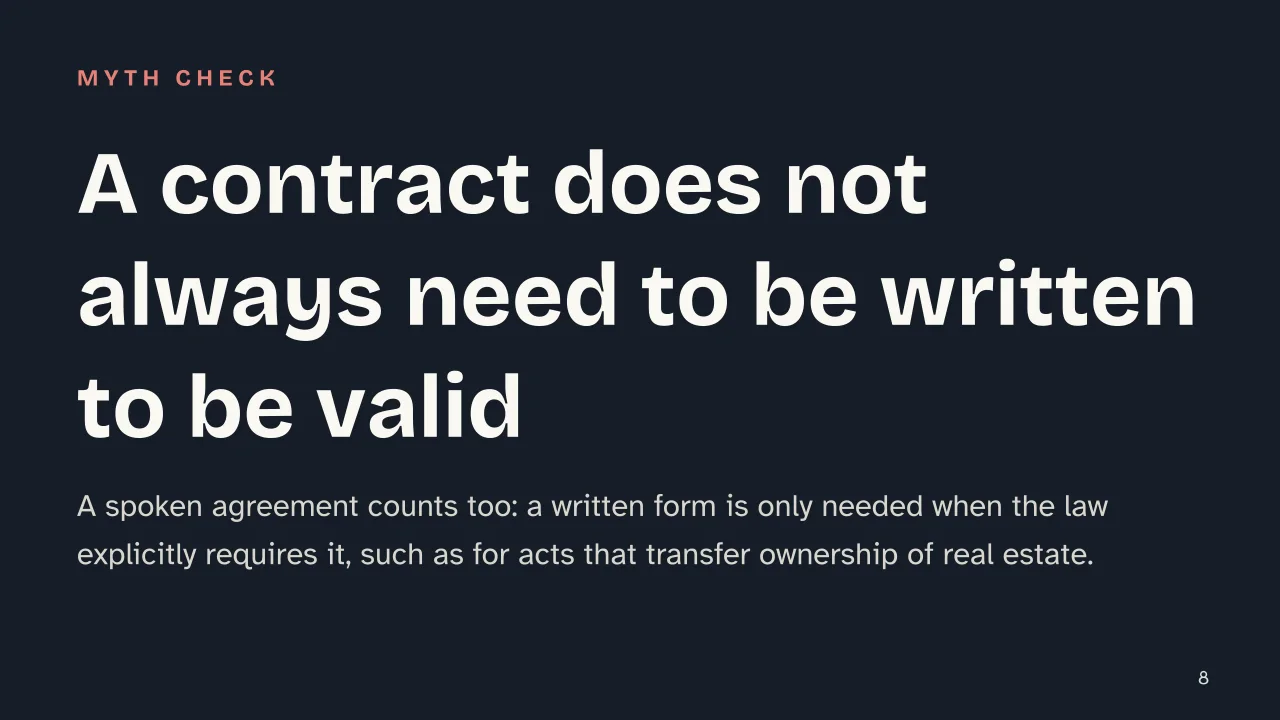
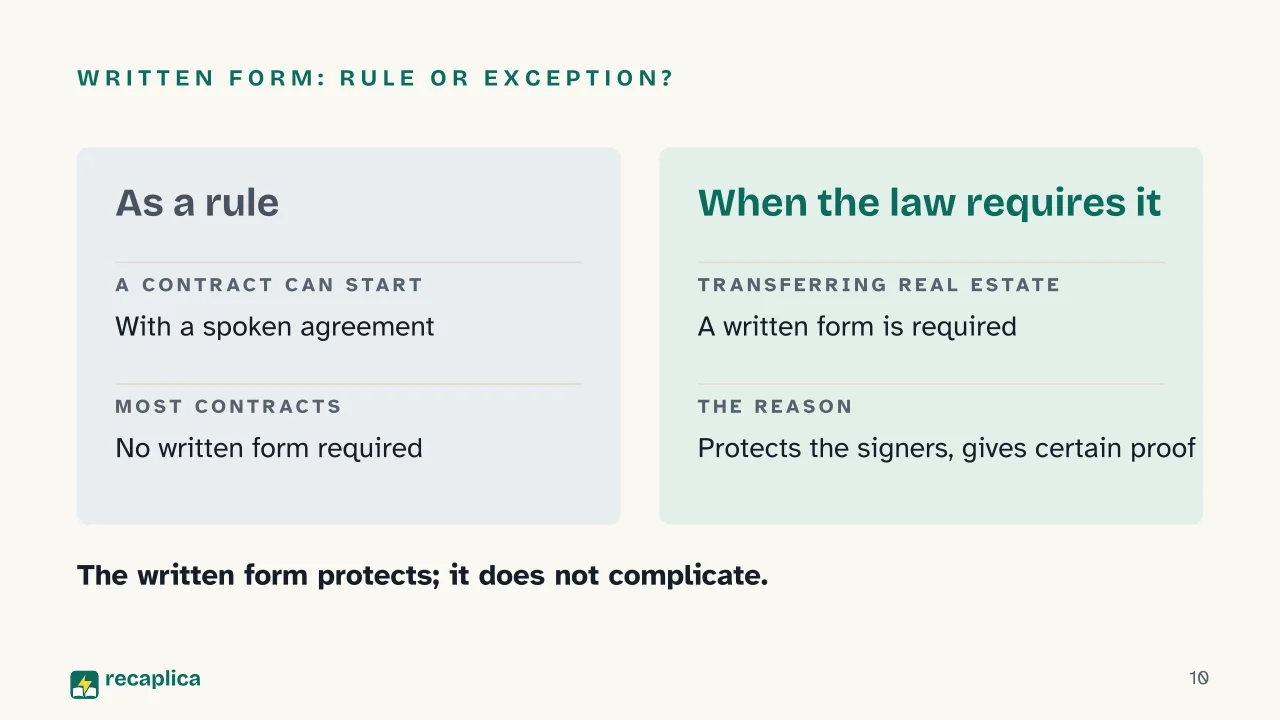
A written form is mandatory only for the acts the law lists by name, such as transferring ownership of real estate (art. 1350)
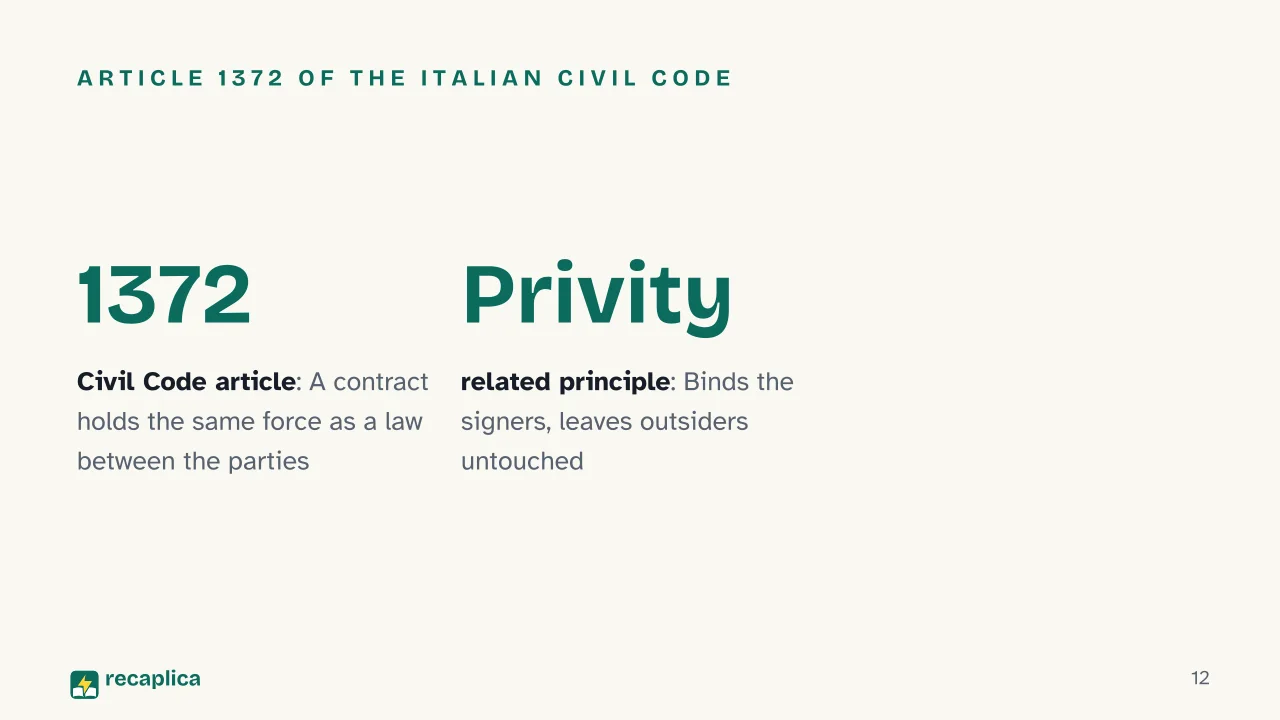
Under article 1372, a contract binds the signing parties the way a law would: it can be undone by mutual consent or in the cases the law allows
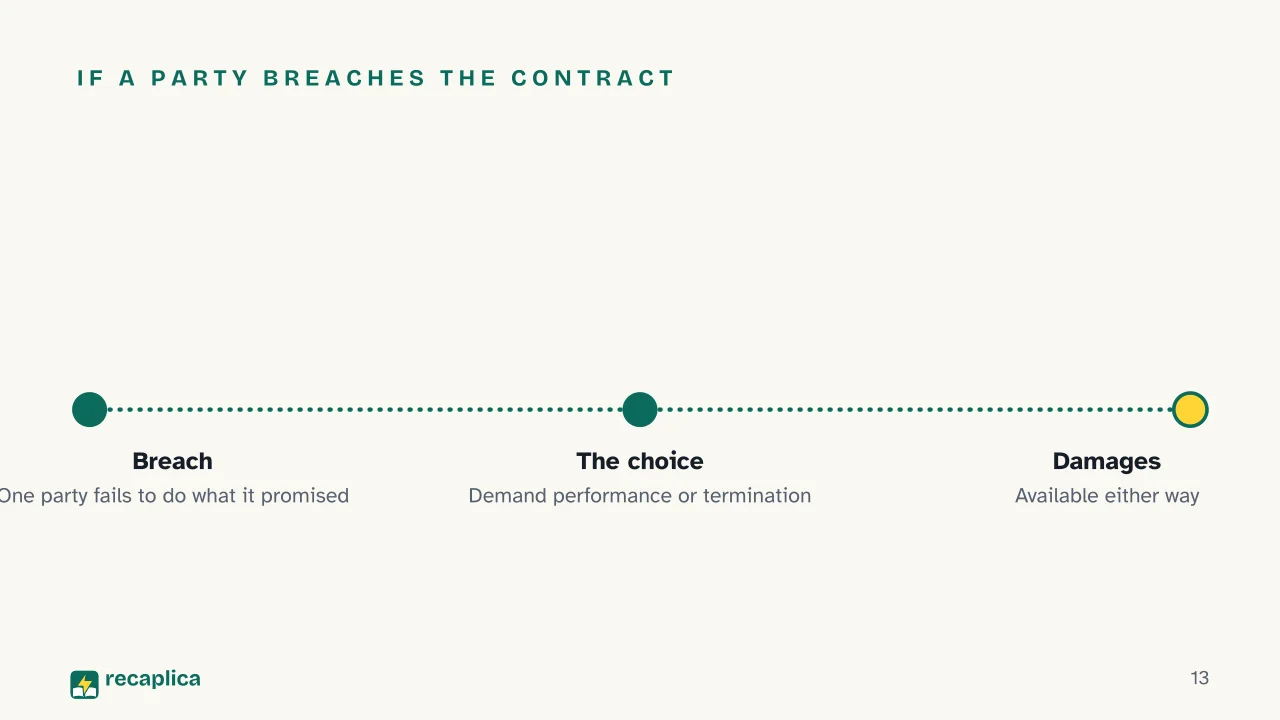
A party facing a breach of contract can demand performance or ask for the contract to be terminated, plus damages either way (art. 1453)
Deep Dive
A contract is not just a form to sign. It is an agreement the law gives teeth to, enforcing it even when one side would rather walk away.
What a contract is, under the Italian Civil Code
Article 1321 of the Italian Civil Code describes a contract as the agreement between two or more parties to create, regulate or end a legal relationship over property — one involving goods or financial obligations. Brocardi’s commentary adds a detail first-time readers often miss: a “party” to a contract does not have to be a single natural person. It is a center of interests, which can group several people together — several heirs selling the family’s land as a block remain, on the seller’s side, a single party, even with three signatures at the bottom of the page.
This definition sits next to the one for a legal norm: a norm applies to the public at large, while a contract creates rules that bind only the people who entered into it, within the limits the law itself allows.
The four elements that make it valid
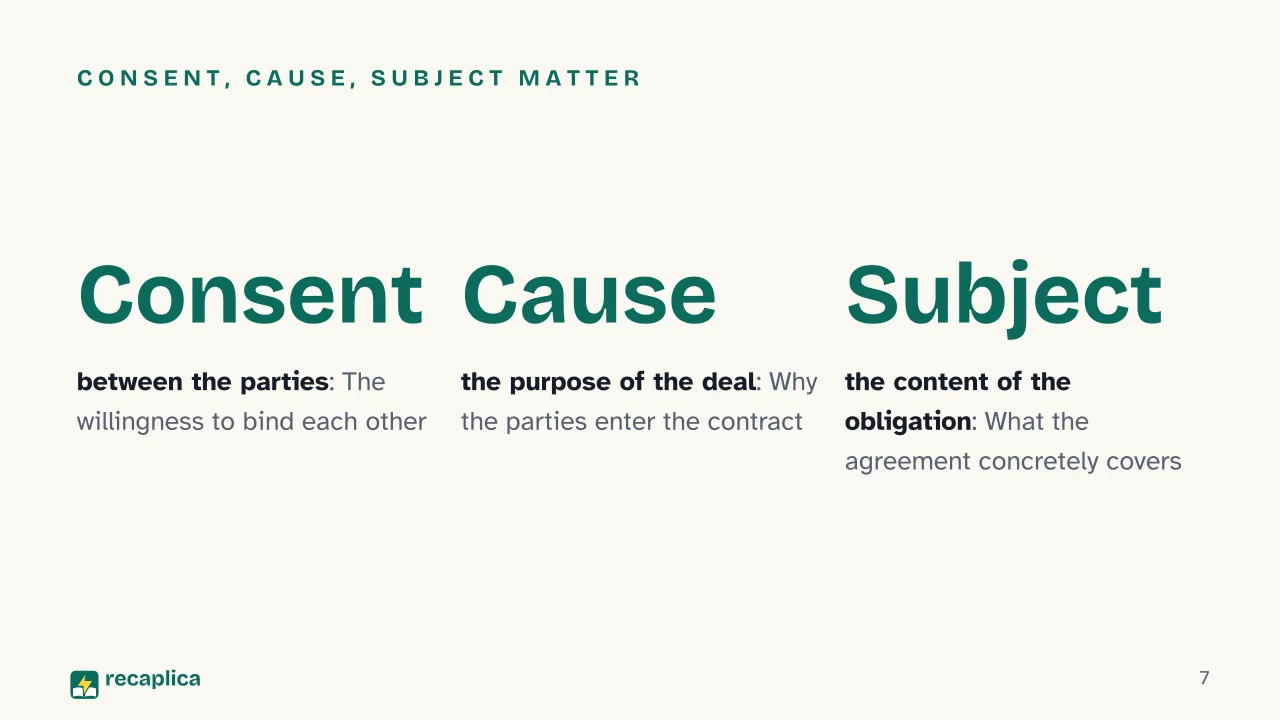
Not every promise becomes a contract in the eyes of the law. Article 1325 of the Civil Code sets out four building blocks, meant — Brocardi’s commentary explains — to protect the parties or the general safety of trade: the consent of the people involved, the cause of the deal, its subject matter and, limited to the cases the law names, a required form.
Element
What it means
Consent
The parties’ willingness to bind themselves to each other
Cause
The economic and social purpose of the deal
Subject matter
The concrete content of the obligation taken on
Form
Specific (e.g. written), only when the law expressly requires it
Practical example: two neighbors agree out loud that one will trim the other’s hedge in exchange for payment. There is consent (the willingness to trade work for money), a cause (the economic exchange) and a subject matter (the hedge trimming, the payment agreed): the contract already exists as it stands, because the law does not require any specific form here.
The first three always apply. The fourth, form, is an add-on that kicks in only where the law spells it out by name: leave it out there, and the contract does not stand.
When a written form is mandatory
This is where the most common misunderstanding sits. Most contracts get by without writing anything down: a written form only becomes necessary for the acts that article 1350 of the Civil Code names specifically, including those that transfer ownership of real estate. When the law does ask for it, Brocardi’s commentary explains, it does so for a precise reason: to help the parties grasp the weight of what they are doing, since some deals weigh on a person’s finances for years, and to make it easier to prove the agreement existed if a dispute ever arises. It is not red tape — it is a safeguard built for whoever signs.
The same logic underpins property rights: passing on a house or a plot of land shapes someone’s finances for years, and a written record leaves solid proof that the transfer happened.
A seller who wants to keep ownership of the goods until the full price is paid can add a dedicated clause to the written contract: retention of title, an arrangement that lives precisely inside contracts of this kind.
Why a contract “has the force of law” between the parties
Article 1372 of the Civil Code explains why a contract cannot be shrugged off: it gives it the same binding force as a law written specifically for whoever signed it. Undoing it requires the consent of every party involved, or one of the situations the law itself allows — among them, one party’s failure to meet its obligations.
The same article is the source of what lawyers call privity of contract: the obligations taken on in a contract apply, as a rule, only to the people who signed it. That guarantee matters outside pure private law too, for instance in consumer rights: the terms agreed between a business and a single customer stay between them, without extending to someone who never signed a contract at all.
What happens if a party breaches the contract
In contracts where each party owes something to the other — paying a price in exchange for a good, for instance — article 1453 of the Civil Code comes into play when one side fails to meet its obligations. The other party can choose: still demand that the contract be carried out, or terminate it. Either way, it can also claim damages for the harm suffered.
One detail concerns the path, not just the final choice: a party that has already sued to demand performance can still change course and ask for termination instead. The reverse path, though, is closed: once termination has been requested, performance can no longer be demanded.
Slide deck
Slides ready to download and make your own in PowerPoint or Google Slides, with speaker notes. Pick the Flash cut or the Full one.
✗ Myth A contract is only valid if it is put in writing.
✓ Reality A written form is not the general rule for contracts: article 1325 requires it only when the law "prescribes it under penalty of nullity." Writing becomes a requirement for the specific acts the Civil Code names, such as transferring ownership of real estate (art. 1350) — there the law asks for it because the act affects a signer's assets for a long time and needs to be provable beyond doubt.
✗ Myth Once signed, a contract can be called off whenever one party changes its mind.
✓ Reality Article 1372 of the Civil Code says the opposite: a contract binds the parties the way a law would, and it can only be undone with the consent of everyone involved or in one of the situations the law allows, such as the breach of contract covered by article 1453.
✗ Myth A contract's obligations extend to anyone connected to it, even indirectly.
✓ Reality The rule is the opposite, and it flows from article 1372: as a general rule, a contract's obligations apply only to the people who signed it. Someone who was never part of the agreement neither carries its burdens nor gets its benefits, except for the specific exceptions the law sets out separately.
Mind map
Drag the background to move around and the nodes to reposition them; use − and + to collapse and expand branches.
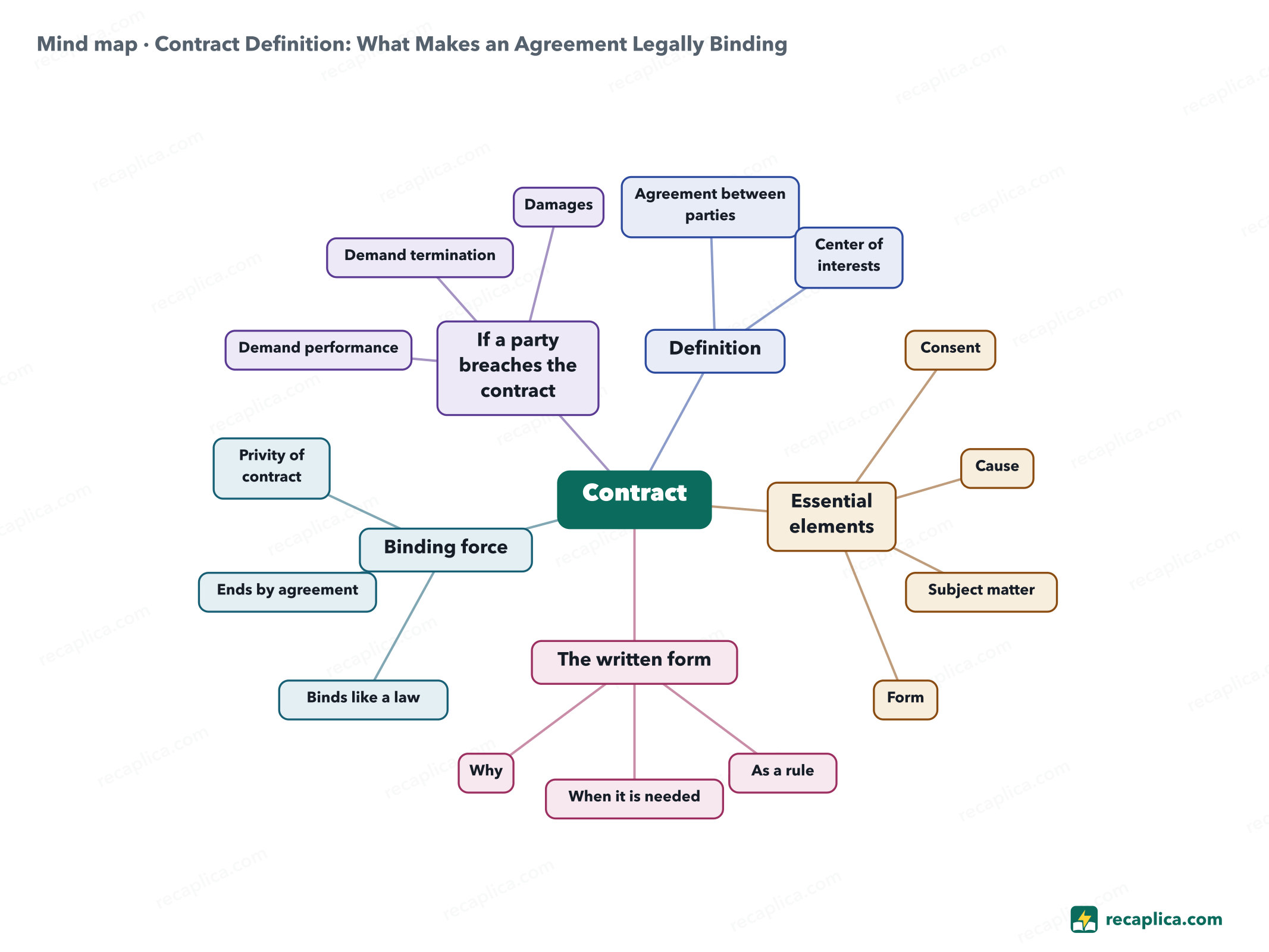
Agreement between partiesshapes, alters or closes a legal relationship over property, art. 1321
Center of interestsone party can be a group acting together, not just one person
Essential elementsart. 1325, Italian Civil Code
Consentthe parties' willingness to bind themselves to each other
Causethe economic purpose of the agreement
Subject matterthe concrete content of the obligation
Formrequired only in the cases the law names
The written form
As a rulenot required
When it is neededfor acts that transfer ownership of real estate, art. 1350
Whyprotects the signers and makes proof easier
Binding forceart. 1372, Italian Civil Code
Binds like a lawbetween the parties who signed it
Ends by agreementof all the parties, or in the cases the law allows
Privity of contractas a rule, applies only to the signers
If a party breaches the contractart. 1453, Italian Civil Code
Demand performancerequire the other party to meet its obligations
Demand terminationend the contract
Damagesavailable either way
Quiz: test yourself
Answer the questions to check what you have learned: you get instant feedback and a short explanation.
Grade0/100/5
Answers: 1-A · 2-A · 3-B · 4-A · 5-A
Flashcards
Tap the card to flip it and check whether you remember the answer, then move to the next one.
1 / 8
Explain it in your own words
The ultimate test: if you can explain it in simple words, you've truly understood it. Write your explanation, then compare it with the Recap.
Your explanation is saved only on this device.
Under article 1321 of the Italian Civil Code, a contract is what two or more parties agree to in order to create, change or end a relationship involving property or money. Article 1325 then sets four conditions for that agreement to count as a valid contract: the parties must consent, there must be a cause and a subject matter and — only when the law says so — a specific form such as writing. Once it exists, article 1372 treats a contract as binding on its signers the way a statute would: ending it needs everyone's agreement, or one of the exceptions the law spells out, such as a party failing to deliver on its promises.
Frequently asked questions
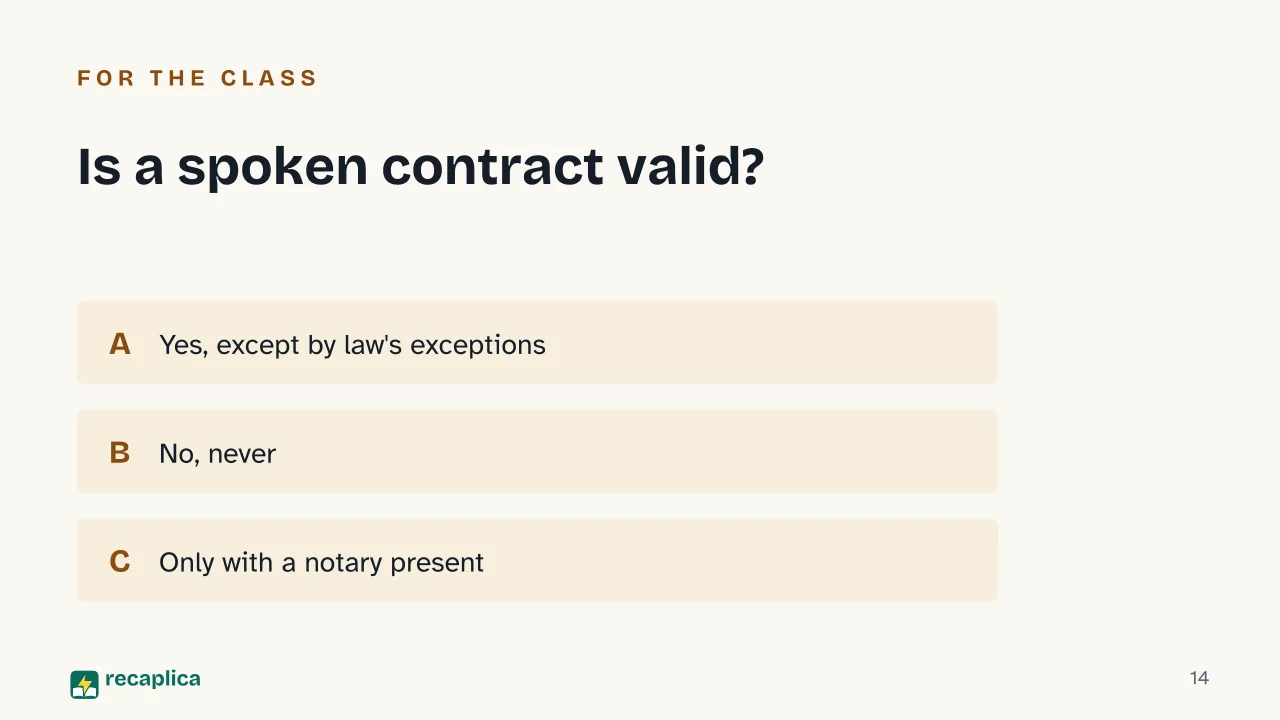
Is a spoken agreement a valid contract?
Yes, except for the acts the Italian Civil Code names specifically: for those, writing is required under penalty of nullity (art. 1325 and art. 1350), such as contracts that pass ownership of real estate. Outside that list, a spoken agreement has the same effect.
What happens if a contract is missing the form the law requires?
When the law requires a specific form, usually written, and that form is missing, the contract is void. Form is one of the four elements article 1325 lists alongside consent, cause and subject matter.
Can a contract be undone whenever someone wants?
No: article 1372 holds a contract to the same weight as a law between the parties. Ending it takes everyone's agreement, or one of the situations the law itself sets out, such as one party's breach.
Does a contract bind people who never signed it?
As a rule, no: privity of contract means its obligations stop at the people who signed. Anyone left outside the deal neither carries its duties nor gets its benefits.
What can I do if the other party does not honor a contract?
Under article 1453 you can choose between insisting that the other party meet its obligations (performance) or ending the contract (termination); either way you can also claim damages for the harm suffered.
Every Recap goes through an independent review before publication.
Statistics, only if you say so
To learn which Recaps help most we would use Google Analytics, with aggregate, anonymous data. It starts only with your OK, and you can change your mind anytime. Privacy policy