Skip to content
recaplica

    One moment: security check

    Cloudflare wants to make sure you're not a robot. Tick the box below and your search will continue on its own.

    IT
    recaplica Property Rights: What They Are and Their Limits
    © 2026 Recaplica · recaplica.com — All rights reserved
    Home › Civics

    Property Rights: What They Are and Their Limits

    By Recaplica Newsroom · Updated on September 30, 2026

    What to print

    Page numbers appear when printing with default margins.

    Slides

    Choose a cut

    Flash10 slidesThe essential thread, to present in classFull14 slidesEvery chapter and the deeper detail

    Both come with speaker notes.

    Telegram channel
    recaplica Clear in 30 seconds, yours in 10 minutes.
    In 30 seconds Key points Deep dive Slides Myths Mind map Quiz Flashcards FAQ

    In 30 seconds quick read

    Property rights let an owner use an asset and dispose of it in a full and exclusive way, but not without conditions: Italian law sets precise limits on that freedom. The 1948 Constitution recognizes private property and, in the same breath, gives it a social function: a duty to stay useful beyond its owner, to the whole community. When the public interest requires it, the law allows an asset to be taken from its owner, but only through a formal declaration and compensation. The same idea, with the same two limits, shows up in international human rights texts too, from the 1948 UN Declaration to the European Convention.

    Key Points

    • Article 832 of the Italian Civil Code gives an owner the right to use and dispose of an asset fully and exclusively, within the limits set by the legal system.
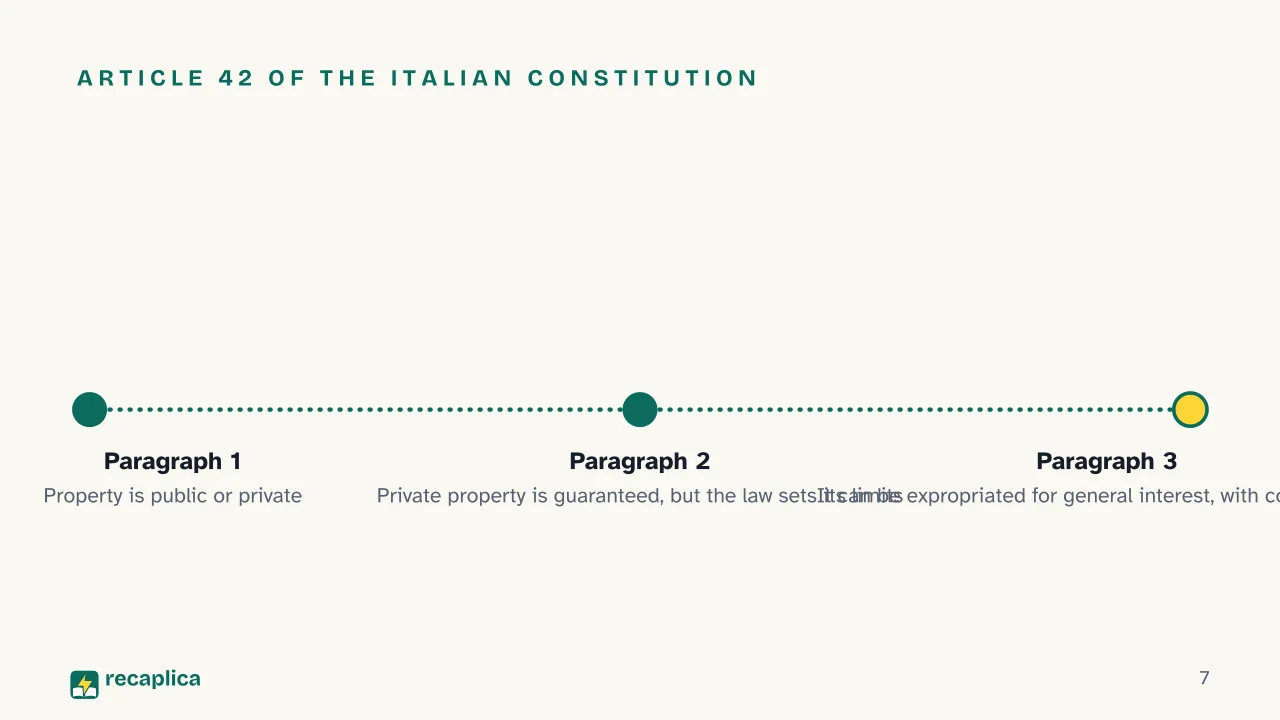
    • Article 42 of the Constitution splits property into public and private, and makes private property answer to a social function fixed by law.
    • Expropriation takes an asset for reasons of general interest, but it always requires compensation (Article 42, paragraph 3 of the Constitution; Article 834 of the Civil Code).
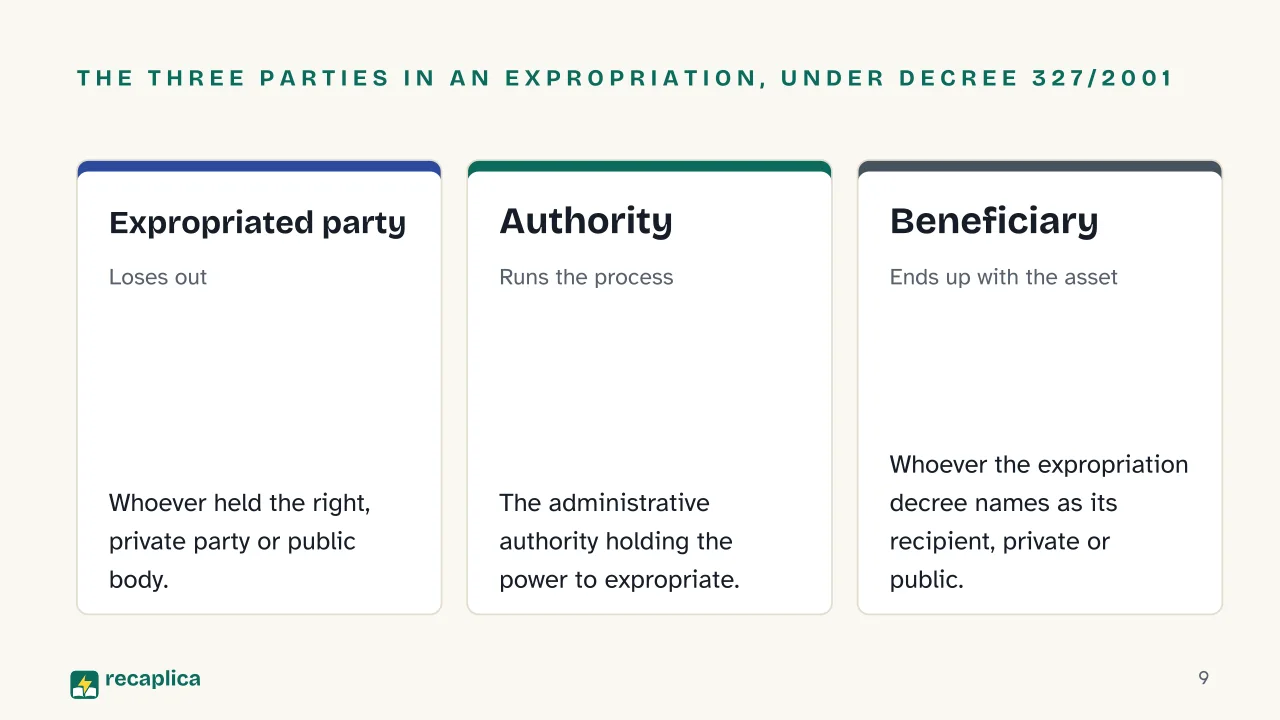
    • Presidential Decree 327/2001 names three parties in an expropriation — the person expropriated, the expropriating authority, and the beneficiary, who can also be a private party.
    • Article 17 of the Universal Declaration of Human Rights recognizes the right to own property and bans arbitrary deprivation of it.
    • Protocol No. 1 to the European Convention on Human Rights adds that a state can still control how property is used in the general interest, including collecting taxes.

    Deep Dive

    What property rights include

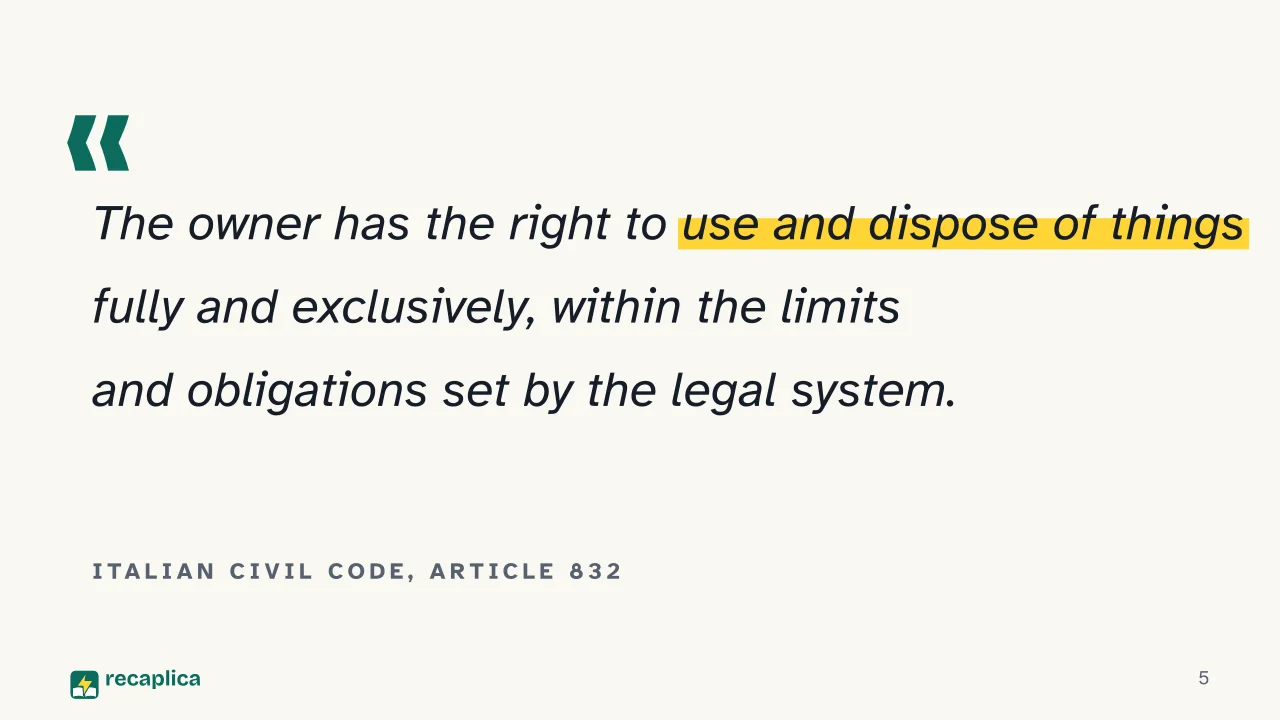
    When something is said to “belong to someone,” the law means something specific. Article 832 of the Italian Civil Code, in force since 1942, defines the content of ownership with two verbs: use and dispose. An owner can use an asset and draw every benefit from it (use), and can also sell it, leave it as inheritance, transform it, or destroy it (dispose). The Civil Code adds that this happens “fully and exclusively”: no one else can interfere without the owner’s consent. The same logic extends to assets with no physical form, such as creative works and inventions: that’s the territory of intellectual property.

    Right after, though, the same provision closes with a condition that changes everything: the owner can do this “within the limits and obligations set by the legal system.” That clause does real work: it pulls in every constraint the law imposes on an owner, at any level, without listing a single one here. Article 832 leans on rules written elsewhere — starting with how a legal norm itself works — rather than spelling out the limits on the spot.

    Public property and private property

    Article 42 of the Constitution, paragraph 1, opens with a simple split: “property is public or private,” and, in the same sentence, explains who owns what: economic assets belong to the state, to public bodies, or to private parties. Article 42 sits among the principles the 1948 Constitution sets for economic relations — one of the many balances described in the structure of the Italian Constitution.

    AspectPublic propertyPrivate property
    Holderstate or public bodiesprivate individuals or legal entities
    ReferenceConst. Art. 42, para. 1Const. Art. 42, para. 1; Civil Code Art. 832
    Main conditiondedicated to a collective use or interestrecognized and guaranteed, but limited by the social function

    The social function: why property has limits

    Paragraph 2 of Article 42 doesn’t stop at recognizing private property: it hands the law the job of “determining the ways it is acquired and used, and its limits, so as to secure its social function and make it accessible to everyone.” The law can therefore step in on how an asset changes hands and how it gets used, without denying the right itself: the aim the Constitution gives it is to keep ownership from serving the owner alone. This principle doesn’t stand alone. It’s the same one Article 832 of the Civil Code anticipates when it mentions “obligations set by the legal system”: the Constitution provides the frame, the Civil Code echoes it in the operating definition of the right itself.

    Expropriation for public utility

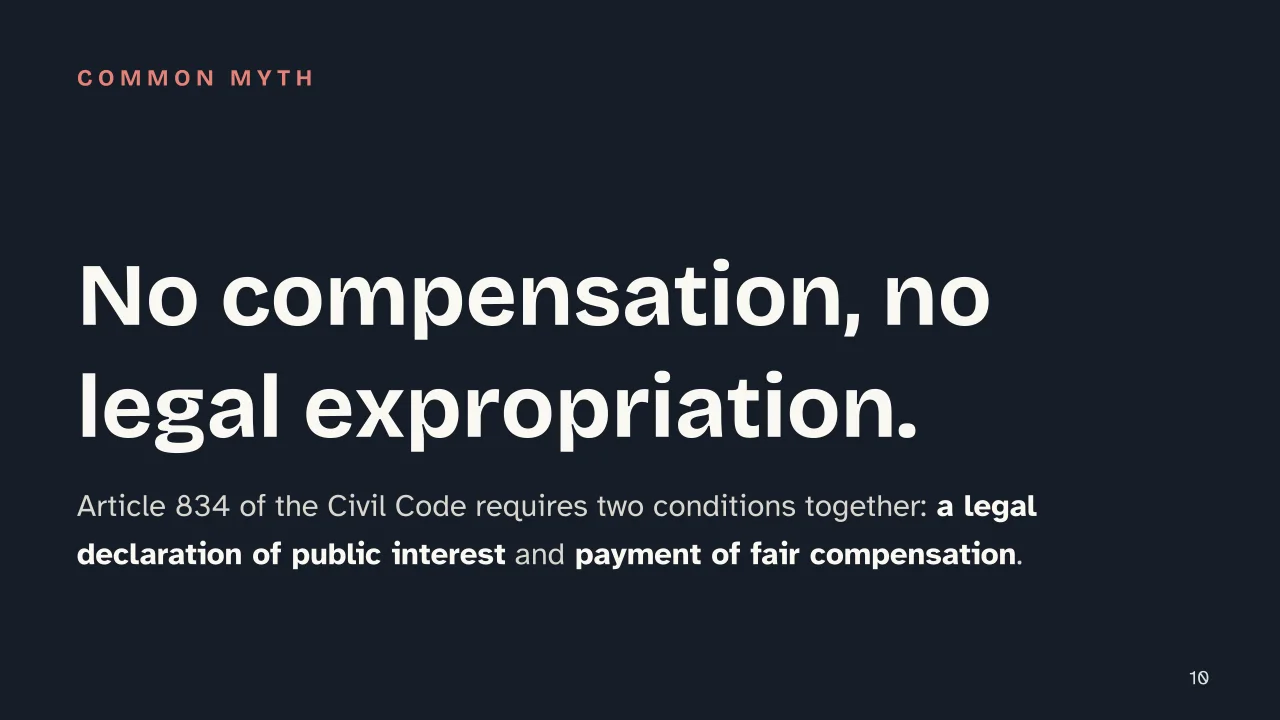
    The strongest limit is expropriation. Article 42, paragraph 3 of the Constitution allows private property to “be expropriated, in the cases provided for by law and subject to compensation, for reasons of general interest.” Article 834 of the Civil Code sets out the identical rule in its own civil-law language: “no one may be deprived, in whole or in part, of assets they own except for a cause of public interest, legally declared, and against payment of fair compensation.” Both conditions have to be met at the same time: a legal declaration of public interest and compensation.

    The practical rules sit in Presidential Decree No. 327 of 8 June 2001, the Italian expropriation code. Article 1 makes clear that the decree covers expropriation “also in favor of private parties,” when it serves to carry out a public project or one of public utility. Article 3 names three parties: the expropriated party is “the party, public or private, holding the right that is expropriated”; the expropriating authority is “the administrative authority holding the power to expropriate and running the relevant procedure.”

    The third is the beneficiary, meaning “the party, public or private, for whose benefit the expropriation decree is issued.”

    Practical example: a town needs to build a public road connecting two neighborhoods, and the route crosses a privately owned farm plot. The town declares the project of public utility (the legal declaration of public interest), starts the procedure as the expropriating authority, and, once the work is finished, pays the owner compensation for the land taken. Without the compensation, the expropriation isn’t legitimate.

    The international foundation: from the Universal Declaration to the ECHR

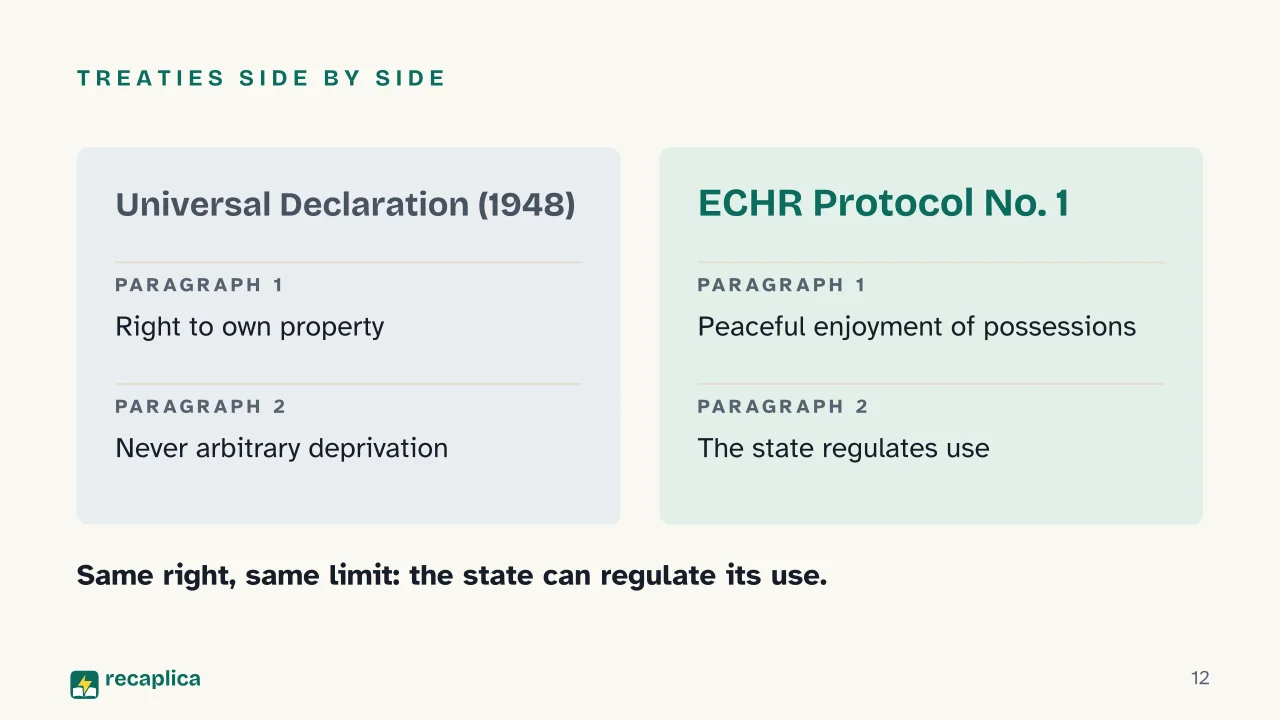
    Property as a right isn’t only an Italian matter. Article 17 of the Universal Declaration of Human Rights, adopted by the UN General Assembly in 1948, states that “everyone has the right to own property alone as well as in association with others” and that “no one shall be arbitrarily deprived of his property.” The word “arbitrarily” isn’t incidental: deprivation stays possible, but only under the conditions the law sets — exactly as in the Italian Constitution.

    Protocol No. 1 to the European Convention on Human Rights, in its Article 1, adds a detail the UN Declaration doesn’t spell out: everyone is entitled to the peaceful enjoyment of their possessions, but a state keeps the power to control the use of property “in accordance with the general interest,” including collecting taxes or other contributions. That’s the difference between taking an asset away (deprivation, which Article 42 of the Constitution also covers) and limiting its use without taking it — a line that shows up in Italian constitutional law and in the international treaties alike.

    Property rights: what the term actually covers

    Anyone searching for “property rights” is usually trying to find out whether owning an asset is a guaranteed right, and what protects it. Between the Italian Constitution and the Universal Declaration, the answer is the same: yes, it’s a recognized right, but a conditional one. There’s no single global rulebook; the same two boundaries show up across every text covered here: property has to stay useful to the community too, and it can’t be taken away on a whim.

    Slide deck

    Slides ready to download and make your own in PowerPoint or Google Slides, with speaker notes. Pick the Flash cut or the Full one.
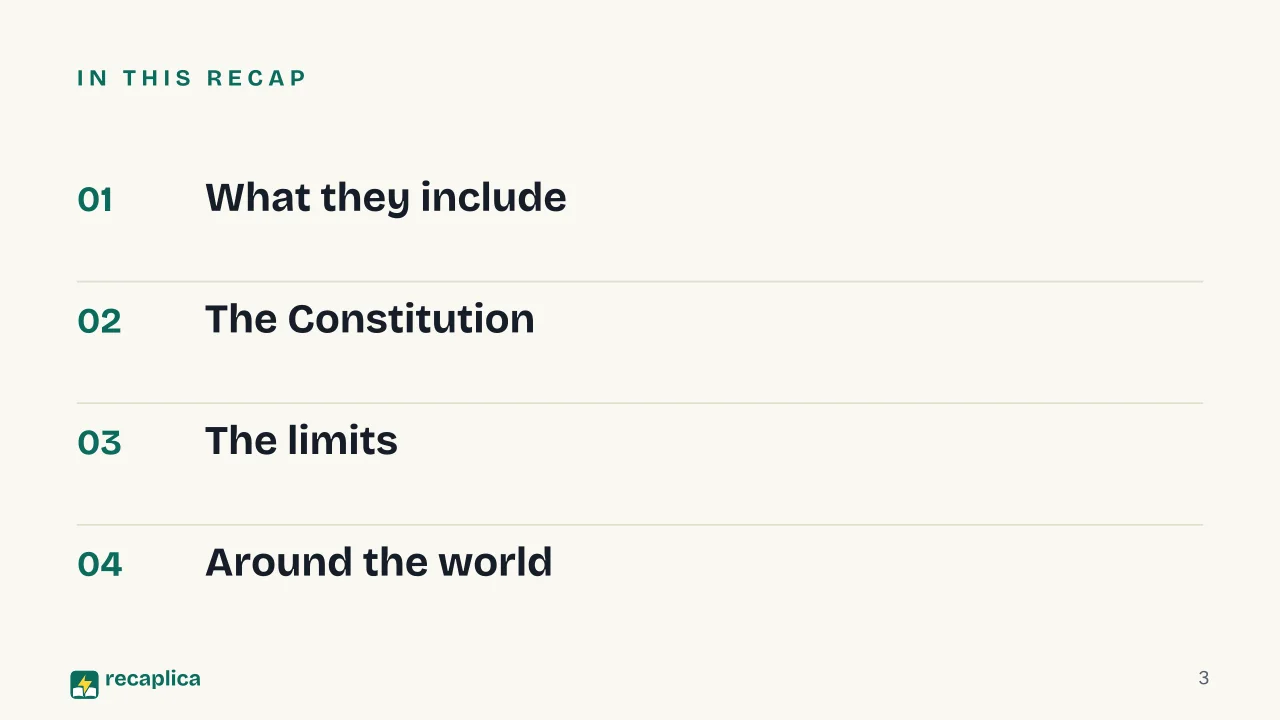
    Slide 1 of the presentation on Property Rights: Property RightsSlide 2 of the presentation on Property Rights: How far does what you own actually reach?Slide 3 of the presentation on Property Rights: In this RecapSlide 4 of the presentation on Property Rights: Chapter 01: What they includeSlide 5 of the presentation on Property Rights: Italian Civil Code, Article 832Slide 6 of the presentation on Property Rights: Chapter 02: The ConstitutionSlide 7 of the presentation on Property Rights: Article 42 of the Italian ConstitutionSlide 8 of the presentation on Property Rights: Chapter 03: The limitsSlide 9 of the presentation on Property Rights: The three parties in an expropriation, under Decree 327/2001: Expropriated party, Authority, BeneficiarySlide 10 of the presentation on Property Rights: No compensation, no legal expropriation.Slide 11 of the presentation on Property Rights: Chapter 04: Around the worldSlide 12 of the presentation on Property Rights: Treaties side by sideSlide 13 of the presentation on Property Rights: Under Article 832 of the Italian Civil Code, what can the owner of an asset do?Slide 14 of the presentation on Property Rights: Keep reading
    Flash10 slidesThe essential thread, to present in classFull14 slidesEvery chapter and the deeper detail

    Common myths

    • ✗ Myth Private property is an absolute right, with no limits.

      ✓ Reality Article 832 of the Civil Code closes its own definition with a condition, the limits and duties the legal system places on every owner, and Article 42 of the Constitution adds the social function on top: the law can restrict how an asset is used or passed on.

    • ✗ Myth A state can take away property without paying anything, as long as there's a public interest.

      ✓ Reality Article 834 of the Civil Code and Article 42, paragraph 3 of the Constitution both demand two conditions together: a legal declaration of public interest and a fair compensation payment. Drop the compensation and the expropriation stops being legitimate.

    • ✗ Myth Expropriation only ever serves the state.

      ✓ Reality Article 1 of Presidential Decree 327/2001 covers expropriation 'also in favor of private parties,' and Article 3 defines the beneficiary as whoever — public or private — the expropriation decree is issued for: a public-works project can benefit a private company just as easily.

    Mind map

    Drag the background to move around and the nodes to reposition them; use − and + to collapse and expand branches.
    Customize
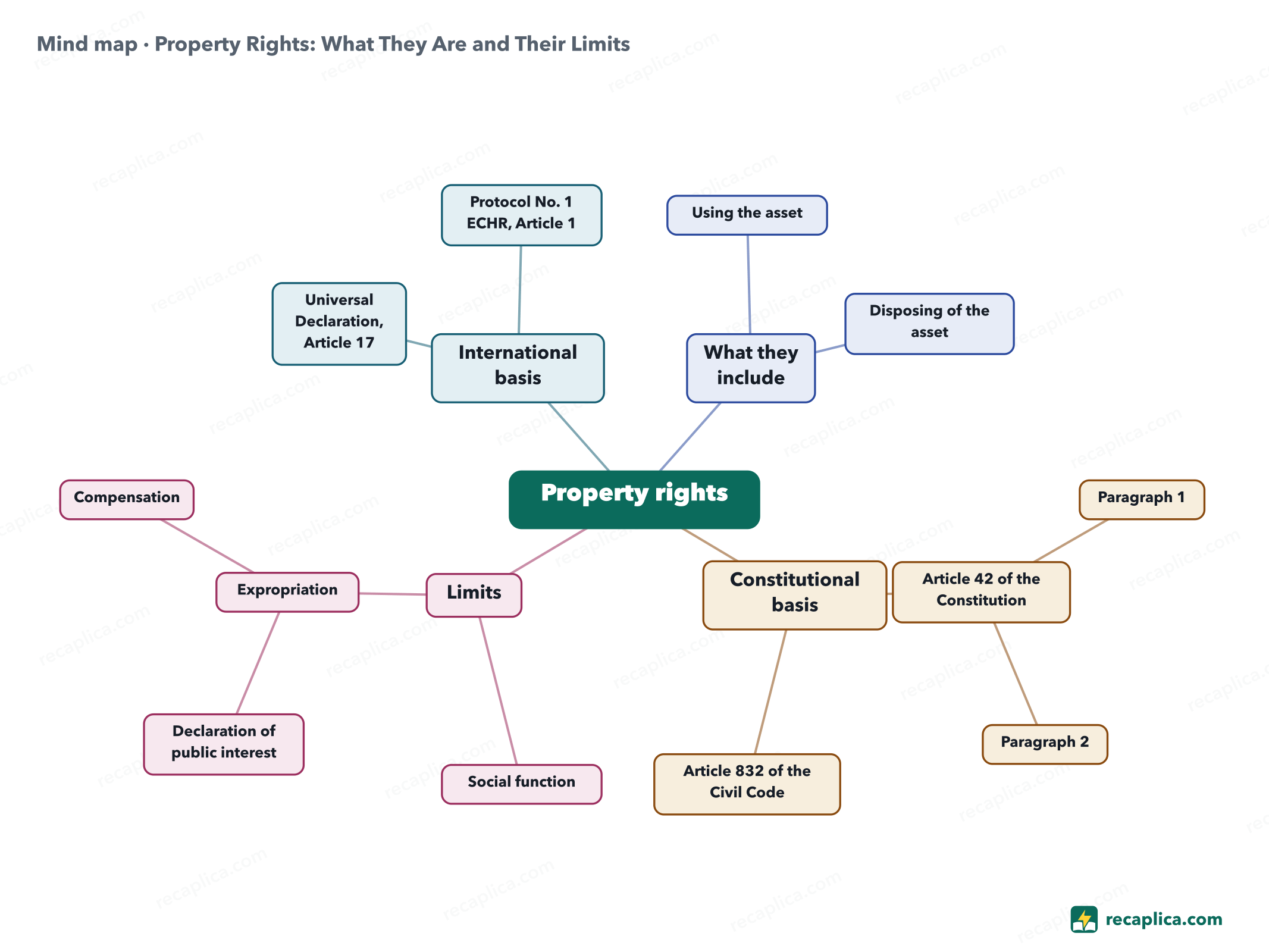
    Mind map: Property Rights: What They Are and Their Limits
    • Property rights
      • What they include
        • Using the asset putting it to use and drawing benefit from it, fully
        • Disposing of the asset selling it, leaving it as inheritance, altering it
      • Constitutional basis
        • Article 42 of the Constitution
          • Paragraph 1 property is public or private
          • Paragraph 2 the law sets its limits for the social function
        • Article 832 of the Civil Code use and dispose fully and exclusively
      • Limits
        • Social function kept accessible to everyone, not only useful to the owner
        • Expropriation
          • Declaration of public interest
          • Compensation a mandatory condition, never optional
      • International basis
        • Universal Declaration, Article 17 right to property, no arbitrary deprivation
        • Protocol No. 1 ECHR, Article 1 peaceful enjoyment, but control of use allowed

    Quiz: test yourself

    Answer the questions to check what you have learned: you get instant feedback and a short explanation.

    Grade 0/10 0/5
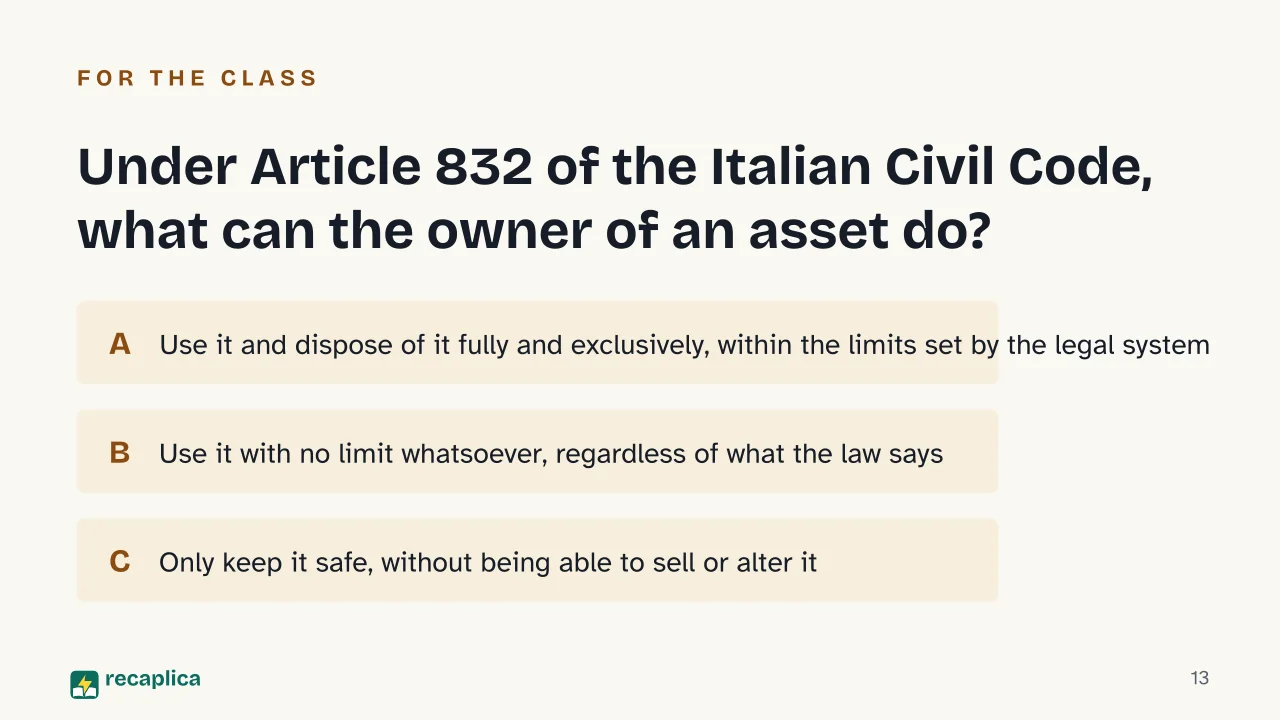
    1 Under Article 832 of the Italian Civil Code, what can the owner of an asset do?

    Article 832 uses exactly these two verbs, use and dispose, and then adds a condition: the owner stays within the limits and obligations the legal system sets.

    2 A state can take someone's property away without paying anything, as long as there's a public interest.

    For Article 834 of the Civil Code and Article 42, paragraph 3 of the Constitution, a public interest on its own isn't enough: it has to be declared by law, and the owner is still owed compensation.

    3 According to Article 42, paragraph 1 of the Constitution, property is…

    Paragraph 1 is the one that literally says 'public or private' and, right there, lists who can own economic assets: the state, public bodies, private parties. The social function only comes in with paragraph 2.

    4 Under the expropriation rules of Presidential Decree 327/2001, who is the 'beneficiary'?

    Article 3 of the Italian expropriation code calls the beneficiary whoever ends up with the decree issued in their favor, and says outright that this can be a public or a private party: a public project can benefit a private party too.

    5 What does Article 17 of the Universal Declaration of Human Rights (1948) state?

    Article 17 recognizes both individual and collective ownership and bans arbitrary deprivation: it's the international foundation that, in Europe, the ECHR Protocol later builds on.

    Answers: 1-A · 2-B · 3-C · 4-B · 5-B

    Flashcards

    Tap the card to flip it and check whether you remember the answer, then move to the next one.

    1 / 7

    Explain it in your own words

    The ultimate test: if you can explain it in simple words, you've truly understood it. Write your explanation, then compare it with the Recap.

    Your explanation is saved only on this device.

    Property rights let an owner use an asset and dispose of it in a full and exclusive way, but not without conditions: Italian law sets precise limits on that freedom. The 1948 Constitution recognizes private property and, in the same breath, gives it a social function: a duty to stay useful beyond its owner, to the whole community. When the public interest requires it, the law allows an asset to be taken from its owner, but only through a formal declaration and compensation. The same idea, with the same two limits, shows up in international human rights texts too, from the 1948 UN Declaration to the European Convention.

    Frequently asked questions

    What is the definition of private property rights?

    Under Article 832 of the Italian Civil Code, private property rights mean an owner may use an asset and dispose of it, fully and exclusively. Article 42 of the Constitution then recognizes private ownership while subjecting it to a social function set by law.

    How is the economic definition of property rights different?

    Italian law does not set out a separate economic definition: the legal one already covers it. Article 832 of the Civil Code spells out what an owner can do with an asset, use it and dispose of it, fully and exclusively, and economic analysis relies on that same definition when it describes ownership.

    What happens if a state expropriates private land?

    The owner loses the asset, but only if there is a legal declaration of public interest and the owner receives compensation: both Article 42, paragraph 3 of the Constitution and Article 834 of the Civil Code require it.

    Do property rights have limits?

    Yes. Article 832 of the Civil Code ties ownership to whatever limits and duties the legal system imposes, and Article 42 of the Constitution subjects private property to its social function.

    What's the difference between public and private property?

    Article 42, paragraph 1 of the Constitution states that property is public or private: public assets belong to the state or to public bodies, private assets belong to individuals or private legal entities. Both stay within the limits the law sets.

    Sources

    • Constitution of the Italian Republic, Article 42
    • Italian Civil Code, Article 832 (content of the right of ownership)
    • Italian Civil Code, Article 834 (expropriation for reasons of public interest)
    • Presidential Decree 327/2001, Italian expropriation code, Article 1
    • Presidential Decree 327/2001, Italian expropriation code, Article 3
    • Universal Declaration of Human Rights, Article 17 (UN, 1948)
    • European Convention on Human Rights, Protocol No. 1, Article 1

    Every Recap goes through an independent review before publication.

    Every evening, the day's new Recaps on our Telegram channel. Join the channel →

    Keep learning

    • Civics Civil Service: What It Is and How It Works in Italy The civil service is both the activity of running public affairs and the set of bodies that carry it out: ministries and agencies, public bodies, independent authorities, state-owned enterprises, and local government such as regions, provinces and municipalities. In Italy, the Constitution's Articles 97 and 98 require sound administration and impartiality, entry to public jobs through open competitive exams, and service to the Nation rather than to any government or party. Part of this machinery — state bodies such as ministries — has no legal personality of its own, because it coincides with the state itself; another part, public bodies, has its own separate legal personality. In 2022, Italy's statistics agency ISTAT counted 12,776 active public institutions, employing more than 3.4 million people. Read the Recap →
    • Civics What Is Fiscal Federalism? Who Raises the Money and Who Gets It Fiscal federalism is the system that lets municipalities, provinces, metropolitan cities and regions in Italy pay for schools, roads and healthcare without relying only on money handed down from the State. Article 119 of the Italian Constitution names three sources: own-source taxes each level of government sets for itself, a share of national tax revenue such as VAT, and an equalization fund that helps territories with less fiscal capacity. Law 42/2009 turned that principle into practice, replacing the old benchmark of historical spending with a standard-needs calculation. At the municipal level the equalization tool is called the Municipal Solidarity Fund, partly financed by a share of property-tax revenue. The system is still a work in progress: the essential service levels, the yardstick for full equalization, have not been defined yet. Read the Recap →
    • Civics Federalism Explained: Who Decides What, and at Which Level Federalism is the general idea that a country's power is shared out among several levels of government, with a constitution fixing who holds which piece. Subsidiarity is the rule that decides where a task lands: it starts at the level closest to people and only moves up when a wider scale is genuinely needed. Italy uses subsidiarity heavily, spelled out in Article 118 of its Constitution, and Article 117 divides lawmaking power between the national government and the regions. Even so, Treccani's entry on Italian regional law is explicit that Italy remains a variant of the unitary state, not a federation in the technical sense used for countries like Germany, the United States or Switzerland, because judicial power in Italy stays with the central government alone. Read the Recap →

    recaplica

    Clear in 30 seconds, yours in 10 minutes.

    Recaps Mind maps Request a Recap Telegram channel Mind map maker Our method About Privacy & cookies Legal notes & terms of use

    © 2026 Recaplica · A project by Curi S.r.l. — VAT IT05472000750

    Statistics, only if you say so

    To learn which Recaps help most we would use Google Analytics, with aggregate, anonymous data. It starts only with your OK, and you can change your mind anytime. Privacy policy