Skip to content
recaplica

    One moment: security check

    Cloudflare wants to make sure you're not a robot. Tick the box below and your search will continue on its own.

    IT
    recaplica Deviance: Definition and Theories in Sociology
    © 2026 Recaplica · recaplica.com — All rights reserved
    Home › Civics

    Deviance: Definition and Theories in Sociology

    By Recaplica Newsroom · Updated on October 6, 2026

    What to print

    Page numbers appear when printing with default margins.

    Slides

    Choose a cut

    Flash10 slidesThe essential thread, to present in classFull15 slidesEvery chapter and the deeper detail

    Both come with speaker notes.

    Telegram channel
    recaplica Clear in 30 seconds, yours in 10 minutes.
    In 30 seconds Key points Deep dive Slides Myths Mind map Quiz Flashcards FAQ

    In 30 seconds quick read

    Sociologists use the word deviance for any behavior that breaks a group's shared rules, and that is a wider idea than breaking the law: an act can be deviant without being illegal, or legal without being accepted. Crime is just the most serious form of deviance, the one society punishes through formal law. Several theories explain why it happens: Durkheim treats it as a structural feature of every society, Merton ties it to the gap between cultural goals and the means to reach them, and Lemert and Becker show how a public label can turn a single act into a lasting identity. Social control, both formal and informal, is how societies manage that boundary.

    Key Points

    • In sociology, deviance means breaking a group's rules, written or not, from everyday customs to laws.
    • Crime is the most serious type of deviance, because it carries formal sanctions.
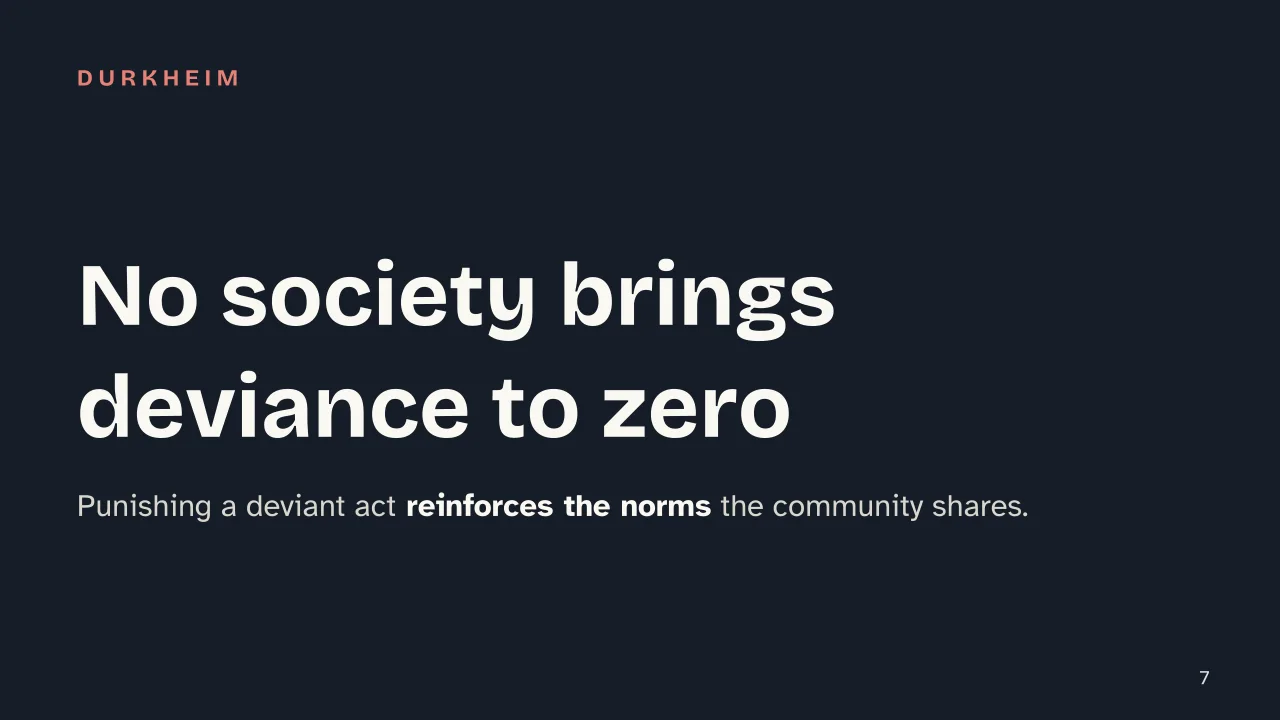
    • For Durkheim, deviance is structural: punishing it reinforces the norms a community shares.
    • For Merton, deviance grows out of the gap between culturally approved goals and the real means to reach them, with five possible responses.
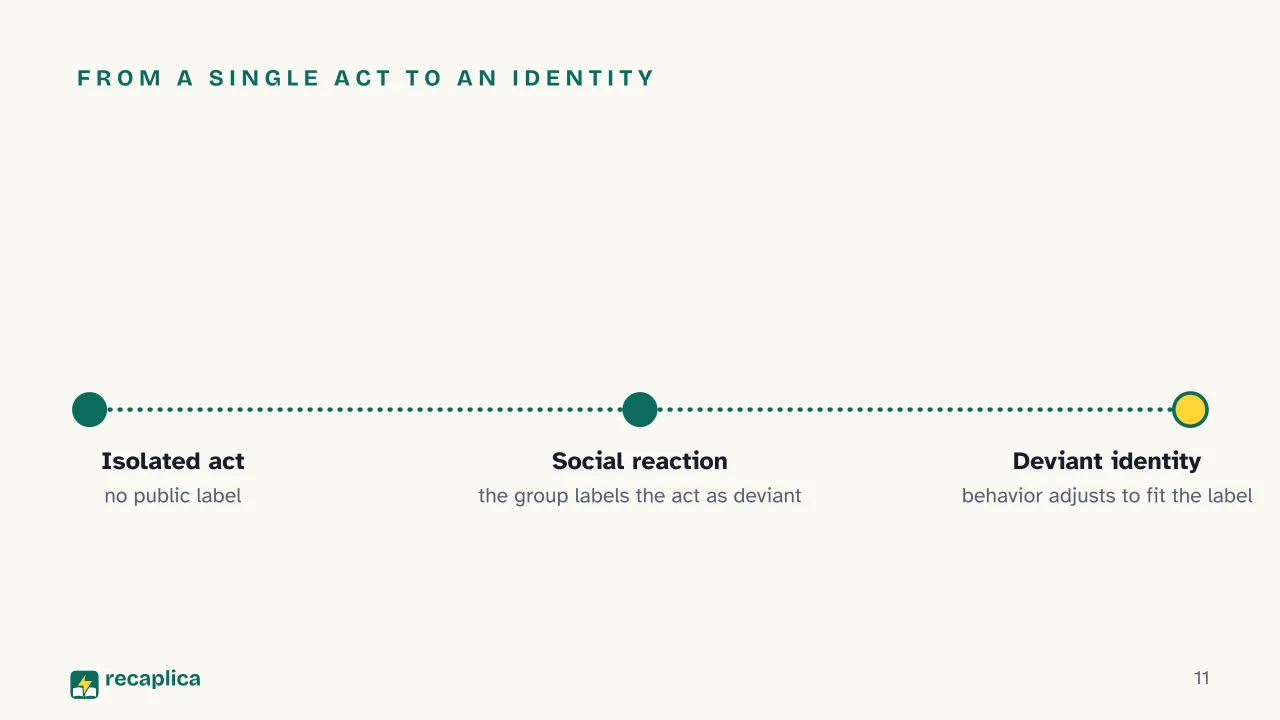
    • For Lemert and Becker, a public label can turn a single act (primary deviance) into a lasting identity (secondary deviance).
    • Social control, informal in everyday relationships and formal in institutions, regulates both deviance and conformity.

    Deep Dive

    What deviance means in sociology

    Sociologists define deviance as any violation of shared social norms, whether those norms are customs, everyday habits, or laws a community treats as binding.

    OpenStax describes it as a broader concept than crime, since it covers behavior that breaks a social expectation even when no law is involved. Showing up late to appointments as a habit, dressing in a way a context considers odd, breaking a food custom the group takes for granted: these are all deviant acts that, in most cases, stay perfectly legal.

    Deviance, crime, and social control

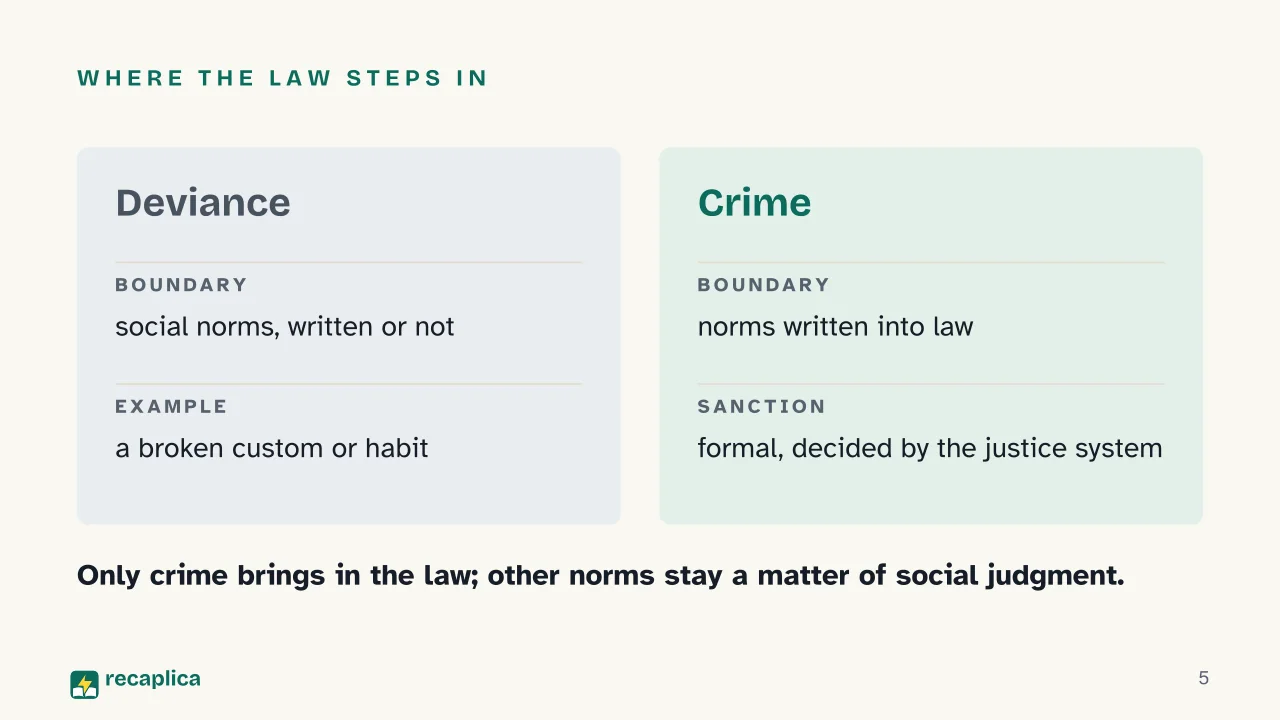
    Among deviant behaviors, society treats crime as the most serious, because it carries formal sanctions: fines, trials, prison time. What separates deviance from illegality is the legal norm, the rule written down and enforced by the state; other social norms, the ones governing manners or group customs, lack that backing but still shape how harshly a community judges whoever breaks them.

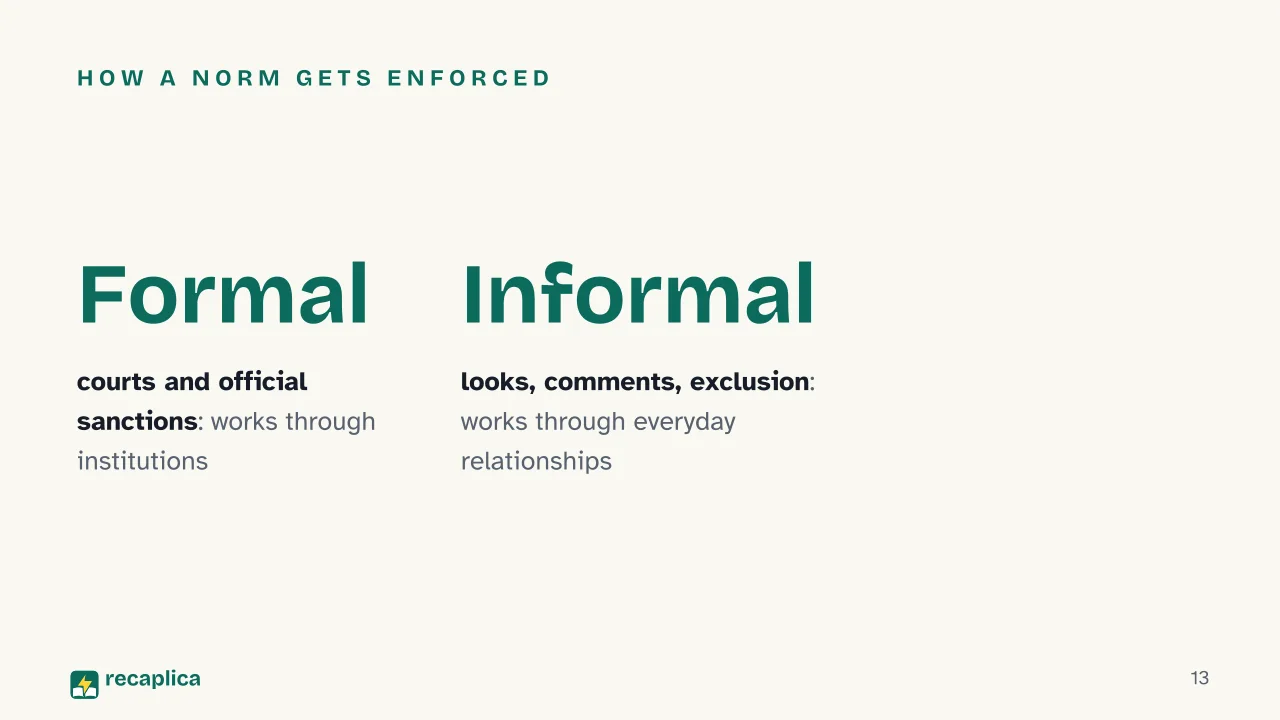
    Social control is the set of mechanisms a society uses to enforce its shared norms, and it works in two ways. Informal control runs through people’s direct reactions in everyday interactions: a disapproving look, a comment, being left out of a group. Formal control runs through official institutions, such as the justice system, which recognize and punish norm violations through codified procedures. Both levels also work in the opposite direction: public praise can reward conformity just as a fine discourages deviance.

    Durkheim: deviance as a structural fact, and anomie

    Durkheim argued that deviance is not a flaw to be removed but a structural feature of any society that functions.

    No community, however orderly, manages to bring it down to zero.

    Deviance tests a society’s existing norms, and punishing it serves to restate and reinforce the rules the community shares.

    Durkheim linked deviance to the concept of anomie, which in his original use describes a state of normlessness: a condition in which a society’s shared moral rules weaken or break down.

    Merton and strain theory

    Merton kept Durkheim’s vocabulary but gave it a different content: for him, anomie is not the absence of rules but the contradiction between goals a culture keeps holding up as valid, financial success above all, and the real shortage of legitimate means to reach them, the same social mobility that lets someone improve their standing. According to OpenStax, it is this strain that pushes some people toward deviance.

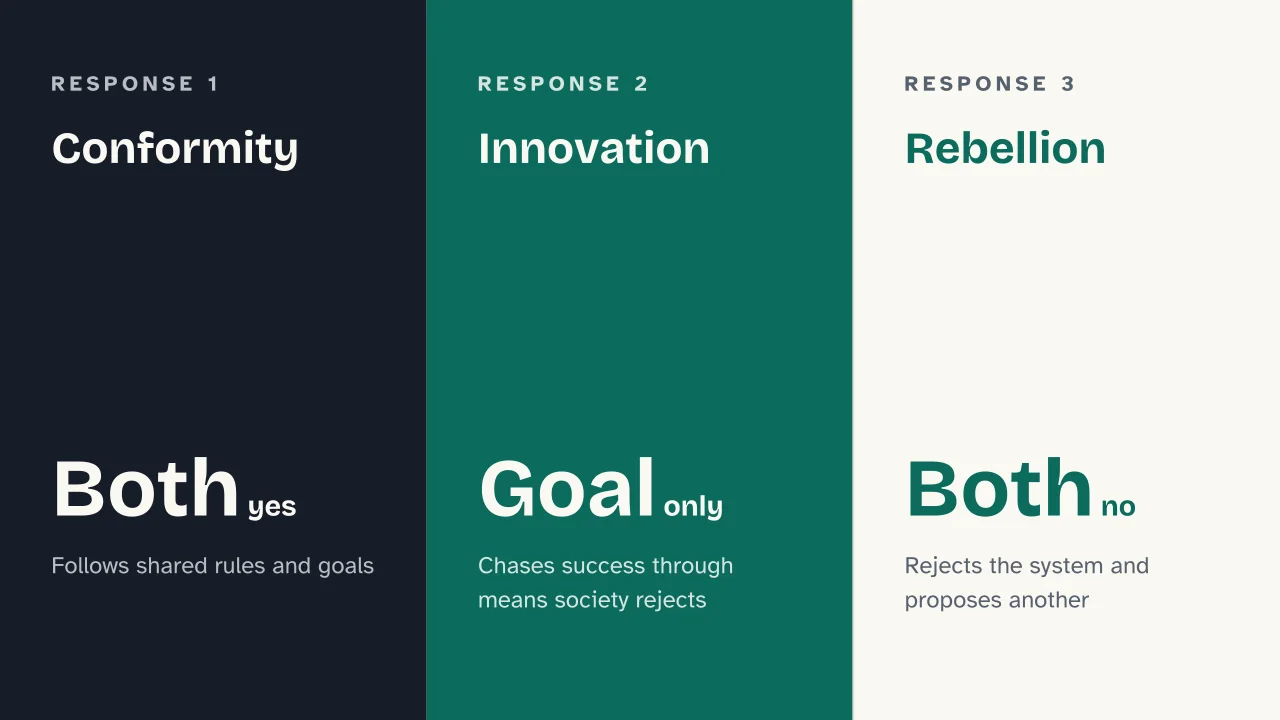
    Merton described five ways of responding to that gap. Someone who conforms accepts both the goals and the legitimate means society recognizes. Someone who innovates shares the goals but pursues them through means that are not approved or are illegal. Someone who chooses ritualism gives up the higher-value goals but keeps following the approved rules and routines anyway. Someone who retreats rejects both the goals and the legitimate means, effectively stepping outside the social game. Someone who rebels rejects the existing goals and means and, unlike the person who retreats, replaces them with new ones, alternatives to the dominant model.

    Practical example: picture two people who grew up in the same neighborhood, both convinced that financial success is a legitimate goal worth pursuing. One takes a job that pays little but is stable, and scales back their ambitions: that is ritualism. The other, without access to an education that opens better doors, starts selling stolen goods to reach the same goal: that is innovation, in Merton’s terms.

    Labeling: Lemert and Howard Becker

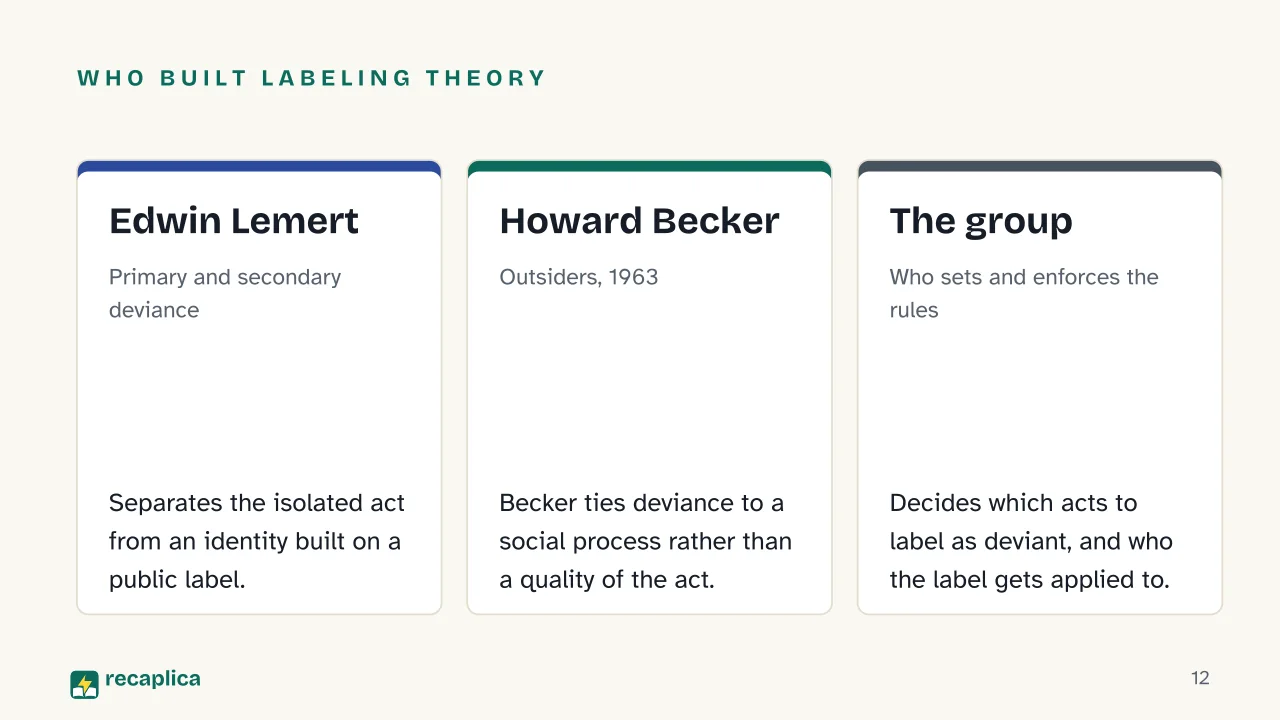
    Lemert distinguished two types of deviance based on their effect on a person’s identity. Primary deviance is a norm violation that stays a one-off episode, never labeled in public: it does not change how the person sees themselves or their relationships. Secondary deviance appears once the public label of “deviant” genuinely reshapes the person’s self-image, pushing them to act in ways that match the label they received.

    Howard Becker pushed this idea to a radical conclusion in his book Outsiders (1963): deviance arises from a two-step social process, in which a group sets the rules and then applies them to whoever it decides to view with suspicion. For Becker, what makes a person deviant is mainly the fact that the label stuck, thanks to others — a mechanism close to how prejudice and stereotypes work, where it is the group’s gaze that fixes an identity onto a person.

    Secondary deviance arises as a consequence of other people’s reaction to the deviant act, and it is the one with real consequences for a person’s life: once someone starts using the deviant behavior, or a role built around it, as a way to cope with the problems that reaction created, the label stops being a description and becomes part of the social status and role the person occupies.

    Practical example: a student skips school once; for Lemert, that stays a case of primary deviance, with no impact on identity. But if teachers and classmates start treating that student as “the troublemaker,” and the student starts acting the part to match the label, that is the secondary deviance Lemert described and Becker later built on.

    Social control, formal and informal

    Social control regulates deviance and conformity together, and the norms it enforces do not come out of nowhere: people learn them through socialization, the process by which someone absorbs their group’s rules from childhood on. Someone who has internalized a norm follows it even without outside enforcement; someone who has not stays exposed to the sanctions, formal or informal, a society reserves for rule-breakers.

    Durkheim and Merton focus on the social conditions that lead someone to break a norm in the first place. Lemert and Becker pick up from there, looking at what happens once that break becomes public and a label sticks to the person responsible.

    Slide deck

    Slides ready to download and make your own in PowerPoint or Google Slides, with speaker notes. Pick the Flash cut or the Full one.
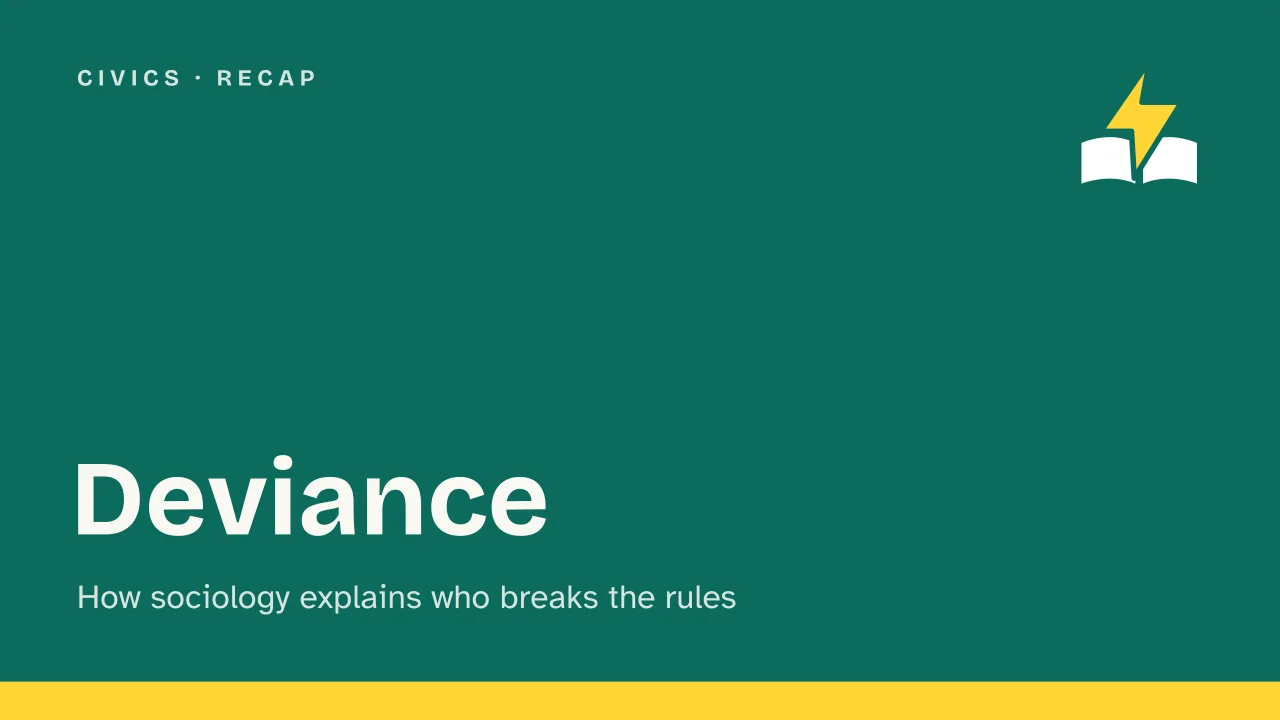
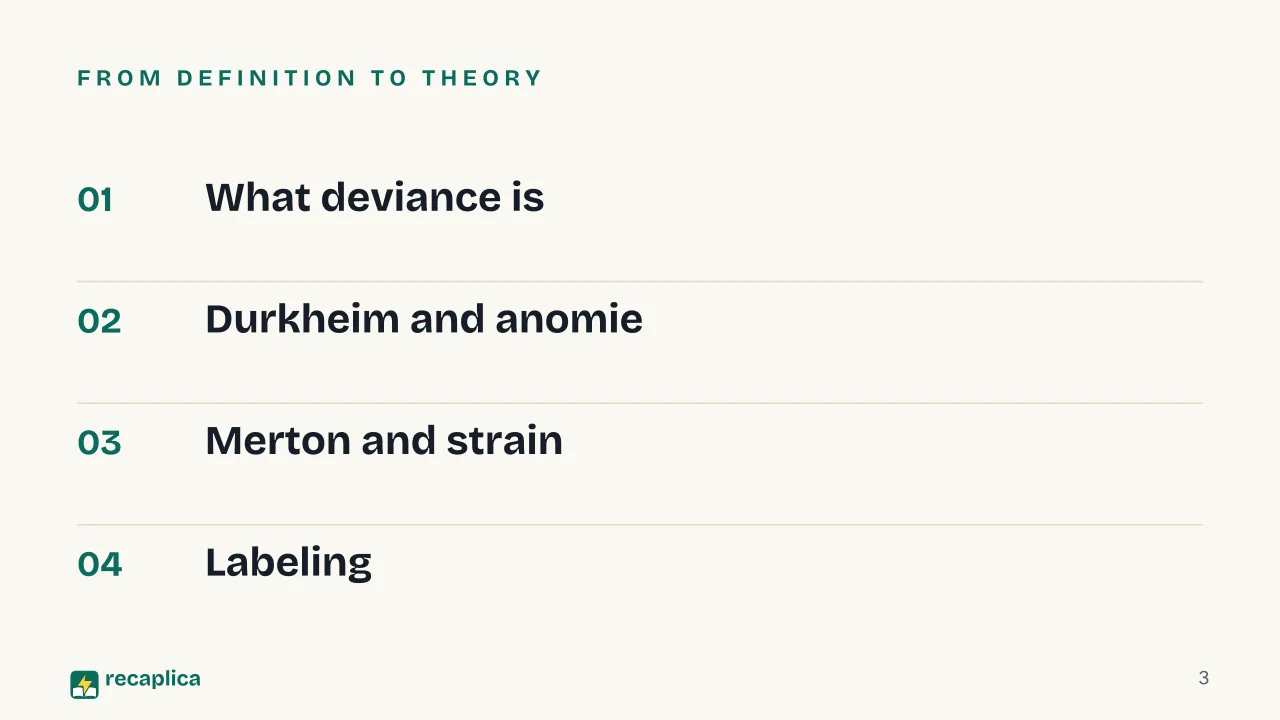
    Slide 1 of the presentation on Deviance: DevianceSlide 2 of the presentation on Deviance: Why does someone break a group's rules?Slide 3 of the presentation on Deviance: From definition to theorySlide 4 of the presentation on Deviance: Chapter 01: What deviance isSlide 5 of the presentation on Deviance: Where the law steps inSlide 6 of the presentation on Deviance: Chapter 02: Durkheim and anomieSlide 7 of the presentation on Deviance: No society brings deviance to zeroSlide 8 of the presentation on Deviance: Chapter 03: Merton and strainSlide 9 of the presentation on Deviance: Conformity · Innovation · RebellionSlide 10 of the presentation on Deviance: Chapter 04: LabelingSlide 11 of the presentation on Deviance: From a single act to an identitySlide 12 of the presentation on Deviance: Who built labeling theory: Edwin Lemert, Howard Becker, The groupSlide 13 of the presentation on Deviance: How a norm gets enforcedSlide 14 of the presentation on Deviance: In Merton's theory, what do you call someone who accepts society's goals but uses illegitimate means?Slide 15 of the presentation on Deviance: Now, for review
    Flash10 slidesThe essential thread, to present in classFull15 slidesEvery chapter and the deeper detail

    Common myths

    • ✗ Myth Deviance always means crime.

      ✓ Reality Sociology defines it as breaking shared social norms: laws, but also customs and everyday expectations. An act can be judged wrong by a group and stay perfectly legal, because crime and deviance only partly overlap.

    • ✗ Myth People become deviant because something is wrong with their personality.

      ✓ Reality For Lemert and Becker, deviance often grows out of a social process: it is the public label attached to an act, more than a fixed trait of the person, that pushes someone toward behavior matching that label in secondary deviance.

    • ✗ Myth Anomie just means a lack of rules.

      ✓ Reality That holds for Durkheim, but Merton uses the same word with a different meaning: for him, anomie is the strain between cultural goals that still hold and the shortage of legitimate means to reach them, an idea quite different from a simple absence of norms.

    Mind map

    Drag the background to move around and the nodes to reposition them; use − and + to collapse and expand branches.
    Customize
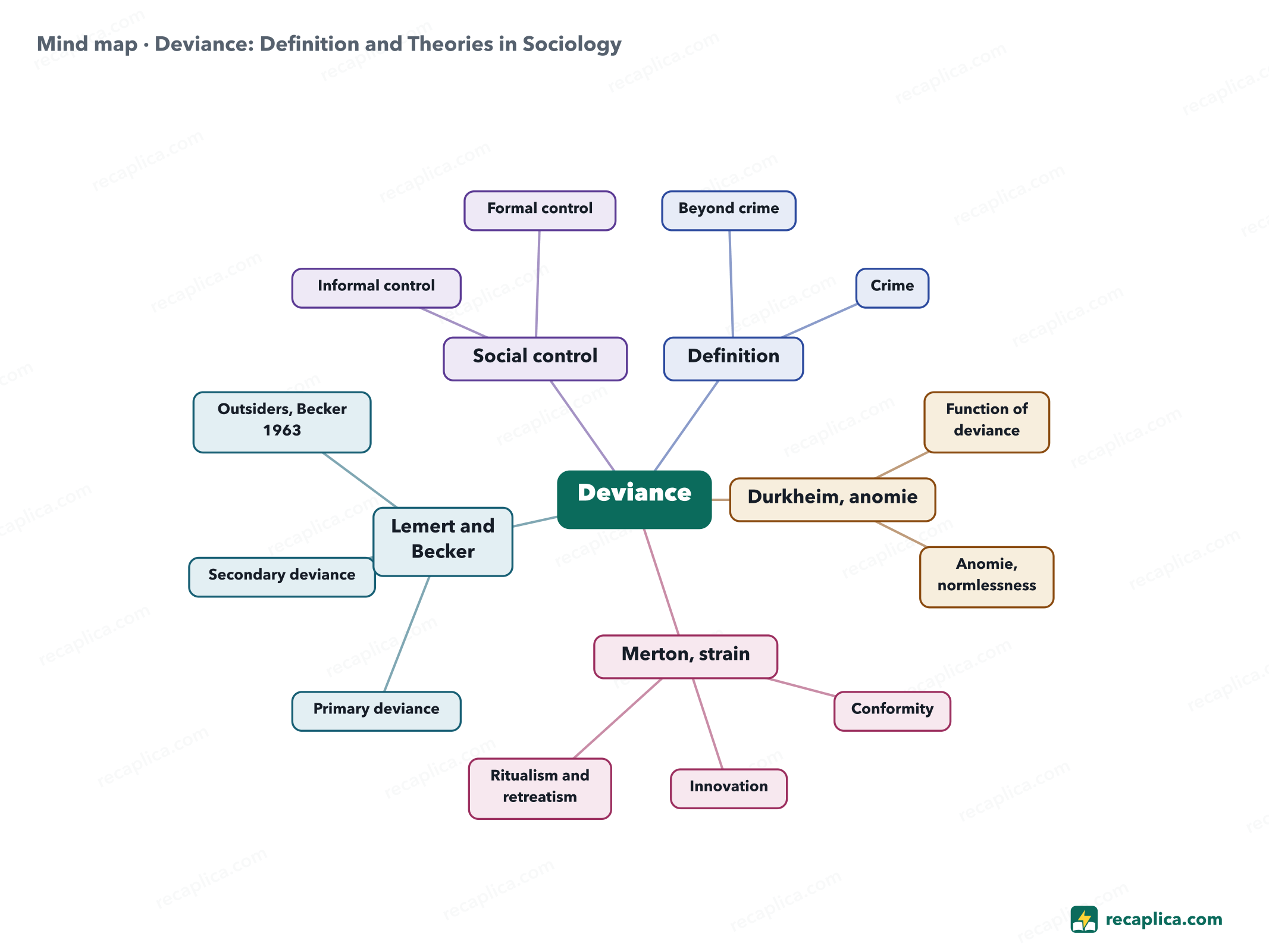
    Mind map: Deviance: Definition and Theories in Sociology
    • Deviance
      • Definition Breaking shared social norms
        • Beyond crime Also covers norms that are not written into law
        • Crime The most serious form, punished by law
      • Durkheim, anomie Deviance as a structural fact
        • Function of deviance Punishment reinforces shared norms
        • Anomie, normlessness Shared moral rules weaken
      • Merton, strain Tension between goals and means
        • Conformity
        • Innovation
        • Ritualism and retreatism
      • Lemert and Becker The role of social reaction
        • Primary deviance
        • Secondary deviance
        • Outsiders, Becker 1963
      • Social control
        • Informal control Reactions in everyday relationships
        • Formal control Institutions and official sanctions

    Quiz: test yourself

    Answer the questions to check what you have learned: you get instant feedback and a short explanation.

    Grade 0/10 0/5
    1 How does sociology define deviance?

    Deviance is a broader concept than crime: it also covers behavior that breaks customs and expectations without breaking any law.

    2 For Durkheim, what function does deviance serve in a society?

    For Durkheim, deviance is a structural feature of every society: punishing it restates and reinforces the norms the community shares.

    3 In Merton's theory, what is the response of someone who shares society's goals but pursues them through illegitimate means?

    Merton calls this innovation: accepting a cultural goal, such as financial success, while using means society does not approve of to reach it.

    4 According to Lemert, what sets secondary deviance apart from primary deviance?

    Primary deviance stays a one-off episode nobody labels publicly; secondary deviance appears once the label becomes public and starts to shape the person's behavior and sense of self.

    5 True or false: Howard Becker, in Outsiders (1963), argues that deviance is a built-in quality of an act.

    Becker argues the opposite: deviance depends on how others react and choose to treat the act as deviant, not on any fixed property of the act itself.

    Answers: 1-B · 2-B · 3-C · 4-B · 5-B

    Flashcards

    Tap the card to flip it and check whether you remember the answer, then move to the next one.

    1 / 8

    Explain it in your own words

    The ultimate test: if you can explain it in simple words, you've truly understood it. Write your explanation, then compare it with the Recap.

    Your explanation is saved only on this device.

    Sociologists use the word deviance for any behavior that breaks a group's shared rules, and that is a wider idea than breaking the law: an act can be deviant without being illegal, or legal without being accepted. Crime is just the most serious form of deviance, the one society punishes through formal law. Several theories explain why it happens: Durkheim treats it as a structural feature of every society, Merton ties it to the gap between cultural goals and the means to reach them, and Lemert and Becker show how a public label can turn a single act into a lasting identity. Social control, both formal and informal, is how societies manage that boundary.

    Frequently asked questions

    What is the difference between deviance and crime?

    Crime means breaking a law and carries formal sanctions; deviance is a wider concept that also includes breaking social norms that were never written into law.

    What did Durkheim mean by anomie?

    For Durkheim, anomie describes a weakening of a society's shared moral rules: when the reference points a group relies on lose their grip, the society enters a state he called normlessness.

    What does Merton's strain theory say?

    Merton borrows Durkheim's word, anomie, but gives it a different meaning: the strain between culturally approved goals, such as financial success, and the real chance of reaching them through legitimate means. This strain produces five possible responses: conformity, innovation, ritualism, retreatism, and rebellion.

    What is secondary deviance according to Lemert?

    It is the deviance that follows a social reaction: when a label publicly attached to a person starts to shape the choices that person makes.

    Who is Howard Becker and what is labeling theory?

    Howard Becker is the sociologist who, in his 1963 book Outsiders, describes deviance as a two-step social process: a group sets rules, then applies them to specific people. This is the core of labeling theory, closely tied to Lemert's distinction between primary and secondary deviance.

    Sources

    • OpenStax, Introduction to Sociology 3e — 7.1 Deviance and Control
    • OpenStax, Introduction to Sociology 3e — 7.2 Theoretical Perspectives on Deviance and Crime
    • Simply Psychology, Merton's Strain Theory of Deviance in Sociology
    • Revise Sociology, Labelling Theory of Crime and Deviance

    Every Recap goes through an independent review before publication.

    Every evening, the day's new Recaps on our Telegram channel. Join the channel →

    Keep learning

    • Civics What Is Pi Day? Why It Falls on March 14 Pi Day is a yearly observance on March 14, chosen because the US date format writes that day as 3/14, matching pi's first digits. Larry Shaw, a physicist at San Francisco's Exploratorium, came up with it in 1988 during a staff retreat at the museum. What started as a small party among coworkers grew into a public celebration with a parade, pie, and a 2009 resolution from the US Congress. Today it's mostly marked in schools and science museums, with digit-memorization contests and discounts at pizza and dessert shops. Read the Recap →
    • Civics Mass Media: What They Are Mass society is a type of society where ordinary people carry real weight in political and social life, but at a cost: more conformity, less individual autonomy, greater exposure to manipulation. The Treccani encyclopedia places its rise between the late 19th and early 20th century, when population growth, urbanization, mass schooling, wider voting rights and industrial organization converge. Mass media, radio and film first, then satellites and the internet, make it possible on a scale never seen before. The Frankfurt School and Ortega y Gasset turned it into an object of criticism, from two different angles: a culture industry that standardizes, and a mass man who blends into the average. Read the Recap →
    • Civics Secularization: Definition, Theories, and How It Shapes Society Secularization is the process through which religious institutions, practices, and beliefs lose social weight, as a society leans more on reason and science, according to EBSCO Research Starters. It shows up on three different levels: institutions, a country's shared culture, and the religious choices each person makes. Max Weber described it as the disenchantment of the world, the modern rationalization that pushed religion and metaphysics outside the boundaries of legitimate knowledge; Émile Durkheim linked it, in 1912, to the split between the sacred and the profane. Pew Research Center data from 2024 show how unevenly the process plays out: in India, Israel, Nigeria, and Thailand, 95% or more of adults still belong to the religion they grew up in, while in South Korea half of adults have left theirs behind. Read the Recap →

    recaplica

    Clear in 30 seconds, yours in 10 minutes.

    Recaps Mind maps Request a Recap Telegram channel Mind map maker Our method About Privacy & cookies Legal notes & terms of use

    © 2026 Recaplica · A project by Curi S.r.l. — VAT IT05472000750

    Statistics, only if you say so

    To learn which Recaps help most we would use Google Analytics, with aggregate, anonymous data. It starts only with your OK, and you can change your mind anytime. Privacy policy