recaplica
Clear in 30 seconds, yours in 10 minutes.
In 30 seconds quick read
Secularization is the process through which religious institutions, practices, and beliefs lose social weight, as a society leans more on reason and science, according to EBSCO Research Starters. It shows up on three different levels: institutions, a country's shared culture, and the religious choices each person makes. Max Weber described it as the disenchantment of the world, the modern rationalization that pushed religion and metaphysics outside the boundaries of legitimate knowledge; Émile Durkheim linked it, in 1912, to the split between the sacred and the profane. Pew Research Center data from 2024 show how unevenly the process plays out: in India, Israel, Nigeria, and Thailand, 95% or more of adults still belong to the religion they grew up in, while in South Korea half of adults have left theirs behind.
Key Points
EBSCO Research Starters defines secularization as the decline of religion's social weight, as a community leans more heavily on reason and science.
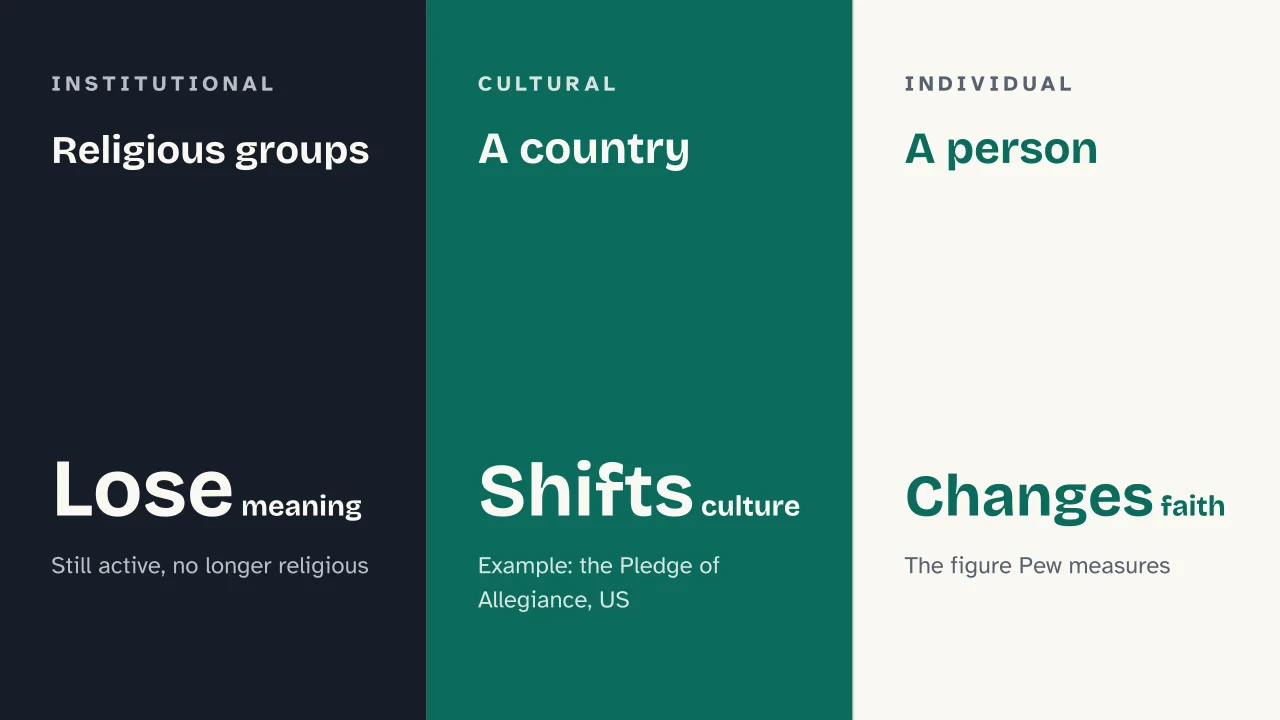
The phenomenon shows up on three levels: institutional, when groups and activities lose their religious character, and cultural, when a country founded on religious principles drifts away from them, the two described by EBSCO Research Starters; individual, when a person changes the faith they grew up with, the level Pew Research Center measures in surveys.
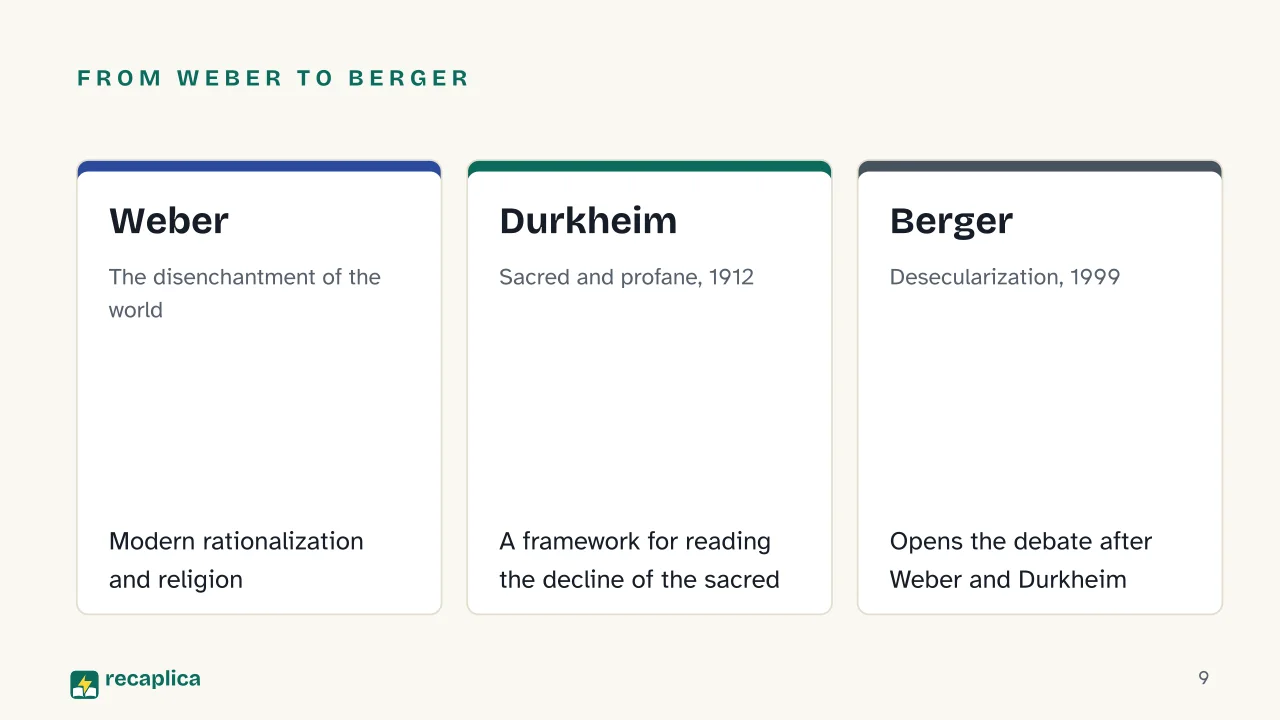
For the Stanford Encyclopedia of Philosophy, Weber's modern rationalization strips religion and metaphysics of their standing as valid knowledge: the disenchantment of the world, strongest only in the West.
Émile Durkheim, in 1912, separated the sacred from the profane: a framework EBSCO Research Starters uses to read how far the sacred has lost ground in modern societies.
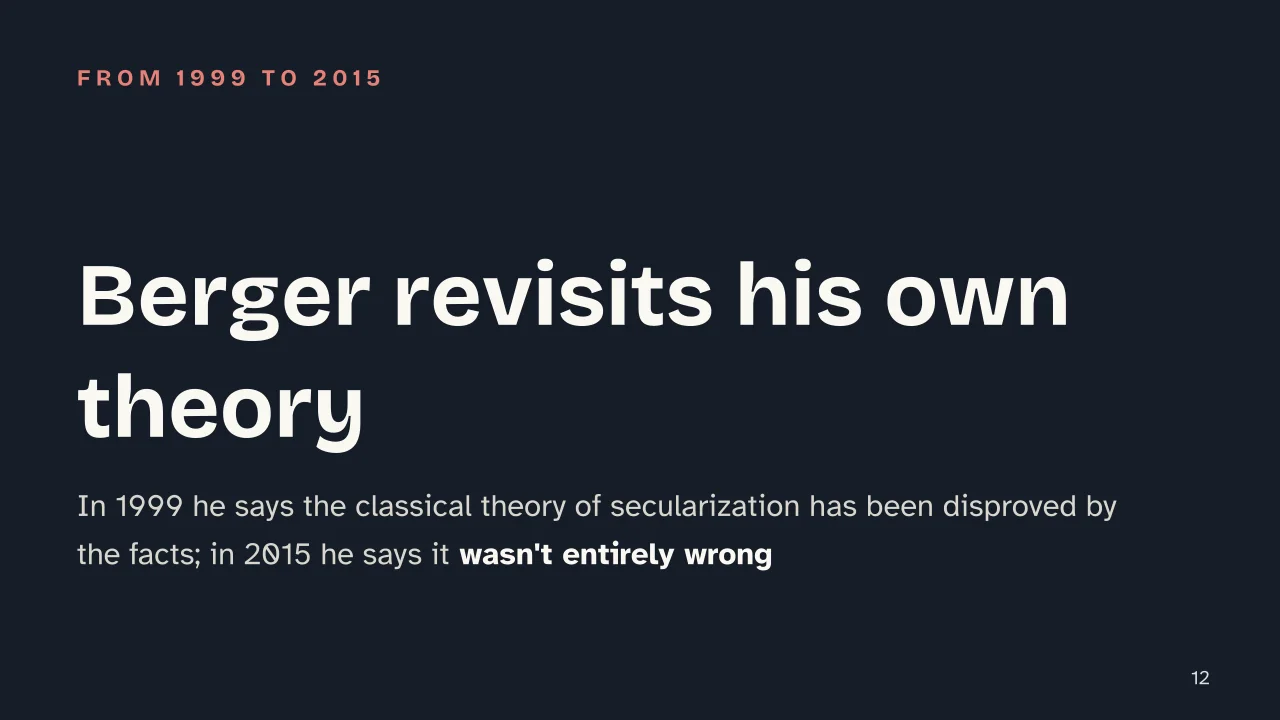
In 1999 Peter Berger coined the term desecularization; he argued that the religious decline predicted by classical sociology was not actually happening. In 2015 he partly revised that view.
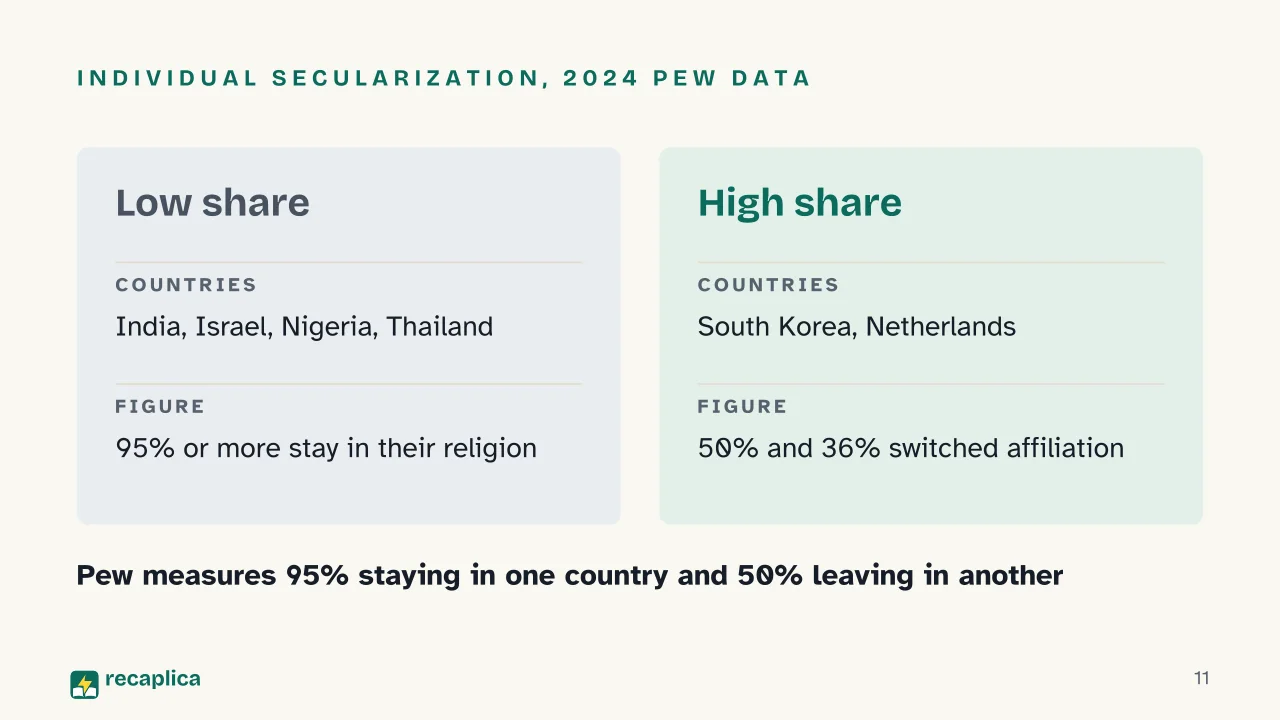
According to Pew Research Center, in 2024 95% or more of adults in India, Israel, Nigeria, and Thailand still belonged to the religion they were raised in, while in South Korea 50% no longer identified with their childhood religion.
Key figures
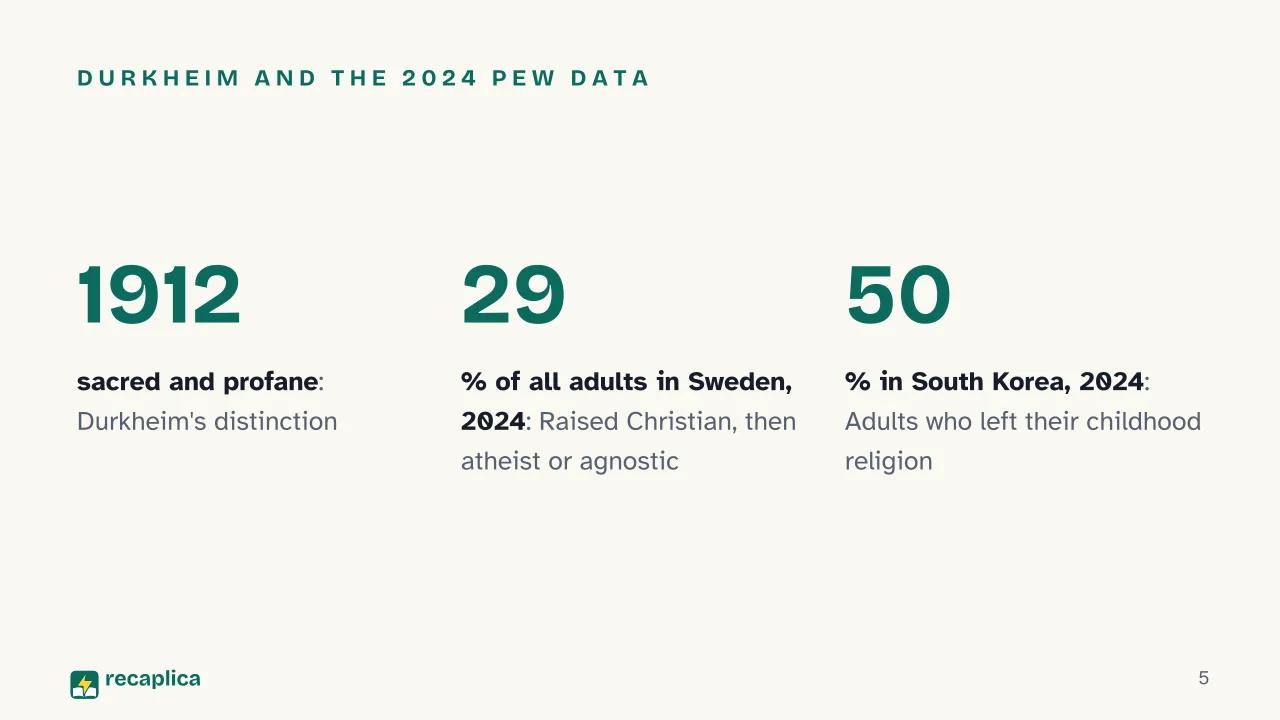
1912 Year Durkheim drew the line between sacred and profane, the frame EBSCO Research Starters applies to the study of secularization. Source: EBSCO Research Starters
29% Share of all Swedish adults who in 2024 said they had been raised Christian and described themselves as atheist, agnostic, or of no particular religion, according to Pew Research Center. Source: Pew Research Center
50% Share of South Korean adults who no longer identified with their childhood religion in 2024, according to the Pew Research Center survey of 36 countries. Source: Pew Research Center
Deep Dive
A definition, before any theory
The starting point is a definition from EBSCO Research Starters: with secularization, religious institutions, practices, and beliefs lose weight in social life, while reason and science gain ground. That is a different phenomenon from secularism, the political principle of separating the state from religion.
The three forms
The phenomenon reads on three distinct levels. EBSCO Research Starters describes two of them: the institutional level, where religious groups and activities keep existing but lose their specifically religious character, and the cultural level, where a society founded on religious grounds gradually moves away from those principles. The third level is individual and covers the choices single people make, changing their religious affiliation over the course of a life: that is what Pew Research Center measures in surveys.
Practical example: EBSCO Research Starters points to the ban on prayer in U.S. public schools and the lawsuits brought to remove the phrase “under God” from the Pledge of Allegiance, which still carries it, as signs of secularization in American culture. These are public institutions where a religious reference present at their founding is under argument, a shift that says nothing, by itself, about the personal faith of the people living in that country.
How a person comes to keep or change a religious affiliation ties into the broader process of learning a group’s norms, covered in the Recap on socialization. Switching religion, or staying outside any affiliation, is also a matter of where a person stands within their own community, a theme picked up in the Recap on social status and role.
Weber’s disenchantment of the world
According to the Stanford Encyclopedia of Philosophy entry on Max Weber, modern rationalization pushed religion, theology, and metaphysics outside the boundaries of legitimate knowledge, into the territory of superstition or irrationality. Weber calls this process the disenchantment of the world, Entzauberung, and treats it as a phenomenon that reaches its most radical form only in modern Western civilization. In the reading the entry offers, disenchantment first helped monotheistic religions take hold in the West; in a later stage, it turned the same rationalizing logic against those religions too, stripping them of their role as a shared worldview in modern secular society. Some readings of Weber, noted in the same entry, add a point of interpretive debate: disenchantment would produce a paradoxical new enchantment, a fragmentation of values that acts almost like magical forces. The same Western religious tradition Weber analyzes traces back to a precise rupture, told in the Recap on Martin Luther and the Protestant Reformation.
Durkheim: the sacred and the profane
EBSCO Research Starters links Durkheim’s 1912 theory to secularization through a pair of concepts: the sacred, what carries symbolic value beyond the ordinary, and the profane, everyday life stripped of that charge. That pairing is the lens the entry applies to the dwindling weight of the sacred in contemporary societies.
The debate after Weber and Durkheim
In 1999 Peter Berger published The Desecularization of the World and introduced the term desecularization to describe a revival or resurgence of religion after a phase of secularization, according to the Wikipedia entry on the concept. In the book, he argues that the classical theory of secularization had been falsified by the facts: in his view, religion was not in any general decline. In a 2015 article he partly walked that position back, saying the theory hadn’t been entirely wrong; Berger himself later called his original use of the term “a bit sloppy,” referring to the plain persistence of religion in the modern world.
On the institutional side, European history offers a textbook case in how the French Revolution redrew the relationship between the state and the church.
How much it varies by country, in 2024
According to the Pew Research Center survey, fielded between January 5 and May 22, 2024 (U.S. data collected from July 17, 2023, to March 4, 2024), the share of adults who no longer identify with their childhood religion varies enormously from one country to another.
Countries
Adults who leave their childhood religion (2024 data)
India, Israel, Nigeria, Thailand
not published: 95% or more stay in their childhood religion
Brazil
21%
United States
28%
Netherlands
36%
South Korea
50%
These percentages always refer to all the adults surveyed in each country. In Sweden, in 2024, 29% said they had been raised Christian and now call themselves atheist, agnostic, or unaffiliated with any particular religion. In Japan, 23% of the adults surveyed said they had been raised Buddhist and identified with no religion; in South Korea the share was 13%.
In Spain, religious change relative to one’s childhood faith is more common among young adults (ages 18-34, 48% in 2024) than among those over 50 (36%). In Colombia the gap is even wider: 34% among young adults, 14% among older adults, again in 2024 data.
Slide deck
Slides ready to download and make your own in PowerPoint or Google Slides, with speaker notes. Pick the Flash cut or the Full one.
✗ Myth Secularization means religion is disappearing everywhere in the world.
✓ Reality According to Pew Research Center, in 2024 95% or more of adults in India, Israel, Nigeria, and Thailand had kept the religion of their upbringing: individual secularization is barely present in these countries, nowhere close to a shared global pattern.
✗ Myth Once secularization starts, it only moves forward and never backward.
✓ Reality In 1999 Peter Berger argued that the facts had disproved classical sociology's theory of religious decline; in 2015 he partly revised that stance, saying it hadn't been entirely wrong. The debate stays open; nothing here is settled.
✗ Myth Secularization and secularism are two names for the same thing.
✓ Reality Secularization describes a social change, the fading weight of religious institutions and practices. Secularism, by contrast, is a political principle: the separation of state and religion.
Mind map
Drag the background to move around and the nodes to reposition them; use − and + to collapse and expand branches.
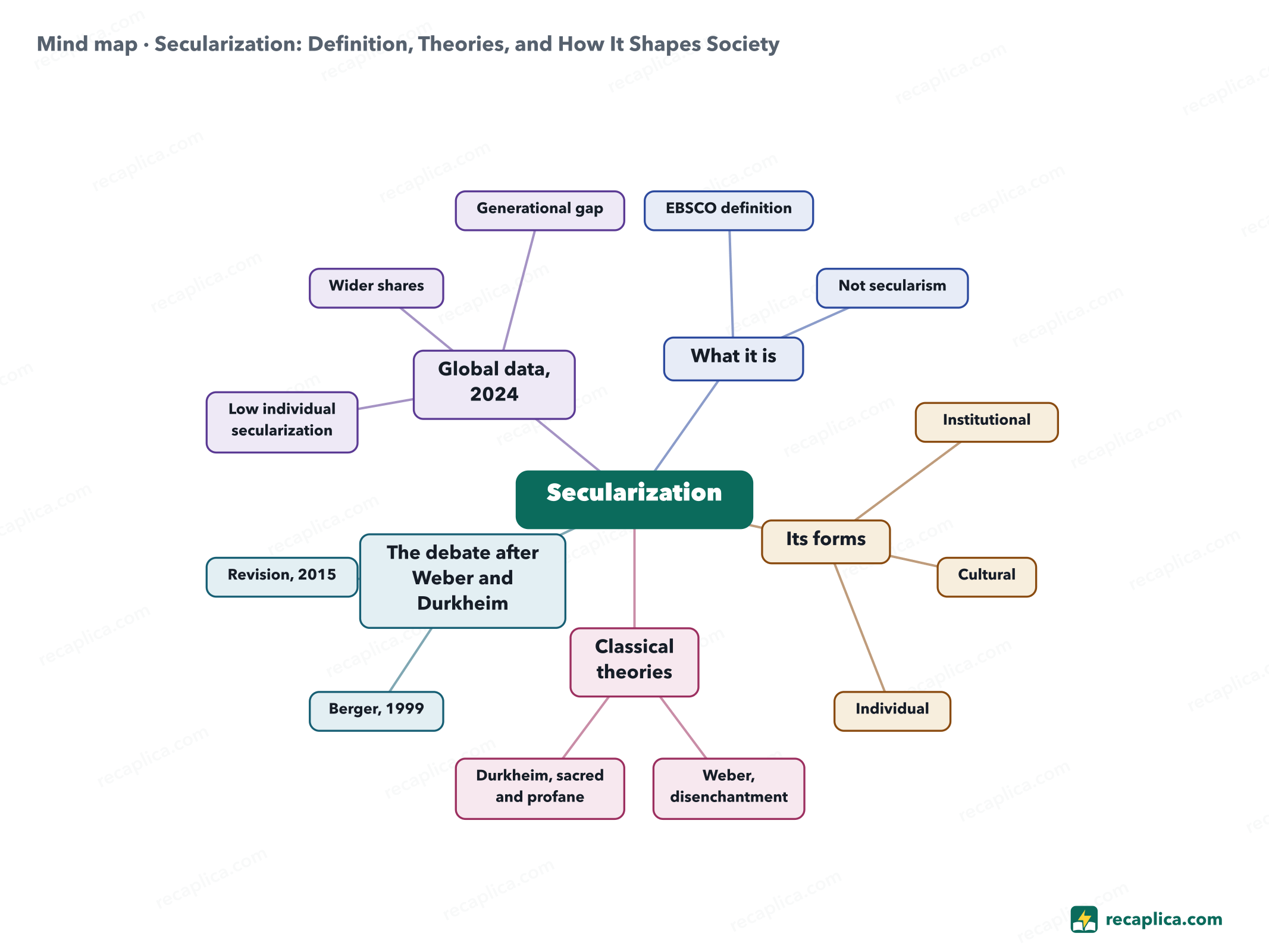
Wider sharesSouth Korea, Netherlands, United States
Generational gapWider among young adults, Spain and Colombia
Quiz: test yourself
Answer the questions to check what you have learned: you get instant feedback and a short explanation.
Grade0/100/5
Answers: 1-A · 2-A · 3-A · 4-A · 5-B
Flashcards
Tap the card to flip it and check whether you remember the answer, then move to the next one.
1 / 7
Explain it in your own words
The ultimate test: if you can explain it in simple words, you've truly understood it. Write your explanation, then compare it with the Recap.
Your explanation is saved only on this device.
Secularization is the process through which religious institutions, practices, and beliefs lose social weight, as a society leans more on reason and science, according to EBSCO Research Starters. It shows up on three different levels: institutions, a country's shared culture, and the religious choices each person makes. Max Weber described it as the disenchantment of the world, the modern rationalization that pushed religion and metaphysics outside the boundaries of legitimate knowledge; Émile Durkheim linked it, in 1912, to the split between the sacred and the profane. Pew Research Center data from 2024 show how unevenly the process plays out: in India, Israel, Nigeria, and Thailand, 95% or more of adults still belong to the religion they grew up in, while in South Korea half of adults have left theirs behind.
Frequently asked questions
What is the meaning of secularization, in simple terms?
It's the term sociologists use for the decline of religion's weight in social life, as reason and science gain ground, according to EBSCO Research Starters.
What's the difference between secularization and secularism?
The two terms point to different things. Secularization, as described by EBSCO Research Starters, is the decline of religious institutions' weight in society; secularism is a political principle, the separation between state and religion.
How is secularization studied in sociology?
Sociology reads it through classical theories such as Weber's disenchantment of the world and Durkheim's split between sacred and profane, and through survey data, such as Pew Research Center's figures on religious switching across countries.
What are some concrete examples of secularization?
EBSCO Research Starters points to two signs of secularization in American culture: prayer banned in public schools, and the lawsuits brought to remove the phrase "under God" from the Pledge of Allegiance, which still carries it.
Is secularization the same everywhere in the world?
No. Pew Research Center's 2024 data show a wide gap: in four countries (India, Israel, Nigeria, and Thailand) at least 95% of adults remain in their original religious group, against 50% of South Koreans who have moved away from theirs.
Every Recap goes through an independent review before publication.
Statistics, only if you say so
To learn which Recaps help most we would use Google Analytics, with aggregate, anonymous data. It starts only with your OK, and you can change your mind anytime. Privacy policy