|
recaplica
Legal norm: what it is and how it differs from other rules | |||||||||||||||
| © 2026 Recaplica · recaplica.com — All rights reserved | |||||||||||||||
Legal norm: what it is and how it differs from other rulesWhat to print Page numbers appear when printing with default margins. SlidesChoose a cut Flash10 slidesThe essential thread, to present in classFull14 slidesEvery chapter and the deeper detailBoth come with speaker notes. In 30 seconds quick readA legal norm is a rule of conduct that draws its binding force from a legal system, not from a social habit or a moral conviction. It is recognized by four traits, generality (it addresses anyone), abstractness (it applies to future, not yet occurred, cases), obligatoriness (it is a command even when it grants a right) and enforceability (breaking it triggers a state sanction). A social or moral norm can forbid the same conduct as a legal norm, such as stealing or killing, but breaking it draws the group's disapproval, not a state sanction. The distinction explains why not every rule that feels binding, a custom, table manners, an ethical principle, is also a legal norm. Key Points
Deep DiveNot every rule of conduct is a legal norm. According to the Enciclopedia Treccani, a norm in the general sense is a rule of behavior set by an authority or adopted through custom, meant to guide the conduct of individuals or a community. It becomes legal once it draws its binding force from a legal system, treating a behavior as a condition or a consequence of a legal relationship. Legal theory, echoed by teaching sources such as WeSchool and general-theory texts such as Diritto.it, identifies four traits that define a legal norm: generality, abstractness, obligatoriness and enforceability. Generality means the norm addresses an open class of people, not one person or a specific group, it applies to “anyone.” Abstractness is about time instead: the norm does not govern an event that already happened, but a type of conduct that can recur an unlimited number of times in the future. Obligatoriness is subtler: for the Enciclopedia Treccani a norm stays conceptually a command even when it permits something, because it authorizes with effect for everyone, it is not a mere suggestion someone can ignore. Enforceability, finally, is among the traits cited most often in textbooks precisely because it is the most visible one in practice, the possibility that the legal system uses public force to enforce the norm or to restore an order that has been broken.
Diritto.it adds another angle: every legal norm has a two-part structure, the precept, meaning the command the norm contains, and the sanction, the consequence set for breaking it. Norms can also be mandatory (they impose a command with immediate effect), prohibitive (they forbid a behavior) or permissive (they grant a right the legal system guarantees, such as moving about, entering into a contract or testifying under the conditions the law sets): a useful distinction for understanding why even a permission stays a norm rather than a plain piece of advice. Legal norm vs social normA legal norm and a social norm can forbid the same conduct, such as stealing or killing; what sets them apart is not the content of the precept, but the source they draw from and the sanction that follows a breach. A moral norm rests on a shared conviction of what is right, a social norm on a group habit or on etiquette; breaking either draws, at most, disapproval, exclusion or social discomfort, not a sanction the state imposes.
According to the Stanford Encyclopedia of Philosophy, John Austin’s command theory explained the legal norm as a credible threat of sanction from whoever holds power; the later critique, carried forward by authors such as Herbert Hart, pointed out that what actually sets a legal sanction apart from an ordinary threat is that both the people it addresses and those who operate within the system recognize it as legitimate, not merely feared. A rule of etiquette can feel binding to an entire social group, but as long as the legal system has not absorbed it, it still lacks that institutional recognition, along with the possibility of being enforced through public force. Sources beyond written statutesA legal norm need not originate from an article parliament has passed. Custom, according to the Enciclopedia Treccani, is the unwritten source of law par excellence: it forms when a behavior repeats over time within a community (the material element) and that community becomes convinced it is obligatory not just morally, but legally (the element known as opinio iuris). In Italy custom remains a limited source of law regardless: article 8 of the preliminary provisions of the civil code grants it effect only when a statute or a regulation refers to it. Written sources still sit at the center, starting with the Italian Constitution, whose higher rank conditions every legal norm below it, through the treaties and regulations that come out of the work of the European Union and bind member states’ legal systems directly. Legal norms, for that matter, do not stop at national borders: international treaties, ratified by statute in the Italian parliament, are legal norms in every sense, and negotiating and applying them day to day runs through the Ministry of Foreign Affairs and International Cooperation. How legal norms are classifiedBeyond the line between legal and social norms, legal theory also distinguishes norms by whether parties can opt out. Waivable norms apply unless the parties agree otherwise, typical of private law between people free to arrange things differently; non-waivable norms apply regardless, leaving no room for individual will, as happens with much of criminal law and with the principles set out in the Constitution. This distinction, together with the one between mandatory, prohibitive and permissive norms, explains why a legal norm can take very different forms, a tax obligation, a criminal prohibition, a contractual right, while still sharing the same four underlying traits: generality, abstractness, obligatoriness and enforceability. Slide deckSlides ready to download and make your own in PowerPoint or Google Slides, with speaker notes. Pick the Flash cut or the Full one.      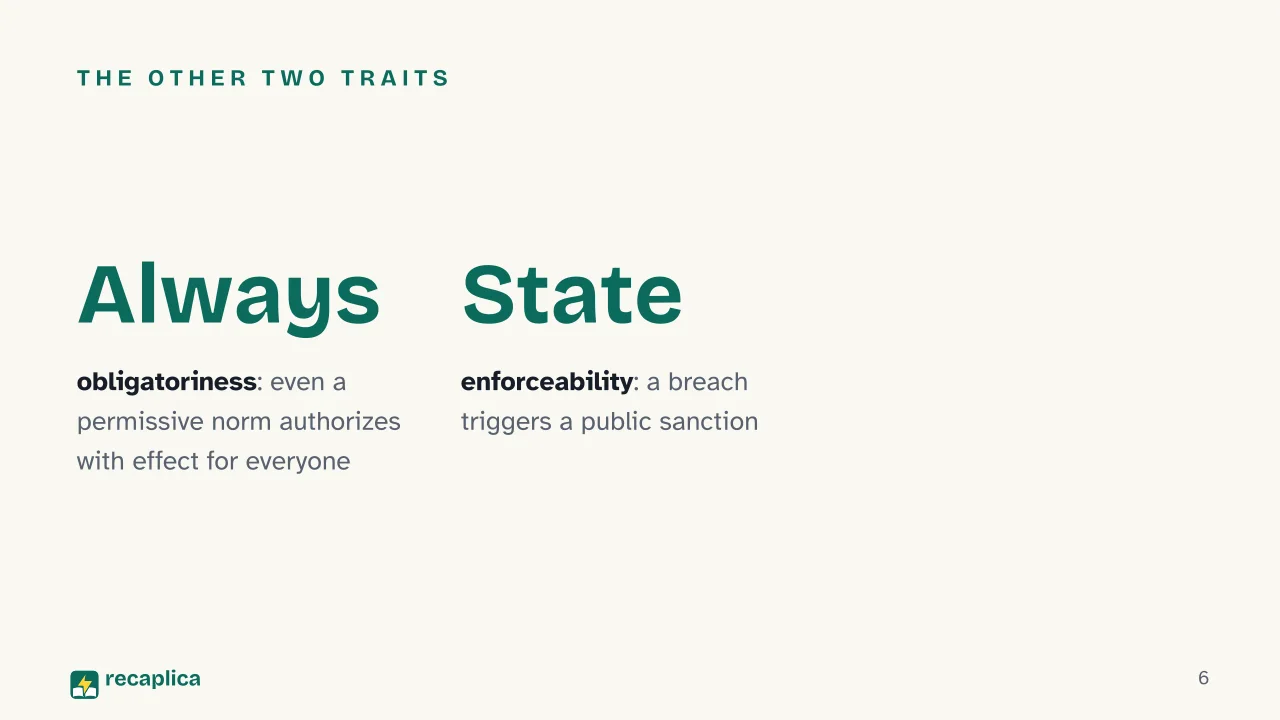  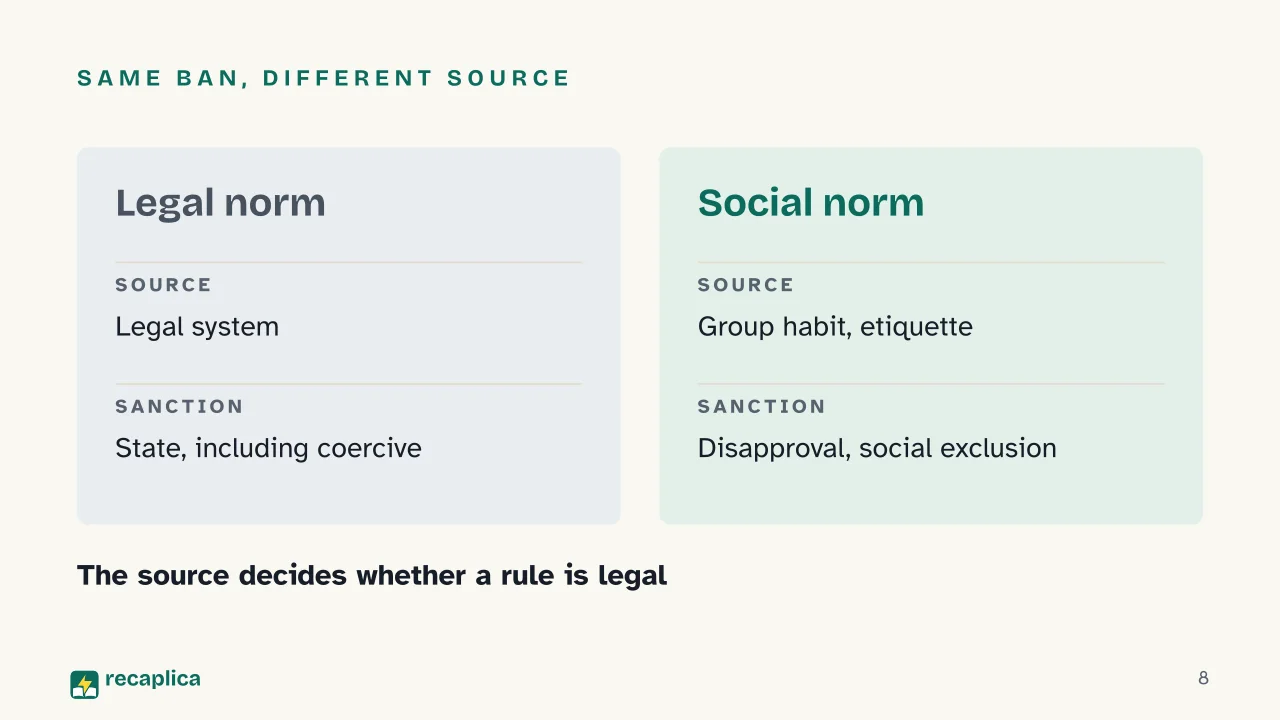  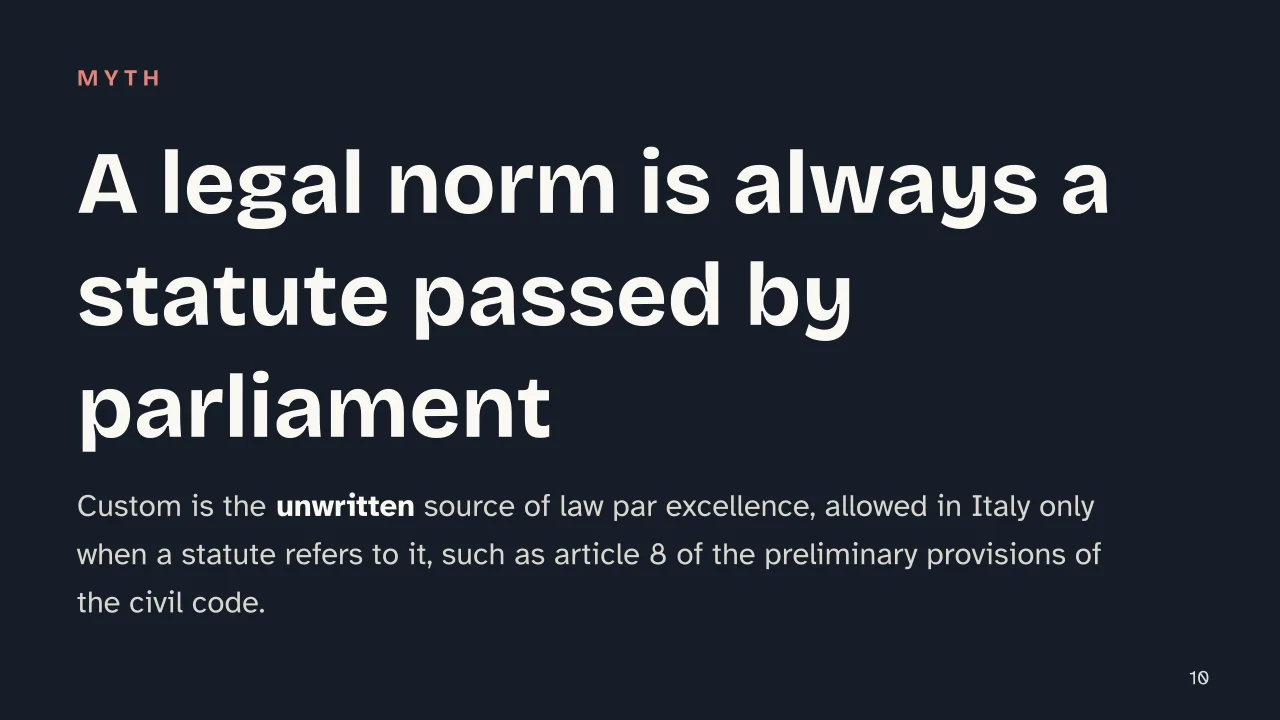  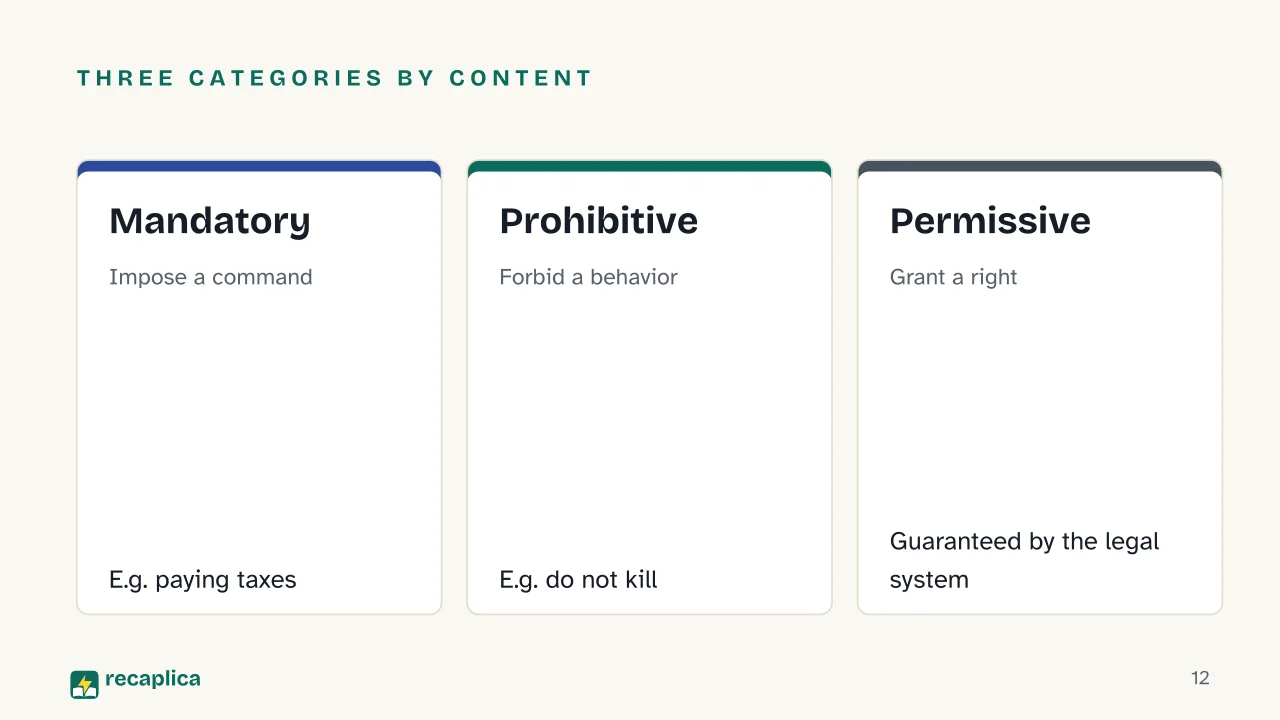   Common myths
Mind mapDrag the background to move around and the nodes to reposition them; use − and + to collapse and expand branches. 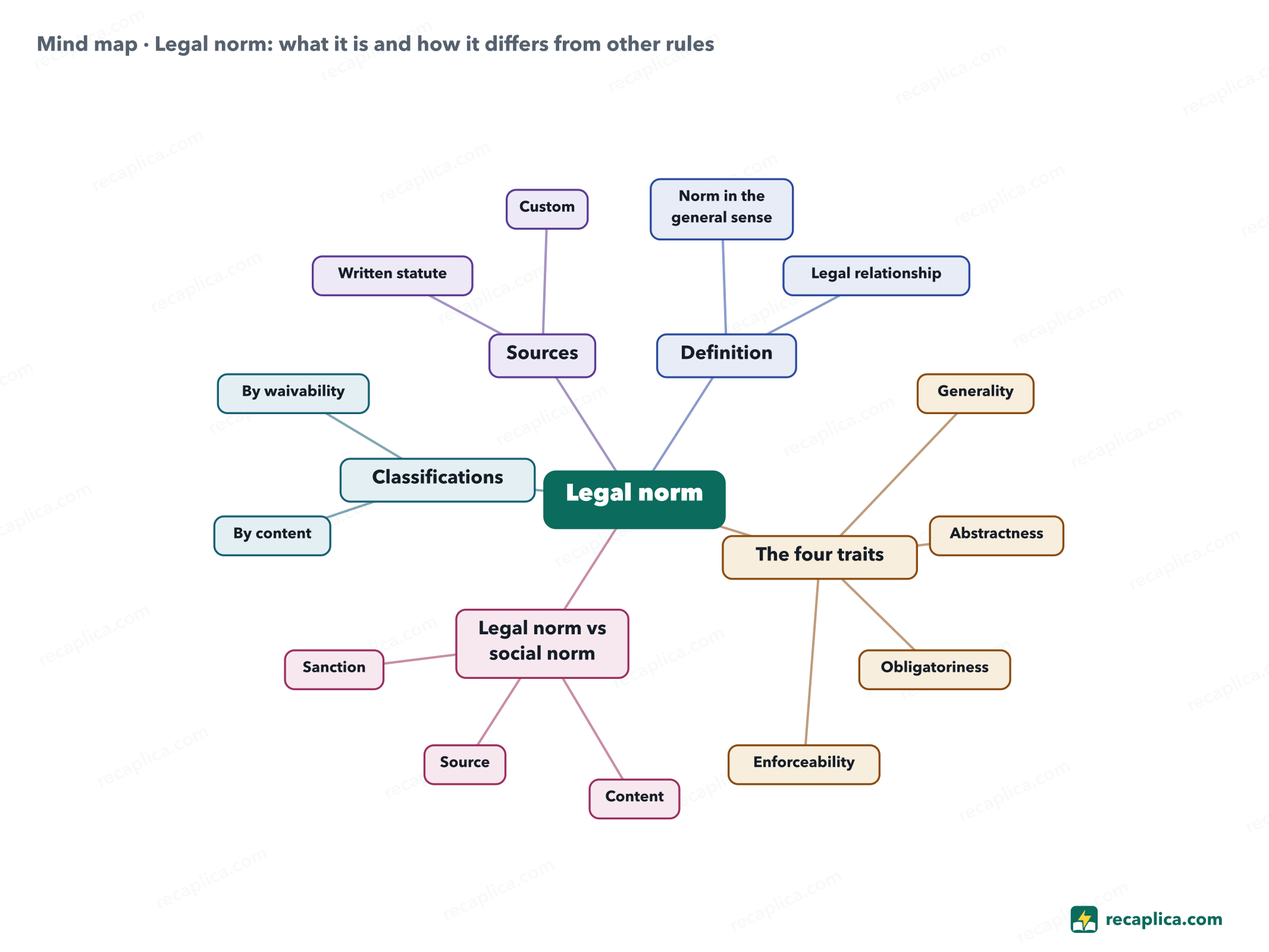
Quiz: test yourselfAnswer the questions to check what you have learned: you get instant feedback and a short explanation. Grade 0/10 0/5
FlashcardsTap the card to flip it and check whether you remember the answer, then move to the next one. 1 / 8 Explain it in your own wordsThe ultimate test: if you can explain it in simple words, you've truly understood it. Write your explanation, then compare it with the Recap. Your explanation is saved only on this device.
Frequently asked questionsWhat is a legal norm?It is a rule of conduct that draws its binding force from a legal system: it is recognized by generality, abstractness, obligatoriness and enforceability, and a state sanction follows a breach. What is the difference between a legal norm and a social norm?They can forbid the same thing, such as stealing or killing; the legal norm draws force from the legal system and carries a state sanction, the social norm rests on a group habit or a moral conviction and its breach draws disapproval, not a state sanction. Does a legal norm have to be written into a statute?No, custom is an unwritten source of law, recognized in Italy when a statute or a regulation refers to it, as article 8 of the preliminary provisions of the civil code establishes. What are the traits that define a legal norm?There are four, generality (applies to anyone), abstractness (applies to undetermined future cases), obligatoriness (it is a command regardless), and enforceability (a breach triggers a state sanction); article 575 of the Italian criminal code, on homicide, shows all four together in a single provision. How are legal norms classified by content?They fall into mandatory norms, which impose a command, prohibitive norms, which forbid a behavior, and permissive norms, which grant a right the legal system guarantees. Every Recap goes through an independent review before publication. |