Skip to content
recaplica

    One moment: security check

    Cloudflare wants to make sure you're not a robot. Tick the box below and your search will continue on its own.

    IT
    recaplica Sports Collaboration Contract in Italy: Rules, Pay and Tax
    © 2026 Recaplica · recaplica.com — All rights reserved
    Home › Civics

    Sports Collaboration Contract in Italy: Rules, Pay and Tax

    By Recaplica Newsroom · Updated on October 4, 2026

    What to print

    Page numbers appear when printing with default margins.

    Slides

    Choose a cut

    Flash10 slidesThe essential thread, to present in classFull17 slidesEvery chapter and the deeper detail

    Both come with speaker notes.

    Telegram channel
    recaplica Clear in 30 seconds, yours in 10 minutes.
    In 30 seconds Key points Figures Deep dive Slides Myths Mind map Quiz Flashcards FAQ

    In 30 seconds quick read

    Italy's sports collaboration contract is the self-employment arrangement that Legislative Decree 36/2021 set up for anyone who coaches, instructs or works for an ASD or SSD, the two legal forms an Italian amateur sports club can take. When the work is ongoing but stays under 24 hours a week, competitions aside, and follows the technical rules of a sports federation, the law treats it as a co.co.co, a coordinated and continuous collaboration; a club or worker can still show the real relationship is different. The worker signs up for INPS's Gestione separata scheme on their own, and pay above certain thresholds changes both the tax and the social security treatment. The role is separate from the administrative co.co.co that also exists inside an ASD, which does not carry the same presumption.

    Key Points

    • Decree 36/2021 lets amateur sports work be structured as self-employment, including a co.co.co, or as employee work.
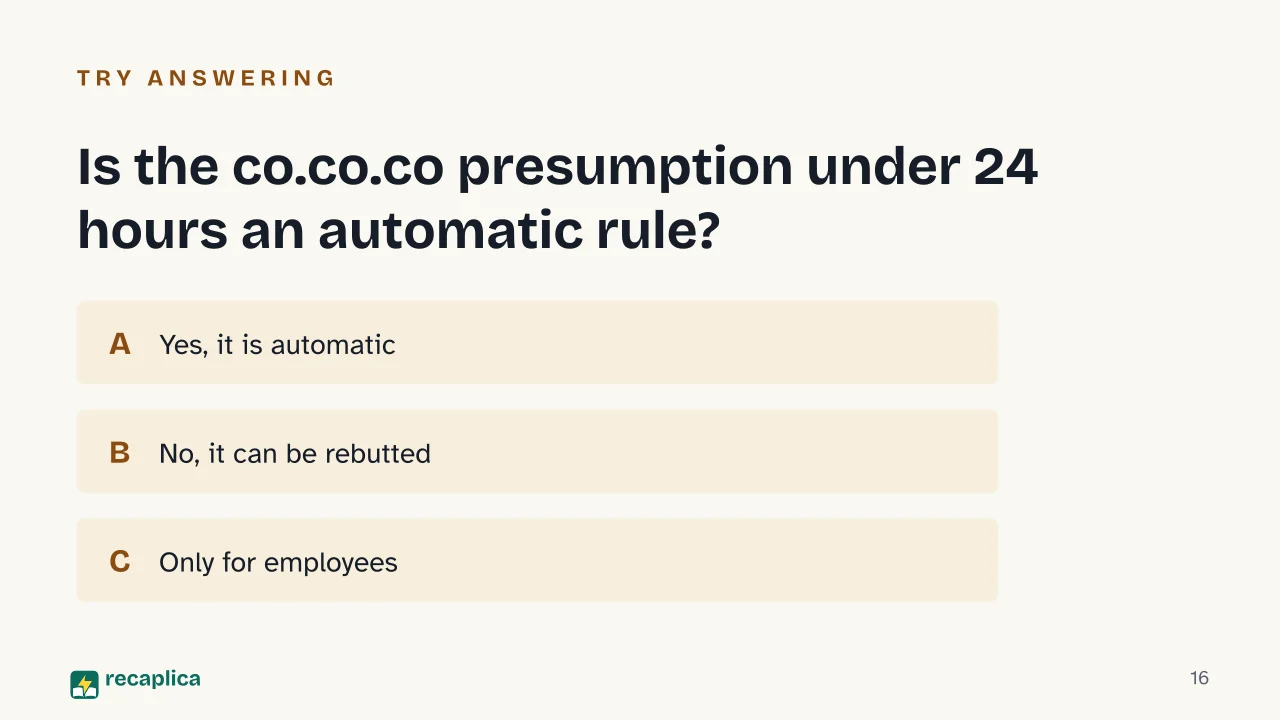
    • Below 24 hours a week of ongoing work, competitions aside, the law presumes a co.co.co, but either side can show the relationship is actually different.
    • The sports worker registers alone with INPS's Gestione separata scheme once the contract is signed.
    • In 2026 the tax-free threshold for amateur sports pay is 15,000 euros a year, and it applies no matter which contract type is used.
    • Social security contributions start above 5,000 euros a year, adding up pay from every club someone works for in that year.
    • An ASD's administrative co.co.co is a different role from the technical sports worker and falls under Article 37 of the decree, outside the 24-hour presumption.

    Key figures

    • 15,000 euros Tax-free threshold for amateur sports pay in 2026, regardless of contract type. Source: Agenzia delle Entrate, Circular 7/E of 2026
    • 5,000 euros Yearly pay threshold above which social security contributions apply, adding up pay from every ASD/SSD in the same year. Source: INPS, Circular no. 88 of 2023
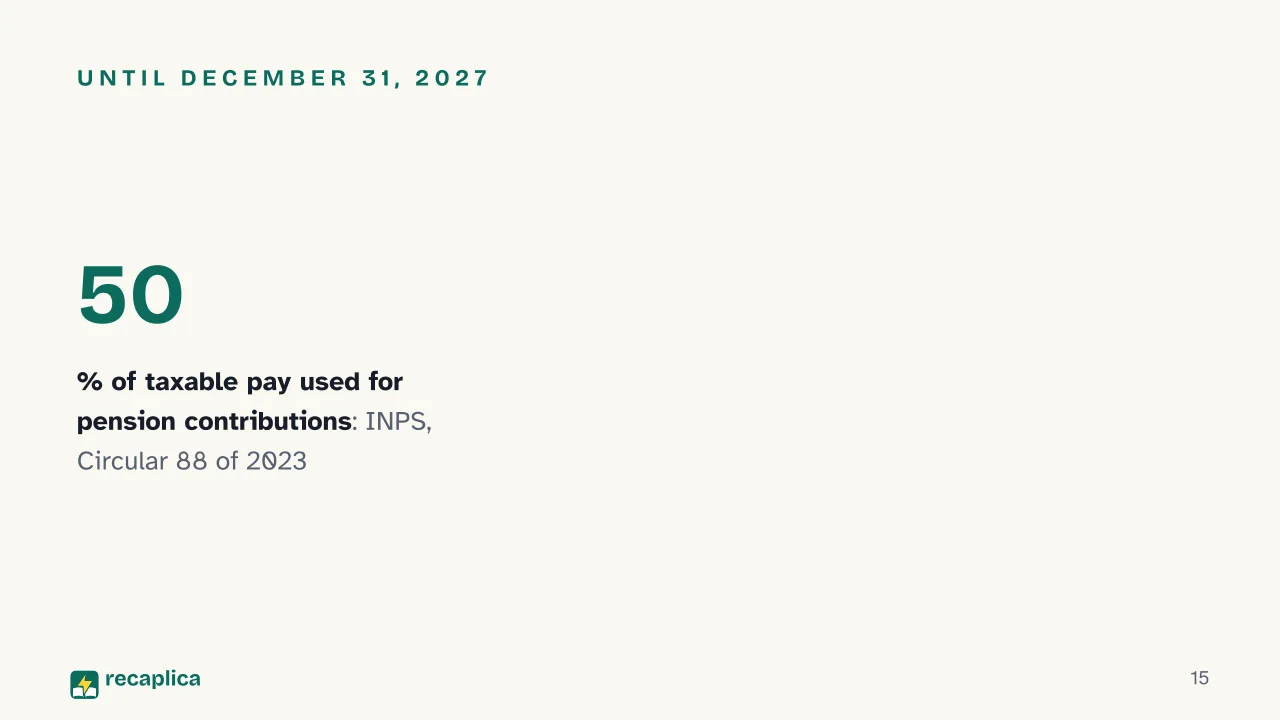
    • until December 31, 2027 Window in which pension contributions are calculated on half the taxable pay, which lowers the future pension built on that share. Source: INPS, Circular no. 88 of 2023

    Deep Dive

    Decree 36/2021 reorganized sports work in Italy, giving amateur sports clubs — ASDs and SSDs, the two legal forms they take — a tool built for anyone who coaches, instructs or referees: the sports collaboration contract. One thing needs to be clear before going further: this is not a single contract type but a framework that can turn into either self-employment or employee status, depending on how the relationship actually works.

    Requirements of the sports co.co.co

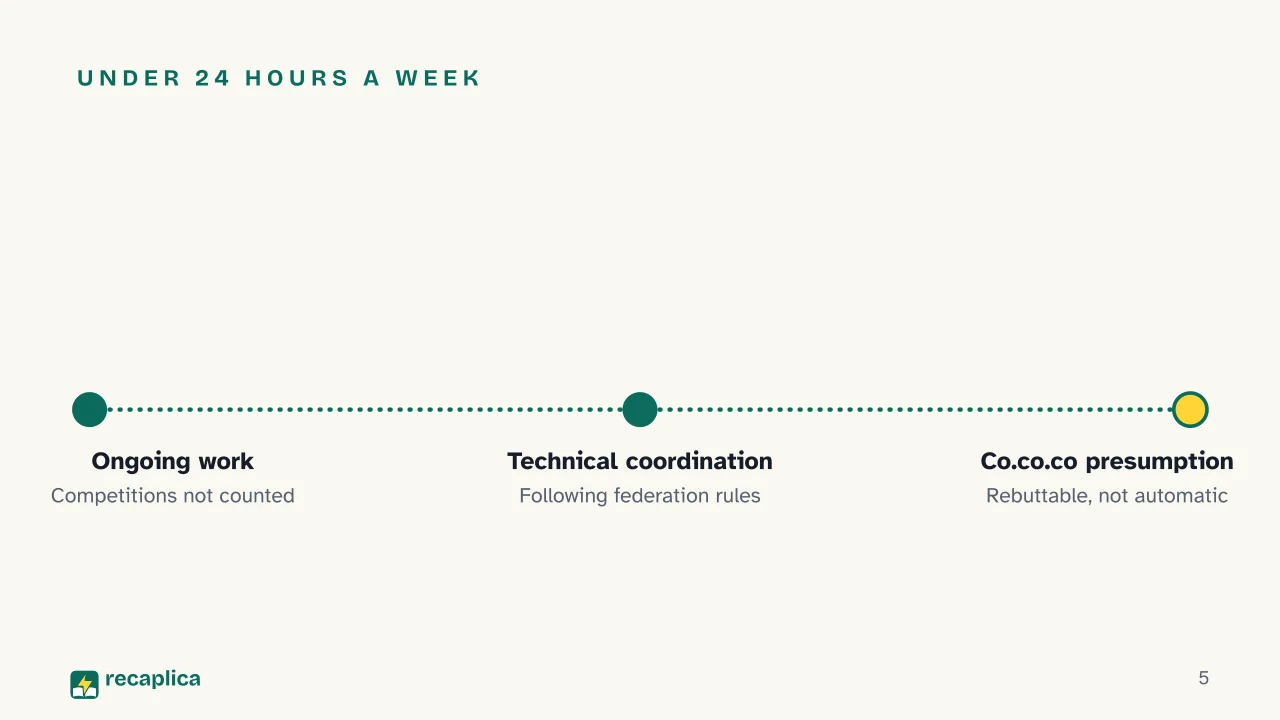
    Decree 36/2021 presumes a contract is a co.co.co when three conditions line up: the work keeps going week after week, it stays under 24 hours once competition time is set aside, and it follows directions issued by a sports federation. That presumption can be rebutted. A club or a worker able to show that the real arrangement works differently — for example, duties carried out on a fixed schedule set by someone else — is free to prove it.

    Practical example: a swimming instructor who coaches 12 hours a week at an SSD, following the federation’s technical program, falls within the co.co.co presumption. If she instead worked 30 hours a week on a fixed schedule set by the club, the presumption would not apply and the relationship would need to be assessed on its own facts.

    A sports worker on a co.co.co has no fixed schedule: they can choose when to train or coach, while still coordinating technically under their federation’s rules. That is one of the traits separating this arrangement from employee status, where the employer sets the hours.

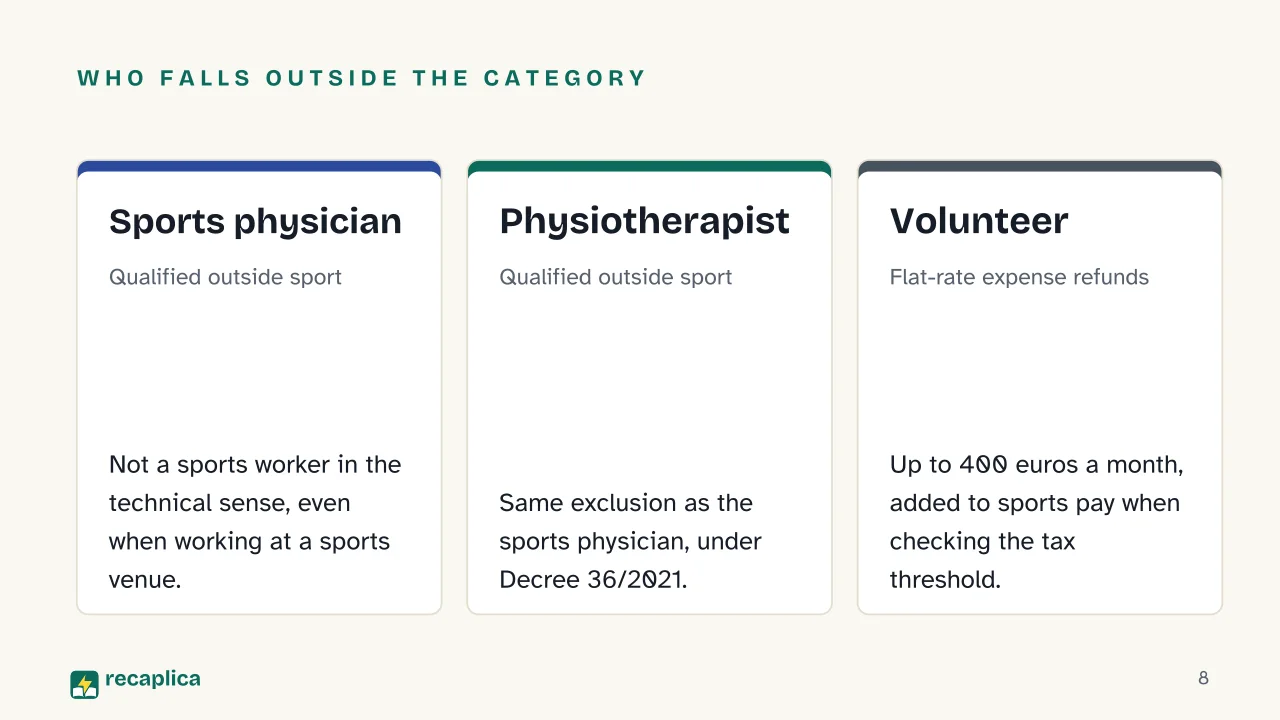
    Not everyone working in a sports setting falls into this category. Doctors, physiotherapists and other professionals qualified outside sport are excluded, even when they work for an ASD during training sessions or competitions: their professional qualification comes from a field that has nothing to do with sport.

    The relationship, and how it differs from a generic co.co.co

    The sports collaboration contract shares its legal basis, Article 409 of the civil procedure code, with the generic co.co.co, but the two are not the same thing: the sports version carries its own thresholds — the 24 hours, the 15,000-euro tax limit, the 5,000-euro contribution limit — that an ordinary co.co.co does not have. Someone working for an ASD on technical sports duties follows the rules in this Recap; someone collaborating with any other organization on different duties follows the general rules instead.

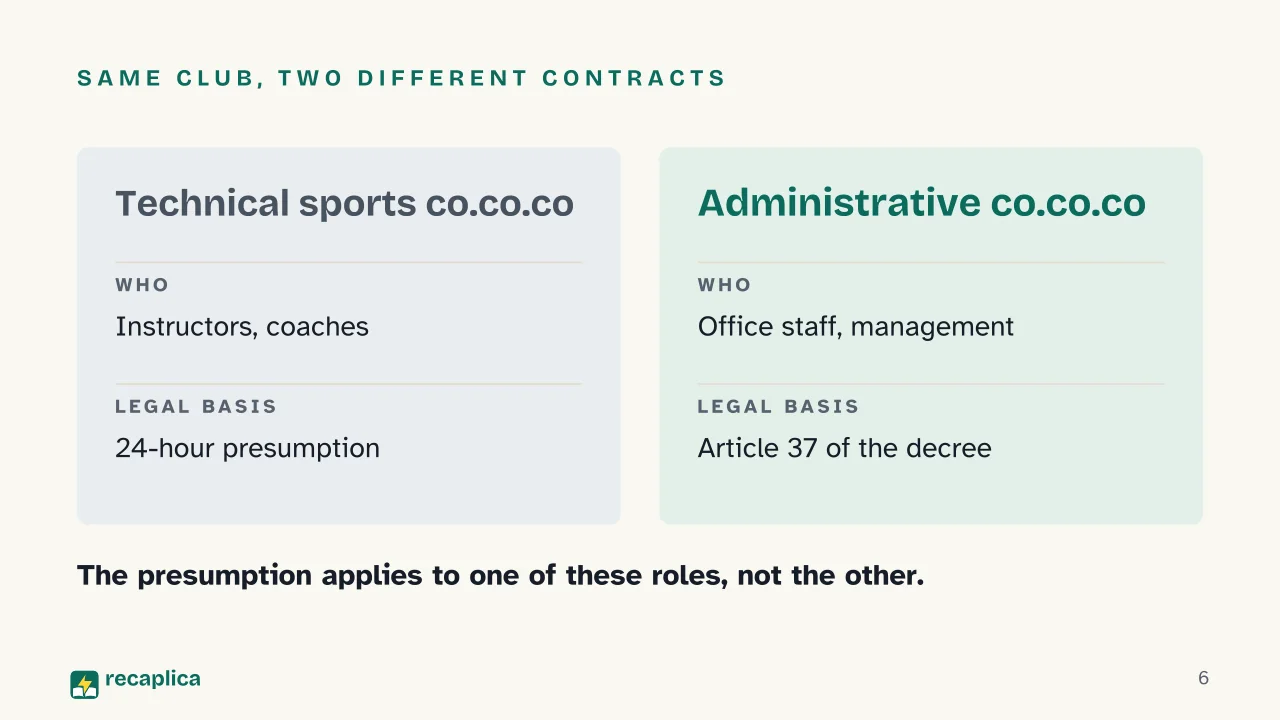
    Within a single ASD, though, different roles that look alike can easily get mixed up. The administrative co.co.co — someone running the office or the accounts, for instance — has its own legal basis in Article 37 of Decree 36/2021 and does not get the 24-hour presumption of self-employment, which is reserved for the technical sports worker. Two people at the same club can end up under two different classifications even if their contracts look similar on paper.

    Pay, tax and the INPS Gestione separata

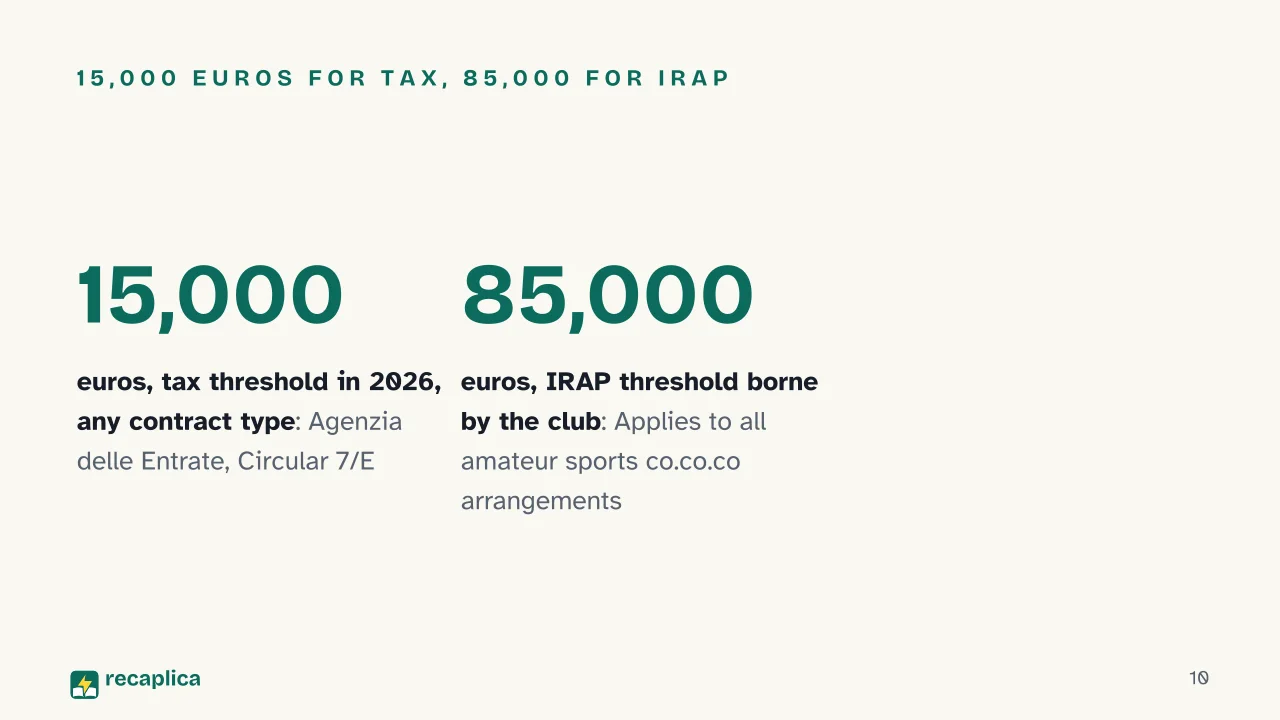
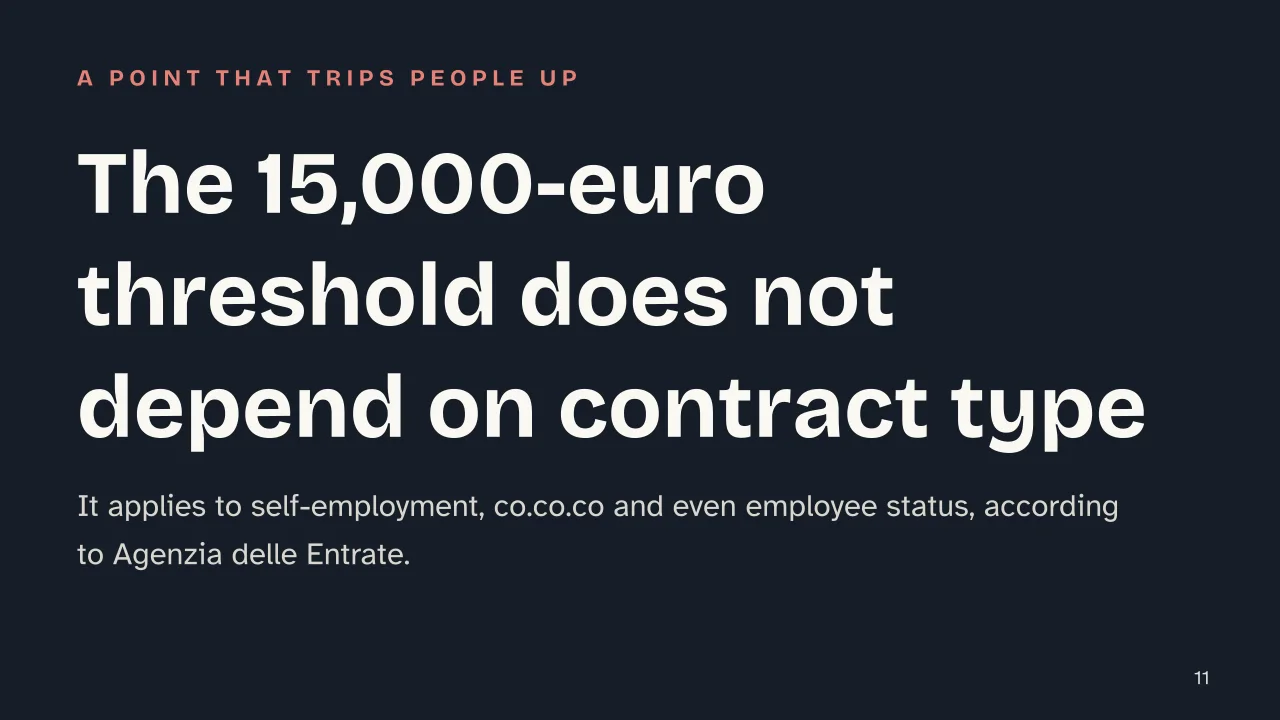
    Under Circular 7/E of 2026 from Agenzia delle Entrate, amateur sports pay stays tax-free up to 15,000 euros in 2026, and that limit covers self-employed work, a co.co.co or even employee status alike. What decides the threshold is the pay received that year, whatever contract covers it. Above that level, ordinary tax rules for employee income take over.

    ThresholdAmountWhat changesSource
    Tax15,000 euros/yearTax-free, for any contract typeAgenzia delle Entrate, 2026
    Contributions5,000 euros/yearSocial security obligation startsINPS, 2023
    IRAP (borne by the club)85,000 euros/yearExcluded from the taxable baseAgenzia delle Entrate, 2026

    Volunteers are a different role from the co.co.co sports worker, and their flat-rate expense refunds of up to 400 euros a month still count toward the 15,000-euro threshold alongside sports pay, even though that money is formally a refund.

    Once the contract is signed, a co.co.co sports worker has to register personally with INPS’s Gestione separata scheme through the institute’s online portal, according to the Ministry of Labour’s FAQ, last updated March 19, 2024. Below 15,000 euros a year in pay, a traditional payslip is not required: obligations can instead run through the national register of amateur sports activities, known as RASD. Above that threshold, ordinary payroll procedures apply.

    Social security contributions

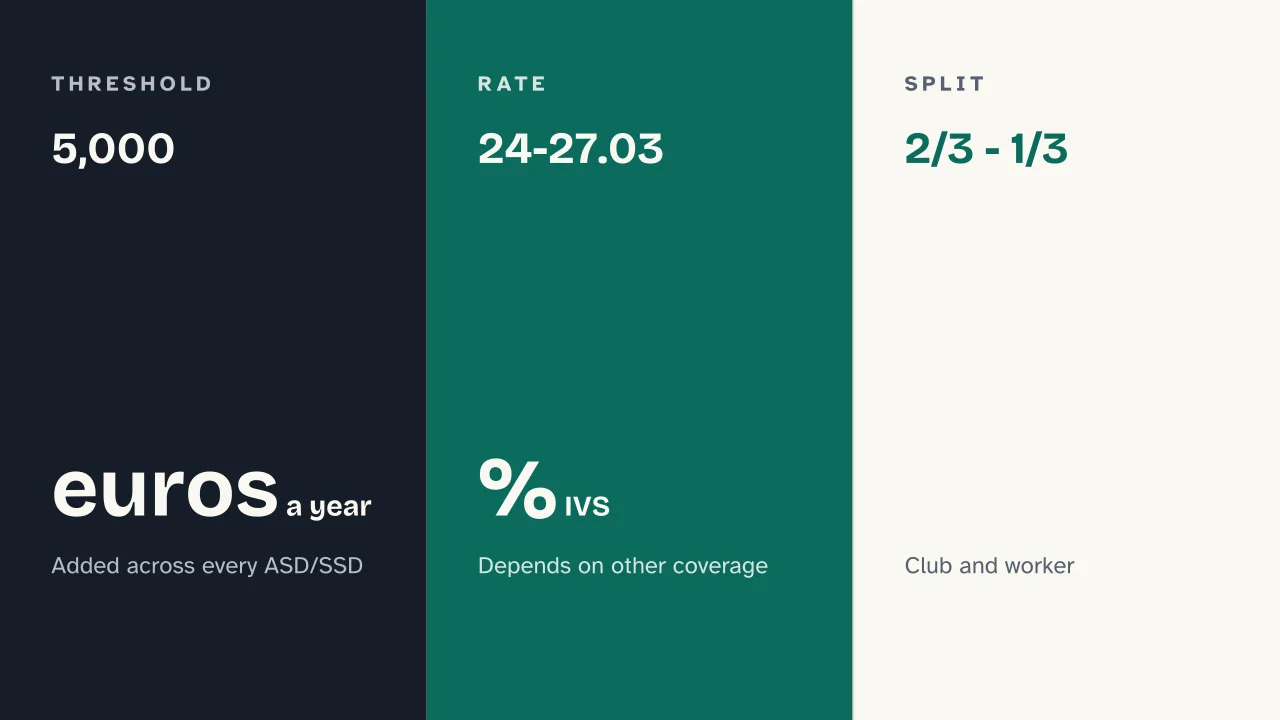
    Social security contributions apply only to the share of pay above 5,000 euros a year — a deductible allowance, not a cliff that makes the whole amount taxable once crossed — under INPS Circular no. 88 of 2023. That threshold is calculated by adding up pay received from every ASD and SSD the worker collaborates with in the same year. Someone working for three different clubs adds up all three amounts before checking whether the limit has been crossed.

    Practical example: a coach who earns 3,000 euros from one ASD and 2,500 euros from another in the same year goes over the 5,000-euro combined limit, even though neither amount on its own reaches that figure: contributions apply only to the 500 euros above the threshold, not to the full 5,500 euros.

    The IVS contribution rate is 24% for a worker who already has other pension coverage, or 25% plus 2.03% for maternity, sickness and DIS-COLL cover (27.03% total) for one who does not. Two-thirds of the contribution is paid by the ASD or SSD, one-third by the sports worker. Someone already covered by mandatory pension insurance elsewhere, or already retired, still pays the 24% IVS contribution; the welfare portion is not required in that case.

    A transitional relief applies until December 31, 2027: pension contributions are calculated on only half the taxable pay. That choice carries forward, too — anyone who relies on this period ends up with a smaller pension slice for those years, since fewer contributions went in.

    Roles that are not the sports collaboration contract

    Two situations are often mistaken for the amateur sports collaboration contract, but follow different rules. Someone employed at a private gym or a commercial sports facility is not a sports collaborator at an ASD or SSD: their classification follows the gym and sports facility collective agreement, the sector’s collective agreement, which covers employees at venues that are often run on a different, for-profit basis. Likewise, a sports sponsorship agreement is not an employment contract: it governs a commercial relationship between a sponsor and a club or athlete, built on marketing logic that has nothing to do with a VAT registration or the INPS Gestione separata scheme described above.

    The third sector also crosses paths with ASDs often, but it is a classification of the organization itself, separate from the contract of the people who work there.

    Slide deck

    Slides ready to download and make your own in PowerPoint or Google Slides, with speaker notes. Pick the Flash cut or the Full one.
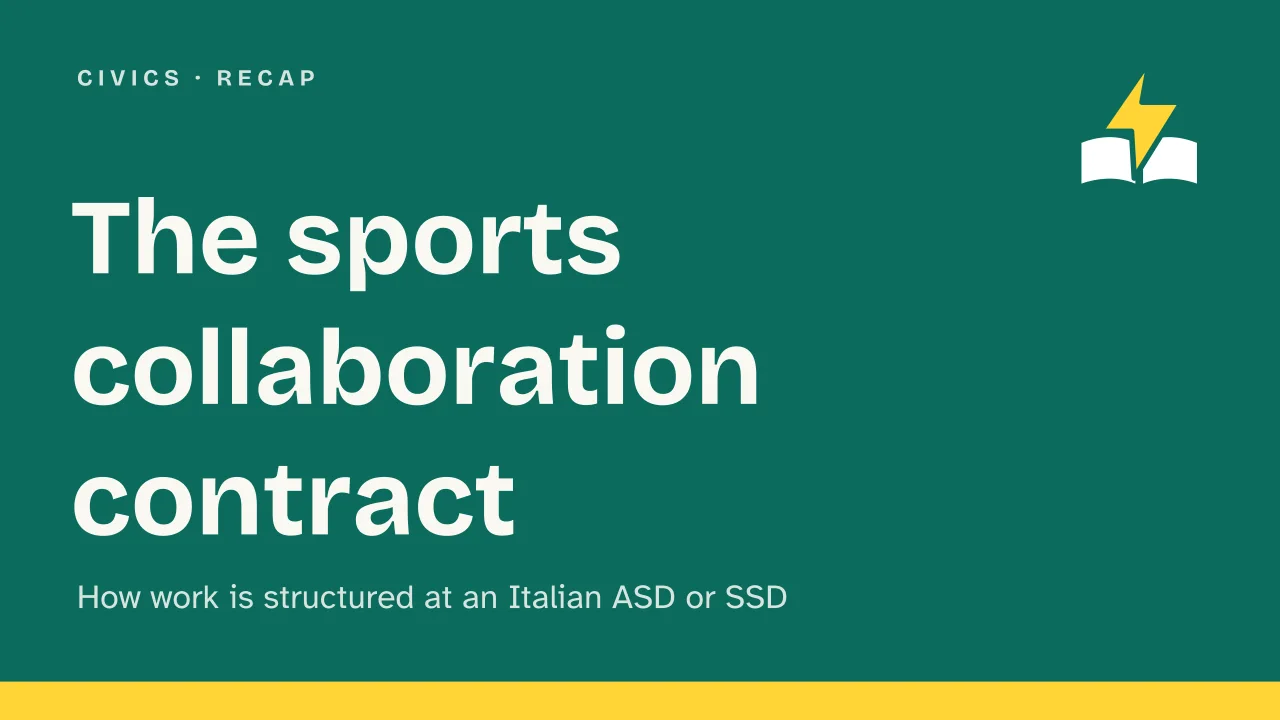
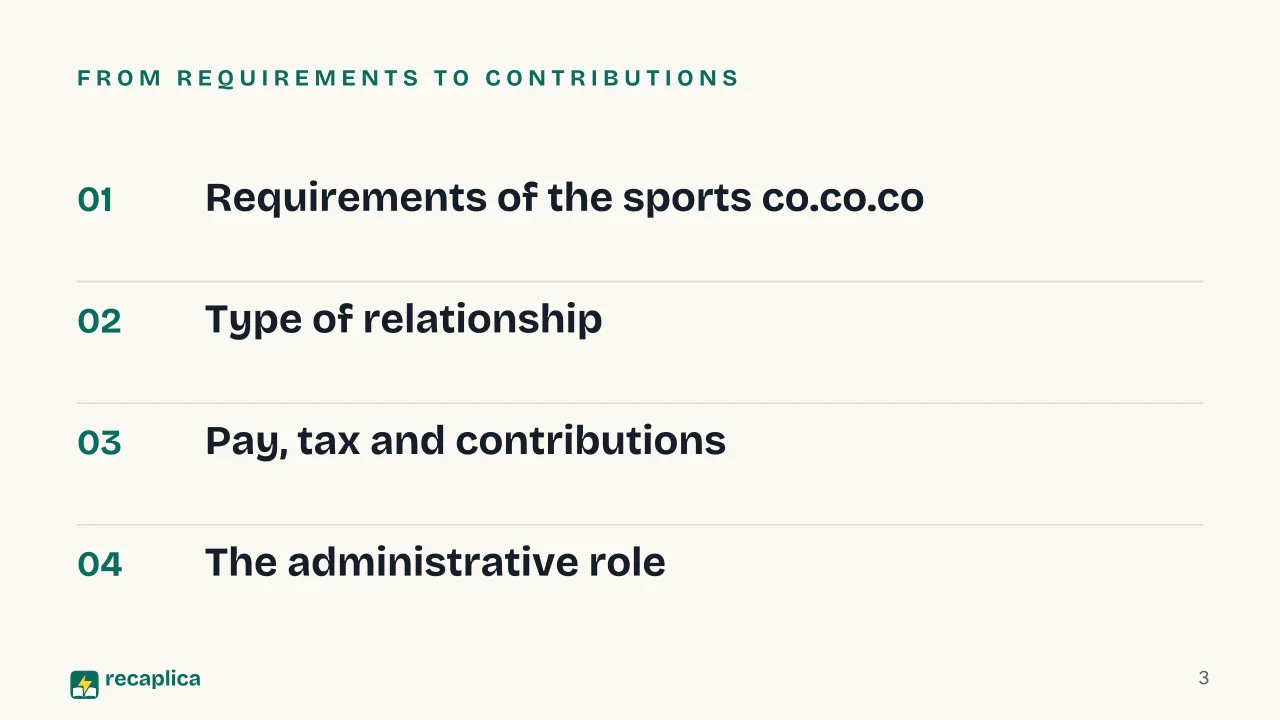
    Slide 1 of the presentation on Sports Collaboration Contract in Italy: The sports collaboration contractSlide 2 of the presentation on Sports Collaboration Contract in Italy: Is an ASD coach self-employed or employed?Slide 3 of the presentation on Sports Collaboration Contract in Italy: From requirements to contributionsSlide 4 of the presentation on Sports Collaboration Contract in Italy: Chapter 01: The requirementsSlide 5 of the presentation on Sports Collaboration Contract in Italy: Under 24 hours a weekSlide 6 of the presentation on Sports Collaboration Contract in Italy: Same club, two different contractsSlide 7 of the presentation on Sports Collaboration Contract in Italy: Chapter 02: The type of relationshipSlide 8 of the presentation on Sports Collaboration Contract in Italy: Who falls outside the category: Sports physician, Physiotherapist, VolunteerSlide 9 of the presentation on Sports Collaboration Contract in Italy: Chapter 03: Pay and taxSlide 10 of the presentation on Sports Collaboration Contract in Italy: 15,000 euros for tax, 85,000 for IRAPSlide 11 of the presentation on Sports Collaboration Contract in Italy: The 15,000-euro threshold does not depend on contract typeSlide 12 of the presentation on Sports Collaboration Contract in Italy: Chapter 04: The contributionsSlide 13 of the presentation on Sports Collaboration Contract in Italy: 5,000 · 24-27.03 · 2/3 - 1/3Slide 14 of the presentation on Sports Collaboration Contract in Italy: Chapter 05: The transitional reliefSlide 15 of the presentation on Sports Collaboration Contract in Italy: Until December 31, 2027Slide 16 of the presentation on Sports Collaboration Contract in Italy: Is the co.co.co presumption under 24 hours an automatic rule?Slide 17 of the presentation on Sports Collaboration Contract in Italy: Next up, the generic co.co.co
    Flash10 slidesThe essential thread, to present in classFull17 slidesEvery chapter and the deeper detail

    Common myths

    • ✗ Myth A sports worker at an ASD never pays social security contributions.

      ✓ Reality INPS requires contributions once yearly pay crosses 5,000 euros, totaling what someone earns across every club in that year. Someone already covered by another pension scheme, or already retired, still pays the 24% IVS contribution; only the welfare portion is waived.

    • ✗ Myth Anyone who works for an ASD is automatically self-employed.

      ✓ Reality Decree 36/2021 also allows employee status. The co.co.co presumption follows a 24-hour weekly threshold: going over it, or producing contrary evidence, takes the relationship out of that presumption.

    • ✗ Myth A club secretary and a sports instructor sign the same kind of contract.

      ✓ Reality Decree 36/2021 keeps the technical sports worker separate from the administrative co.co.co, which has its own legal basis in Article 37 of the decree. Only the first role carries the 24-hour presumption.

    Mind map

    Drag the background to move around and the nodes to reposition them; use − and + to collapse and expand branches.
    Customize
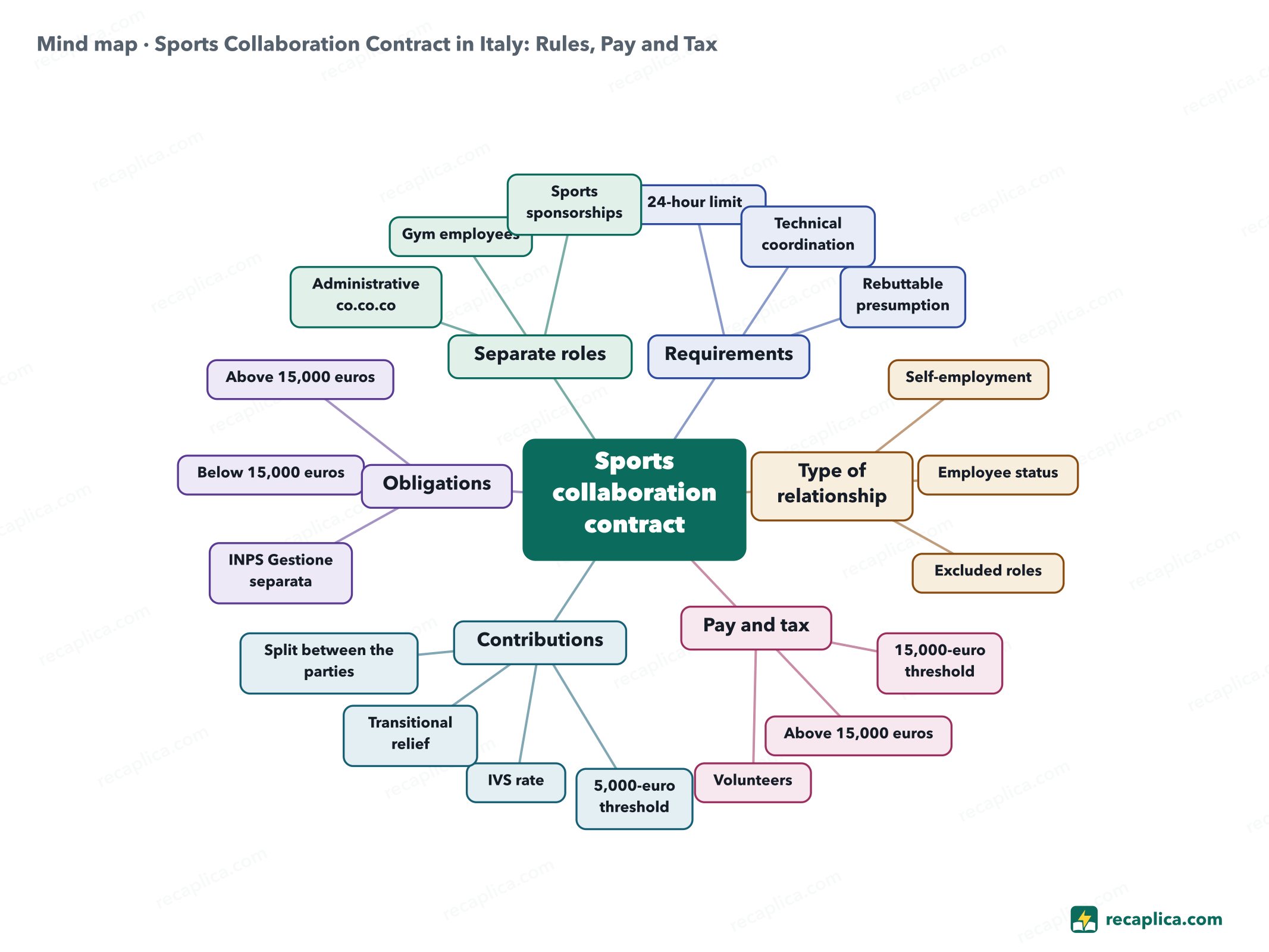
    Mind map: Sports Collaboration Contract in Italy: Rules, Pay and Tax
    • Sports collaboration contract
      • Requirements
        • 24-hour limit Ongoing weekly commitment, competitions not counted
        • Technical coordination Following the rules of a sports federation
        • Rebuttable presumption Can be overturned with contrary evidence
      • Type of relationship
        • Self-employment Co.co.co form, worker sets their own schedule
        • Employee status The other option under Decree 36/2021
        • Excluded roles Doctors and physiotherapists qualified outside sport
      • Pay and tax
        • 15,000-euro threshold Tax-free in 2026, for any contract type
        • Above 15,000 euros Ordinary tax rules for employee income
        • Volunteers Flat-rate expense refunds up to 400 euros a month count toward the threshold
      • Contributions
        • 5,000-euro threshold Sum of pay from every ASD and SSD in the same year
        • IVS rate 24% with other coverage, 27.03% without
        • Transitional relief Half the taxable pay until 2027
        • Split between the parties Two-thirds from the club, one-third from the worker
      • Obligations
        • INPS Gestione separata Personal registration once the contract is signed
        • Below 15,000 euros Obligations can run through the RASD national register
        • Above 15,000 euros Ordinary payroll procedures
      • Separate roles
        • Administrative co.co.co Article 37 of the decree, no 24-hour presumption
        • Gym employees A different contract, the sports facilities collective agreement
        • Sports sponsorships Commercial marketing agreements

    Quiz: test yourself

    Answer the questions to check what you have learned: you get instant feedback and a short explanation.

    Grade 0/10 0/5
    1 Which type of relationship can amateur sports work take under Decree 36/2021?

    Decree 36/2021 allows both paths, and the self-employed one can take the co.co.co form set out in Article 409 of the Italian civil procedure code.

    2 Below how many weekly hours does the law presume an amateur sports contract is a co.co.co?

    The threshold is 24 hours a week of ongoing work, net of competitions: above it the presumption drops away, and even below it the presumption can still be rebutted.

    3 Is the co.co.co presumption tied to the 24-hour threshold always true, with no exceptions?

    It is a rebuttable presumption: anyone who can show the relationship is actually something else, such as disguised employee status, is free to prove it.

    4 In 2026, does the 15,000-euro tax threshold for amateur sports pay apply only to a co.co.co?

    Circular 7/E of 2026 states that the tax-free threshold covers any amateur sports contract type, self-employed, co.co.co or employee, without distinguishing by relationship type.

    5 What sets an ASD's administrative co.co.co apart from the technical sports worker?

    The administrative co.co.co, for example someone running the office, follows Article 37 of the decree: the 24-hour presumption stays reserved for the technical sports worker.

    Answers: 1-C · 2-C · 3-B · 4-B · 5-B

    Flashcards

    Tap the card to flip it and check whether you remember the answer, then move to the next one.

    1 / 8

    Explain it in your own words

    The ultimate test: if you can explain it in simple words, you've truly understood it. Write your explanation, then compare it with the Recap.

    Your explanation is saved only on this device.

    Italy's sports collaboration contract is the self-employment arrangement that Legislative Decree 36/2021 set up for anyone who coaches, instructs or works for an ASD or SSD, the two legal forms an Italian amateur sports club can take. When the work is ongoing but stays under 24 hours a week, competitions aside, and follows the technical rules of a sports federation, the law treats it as a co.co.co, a coordinated and continuous collaboration; a club or worker can still show the real relationship is different. The worker signs up for INPS's Gestione separata scheme on their own, and pay above certain thresholds changes both the tax and the social security treatment. The role is separate from the administrative co.co.co that also exists inside an ASD, which does not carry the same presumption.

    Frequently asked questions

    How does a sports contract work for someone at an ASD?

    Decree 36/2021 leaves two paths open: employee status, or self-employment, which most often takes the form of a co.co.co. When that work stays under 24 weekly hours, net of competition time, a co.co.co is presumed, though the presumption can still be rebutted.

    Does a sports contract always involve social security contributions?

    No: the contribution requirement only applies above 5,000 euros a year, adding up pay from every ASD and SSD worked for in the same year. Below that threshold INPS does not require contributions.

    What is the difference between a sports co.co.co and a generic co.co.co?

    A generic co.co.co, governed by Article 409 of the civil procedure code, lacks the specific thresholds of amateur sports work. The technical sports co.co.co, set out in Decree 36/2021, has the 24-hour threshold tied to the self-employment presumption, the 15,000-euro tax threshold and the 5,000-euro contribution threshold, plus its own IVS rate.

    Do an instructor and a secretary at the same ASD have the same contract?

    No: the instructor, as a technical sports worker, can rely on the co.co.co presumption tied to the 24-hour threshold. The secretary, as an administrative co.co.co, has a separate legal basis in Article 37 of the decree and does not get that presumption.

    Does the sports collaboration contract also apply to someone working at a private gym?

    No, unless the gym is itself an ASD or SSD: employees of commercial gyms and sports facilities fall under a different arrangement, the sector's collective agreement, separate from the amateur sports collaboration covered here.

    Sources

    • Legislative Decree 36 of February 28, 2021 - Reorganization of rules on professional and amateur sports bodies and sports work (consolidated text)
    • Italian Ministry of Labour and Social Policies / Department for Sport - FAQ on sports work (March 19, 2024)
    • Agenzia delle Entrate - Circular no. 7/E of August 7, 2026
    • INPS - Circular no. 88 of October 31, 2023

    Every Recap goes through an independent review before publication.

    Every evening, the day's new Recaps on our Telegram channel. Join the channel →

    Keep learning

    • Civics Gym and Sports Facility Collective Agreement in Italy: Who It Covers Italy's national collective agreement for gyms and sports facilities, known as the CCNL Impianti Sportivi e Palestre, sets the employment rules for people hired as staff at gyms, fitness clubs and sports centers. It does not cover people working under Italy's separate sports worker status, created by Legislative Decree 36/2021. The version in force was signed on January 12, 2024, and runs through December 31, 2026. That same renewal also set pay rules for amateur sports collaborators, while the agreement itself remains one for employees. Read the Recap →
    • History The History of Football Rules: From 1863 to VAR Football as we know it began in London in 1863, when twelve clubs founded the Football Association and wrote down the first shared set of rules. From there the game changed piece by piece: goalkeepers were formalized, the crossbar arrived, offside was relaxed step by step, and the penalty kick grew out of two disputed incidents in Scotland and England. Cards and VAR are even more recent inventions, created to solve problems that had shown up on the pitch. IFAB, the body that has decided the rules since 1886, brings together the British football associations and FIFA. Read the Recap →
    • History Table Tennis Rules: How Ping Pong Works, from the Table to Scoring Table tennis, known worldwide as ping pong, started out as a parlour game in Victorian England in the 1880s, when the upper class played it after dinner with whatever was lying around. The name "Ping-Pong" arrived in 1901, when the games company Jaques of London trademarked it, inspired by the sound the ball made against paddle and table. The official rules, set out by the International Table Tennis Federation in its 2025 statutes, define the table's size, the net's height, the ball's specifications and the scoring system, where a game is won at 11 points. The sport only made it to the Olympics in 1988, in Seoul, decades after becoming a Paralympic event in 1960. Along the way, the ball itself changed twice, first in size and then in material, for reasons of both play and safety. Read the Recap →

    recaplica

    Clear in 30 seconds, yours in 10 minutes.

    Recaps Mind maps Request a Recap Telegram channel Mind map maker Our method About Privacy & cookies Legal notes & terms of use

    © 2026 Recaplica · A project by Curi S.r.l. — VAT IT05472000750

    Statistics, only if you say so

    To learn which Recaps help most we would use Google Analytics, with aggregate, anonymous data. It starts only with your OK, and you can change your mind anytime. Privacy policy