|
recaplica
Who Invented Television? The Baird-Farnsworth Timeline | |||||||||||||||
| © 2026 Recaplica · recaplica.com — All rights reserved | |||||||||||||||
Who Invented Television? The Baird-Farnsworth TimelineWhat to print Page numbers appear when printing with default margins. SlidesChoose a cut Flash10 slidesThe essential thread, to present in classFull16 slidesEvery chapter and the deeper detailBoth come with speaker notes. In 30 seconds quick readTelevision does not have a single inventor: it grew out of two separate paths that ran side by side for years. On January 26, 1926, the Scottish engineer John Logie Baird showed a mechanical system in London that broke images apart with a spinning, perforated disc. Around the same years, in the United States, Philo Farnsworth and Vladimir Zworykin were each building a fully electronic television. The BBC put both technologies to the test in its first regular broadcast service and dropped the mechanical one in 1937: that decision set the standard television would run on for decades. Key Points
Key figures
Deep DiveThe Origin of Television: Baird’s Mechanical DiscOn January 26, 1926, in a London laboratory, John Logie Baird showed a group of Royal Institution members something that until then had only existed on paper: moving pictures sent across a distance. His system was entirely mechanical. A spinning perforated disc, known as the Nipkow disc after the German engineer who had patented the idea decades earlier, broke the live picture into 30 lines and pieced it back together on the other end. Over the next two years Baird pushed his system well beyond the lab. Between May 24 and May 27, 1927, he sent television pictures over phone lines from London to Glasgow, a distance of 438 miles. On February 8, 1928, came an even bigger leap: a television broadcast that crossed the Atlantic. These were technical trials, not yet a public service, but they were enough to show the idea held up outside a single room.
The Electronic Path: Farnsworth and ZworykinWhile Baird worked in London, two inventors in the United States were chasing a different idea: replace every moving part with an electronic tube instead. The first was Philo Taylor Farnsworth, who filed a patent application in 1927 for the image dissector, a tube built to capture pictures with no discs and no moving parts; the patent was granted in 1930. The second was Vladimir Zworykin, who worked for RCA on a rival tube, the iconoscope, with direct backing from RCA president David Sarnoff. One source credits Zworykin with building an early iconoscope as far back as 1924, before he even joined RCA in 1929. No other source confirms that date. The two electronic tubes were soon locked in a dispute that ended up in court. RCA, through Zworykin’s work, challenged Farnsworth’s patent claims; Farnsworth, in turn, accused Zworykin of having built RCA’s new patent partly on information gathered during a visit to his lab. The US Patent Office ruled in Farnsworth’s favor in 1934, granting him priority of invention over the image dissector; RCA appealed and lost in 1936. The dispute only closed in September 1939, when RCA agreed to a multi-year licensing deal on Farnsworth’s patent worth $1 million. It was a win on paper, but it landed after the industry had already built its commercial broadcasts around RCA’s system: the deal never shifted the market standard, which stayed Zworykin’s iconoscope.
The BBC Steps In: The Choice of 1937On November 2, 1936, the BBC launched its first regular high-definition television service from Alexandra Palace, covering the London area. For a few months, rather than choosing right away, the BBC alternated Baird’s mechanical system with the electronic Marconi-EMI system, built around the Emitron tube, week by week; the same Marconi-EMI consortium also had a deal with Farnsworth to use his image dissector, but ruled it inferior to the Emitron because it needed far more studio light. The head-to-head trial did not last long. On February 6, 1937, the Television Advisory Committee recommended dropping Baird’s system; the Marconi-EMI Emitron stood alone and became the foundation of British television for decades. The committee based its choice on practical performance, comparing the two broadcasts week after week. The Beginning of Television’s Mass Audience: From First Sales to the WarThe technical verdict was in. Commercial success was another matter. On May 12, 1937, the day of King George VI’s coronation, the first major outside broadcast in electronic television pushed the number of TV sets sold in the London area to 9,000. These were small numbers, concentrated in a single city: at this stage television stayed an object for the few, while radio had already found its way into millions of homes. Growth then stopped abruptly. By September 1, 1939, when the British service was suspended at the start of the Second World War, Britain is estimated to have had around 20,000 TV sets. That same year, on the other side of the Atlantic, Zworykin and RCA’s electronic system was unveiled to the public at the New York World’s Fair: just as British television went dark for the war, American television was only then reaching a wide audience. Readers who want to follow how these technologies later merged with computing and networks can continue with the history of computers and the history of the internet, two inventions that would run on screens born from these same early experiments. The legal fight between Farnsworth and RCA is also a textbook case in intellectual property: winning a patent lawsuit is not, on its own, enough to guarantee commercial success, as would happen again decades later in the history of Apple and Steve Jobs. Slide deckSlides ready to download and make your own in PowerPoint or Google Slides, with speaker notes. Pick the Flash cut or the Full one.   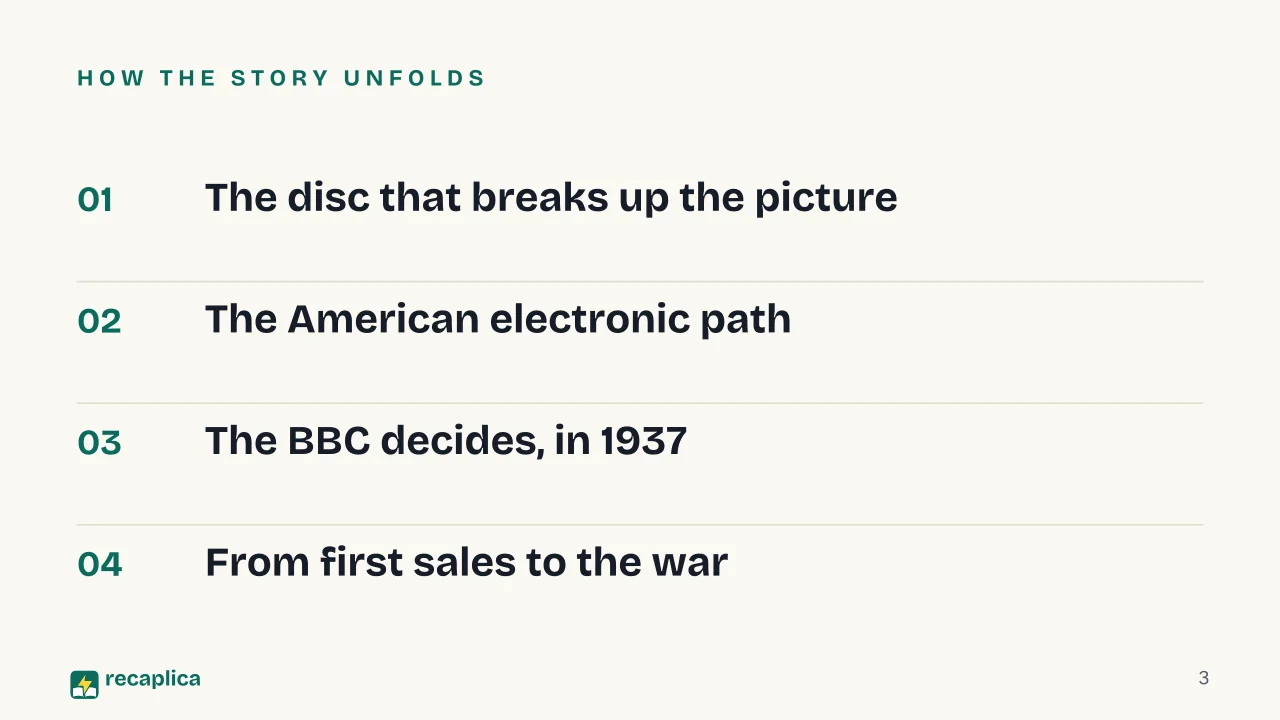   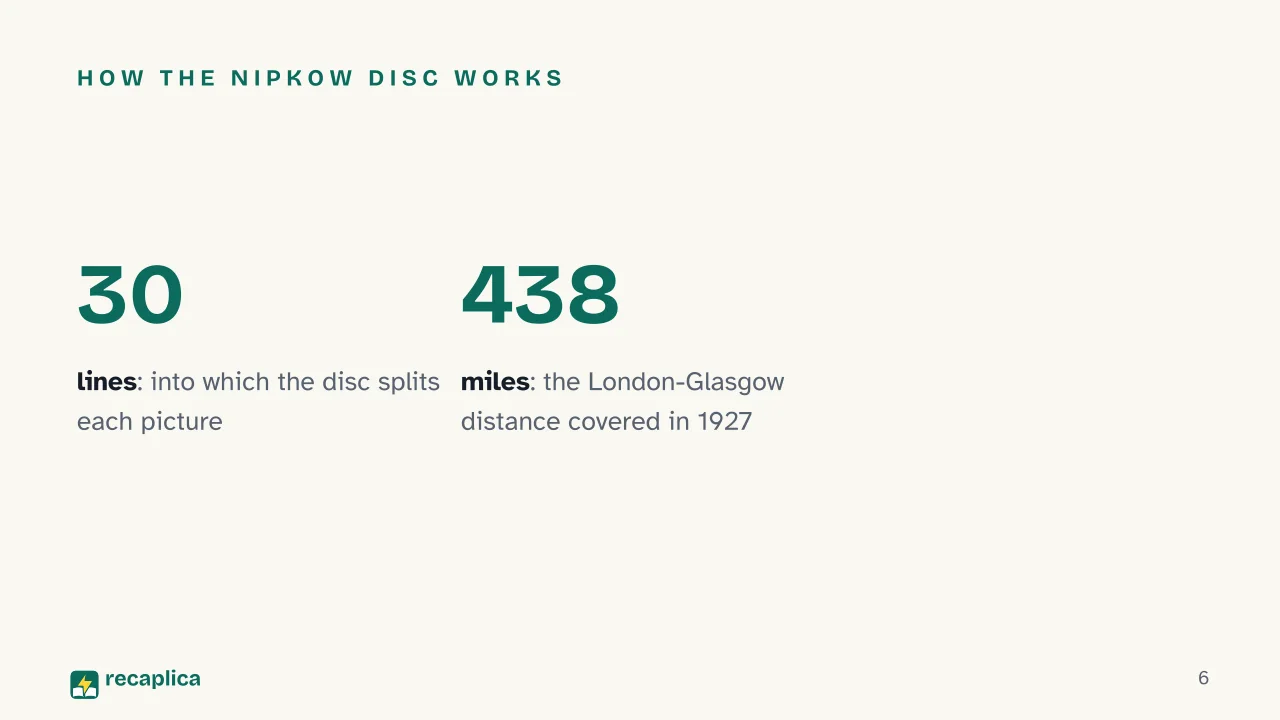  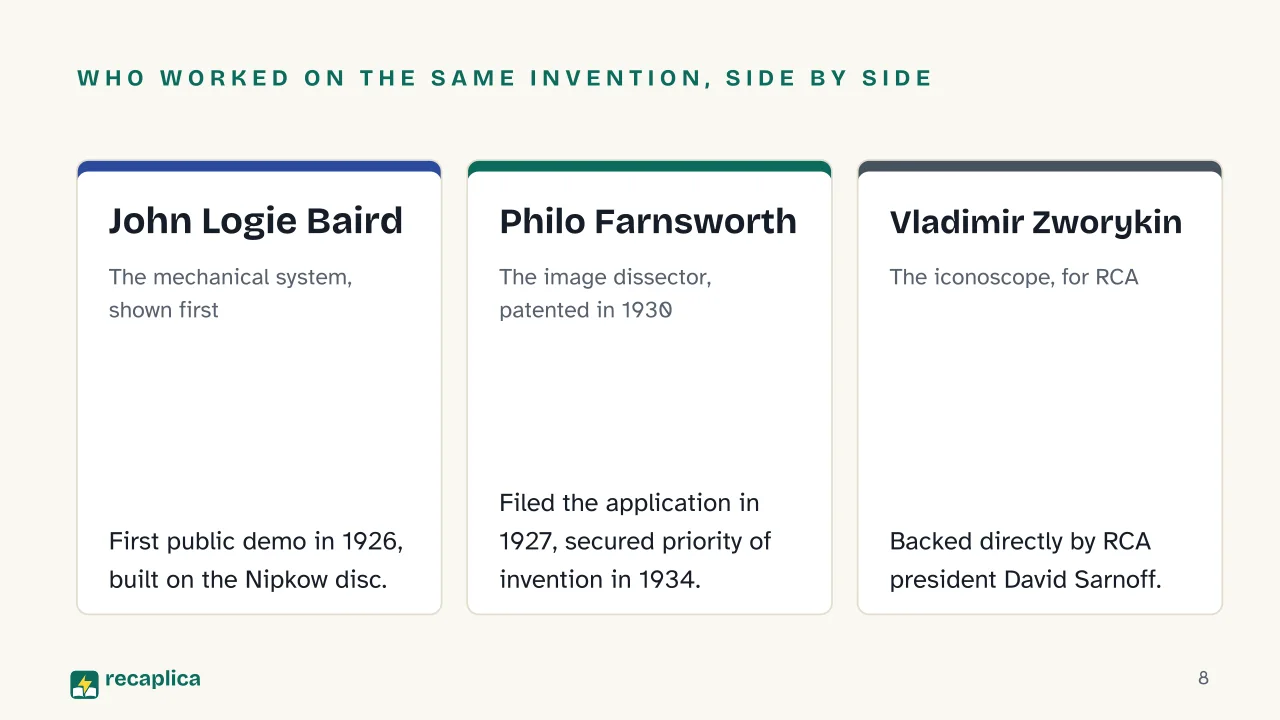 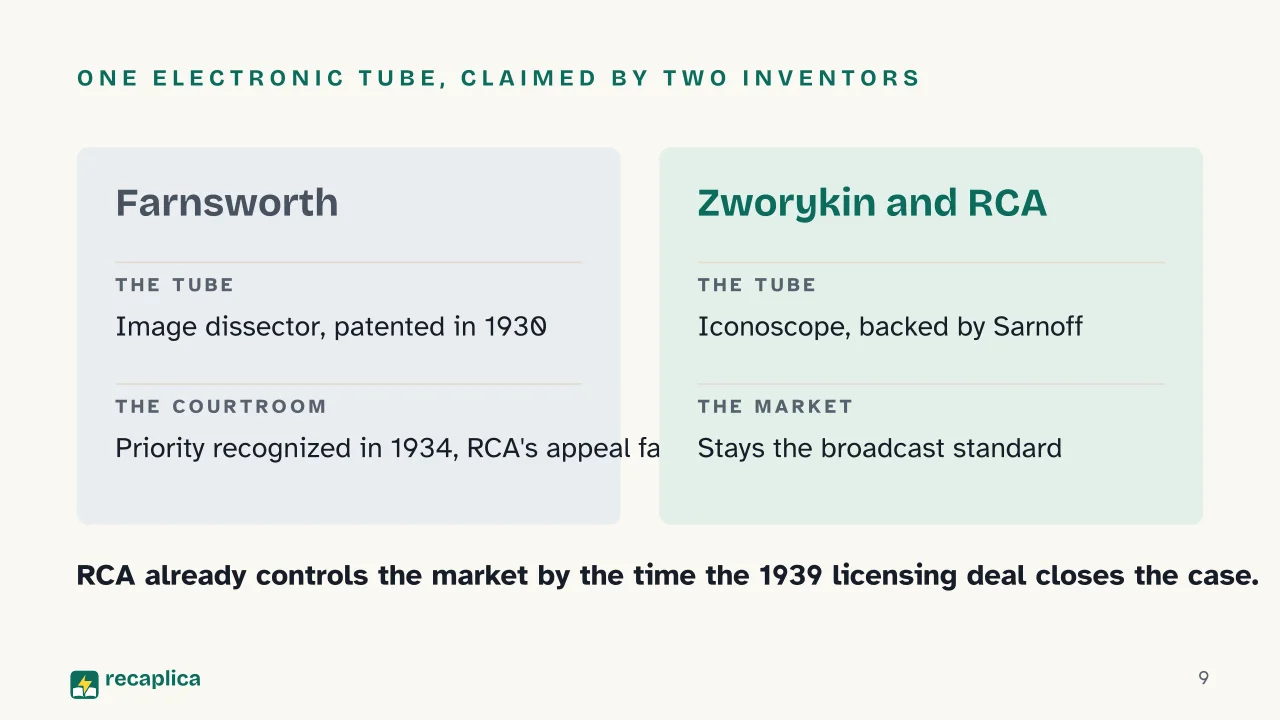  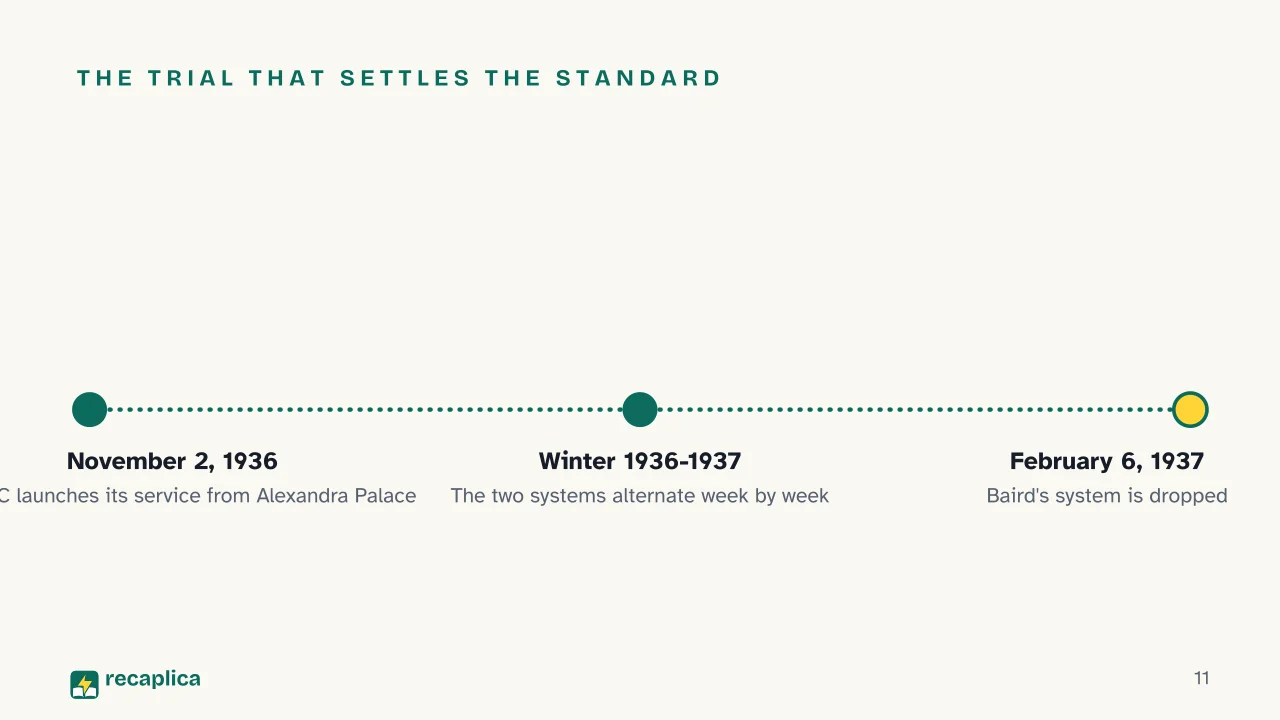 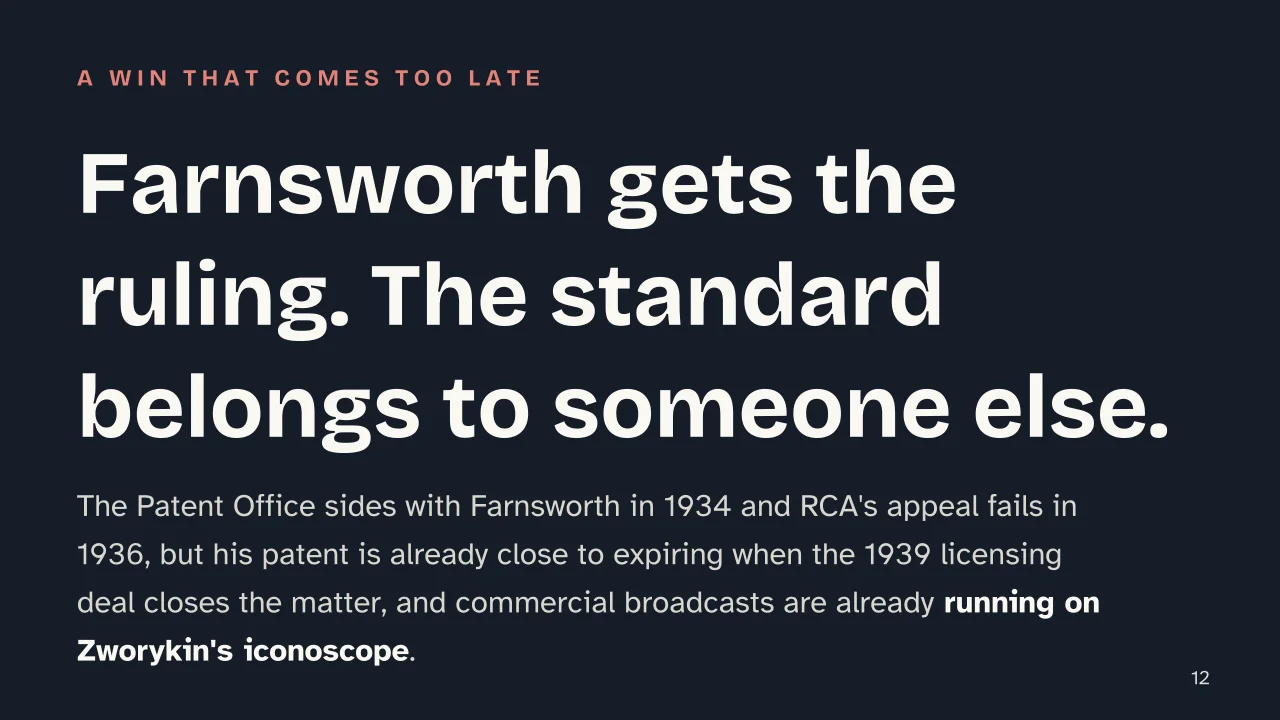  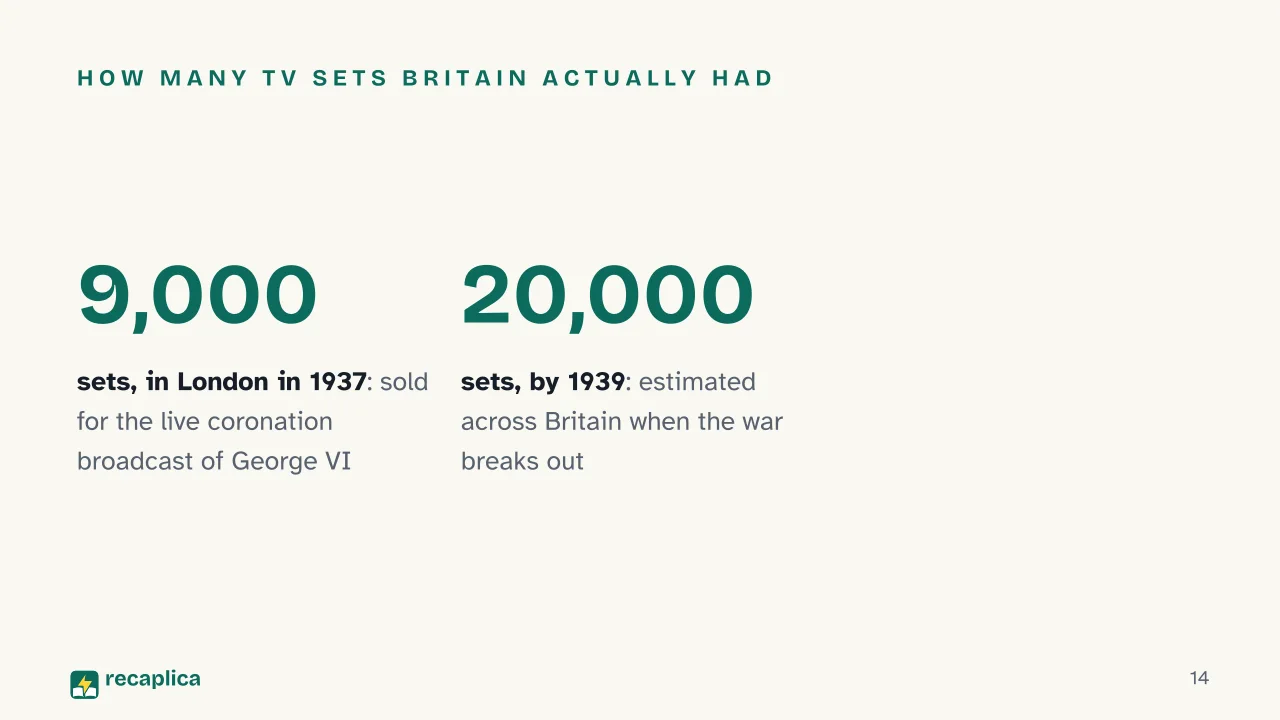   Common myths
Mind mapDrag the background to move around and the nodes to reposition them; use − and + to collapse and expand branches. 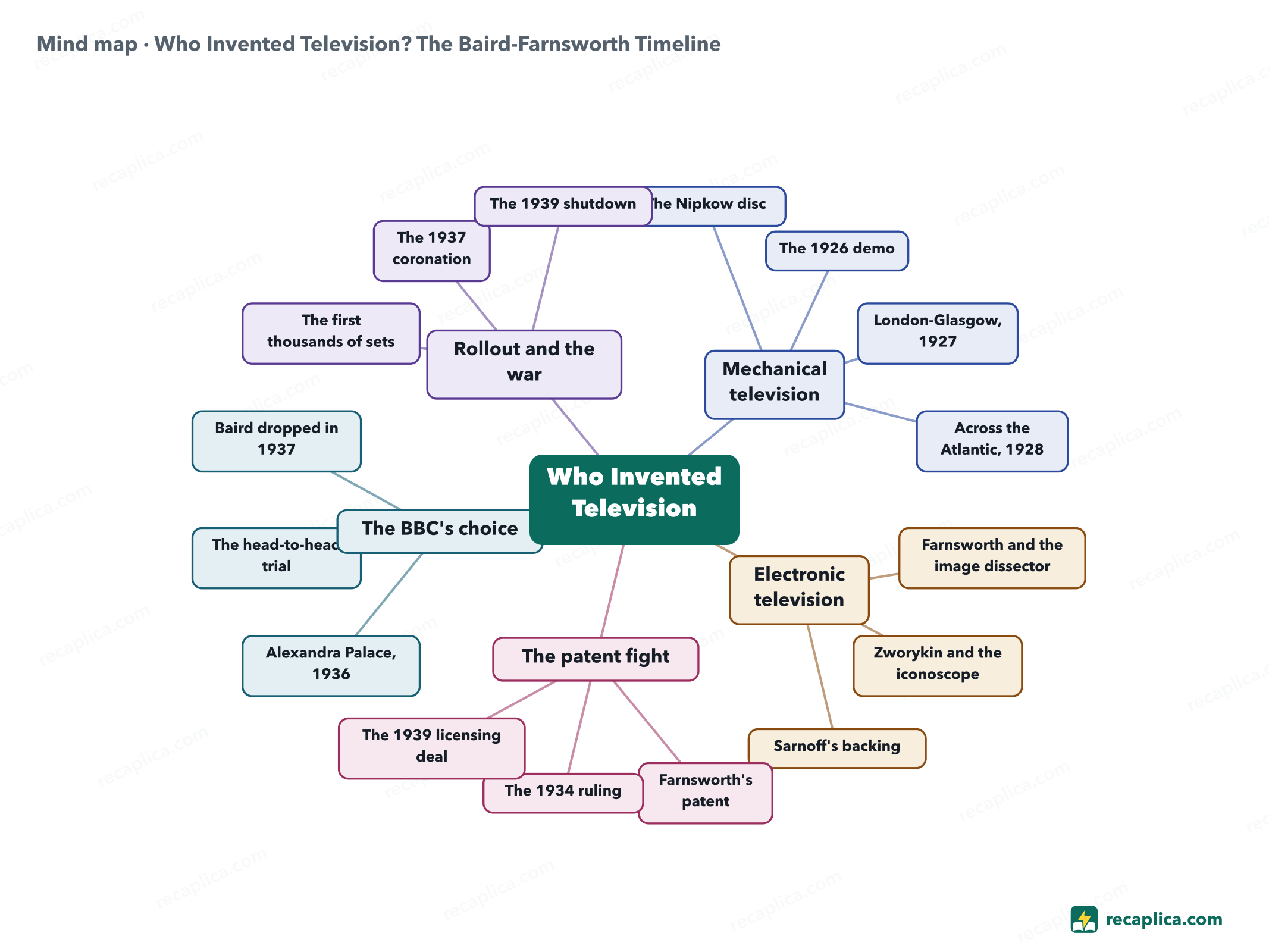
Quiz: test yourselfAnswer the questions to check what you have learned: you get instant feedback and a short explanation. Grade 0/10 0/5
FlashcardsTap the card to flip it and check whether you remember the answer, then move to the next one. 1 / 8 Explain it in your own wordsThe ultimate test: if you can explain it in simple words, you've truly understood it. Write your explanation, then compare it with the Recap. Your explanation is saved only on this device.
Frequently asked questionsTelevision was invented by whom, exactly?No single person. John Logie Baird built the first working system and showed it in public first, in 1926, using a mechanical disc. In the United States, Philo Farnsworth and Vladimir Zworykin separately developed the electronic technology that would later become the industry standard. What year was TV invented?There is no single year. Baird's mechanical system had its first public demo in 1926. Farnsworth filed his electronic image dissector patent in 1927. The BBC's first regular broadcast service started in 1936, and the electronic standard that most TVs would use for decades was settled in 1937. What is the history of the TV, from the first demo to wider use?After the 1926 demo, Baird ran long-distance tests in 1927-1928, then the BBC launched a regular service in 1936. In 1937 the electronic standard won out over the mechanical one; by 1939, with around 20,000 sets in Britain, the war halted broadcasts altogether. Why did the BBC pick the electronic system over Baird's in 1937?During months of alternating broadcasts at Alexandra Palace, the Marconi-EMI system produced sharper, easier-to-manage pictures than Baird's mechanical one. The Television Advisory Committee recommended dropping Baird's system on February 6, 1937. Who actually won the television patent lawsuit?Philo Farnsworth. The US Patent Office ruled in his favor in 1934, RCA lost its appeal in 1936, and in 1939 RCA agreed to a $1 million licensing deal. The legal win never turned into a market win, though, since the standard stayed Vladimir Zworykin's iconoscope. Every Recap goes through an independent review before publication. |