|
recaplica
Intellectual Property: What It Is and What It Protects | ||||||||||||||||||||
| © 2026 Recaplica · recaplica.com — All rights reserved | ||||||||||||||||||||
Intellectual Property: What It Is and What It ProtectsWhat to print Page numbers appear when printing with default margins. SlidesChoose a cut Flash10 slidesThe essential thread, to present in classFull10 slidesEvery chapter and the deeper detailBoth come with speaker notes. In 30 seconds quick readIntellectual property is the branch of law that protects what the mind creates, works, inventions, trademarks, designs, even though they have no physical form. It splits into two main families: copyright, which exists the moment a work is created, and industrial property, which covers patents, trademarks and designs and begins only when an application is filed with an office. Each right runs for its own length of time and comes into being in its own way, set out in national laws (in Italy, the Industrial Property Code) inside a framework of international treaties going back to the nineteenth century. Key Points
Key figures
Deep DiveThings you cannot touch, but still belong to someoneA house, a plot of land, a car: property rights protect that kind of asset, the kind you can physically hold. Intellectual property applies the same legal idea to things with no physical form: a novel, a song, the blueprint of an engine, the name of a company. For the World Intellectual Property Organization (WIPO, the United Nations agency dedicated to the field), these are “creations of the mind”: inventions, literary and artistic works, designs, and the signs (names, symbols, images) used in commerce. Where property rights sit inside a country’s constitutional order, so does intellectual property: in Italy the Italian Constitution sets out the general principle and leaves ordinary law, copyright legislation on one side and industrial property legislation on the other, to work out the details of each right. WIPO lists several sub-fields under this umbrella: alongside patents, copyright, trademarks and industrial designs, there are also geographical indications (signs that show where a product comes from) and trade secrets (confidential information that can be sold or licensed). In everyday practice, though, the subject almost always splits into two broad families, each with its own rules for how protection begins and how long it lasts. Copyright and how it protects a workCopyright protects creative works: books, music, paintings, sculptures, films, computer programs. WIPO puts it plainly: in most countries, copyright protection “is obtained automatically without the need for registration or other formalities.” The rights that follow split into two groups. Economic rights let the author profit from the work, sell it, license it, transfer it, and under Italian law they last for the author’s lifetime plus 70 years after death; once that period passes, the work enters the public domain and anyone can use it freely. Moral rights, by contrast, protect the author’s personality and reputation: under Italy’s SIAE they are unassignable, cannot expire and cannot be waived, and can still be invoked after the author’s death, with no time limit.
Industrial property and the Industrial Property CodeIndustrial property works the opposite way: it does not arise on its own, it only exists once an application has been filed and granted by a competent office, in Italy the Ministry of Enterprises and Made in Italy (MIMIT). It covers three main rights, each with a different duration. A patent protects an industrial invention, defined by MIMIT as “new and original solutions to a technical problem”: it lasts 20 years from the filing date and cannot be renewed. A trademark protects a sign capable of distinguishing one business’s goods or services from another’s: it lasts 10 years from the filing date but can be renewed indefinitely in 10-year periods. A design or model protects the ornamental or aesthetic appearance of an object: it lasts 5 years, renewable for further 5-year periods up to a maximum of 25 years.
The Italian rules sit in the Industrial Property Code, Legislative Decree no. 30 of 10 February 2005, which, in MIMIT’s own words, introduces “an organic and structured set of rules on the protection, enforcement and economic use of intellectual property rights.” A 2023 law updated it, focused on administrative simplification and digitising filing procedures.
Copyright or author’s rights: are they the same thing?In everyday use, copyright and what continental Europe calls author’s rights (droit d’auteur, diritto d’autore) are treated almost as synonyms, and for the most part they are: both protect the person who creates a work, and both arise without registration under the Berne Convention. The difference lies more in legal tradition than in day-to-day effect. The civil-law tradition, of which Italy’s diritto d’autore is an example, also grants the author moral rights, described above, which stay with the author even after the economic rights have been sold; the common-law copyright tradition has historically put more weight on the economic side of protection. Broadly speaking, one puts more emphasis on the personal bond between creator and work, the other more on the right to exploit it: that is a general reading, not a point-by-point comparison certified by any single source, and it should be taken with that caution. The international picture: two nineteenth-century treaties and a WTOagreement Intellectual property protection has crossed national borders for more than a century. The Paris Convention, adopted on 20 March 1883, covers industrial property “in the widest sense,” including patents, trademarks, industrial designs and geographical indications: it was the first major step that let creators get their work protected outside their own country. The Berne Convention, adopted in 1886, does the same for copyright, giving authors the means to control the use of their works: who uses them and on what terms. The broadest reference point is the World Trade Organization’s TRIPS Agreement, which sets minimum standards of protection that every member state must guarantee: 20 years for patents from the filing date, and at least the author’s lifetime plus 50 years for copyright (or at least 50 years from publication, for works whose term is not measured against a person’s lifetime). These are minimums, not ceilings: any state can protect more, never less. Italy, for instance, sits exactly at the TRIPS minimum on patents, 20 years, but goes beyond the minimum on copyright, with 70 years after death instead of 50. People who mix up these rights tend to picture intellectual property as one single, uniform kind of protection. In reality each family, copyright, patents, trademarks, designs, begins in its own way, lasts for its own length of time, and answers a different question: what, exactly, is being protected, and for how long does it make sense to protect it. Slide deckSlides ready to download and make your own in PowerPoint or Google Slides, with speaker notes. Pick the Flash cut or the Full one.    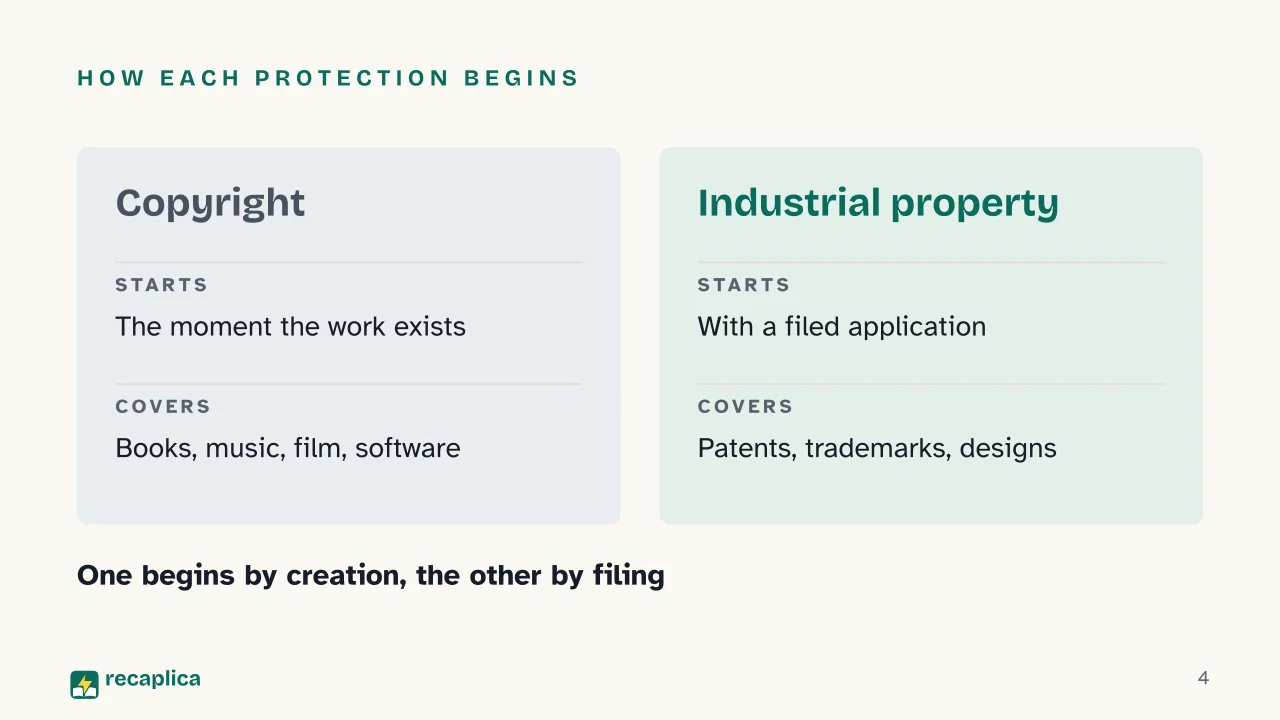 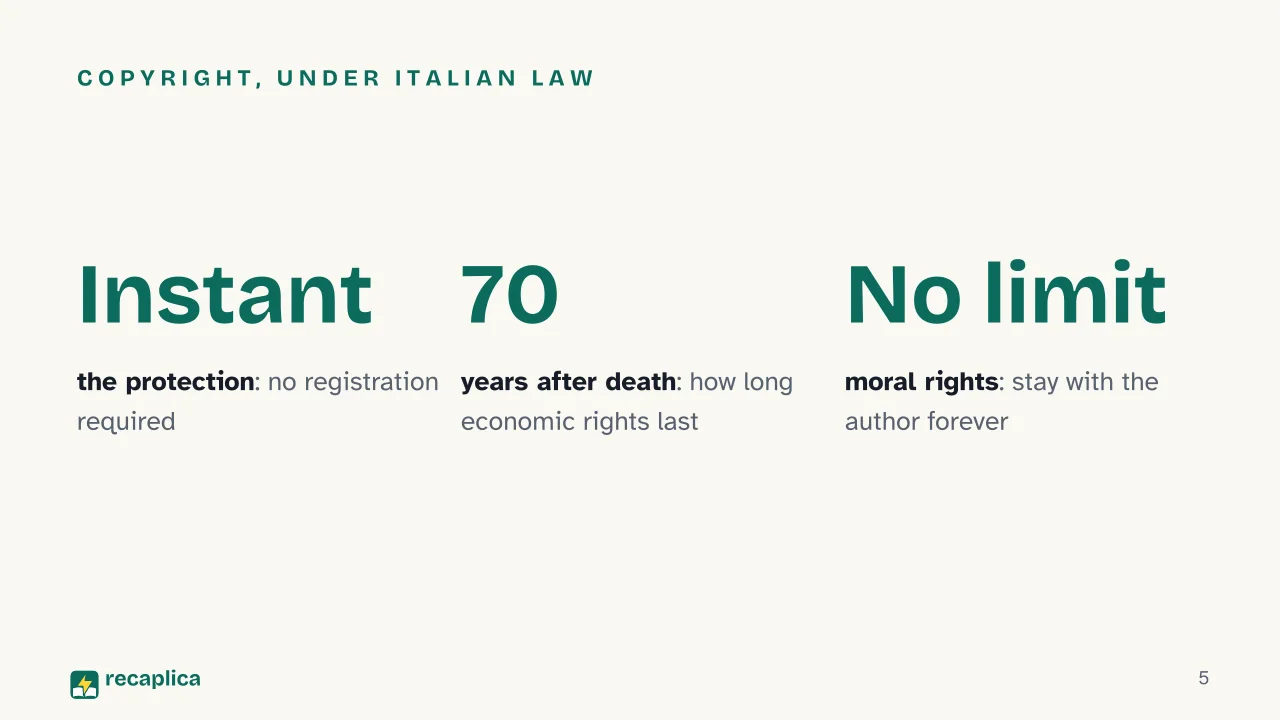 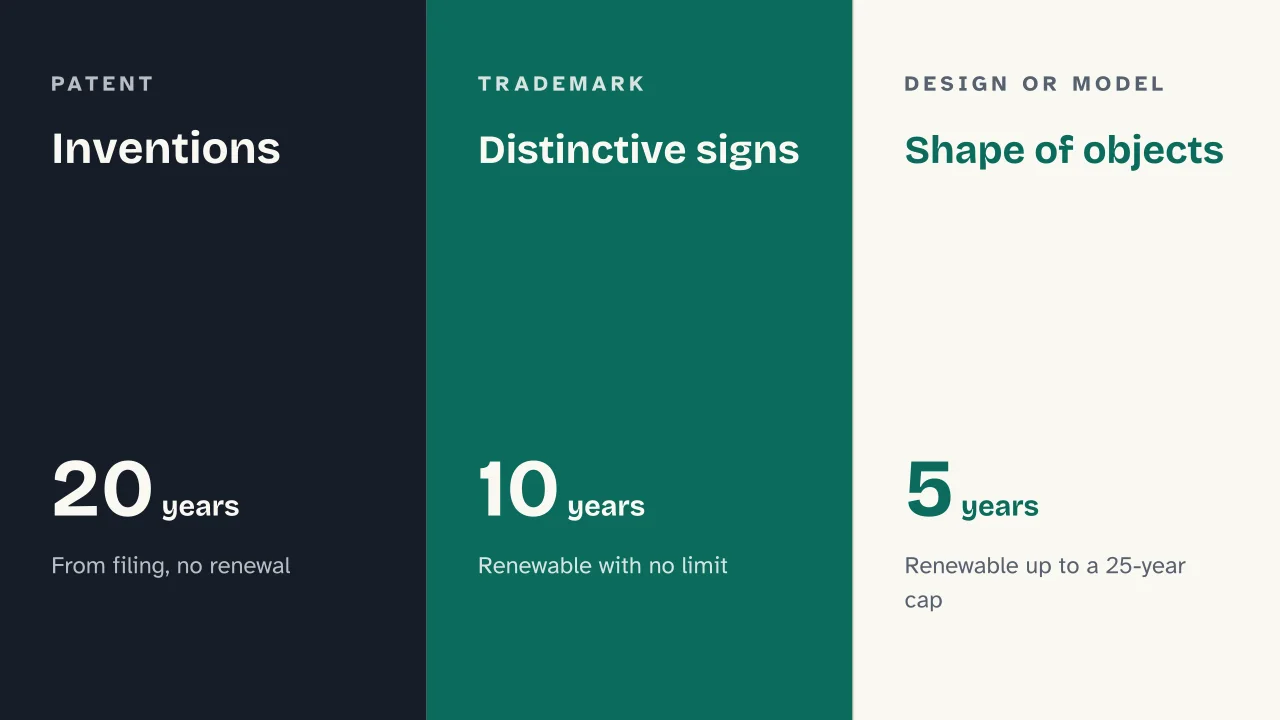 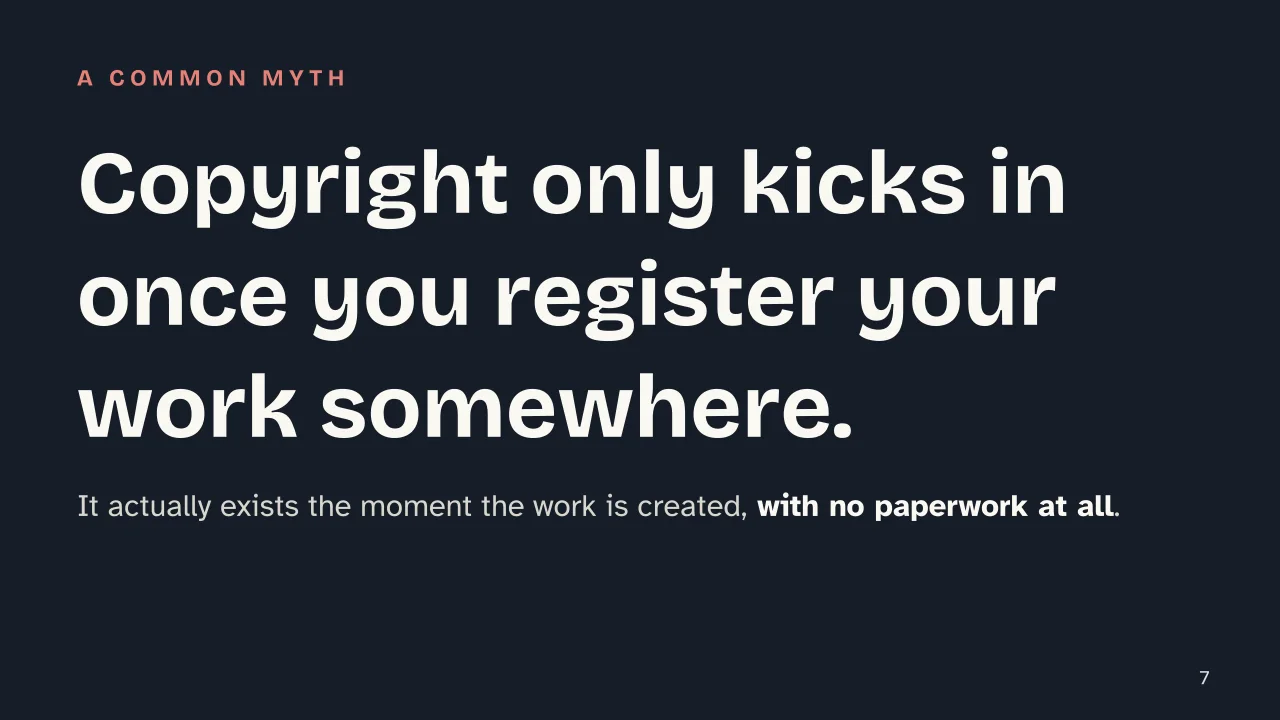 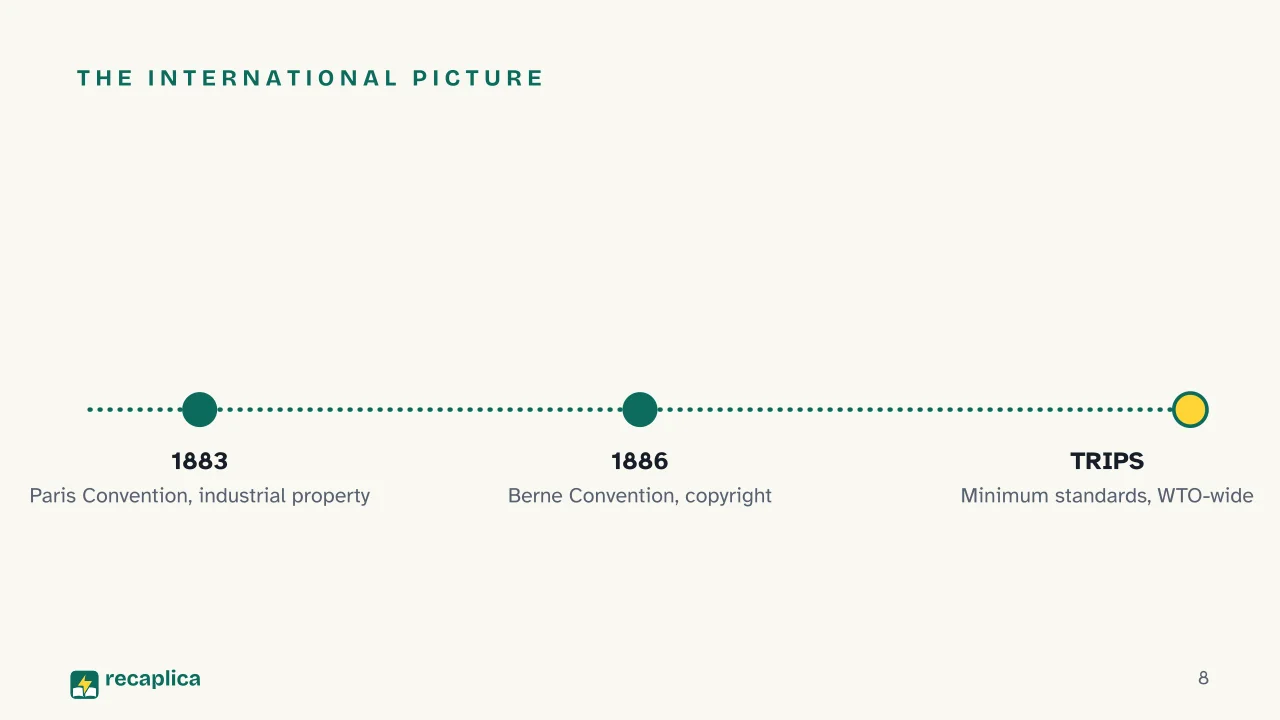 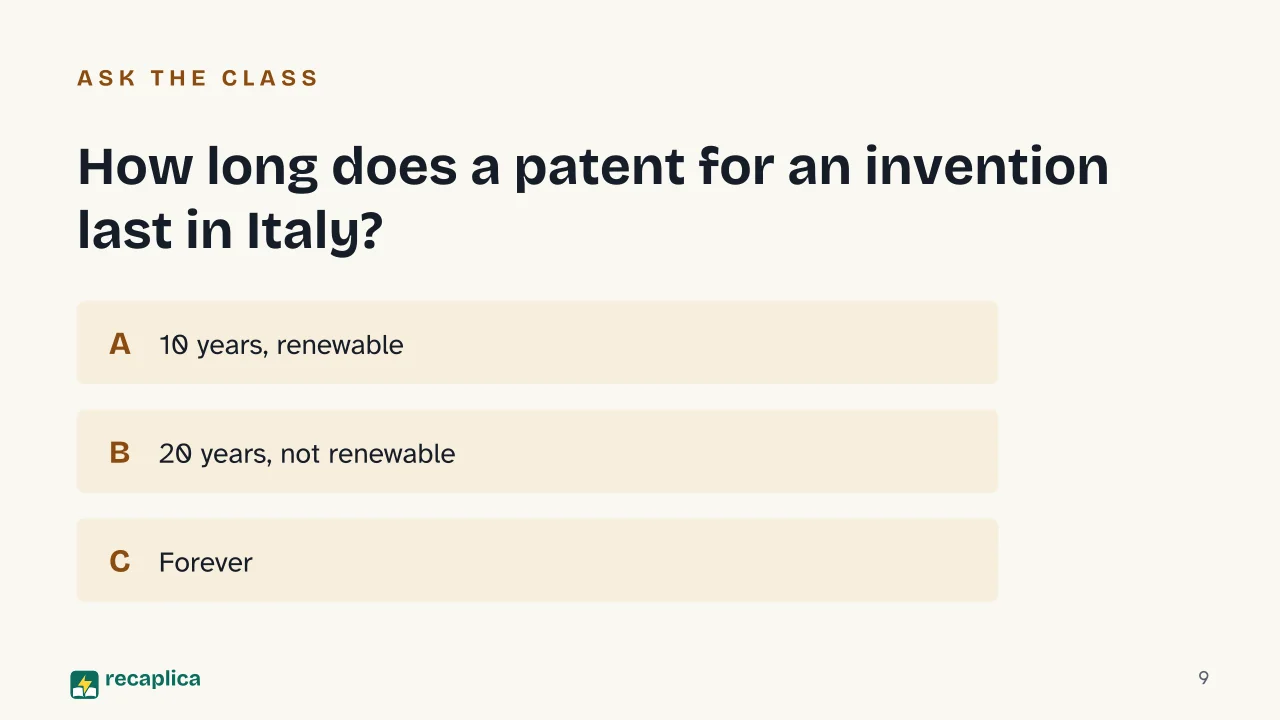  Common myths
Mind mapDrag the background to move around and the nodes to reposition them; use − and + to collapse and expand branches. 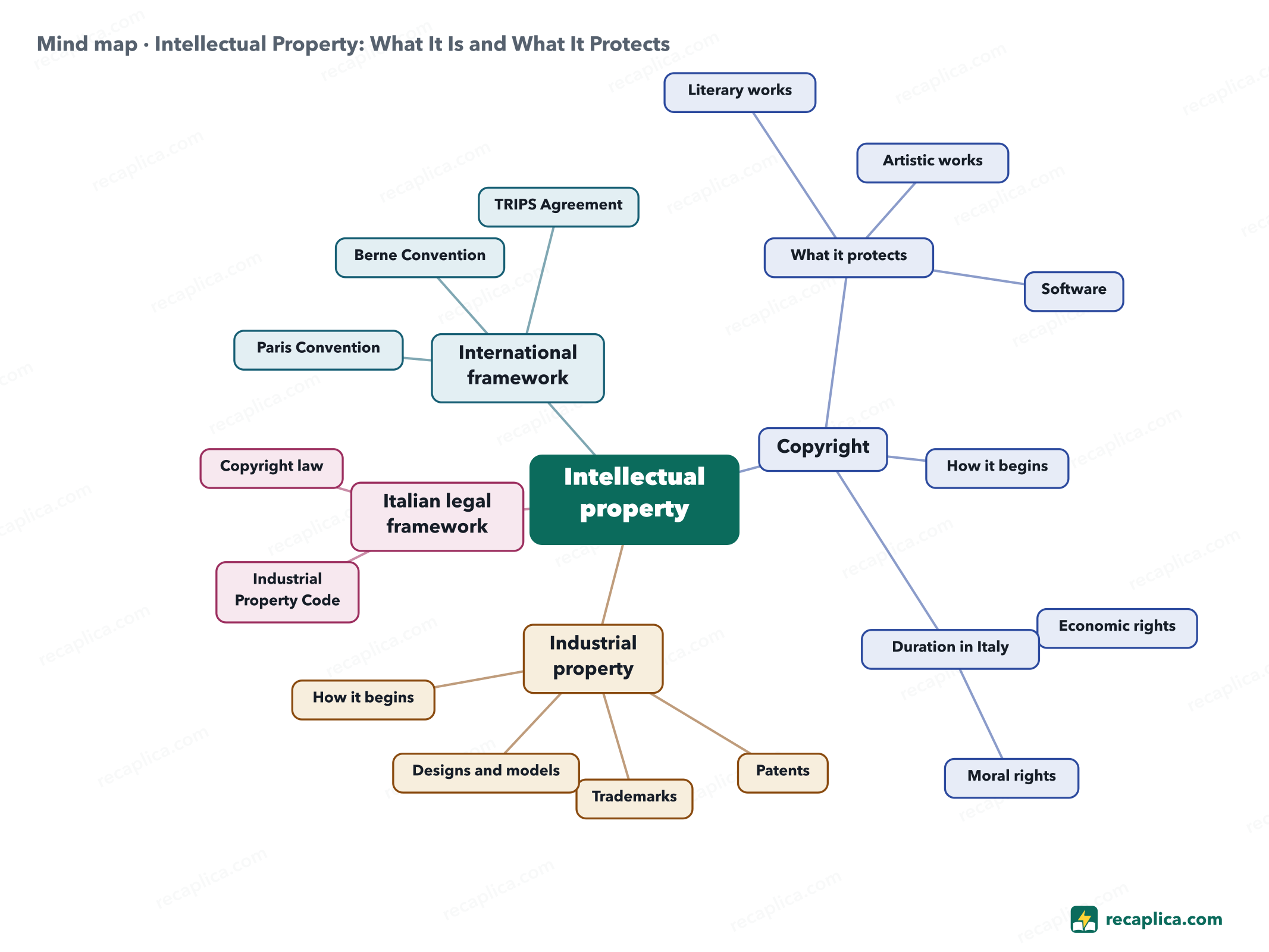
Quiz: test yourselfAnswer the questions to check what you have learned: you get instant feedback and a short explanation. Grade 0/10 0/5
FlashcardsTap the card to flip it and check whether you remember the answer, then move to the next one. 1 / 8 Explain it in your own wordsThe ultimate test: if you can explain it in simple words, you've truly understood it. Write your explanation, then compare it with the Recap. Your explanation is saved only on this device.
Frequently asked questionsWhat's the difference between copyright and "author's rights" (droit d'auteur)?In practice they protect much the same kinds of works, and in everyday use the terms are often treated as interchangeable. The difference lies in the legal tradition each comes from. In the civil-law tradition common in continental Europe, of which Italy's diritto d'autore is one example, the author also holds moral rights tied to reputation and the integrity of the work; Italy's SIAE describes them as unassignable and permanent, and they stay with the author even once the economic rights are sold. Copyright in the common-law tradition has historically leaned more on the economic side. This is a general reading, offered with caution: none of the sources consulted compares the two systems point by point. Do you have to register a work to be protected by copyright?No. According to WIPO, and under the Berne Convention that most countries follow, protection arises on its own as soon as the work exists; no registration or other formality is required. Many countries still run a voluntary registration system, useful as evidence in a dispute, but the right does not depend on it. How long does industrial property protection last?It depends on the right in question. Under Italian law a patent for an invention runs for 20 years from the day it is filed and then expires; there is no renewal. A trademark runs for 10 years from filing and can be renewed every 10 years with no limit on the number of renewals. A design or model runs for 5 years, renewable in 5-year periods up to a maximum cap of 25 years. What is the Industrial Property Code?It is the Italian law (Legislative Decree 30/2005) that brings together, in a single text, the rules on patents, trademarks, designs and models: their protection, enforcement and economic use. A 2023 law updated it to strengthen the competitiveness of the system and digitise filing procedures. Can a plain idea, on its own, be protected as intellectual property?No, so long as it stays an idea. Under WIPO's rules, copyright protects expressions, a written text, a composed melody, a finished drawing, not ideas, procedures or methods as such. An invention can become a patent, but only once it is described in an application filed with a competent office. Every Recap goes through an independent review before publication. |