Skip to content
recaplica

    One moment: security check

    Cloudflare wants to make sure you're not a robot. Tick the box below and your search will continue on its own.

    IT
    recaplica History of Apple and Steve Jobs, from the Garage to His Return as CEO
    © 2026 Recaplica · recaplica.com — All rights reserved
    Home › Technology

    History of Apple and Steve Jobs, from the Garage to His Return as CEO

    By Recaplica Newsroom · Updated on September 15, 2026

    What to print

    Page numbers appear when printing with default margins.

    Slides

    Choose a cut

    Flash10 slidesThe essential thread, to present in classFull14 slidesEvery chapter and the deeper detail

    Both come with speaker notes.

    Telegram channel
    recaplica Clear in 30 seconds, yours in 10 minutes.
    In 30 seconds Key points Figures Deep dive Slides Myths Mind map Quiz Flashcards FAQ

    In 30 seconds quick read

    Apple starts on April 1, 1976, in a garage in Los Altos, founded by Steve Jobs, Steve Wozniak and Ronald Wayne, who leaves the partnership after only twelve days. In 1985 Jobs himself leaves the company after a clash with then-CEO John Sculley, and over the following decade he founds NeXT and buys Pixar, the studio behind the 1995 hit Toy Story. Apple acquires NeXT between late 1996 and early 1997, bringing Jobs back to the company he had founded. Under his leadership Apple launches the iMac in 1998, the iPod in 2001 and the iPhone in 2007, before his death in 2011.

    Key Points

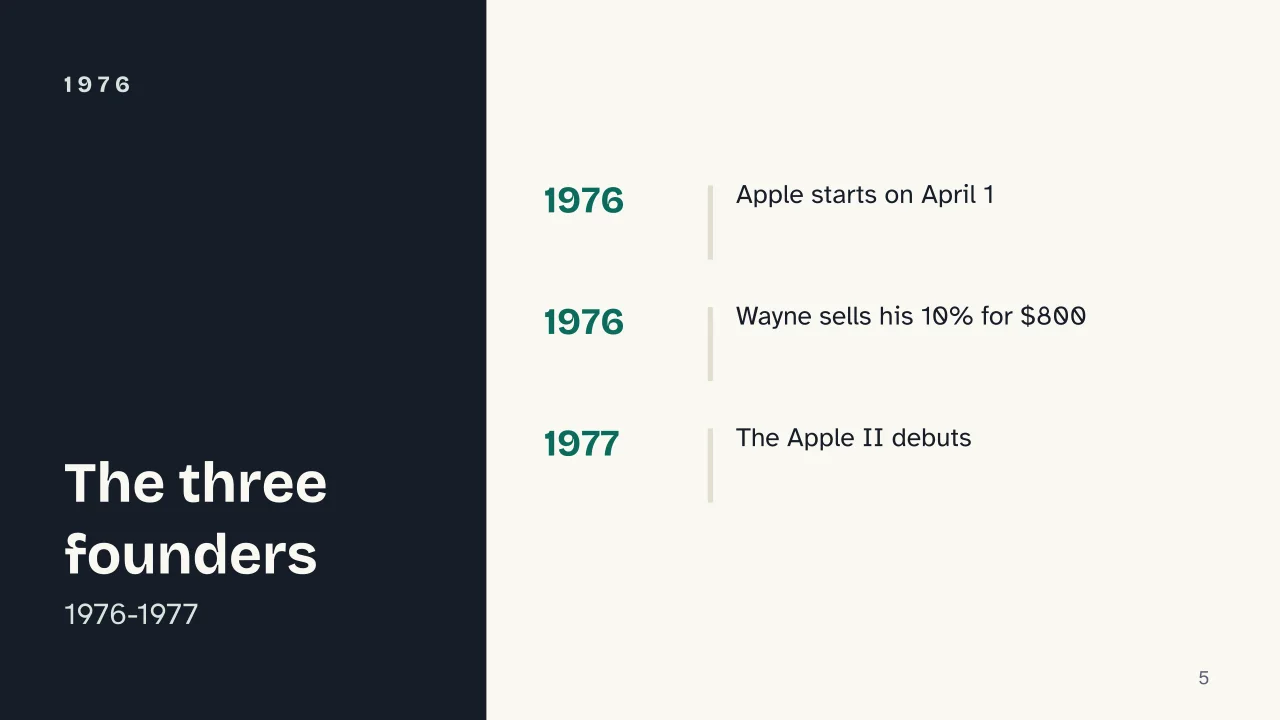
    • Apple is founded on April 1, 1976, by Steve Jobs, Steve Wozniak and Ronald Wayne, who sells his 10% stake for $800 just twelve days later.
    • Jobs leaves Apple on September 17, 1985, after the board strips him of operational power in favor of then-CEO John Sculley.
    • During the decade outside Apple he founds NeXT, which struggles commercially for years and abandons computer manufacturing for software in 1992.
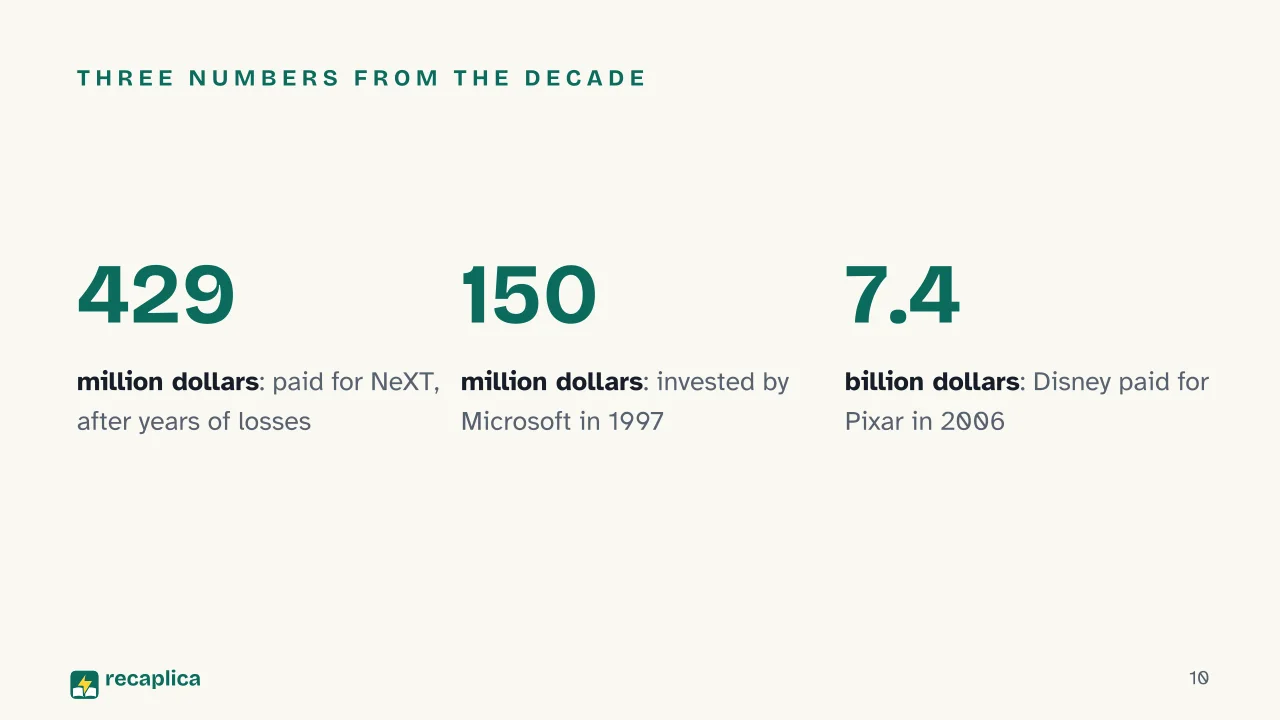
    • In 1986 he buys Lucasfilm's computer graphics division, the future Pixar, which releases Toy Story in 1995 and is sold to Disney in 2006 for about $7.4 billion.
    • Apple acquires NeXT between December 1996 and February 1997 for $429 million, bringing Jobs back to the company; he becomes CEO in 1997.
    • Under his leadership Apple launches the iMac in 1998, the iPod in 2001 and the iPhone in 2007; Jobs dies on October 5, 2011.

    Key figures

    • $800 Amount Ronald Wayne received for selling his 10% Apple stake, twelve days after the company's founding in 1976. Source: Fortune
    • $429 million Price Apple paid, in cash and stock, to acquire NeXT between late 1996 and early 1997. Source: Computer History Museum / Cult of Mac
    • $7.4 billion Value of Disney's 2006 acquisition of Pixar, paid in stock. Source: Yahoo Finance / Fortune

    Deep Dive

    A garage in Los Altos

    Apple Computer Company starts on April 1, 1976, as a partnership between three people, Steve Jobs, Steve Wozniak and Ronald Wayne. Wozniak builds the first circuit board, the Apple I, while Jobs handles selling it. On January 3, 1977, the partnership becomes Apple Computer, Inc.; a few months later, on April 16, 1977, the Apple II debuts, with color graphics and eight expansion slots, a leap over the personal computers already on the market (for that broader context, see also the history of computers).

    The forgotten third founder

    Wayne receives a 10% stake at the founding, with Jobs and Wozniak splitting the rest, 45% each. Twelve days after signing, though, Wayne sells his share for $800, later collecting another $1,500 to give up any future claim on the company. His biggest worry wasn’t a lack of faith in the project but personal liability for the young company’s debts, Apple had just taken out a $15,000 loan to cover its first big contract, and Wayne didn’t want to be on the hook if things went wrong.

    Real-world example: that 10% stake, sold for $800 in 1976, was worth, according to a 2026 estimate, $75 billion to $360 billion, the effect of decades of growth in stocks and financial markets.

    Lisa, Macintosh and the ouster

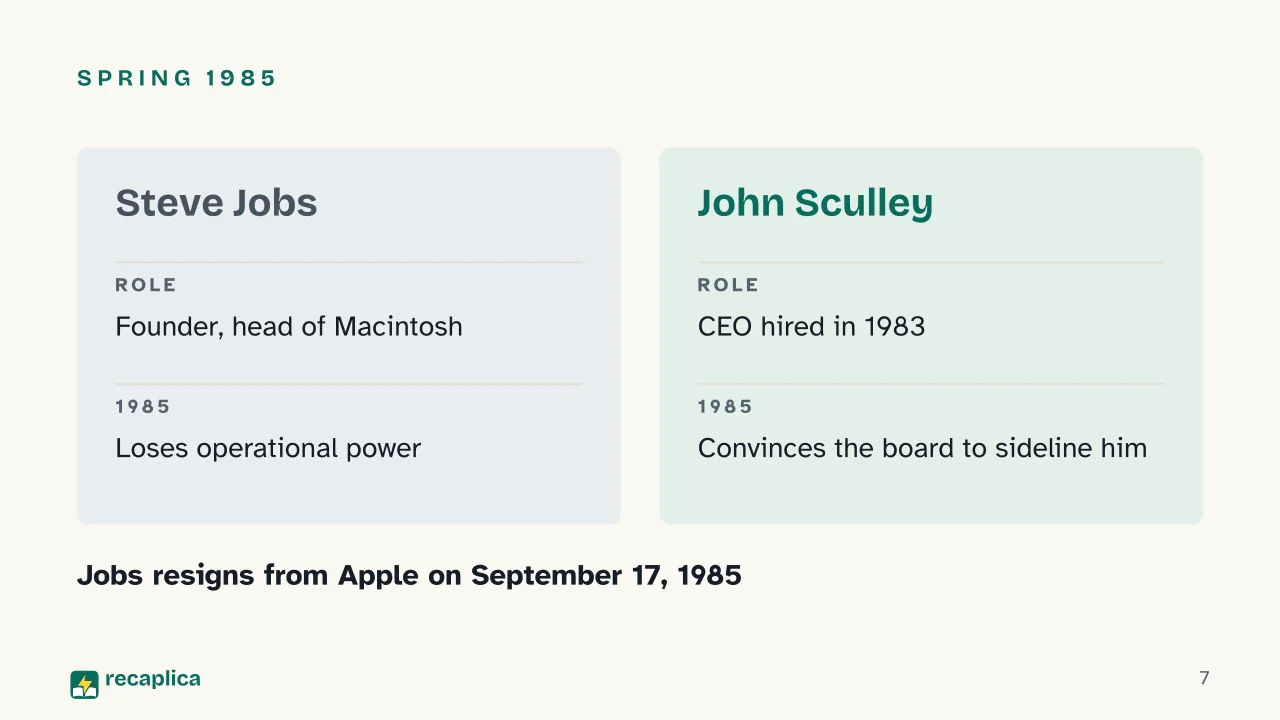
    In January 1983 Apple unveils the Lisa, among the first personal computers built for a mass market with a graphical interface; on January 24, 1984, the Macintosh follows, bringing graphical computing to a much wider audience. Jobs leads that team, and his relationship with John Sculley, the executive Apple had hired as CEO in 1983, keeps deteriorating. In spring 1985 the board moves Jobs out of his operational roles; on September 17, 1985, Jobs formally resigns from Apple.

    The decade outside Apple, NeXT

    Jobs leaves Apple and immediately founds NeXT, together with several veterans of the Macintosh and Lisa teams. The company struggles for years, between 1991 and 1993 it racks up annual losses of $40 million to $66 million, and only turns a profit in 1994, with net income of just $1.03 million. In the fourth quarter of 1992 NeXT stops making physical computers altogether and becomes a software-only company, porting its NEXTSTEP operating system to Intel processors; in 1995 it renames itself NeXT Software, Inc. In March 1996 it ships WebObjects, a tool for building web and intranet applications that brings in a large share of the company’s software revenue. Years later NEXTSTEP would become the technical foundation of macOS, a link the history of Apple’s operating systems traces beyond the original Macintosh.

    The decade outside Apple, Pixar

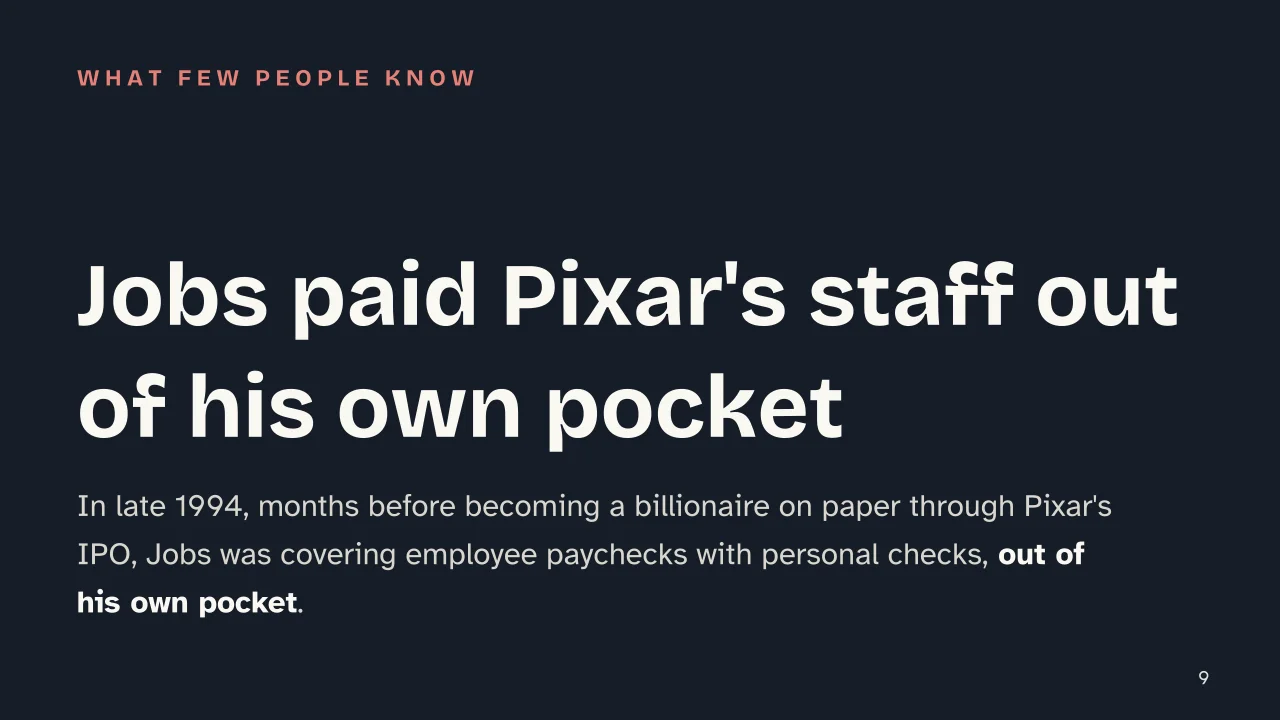
    In 1986 Jobs pays Lucasfilm $5 million for its computer graphics division and puts in another $5 million of his own, taking a 70% stake in what becomes Pixar. For years Pixar generates no profit; by late 1994 Jobs is covering employee payroll himself, with personal checks. On November 29, 1995, the night before Thanksgiving, Toy Story opens in theaters, the first feature-length computer-animated film, earning $29 million on its opening weekend. Days later Pixar goes public, its stock closing the first day of trading at $39, well above the initial range of $12 to $14, and Jobs’s 80% stake is suddenly worth over a billion dollars.

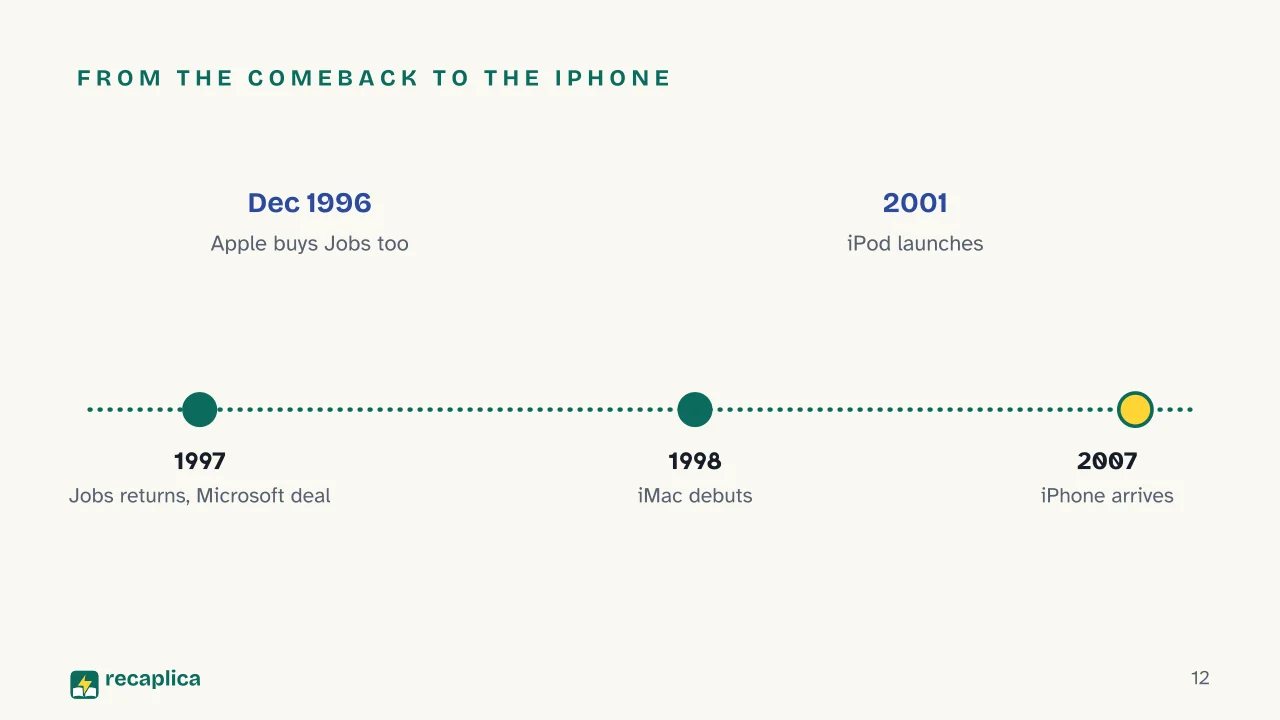
    The timeline, at a glance

    YearEvent
    1976Apple is founded
    1977Apple II
    1985Jobs leaves Apple, founds NeXT
    1986Jobs buys the future Pixar
    1995Toy Story and Pixar’s IPO
    1997Apple acquires NeXT, Jobs returns
    1998iMac
    2001iPod
    2006Pixar sold to Disney
    2007iPhone
    2011Jobs dies

    The return to Apple

    By late 1996 Apple is negotiating to buy NeXT; the announcement comes on December 20, 1996, and the deal closes in the following months for $429 million in cash plus 1.5 million Apple shares. Apple’s CEO at the time, Gil Amelio, puts it bluntly, “I’m not just buying software, I’m buying Steve.” Jobs first returns as an informal adviser, without a real contract, since he is still closely involved with Pixar. Amelio leaves the company in July 1997; in the months that follow, Jobs becomes interim CEO.

    Microsoft bails out Apple

    On August 6, 1997, at the Macworld Expo in Boston, Apple announces a deal with its longtime rival, Microsoft invests $150 million in Apple stock, commits to keep developing Office for Mac for five years, and the two companies cross-license their patents, ending ongoing lawsuits. Apple agrees to make Internet Explorer the default browser on the Mac. In absolute terms $150 million is a modest sum for a company still holding $1.2 billion in cash, the value of the deal is mostly strategic. Bill Gates’s face appears on the screen behind Jobs via video link, drawing boos from part of the crowd, an anecdote that became iconic and was recounted by several independent sources at the time. It also signals how much the balance of power between the two companies had shifted (for the broader comparison, see Windows, macOS and Linux).

    iMac, iPod, iPhone

    On May 6, 1998, Apple unveils the iMac, a 233 MHz G3 processor, a 15-inch screen, a $1,299 price tag, and a curved, translucent Bondi Blue design from Jony Ive’s first major project after being named head of industrial design in 1997. At the launch Jobs describes it as built for what people say they want most from a computer, “to get on the internet, simply and fast,” a goal tied to the broader spread of the internet at the time. The iMac becomes the best-selling computer of the 1998 holiday season.

    In October 2001 the iPod arrives, an MP3 player with a 5-gigabyte drive holding up to 1,000 songs, priced at $399 and available starting November 10. On June 29, 2007, the iPhone debuts, with a multitouch interface that redefines the mobile phone.

    The final years

    Jobs leads Apple until shortly before his death, on October 5, 2011, following a battle with pancreatic cancer. In 2006 Disney buys Pixar for about $7.4 billion in stock, making Jobs Disney’s largest individual shareholder, with a 7% stake.

    Slide deck

    Slides ready to download and make your own in PowerPoint or Google Slides, with speaker notes. Pick the Flash cut or the Full one.
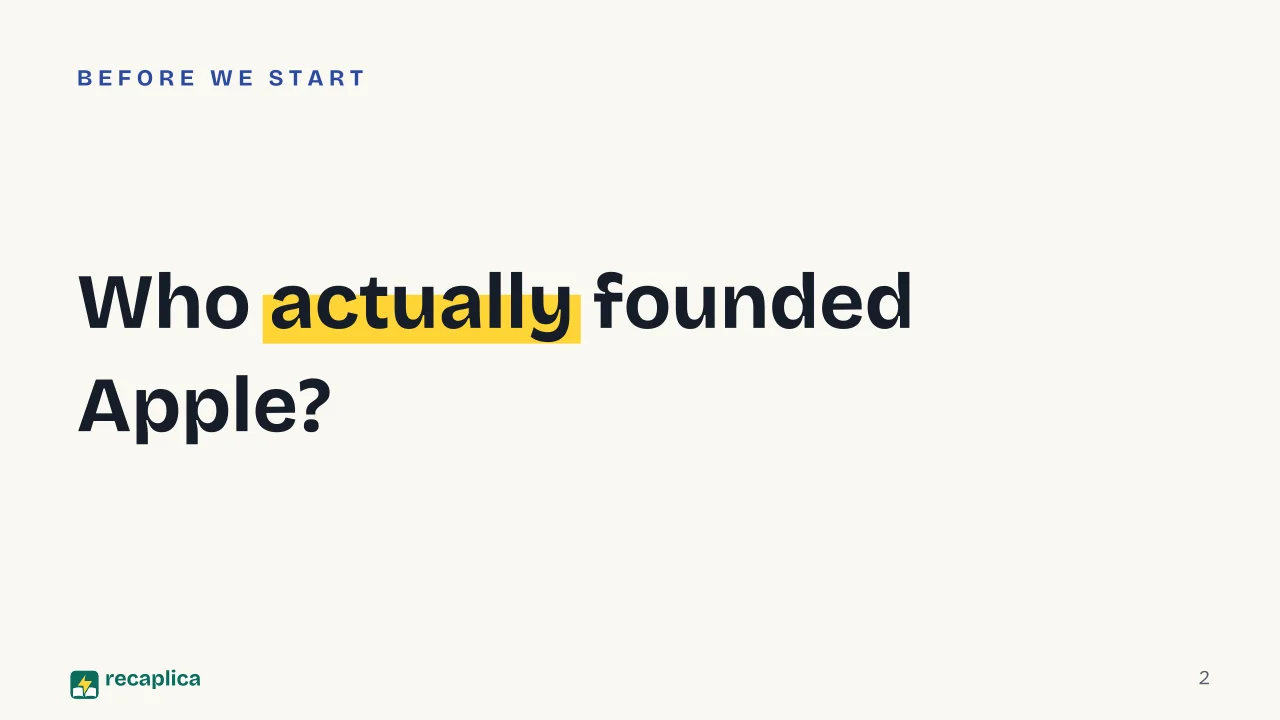
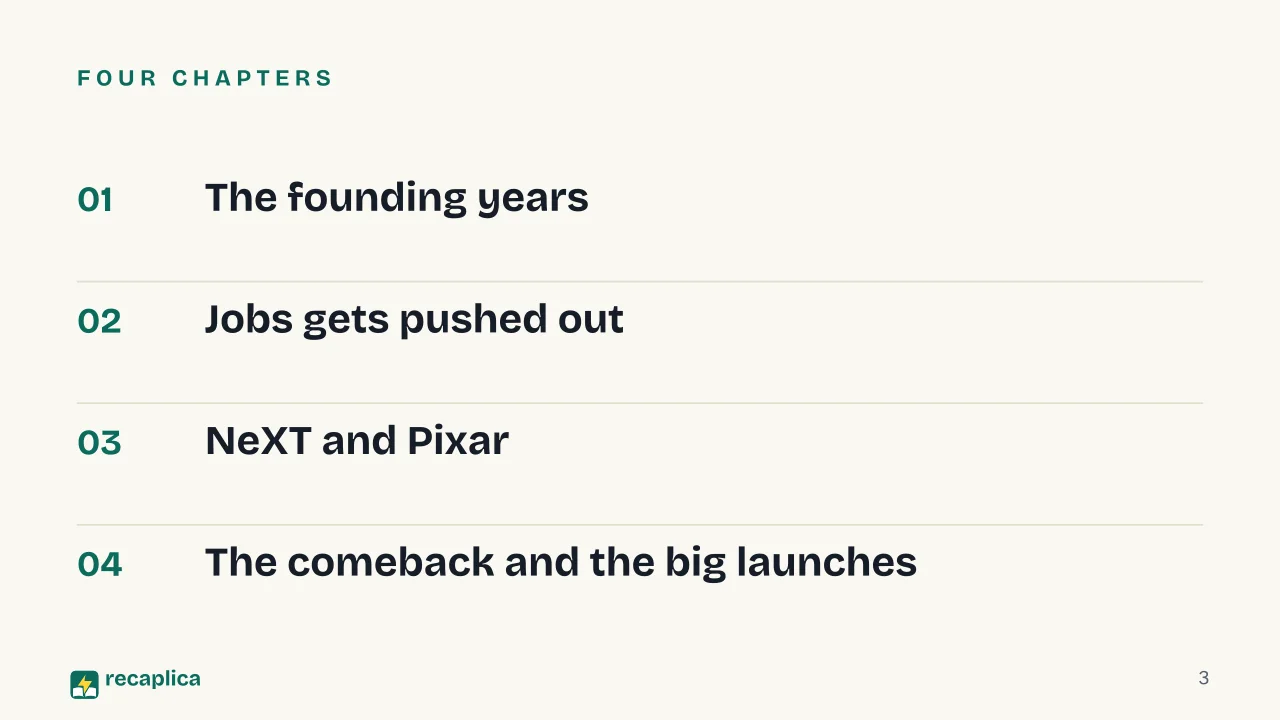
    Slide 1 of the presentation on History of Apple and Steve Jobs, from the Garage to His Return as CEO: Apple and Steve JobsSlide 2 of the presentation on History of Apple and Steve Jobs, from the Garage to His Return as CEO: Who actually founded Apple?Slide 3 of the presentation on History of Apple and Steve Jobs, from the Garage to His Return as CEO: Four chaptersSlide 4 of the presentation on History of Apple and Steve Jobs, from the Garage to His Return as CEO: Chapter 01: The founding yearsSlide 5 of the presentation on History of Apple and Steve Jobs, from the Garage to His Return as CEO: 1976Slide 6 of the presentation on History of Apple and Steve Jobs, from the Garage to His Return as CEO: Chapter 02: Jobs gets pushed outSlide 7 of the presentation on History of Apple and Steve Jobs, from the Garage to His Return as CEO: Spring 1985Slide 8 of the presentation on History of Apple and Steve Jobs, from the Garage to His Return as CEO: Chapter 03: NeXT and PixarSlide 9 of the presentation on History of Apple and Steve Jobs, from the Garage to His Return as CEO: Jobs paid Pixar's staff out of his own pocketSlide 10 of the presentation on History of Apple and Steve Jobs, from the Garage to His Return as CEO: Three numbers from the decadeSlide 11 of the presentation on History of Apple and Steve Jobs, from the Garage to His Return as CEO: Chapter 04: The comeback and the big launchesSlide 12 of the presentation on History of Apple and Steve Jobs, from the Garage to His Return as CEO: From the comeback to the iPhoneSlide 13 of the presentation on History of Apple and Steve Jobs, from the Garage to His Return as CEO: Why did Jobs leave Apple in 1985?Slide 14 of the presentation on History of Apple and Steve Jobs, from the Garage to His Return as CEO: The full Recap
    Flash10 slidesThe essential thread, to present in classFull14 slidesEvery chapter and the deeper detail

    Common myths

    • ✗ Myth Steve Jobs founded Apple on his own.

      ✓ Reality On April 1, 1976, the founding partnership had three members, not two: Jobs, Wozniak and Ronald Wayne, who held a 10% stake. Wayne walked away twelve days later, worried he could be held personally liable for the young company's debts, a $15,000 loan taken out for its first big contract, which is why most retellings since have narrowed the story down to Jobs and Wozniak.

    • ✗ Myth After being pushed out in 1985, Jobs disappeared until his return to Apple in 1997.

      ✓ Reality That decade produced NeXT and his purchase of the studio that became Pixar, which released Toy Story in 1995 and turned Jobs into a paper billionaire overnight once the company went public. NeXT, on the other hand, struggled for years as a hardware maker, with annual losses reaching $66 million, before converting to software only in 1992.

    • ✗ Myth Apple bought NeXT in 1997 mainly for its technology.

      ✓ Reality Apple's own CEO at the time, Gil Amelio, said as much when the deal was announced, that the company wasn't just buying software, it was buying Steve Jobs himself. NeXT's NEXTSTEP technology later became the foundation of macOS, but the deal was first and foremost a way to put Jobs back in charge of the company he had founded.

    Mind map

    Drag the background to move around and the nodes to reposition them; use − and + to collapse and expand branches.
    Customize
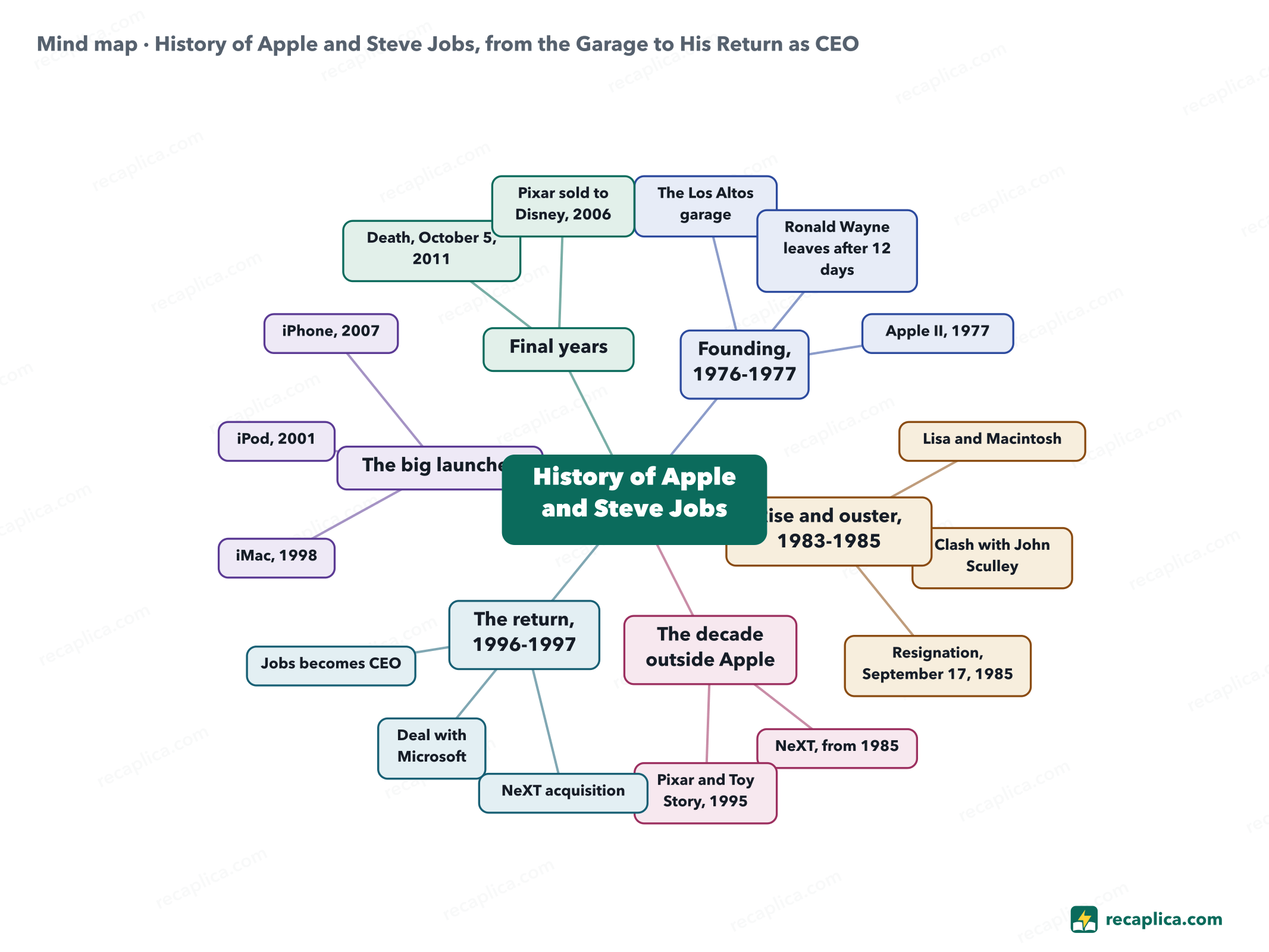
    Mind map: History of Apple and Steve Jobs, from the Garage to His Return as CEO
    • History of Apple and Steve Jobs
      • Founding, 1976-1977
        • The Los Altos garage
        • Ronald Wayne leaves after 12 days
        • Apple II, 1977
      • Rise and ouster, 1983-1985
        • Lisa and Macintosh
        • Clash with John Sculley
        • Resignation, September 17, 1985
      • The decade outside Apple
        • NeXT, from 1985
        • Pixar and Toy Story, 1995
      • The return, 1996-1997
        • NeXT acquisition
        • Deal with Microsoft
        • Jobs becomes CEO
      • The big launches
        • iMac, 1998
        • iPod, 2001
        • iPhone, 2007
      • Final years
        • Death, October 5, 2011
        • Pixar sold to Disney, 2006

    Quiz: test yourself

    Answer the questions to check what you have learned: you get instant feedback and a short explanation.

    Grade 0/10 0/5
    1 In what year was Apple founded?

    Apple Computer Company was founded on April 1, 1976; it didn't become Apple Computer, Inc. until January 3, 1977.

    2 Which of these was not one of Apple's three founding partners in 1976?

    Sculley joined Apple as its hired CEO in 1983, seven years after the founding, not as one of the three original partners.

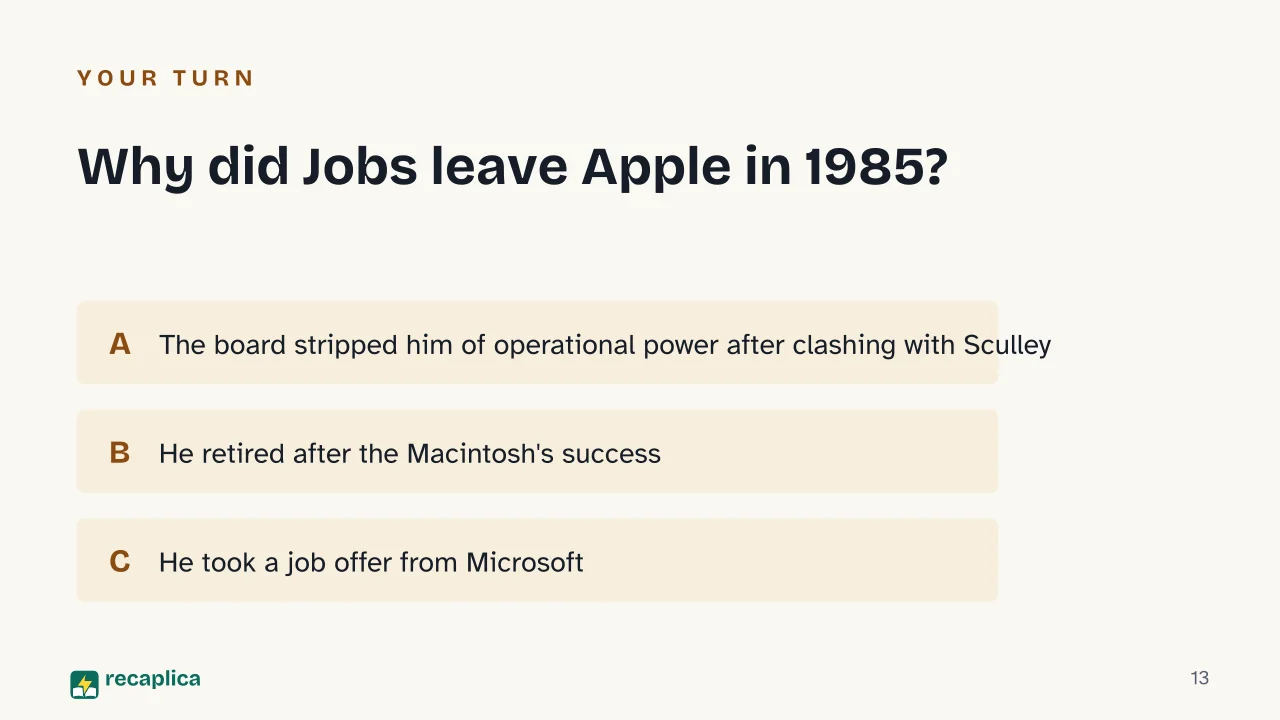
    3 Why did Steve Jobs leave Apple in 1985?

    In spring 1985 the board moved Jobs out of his operational roles in favor of Sculley; Jobs formally resigned on September 17, 1985.

    4 According to Apple's CEO at the time, Gil Amelio, what was the company really buying by acquiring NeXT in 1996-1997?

    Amelio said so openly when the acquisition was announced: the main goal was bringing Jobs back to lead Apple.

    5 True or false, Pixar, the studio Jobs bought in 1986, was sold to Disney in 2006.

    Disney bought Pixar in 2006 for about $7.4 billion in stock, making Jobs Disney's largest individual shareholder.

    Answers: 1-B · 2-D · 3-A · 4-A · 5-A

    Flashcards

    Tap the card to flip it and check whether you remember the answer, then move to the next one.

    1 / 8

    Explain it in your own words

    The ultimate test: if you can explain it in simple words, you've truly understood it. Write your explanation, then compare it with the Recap.

    Your explanation is saved only on this device.

    Apple starts on April 1, 1976, in a garage in Los Altos, founded by Steve Jobs, Steve Wozniak and Ronald Wayne, who leaves the partnership after only twelve days. In 1985 Jobs himself leaves the company after a clash with then-CEO John Sculley, and over the following decade he founds NeXT and buys Pixar, the studio behind the 1995 hit Toy Story. Apple acquires NeXT between late 1996 and early 1997, bringing Jobs back to the company he had founded. Under his leadership Apple launches the iMac in 1998, the iPod in 2001 and the iPhone in 2007, before his death in 2011.

    Frequently asked questions

    Who founded Apple?

    Apple started on April 1, 1976, as a partnership between three people, Steve Jobs, Steve Wozniak and Ronald Wayne. Wayne left the partnership after twelve days, selling his 10% stake for $800.

    Why was Steve Jobs pushed out of Apple?

    In spring 1985 Apple's board moved Jobs out of his operational roles, after a clash with then-CEO John Sculley, hired two years earlier. Jobs formally resigned on September 17, 1985.

    What did Steve Jobs do after leaving Apple?

    He immediately founded NeXT, a computer company that struggled commercially for years and switched to software only in 1992. In 1986 he also bought the studio that became Pixar, which released Toy Story in 1995 and was sold to Disney in 2006.

    How did Steve Jobs return to lead Apple?

    Apple acquired NeXT between December 1996 and February 1997 mainly to bring Jobs back, as then-CEO Gil Amelio put it at the time. Jobs first returned as an informal adviser, then became CEO in 1997 after Amelio left.

    When did Steve Jobs die?

    Steve Jobs died on October 5, 2011, after a battle with pancreatic cancer, while still leading Apple.

    Sources

    • Apple Timeline (Computer History Museum)
    • NeXT, Steve Jobs' Dot Com IPO that Never Happened (Computer History Museum)
    • Today in Apple history, NeXT buyout brings Steve Jobs back to Cupertino (Cult of Mac)
    • Pixar's True Story (Computer History Museum)
    • Apple Presents iPod (Apple Newsroom)
    • Steve Jobs became a billionaire thanks to a Pixar gamble (Yahoo Finance)
    • Apple cofounder sold 10 percent stake for 800 dollars (Fortune)
    • Apple and Microsoft Call Truce (This Day in Tech History)
    • On May 6, 1998 the iMac changed Apple, and the entire world (AppleInsider)

    Every Recap goes through an independent review before publication.

    Every evening, the day's new Recaps on our Telegram channel. Join the channel →

    Keep learning

    • Technology ASCII Table: What Is It? The ASCII table assigns a fixed number to every letter, digit, punctuation mark, and keyboard control command, so that a computer, which only handles numbers, can represent text. Published in 1963 by the ANSI X3.4 committee and adopted for U.S. federal computers in 1968, it uses 7 bits and covers 128 characters, almost all of them from the English alphabet, according to the IEEE's Engineering and Technology History Wiki. RFC 20 shows how those 7 bits fit neatly inside an 8-bit byte, with the highest bit left unused; putting that extra bit to work opens up more combinations, the basis for the variants known as Extended ASCII. Because it only covers English, though, standard ASCII falls short for languages with accents, ideograms, or other alphabets — a gap Unicode was built to close. Read the Recap →
    • Technology Binary Code: What It Is and How Computers Write Numbers Binary code is how a computer represents numbers using only two digits, 0 and 1. The reason is physical: a computer's circuits reliably tell apart only two electrical states, current off or current on, and we label them 0 and 1 for convenience. Just like the decimal system, each digit's value depends on its position, but here positions are worth powers of two instead of powers of ten: the number 101 works out to (1×4)+(0×2)+(1×1), which is 5. Eight of these digits together form a byte, the unit a computer typically uses to hold one number. Binary alone covers numbers; writing letters needs an extra convention, such as ASCII or Unicode, covered in their own Recaps. Read the Recap →
    • Technology Unicode: What Is It? How It Replaced ASCII Unicode is the standard that gives a unique number, called a code point, to every character in every written language. It replaced ASCII, the 1963 code whose 128 characters covered only the English alphabet, with no accents and no other scripts. Text online travels almost always as UTF-8, one of the forms Unicode uses to turn those numbers into bytes, and it's backward compatible: a file written purely in ASCII is already valid UTF-8. Version 18.0 of the standard, published in September 2026, covers 172,808 characters. Read the Recap →

    recaplica

    Clear in 30 seconds, yours in 10 minutes.

    Recaps Mind maps Request a Recap Telegram channel Mind map maker Our method About Privacy & cookies Legal notes & terms of use

    © 2026 Recaplica · A project by Curi S.r.l. — VAT IT05472000750

    Statistics, only if you say so

    To learn which Recaps help most we would use Google Analytics, with aggregate, anonymous data. It starts only with your OK, and you can change your mind anytime. Privacy policy