Skip to content
recaplica

    One moment: security check

    Cloudflare wants to make sure you're not a robot. Tick the box below and your search will continue on its own.

    IT
    recaplica Turing Machine: What It Is and How It Works
    © 2026 Recaplica · recaplica.com — All rights reserved
    Home › Technology

    Turing Machine: What It Is and How It Works

    By Recaplica Newsroom · Updated on October 3, 2026

    What to print

    Page numbers appear when printing with default margins.

    Slides

    Choose a cut

    Flash10 slidesThe essential thread, to present in classFull16 slidesEvery chapter and the deeper detail

    Both come with speaker notes.

    Telegram channel
    recaplica Clear in 30 seconds, yours in 10 minutes.
    In 30 seconds Key points Deep dive Slides Myths Mind map Quiz Flashcards FAQ

    In 30 seconds quick read

    A Turing machine is a theoretical model of computation: a tape divided into squares, a head that reads and writes one symbol at a time, and a finite number of states. At each step a transition function decides what to write, which way to move the head, and which state comes next, looking only at the present situation and never at what came before. The model exists to pin down, with precision, what "computable" actually means, and it has been used to show that some problems cannot be solved by any machine, real or theoretical, no matter how it is built. The halting problem is the best known case.

    Key Points

    • The tape is a row of squares, infinite in one direction, holding one symbol per square.
    • The head reads and writes one symbol at a time, then moves one square left or right.
    • States are finite in number; the transition function picks the symbol, the direction, and the next state.
    • Each step depends only on the current state and symbol, never on how the machine got there.
    • The halting problem has no general solution: a proof by contradiction rules one out.
    • The Church-Turing thesis extends that limit to every mechanical procedure, not just Turing's model.

    Deep Dive

    A Turing machine is not something you can hold. It is a model drawn on paper to answer one precise question: what does it actually mean to compute? Alan Turing answered in 1936 by describing a minimal machine, made of a tape, a head, and states, and showing that these few ingredients can reproduce anything a person would call a calculation (a few years later, Turing put these same ideas to work breaking the Nazi Enigma code: the Recap on Alan Turing and the Enigma Machine tells that story).

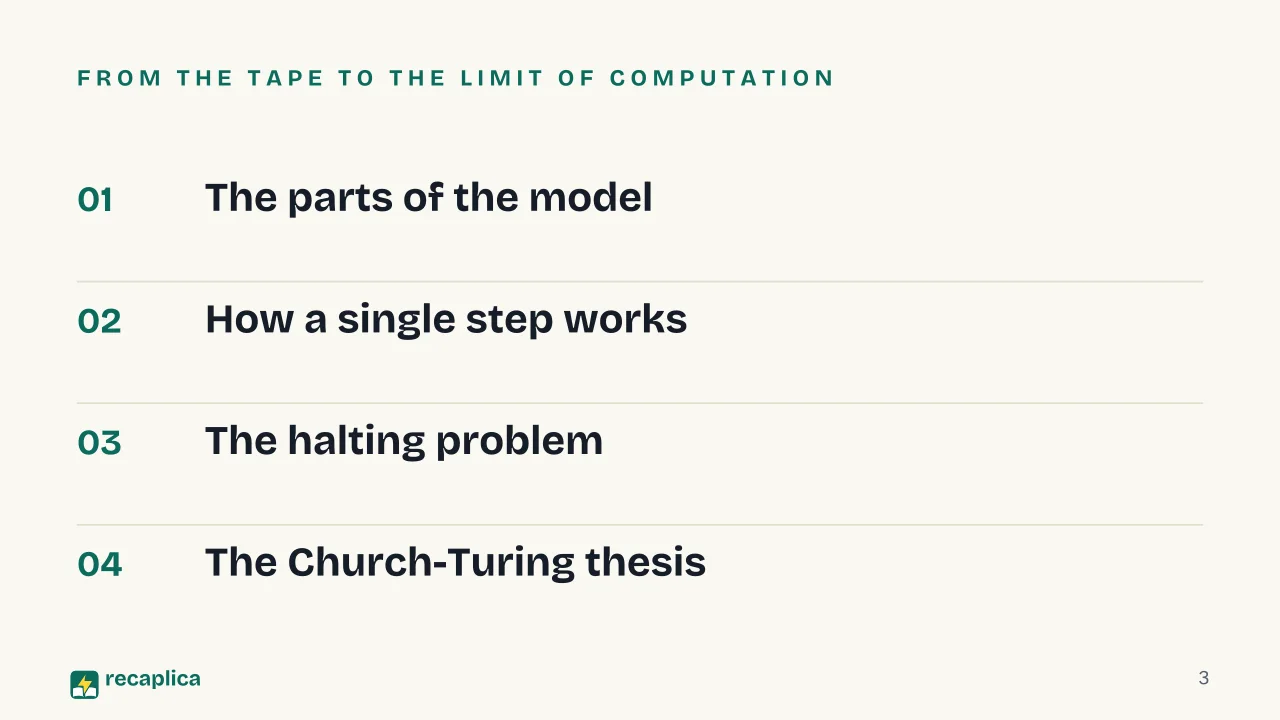
    The parts of the model

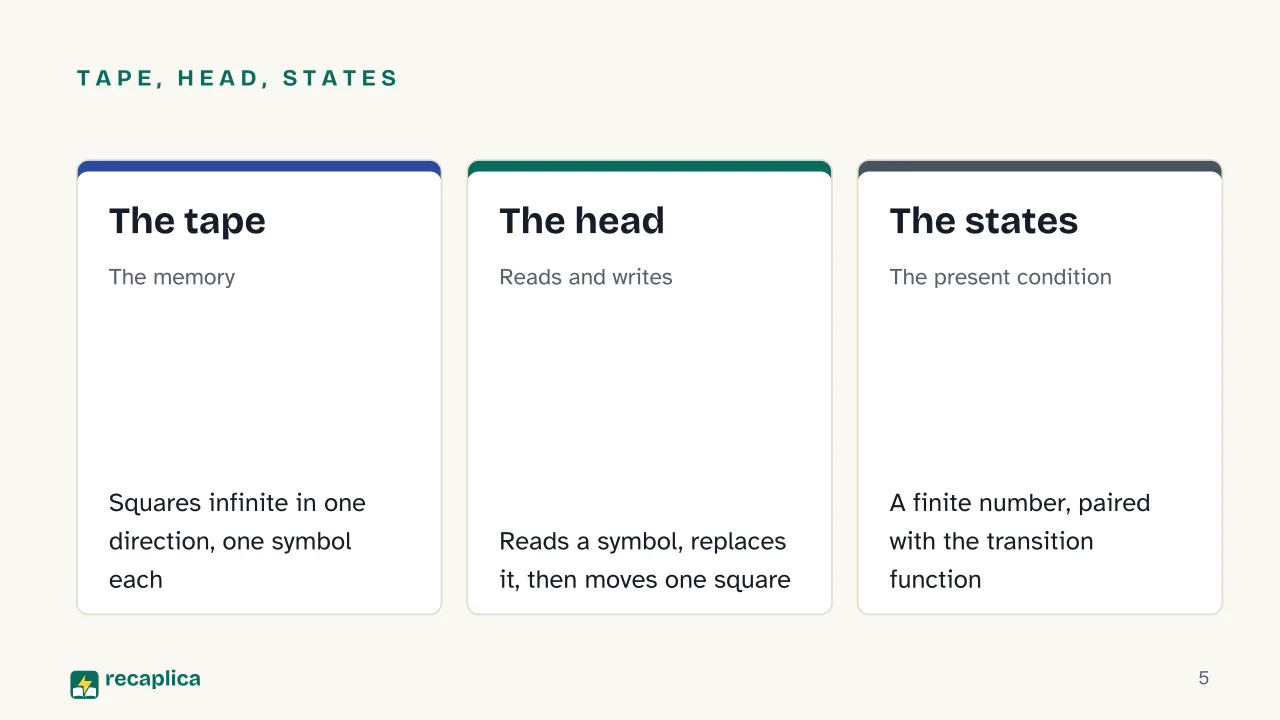
    The tape is divided into squares, each able to hold one symbol. It is infinite in one direction, so the machine always finds an empty square ahead of it. A head sits on one square at a time, reads the symbol there, and, if needed, replaces it with another.

    The machine is always in one of a finite number of states (Turing called them “m-configurations”). A handful of states, combined with the right rules, is enough to represent fairly complicated procedures.

    Linking states and symbols is the transition function: starting from where the machine stands and what it reads, it fixes three outcomes, the symbol to leave on the tape, the direction the head takes next, and the state the machine moves into. Compared with the von Neumann architecture, which describes how real computers are organized, the Turing machine is the theoretical ancestor: a model conceived before a single microprocessor existed, still used today to understand the limits of the ones still to come.

    How a single step works

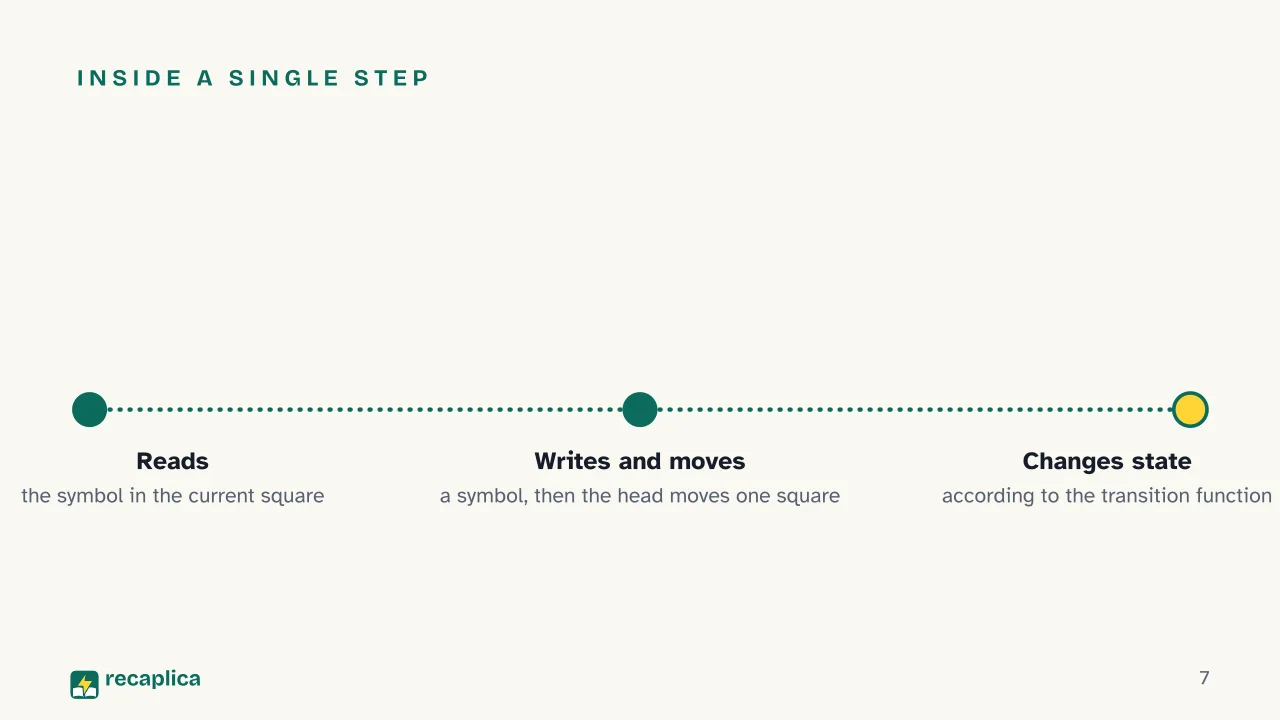
    Every step a Turing machine takes is three elementary actions: write a symbol, move the head one square, change state. The order matters, but the logic stays the same: the action depends only on the current state and symbol.

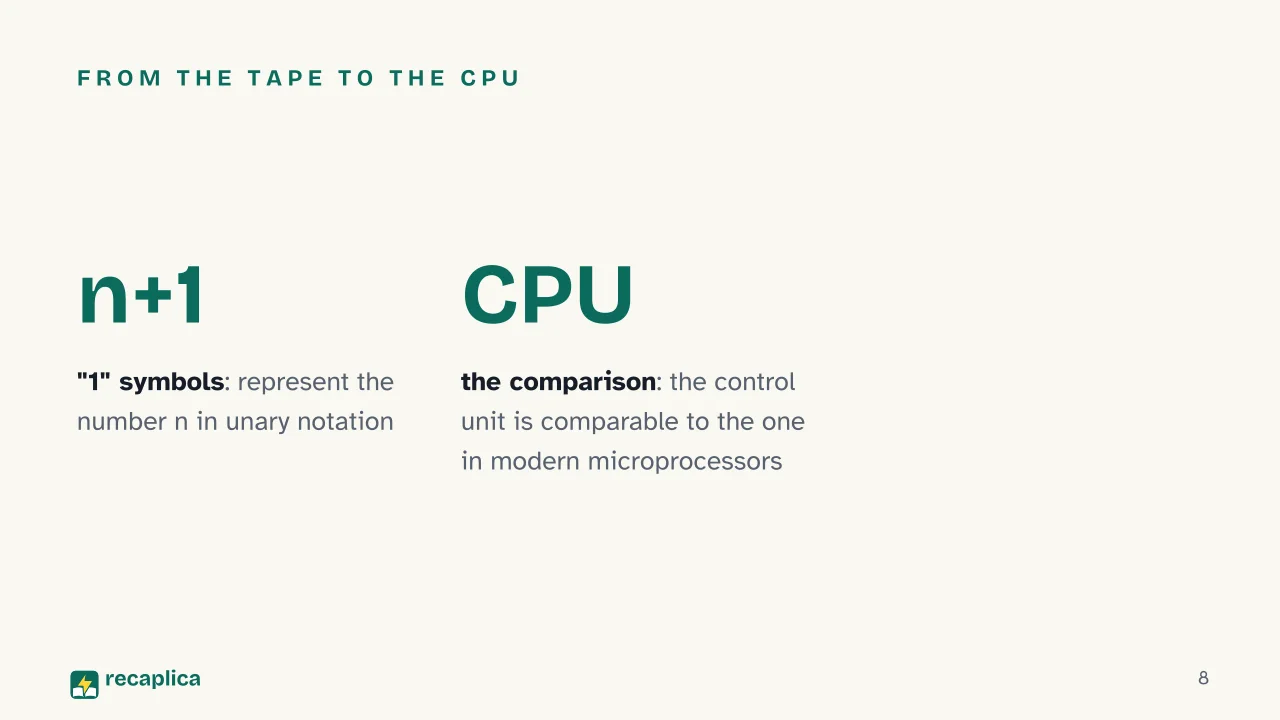
    Practical example: to represent the number 3, a Turing machine working in unary notation writes a block of four consecutive “1” symbols on the tape (the number n takes n+1 symbols). One repeated symbol, with the right rules for counting it, is already enough to do arithmetic.

    The same principle, minimal rules applied step by step, shows up in a different example: a machine that increments a number written in binary code scans the digits from right to left, changes “1”s to “0” until it finds a “0”, and flips that one to “1”. It is the same carry used when adding by hand in columns, translated into a language with only two digits.

    ElementWhat it does
    TapeHolds the symbols, infinite in one direction
    HeadReads and writes, one symbol at a time
    StatesFinite in number, represent the current condition
    Transition functionDecides symbol, direction, and next state

    Anyone looking for a broader definition of what a sequence of rules like this actually is can read the Recap on the algorithm: a Turing machine is one of its strictest formalizations, specified down to the smallest detail.

    The halting problem

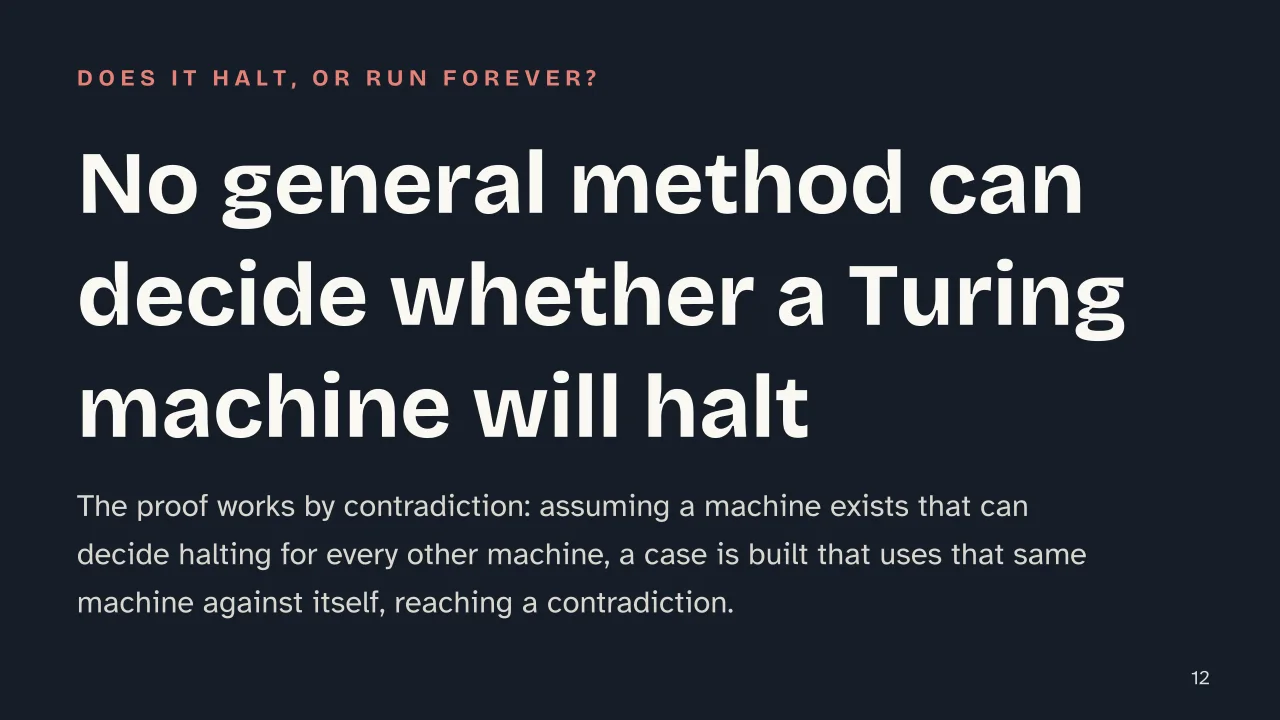
    A procedure of this kind can come to a stop, or it can run forever without ever halting. The halting problem asks whether a general method exists, a machine that works for every other machine and every input, able to say in advance which of the two will happen.

    The answer is no. The proof works by contradiction: assume a machine exists that can decide whether every other machine halts, then build a specific case that turns that same machine against itself, reaching a logical contradiction. The technique is called a diagonal construction, and it is due to Turing.

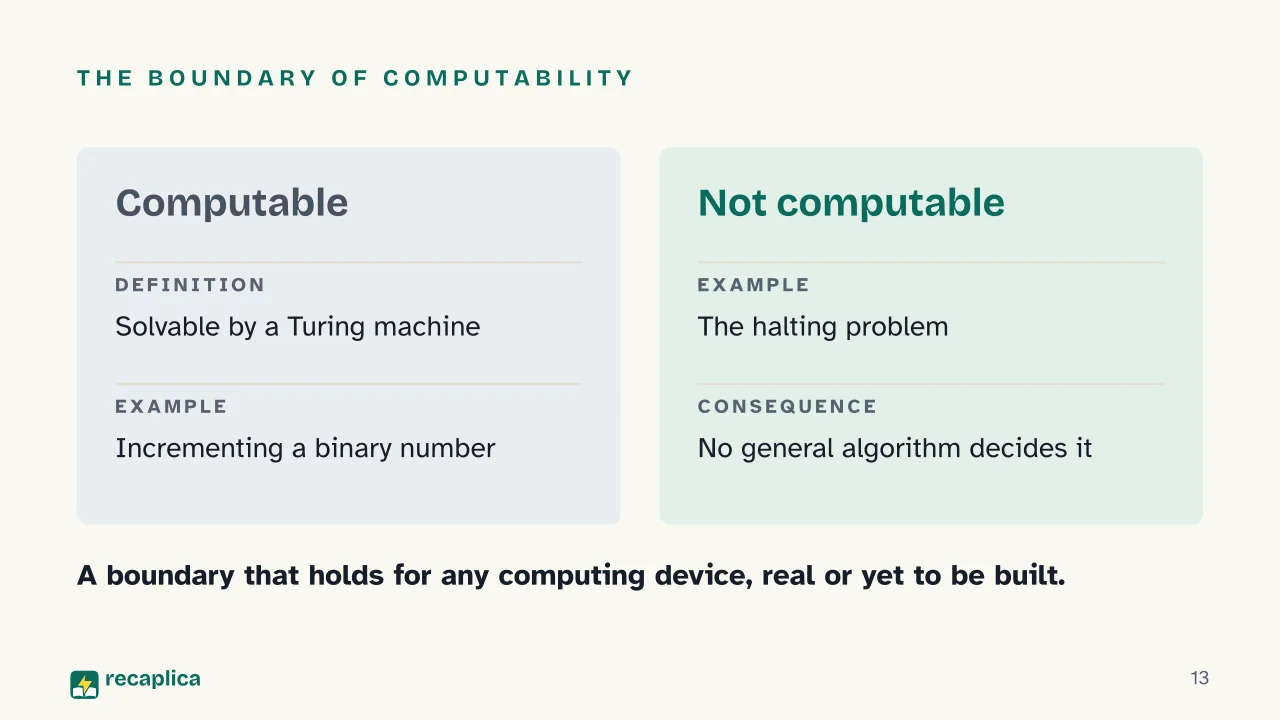
    It is a proven impossibility, holding for any machine, slow or extremely fast: more time or more computing power do not change the result.

    The Church-Turing thesis

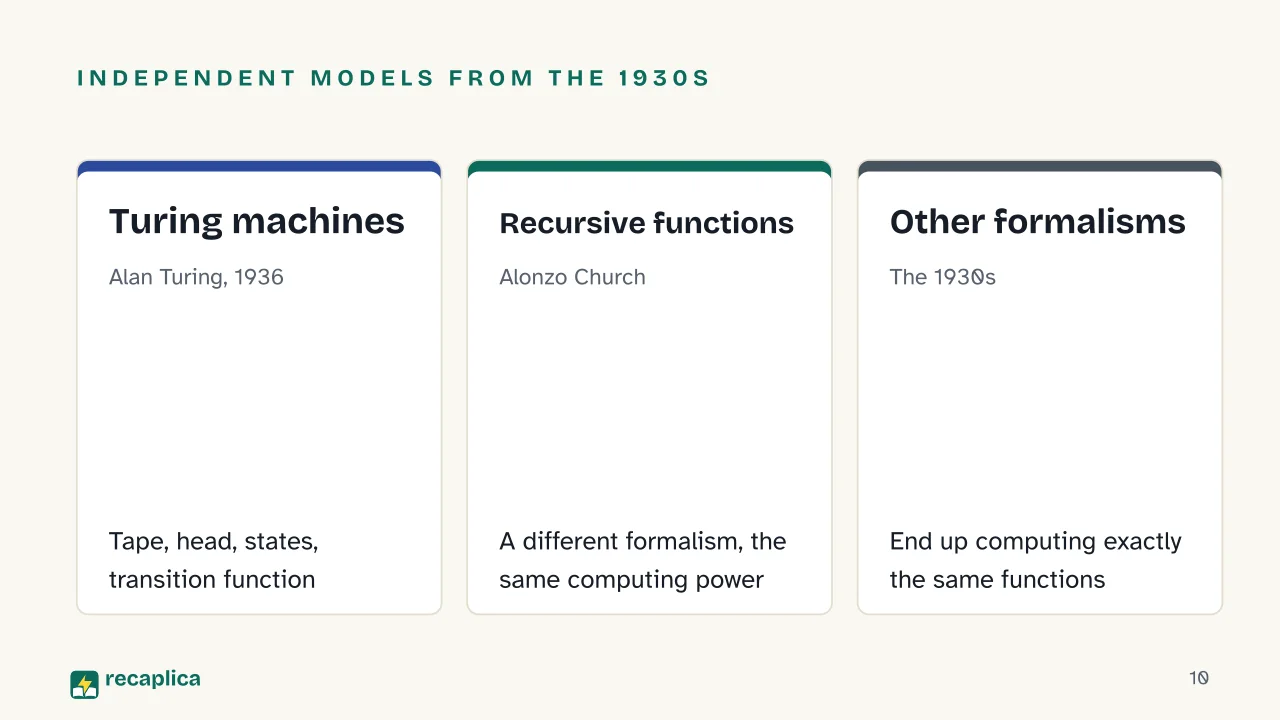
    In the mid-1930s, Alonzo Church and Alan Turing arrived, independently, at the same idea: anything computable by an effective method, an algorithm in the everyday sense of the word, can be computed by a Turing machine.

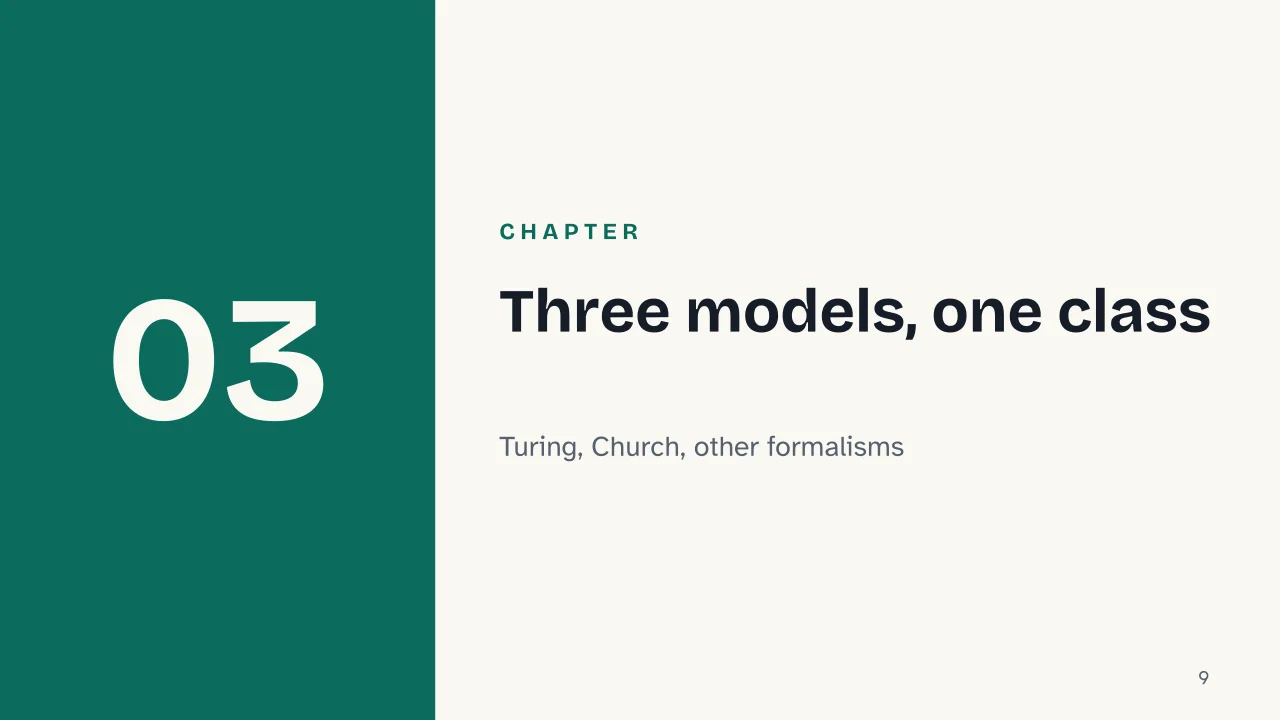
    It is a thesis: no formal mathematical proof exists, but the fact that computation models developed independently in those same years, Turing machines, Church’s recursive functions, other formalisms, converge on one single class of computable functions has made the thesis more credible over time. Kurt Gödel, for his part, judged the Turing machine the first precise and, in his view, correct account of what a mechanical procedure intuitively means; it is one logician’s opinion, carrying real authority but no formal proof behind it.

    The practical consequence touches every computer that exists or ever will: the limits of the theoretical model hold for real machines too, whatever technology builds them. The Church-Turing thesis carries the halting problem into every real machine, a boundary that has nothing to do with any particular programming language, as the Recap on the history of computers also shows. A second consequence concerns numbers instead of programs: the real numbers form a larger infinity than the possible Turing-machine programs, which, by contrast, can be counted one by one, listed in an imaginary catalog. It follows that real numbers necessarily exist that no Turing machine will ever be able to compute: there are simply more of them than there are programs available to compute them, however much time the machine is given to work.

    A machine that simulates others

    The name “universal Turing machine” describes the idea of a single machine able to simulate any other Turing machine. It is a direct extension of the model described so far, but the exact mechanism falls outside what is covered here: it is only named, because the name comes up often alongside the rest of computability theory.

    Slide deck

    Slides ready to download and make your own in PowerPoint or Google Slides, with speaker notes. Pick the Flash cut or the Full one.
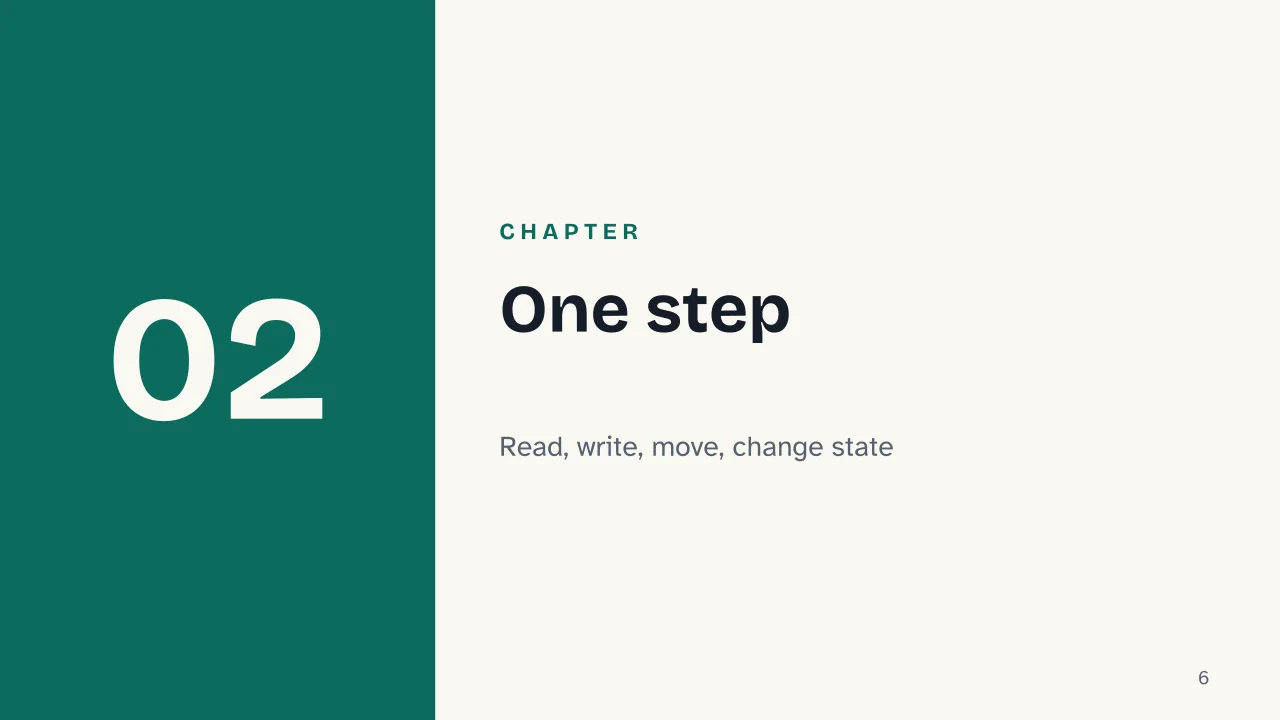
    Slide 1 of the presentation on Turing Machine: The Turing MachineSlide 2 of the presentation on Turing Machine: What does it actually mean to compute?Slide 3 of the presentation on Turing Machine: From the tape to the limit of computationSlide 4 of the presentation on Turing Machine: Chapter 01: The componentsSlide 5 of the presentation on Turing Machine: Tape, head, states: The tape, The head, The statesSlide 6 of the presentation on Turing Machine: Chapter 02: One stepSlide 7 of the presentation on Turing Machine: Inside a single stepSlide 8 of the presentation on Turing Machine: From the tape to the CPUSlide 9 of the presentation on Turing Machine: Chapter 03: Three models, one classSlide 10 of the presentation on Turing Machine: Independent models from the 1930s: Turing machines, Recursive functions, Other formalismsSlide 11 of the presentation on Turing Machine: Chapter 04: The limitSlide 12 of the presentation on Turing Machine: No general method can decide whether a Turing machine will haltSlide 13 of the presentation on Turing Machine: The boundary of computabilitySlide 14 of the presentation on Turing Machine: A 1936 paperSlide 15 of the presentation on Turing Machine: Can a powerful enough computer always tell whether a program will halt?Slide 16 of the presentation on Turing Machine: Now for the review
    Flash10 slidesThe essential thread, to present in classFull16 slidesEvery chapter and the deeper detail

    Common myths

    • ✗ Myth A Turing machine is a real computer, with wires and circuits inside

      ✓ Reality It is an abstract theoretical model, built to reason on paper about what computing means, not a device meant to be assembled. It still works as a real benchmark, because the model is as powerful as any other known model of computation.

    • ✗ Myth A powerful enough computer eventually solves any problem

      ✓ Reality The halting problem proves the opposite: a proof by contradiction rules out any general method for deciding whether a machine will halt, no matter how much time or computing power is available.

    • ✗ Myth The Church-Turing thesis is a theorem proven mathematically

      ✓ Reality It is a thesis, never proven as a mathematical theorem: confidence in it comes from the fact that computation models developed independently in the same years, Turing machines, Church's recursive functions, other formalisms, all single out the same class of computable functions. Logician Kurt Gödel judged that the Turing machine had given the intuitive notion of a mechanical procedure a precise, and in his view correct, definition; that remains an authoritative opinion, not a proof.

    Mind map

    Drag the background to move around and the nodes to reposition them; use − and + to collapse and expand branches.
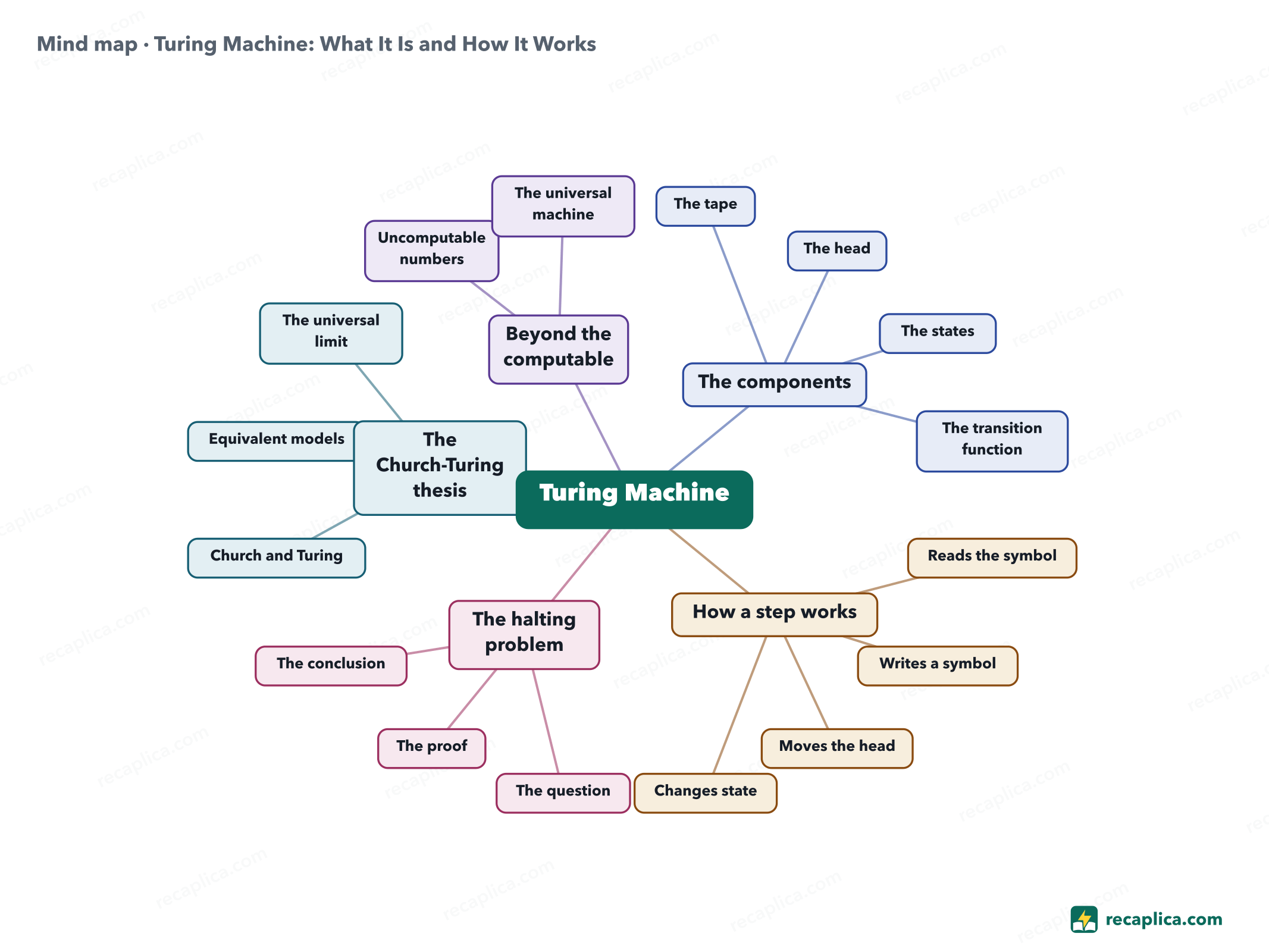
    Customize
    Mind map: Turing Machine: What It Is and How It Works
    • Turing Machine
      • The components tape, head, states, transition function
        • The tape squares holding one symbol each, infinite in one direction
        • The head reads and writes one symbol at a time
        • The states a finite number, also called m-configurations
        • The transition function determines symbol, direction, and next state
      • How a step works
        • Reads the symbol
        • Writes a symbol
        • Moves the head left or right, one square
        • Changes state
      • The halting problem
        • The question is there a method that tells if a machine will halt?
        • The proof by contradiction, with a diagonal construction
        • The conclusion no general algorithm can decide it
      • The Church-Turing thesis
        • Church and Turing put forward independently, in the mid-1930s
        • Equivalent models recursive functions, other formalisms, same computable class
        • The universal limit if no Turing machine computes it, no mechanical procedure can
      • Beyond the computable
        • Uncomputable numbers real numbers outnumber the possible programs, which are countable
        • The universal machine simulates any other Turing machine, only briefly mentioned here

    Quiz: test yourself

    Answer the questions to check what you have learned: you get instant feedback and a short explanation.

    Grade 0/10 0/5
    1 What is the tape of a Turing machine?

    The tape is divided into squares that can each hold a symbol, and it is infinite in one direction.

    2 Given the current state and the symbol read, what does the transition function determine?

    Those three things together, symbol, direction, state, are what define the next step.

    3 True or false: a powerful enough computer can always solve the halting problem, given enough time.

    The proof by contradiction rules out any such general method, regardless of computing power or time available.

    4 What does the Church-Turing thesis state?

    It is the equivalence between 'computable by an effective method' and 'computable by a Turing machine', put forward by Church and Turing.

    5 Why do real numbers exist that no Turing machine can compute?

    Turing-machine programs can be counted one by one, so they are countable; the real numbers always outnumber them.

    Answers: 1-A · 2-B · 3-B · 4-A · 5-A

    Flashcards

    Tap the card to flip it and check whether you remember the answer, then move to the next one.

    1 / 8

    Explain it in your own words

    The ultimate test: if you can explain it in simple words, you've truly understood it. Write your explanation, then compare it with the Recap.

    Your explanation is saved only on this device.

    A Turing machine is a theoretical model of computation: a tape divided into squares, a head that reads and writes one symbol at a time, and a finite number of states. At each step a transition function decides what to write, which way to move the head, and which state comes next, looking only at the present situation and never at what came before. The model exists to pin down, with precision, what "computable" actually means, and it has been used to show that some problems cannot be solved by any machine, real or theoretical, no matter how it is built. The halting problem is the best known case.

    Frequently asked questions

    What is the difference between a Turing machine and a real computer?

    A Turing machine is a theoretical model, not a physical device: it exists to pin down precisely what 'computable' means. The model still holds up well in practice, since it is as powerful as any other known way of computing.

    What is a universal Turing machine?

    The name describes the idea of a single Turing machine able to simulate any other Turing machine. The underlying mechanism is beyond the scope of this Recap, so only the name is given here.

    What is the unary notation used on a Turing machine's tape?

    It is a way of writing numbers on the tape with a single repeated symbol: the number n is represented by a block of n+1 consecutive "1" symbols.

    Does the halting problem apply only to Turing machines, or to real computers too?

    It applies to real computers too: under the Church-Turing thesis, the limits of the model hold for any real computing device, whatever technology it is built with.

    In what year, and in which paper, did Turing introduce this machine?

    In 1936, in the paper "On Computable Numbers, with an Application to the Entscheidungsproblem".

    Sources

    • Stanford Encyclopedia of Philosophy - Turing Machine
    • Stanford Encyclopedia of Philosophy - The Church-Turing Thesis
    • Stanford Encyclopedia of Philosophy - Computability and Complexity
    • Princeton University - 5.2 Turing Machines

    Every Recap goes through an independent review before publication.

    Every evening, the day's new Recaps on our Telegram channel. Join the channel →

    Keep learning

    • Technology Isometric Drawing: What It Is and How to Draw It Isometric drawing represents a three-dimensional object on a flat sheet without distorting its proportions along any of the three axes. The coordinate axes always meet at 120° angles, and the scale is identical along each one — hence the name, which comes from the Greek for equal measure. It is built either by starting from a vertical axis and drawing the other two tilted 120° apart, or by rotating the object roughly 45° and then about 35° relative to the viewer. It is the most common type of axonometric projection in technical drawing, and it also shows up in video games and pixel art. Read the Recap →
    • Technology Monometric Axonometric Projection: What It Is and How to Draw It Monometric axonometric projection is an oblique projection used in technical drawing to represent a three-dimensional object on a flat sheet. In the scheme most common in Italian school curricula, the vertical axis stays upright, while the other two axes are drawn at 30° and 60° from the horizontal, with a 120° angle between the x-axis and the vertical axis. What sets it apart from cavalier axonometric projection is that the object's measurements are transferred onto all three axes without any reduction, at true scale. In Italian technical-drawing vocabulary the name carries some genuine uncertainty: some sources treat it as a synonym for isometric projection, while other textbooks present it as a separate category. Read the Recap →
    • Technology Axonometric Projection: Definition and How to Draw It Axonometric projection is the descriptive-geometry method for drawing a three-dimensional object on a flat sheet in a single view. Unlike perspective, parallel lines stay parallel, so distances can be measured straight off the drawing. Several variants exist, isometric, trimetric, dimetric, oblique (cavalier), which change the angles between the axes and how each one shortens the measurements. The type most used in school technical drawing is isometric, with 120° angles between the axes, built from an isometric scale that carries the correct lengths onto the paper. Engineers and architects also rely on it to show the shape and structure of a building in one diagram. Read the Recap →

    recaplica

    Clear in 30 seconds, yours in 10 minutes.

    Recaps Mind maps Request a Recap Telegram channel Mind map maker Our method About Privacy & cookies Legal notes & terms of use

    © 2026 Recaplica · A project by Curi S.r.l. — VAT IT05472000750

    Statistics, only if you say so

    To learn which Recaps help most we would use Google Analytics, with aggregate, anonymous data. It starts only with your OK, and you can change your mind anytime. Privacy policy