Skip to content
recaplica

    One moment: security check

    Cloudflare wants to make sure you're not a robot. Tick the box below and your search will continue on its own.

    IT
    recaplica Alan Turing and the Enigma Machine: How the Nazi Code Was Broken
    © 2026 Recaplica · recaplica.com — All rights reserved
    Home › History

    Alan Turing and the Enigma Machine: How the Nazi Code Was Broken

    By Recaplica Newsroom · Updated on October 3, 2026

    What to print

    Page numbers appear when printing with default margins.

    Slides

    Choose a cut

    Flash10 slidesThe essential thread, to present in classFull16 slidesEvery chapter and the deeper detail

    Both come with speaker notes.

    Telegram channel
    recaplica Clear in 30 seconds, yours in 10 minutes.
    In 30 seconds Key points Figures Deep dive Slides Myths Mind map Quiz Flashcards FAQ

    In 30 seconds quick read

    The Enigma machine was the device the German military used to encrypt its messages during World War II: three rotors, a reflector and, in the military models, a plugboard that swapped letters in pairs. At Bletchley Park, in England, Alan Turing and Gordon Welchman designed the Bombe, an electromechanical machine built to find Enigma's daily key starting from a suspected fragment of plaintext, the crib. The work broke German air force messages first, from 1940, then submarine traffic, after German documents were captured in 1941. The historian Harry Hinsley judged, in 1993, that the Allies would still have won the war without that breakthrough, but not until 1946 or 1947.

    Key Points

    • Enigma scrambled letters through a set of removable rotors and an adjustable reflector; the military models also carried a plugboard that swapped letters in pairs.
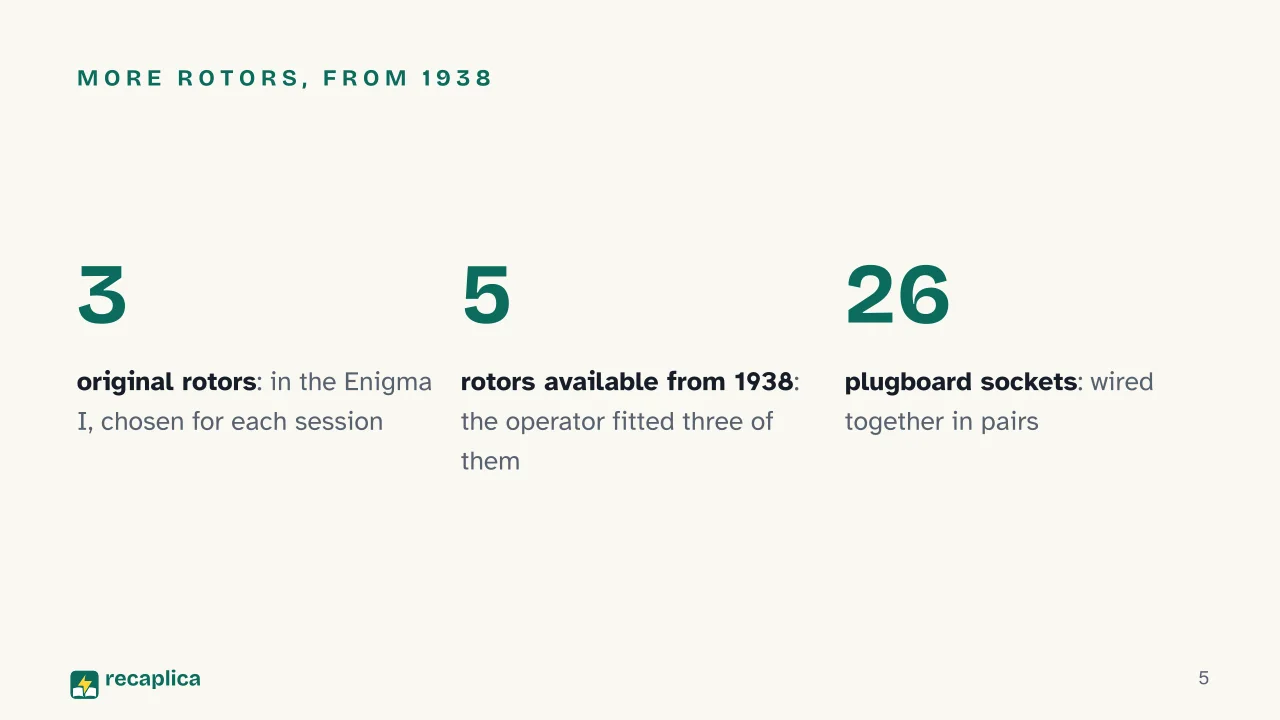
    • From 1938 the Enigma I offered five rotors, three of which the operator chose for each session.
    • Alan Turing and Gordon Welchman designed the Bombe in late 1939: an electromechanical device for working back, from a crib, to Enigma's daily key.
    • The first Bombe, Victory, started breaking codes at Bletchley Park on 14 March 1940; by the end of the war 211 were running, operated mostly by women of the WRNS.
    • The breakthrough on naval ciphers came in February 1941, with documents captured from the German trawler Krebs; in February 1942 a new four-rotor Enigma made U-boat traffic unreadable again, until December of that year.
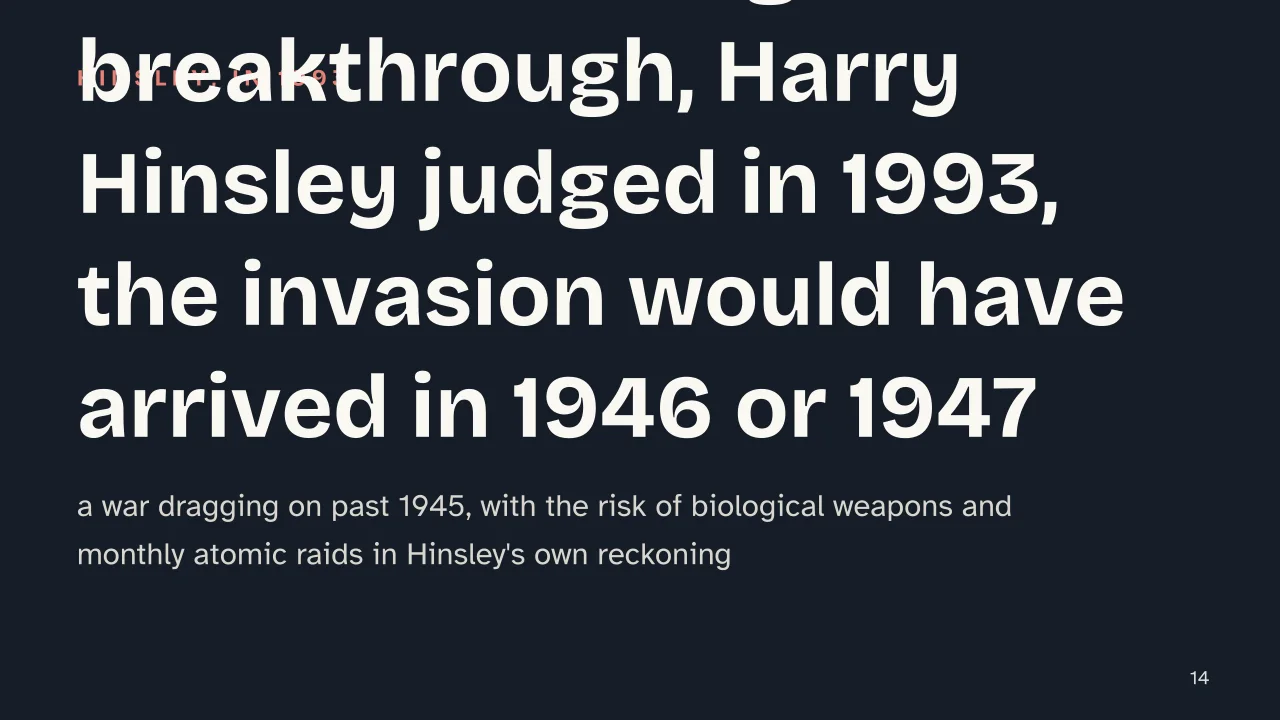
    • The historian Harry Hinsley judged, in 1993, that without the Enigma breakthrough the Allied landing in Europe would have slipped to 1946 or 1947.

    Key figures

    • 5 rotors From 1938 the Enigma I offered five rotors to choose three from for each session, instead of the original three. Source: Bletchley Park Trust, 1938
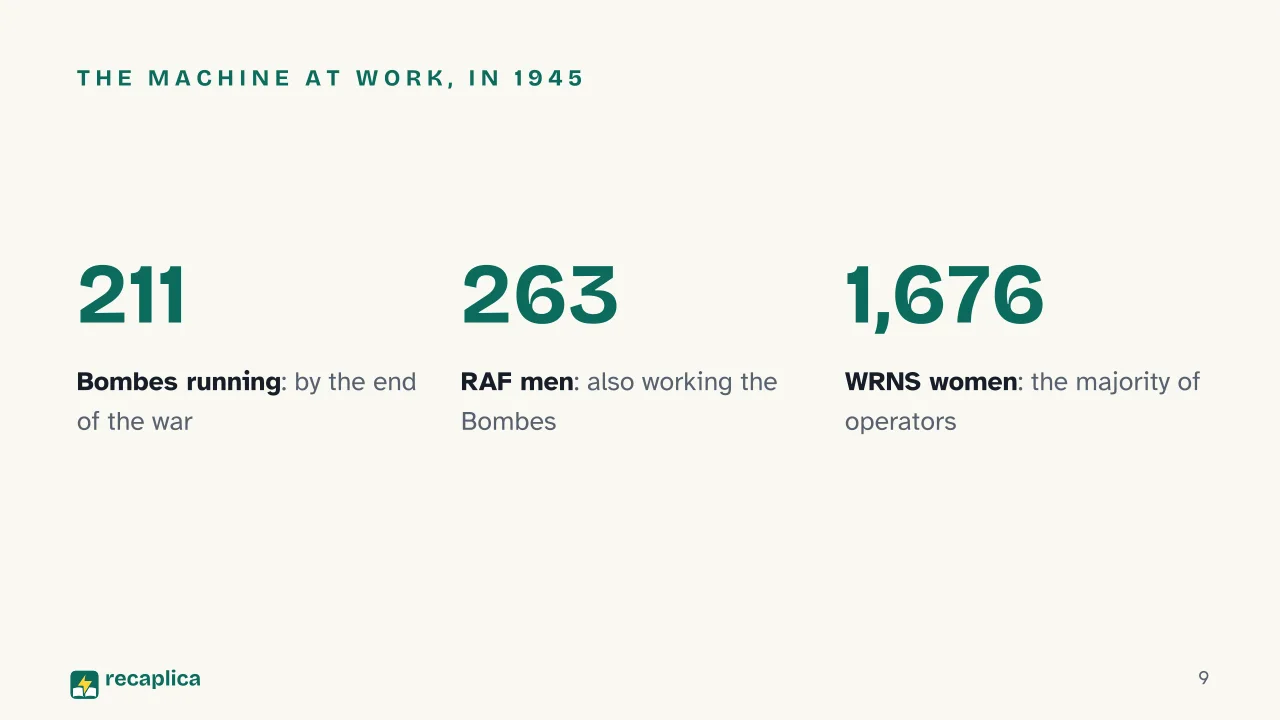
    • 211 Bombes By the end of the war, in 1945, 211 Bombes were running, operated by almost 1,676 women of the WRNS and 263 men of the RAF. Source: The National Museum of Computing

    Deep Dive

    How the Enigma Machine Encrypted Text

    According to the Bletchley Park Trust, the German military Enigma, in its Enigma I version, enciphered letters by routing them through three removable rotors, which could be reordered to change the cipher for each session. An adjustable reflector then sent the signal back through those same rotors, pushing it along the same path twice.

    The Enigma I was also the first model to add a plugboard: twenty-six sockets, wired together in pairs, that rerouted two letters in the gap between a key press and the signal’s arrival at the rotors. No civilian Enigma carried one. From 1938, two more rotors joined the original three: the operator now picked three out of five for each session, and every different combination of rotors, rings and plugboard settings produced a different cipher.

    The Crib and the Bombe: Bletchley Park’s Method

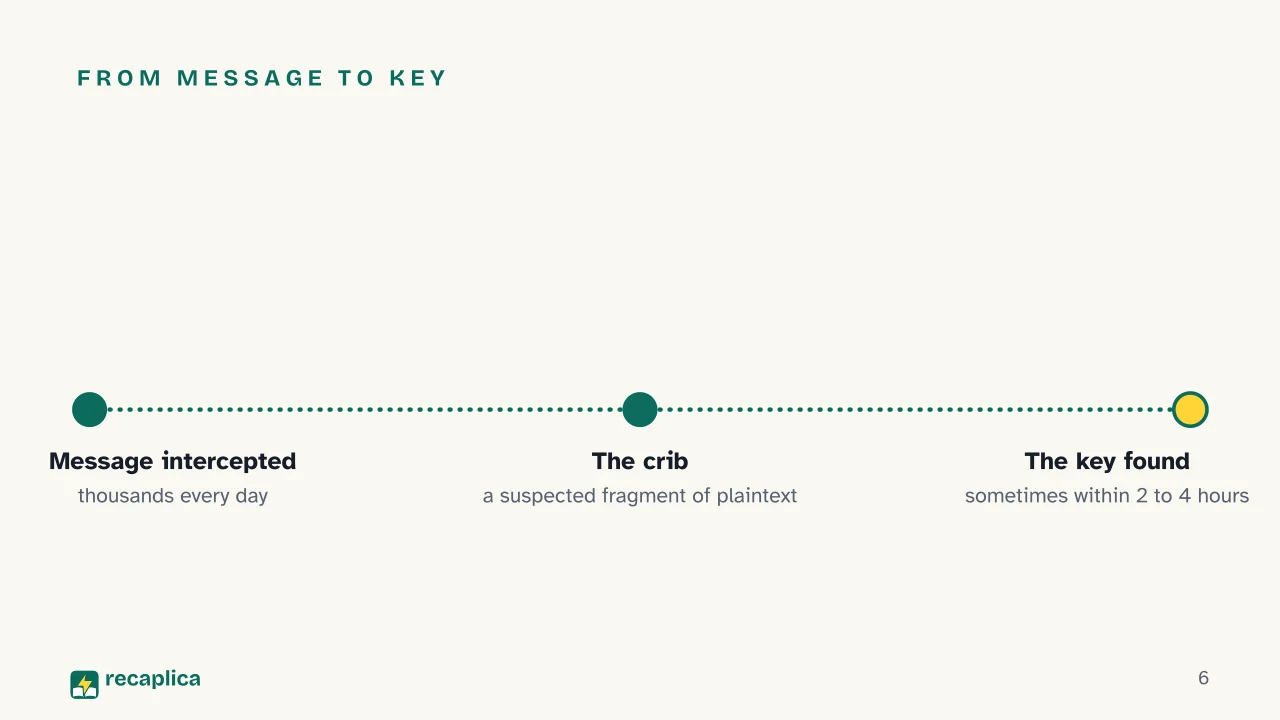
    Enigma’s keys changed every day and, according to The National Museum of Computing, had to be found in time to read between 3,000 and 5,000 intercepted messages daily. Turing and the Cambridge mathematician Gordon Welchman built the Bombe toward the end of 1939, an electromechanical device meant to speed up the search for those settings.

    Practical example: a cryptanalyst would spot, in an intercepted message, a pattern that matched a crib — a fragment of plaintext they suspected was hiding in there. The Bombe, which held several drums wired together like multiple Enigma machines, then mechanically tested many setting combinations, discarding whichever ones clashed with the crib until only the daily key was left standing.

    Some daily keys fell within 2 to 4 hours, The National Museum of Computing notes; others were never broken at all. Speed mattered, because the key would change again the next day.

    Bletchley Park: The Team Behind the Machine

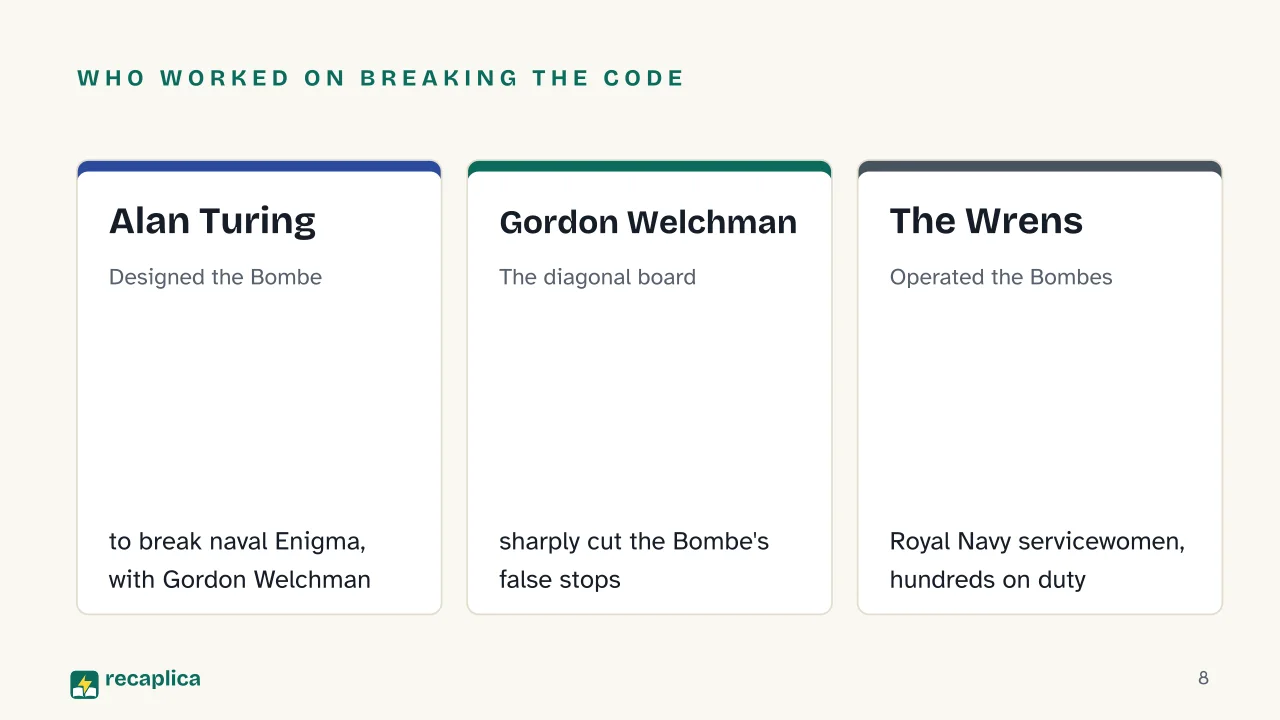
    The work went on in wooden huts, built across the grounds of the Bletchley Park estate. Turing ran Hut Eight, given over to cryptanalysis of German naval signals. Gordon Welchman’s contribution, the diagonal board, sharply cut the number of false stops the Bombe produced — the dead ends in the hunt for the key. Victory, the first Bombe, running from 14 March 1940, was still Turing’s original design, without that upgrade: the first machine with Welchman’s diagonal board, nicknamed Agnes, entered service in August 1940. Hundreds of Bombes were kept running by the Wrens, the Royal Navy’s servicewomen: by the end of the war, almost 1,676 women of the WRNS and 263 men of the RAF were operating 211 of them.

    The first dedicated building, Hut 11, held up to six machines from March 1941. Hut 11A replaced it in February 1942, with room for nine.

    A few years after the war, in 1952, Turing himself was convicted over his homosexuality: the Recap Was Alan Turing Gay? The 1952 Conviction, Chemical Castration and Pardon tells what happened to him.

    From the Air Force to the U-boats: The War by Radio

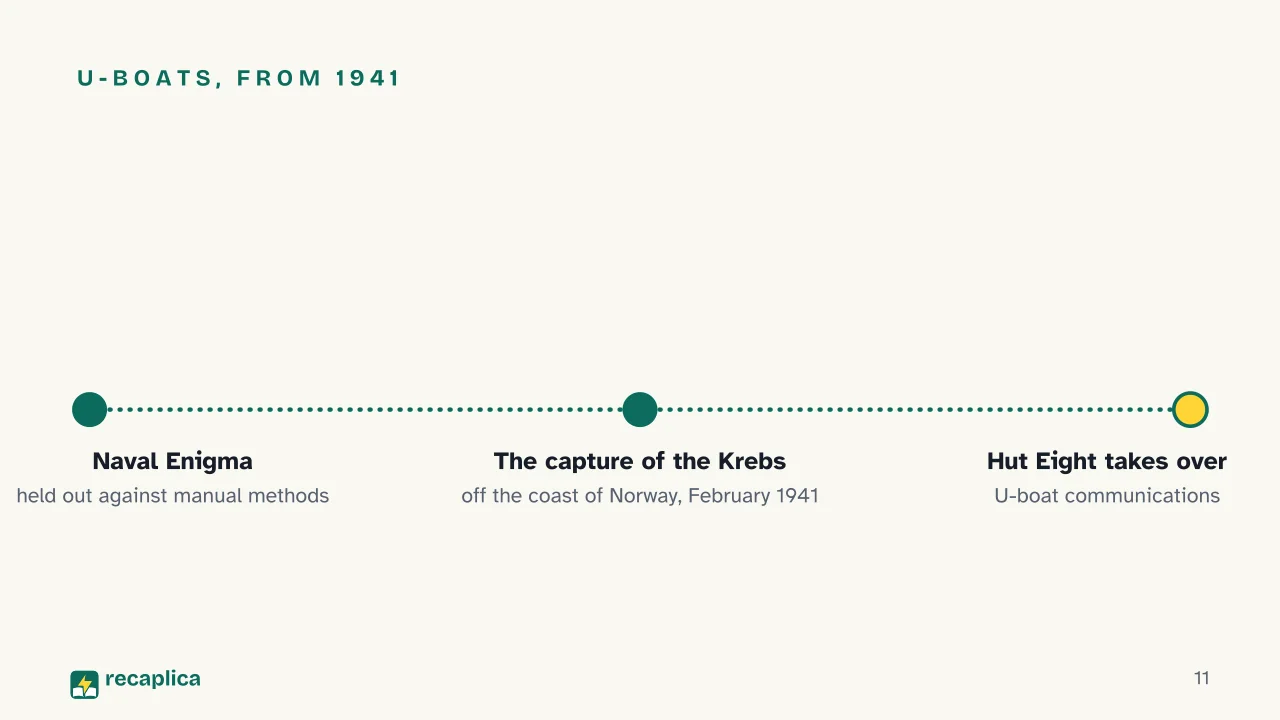
    By May 1940, Victory was already breaking German air force messages, the Luftwaffe’s traffic. Naval ciphers held out longer: the breakthrough came in February 1941, thanks to documents captured from the German trawler Krebs, off the coast of Norway. From that point on, helped by further captures, German submarine communications fell largely under the control of the Hut Eight codebreakers, directed by Turing.

    AspectLuftwaffe EnigmaNaval Enigma (U-boats)
    Rotors in useThreeFour, from 1 February 1942
    Broken fromMay 1940February 1941, after the Krebs capture
    Blackout period—Unreadable from 1 February to December 1942

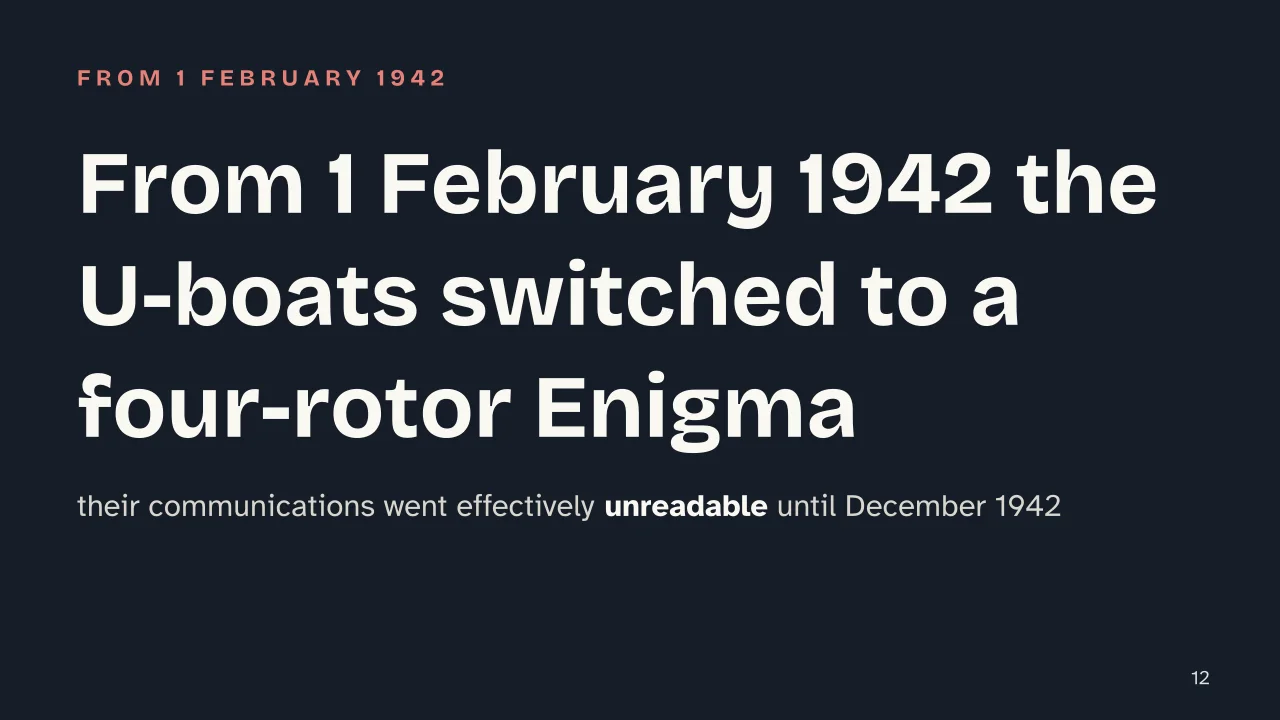
    On 1 February 1942, the U-boats switched to a four-rotor version of Enigma, more complex than anything used before, and their communications went effectively unreadable until December of that year.

    How Much It Really Mattered

    Those who had worked on the decryption at Bletchley Park kept total silence about it for thirty years after the war ended, until the mid-1970s. Harry Hinsley, the official historian of British intelligence, judged in a 1993 address that without the Enigma breakthrough the Allied invasion of Europe would have slipped to 1946 or 1947, with the war dragging on past 1945. Hinsley suggested that scenario might have brought biological weapons such as anthrax and American atomic bombing raids roughly once a month after July 1945.

    Two Machines, One Surname

    The Enigma machine was the physical device the Germans used to encrypt their messages, and the Bombe is what Bletchley Park built to break it. The Turing machine is something else, despite the near-identical name: a theoretical concept, built from a tape, a head and a set of states, which defined what a computer can or cannot calculate. The author and the surname in the title are all the two machines have in common.

    For the wider context of the conflict, the Recap on World War II is worth a look. The step-by-step method Turing and Welchman built, a sequence of mechanical steps narrowing down the possibilities to a single key, points toward the modern idea of an algorithm; the Bombes themselves, large-scale electromechanical calculating machines, open onto the broader history of computers.

    Slide deck

    Slides ready to download and make your own in PowerPoint or Google Slides, with speaker notes. Pick the Flash cut or the Full one.
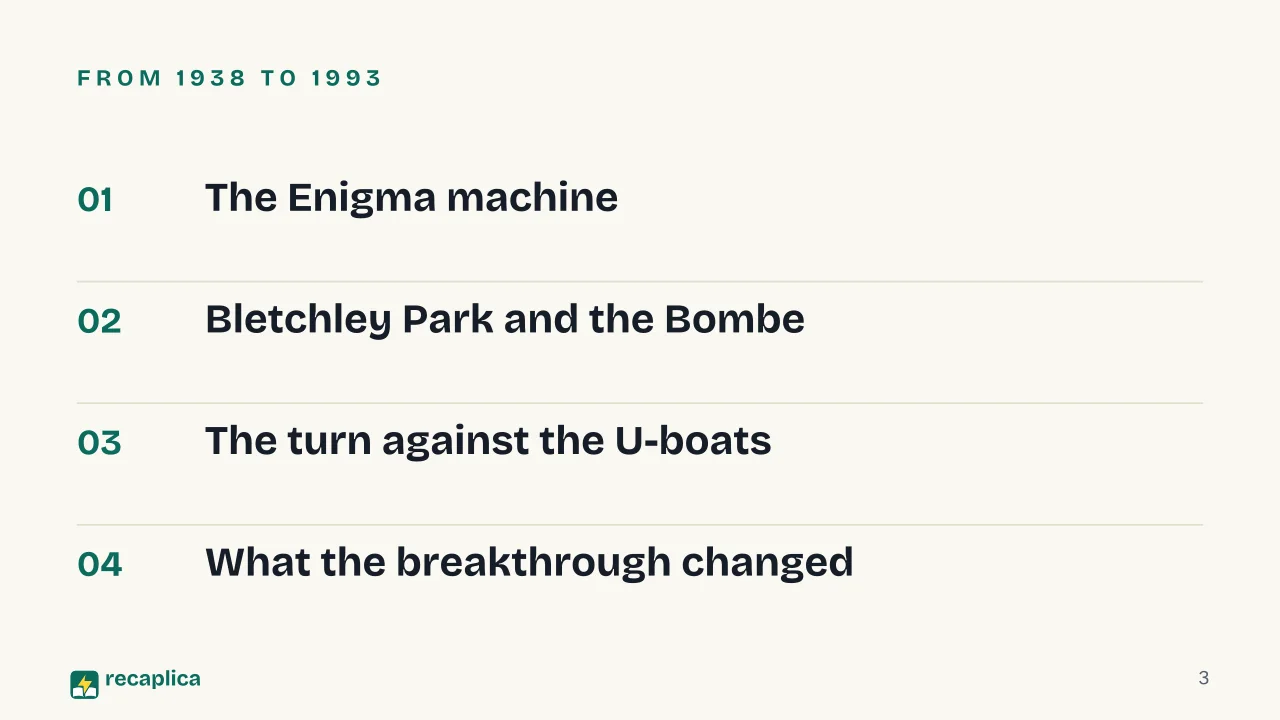
    Slide 1 of the presentation on Alan Turing and the Enigma Machine: Alan Turing and the Enigma MachineSlide 2 of the presentation on Alan Turing and the Enigma Machine: How do you crack a code that changes every day?Slide 3 of the presentation on Alan Turing and the Enigma Machine: From 1938 to 1993Slide 4 of the presentation on Alan Turing and the Enigma Machine: Chapter 01: The Enigma MachineSlide 5 of the presentation on Alan Turing and the Enigma Machine: More rotors, from 1938Slide 6 of the presentation on Alan Turing and the Enigma Machine: From message to keySlide 7 of the presentation on Alan Turing and the Enigma Machine: Chapter 02: Bletchley Park and the BombeSlide 8 of the presentation on Alan Turing and the Enigma Machine: Who worked on breaking the code: Alan Turing, Gordon Welchman, The WrensSlide 9 of the presentation on Alan Turing and the Enigma Machine: The machine at work, in 1945Slide 10 of the presentation on Alan Turing and the Enigma Machine: Chapter 03: The turn against the U-boatsSlide 11 of the presentation on Alan Turing and the Enigma Machine: U-boats, from 1941Slide 12 of the presentation on Alan Turing and the Enigma Machine: From 1 February 1942 the U-boats switched to a four-rotor EnigmaSlide 13 of the presentation on Alan Turing and the Enigma Machine: Chapter 04: What the breakthrough changedSlide 14 of the presentation on Alan Turing and the Enigma Machine: Without the Enigma breakthrough, Harry Hinsley judged in 1993, the invasion would have arrived in 1946 or 1947Slide 15 of the presentation on Alan Turing and the Enigma Machine: What triggered the breakthrough on German naval ciphers, in February 1941?Slide 16 of the presentation on Alan Turing and the Enigma Machine: Where to read more?
    Flash10 slidesThe essential thread, to present in classFull16 slidesEvery chapter and the deeper detail

    Common myths

    • ✗ Myth Many people assume Enigma was a machine that could never be broken.

      ✓ Reality Every combination of rotors, rings and plugboard produced a different cipher, but the method of cribs and the Turing-Welchman Bombe narrowed the possible combinations down to the key, in some cases within 2 to 4 hours.

    • ✗ Myth Breaking Enigma is often pictured as Alan Turing's work alone.

      ✓ Reality Gordon Welchman contributed the diagonal board, which sharply cut the Bombe's false stops, and hundreds of women of the WRNS and men of the RAF kept the machines running day and night.

    • ✗ Myth Once broken, the German cipher is assumed to have stayed readable for the rest of the war.

      ✓ Reality From 1 February 1942 a new four-rotor naval Enigma shut down U-boat traffic again, and reading it only became possible once more in December 1942.

    Mind map

    Drag the background to move around and the nodes to reposition them; use − and + to collapse and expand branches.
    Customize
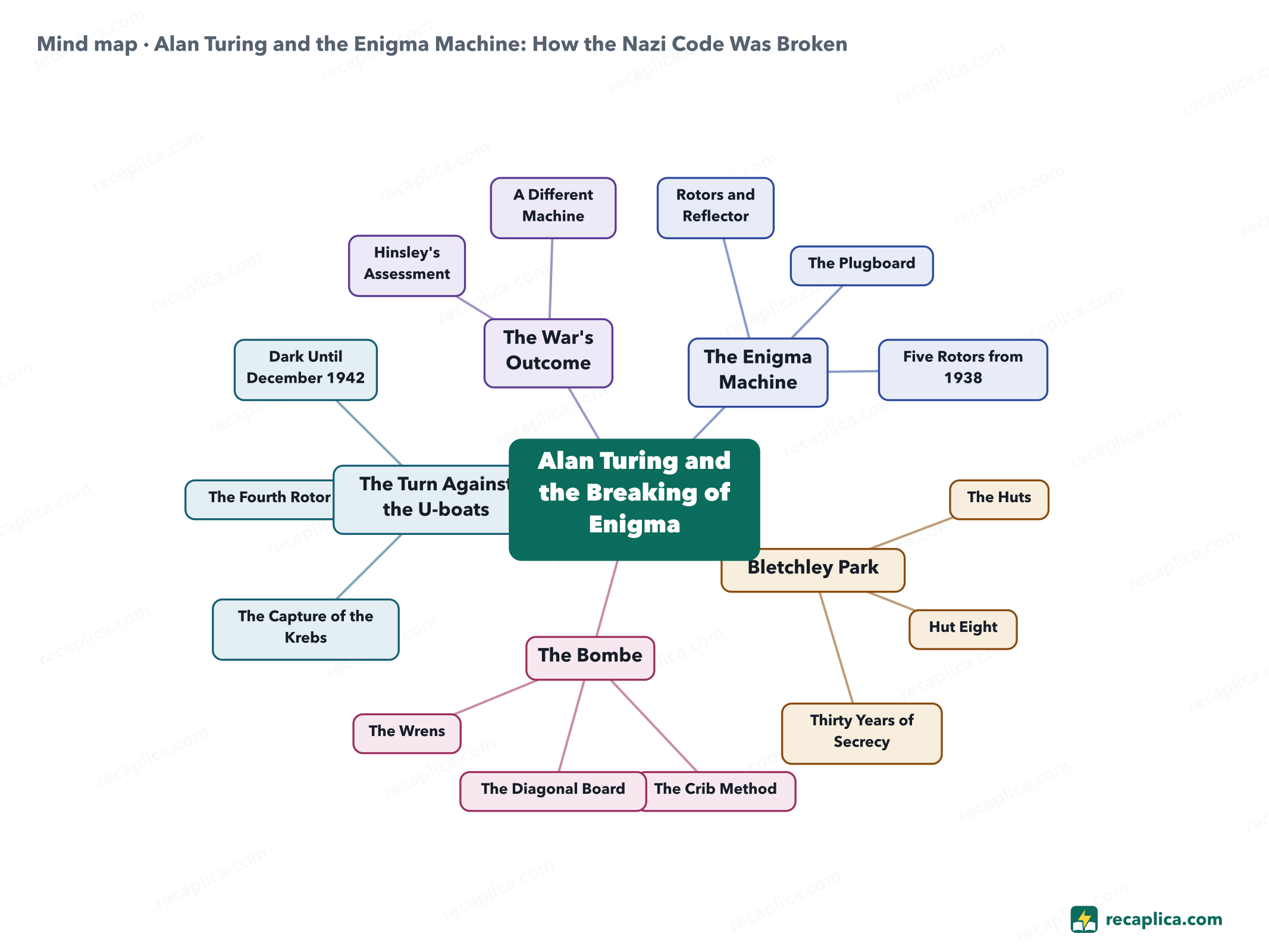
    Mind map: Alan Turing and the Enigma Machine: How the Nazi Code Was Broken
    • Alan Turing and the Breaking of Enigma
      • The Enigma Machine
        • Rotors and Reflector three removable rotors, a reflector that sends the signal back
        • The Plugboard swaps letter pairs before the rotors, military models only
        • Five Rotors from 1938 the operator picks three for each session
      • Bletchley Park
        • The Huts the buildings where the technical work happened
        • Hut Eight run by Turing, German naval signals
        • Thirty Years of Secrecy kept until the mid-1970s
      • The Bombe
        • The Crib Method a suspected fragment of plaintext checked against the enciphered message
        • The Diagonal Board Gordon Welchman's contribution, fewer false stops
        • The Wrens the Royal Navy servicewomen who ran the machines
      • The Turn Against the U-boats
        • The Capture of the Krebs February 1941, off the coast of Norway
        • The Fourth Rotor from 1 February 1942, a more complex naval Enigma
        • Dark Until December 1942 communications unreadable again
      • The War's Outcome
        • Hinsley's Assessment in 1993, the invasion slipping to 1946 or 1947
        • A Different Machine Turing's theoretical machine is a separate concept

    Quiz: test yourself

    Answer the questions to check what you have learned: you get instant feedback and a short explanation.

    Grade 0/10 0/5
    1 What did the plugboard add to Enigma's encryption?

    According to the Bletchley Park Trust, the plugboard linked letters in pairs the instant after the operator pressed a key, before the signal ever reached the rotors — an extra layer of encryption found only in the military models.

    2 Who designed the Bombe together with Alan Turing?

    At the end of 1939, Turing and the Cambridge mathematician Gordon Welchman designed the British Bombe together.

    3 True or false: the Bombes were operated mostly by women of the WRNS.

    The Bombes were run mainly by the Wrens, the Women's Royal Naval Service; a smaller group of RAF men did the same work.

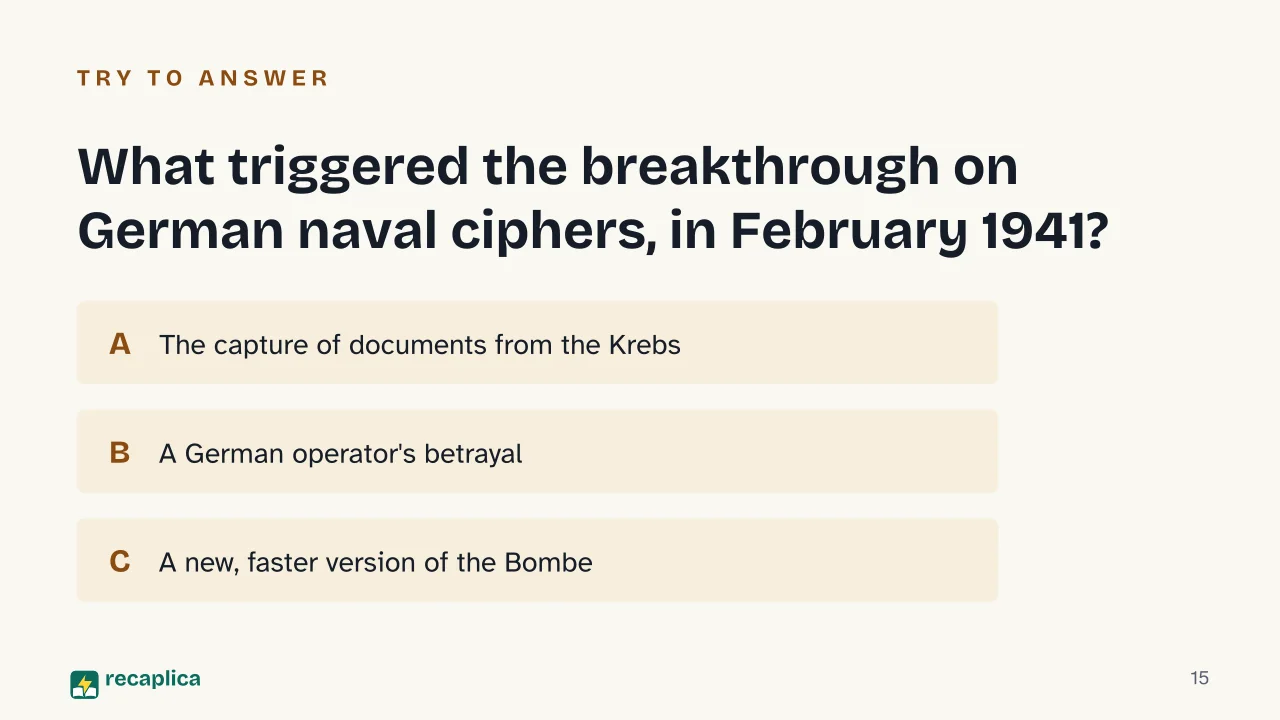
    4 What triggered the breakthrough on German naval ciphers, in February 1941?

    The breakthrough came from documents captured aboard the Krebs, off the coast of Norway: from then on, naval cryptanalysis, run by Turing in Hut Eight, came to dominate German submarine communications.

    5 What did the historian Harry Hinsley conclude, in 1993, about the Enigma breakthrough?

    Hinsley, the official historian of British intelligence, judged in 1993 that the Allied invasion would have landed in 1946 or 1947, with the same final result for the war.

    Answers: 1-A · 2-A · 3-A · 4-A · 5-A

    Flashcards

    Tap the card to flip it and check whether you remember the answer, then move to the next one.

    1 / 8

    Explain it in your own words

    The ultimate test: if you can explain it in simple words, you've truly understood it. Write your explanation, then compare it with the Recap.

    Your explanation is saved only on this device.

    The Enigma machine was the device the German military used to encrypt its messages during World War II: three rotors, a reflector and, in the military models, a plugboard that swapped letters in pairs. At Bletchley Park, in England, Alan Turing and Gordon Welchman designed the Bombe, an electromechanical machine built to find Enigma's daily key starting from a suspected fragment of plaintext, the crib. The work broke German air force messages first, from 1940, then submarine traffic, after German documents were captured in 1941. The historian Harry Hinsley judged, in 1993, that the Allies would still have won the war without that breakthrough, but not until 1946 or 1947.

    Frequently asked questions

    How did the Enigma machine work?

    The German Enigma machine used three removable rotors that enciphered letters, a reflector that sent the signal back through the rotors, and, in the military Enigma I model, a plugboard that swapped pairs of letters before the rotors: every combination of these settings produced a different cipher.

    What is Bletchley Park?

    It's the British estate where, during World War II, the cryptanalysis team partly led by Alan Turing worked, in buildings called huts; the Bombes that deciphered Enigma messages were built and operated there.

    Did Alan Turing invent the computer by breaking Enigma?

    No: at Bletchley Park Turing designed the Bombe, an electromechanical device built to find Enigma's keys, a different thing from the theoretical Turing machine he had described a few years earlier (see the linked Recap on the Turing machine).

    How much did breaking Enigma shorten the war?

    There's no firm figure: Harry Hinsley, in 1993, judged the war's final result already settled either way; what would have changed, in his assessment, was only the date — 1946 or 1947 instead of 1945.

    Why did the work at Bletchley Park stay secret for so long?

    The people who had worked there couldn't talk about it for roughly thirty years: the secrecy only lifted in the mid-1970s.

    Sources

    • Enigmas of Bletchley Park
    • 6 facts about the Bombe
    • The Turing-Welchman Bombe
    • Alan Turing Scrapbook — The Enigma War
    • Alan Turing Scrapbook — The Electronic War

    Every Recap goes through an independent review before publication.

    Every evening, the day's new Recaps on our Telegram channel. Join the channel →

    Keep learning

    • History Was Alan Turing Gay? The 1952 Conviction, Chemical Castration and Pardon Yes, Alan Turing was gay. In 1952 a court in Manchester convicted him after police charged him over a same-sex relationship, an act British law classified as 'gross indecency.' The judge gave him a choice: prison, or probation on condition of hormone injections that sources call 'chemical castration.' Turing chose the treatment, lost the security clearance that let him do classified cryptologic work for the British state, and died at his home in Wilmslow on 7 June 1954. In 2013 Queen Elizabeth II granted him an individual royal pardon, and in 2017 a law known as Turing's Law extended a posthumous pardon to thousands of other men convicted under sexual offences long since struck from the law books. Read the Recap →
    • History The Atomic Bomb: How Nuclear Fission Works, and the History of Hiroshima and Nagasaki The atomic bomb is a weapon that releases an enormous amount of energy by splitting the nuclei of heavy atoms such as uranium or plutonium, a process called nuclear fission. The Manhattan Project, the secret program that built the first American atomic bombs, cost $2.2 billion at the time and employed 130,000 people at its peak. On 6 August 1945 the United States dropped Little Boy on Hiroshima, and three days later, on 9 August, Fat Man on Nagasaki: the only two atomic bombs ever used in a war. Deaths ran into the tens of thousands in the months that followed, and Japan surrendered on 14 August 1945, a decision whose relative weight of causes historians still debate. Since 1970 the Treaty on the Non-Proliferation of Nuclear Weapons has tried to limit the spread of these weapons around the world. Read the Recap →
    • History Why Korea Is Divided: North Korea's History and How It's Ruled North and South Korea have been separate states since 1948, the outcome of several factors layered on top of each other, the legacy of Japanese occupation, the division the Allies drew along the 38th parallel in August 1945, and the Korean War of 1950-53, which ended only in an armistice never followed by a peace treaty. In the north, the Democratic People's Republic of Korea has been led since 1948 by the Kim dynasty, by Kim Jong Un since 2011, through a single ruling party and a state ideology of self-reliance called Juche. North Korea publishes no reliable official statistics and its economy depends almost entirely on trade with China; since 2006 the country has been under a series of UN Security Council sanctions tied to its nuclear and missile programs. Technically, the two Koreas remain in a suspended conflict more than seventy years on. Read the Recap →

    recaplica

    Clear in 30 seconds, yours in 10 minutes.

    Recaps Mind maps Request a Recap Telegram channel Mind map maker Our method About Privacy & cookies Legal notes & terms of use

    © 2026 Recaplica · A project by Curi S.r.l. — VAT IT05472000750

    Statistics, only if you say so

    To learn which Recaps help most we would use Google Analytics, with aggregate, anonymous data. It starts only with your OK, and you can change your mind anytime. Privacy policy