Skip to content
recaplica

    One moment: security check

    Cloudflare wants to make sure you're not a robot. Tick the box below and your search will continue on its own.

    IT
    recaplica The History of Mac OS and macOS: System 1, NeXTSTEP and Apple Silicon
    © 2026 Recaplica · recaplica.com — All rights reserved
    Home › Technology

    The History of Mac OS and macOS: System 1, NeXTSTEP and Apple Silicon

    By Recaplica Newsroom · Updated on September 6, 2026

    What to print

    Page numbers appear when printing with default margins.

    Slides

    Choose a cut

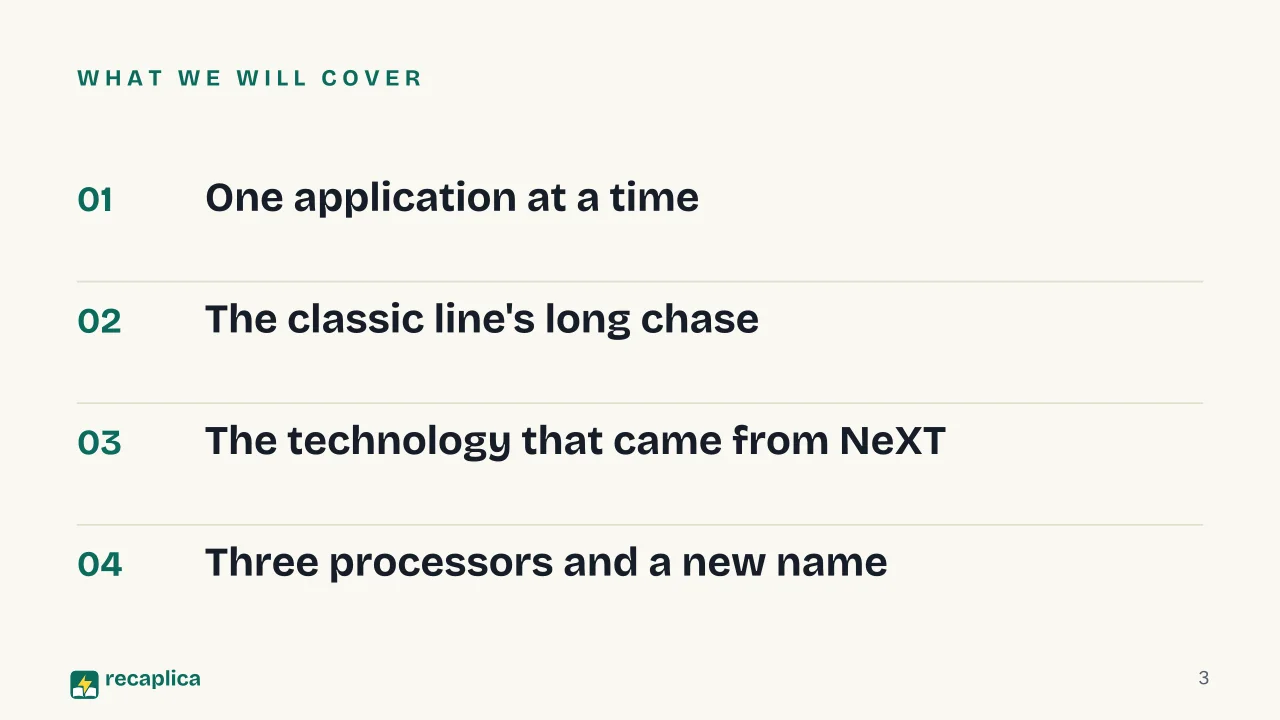
    Flash10 slidesThe essential thread, to present in classFull18 slidesEvery chapter and the deeper detail

    Both come with speaker notes.

    Telegram channel
    recaplica Clear in 30 seconds, yours in 10 minutes.
    In 30 seconds Key points Figures Deep dive Slides Myths Mind map Quiz Flashcards FAQ

    In 30 seconds quick read

    The first Macintosh launched on January 24, 1984, running an operating system that could handle only one application at a time, System 1.0. For fifteen years Apple kept updating it piece by piece, all the way to Mac OS 9, while chasing an internal overhaul project called Copland that never landed. The breakthrough came from the company's own founder: in 1997 Apple bought back NeXT, the company Steve Jobs had started after leaving in 1985, inheriting its NeXTSTEP technology, which became the foundation of Mac OS X in 2001. From there the Mac's operating system went through two more processor architecture changes, from PowerPC to Intel and then from Intel to Apple Silicon, and in 2025 it even changed the way its versions are numbered.

    Key Points

    • The Macintosh 128K, launched January 24, 1984 for $2,495, sold 70,000 units by May 3 of that year; the launch came just days after Ridley Scott's "1984" ad aired during Super Bowl XVIII.
    • Classic Mac OS stayed single-application for years, gained cooperative multitasking with the MultiFinder in 1987, and finally got virtual memory and 32-bit addressing with System 7 in 1991; the last update, Mac OS 9.2.2, shipped on December 5, 2001.
    • After being pushed out of Apple in September 1985, Steve Jobs founded NeXT; in 1997, with the internal Copland project dead, Apple bought NeXT for $427 million and inherited its NeXTSTEP technology.
    • Mac OS X debuted on March 24, 2001 under the code name "Cheetah" and brought a hybrid Unix kernel, Darwin, built on Mach with roots in FreeBSD.
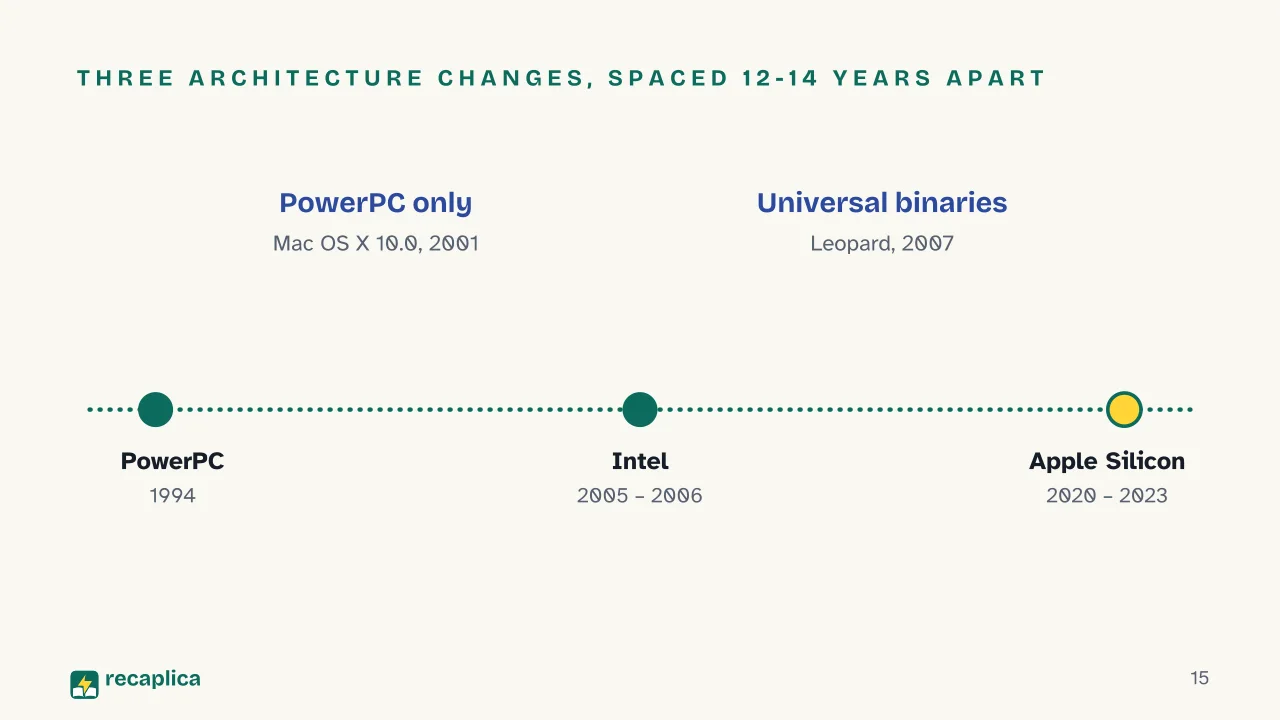
    • The Mac's history includes three processor architecture transitions, spaced 12-14 years apart, from Motorola 68000 to PowerPC in 1994, from PowerPC to Intel between 2005 and 2006, and from Intel to Apple Silicon between 2020 and 2023.
    • Since 2025 Apple numbers macOS after the calendar year, with macOS 26 "Tahoe" released on September 15, 2025 and macOS 27 "Golden Gate" expected in 2026.

    Key figures

    • $2,495 the Macintosh 128K's launch price in January 1984, equivalent to roughly $7,700 in 2025 dollars Source: Wikipedia, Macintosh 128K
    • $427 million the amount Apple paid to acquire NeXT in 1997, the deal that brought Steve Jobs back to the company and made NeXTSTEP the foundation of Mac OS X Source: Wikipedia, NeXT
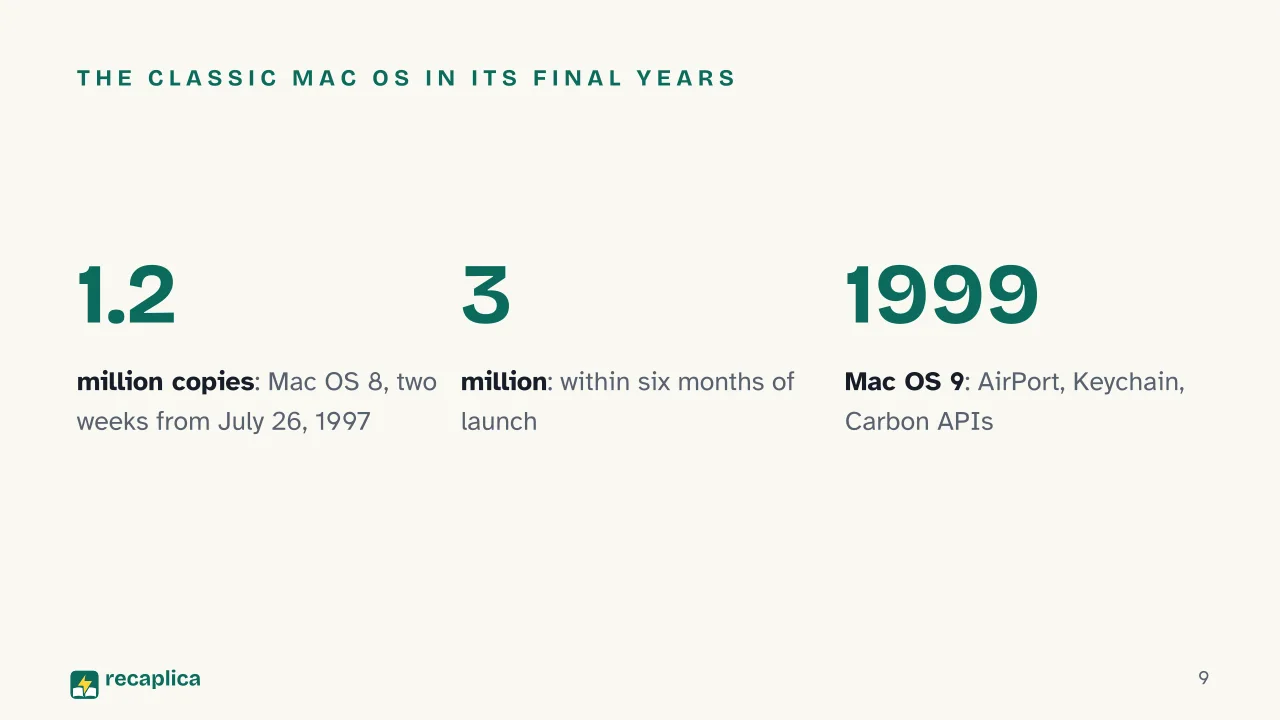
    • 1.2 million copies copies of Mac OS 8 sold in the two weeks after its July 26, 1997 launch, rising to 3 million within six months Source: Wikipedia, Classic Mac OS

    Deep Dive

    A computer for the rest of us, running one app at a time

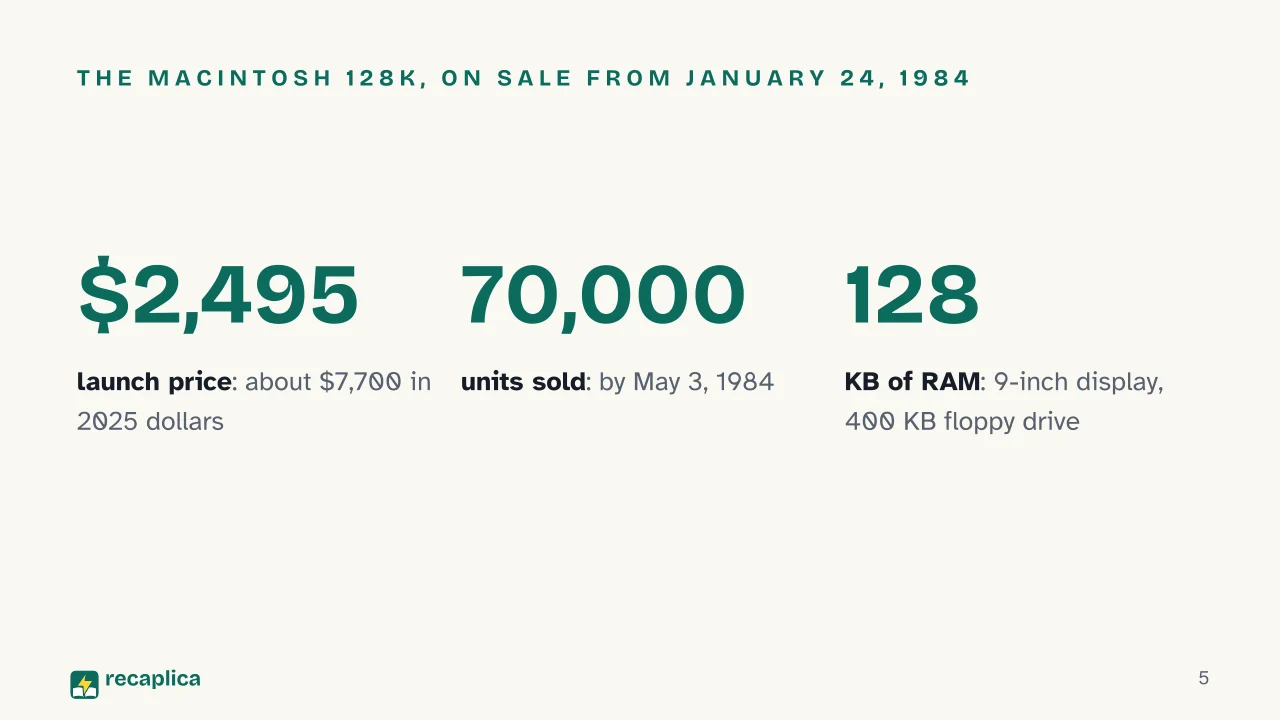
    On January 24, 1984, Apple put the Macintosh 128K on sale for $2,495, about $7,700 in 2025 dollars: a 9-inch monochrome display, 128 KB of RAM, a Motorola 68000 processor running at 7.8336 MHz, and a 400 KB 3.5-inch floppy drive, in a machine weighing 16.5 lb (7.5 kg). The launch came just days after “1984,” the ad directed by Ridley Scott for the Chiat/Day agency, aired nationally on January 22 during the third quarter of Super Bowl XVIII: Apple’s board had initially rejected it, and it was Steve Wozniak who offered to personally cover half the cost of the airtime just to see it broadcast. The ad would later enter the Clio Awards Hall of Fame in 1995 and top Advertising Age’s list of the fifty greatest commercials of all time; the Macintosh itself sold 70,000 units by May 3, 1984.

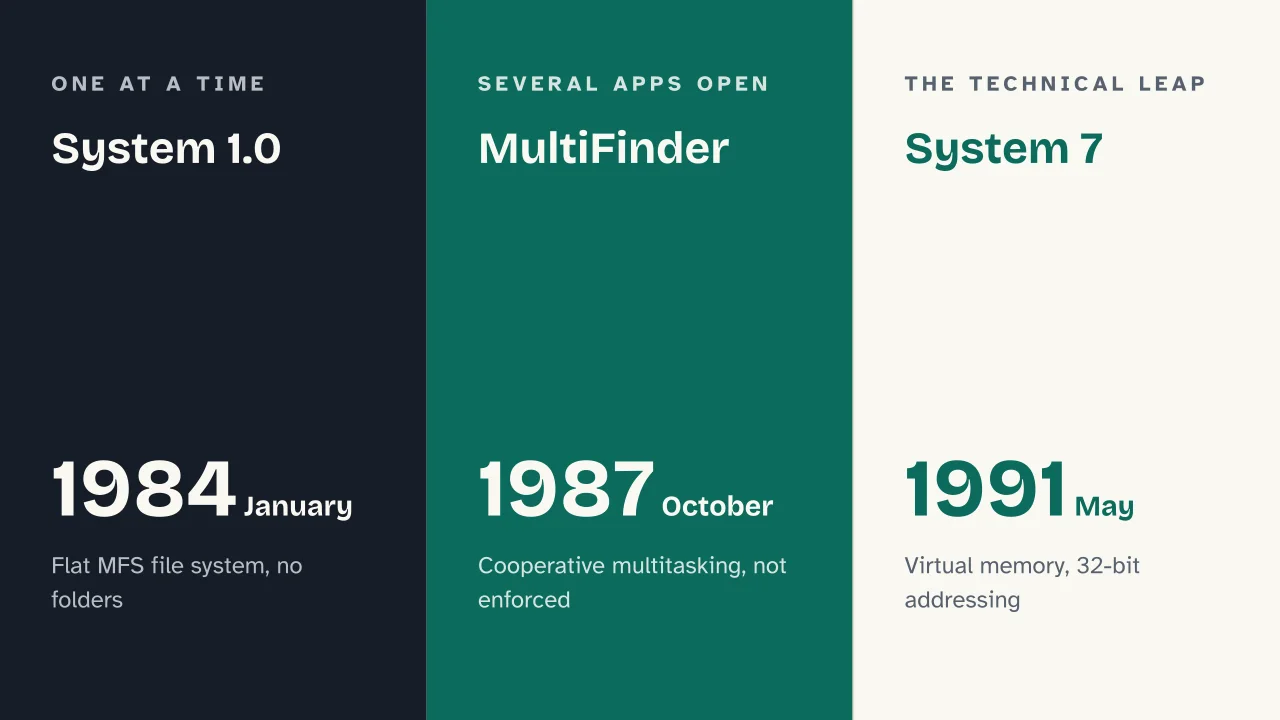
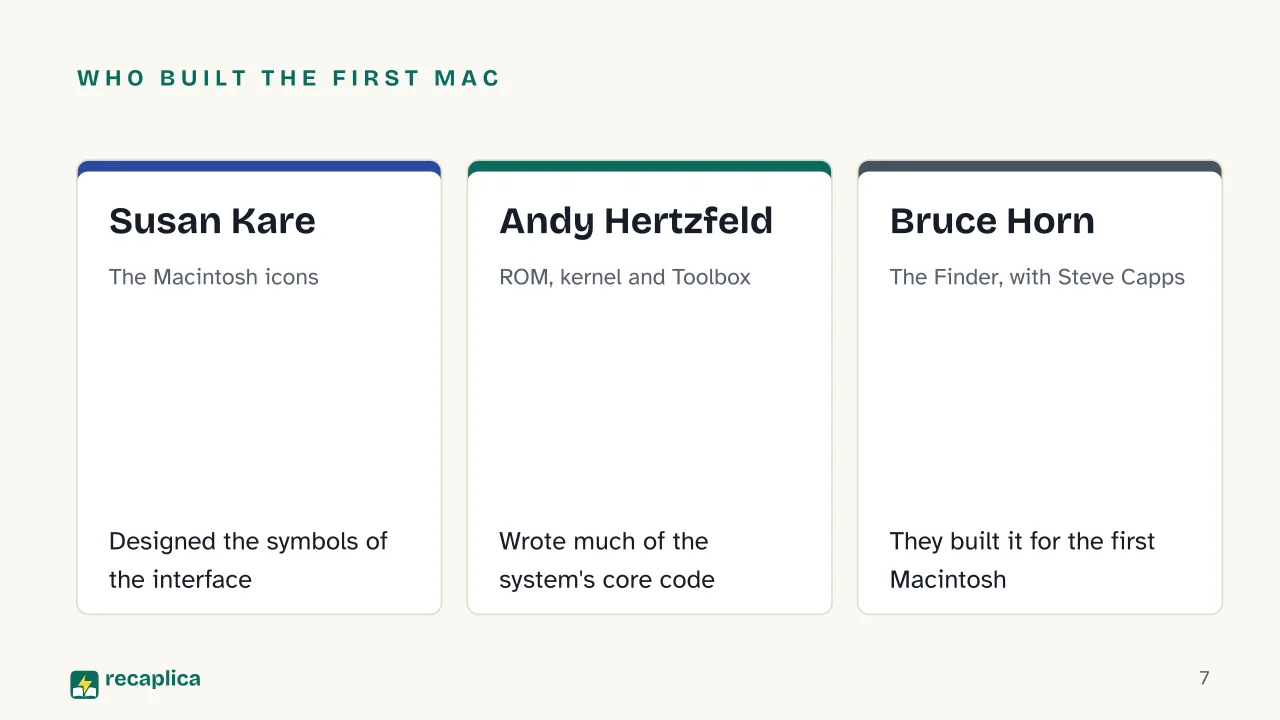
    The operating system inside that machine, System 1.0, was deliberately minimal: it could run only one application at a time and relied on a flat file system, the Macintosh File System (MFS), with no nested folders, just a plain list of files. Behind the scenes was a small team that would go on to shape the history of personal computing: Andy Hertzfeld wrote much of the ROM, kernel and Toolbox code, Susan Kare designed the icons that made the interface instantly recognizable, and Bruce Horn and Steve Capps built the Finder. Steve Jobs had taken over the Macintosh project in 1981 from its original leader, Jef Raskin, while Apple’s other co-founder, Steve Wozniak, was on leave during the project’s most critical development phase.

    Later versions arrived quickly. System 2.0 (April 1985) added support for AppleTalk networking and the LaserWriter printer, and introduced the screenshot shortcut Cmd+Shift+3. System 2.1, a few months later, brought in HFS (Hierarchical File System), the file system that would replace MFS, while System 4.0 in 1987 added the first color support. The real turning point was System Software 5 (October 1987), the first Mac OS package sold at retail, which introduced the MultiFinder: for the first time, more than one application could stay open at once, though multitasking was still “cooperative,” meaning it depended on each program’s willingness to hand control of the processor back and forth. That’s a very different mechanism from a modern operating system with preemptive multitasking, where a scheduler algorithm decides, moment by moment, which program gets control of the processor.

    Practical example: picture working in 1988 on a Macintosh with System 6 freshly installed, running a spreadsheet and a word processor side by side thanks to the MultiFinder. If one of the two programs freezes without handing control back to the system, the other stops responding too. That’s exactly what “cooperative” means in the MultiFinder’s name: the two programs coexist only as long as they behave, not because the operating system enforces any separation between them.

    From System 7 to Mac OS 9: the classic line’s long chase

    System 7, released on May 13, 1991, was the most ambitious overhaul of the classic line: it introduced native virtual memory support, 32-bit addressing, a MultiFinder that was now permanent rather than optional, scalable TrueType fonts, and the AppleScript automation language. With System 7.1 in 1992, the first Mac OS version sold as a standalone product, fonts moved into a dedicated folder, and the 7.1.2 update brought the first support for the new PowerPC processors, running alongside the older Motorola 68k chips for years. System 7.5 in 1994 folded in many features that started out as shareware Apple had acquired, but it suffered stability problems on PowerPC machines.

    In 1997 the word “System” dropped out of the name: Mac OS 7.6 was the first release simply called “Mac OS,” and it dropped support for the original Motorola 68000 processors. A few months later came Mac OS 8 (July 26, 1997), with a multi-threaded Finder and a new look called “Platinum”: it sold 1.2 million copies in its first two weeks and 3 million within six months of launch. Mac OS 8.1 introduced the HFS+ file system and USB support, while remaining the last version compatible with 68k chips; versions 8.5 and 8.6, which by then required PowerPC processors only, added the Sherlock search tool, FireWire support and a redesigned “nanokernel.” Mac OS 9, on October 23, 1999, was the classic line’s final major release: it brought support for AirPort wireless networking, the first multi-user features, file encryption and the Keychain password manager, and introduced the Carbon APIs, built specifically as a bridge to the operating system that would come next. The family’s last update, Mac OS 9.2.2, shipped on December 5, 2001, by which point Mac OS X had already been unveiled.

    VersionYearMain innovation
    System 1.01984Single application, flat MFS file system
    System Software 51987MultiFinder, cooperative multitasking
    System 71991Virtual memory, 32-bit addressing
    Mac OS 81997Multi-threaded Finder, Platinum look
    Mac OS 91999AirPort, Keychain, Carbon APIs
    Mac OS X 10.0 Cheetah2001Darwin kernel, NeXTSTEP legacy
    Mac OS X 10.6 Snow Leopard2009First Intel-only release
    macOS 11 Big Sur2020First Apple Silicon support
    macOS 26 Tahoe2025Numbering aligned with the calendar year

    Jobs’ return, and the technology Apple actually needed

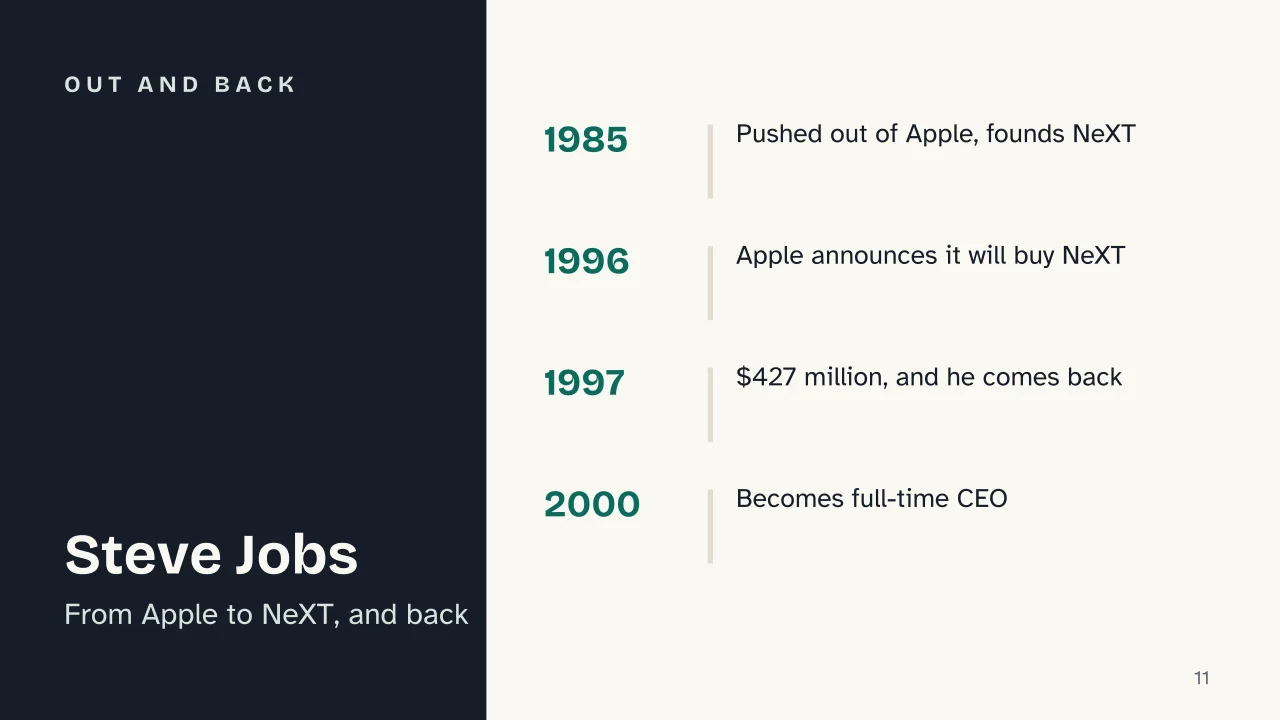
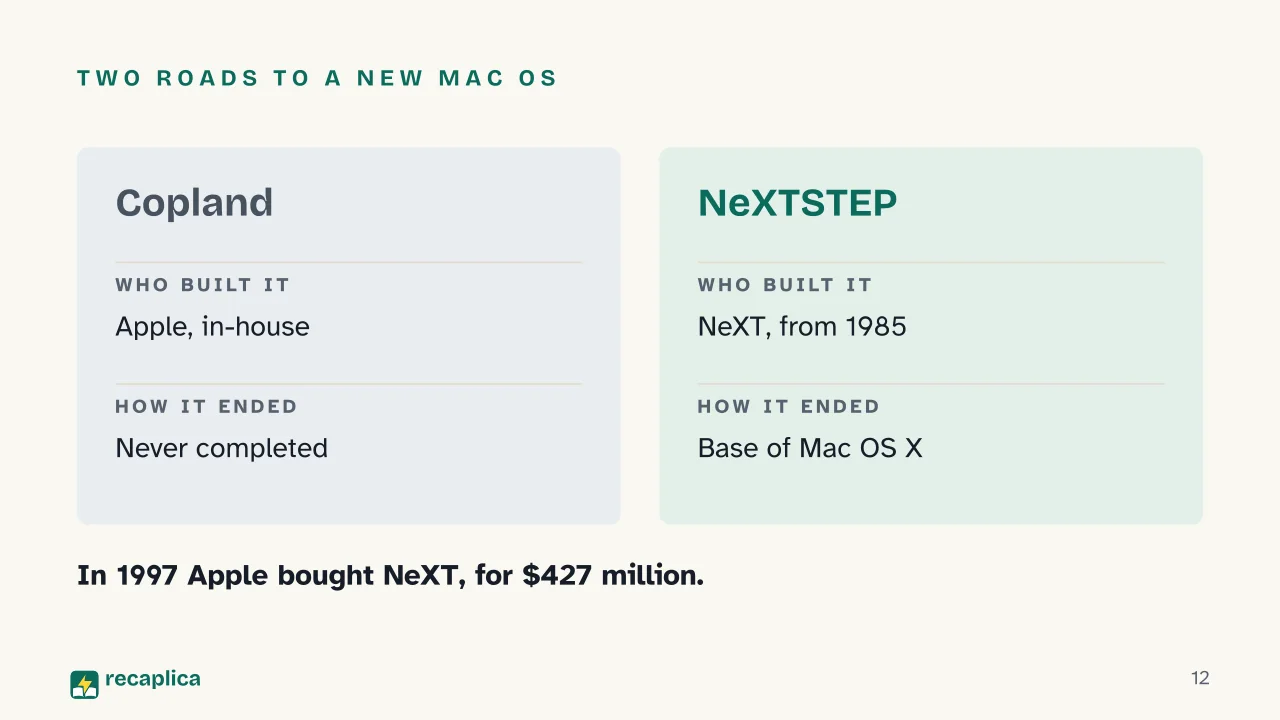
    While the classic line kept aging, Apple had spent years trying to build a more modern successor with an internal project called Copland, which never reached completion. The fix came from an unexpected direction: in September 1985, after months of being gradually pushed out of company decisions, Steve Jobs resigned from Apple and founded NeXT, promising the board he would not compete directly with the company he had helped create. Under engineer Avie Tevanian, NeXT built NeXTSTEP, an operating system with an object-oriented architecture and a graphical interface well ahead of its time; the company later teamed up with Sun Microsystems to create OpenStep, designed to separate the application layer so it could run on other companies’ operating systems too.

    With Copland effectively dead, Apple announced on December 20, 1996 that it would acquire NeXT, a deal that closed on February 7, 1997. The price Apple paid, in cash, stock, stock options and assumed debt, came to $427 million; Jobs personally received 1.5 million shares of Apple stock, even though he would have preferred to be paid entirely in cash. His return to the company wasn’t immediate: he came back first as an advisor, then became interim CEO on September 16, 1997, and only took the job full-time in 2000. Tevanian, who had been vice president of engineering at NeXT, followed him to Apple, and his work proved decisive in bringing the technology that would become the foundation of Mac OS X in-house.

    Mac OS X: the technical leap, and three architecture changes

    Mac OS X 10.0, code-named “Cheetah,” debuted on March 24, 2001, built on the hybrid Darwin kernel (version 1.3.1), based on Mach with roots in FreeBSD and compliant with POSIX standards, a Unix-based technical foundation, different from the classic line it was replacing. From there Apple shipped almost one version a year for more than two decades: Puma (2001), Jaguar (2002), Panther (2003), Tiger (2005), Leopard (2007), Snow Leopard (2009), Lion (2011), Mountain Lion (2012), Mavericks (2013), Yosemite (2014), El Capitan (2015), Sierra (2016), High Sierra (2017), Mojave (2018) and Catalina (2019), followed by the more recent name changes: Big Sur (2020), Monterey (2021), Ventura (2022), Sonoma (2023) and Sequoia (2024).

    Behind that string of names runs a parallel story, the one about the processor, part of the same broader arc traced by the history of computers more generally. Mac OS X 10.0 ran only on PowerPC chips, inherited from the classic line since 1994; the first Intel-based Macs arrived in 2006, running a specialized version of Tiger, and the following year Leopard introduced “universal binaries,” capable of running natively on both PowerPC and Intel. In 2009, Snow Leopard became the first Intel-only release, closing out the second processor architecture transition in the Mac’s history (the first, from Motorola 68000 to PowerPC, dated back to 1994).

    Practical example: someone who upgraded a PowerPC Mac to Mac OS X Leopard in 2007 could keep using most of their existing software, thanks to universal binaries. Someone who tried installing Snow Leopard on that same PowerPC Mac two years later, though, was simply out of luck: that release required an Intel processor, no exceptions.

    The third transition came later, and Apple’s own words tell it best: on June 22, 2020, at WWDC, CEO Tim Cook announced the move to processors designed in-house by Apple, saying, “Today we’re announcing our transition to Apple silicon, making this a historic day for the Mac.” The first Macs with the M1 chip, the Mac mini, MacBook Air and 13-inch MacBook Pro, arrived on November 10-11, 2020, alongside two technologies meant to soften the transition: Rosetta 2, which dynamically translates apps written for Intel so they run on the new ARM chips, and the “Universal 2” format, which lets developers build a single app that runs natively on both Apple Silicon and Intel Macs. Cook’s announced plan called for roughly two years to complete the transition across the whole Mac lineup; the actual process wrapped up on June 5, 2023, when Apple introduced the Mac Pro with an M2 Ultra chip, the last Intel-based model left to be replaced.

    The new yearly naming, and where macOS stands in the market

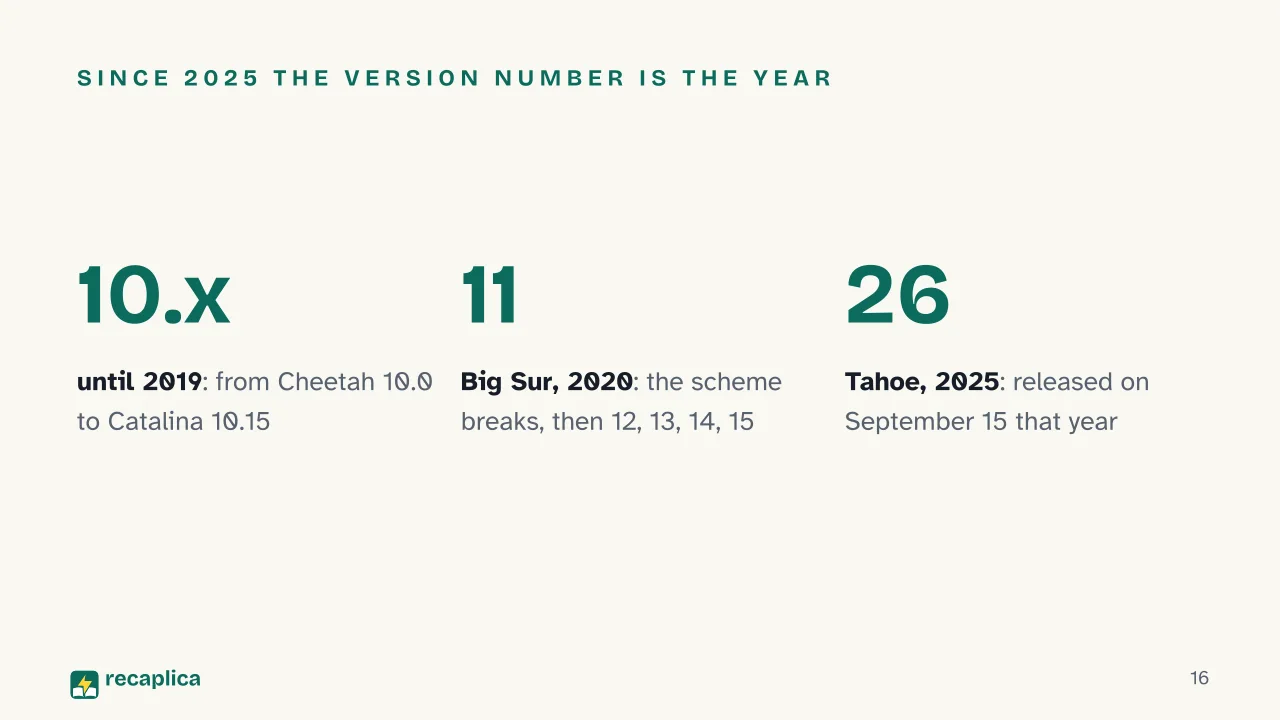
    In 2025, macOS also changed how it counts its versions. Until 2019 the system had stayed on the 10.x scheme, from Cheetah (10.0) to Catalina (10.15); in 2020, Big Sur broke that pattern by becoming simply “macOS 11,” followed by Monterey (12), Ventura (13), Sonoma (14) and Sequoia (15). With macOS 26 “Tahoe,” released on September 15, 2025, Apple made a second leap, aligning the version number with the calendar year: the 2026 release, code-named “Golden Gate” and numbered 27, was still upcoming as of when the sources for this Recap were checked, but it’s already described as the last version to offer full Rosetta 2 support, with Tahoe billed as the last release able to run on Intel-based Macs.

    More than four decades after that 1984 Macintosh 128K, macOS still plays second fiddle in the desktop and laptop computer market compared with Apple’s longtime rival: as of April 2026 it was the second most widely used operating system in that segment, behind Microsoft Windows — whose own story, which started as a graphical shell running on top of MS-DOS, is told in the history of Microsoft Windows — and ahead of every Linux distribution combined.

    Slide deck

    Slides ready to download and make your own in PowerPoint or Google Slides, with speaker notes. Pick the Flash cut or the Full one.
    Slide 1 of the presentation on The History of Mac OS and macOS: The history of Mac OS and macOSSlide 2 of the presentation on The History of Mac OS and macOS: Why did the Mac's future arrive from outside Apple?Slide 3 of the presentation on The History of Mac OS and macOS: What we will coverSlide 4 of the presentation on The History of Mac OS and macOS: Chapter 01: One application at a timeSlide 5 of the presentation on The History of Mac OS and macOS: The Macintosh 128K, on sale from January 24, 1984Slide 6 of the presentation on The History of Mac OS and macOS: System 1.0 · MultiFinder · System 7Slide 7 of the presentation on The History of Mac OS and macOS: Who built the first Mac: Susan Kare, Andy Hertzfeld, Bruce HornSlide 8 of the presentation on The History of Mac OS and macOS: Chapter 02: The classic line's long chaseSlide 9 of the presentation on The History of Mac OS and macOS: The classic Mac OS in its final yearsSlide 10 of the presentation on The History of Mac OS and macOS: Chapter 03: The technology that came from NeXTSlide 11 of the presentation on The History of Mac OS and macOS: Out and backSlide 12 of the presentation on The History of Mac OS and macOS: Two roads to a new Mac OSSlide 13 of the presentation on The History of Mac OS and macOS: Mac OS X was not written from scratch.Slide 14 of the presentation on The History of Mac OS and macOS: Chapter 04: Three processors and a new nameSlide 15 of the presentation on The History of Mac OS and macOS: Three architecture changes, spaced 12-14 years apartSlide 16 of the presentation on The History of Mac OS and macOS: Since 2025 the version number is the yearSlide 17 of the presentation on The History of Mac OS and macOS: Which was the Mac's third architecture transition?Slide 18 of the presentation on The History of Mac OS and macOS: Now for the review
    Flash10 slidesThe essential thread, to present in classFull18 slidesEvery chapter and the deeper detail

    Common myths

    • ✗ Myth The first Macintosh already had an operating system capable of keeping several programs open at once.

      ✓ Reality System 1.0 in 1984 could run only one application at a time; cooperative multitasking arrived only in 1987 with the MultiFinder in System Software 5, and more modern multitasking only with Mac OS X in 2001.

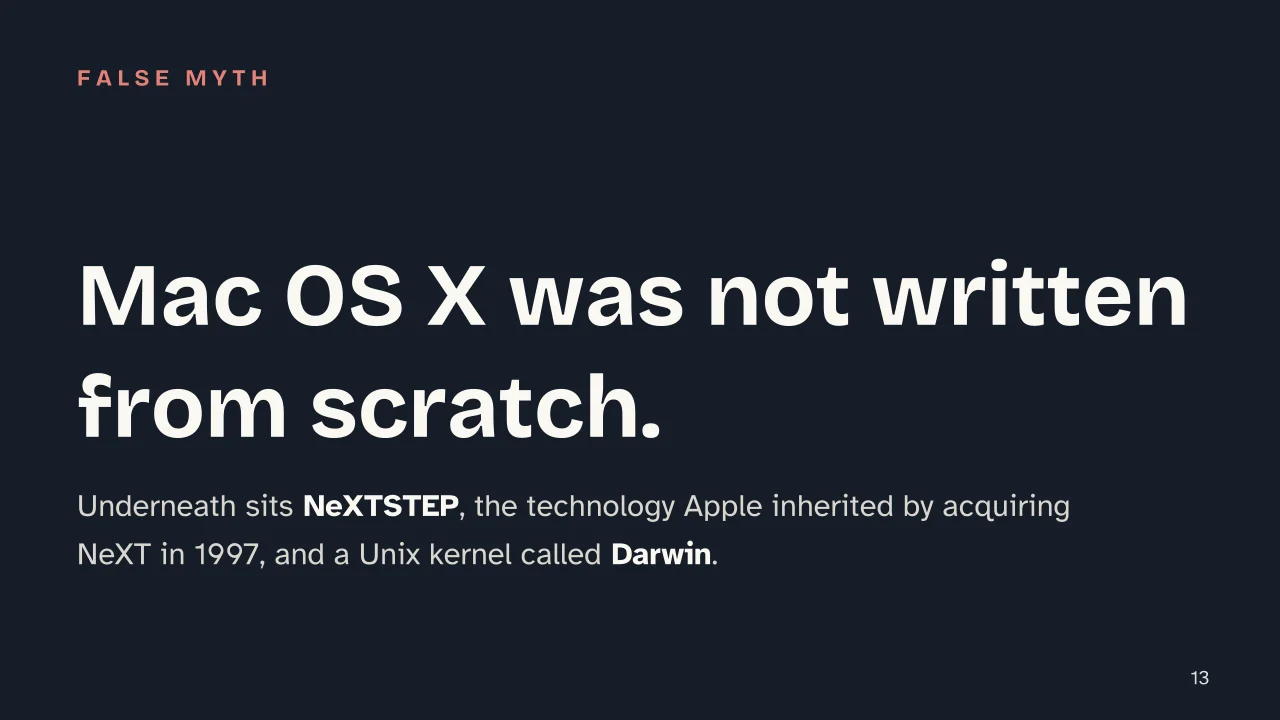
    • ✗ Myth Mac OS X was written entirely from scratch by Apple after the Copland project failed.

      ✓ Reality It was built on NeXTSTEP, the technology Apple inherited by acquiring NeXT in 1997 for $427 million, after Copland was abandoned; engineer Avie Tevanian, who came over from NeXT, played a critical role in bringing that technology into Apple.

    • ✗ Myth The Apple Silicon transition, started in 2020, was the first time the Mac changed processor architecture.

      ✓ Reality It was the third such transition in the Mac's history; the Motorola 68000 to PowerPC switch came first, in 1994, then PowerPC to Intel between 2005 and 2006.

    Mind map

    Drag the background to move around and the nodes to reposition them; use − and + to collapse and expand branches.
    Customize
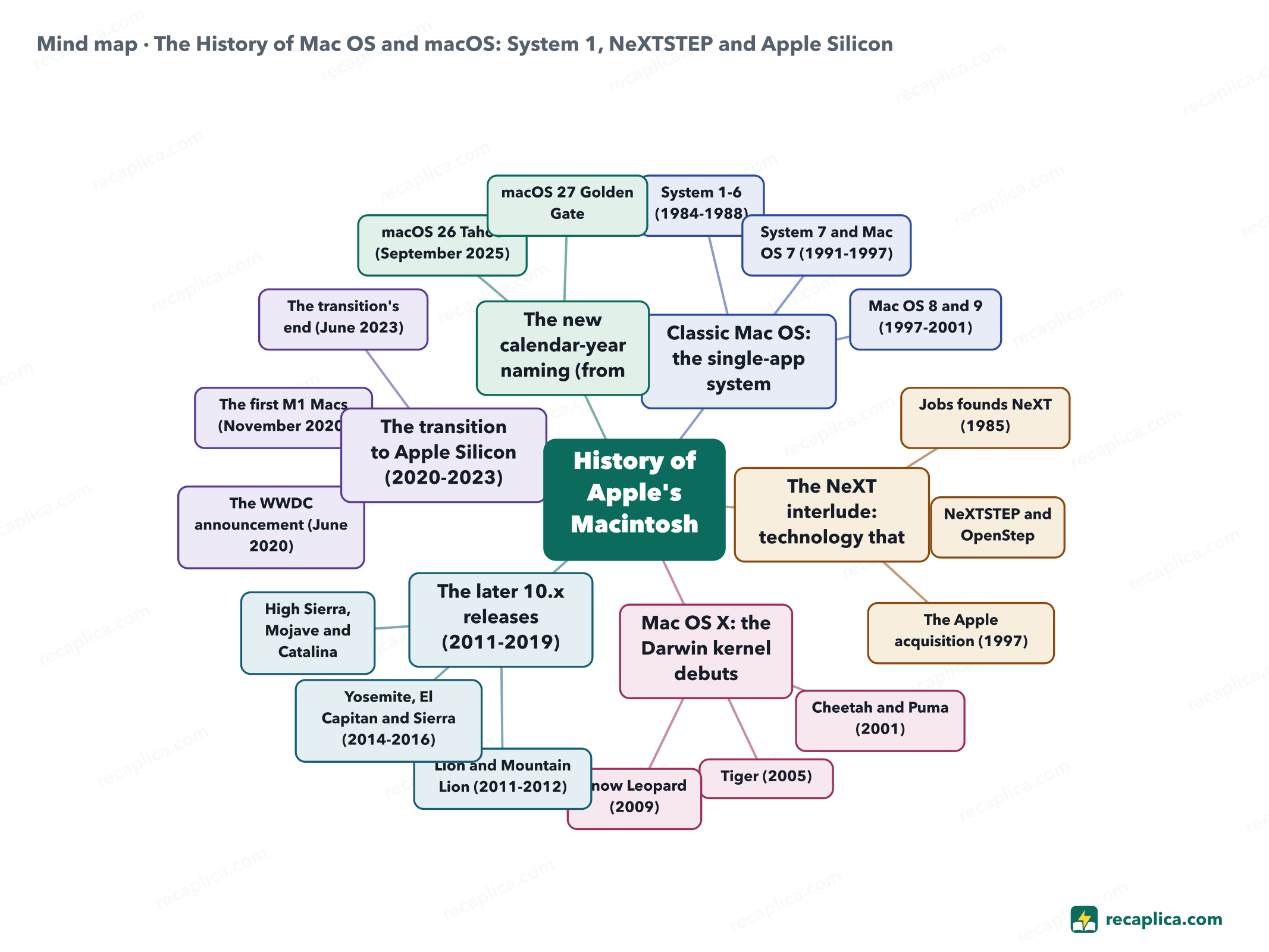
    Mind map: The History of Mac OS and macOS: System 1, NeXTSTEP and Apple Silicon
    • History of Apple's Macintosh operating systems
      • Classic Mac OS: the single-app system (1984-2001)
        • System 1-6 (1984-1988) from the Macintosh 128K to cooperative multitasking with the MultiFinder
        • System 7 and Mac OS 7 (1991-1997) virtual memory, 32-bit addressing, AppleScript
        • Mac OS 8 and 9 (1997-2001) HFS+ file system, Sherlock search, Carbon APIs
      • The NeXT interlude: technology that came back to Apple (1985-1997)
        • Jobs founds NeXT (1985) after leaving Apple, following months of internal sidelining
        • NeXTSTEP and OpenStep object-oriented architecture, led by Avie Tevanian
        • The Apple acquisition (1997) $427 million, Jobs' return in three stages
      • Mac OS X: the Darwin kernel debuts (2001-2009)
        • Cheetah and Puma (2001) the first two releases, 10.0 and 10.1
        • Tiger (2005) first version to support Intel Macs
        • Snow Leopard (2009) first Intel-only release
      • The later 10.x releases (2011-2019)
        • Lion and Mountain Lion (2011-2012) versions 10.7 and 10.8
        • Yosemite, El Capitan and Sierra (2014-2016) versions 10.10, 10.11 and 10.12
        • High Sierra, Mojave and Catalina (2017-2019) versions 10.13, 10.14 and 10.15
      • The transition to Apple Silicon (2020-2023)
        • The WWDC announcement (June 2020) Tim Cook's official reveal
        • The first M1 Macs (November 2020) Mac mini, MacBook Air, 13-inch MacBook Pro
        • The transition's end (June 2023) Mac Pro with M2 Ultra chip, Intel's exit
      • The new calendar-year naming (from 2025)
        • macOS 26 Tahoe (September 2025) numbering aligned with the calendar year
        • macOS 27 Golden Gate expected in 2026, last with full Rosetta 2 support

    Quiz: test yourself

    Answer the questions to check what you have learned: you get instant feedback and a short explanation.

    Grade 0/10 0/5
    1 What was System 1.0, the operating system that debuted with the first Macintosh in January 1984, really?

    System 1.0, released on January 24, 1984 alongside the original Macintosh, could run only one application at a time and relied on the Macintosh File System (MFS), a flat file system with no real folders. Cooperative multitasking wouldn't arrive until 1987, with the MultiFinder in System Software 5.

    2 Why did Steve Jobs leave Apple in September 1985 to found NeXT?

    According to Wikipedia's entry on NeXT, by September 1985, after months of being gradually pushed out of company decisions, Jobs resigned from Apple. He founded NeXT after promising Apple's board he would not compete directly with the company he had helped build.

    3 True or false: Mac OS X, unveiled in 2001, was written entirely from scratch by Apple, with no ties to technology developed elsewhere beforehand.

    False. Mac OS X was built on NeXTSTEP, the operating system developed by NeXT, the company Steve Jobs founded in 1985 and that Apple bought back in 1997 for $427 million, after the internal modernization project known as Copland had been abandoned.

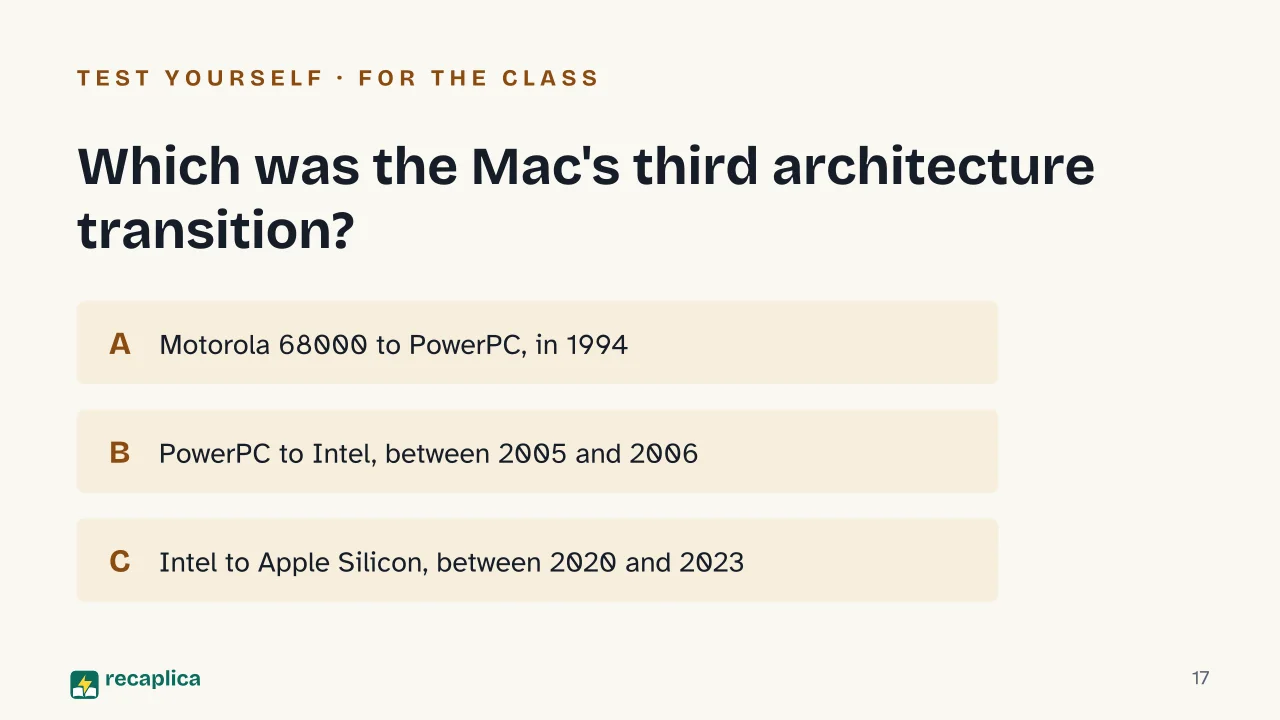
    4 Which was, in chronological order, the third processor architecture transition in the Mac's history?

    The Mac's history includes three processor architecture changes, from Motorola 68000 to PowerPC in 1994, from PowerPC to Intel between 2005 and 2006, and finally from Intel to Apple Silicon, a transition announced in June 2020 and completed in June 2023, when the last Intel-based Mac Pro was replaced by a model with an M2 Ultra chip.

    5 What changes about how macOS versions are numbered starting in 2025?

    With macOS 26 "Tahoe," released on September 15, 2025, Apple dropped its earlier numbering scheme (which had gone from 10.x to a single number with Big Sur in 2020) to align it with the calendar year; the following version, expected in 2026, is numbered 27 and carries the code name "Golden Gate."

    Answers: 1-B · 2-A · 3-B · 4-A · 5-B

    Flashcards

    Tap the card to flip it and check whether you remember the answer, then move to the next one.

    1 / 8

    Explain it in your own words

    The ultimate test: if you can explain it in simple words, you've truly understood it. Write your explanation, then compare it with the Recap.

    Your explanation is saved only on this device.

    The first Macintosh launched on January 24, 1984, running an operating system that could handle only one application at a time, System 1.0. For fifteen years Apple kept updating it piece by piece, all the way to Mac OS 9, while chasing an internal overhaul project called Copland that never landed. The breakthrough came from the company's own founder: in 1997 Apple bought back NeXT, the company Steve Jobs had started after leaving in 1985, inheriting its NeXTSTEP technology, which became the foundation of Mac OS X in 2001. From there the Mac's operating system went through two more processor architecture changes, from PowerPC to Intel and then from Intel to Apple Silicon, and in 2025 it even changed the way its versions are numbered.

    Frequently asked questions

    What's the difference between classic Mac OS and Mac OS X?

    Classic Mac OS is the line running from System 1.0 in 1984 to Mac OS 9.2.2, the last update, released December 5, 2001, a system Apple built from scratch, first single-application, later with cooperative multitasking. Mac OS X, which debuted on March 24, 2001, is a different system altogether, built on the NeXTSTEP technology Apple acquired in 1997, with a Unix kernel (Darwin) at its core; every version since then, up to macOS, shares that same technical foundation.

    Why did Apple buy NeXT in 1997?

    Mainly because Copland, the internal project through which Apple had tried to modernize Mac OS, had failed. By acquiring NeXT (announced December 20, 1996, deal closed February 7, 1997, for $427 million), Apple got NeXTSTEP, an already mature operating system, and brought Steve Jobs back into the company, first as an advisor, then as interim CEO starting September 16, 1997, and finally as full-time CEO in 2000.

    What is Rosetta 2?

    It's the dynamic binary translation technology Apple introduced alongside the first Apple Silicon Macs, launched in November 2020, letting the new ARM-based Macs run apps written for Intel processors without developers having to update them right away.

    How many times has the Mac changed processor architecture?

    Three times, from Motorola 68000 to PowerPC in 1994, from PowerPC to Intel between 2005 and 2006, and from Intel to Apple Silicon (Apple-designed ARM processors) between 2020 and 2023, when the last Intel-based Mac Pro was replaced by a model with an M2 Ultra chip.

    Why is macOS Tahoe called "26" instead of "16"?

    Because starting in 2025 Apple dropped its old sequential version numbering (which had gone from 10.x to a single number in 2020, with Big Sur numbered 11) to make it match the calendar year; macOS 26 "Tahoe" was released on September 15, 2025, and the following version, expected in 2026, will be called macOS 27 "Golden Gate."

    Sources

    • Classic Mac OS (Wikipedia)
    • macOS (Wikipedia)
    • Macintosh 128K (Wikipedia)
    • NeXT (Wikipedia)
    • 1984 (advertisement) (Wikipedia)
    • Apple announces Mac transition to Apple silicon (Apple Newsroom)
    • Mac transition to Apple silicon (Wikipedia)

    Every Recap goes through an independent review before publication.

    Every evening, the day's new Recaps on our Telegram channel. Join the channel →

    Keep learning

    • Technology ASCII Table: What Is It? The ASCII table assigns a fixed number to every letter, digit, punctuation mark, and keyboard control command, so that a computer, which only handles numbers, can represent text. Published in 1963 by the ANSI X3.4 committee and adopted for U.S. federal computers in 1968, it uses 7 bits and covers 128 characters, almost all of them from the English alphabet, according to the IEEE's Engineering and Technology History Wiki. RFC 20 shows how those 7 bits fit neatly inside an 8-bit byte, with the highest bit left unused; putting that extra bit to work opens up more combinations, the basis for the variants known as Extended ASCII. Because it only covers English, though, standard ASCII falls short for languages with accents, ideograms, or other alphabets — a gap Unicode was built to close. Read the Recap →
    • Technology Binary Code: What It Is and How Computers Write Numbers Binary code is how a computer represents numbers using only two digits, 0 and 1. The reason is physical: a computer's circuits reliably tell apart only two electrical states, current off or current on, and we label them 0 and 1 for convenience. Just like the decimal system, each digit's value depends on its position, but here positions are worth powers of two instead of powers of ten: the number 101 works out to (1×4)+(0×2)+(1×1), which is 5. Eight of these digits together form a byte, the unit a computer typically uses to hold one number. Binary alone covers numbers; writing letters needs an extra convention, such as ASCII or Unicode, covered in their own Recaps. Read the Recap →
    • Technology Unicode: What Is It? How It Replaced ASCII Unicode is the standard that gives a unique number, called a code point, to every character in every written language. It replaced ASCII, the 1963 code whose 128 characters covered only the English alphabet, with no accents and no other scripts. Text online travels almost always as UTF-8, one of the forms Unicode uses to turn those numbers into bytes, and it's backward compatible: a file written purely in ASCII is already valid UTF-8. Version 18.0 of the standard, published in September 2026, covers 172,808 characters. Read the Recap →

    recaplica

    Clear in 30 seconds, yours in 10 minutes.

    Recaps Mind maps Request a Recap Telegram channel Mind map maker Our method About Privacy & cookies Legal notes & terms of use

    © 2026 Recaplica · A project by Curi S.r.l. — VAT IT05472000750

    Statistics, only if you say so

    To learn which Recaps help most we would use Google Analytics, with aggregate, anonymous data. It starts only with your OK, and you can change your mind anytime. Privacy policy