recaplica
Clear in 30 seconds, yours in 10 minutes.
In 30 seconds quick read
Unicode is the standard that gives a unique number, called a code point, to every character in every written language. It replaced ASCII, the 1963 code whose 128 characters covered only the English alphabet, with no accents and no other scripts. Text online travels almost always as UTF-8, one of the forms Unicode uses to turn those numbers into bytes, and it's backward compatible: a file written purely in ASCII is already valid UTF-8. Version 18.0 of the standard, published in September 2026, covers 172,808 characters.
Key Points
Unicode assigns a number, the code point, to every character in every language, not just the English alphabet.
ASCII, published in 1963, uses 7 bits for a maximum of 128 characters: accented letters and non-Latin scripts are left out.
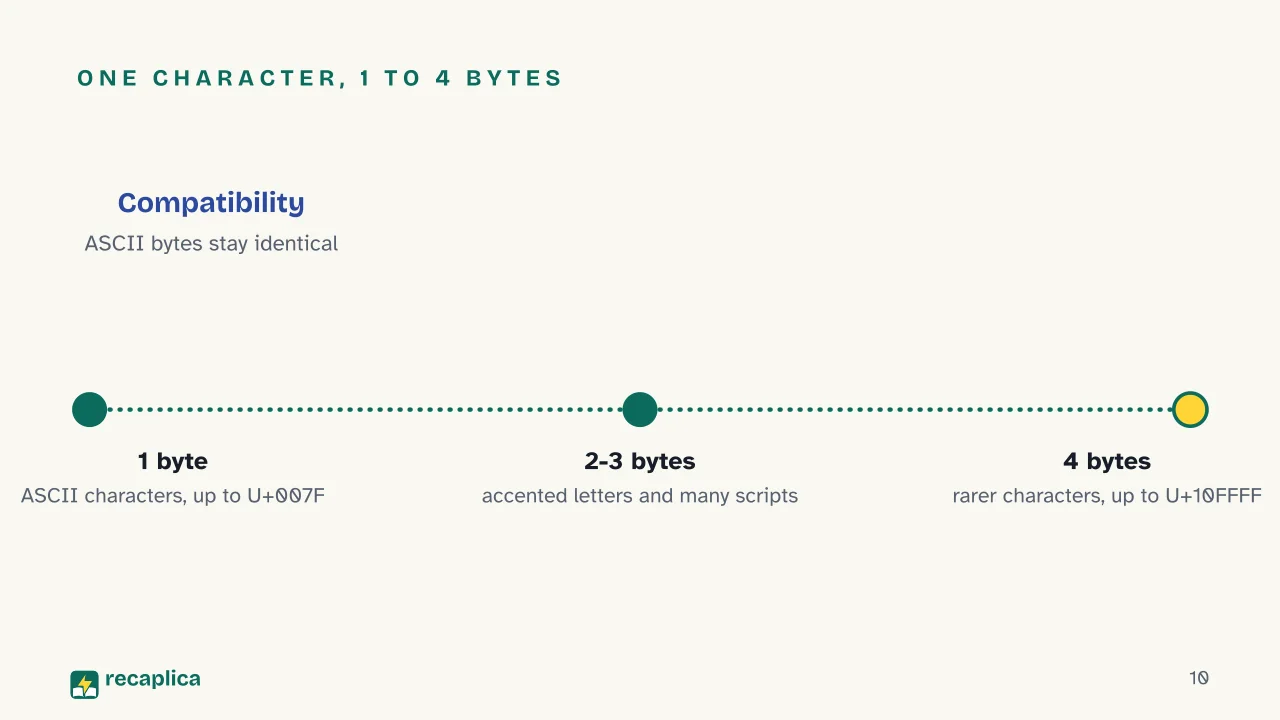
UTF-8 turns Unicode code points into sequences of 1 to 4 bytes and stays compatible with ASCII, which remains a single, identical byte.
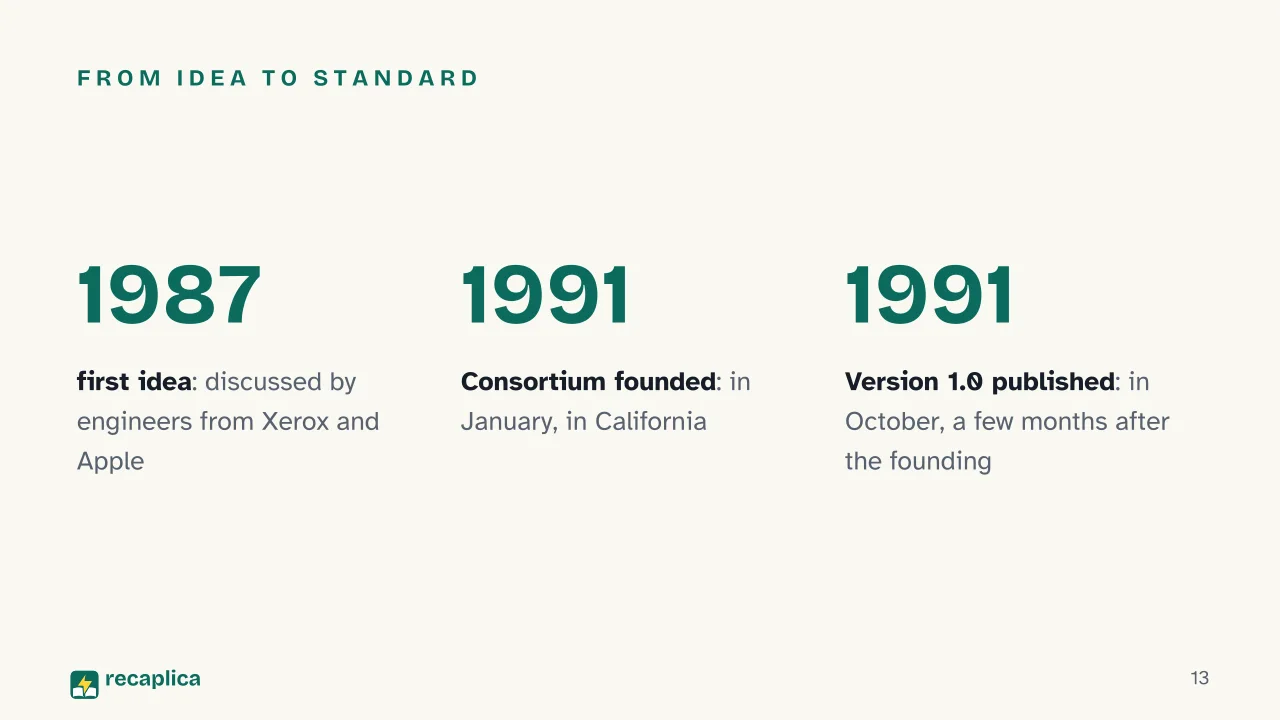
The Unicode Consortium, founded in January 1991 in California, published Version 1.0 of the standard that October.
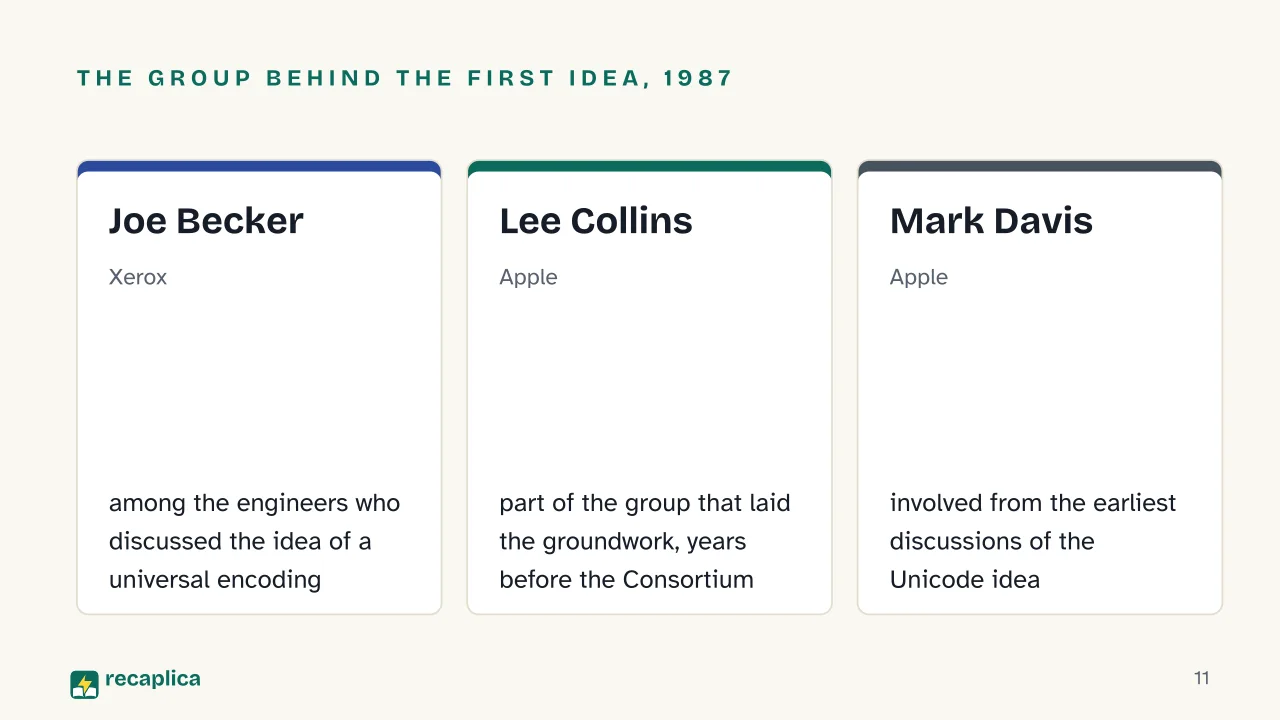
The idea of a universal encoding took shape around 1987, in discussions among engineers from Xerox and Apple.
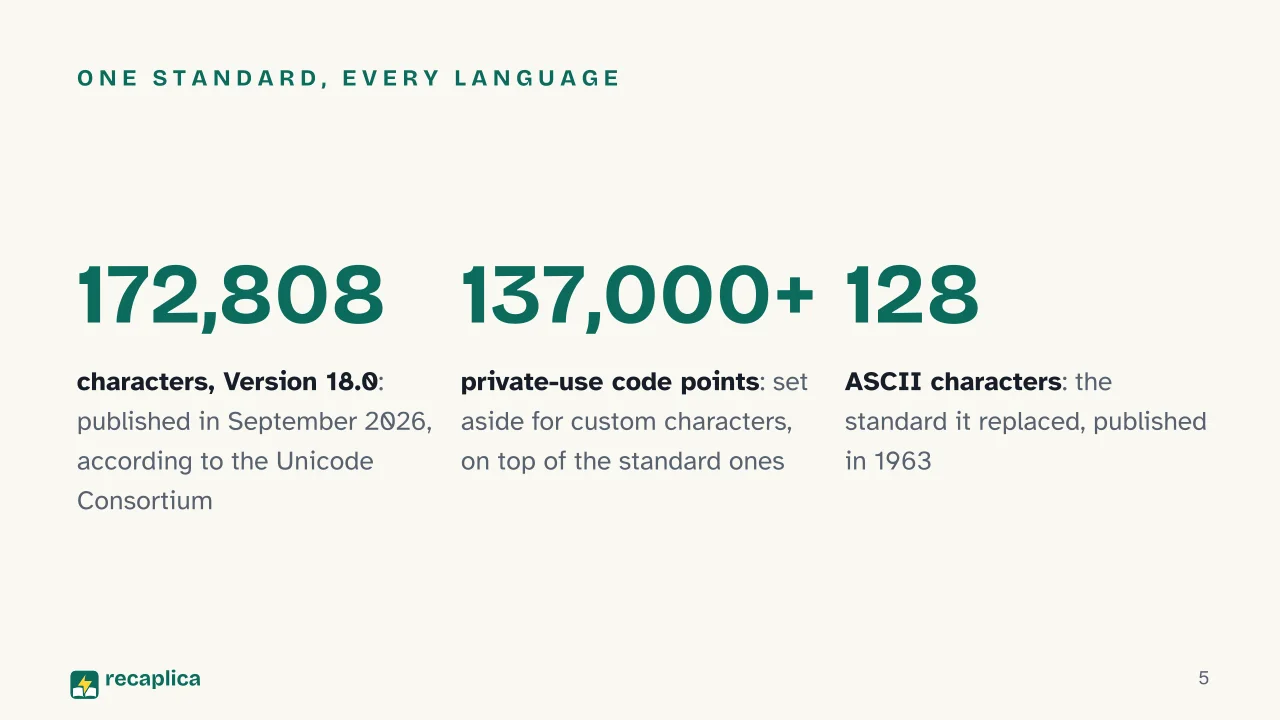
Version 18.0 of the standard, published in September 2026, covers 172,808 characters.
Key figures
172,808 characters covered by Version 18.0 of the Unicode standard, published in September 2026 Source: Unicode Consortium
128 maximum characters representable in ASCII, the standard published in 1963 using 7 bits per character Source: Wikipedia, ASCII entry
1991 year Version 1.0 of the Unicode standard was published, in October Source: Unicode Consortium
Deep Dive
One Number for Every Character
According to the Unicode Consortium’s FAQ, Unicode is the universal character-encoding standard, the basis on which text in any language gets processed, stored and exchanged. To every possible character — a letter, a punctuation mark, a symbol — the standard assigns a unique number, called a code point, written in U+ notation followed by hexadecimal digits. Inside, a computer only ever works with binary numbers: Unicode is the bridge that turns those numbers into characters a person can read.
Real-world example: open the same text file on a computer in Italy, one in Japan and one in Saudi Arabia, and see the same characters everywhere — accents, ideograms, right-to-left script — and that’s only possible because every system agrees on the same number for the same character. Before Unicode, each system kept its own table, and the same number could stand for a different letter depending on the machine.
Why ASCII Wasn’t Enough
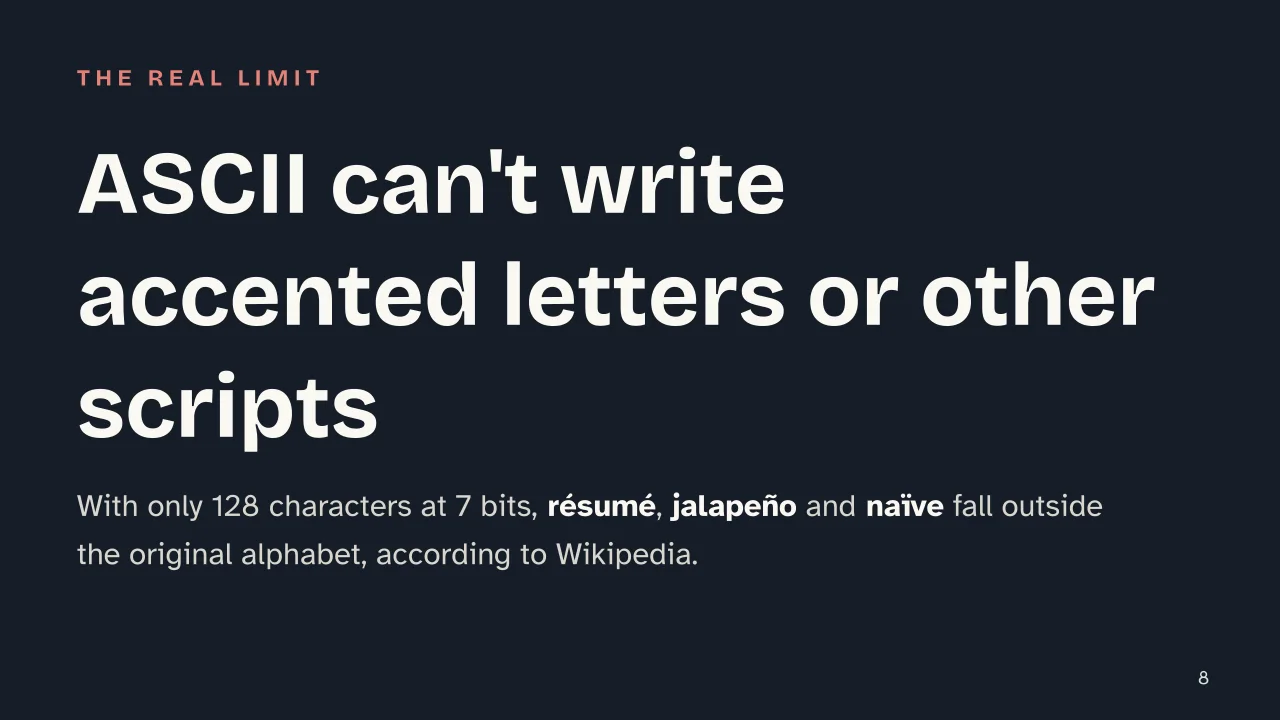
ASCII, published in 1963 as standard ASA X3.4-1963, uses 7 bits per character: a value from 0 to 127, for a total of 128 code points, 95 of them printable and 33 control characters. That was plenty for English typed on an American keyboard, but according to Wikipedia the standard doesn’t directly support words or names such as résumé, jalapeño or naïve, since it has no code points for letters with diacritical marks. Later revisions tried stretching the space to 8 bits, with “relative” encodings of ASCII built for individual languages, but they stayed incompatible with one another: none covered more than one alphabet at a time.
How UTF-8 Works
Unicode assigns the numbers; UTF-8 is the most common way to turn them into bytes for storage or transmission. It’s specified by the IETF’s RFC 3629, published in November 2003: every character becomes a sequence of 1 to 4 bytes, depending on how high its code point sits, covering the entire U+0000-U+10FFFF range. The first byte carries a bit pattern that says how many bytes follow it; the following bytes always start with the same two bits, so a program can always tell where a new character begins, even opening the file partway through.
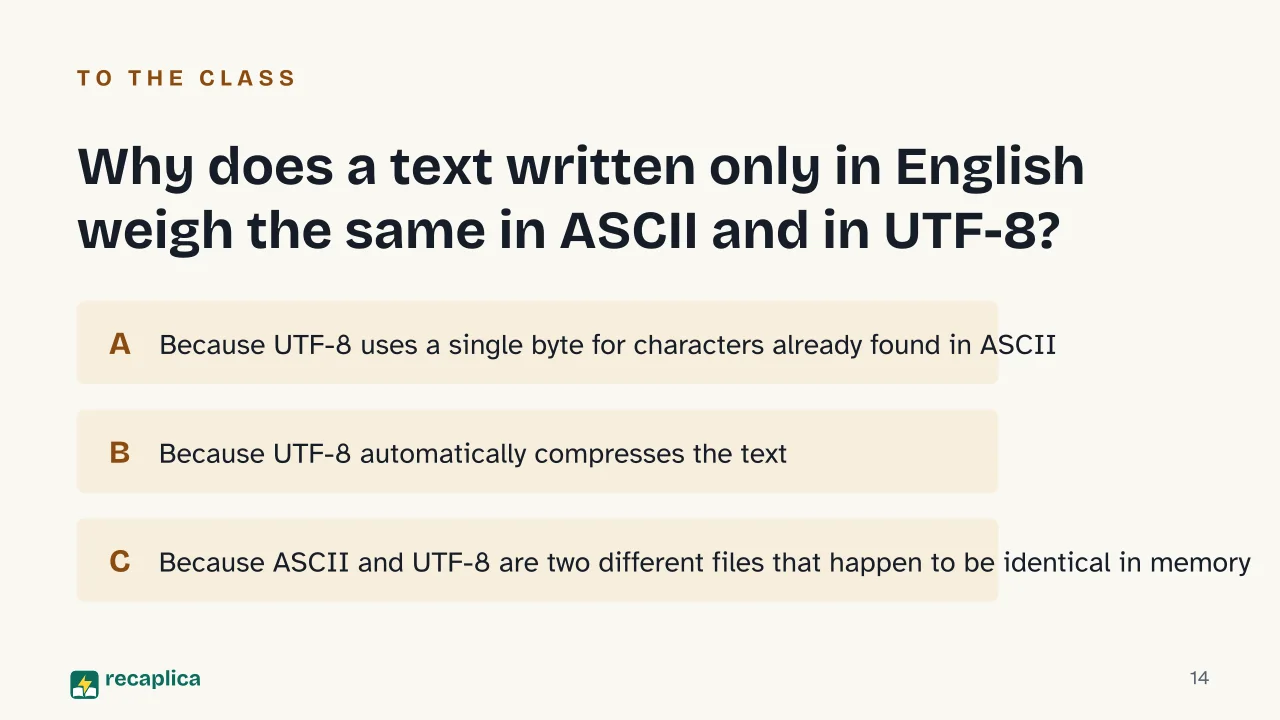
The feature that made UTF-8 the web’s default choice is backward compatibility: per RFC 3629, US-ASCII characters are encoded in a single octet carrying the normal US-ASCII value. A file written purely in ASCII, read as UTF-8, produces exactly the same text — no conversion, no byte changes. When text travels from a server to a browser, across the network that carries data from one end to the other, the declared encoding has to match the one the file was written in, or the characters arrive garbled.
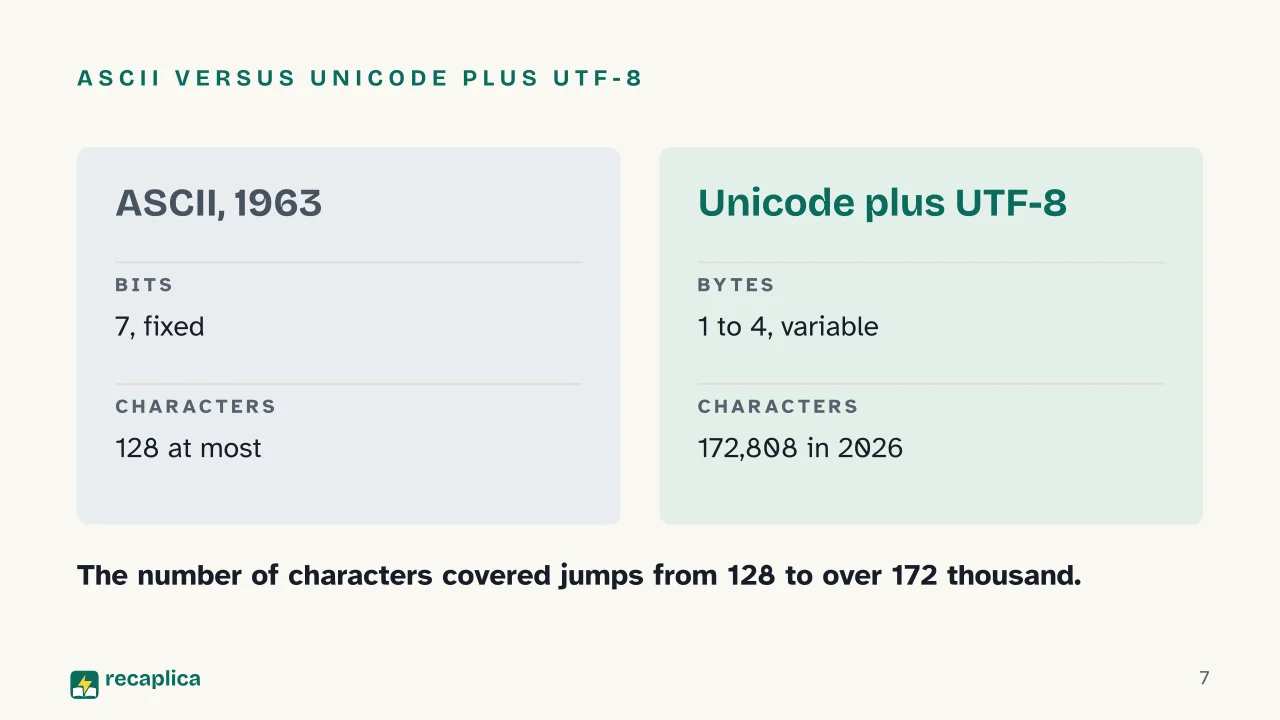
ASCII (1963)
Unicode plus UTF-8
Bits per character
7, fixed
8 to 32, variable (1-4 bytes)
Maximum characters
128
172,808 in Version 18.0 (2026)
Alphabets covered
English only, no accents
every language and writing system the standard covers
Relationship between the two
—
the first 128 characters stay a byte identical to ASCII
A Short History
The idea of a universal encoding emerged, according to the Consortium’s history page, roughly four years before the organization was founded — so around 1987 — from discussions among engineers at Xerox (Joe Becker) and Apple (Lee Collins and Mark Davis). The Unicode Consortium was formally incorporated in January 1991, in California. Version 1.0 of the standard, Volume 1, was published a few months later, in October of that same year.
Since then the standard has grown version by version, adding scripts and new ranges of code points, including a private-use area of over 137,000 code points for anyone who needs custom characters outside the standard. Developers work with text already encoded in Unicode almost constantly, often through the UTF-8 algorithm described above, without even noticing: one of the developments covered in the history of computers.
Slide deck
Slides ready to download and make your own in PowerPoint or Google Slides, with speaker notes. Pick the Flash cut or the Full one.
✓ Reality Unicode is the standard that assigns a number, the code point, to each character; UTF-8 is just one way of turning those numbers into bytes. The Unicode Consortium's FAQ also names UTF-16 and UTF-32 as other transformation formats of the same standard.
✗ Myth ASCII has been replaced and is no longer relevant
✓ Reality ASCII lives on inside UTF-8. Per RFC 3629, US-ASCII characters stay encoded in a single octet carrying their original value, which is why any text written purely in ASCII is already valid UTF-8.
✗ Myth Every character takes up more space under Unicode
✓ Reality Not the characters ASCII already covered. The Consortium's UTF-8 FAQ shows those still take a single byte each, exactly as under ASCII: it's characters outside that range, like accented letters or non-Latin scripts, that need more room.
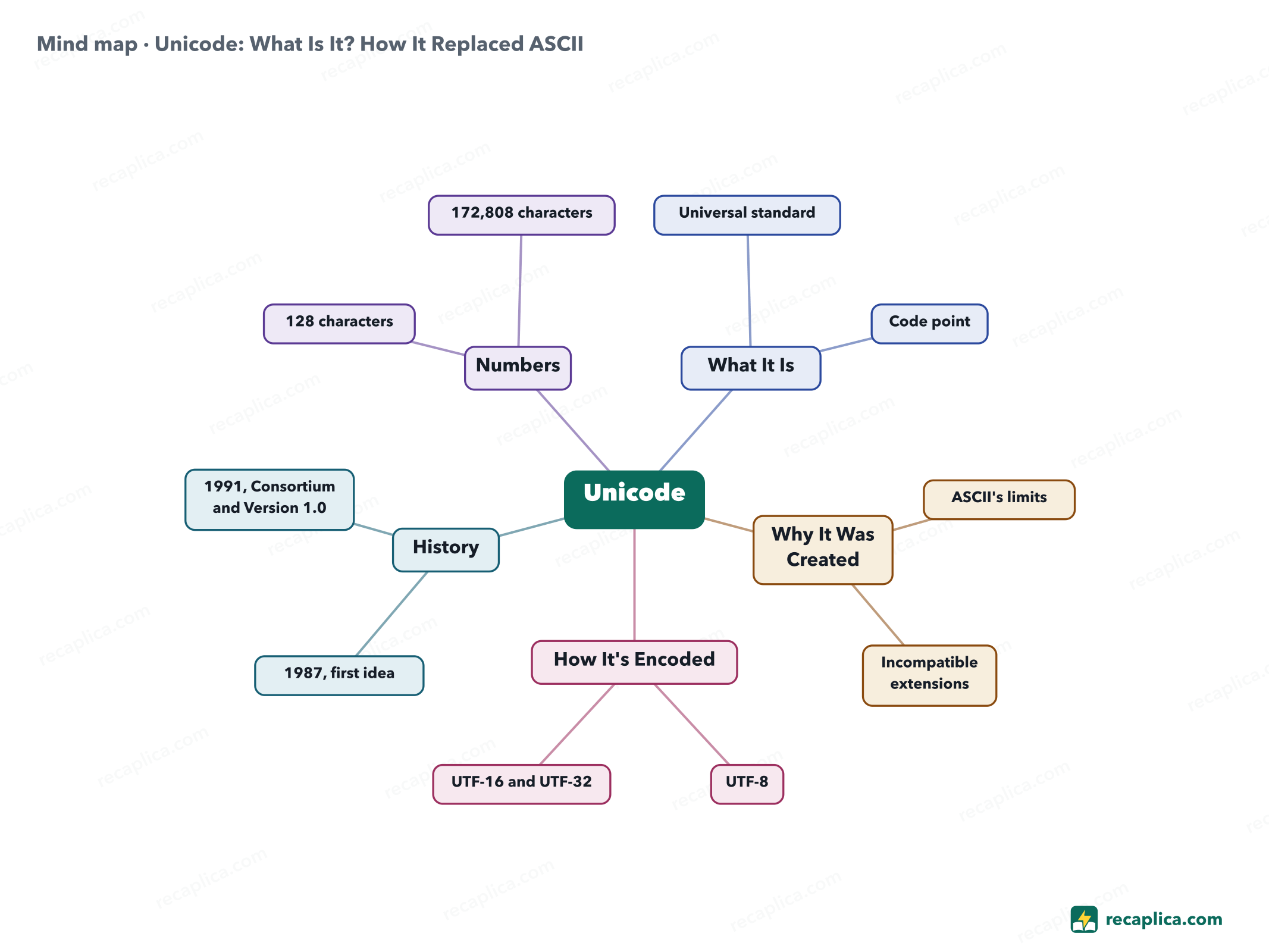
Mind map
Drag the background to move around and the nodes to reposition them; use − and + to collapse and expand branches.
Universal standardassigns a number, the code point, to every character in every language
Code pointU+ notation, within the range U+0000 to U+10FFFF
Why It Was Created
ASCII's limits128 characters at 7 bits, English alphabet only
Incompatible extensionsthe 8-bit versions of ASCII weren't compatible with each other
How It's Encoded
UTF-81 to 4 bytes per character, compatible with ASCII
UTF-16 and UTF-32other transformation formats of the same standard
History
1987, first ideadiscussions among engineers from Xerox and Apple
1991, Consortium and Version 1.0organization founded in January, standard published in October
Numbers
128 charactersASCII's maximum
172,808 charactersVersion 18.0 of Unicode, September 2026
Quiz: test yourself
Answer the questions to check what you have learned: you get instant feedback and a short explanation.
Grade0/100/5
Answers: 1-A · 2-A · 3-C · 4-A · 5-C
Flashcards
Tap the card to flip it and check whether you remember the answer, then move to the next one.
1 / 7
Explain it in your own words
The ultimate test: if you can explain it in simple words, you've truly understood it. Write your explanation, then compare it with the Recap.
Your explanation is saved only on this device.
Unicode is the standard that gives a unique number, called a code point, to every character in every written language. It replaced ASCII, the 1963 code whose 128 characters covered only the English alphabet, with no accents and no other scripts. Text online travels almost always as UTF-8, one of the forms Unicode uses to turn those numbers into bytes, and it's backward compatible: a file written purely in ASCII is already valid UTF-8. Version 18.0 of the standard, published in September 2026, covers 172,808 characters.
Frequently asked questions
Are Unicode and UTF-8 the same thing?
No. Unicode is the standard that assigns a number, the code point, to each character; UTF-8 is one way of translating those numbers into bytes for storage or transmission. UTF-16 and UTF-32 also exist, other transformation formats of the same standard, according to the Unicode Consortium's FAQ.
Why wasn't ASCII enough?
Because with only 128 characters at 7 bits, it covered just the English alphabet. According to Wikipedia, ASCII doesn't directly support words or names with diacritical marks, such as résumé, jalapeño or naïve, because it has no code points for those letters.
How many bytes does a character take up in UTF-8?
1 to 4, according to RFC 3629: the number of bytes depends on how high the character's code point sits, up to the full U+0000-U+10FFFF range.
What does the acronym ASCII stand for?
American Standard Code for Information Interchange. It was published in 1963, alongside the introduction of the Teletype Model 33, according to Wikipedia.
Who manages the Unicode standard?
The Unicode Consortium, the organization founded in January 1991 in California, which maintains and updates the standard: Version 18.0, from September 2026, covers 172,808 characters.
Every Recap goes through an independent review before publication.
Statistics, only if you say so
To learn which Recaps help most we would use Google Analytics, with aggregate, anonymous data. It starts only with your OK, and you can change your mind anytime. Privacy policy