Skip to content
recaplica

    One moment: security check

    Cloudflare wants to make sure you're not a robot. Tick the box below and your search will continue on its own.

    IT
    recaplica Stocks and the stock market: how they actually work
    © 2026 Recaplica · recaplica.com — All rights reserved
    Home › Economics

    Stocks and the stock market: how they actually work

    By Recaplica Newsroom · Updated on August 31, 2026

    What to print

    Page numbers appear when printing with default margins.

    Slides

    Choose a cut

    Flash10 slidesThe essential thread, to present in classFull17 slidesEvery chapter and the deeper detail

    Both come with speaker notes.

    Telegram channel
    recaplica Clear in 30 seconds, yours in 10 minutes.
    In 30 seconds Key points Deep dive Slides Myths Mind map Quiz Flashcards FAQ

    In 30 seconds quick read

    A share is a small slice of ownership in a company: whoever buys one becomes a part-owner, with the right to vote at shareholder meetings and to receive dividends if any are paid. The stock market is the regulated marketplace where shares are bought and sold, with prices moving constantly as supply meets demand. Returns are possible, guarantees are zero: prices can rise and fall alike.

    Key Points

    • A share is one of the units a company's capital is divided into: buying one makes you a part-owner.
    • Shareholders hold economic rights (dividends, if distributed) and administrative rights (voting at meetings).
    • The stock market is the regulated venue where listed shares trade through authorized intermediaries.
    • Prices form from the continuous meeting of buyers and sellers.
    • Indexes (like the S&P 500 or the FTSE MIB) compress a basket of stocks into a single number.
    • Stocks guarantee nothing: you can earn a lot and you can lose your entire investment.

    Deep Dive

    A slice of a business, not a piece of paper

    Behind the noise of the charts sits a simple idea. A company’s capital is divided into many equal units: shares. Whoever buys one becomes a part-owner of that business — a small slice of its factories, brands and future profits. That’s how Italy’s market authority, Consob, defines them, and the definition holds on every exchange in the world.

    Ownership brings two families of rights. Economic ones: if the company makes a profit and decides to distribute part of it, you collect a dividend in proportion to your shares. And administrative ones: voting at shareholder meetings, where owners approve accounts and appoint management. With a handful of shares your vote weighs little, but the principle stands — you’re not a customer, you’re a co-owner.

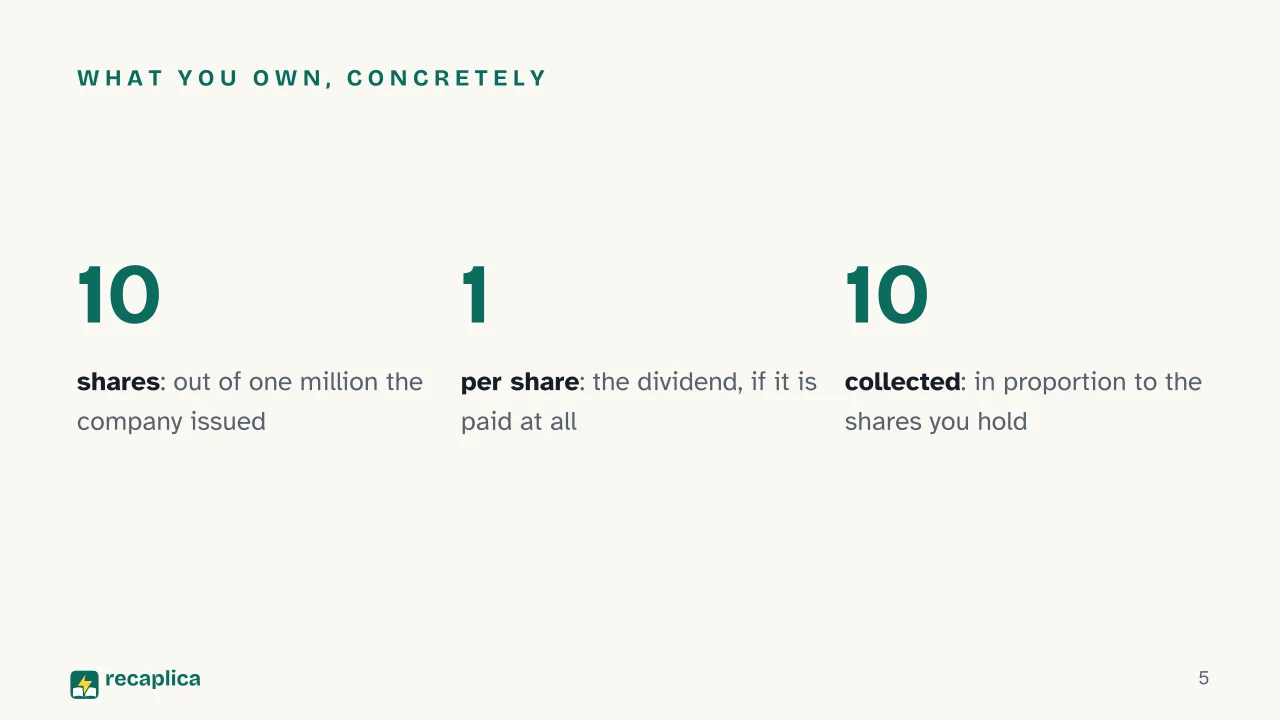
    Practical example: you own 10 shares of a company that has issued one million. You own one hundred-thousandth of the business: of its plants, its brands, its future profits. If it pays a dividend of 1 per share, you collect 10.

    The market: where the slices change hands

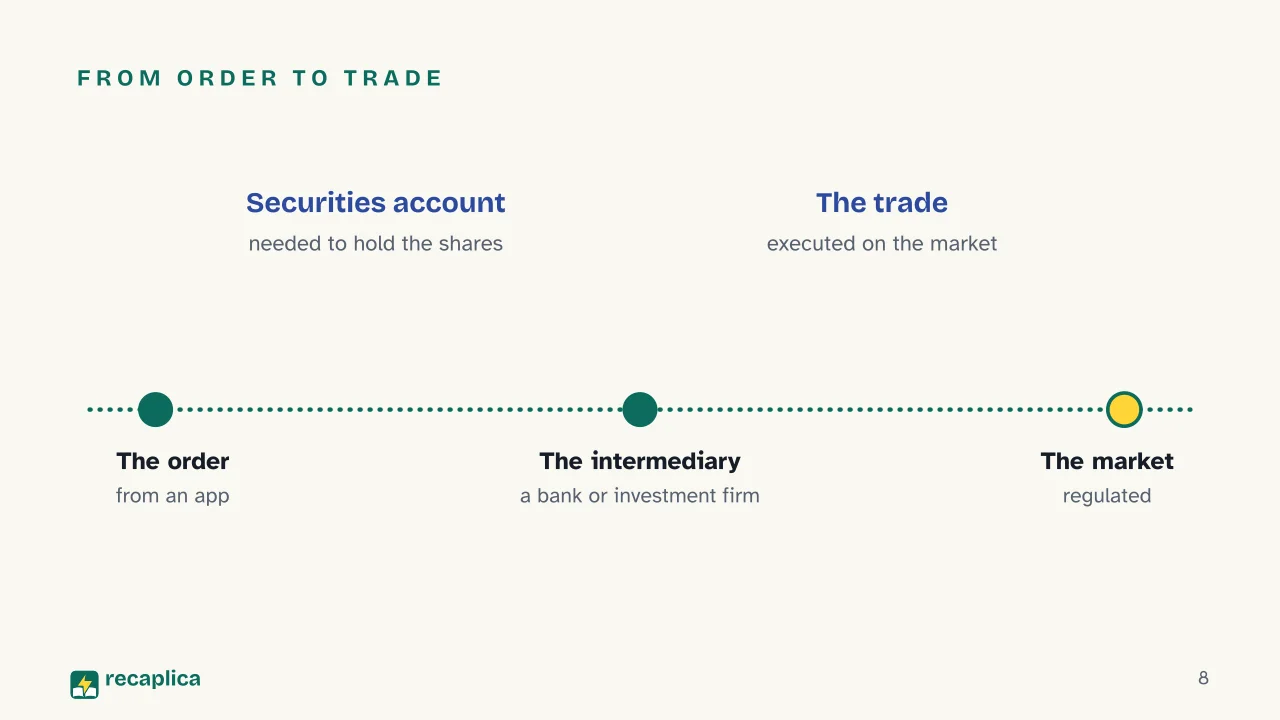
    The stock market is the regulated venue where listed shares are bought and sold. You don’t walk in directly: orders go through authorized intermediaries — banks and investment firms, these days almost always via an app — which execute them on the market.

    Nobody in particular decides the flickering price you see: it’s supply meeting demand, updated at every trade. Expected earnings, news, interest rates, fears and enthusiasms all pour into that number. In the short run the price can drift far from the value of the underlying business; over the long run, it tends to chase it.

    Indexes: the thermometer in a single number

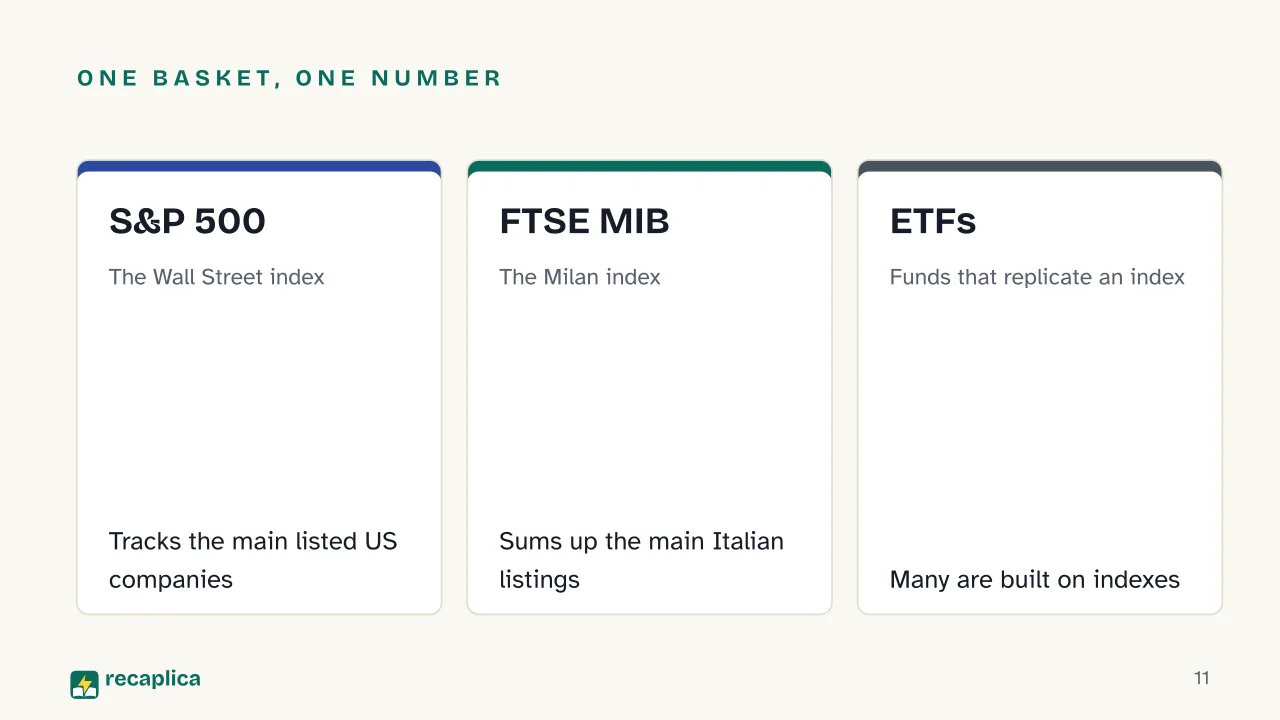
    Following thousands of stocks is impossible, so markets get summarized into indexes: baskets of the main companies whose combined performance becomes one value. The S&P 500 for Wall Street, the FTSE MIB for Milan. When you hear “the market gained 1% today”, it’s almost always the index talking. Indexes also underpin many diversified investment products, such as the ETFs that replicate them.

    The risks, with no sugarcoating

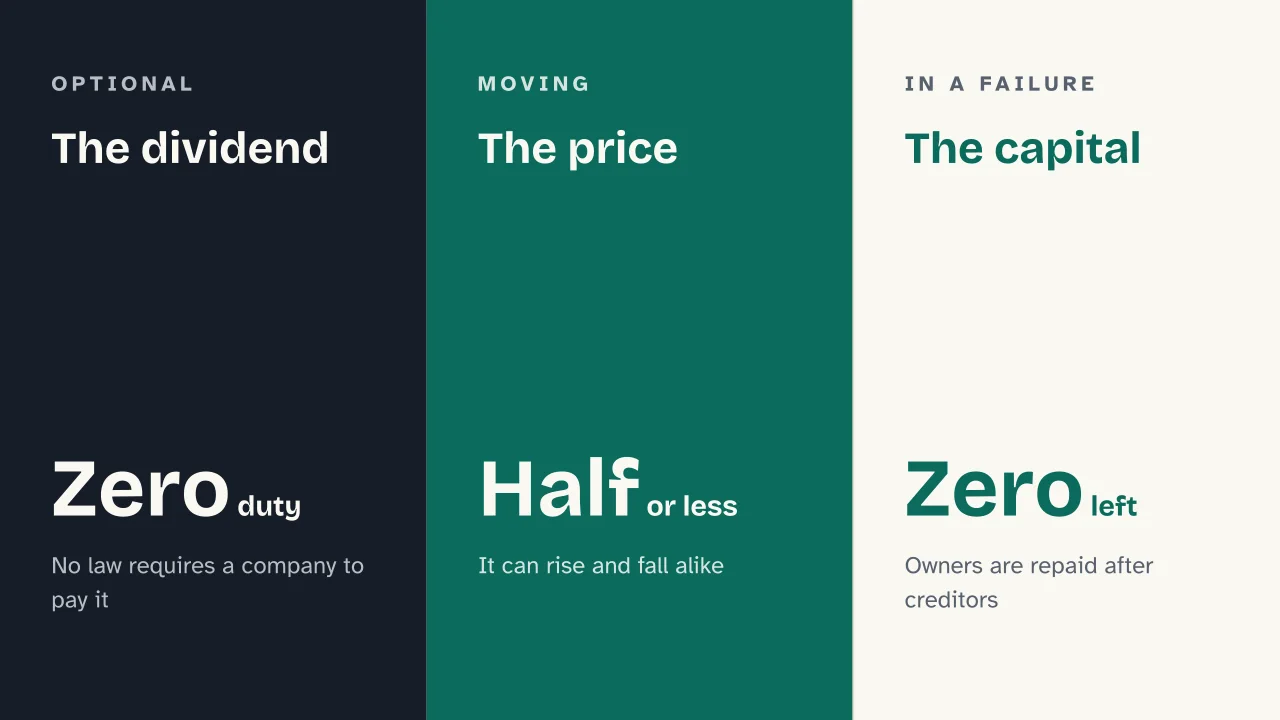
    Let’s be blunt: stocks guarantee nothing. Dividends are optional. Prices can halve. If the company fails, shares can go to zero, and owners are repaid last, after every creditor. During recessions, markets can fall for a long time, and no rule says a crashed stock must return to its old price.

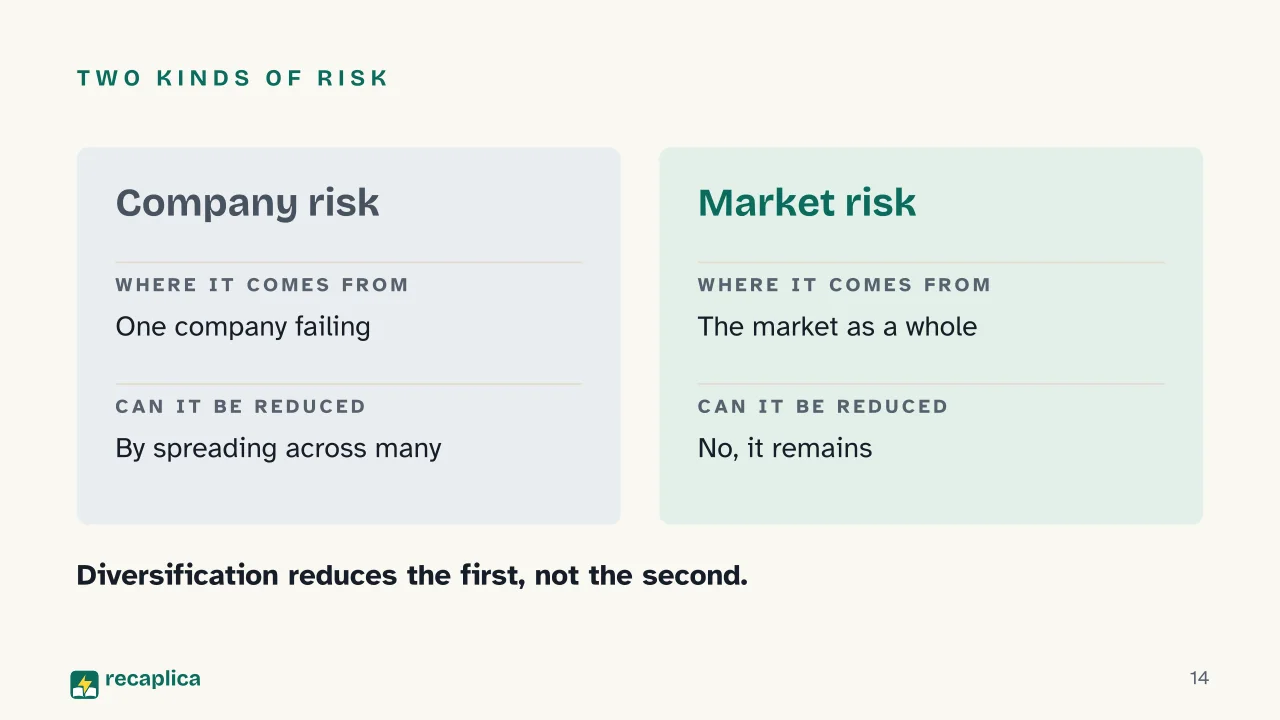
    Finance’s most agreed-upon antidote is diversification: spreading investments across many companies, sectors and countries, so that no single shipwreck sinks the portfolio. It reduces company-specific risk; market-wide risk remains, and must be priced in.

    What this article is (and isn’t)

    One last thing, the most important: this article explains how stocks work — not whether, when or how much to invest. Those decisions depend on your situation, your goals and your tolerance for losses, and they deserve a licensed advisor, not an article.

    Slide deck

    Slides ready to download and make your own in PowerPoint or Google Slides, with speaker notes. Pick the Flash cut or the Full one.
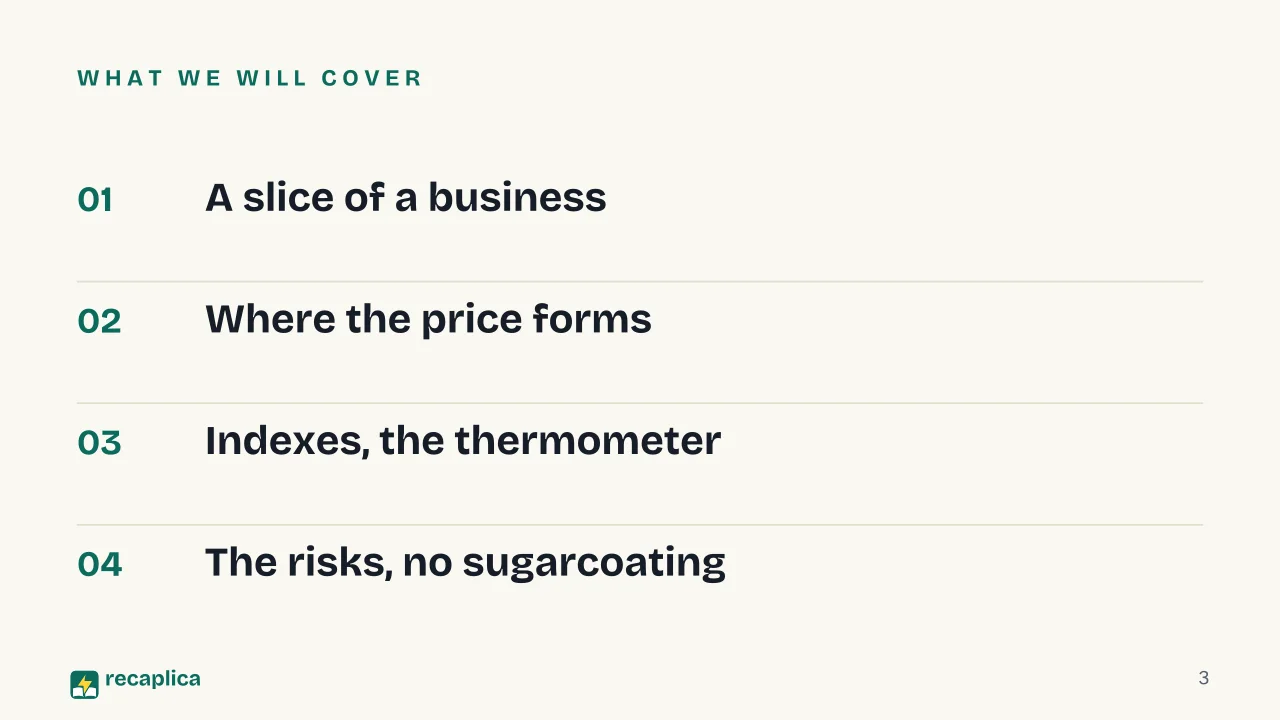
    Slide 1 of the presentation on Stocks and the stock market: The stock marketSlide 2 of the presentation on Stocks and the stock market: What exactly do you own when you buy a share?Slide 3 of the presentation on Stocks and the stock market: What we will coverSlide 4 of the presentation on Stocks and the stock market: Chapter 01: A slice of a businessSlide 5 of the presentation on Stocks and the stock market: What you own, concretelySlide 6 of the presentation on Stocks and the stock market: Stock or bond?Slide 7 of the presentation on Stocks and the stock market: Chapter 02: Where the price formsSlide 8 of the presentation on Stocks and the stock market: From order to tradeSlide 9 of the presentation on Stocks and the stock market: Who decides the price of a listed share?Slide 10 of the presentation on Stocks and the stock market: Chapter 03: Indexes, the thermometerSlide 11 of the presentation on Stocks and the stock market: One basket, one number: S&P 500, FTSE MIB, ETFsSlide 12 of the presentation on Stocks and the stock market: Chapter 04: The risks, no sugarcoatingSlide 13 of the presentation on Stocks and the stock market: The dividend · The price · The capitalSlide 14 of the presentation on Stocks and the stock market: Two kinds of riskSlide 15 of the presentation on Stocks and the stock market: Yesterday's price is not a promise about tomorrow.Slide 16 of the presentation on Stocks and the stock market: What is a stock index like the S&P 500?Slide 17 of the presentation on Stocks and the stock market: Now, the review
    Flash10 slidesThe essential thread, to present in classFull17 slidesEvery chapter and the deeper detail

    Common myths

    • ✗ Myth Buying stocks is like gambling at a casino.

      ✓ Reality At a casino the house wins by mathematical construction; a share is a stake in a real business that produces and earns. The risk is real, but behind the price sits economic value, not a dice roll.

    • ✗ Myth If a stock has fallen a lot, sooner or later it must bounce back.

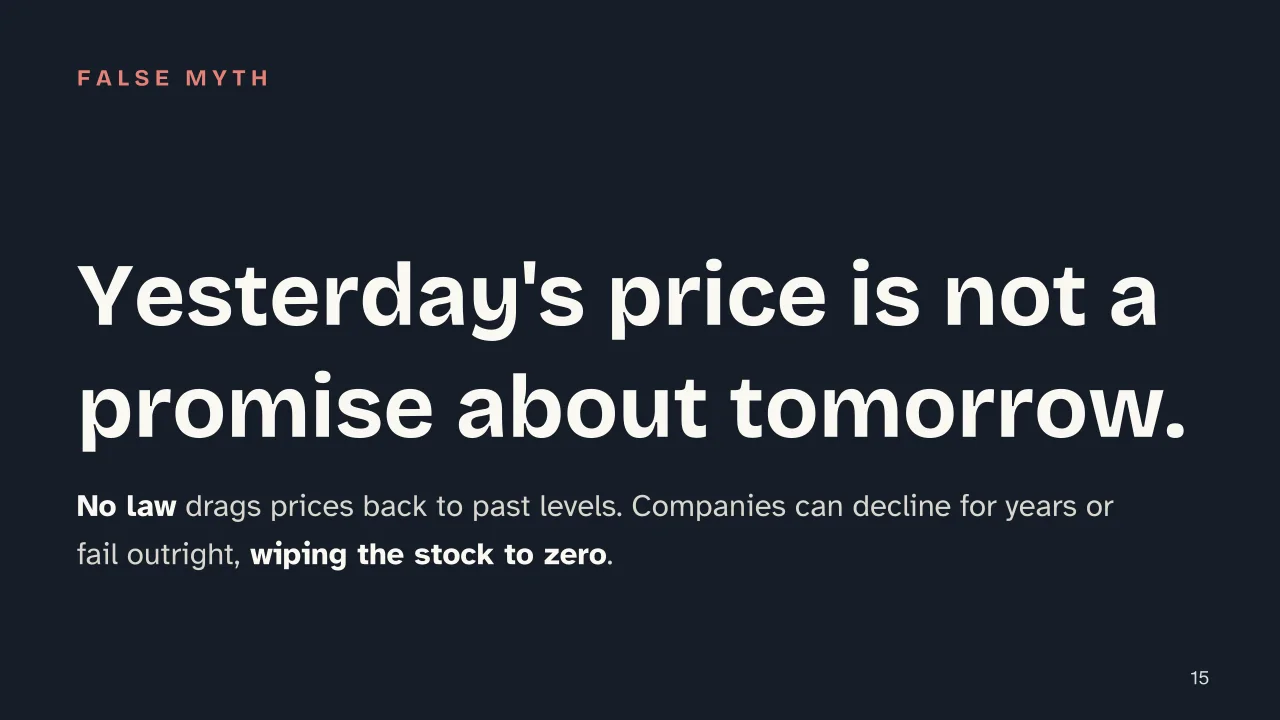
      ✓ Reality No law drags prices back to past levels: companies can decline for years or fail outright, wiping the stock to zero. Yesterday's price is not a promise about tomorrow.

    • ✗ Myth Only people who trade every day make money in the market.

      ✓ Reality Frantic trading is statistically the most losing activity for non-professionals, between timing errors and accumulating costs. Historically, most market returns went to those who stayed invested for the long haul, not to those who darted in and out.

    Mind map

    Drag the background to move around and the nodes to reposition them; use − and + to collapse and expand branches.
    Customize
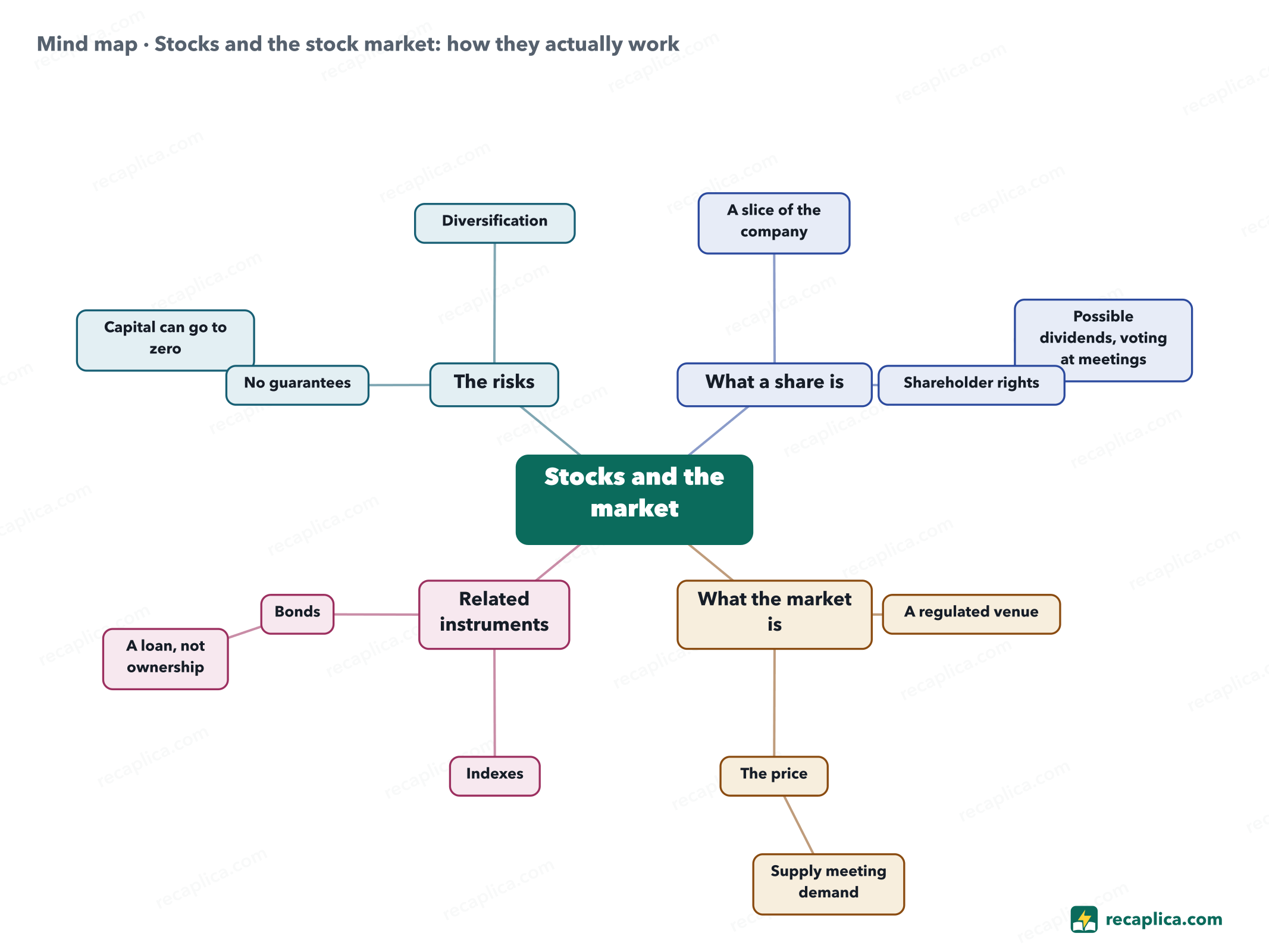
    Mind map: Stocks and the stock market: how they actually work
    • Stocks and the market
      • What a share is
        • A slice of the company Whoever buys one becomes a part-owner.
        • Shareholder rights
          • Possible dividends, voting at meetings
      • What the market is
        • A regulated venue Trades run through authorized intermediaries.
        • The price
          • Supply meeting demand
      • Related instruments
        • Indexes S&P 500, FTSE MIB summarize a basket.
        • Bonds
          • A loan, not ownership
      • The risks
        • No guarantees
          • Capital can go to zero
        • Diversification Spreading out to reduce single-company risk.

    Quiz: test yourself

    Answer the questions to check what you have learned: you get instant feedback and a short explanation.

    Grade 0/10 0/5
    1 What exactly do you own when you buy a share?

    A share is a piece of the company's capital: you're an owner, not a creditor. A loan with repayment obligations is a bond — a different instrument.

    2 What is a dividend?

    A profitable company may decide to distribute part of its earnings to shareholders. May: no law requires it, and many companies reinvest everything.

    3 How does a listed stock's price form?

    At every moment of trading, the price is whatever the latest buyer and seller agreed on: expectations, earnings, news and moods tip the scale.

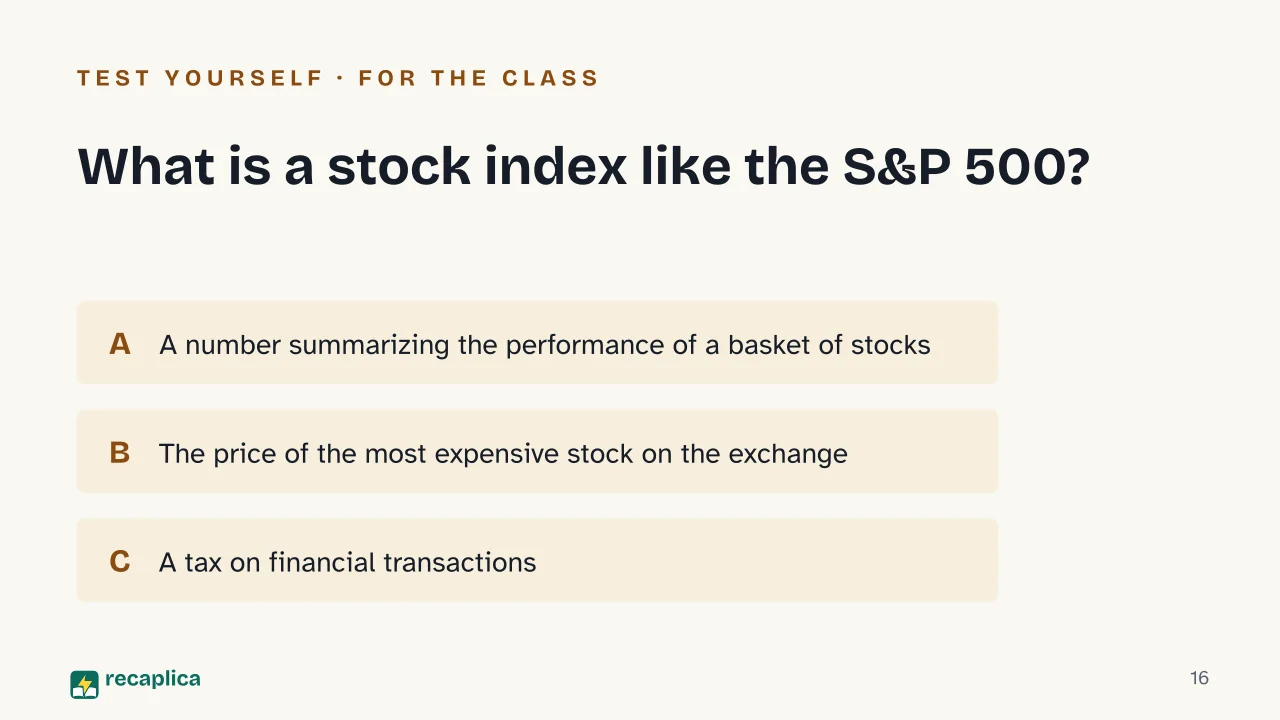
    4 What is a stock index like the S&P 500?

    An index compresses the performance of a market's main listed companies into a single value: when it rises, that basket as a whole has gained.

    5 True or false: investing in stocks, you can lose your entire invested capital.

    If the company fails, its shares can go to zero. It's the flip side of the potential return: risk and reward travel together.

    Answers: 1-A · 2-A · 3-A · 4-A · 5-A

    Flashcards

    Tap the card to flip it and check whether you remember the answer, then move to the next one.

    1 / 7

    Explain it in your own words

    The ultimate test: if you can explain it in simple words, you've truly understood it. Write your explanation, then compare it with the Recap.

    Your explanation is saved only on this device.

    A share is a small slice of ownership in a company: whoever buys one becomes a part-owner, with the right to vote at shareholder meetings and to receive dividends if any are paid. The stock market is the regulated marketplace where shares are bought and sold, with prices moving constantly as supply meets demand. Returns are possible, guarantees are zero: prices can rise and fall alike.

    Frequently asked questions

    What's the difference between stocks and bonds?

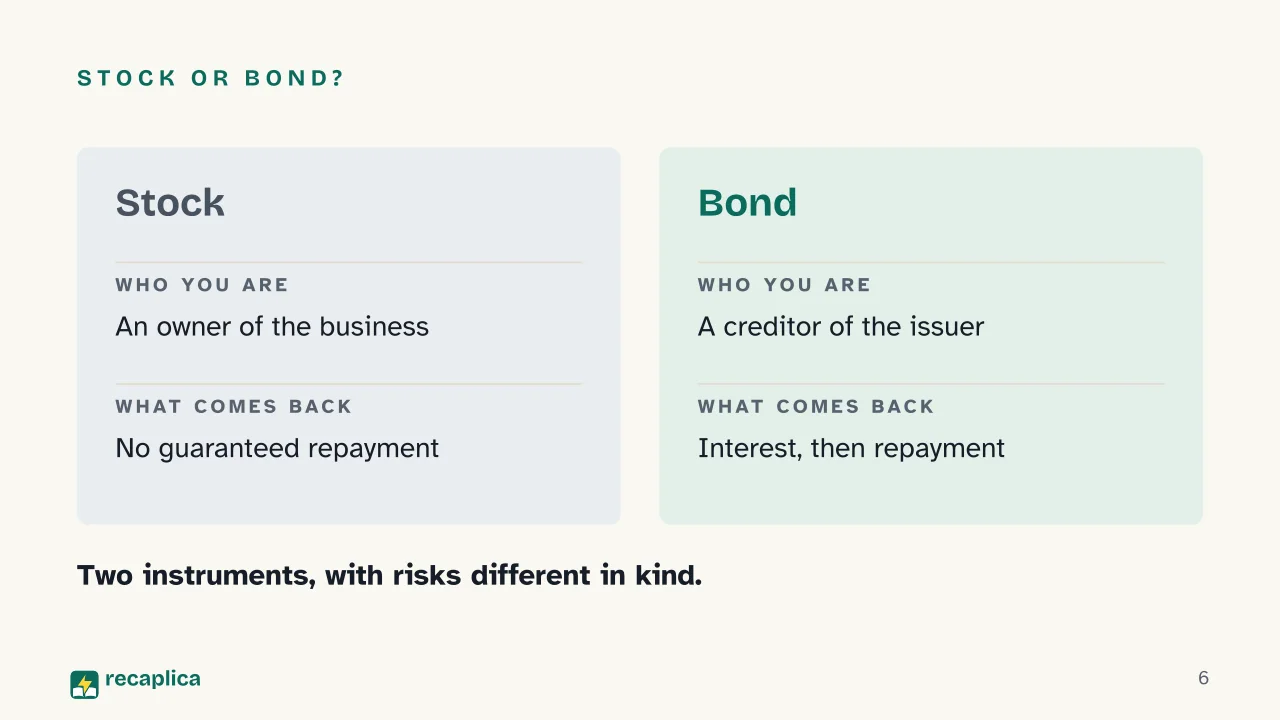
    With a stock you're an owner: you share profits and risks, with no maturity or guaranteed repayment. With a bond you're a creditor: you lend money for interest and repayment at maturity, barring issuer default. The risks and expected returns are different in kind.

    How are stocks actually bought?

    Through authorized intermediaries — banks or investment firms, nowadays almost always via an app. You need a securities account and place orders; the intermediary executes the trade on the regulated market.

    What does diversification mean?

    Not concentrating everything in a few stocks: spreading investments across many companies, sectors and countries reduces the impact of any single failure. It's finance's most agreed-upon principle, often implemented through funds and ETFs.

    Does this article tell me whether and how to invest?

    No: it's education, not financial advice. Investment decisions depend on your personal situation, goals and risk tolerance, and deserve a licensed advisor.

    Sources

    • Consob — Investor education: shares (Italy's market authority)

    Every Recap goes through an independent review before publication.

    Every evening, the day's new Recaps on our Telegram channel. Join the channel →

    Keep learning

    • Economics How to Avoid Foreign Transaction Fees When You Pay or Withdraw Abroad When you pay or withdraw money in a currency other than your own, the cost of the conversion shows up in two possible ways, a margin built into the exchange rate and, sometimes, a fixed fee per transaction. Dynamic Currency Conversion (DCC) is the option to see the amount charged in your home currency instead of the local one, and it comes with a margin set by whoever offers it. Regulation (EU) 2019/518 requires that margin to be disclosed as a percentage before a payment is confirmed, at both card terminals and ATMs. Traditional credit cards, prepaid travel cards and multi-currency digital accounts each handle these charges under their own rules, worth checking before a trip. Read the Recap →
    • Economics Bonds: what they are, how they pay and why their price changes A bond is a loan: whoever buys one gives money to a government, a bank or a company, which promises to repay the face value on a set date and, often, to pay interest along the way, called the coupon. The bondholder is a lender, not an owner. What you actually earn also depends on the price you paid, which can be higher or lower than the repayment value. When market interest rates rise, the price of fixed-rate bonds already in circulation falls, and vice versa. Bonds are usually less risky than stocks, but they are not free of risk. Read the Recap →
    • Economics Interest rates: what they are and how they move the economy The interest rate is the price of money: what it costs to borrow it, or what you earn for lending it. Benchmark rates are set by central banks (the ECB in the euro area) and ripple out to mortgages, loans and savings accounts. High rates cool spending and inflation; low rates fuel consumption and investment. As of mid-2026 the ECB deposit rate stands at 2.25%. Read the Recap →

    recaplica

    Clear in 30 seconds, yours in 10 minutes.

    Recaps Mind maps Request a Recap Telegram channel Mind map maker Our method About Privacy & cookies Legal notes & terms of use

    © 2026 Recaplica · A project by Curi S.r.l. — VAT IT05472000750

    Statistics, only if you say so

    To learn which Recaps help most we would use Google Analytics, with aggregate, anonymous data. It starts only with your OK, and you can change your mind anytime. Privacy policy