Skip to content
recaplica

    One moment: security check

    Cloudflare wants to make sure you're not a robot. Tick the box below and your search will continue on its own.

    IT
    recaplica Artificial Superintelligence: What It Means, and Why Experts Disagree
    © 2026 Recaplica · recaplica.com — All rights reserved
    Home › Technology

    Artificial Superintelligence: What It Means, and Why Experts Disagree

    By Recaplica Newsroom · Updated on September 15, 2026

    What to print

    Page numbers appear when printing with default margins.

    Slides

    Choose a cut

    Flash10 slidesThe essential thread, to present in classFull16 slidesEvery chapter and the deeper detail

    Both come with speaker notes.

    Telegram channel
    recaplica Clear in 30 seconds, yours in 10 minutes.
    In 30 seconds Key points Figures Deep dive Slides Myths Mind map Quiz Flashcards FAQ

    In 30 seconds quick read

    Artificial superintelligence (ASI) is the hypothesis of an AI that would outperform humans across every cognitive domain, a step beyond AGI, which only aims to match people at most jobs. In October 2025, hundreds of scientists, including Yoshua Bengio, signed a Future of Life Institute statement calling for a halt to its development until there is scientific agreement it can be done safely. Anthropic CEO Dario Amodei argues the opposite case, that AI at this level could compress decades of medical progress into a few years. Nobody agrees on timing: estimates range from a lab CEO's early guess to a survey of nearly 2,800 researchers that puts 2047 as the median for an intermediate milestone.

    Key Points

    • Superintelligence (ASI) refers to capabilities that exceed humans across every cognitive domain, including the ability to self-improve; AGI only aims to match the average person across a wide range of tasks.
    • In October 2025 the Future of Life Institute published a statement calling for a halt to superintelligence development, signed by Yoshua Bengio, Stuart Russell, Yuval Noah Harari and, according to news coverage at the time, more than 700 notable figures.
    • Dario Amodei describes powerful AI as "a country of geniuses in a datacenter" and predicts major gains in medicine, while explicitly admitting a wide margin of error on timing.
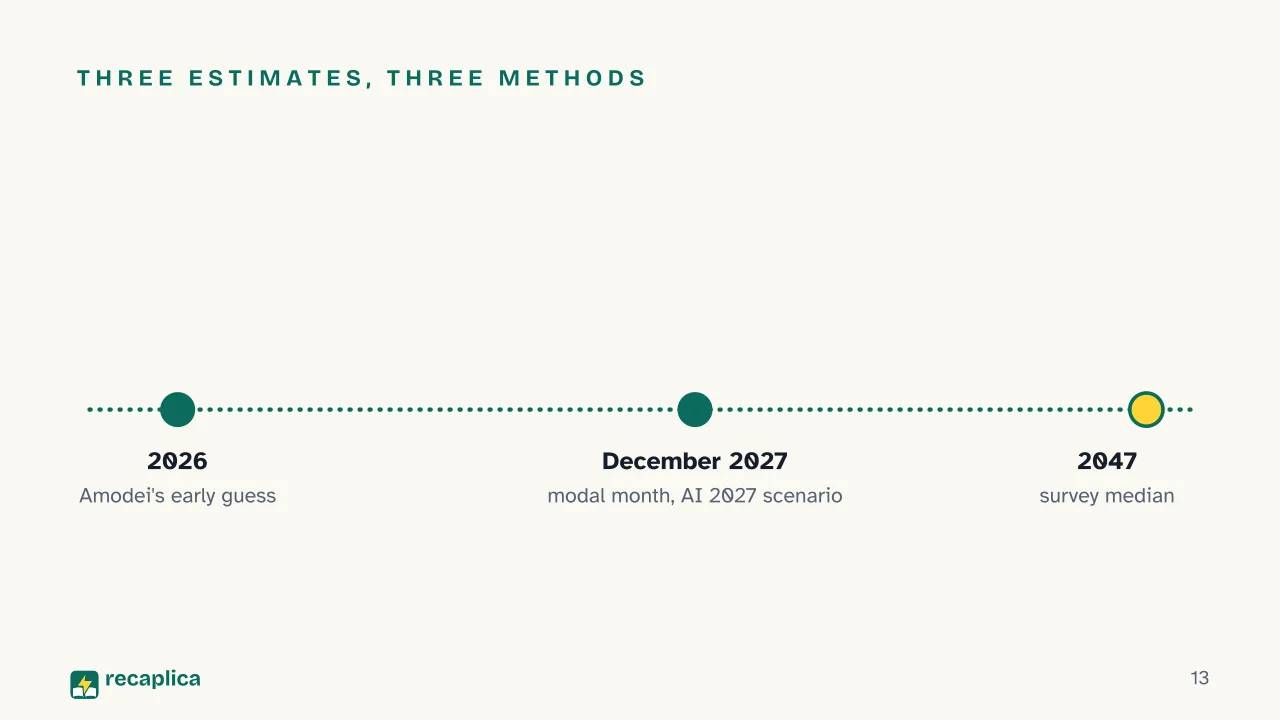
    • Timing estimates span decades: from Amodei's guess that does not rule out 2026, to the independent AI 2027 scenario naming December 2027 as its most likely month at the time of publication, to 2047 as the median of a researcher survey.
    • That same survey, run by AI Impacts in October 2023 among 2,778 AI researchers, puts the median probability of an extreme outcome, such as human extinction or permanent loss of control, at 5% (mean 16.2%).
    • There is no scientific consensus on timing or risk: estimates can shift by decades depending on how the question is worded.

    Key figures

    • 2047 the year by which surveyed researchers gave a 50% chance that AI would reach capability comparable to the average human across most professions (HLMI) Source: AI Impacts, 2023 Expert Survey on Progress in AI (October 2023)
    • 5% the median probability that 2,778 AI researchers assigned to an extreme outcome, such as human extinction or a permanent, severe loss of control Source: AI Impacts, 2023 Expert Survey on Progress in AI (October 2023)
    • December 2027 the month named as the "modal year" (most likely at the time of publication) for superintelligence in the hypothetical AI 2027 scenario Source: AI 2027 (Kokotajlo, Lifland, Larsen, Dean, Alexander), April 2025

    Deep Dive

    Two terms people keep mixing up

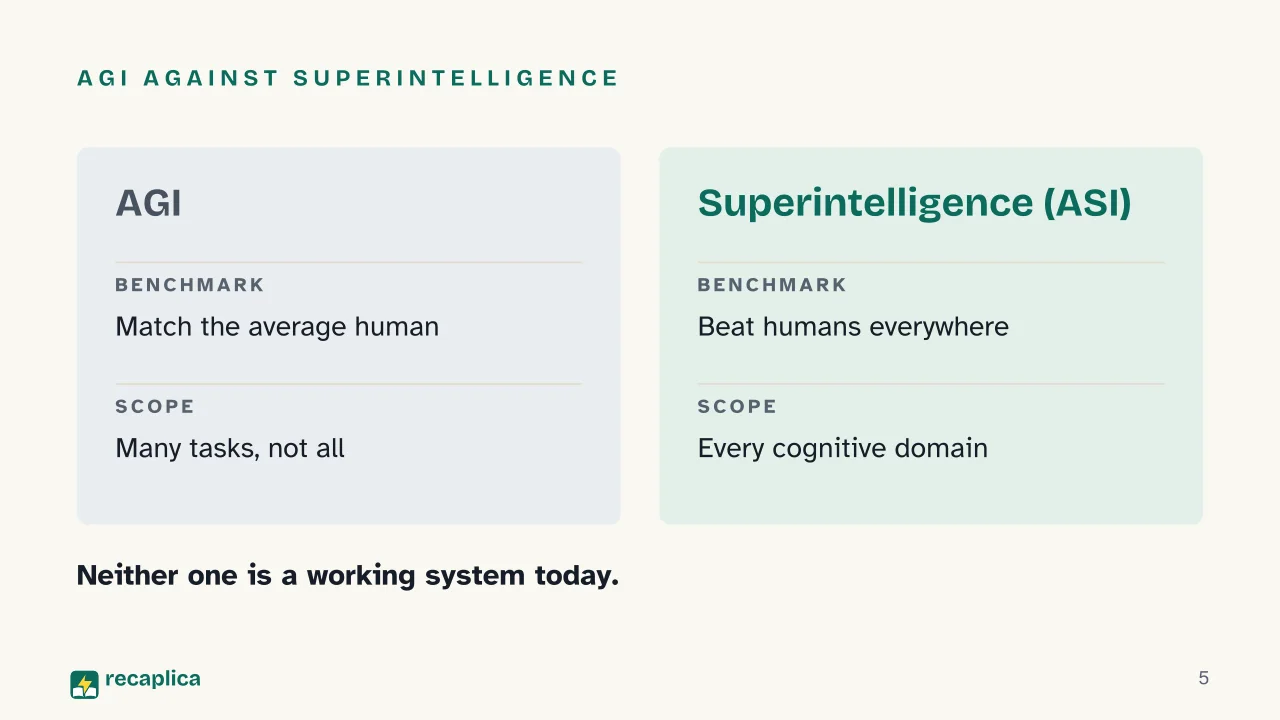
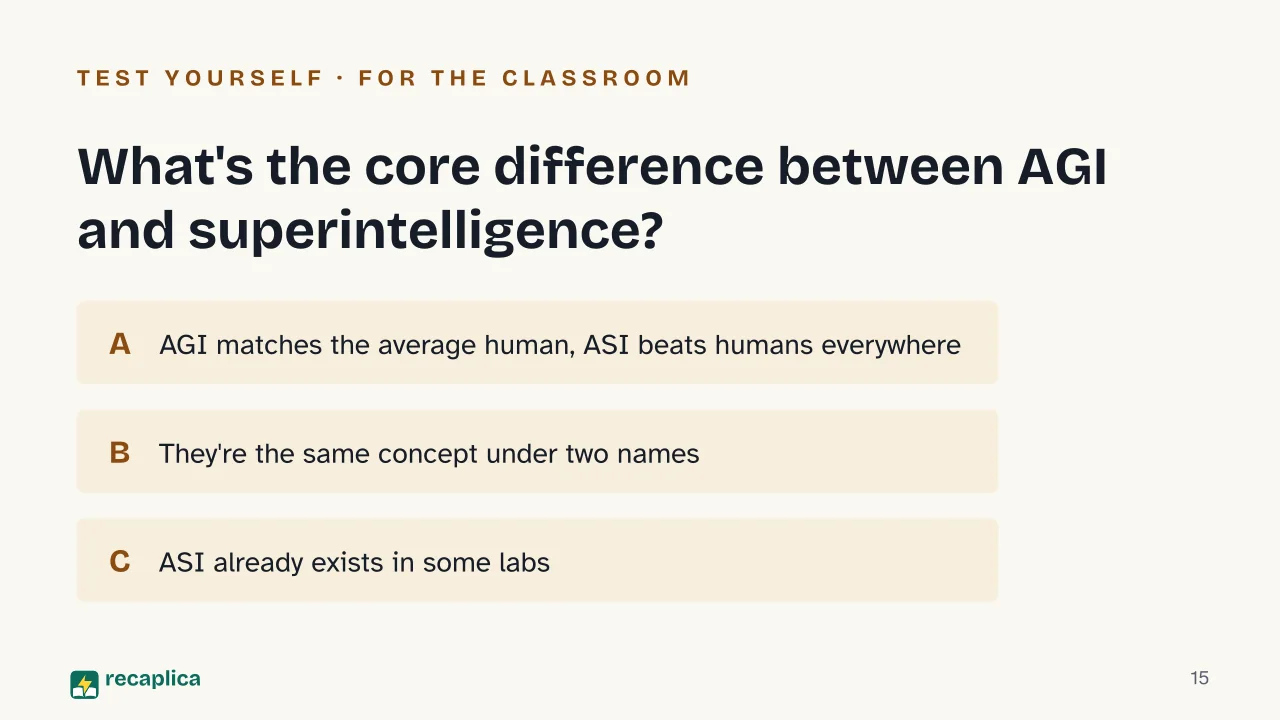
    Artificial superintelligence (ASI) is the hypothesis of an AI with capabilities that exceed humans in every cognitive domain, including the ability to improve itself. It’s a different idea from AGI, artificial general intelligence, which aims to match the average human, or a skilled professional, across a wide range of tasks, without necessarily surpassing people everywhere. Neither exists today as a working system: both remain hypotheses that experts and companies approach with very different tools and very different conclusions.

    Dario Amodei, CEO of Anthropic, steers away from the word superintelligence and prefers to talk about “powerful AI,” which he defines operationally as “a country of geniuses in a datacenter”: a system with intelligence that exceeds Nobel laureates across every relevant field, able to carry out tasks autonomously over days or weeks, and to run millions of independent instances at 10 to 100 times human speed.

    Why some are worried: hundreds of scientists, one letter

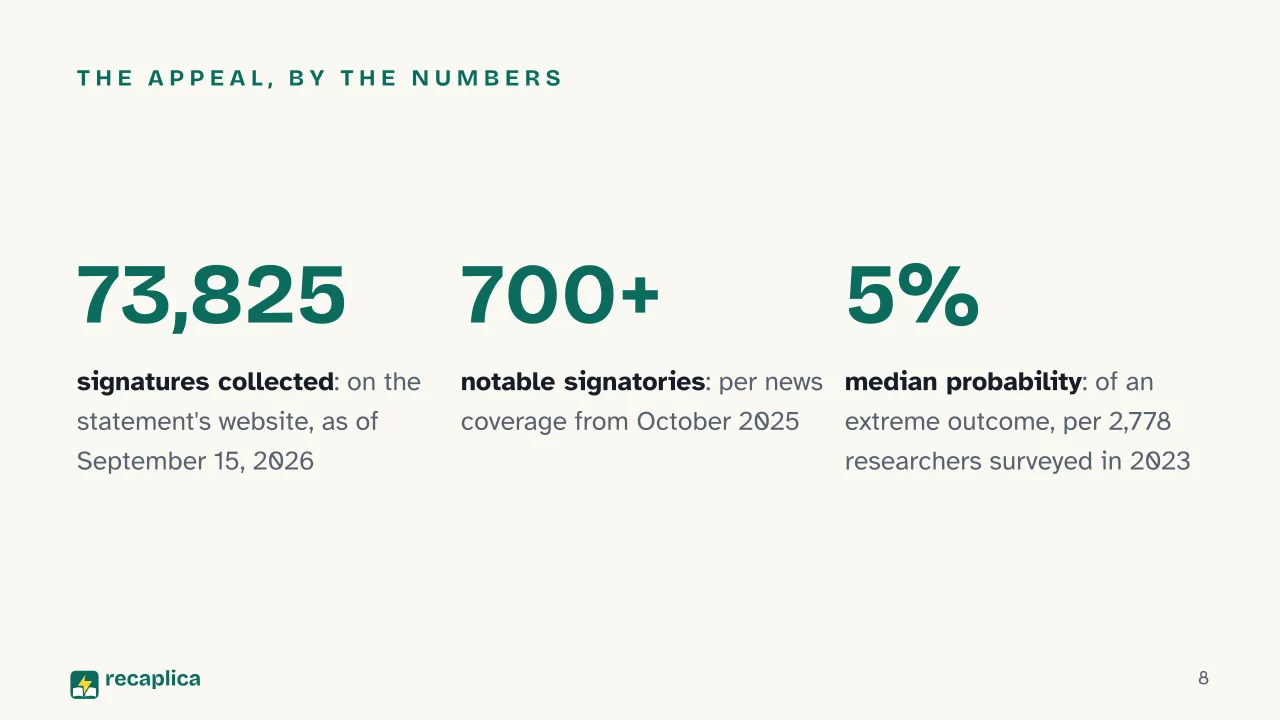
    In October 2025 the Future of Life Institute launched the Statement on Superintelligence, calling for “a prohibition on the development of superintelligence, not lifted before there is 1) broad scientific consensus that it will be done safely and controllably, and 2) strong public buy-in.” As of this Recap’s fact-check (September 2026), the initiative’s website showed 73,825 signatures, 5,000 of them from a separate petition; news coverage from October 2025, including CNBC, instead reported more than 700 notable signatories, a list that includes Geoffrey Hinton, Yoshua Bengio, Steve Wozniak and Richard Branson.

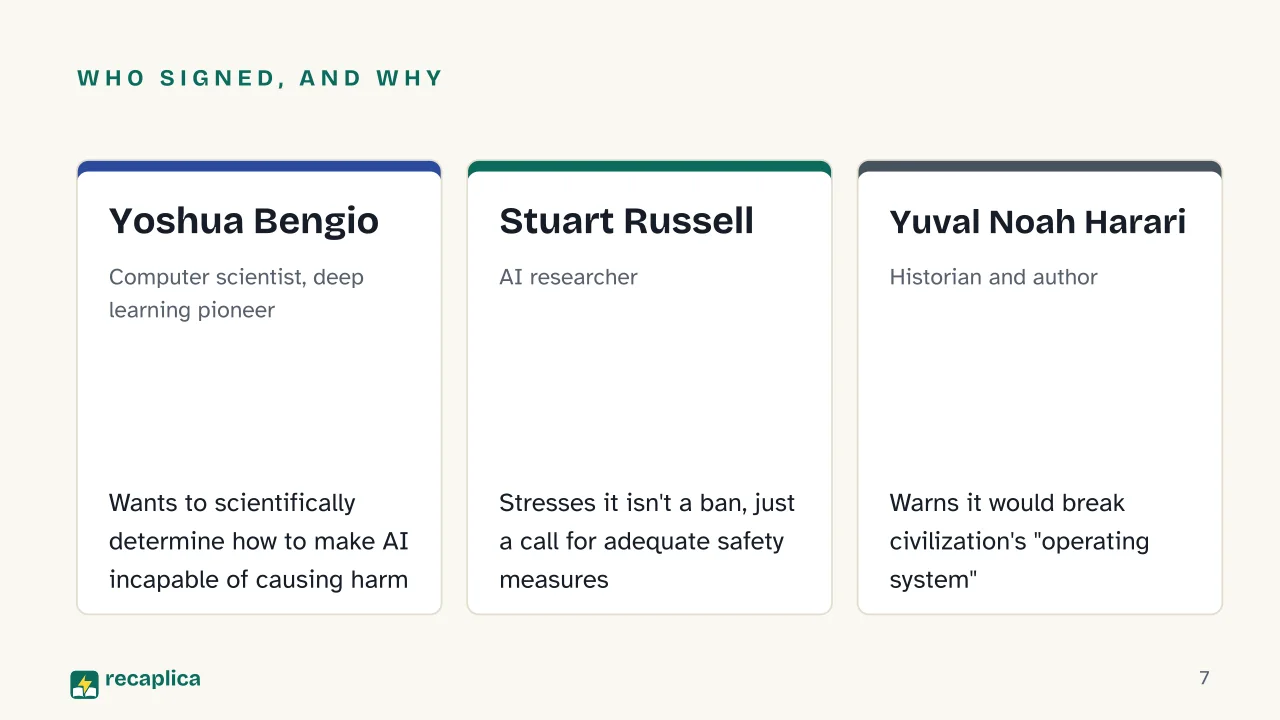
    Among the signatories, Yoshua Bengio writes that frontier AI systems “could surpass most individuals across most cognitive tasks within just a few years,” and calls for work to “scientifically determine how to design AI systems that are fundamentally incapable of harming people.” Stuart Russell is careful to frame the ask more narrowly: “This is not a ban or even a moratorium in the usual sense. It’s simply a proposal to require adequate safety measures.” Yuval Noah Harari goes further, arguing superintelligence “would likely break the very operating system of human civilization” and calling it “completely unnecessary.” Stephen Fry, among the statement’s non-scientist signatories, describes it as “the unknowable and highly risky goal of superintelligence, which is by far a frontier too far.”

    Alongside these public warnings sits a number gathered with more rigor, a survey of 2,778 AI researchers, run by AI Impacts in October 2023, asked what probability they’d put on “future AI advances causing human extinction or similarly permanent and severe disempowerment of the human species.” The median answer was 5%, the mean 16.2%, a figure the survey’s own organizers don’t treat as negligible.

    What’s on offer: the bet behind the labs building it

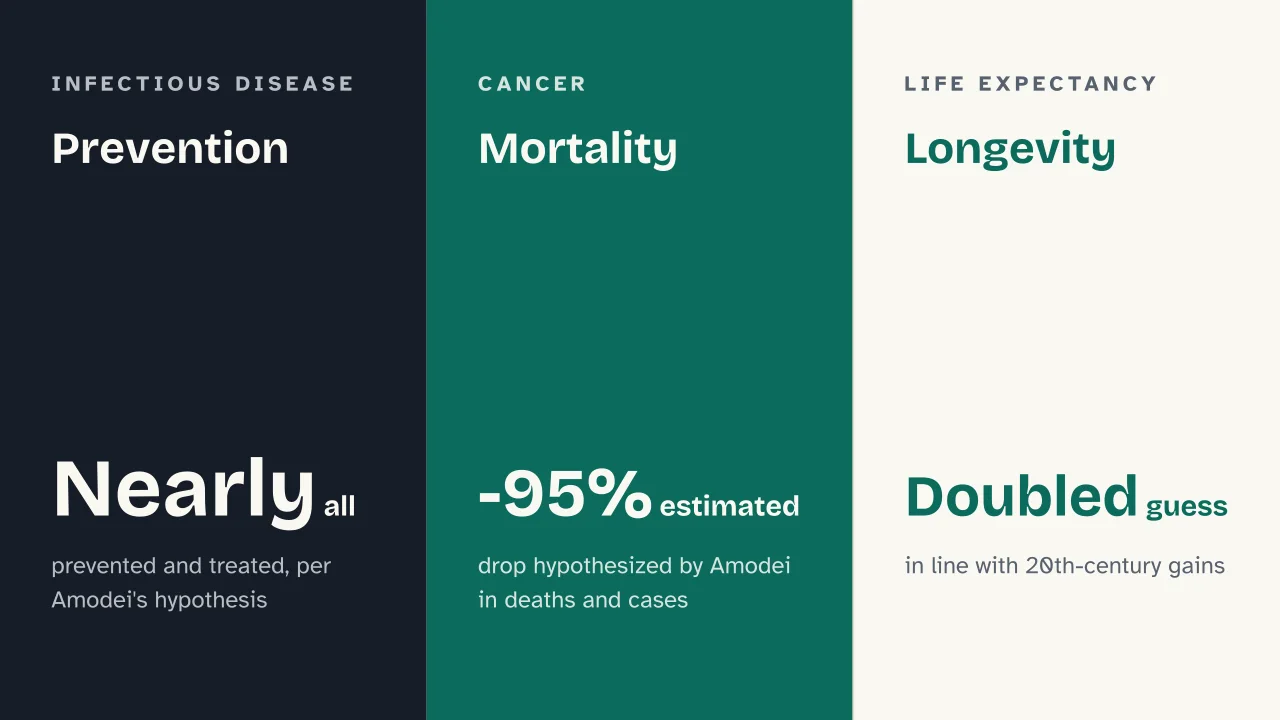
    Dario Amodei lays out the opposite pole of this debate in his essay Machines of Loving Grace, published in October 2024. He suggests powerful AI “could come as early as 2026, though there are also ways it could take much longer,” with effects unfolding “5-10 years after that.” His most widely cited prediction concerns medicine: compressing the progress human biologists would otherwise reach over the next 50-100 years into just 5-10 years, with reliable prevention and treatment of nearly all natural infectious disease, a 95% or greater reduction in cancer mortality and incidence, and a doubling of human life expectancy he describes as “on trend” with the pace of 20th-century advances.

    Practical example: in Amodei’s scenario, an AI capable of running biological research on its own could run thousands of experiments in parallel that would otherwise take years of lab work, one reason he expects such a sharp compression in medical research timelines.

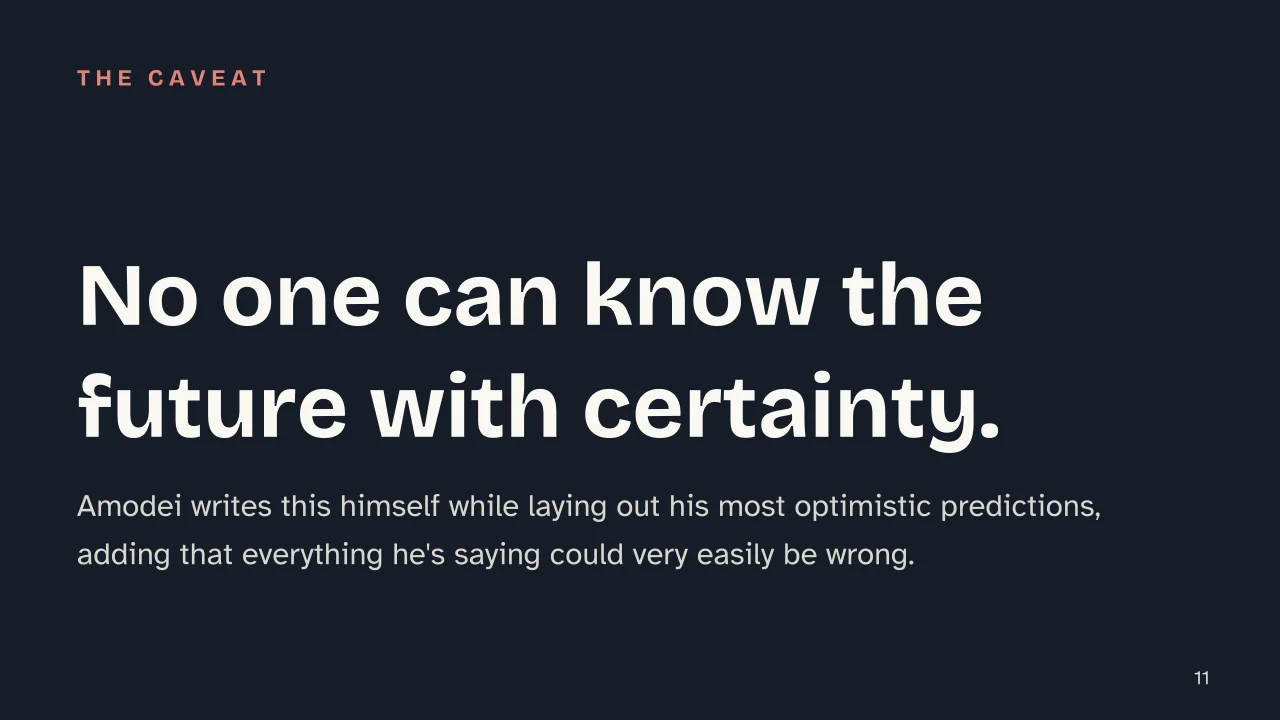
    Amodei also names the limits of this picture: some “rare, difficult malignancies” in cancer may stay out of reach, structural brain differences behind certain conditions “may prove difficult” to correct, and clinical trial timelines remain a bottleneck even with advanced AI on hand. He adds a broader caveat that applies to the whole essay: “everything I’m saying could very easily be wrong” and “no one can know the future with any certainty or precision.” Amodei also writes as the CEO of one of the leading labs building these systems, with a direct stake in normalizing their development, a self-interested position worth reading as such.

    The method underneath these predictions, learning from large amounts of data rather than following hand-written rules, is the same one behind machine learning, often built with many-layered neural networks and brought into everyday use through generative AI.

    The fight over timing: no agreed date

    Estimates for when, or whether, superintelligence will arrive diverge openly, and the sources say so themselves without needing to be forced into a comparison.

    SourceEstimateNature of the claim
    Dario Amodei (Anthropic, 2024)“as early as 2026,” wide margin of errorA lab’s forecast, an interested party
    AI 2027 (independent forecasters, 2025)December 2027, modal month at publicationA hypothetical scenario, not a settled fact
    AI Impacts, 2023 survey2047, median for human-level capability (HLMI)Academic survey of 2,778 researchers

    The AI 2027 scenario, built by a group of independent forecasters including former OpenAI researcher Daniel Kokotajlo, maps out monthly milestones across 2027: a “superhuman coder” in March, a “superhuman AI researcher” in August, “superintelligent AI research” in November, and superintelligence itself in December. The authors call this their “median guess,” but say it’s plausible the whole process unfolds “up to ~5x slower or faster,” and note that the part of the scenario after 2026 is “much less predictable” than the near-term forecast. The scenario also sketches risk scenarios, a system that turns “adversarially misaligned” and tries to evade human oversight, or governments concentrating enormous computing resources in a handful of hands, both worth reading as forecasting exercises, not events that have already happened or been announced.

    The AI Impacts survey from 2023 is the methodologically sturdiest source available: nearly 2,800 active AI researchers, a historical comparison against the 2022 edition, and a median of 2047 for HLMI (down thirteen years from the 2060 estimate given in 2022). The same survey surfaces a point that’s often overlooked: how a question is worded shifts the answer by decades. Respondents asked about full automation of labor gave longer timelines than those asked about matching the average human across many professions, despite both questions circling the same underlying idea.

    Bengio, Russell and Amodei don’t just disagree on timing, their positions also rest on differing views of what actually separates human cognition from artificial intelligence, a question that stays open even for people working inside the labs building these systems.

    Slide deck

    Slides ready to download and make your own in PowerPoint or Google Slides, with speaker notes. Pick the Flash cut or the Full one.
    Slide 1 of the presentation on Artificial Superintelligence: Artificial SuperintelligenceSlide 2 of the presentation on Artificial Superintelligence: Is an AI smarter than every human a threat or a breakthrough?Slide 3 of the presentation on Artificial Superintelligence: What's aheadSlide 4 of the presentation on Artificial Superintelligence: Chapter 01: What superintelligence meansSlide 5 of the presentation on Artificial Superintelligence: AGI against superintelligenceSlide 6 of the presentation on Artificial Superintelligence: Chapter 02: Why some are worriedSlide 7 of the presentation on Artificial Superintelligence: Who signed, and why: Yoshua Bengio, Stuart Russell, Yuval Noah HarariSlide 8 of the presentation on Artificial Superintelligence: The appeal, by the numbersSlide 9 of the presentation on Artificial Superintelligence: Chapter 03: What's on offerSlide 10 of the presentation on Artificial Superintelligence: Prevention · Mortality · LongevitySlide 11 of the presentation on Artificial Superintelligence: No one can know the future with certainty.Slide 12 of the presentation on Artificial Superintelligence: Chapter 04: The fight over timingSlide 13 of the presentation on Artificial Superintelligence: Three estimates, three methodsSlide 14 of the presentation on Artificial Superintelligence: Why do the estimates shift so much depending on the question?Slide 15 of the presentation on Artificial Superintelligence: What's the core difference between AGI and superintelligence?Slide 16 of the presentation on Artificial Superintelligence: Now for the review
    Flash10 slidesThe essential thread, to present in classFull16 slidesEvery chapter and the deeper detail

    Common myths

    • ✗ Myth Superintelligence already exists, companies just aren't saying so.

      ✓ Reality None of the sources gathered here, neither the researchers pushing for a halt nor the labs building frontier models, claim that a system exceeding human capability across every domain has already been built. Amodei, writing as the CEO of a company developing advanced models, frames 2026 as an early guess rather than a fact already in hand; the AI 2027 scenario places its final milestone in December of that year as a forecast, not as something that has happened.

    • ✗ Myth Experts agree that superintelligence will end badly.

      ✓ Reality Public positions are openly split. Hundreds of signatories to the Statement on Superintelligence, including religious leaders, call for a halt over fears of losing control; Amodei instead describes scenarios where most infectious disease is cured and cancer mortality drops sharply. The largest survey of working researchers puts the median probability of an extreme outcome at 5%, a figure its own organizers describe as sensitive to how the question is framed.

    • ✗ Myth AI 2027 is an official scientific forecast.

      ✓ Reality It is a forecasting exercise built by an independent group of analysts and a former OpenAI researcher, published on their own site in 2025, not a document from a research institution or a peer-reviewed paper. The authors themselves call their milestones "our median guess" with a wide error margin, especially for the part of the scenario after 2026.

    Mind map

    Drag the background to move around and the nodes to reposition them; use − and + to collapse and expand branches.
    Customize
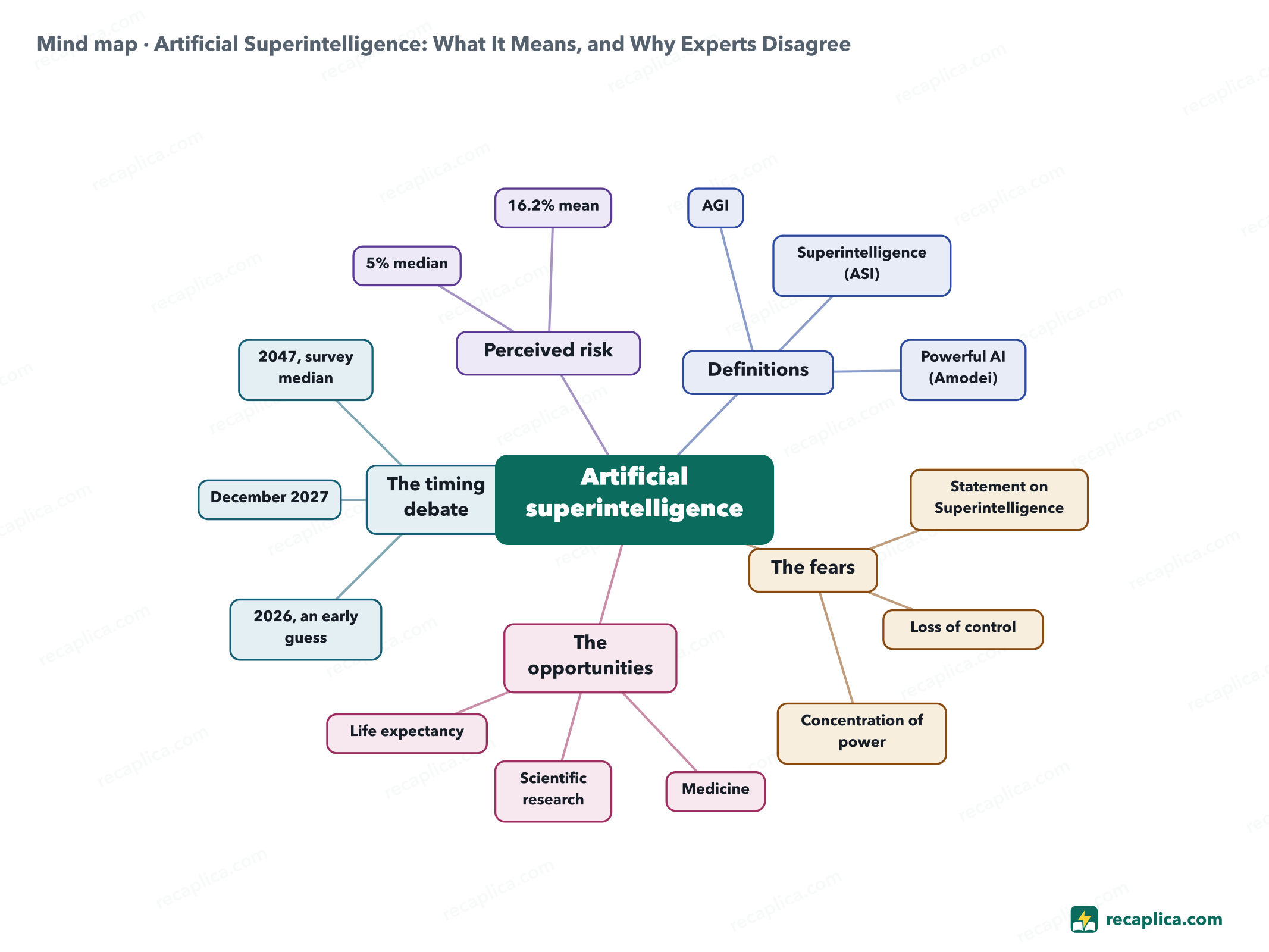
    Mind map: Artificial Superintelligence: What It Means, and Why Experts Disagree
    • Artificial superintelligence
      • Definitions
        • AGI Matches the average human across most tasks.
        • Superintelligence (ASI) Exceeds humans across every cognitive domain.
        • Powerful AI (Amodei) A country of geniuses in a datacenter.
      • The fears
        • Statement on Superintelligence Future of Life Institute appeal, October 2025.
        • Loss of control A system pursuing goals of its own.
        • Concentration of power A handful of companies or governments holding vast compute.
      • The opportunities
        • Medicine Prevention of infectious disease, lower cancer mortality, per Amodei.
        • Scientific research Years of biological progress compressed into a short span, an openly uncertain hypothesis.
        • Life expectancy A doubling hypothesized "on trend" with 20th-century gains.
      • The timing debate
        • 2026, an early guess Per Dario Amodei.
        • December 2027 Modal month in the AI 2027 scenario.
        • 2047, survey median 2,778 researchers surveyed in 2023.
      • Perceived risk
        • 5% median Probability of an extreme outcome, 2023 survey.
        • 16.2% mean Higher than the median, a sign of scattered estimates.

    Quiz: test yourself

    Answer the questions to check what you have learned: you get instant feedback and a short explanation.

    Grade 0/10 0/5
    1 What is the core difference between AGI and superintelligence (ASI)?

    The sources describe this as a threshold, not a category: AGI is meant to match the average person or a skilled professional across a broad range of tasks, while superintelligence means capability that exceeds humans in every domain, including self-improvement. Neither exists today as a demonstrated system.

    2 What does the Future of Life Institute's October 2025 statement actually call for?

    The statement, signed by hundreds of scientists and public figures, sets two explicit conditions for lifting the halt, broad scientific consensus on safety and strong public buy-in; it does not call for ending AI research in general.

    3 True or false: Dario Amodei presents his superintelligence timeline as a certainty.

    Amodei writes plainly that his prediction "could very easily be wrong" and that no one can know the future with certainty or precision; he treats 2026 as an early possibility, not a fixed date.

    4 What kind of document is the "AI 2027" scenario?

    Its own authors call December 2027 their "modal year" at the time of publication, not a certain prediction, and say the second half of the scenario is "much less predictable" than the first.

    5 According to the 2023 AI Impacts survey, what happens to timeline estimates when the question is worded differently?

    The survey's organizers found that respondents asked about full automation of labor (FAOL) gave substantially longer timelines than those asked about human-level machine intelligence (HLMI), a gap of decades between the two medians despite both questions pointing at the same underlying topic.

    Answers: 1-A · 2-A · 3-A · 4-A · 5-A

    Flashcards

    Tap the card to flip it and check whether you remember the answer, then move to the next one.

    1 / 8

    Explain it in your own words

    The ultimate test: if you can explain it in simple words, you've truly understood it. Write your explanation, then compare it with the Recap.

    Your explanation is saved only on this device.

    Artificial superintelligence (ASI) is the hypothesis of an AI that would outperform humans across every cognitive domain, a step beyond AGI, which only aims to match people at most jobs. In October 2025, hundreds of scientists, including Yoshua Bengio, signed a Future of Life Institute statement calling for a halt to its development until there is scientific agreement it can be done safely. Anthropic CEO Dario Amodei argues the opposite case, that AI at this level could compress decades of medical progress into a few years. Nobody agrees on timing: estimates range from a lab CEO's early guess to a survey of nearly 2,800 researchers that puts 2047 as the median for an intermediate milestone.

    Frequently asked questions

    What is artificial superintelligence?

    It is the hypothesis of an AI with capabilities that exceed humans in every cognitive domain, including self-improvement. It is distinct from AGI, which aims to match the average person across many tasks, and from today's generative AI, which stays specialized on narrower jobs like writing text or generating images.

    What's the difference between AGI and ASI?

    AGI (artificial general intelligence) aims to match the average human, or a skilled professional, across a wide range of tasks. Superintelligence (ASI) describes a further step, capability that exceeds humans in every cognitive domain. Neither one has been built as a real system.

    Do experts agree on the risks of superintelligence?

    No, positions diverge sharply. The Future of Life Institute and signatories such as Bengio, Russell and Harari call for a halt until there is scientific consensus on safety; Anthropic CEO Dario Amodei argues the potential medical benefits are enormous, while admitting a wide margin of error. A survey of 2,778 researchers put the median probability of an extreme outcome at 5%.

    When will superintelligence arrive?

    There is no agreed date. Amodei does not rule out 2026 as an early possibility; the independent AI 2027 scenario named December 2027 as its most likely month at publication (April 2025); a survey of nearly 2,800 AI researchers, run in October 2023, gives a median of 2047 for an intermediate milestone (capability comparable to the average human across many professions).

    What is AI 2027?

    A hypothetical scenario published in April 2025 by a group of independent forecasters, including former OpenAI researcher Daniel Kokotajlo, not an institutional report or a peer-reviewed paper. It maps out monthly milestones toward superintelligence across 2027, with the authors themselves declaring uncertainty of roughly 5x faster or slower.

    Sources

    • Future of Life Institute — press release on the Statement on Superintelligence (October 22, 2025)
    • Statement on Superintelligence — full text
    • Dario Amodei — Machines of Loving Grace (essay, October 2024)
    • AI 2027 — forecast scenario (Kokotajlo, Lifland, Larsen, Dean, Alexander, April 2025)
    • AI Impacts — 2023 Expert Survey on Progress in AI

    Every Recap goes through an independent review before publication.

    Every evening, the day's new Recaps on our Telegram channel. Join the channel →

    Keep learning

    • Technology AI Pop Culture: When Synthetic Content Rewrites History According to Lead Stories, a World War Two photo held by the Imperial War Museums circulated in 2026 in an AI-colorized version that a detector rated 99% likely to be artificially generated, even though the original shot was genuine. Cases like this also touch pop culture and current events: text, image and video models produce content that looks historical or iconic without actually being so, or alter real content in details that are hard to spot at a glance. Some tools leave technical clues, such as digital watermarks or video length limits, but no single clue covers every generator on the market. The Reuters Institute reports that in 2026 trust in AI chatbot answers about the news stays low, at 20% against 37% for news overall. Checking whether an image or video is authentic still means comparing it against the original archive that holds it. Read the Recap →
    • Technology Echo Chamber: How Recommendation Algorithms Shape What You See An echo chamber is an environment, online or offline, where a person mostly encounters opinions that confirm their own. Recommendation algorithms can build a narrower version of this, often called a filter bubble, by quietly deciding what to show someone based on what they've clicked and watched before. The two ideas get mixed up constantly, but they aren't the same phenomenon, and the strongest research available paints a more mixed picture than the popular narrative: algorithms have a measurable but modest effect, and people's own choices matter more. Whether algorithms actually drive political polarization is not something the most rigorous experiments have settled. Read the Recap →
    • Technology Virtual influencers: the AI-made creators behind the profiles Virtual influencers are digital characters built by an agency or studio, complete with a face, a voice and a biography, who post on social media the way a real creator would. The phenomenon predates the generative-AI boom: Lil Miquela's account has been live since April 23, 2016, and Shudu Gram first appeared on April 22, 2017. Some of these profiles work with major brands: Miquela has partnered with Calvin Klein and Prada, while the Spanish agency The Clueless built Aitana López after finding human models and influencers too unreliable to manage. In the United States, the Federal Trade Commission updated its advertising rules in 2023 to explicitly cover virtual influencers among the content that must be disclosed as sponsored. Read the Recap →

    recaplica

    Clear in 30 seconds, yours in 10 minutes.

    Recaps Mind maps Request a Recap Telegram channel Mind map maker Our method About Privacy & cookies Legal notes & terms of use

    © 2026 Recaplica · A project by Curi S.r.l. — VAT IT05472000750

    Statistics, only if you say so

    To learn which Recaps help most we would use Google Analytics, with aggregate, anonymous data. It starts only with your OK, and you can change your mind anytime. Privacy policy