Skip to content
recaplica

    One moment: security check

    Cloudflare wants to make sure you're not a robot. Tick the box below and your search will continue on its own.

    IT
    recaplica Whale: What It Is and How It Lives
    © 2026 Recaplica · recaplica.com — All rights reserved
    Home › Science

    Whale: What It Is and How It Lives

    By Recaplica Newsroom · Updated on October 3, 2026

    What to print

    Page numbers appear when printing with default margins.

    Slides

    Choose a cut

    Flash10 slidesThe essential thread, to present in classFull16 slidesEvery chapter and the deeper detail

    Both come with speaker notes.

    Telegram channel
    recaplica Clear in 30 seconds, yours in 10 minutes.
    In 30 seconds Key points Deep dive Slides Myths Mind map Quiz Flashcards FAQ

    In 30 seconds quick read

    A whale isn't a fish but a mammal that breathes air and returned to the water after an evolutionary path from land-dwelling ancestors. The group splits into two branches with different mouths, baleen whales, which filter small prey with baleen plates, and toothed whales, which hunt with teeth. The title of biggest animal in the world belongs to the blue whale, a baleen whale that can exceed 149 tons according to NOAA Fisheries; the sperm whale, the largest toothed whale, still stays smaller. Some whales migrate thousands of kilometers between the polar waters where they feed and the warm waters where they breed, and their lives can last up to ninety years.

    Key Points

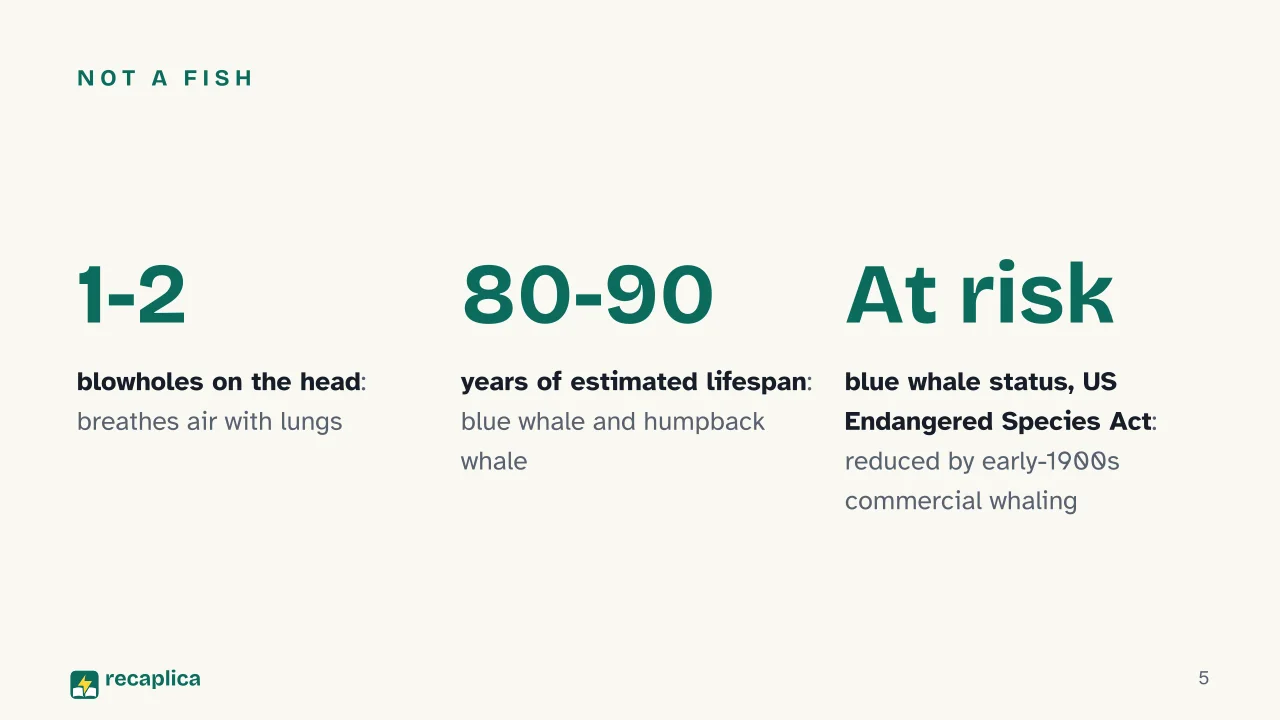
    • Whales are mammals: they breathe air with lungs through one or two blowholes on top of the head, instead of gills, according to americanoceans.org.
    • The group splits into two biological branches: baleen whales, with baleen plates for filtering, and toothed whales, with teeth for hunting, according to NOAA Fisheries.
    • The title of biggest animal in the world belongs to the blue whale, a baleen whale: Antarctic individuals exceed 33 meters and 149 tons, according to NOAA Fisheries.
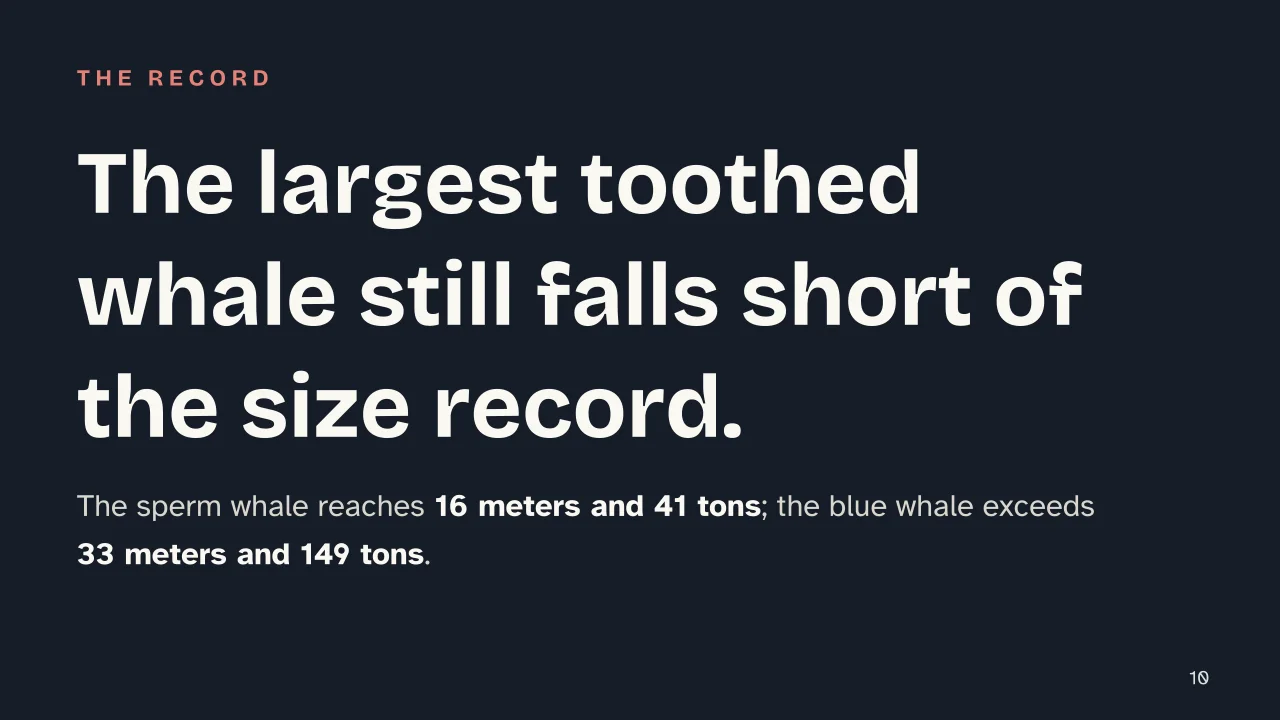
    • The sperm whale, a toothed whale, is the largest toothed cetacean but stays smaller than the blue whale: up to 16 meters and 41 tons, according to NOAA Fisheries.
    • The blue whale feeds almost exclusively on krill, and the largest individuals can eat up to about 5.4 tons a day, according to NOAA Fisheries.
    • The blue whale carries an endangered listing under the US Endangered Species Act: its numbers are a small fraction of what they were before large-scale commercial whaling took hold in the early 1900s, according to NOAA Fisheries, even though populations are growing worldwide.

    Deep Dive

    A whale isn’t a big fish. It’s a mammal, and it carries one or two blowholes on the crown of its head for breathing, while dolphins have only one, according to americanoceans.org. Over the course of evolution the cetacean group returned to the water after descending from land-dwelling ancestors, a path that Darwin’s theory of evolution helps frame: natural selection doesn’t follow a fixed blueprint, it gradually adapts a lineage to the environment it lives in.

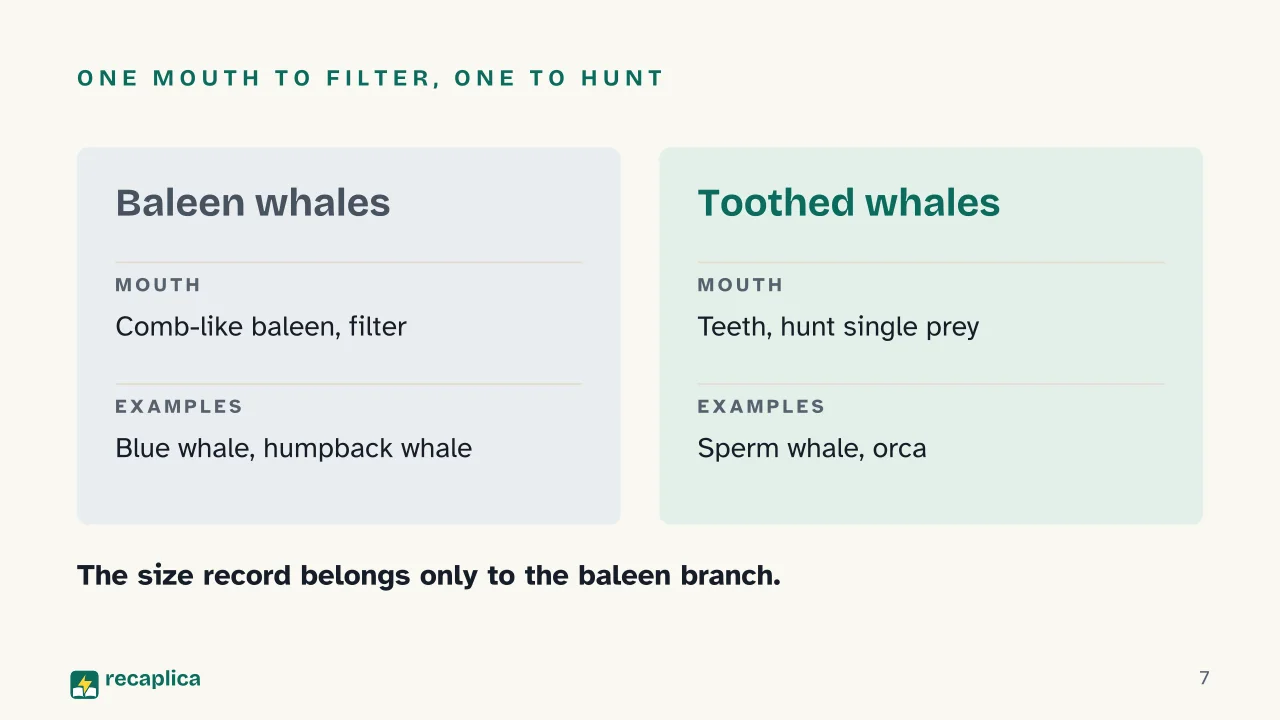
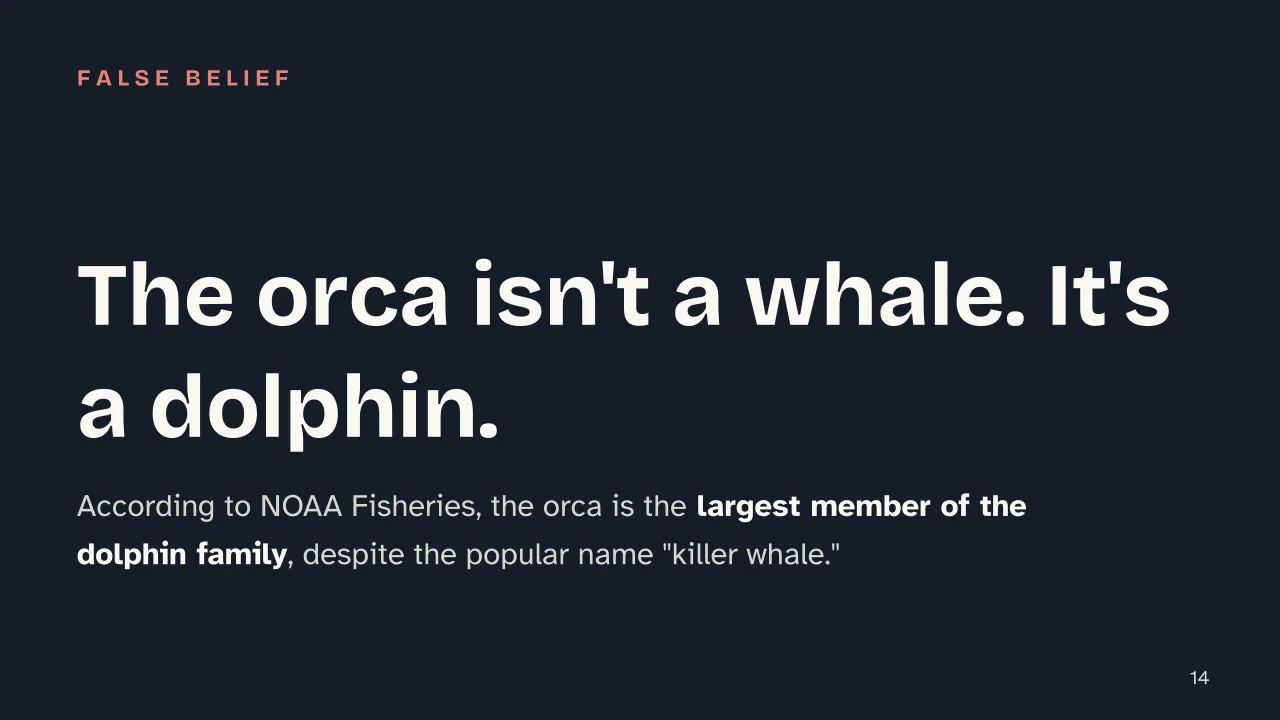
    Within the cetacean group there are two biological branches with very different mouths. According to NOAA Fisheries, baleen whales use baleen plates to strain small prey, such as krill, out of the water; toothed whales instead have teeth and hunt fish, squid, and other marine mammals one at a time. The distinction matters more than the common name: the orca, popularly called the “killer whale,” actually belongs to the dolphin family (Delphinidae), of which it’s the largest member, a toothed whale, not a baleen whale.

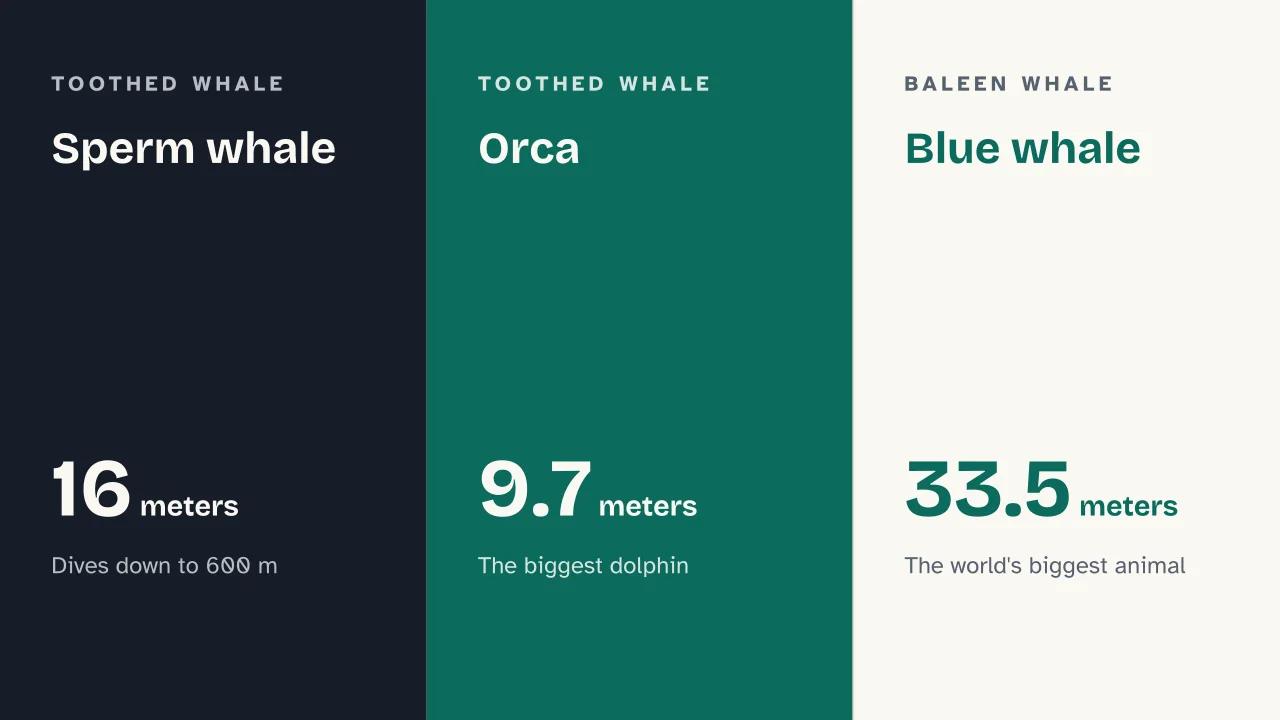
    The title of biggest animal in the world still goes to a baleen whale. According to NOAA Fisheries, blue whales in the North Atlantic and North Pacific reach about 27 meters and exceed 45 tons, while Antarctic individuals reach about 33.5 meters and exceed 149 tons: no other animal has ever come close to that size. The sperm whale, a toothed whale, measures between about 12 meters (females) and 16 meters (males) and weighs between about 14 and 41 tons: the bulkiest of all known toothed whales, though still far smaller than the blue whale.

    Blue whales live in every ocean except the Arctic, according to NOAA Fisheries.

    Practical example: picture a blue whale and a sperm whale side by side: 33 meters against 16 is more than double, yet both count among the ocean’s giants. The confusion comes from comparing two different things, the largest of all cetaceans and the largest toothed cetacean, not the same record.

    FeatureBaleen whales (e.g. blue whale)Toothed whales (e.g. sperm whale, orca)
    MouthComb-like baleen platesTeeth
    FeedingFilter krill and small fishHunt prey one at a time
    Largest exampleBlue whale, over 33 mSperm whale, up to 16 m
    BlowholesTwoOne

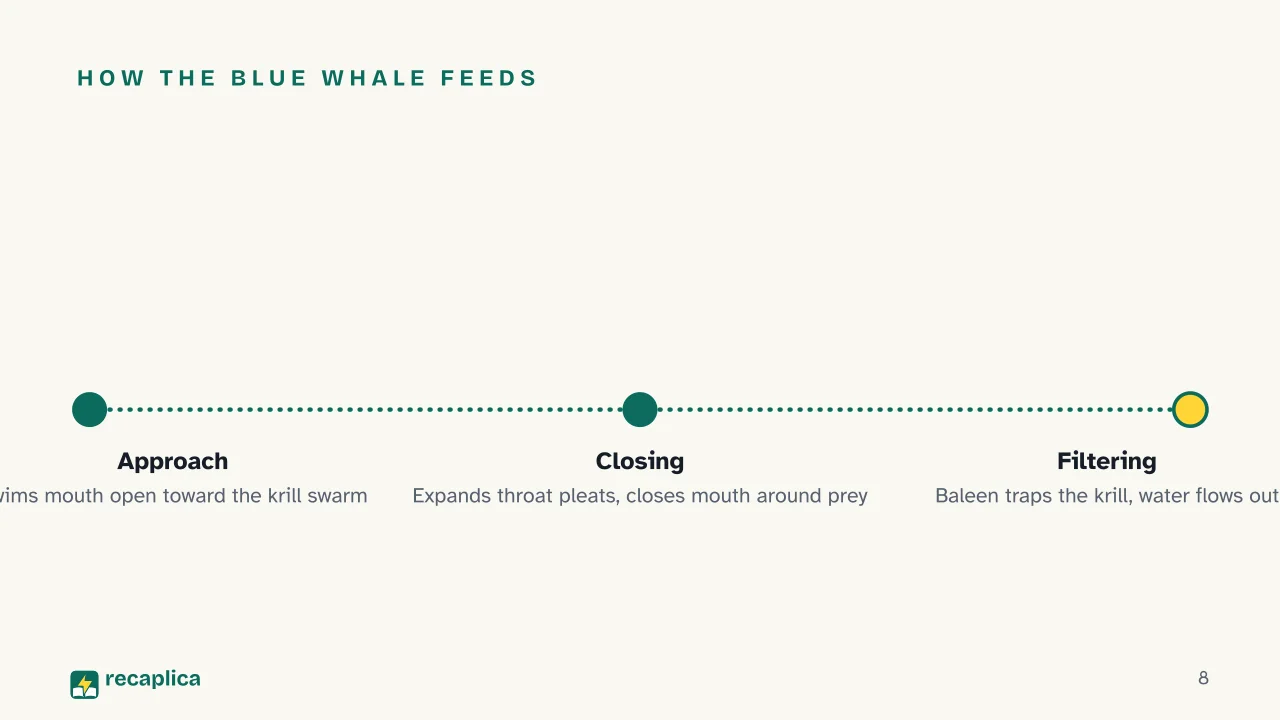
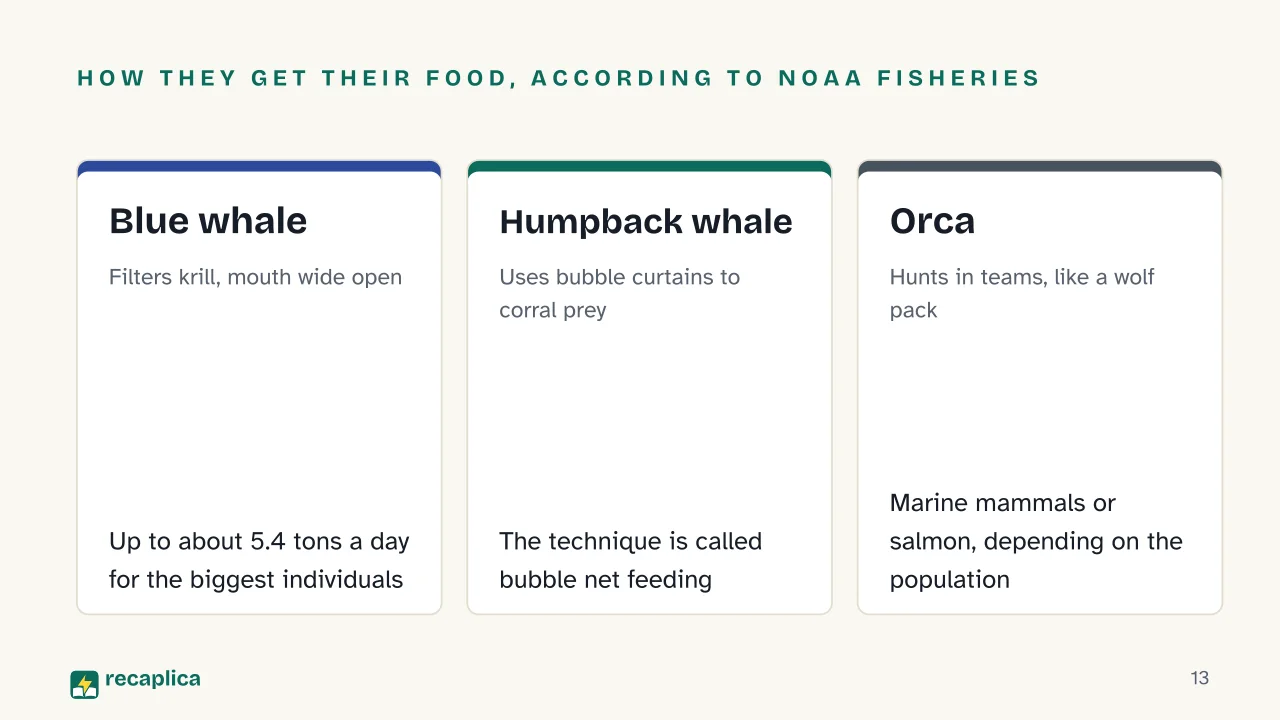
    The blue whale feeds almost exclusively on krill, with fish and copepods as occasional extras, according to NOAA Fisheries. It approaches krill swarms with its mouth wide open, then expands the pleats in its throat and closes its mouth around the prey: the largest individuals can eat up to about 5.4 tons a day. The humpback whale, another baleen whale, uses a different technique, group coordinated bubble net feeding: curtains of air bubbles that concentrate prey into a tighter spot, easier to swallow in one go.

    Toothed whales hunt very differently. The sperm whale chases prey during deep dives that typically reach about 600 meters and can last up to 45 minutes, according to NOAA Fisheries. The orca has the most varied diet of any cetacean: “transient” populations feed mainly on marine mammals and squid, while “resident” populations rely mostly on salmon, and it often hunts in teams, working together like a pack of wolves. It lives in groups called pods, built around maternal bonds and seen traveling together more than half the time. The social behavior of marine mammals stays a field of study on its own across many species, from orcas to otters, each with its own adaptations to life in the water.

    The blue whale spends summer feeding in polar waters, then makes long migrations toward equatorial waters as winter sets in, according to NOAA Fisheries. Some humpback whale populations migrate roughly 8,000 km between tropical breeding grounds and the colder, richer waters where they feed. During these journeys the blue whale typically swims at around 8 km/h, but can speed up past 32 km/h in short bursts.

    Whales also communicate across great distances. The blue whale is among the loudest animals on the planet and produces pulses, moans, and groans that, under favorable ocean conditions, are thought to be heard by other whales up to about 1,600 km away, according to NOAA Fisheries. The humpback whale is best known for its song and for surface behaviors such as breaching, leaping out of the water, and slapping its pectoral fins and tail.

    Estimated lifespan is about 80-90 years for both the blue whale and the humpback whale, according to NOAA Fisheries; the sperm whale’s can reach about 60 years. Conservation status varies by species. NOAA Fisheries lists the blue whale as endangered everywhere it lives: the individuals left are only a remnant of the numbers that existed before commercial hunting expanded in the early 1900s, even though populations are growing worldwide. In 2016, four of the humpback whale’s 14 distinct population segments were still protected as endangered and one as threatened. The orca, for its part, has a global population estimated at about 50,000 individuals according to NOAA Fisheries, though some local populations are tiny: a July 2025 census counted only 74 orcas in the “Southern Resident” population.

    This Recap doesn’t go into species- and place-specific detail, such as the narwhal, the bowhead whale, or the Pelagos Sanctuary in the Mediterranean: those deserve a Recap of their own. The whale, like every mammal, is built from the same basic biological units: the Recap on the cell tells that story.

    Slide deck

    Slides ready to download and make your own in PowerPoint or Google Slides, with speaker notes. Pick the Flash cut or the Full one.
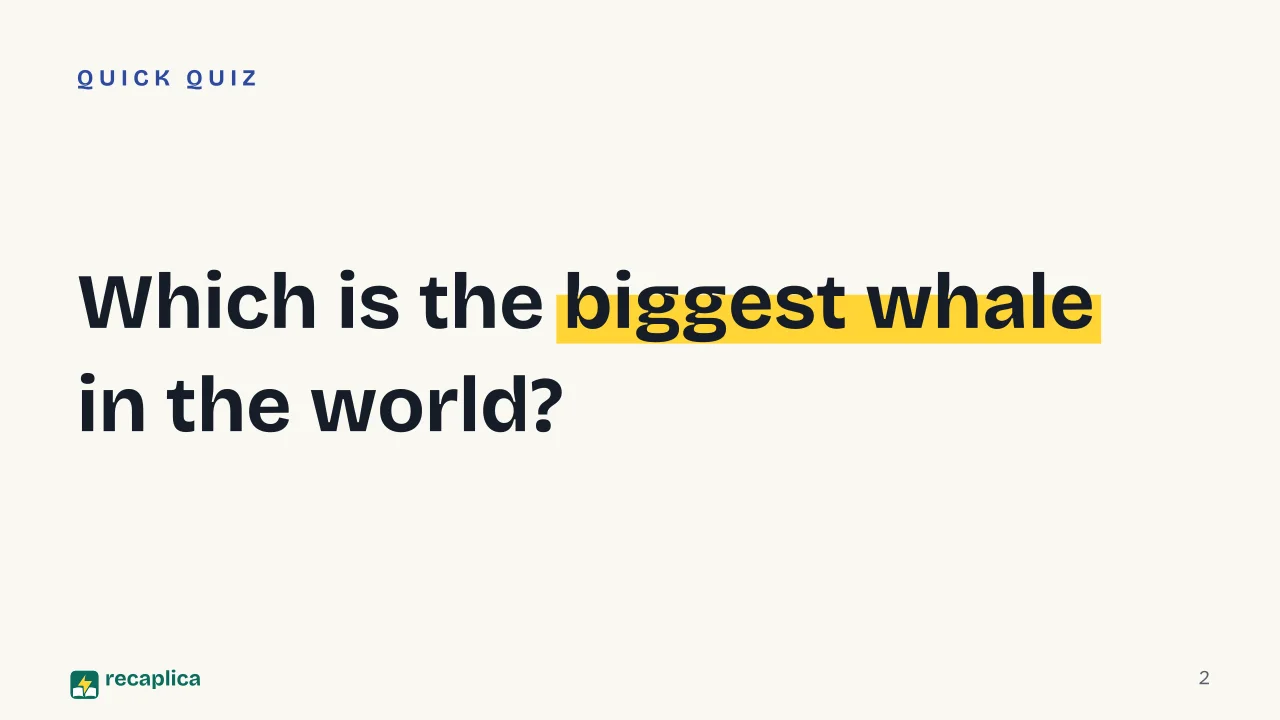
    Slide 1 of the presentation on Whale: WhaleSlide 2 of the presentation on Whale: Which is the biggest whale in the world?Slide 3 of the presentation on Whale: Inside this RecapSlide 4 of the presentation on Whale: Chapter 01: A mammal that returned to waterSlide 5 of the presentation on Whale: Not a fishSlide 6 of the presentation on Whale: Chapter 02: Two branches, different mouthsSlide 7 of the presentation on Whale: One mouth to filter, one to huntSlide 8 of the presentation on Whale: How the blue whale feedsSlide 9 of the presentation on Whale: Chapter 03: The size recordSlide 10 of the presentation on Whale: The largest toothed whale still falls short of the size record.Slide 11 of the presentation on Whale: Sperm whale · Orca · Blue whaleSlide 12 of the presentation on Whale: Chapter 04: Life, feeding, and migrationSlide 13 of the presentation on Whale: How they get their food, according to NOAA Fisheries: Blue whale, Humpback whale, OrcaSlide 14 of the presentation on Whale: The orca isn't a whale. It's a dolphin.Slide 15 of the presentation on Whale: Which is the biggest whale in the world?Slide 16 of the presentation on Whale: Time for a recap
    Flash10 slidesThe essential thread, to present in classFull16 slidesEvery chapter and the deeper detail

    Common myths

    • ✗ Myth All whales hunt with teeth, the way orcas do in documentaries.

      ✓ Reality Whales split into two different biological branches. Baleen whales, including the blue whale, the largest of all, have baleen plates and filter small prey like krill from the water; teeth belong to toothed whales, such as the sperm whale and the orca. Mixing up the two groups leads to thinking the biggest whale hunts like an orca: it doesn't.

    • ✗ Myth The orca is a whale, as its common name "killer whale" suggests.

      ✓ Reality Biologically the orca is a dolphin: according to NOAA Fisheries it's the largest member of the family Delphinidae, a toothed whale. The common name comes from its size and predatory behavior, not from scientific classification.

    • ✗ Myth The sperm whale, with its teeth and deep dives, is the biggest whale in the world.

      ✓ Reality The sperm whale is the largest living toothed whale, but the blue whale far outsizes it: according to NOAA Fisheries, this baleen whale exceeds 33 meters and 149 tons, more than double the sperm whale's maximum length.

    Mind map

    Drag the background to move around and the nodes to reposition them; use − and + to collapse and expand branches.
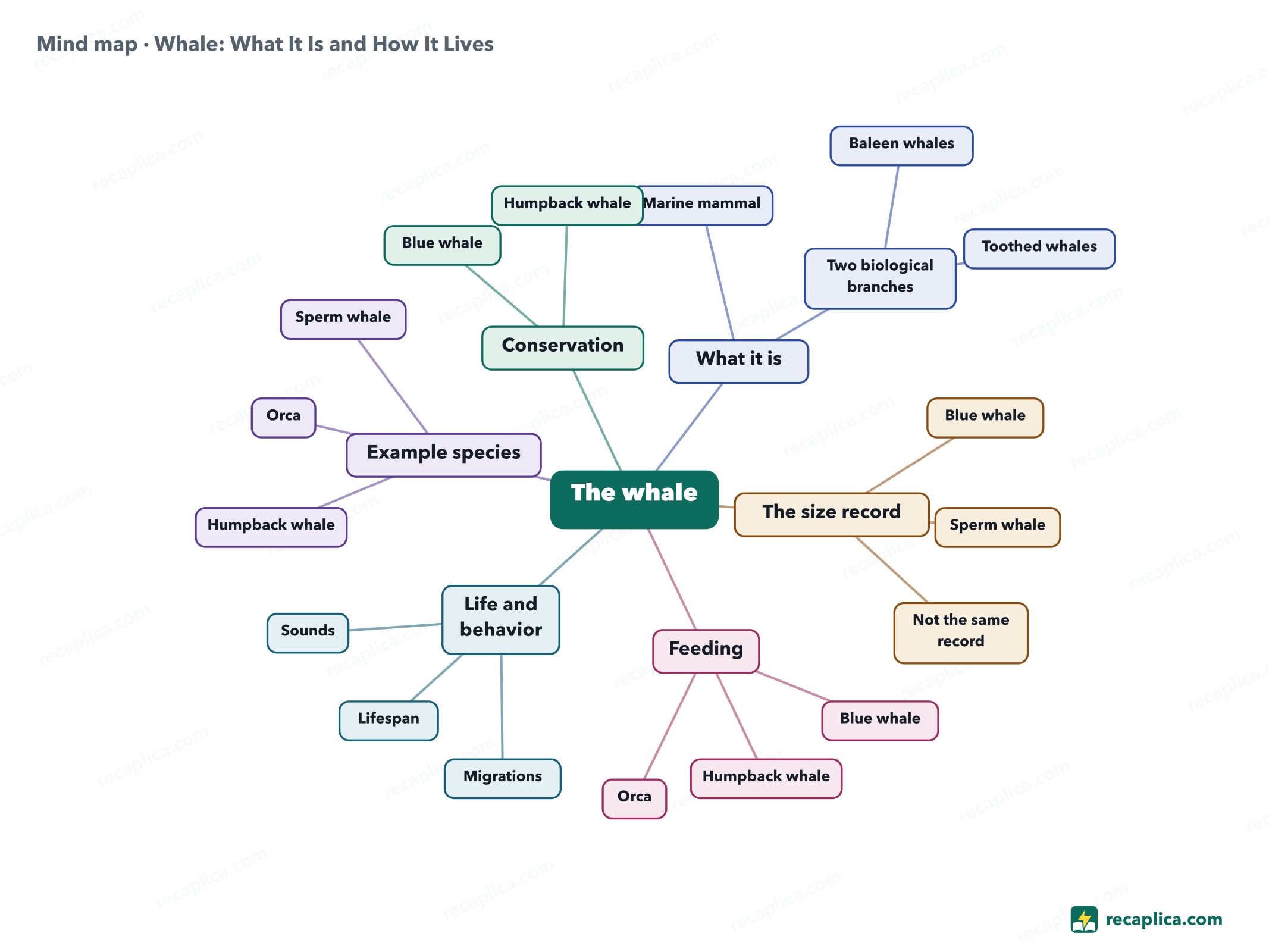
    Customize
    Mind map: Whale: What It Is and How It Lives
    • The whale
      • What it is
        • Marine mammal Breathes air through one or two blowholes, instead of gills
        • Two biological branches
          • Baleen whales Baleen plates, filter krill and small fish
          • Toothed whales Teeth, hunt fish, squid, marine mammals
      • The size record
        • Blue whale Up to 33.5 meters and 149 tons, a baleen whale
        • Sperm whale Up to 16 meters and 41 tons, the largest toothed whale
        • Not the same record The two branches aren't measured on the same scale
      • Feeding
        • Blue whale Up to about 5.4 tons of krill a day
        • Humpback whale Bubble net feeding, bubble curtains to concentrate prey
        • Orca The most varied diet among cetaceans, fish or marine mammals
      • Life and behavior
        • Migrations Polar waters in summer, warm waters in winter
        • Lifespan 80-90 years for blue whale and humpback whale
        • Sounds Pulses, moans, and groans heard across great distances
      • Example species
        • Humpback whale Up to 18 meters, known for its song and breaching
        • Orca A toothed whale, lives in matriarchal pods
        • Sperm whale Dives down to 600 meters, up to 45 minutes
      • Conservation
        • Blue whale Listed as endangered, reduced by historic whaling
        • Humpback whale Some population segments still protected in 2016

    Quiz: test yourself

    Answer the questions to check what you have learned: you get instant feedback and a short explanation.

    Grade 0/10 0/5
    1 Which is the biggest whale in the world?

    According to NOAA Fisheries, the blue whale is the largest animal that has ever lived on the planet: Antarctic individuals exceed 33 meters and 149 tons. The sperm whale is the largest toothed whale but stays smaller.

    2 What biologically separates baleen whales from toothed whales?

    According to NOAA Fisheries, baleen whales have baleen plates that filter prey, such as krill, from the water, while toothed whales have teeth and eat fish, squid, and other marine mammals.

    3 True or false: the orca, also called the "killer whale," is biologically a baleen whale.

    False: according to NOAA Fisheries the orca is the largest member of the dolphin family (Delphinidae), a toothed whale. Its common name doesn't match its biological classification.

    4 How does the blue whale feed?

    According to NOAA Fisheries, the blue whale swims with its mouth open toward swarms of krill, expands the pleats in its throat, then closes its mouth around the prey and filters it through its baleen.

    5 According to NOAA Fisheries, how long can a blue whale live?

    NOAA Fisheries estimates a lifespan of about 80-90 years for the blue whale, the same estimate given for the humpback whale.

    Answers: 1-C · 2-B · 3-B · 4-B · 5-C

    Flashcards

    Tap the card to flip it and check whether you remember the answer, then move to the next one.

    1 / 8

    Explain it in your own words

    The ultimate test: if you can explain it in simple words, you've truly understood it. Write your explanation, then compare it with the Recap.

    Your explanation is saved only on this device.

    A whale isn't a fish but a mammal that breathes air and returned to the water after an evolutionary path from land-dwelling ancestors. The group splits into two branches with different mouths, baleen whales, which filter small prey with baleen plates, and toothed whales, which hunt with teeth. The title of biggest animal in the world belongs to the blue whale, a baleen whale that can exceed 149 tons according to NOAA Fisheries; the sperm whale, the largest toothed whale, still stays smaller. Some whales migrate thousands of kilometers between the polar waters where they feed and the warm waters where they breed, and their lives can last up to ninety years.

    Frequently asked questions

    Which is the biggest whale in the world?

    The blue whale. According to NOAA Fisheries, North Atlantic and North Pacific individuals reach about 27 meters and exceed 45 tons, while Antarctic ones reach about 33.5 meters and exceed 149 tons: it holds the absolute size record among all known animals.

    Is a whale a fish?

    No, it's a mammal. It breathes air through one or two blowholes on top of its head instead of gills, according to americanoceans.org, and nurses its young. It returned to the water over the course of evolution after descending from land-dwelling ancestors.

    What's the difference between a whale and a dolphin?

    The number of blowholes is a visible clue: whales have one or two, dolphins just one, according to americanoceans.org. But the deeper distinction is biological: many species called "dolphins" (like the orca) are actually toothed whales, while the great filter-feeding whales, like the blue whale, are baleen whales.

    Why isn't the sperm whale the biggest whale, since it has teeth?

    Because the size record covers all cetaceans, baleen whales included: the sperm whale, according to NOAA Fisheries, reaches about 16 meters and 41 tons in males, making it the largest living toothed whale. It still stays far smaller than the blue whale, a baleen whale that reaches 33 meters and 149 tons.

    Are whales at risk of extinction?

    It depends on the species and the population. The blue whale is listed as endangered under the US Endangered Species Act across its entire range, according to NOAA Fisheries, which counts far fewer individuals than existed before commercial whaling began in the early 20th century, even though populations are growing worldwide. For the humpback whale, out of 14 distinct population segments, four were still listed as endangered and one as threatened in 2016, also according to NOAA Fisheries.

    Sources

    • NOAA Fisheries — Blue Whale
    • NOAA Fisheries — Humpback Whale
    • NOAA Fisheries — Sperm Whale
    • NOAA Fisheries — Killer Whale
    • NOAA Fisheries — Whales (overview)
    • americanoceans.org — Whale vs Dolphin

    Every Recap goes through an independent review before publication.

    Every evening, the day's new Recaps on our Telegram channel. Join the channel →

    Keep learning

    • Science Bowhead Whale: The Arctic's Longest-Living Mammal The bowhead whale (Balaena mysticetus) spends its entire life in Arctic and subarctic seas, from the Bering Sea to the Sea of Okhotsk and the waters off eastern Greenland. According to NOAA Fisheries it can weigh more than 90,000 kg and reach 19 meters in length, and according to NAMMCO it's the longest-living mammal known, with a lifespan that can reach roughly 200 years. It has no dorsal fin, the thickest skull arch of any cetacean, and blubber up to nearly half a meter thick, adaptations that keep it at home in Arctic ice. Commercial whaling, which had effectively ended by 1921, had driven it down to fewer than 3,000 animals worldwide; according to the IUCN's 2018 and 2023 assessments, several stocks are growing. Read the Recap →
    • Science What Is a Narwhal? The Truth Behind the Arctic «Unicorn of the Sea» A narwhal is an Arctic whale in the dolphin family, a toothed whale set apart from the large baleen whales. It lives among the ice of the Arctic Ocean, shifting with the seasons between the pack ice and coastal waters. In adult males, one of the upper teeth grows out through the lip into a long spiral that can reach about 3 meters: it is this tooth, thought by the sources to work mainly as a way of ranking males against each other, that gets mistaken for a horn. The same mix-up follows the "pink narwhal" seen on plush toys and memes, an imaginary creature that looks nothing like the pale, grey-toned animal that actually exists. Read the Recap →
    • Science CRISPR: What It Is and Where Gene Editing Hits Its Ethical Limits CRISPR-Cas9 is a tool that uses a short guide RNA to find an exact spot in a strand of DNA, then relies on the Cas9 protein to cut it, opening the door to deleting or inserting genetic code. The sharpest ethical line separates somatic editing, which affects only the treated person's own cells, from germline or heritable editing, which changes embryos or reproductive cells and passes the change on to future generations. In November 2018, Chinese researcher He Jiankui announced that he had used CRISPR to edit the embryos that became twin girls, the most debated case of heritable human gene editing to date. Around the same time, in December 2018, the World Health Organization set up an expert committee on the governance of human genome editing, which published international recommendations spanning nine areas in 2021. Bioethics bodies do not speak with one voice on banning heritable editing outright: the Nuffield Council on Bioethics allows it under very strict conditions, including proven clinical safety and broad public debate. Read the Recap →

    recaplica

    Clear in 30 seconds, yours in 10 minutes.

    Recaps Mind maps Request a Recap Telegram channel Mind map maker Our method About Privacy & cookies Legal notes & terms of use

    © 2026 Recaplica · A project by Curi S.r.l. — VAT IT05472000750

    Statistics, only if you say so

    To learn which Recaps help most we would use Google Analytics, with aggregate, anonymous data. It starts only with your OK, and you can change your mind anytime. Privacy policy