Skip to content
recaplica

    One moment: security check

    Cloudflare wants to make sure you're not a robot. Tick the box below and your search will continue on its own.

    IT
    recaplica Otters: Behavior, Habitat, and Aquatic Adaptations
    © 2026 Recaplica · recaplica.com — All rights reserved
    Home › Science

    Otters: Behavior, Habitat, and Aquatic Adaptations

    By Recaplica Newsroom · Updated on September 14, 2026

    What to print

    Page numbers appear when printing with default margins.

    Slides

    Choose a cut

    Flash10 slidesThe essential thread, to present in classFull14 slidesEvery chapter and the deeper detail

    Both come with speaker notes.

    Telegram channel
    recaplica Clear in 30 seconds, yours in 10 minutes.
    In 30 seconds Key points Figures Deep dive Slides Myths Mind map Quiz Flashcards FAQ

    In 30 seconds quick read

    Otters are 14 species of carnivorous mammals in the subfamily Lutrinae, related to badgers, martens, and weasels, found in rivers, lakes, and coastlines across most of the world. Most species live in fresh water, but the sea otter of the Pacific spends nearly its entire life at sea. Lacking the thick fat layer of seals or walruses, otters insulate themselves with extremely dense fur that traps air, and several species even use stones as tools to crack open shells and hard-shelled prey. Their social behavior ranges from the stable family groups of the giant otter to the temporary gatherings of the sea otter, with territoriality that, according to a 2024 study, depends heavily on context.

    Key Points

    • There are 14 otter species, all semiaquatic or marine, grouped in the subfamily Lutrinae alongside badgers, martens, and weasels.
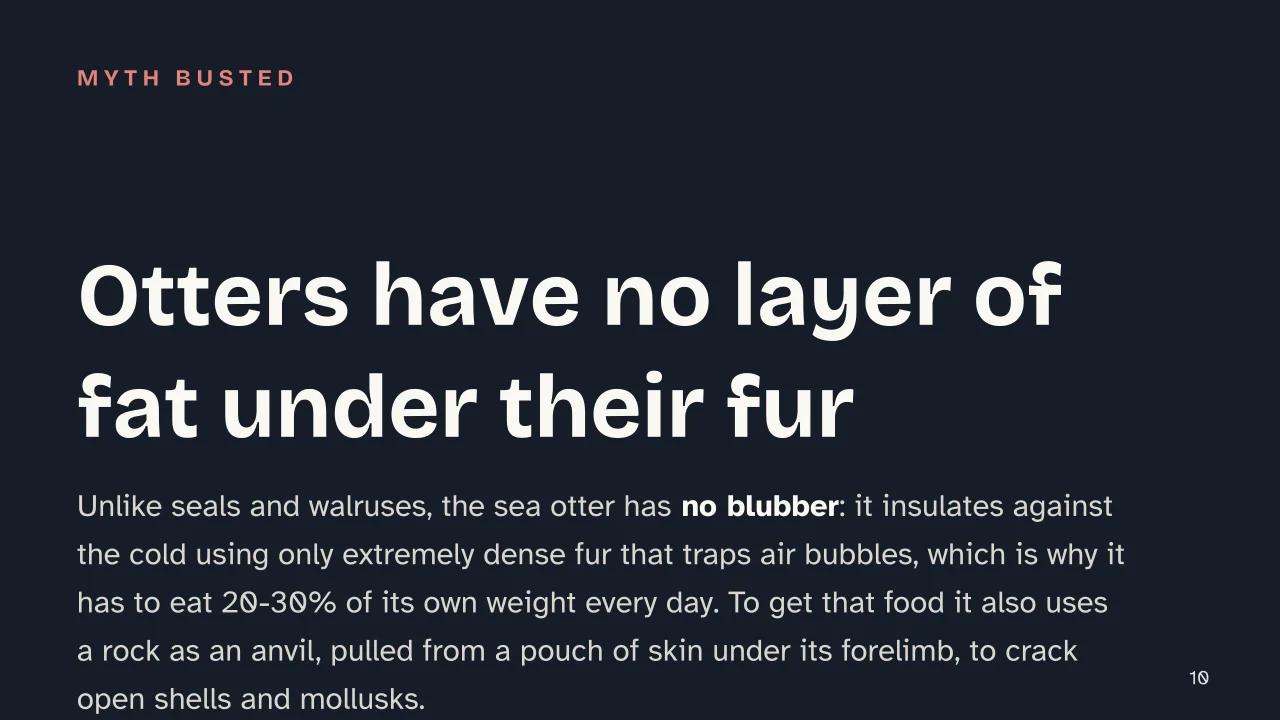
    • Sea otters have no layer of body fat: they insulate against the cold with dense, waterproof fur that traps air bubbles.
    • Several sea otters use a rock as an anvil and hammer, kept in a pouch of skin under the forelimb, to crack open mollusks and crustaceans.
    • The South American giant otter lives in family groups of 5-8 individuals across a territory of about 12 km² (4.6 sq mi) and communicates with at least nine distinct vocalizations.
    • Otters and other diving mammals carry high concentrations of protective brain proteins (neuroglobin and cytoglobin) that shield them from oxygen deprivation during dives.
    • Territoriality isn't always rigid: in a Mediterranean river during a drought, Eurasian otters showed wide overlap between territories, possibly linked to kinship among individuals.

    Key figures

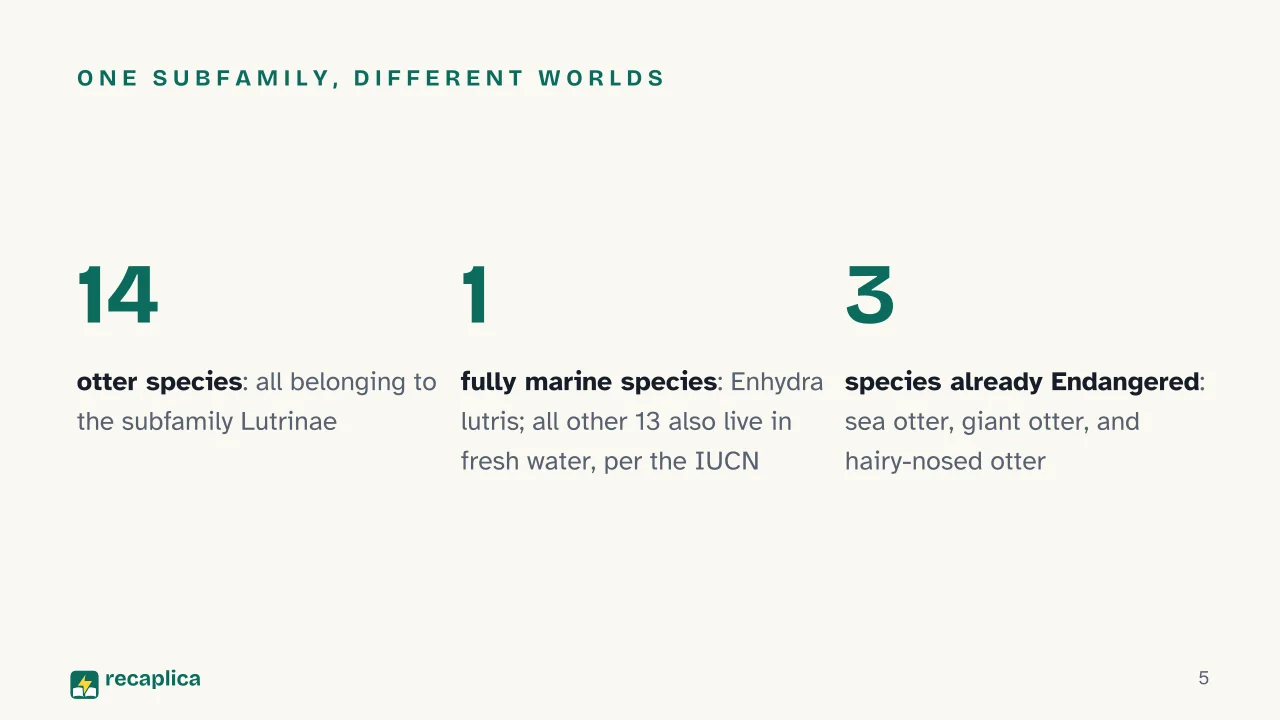
    • 14 otter species alive today worldwide, all belonging to the subfamily Lutrinae and all semiaquatic or marine. Source: IUCN SSC Otter Specialist Group
    • 20-30% of its own body mass in food every day: that's the energy requirement of the sea otter, which has to make up for having no insulating fat layer. Source: U.S. Fish and Wildlife Service
    • 4.21 individuals/km² the density of Eurasian otters measured on a Mediterranean river during a drought, up to five times higher than previous estimates for the Iberian Peninsula. Source: Jiménez et al. 2024, Scientific Reports

    Deep Dive

    Who otters are

    Otters aren’t a single species but a group of 14 living species, grouped in the subfamily Lutrinae. They belong to the family Mustelidae, the same family as badgers, martens, and weasels: they’re carnivores, not rodents, even though their aquatic lifestyle often gets them mistaken for beavers. Their geographic range covers nearly every continent: from Africa to Asia, from Europe to the Americas, with different species adapted to rivers, lakes, rocky coastlines, and, in one case, almost entirely to the open ocean.

    The IUCN SSC Otter Specialist Group’s classification lists very different conservation statuses across species: the sea otter (Enhydra lutris) and the giant otter (Pteronura brasiliensis) are both Endangered, as is the hairy-nosed otter; the smooth-coated otter (Lutrogale perspicillata) is Vulnerable, while the North American river otter (Lontra canadensis) is Least Concern. There’s no single conservation story for “otters”: each species has its own trajectory, tied to its own habitat and its own threats.

    Where they live, species by species

    Most of the 14 species live in fresh water: rivers, lakes, and streams, often with a clear preference for banks with vegetation that offers cover. The South American giant otter, for instance, favors “gently sloped river banks and secluded areas with overhanging vegetation,” across the large river systems of the Orinoco, Amazon, and La Plata, from northern Argentina to Venezuela and Colombia.

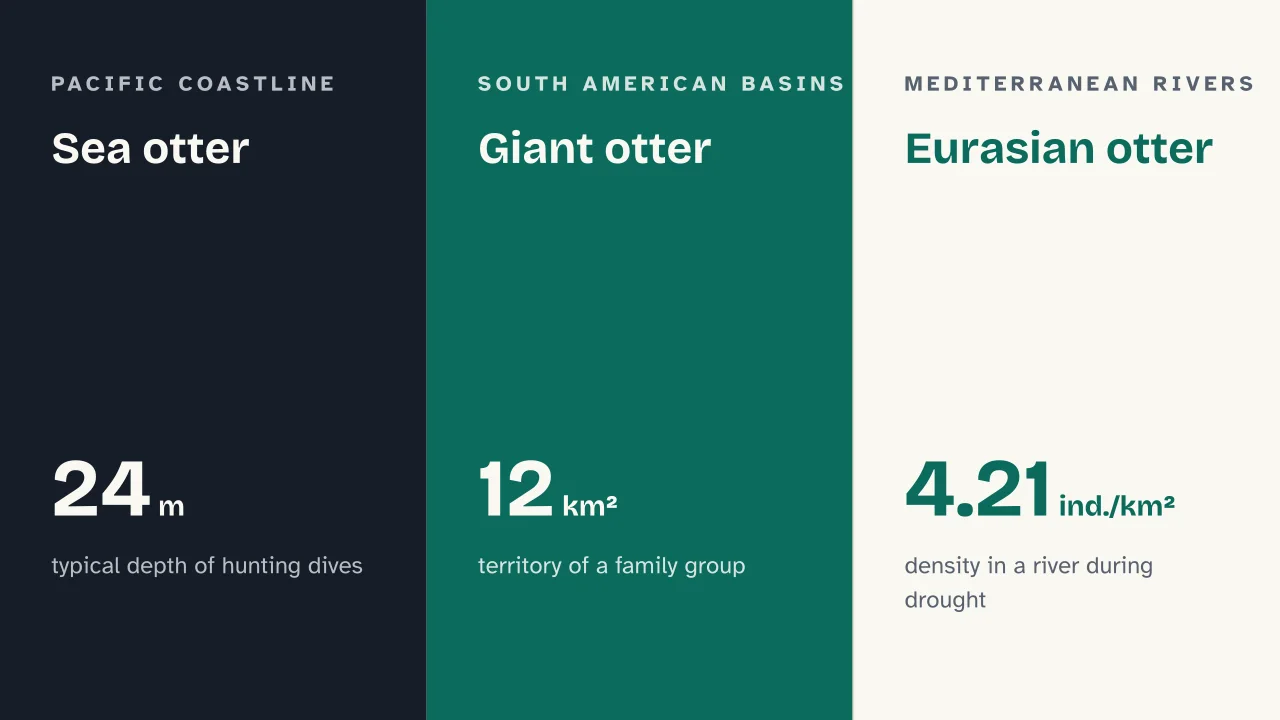
    The sea otter, by contrast, is the only species that’s almost entirely oceanic: the southern subspecies lives along the central California coast, between San Mateo and Santa Barbara counties, plus San Nicolas Island, using both exposed rocky and sandy outer coastlines and protected areas such as bays and estuaries. There it typically dives to less than 24 meters (about 80 feet) to hunt mollusks, crustaceans, and sea urchins on the seafloor, locating them with its sensitive paws and whiskers.

    A 2024 study on a Mediterranean river during drought conditions measured a density for the Eurasian otter (Lutra lutra) up to five times higher than previous estimates for the Iberian Peninsula: 4.21 individuals per km², compared with 0.13-0.27 individuals per km recorded in Portugal and 0.16-0.28 individuals per km on the Danube. Otter habitats are, in any case, part of the same water cycle that feeds rivers, lakes, and estuaries in every season.

    SpeciesMain habitatSocial lifeDiet
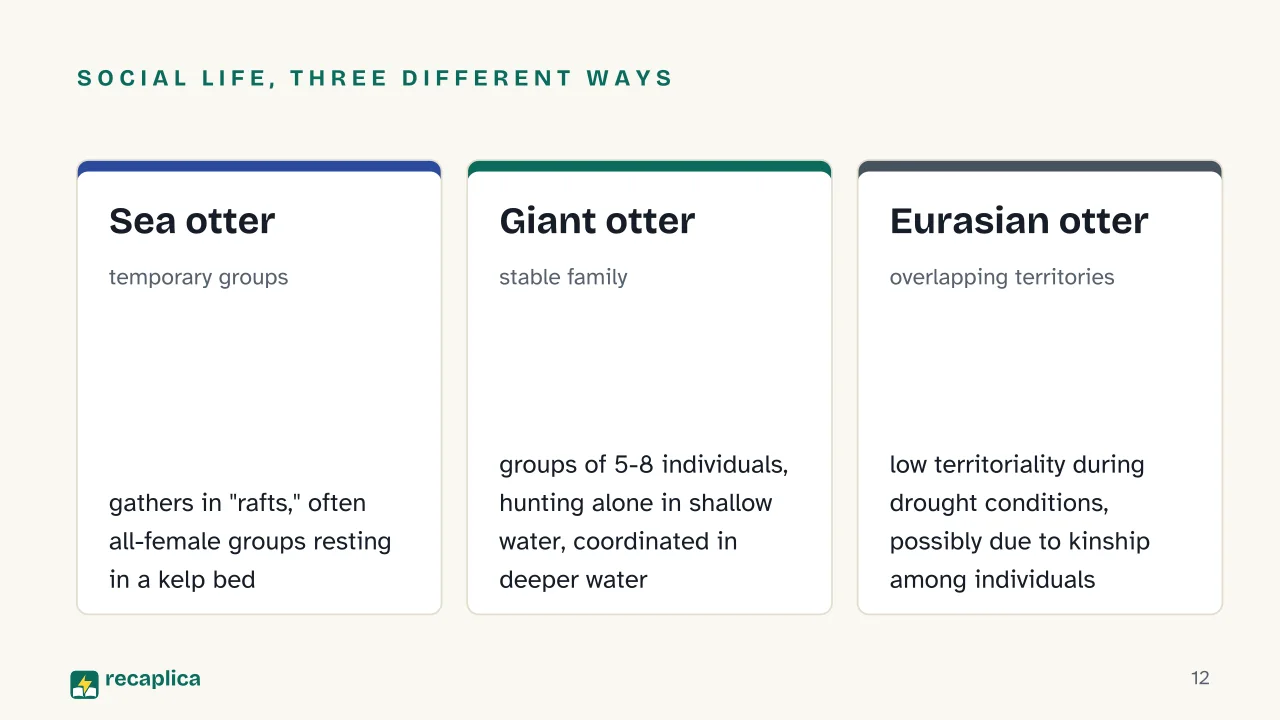
    Sea otterPacific coastline (California)Temporary groups (“rafts”)Mollusks, crustaceans, sea urchins
    Giant otterTropical rivers and lakes (South America)Stable family of 5-8 individualsFish (catfish, perches, characins)
    Eurasian otterTemperate rivers (Europe, Asia)Often overlapping territoriesFish and crayfish, including invasive species

    Adapting to life in water

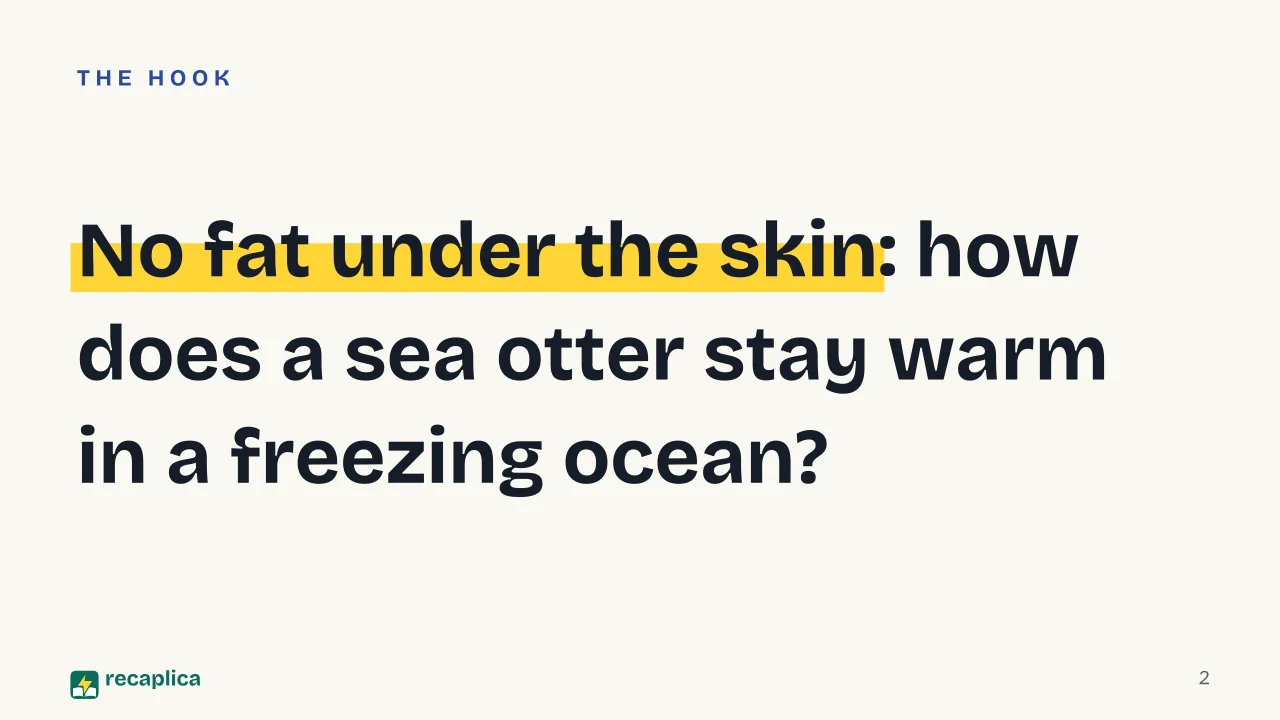
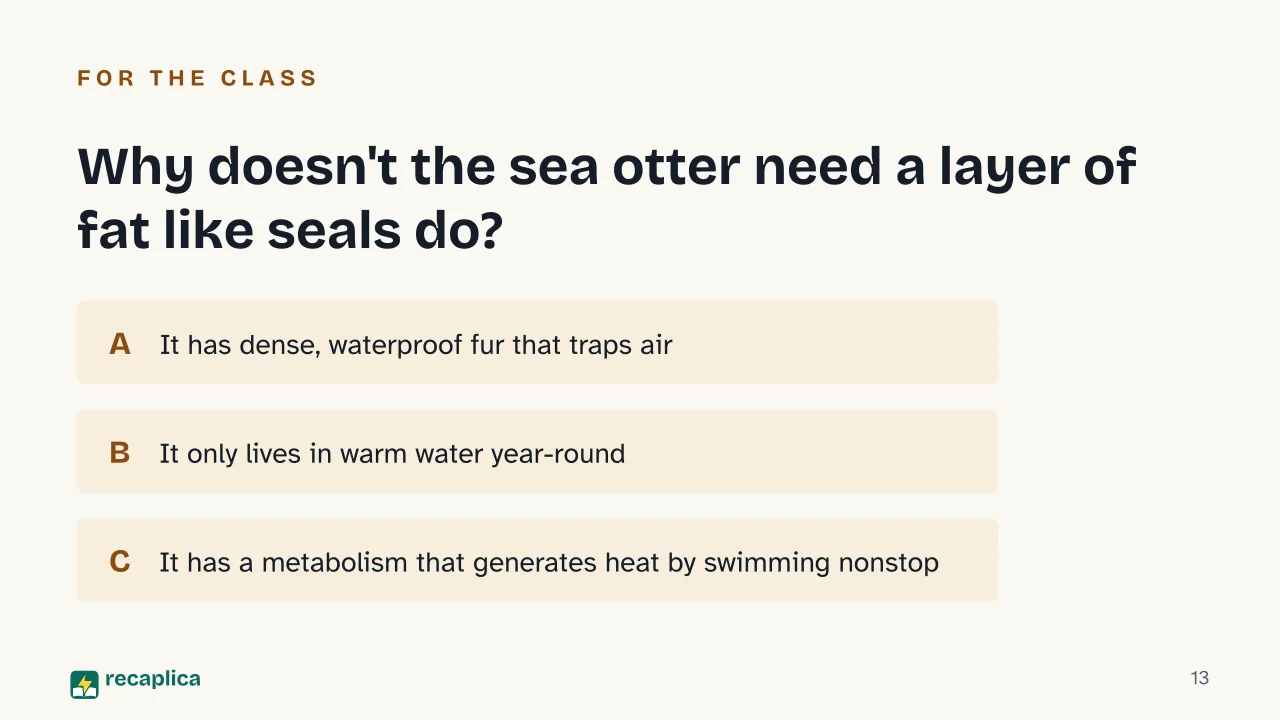
    The most surprising adaptation involves thermal insulation. Unlike most marine mammals, the sea otter has no layer of fat (blubber): it relies instead on fur that’s especially dense and waterproof, trapping air bubbles against the skin and separating it from the cold water. It’s the same insulating principle that, in a different form, body fat provides in other animals and in humans: here, trapped air in the fur does the job instead of fatty tissue.

    Real-world example: a sea otter that has just finished swimming spends a long time “grooming” itself with its front paws — not for surface cleanliness, but to work fresh air back into its fur. Without those renewed air bubbles, insulation drops and the cold of the ocean becomes a real risk.

    This kind of insulation comes at a huge energy cost: an adult sea otter has to eat 20 to 30% of its own body mass every day just to meet its energy needs. Several species have also developed tool use: the sea otter pulls a flat rock from a pouch of skin under its forelimb and uses it as an anvil, striking it repeatedly against oysters and other mollusks until the shell cracks.

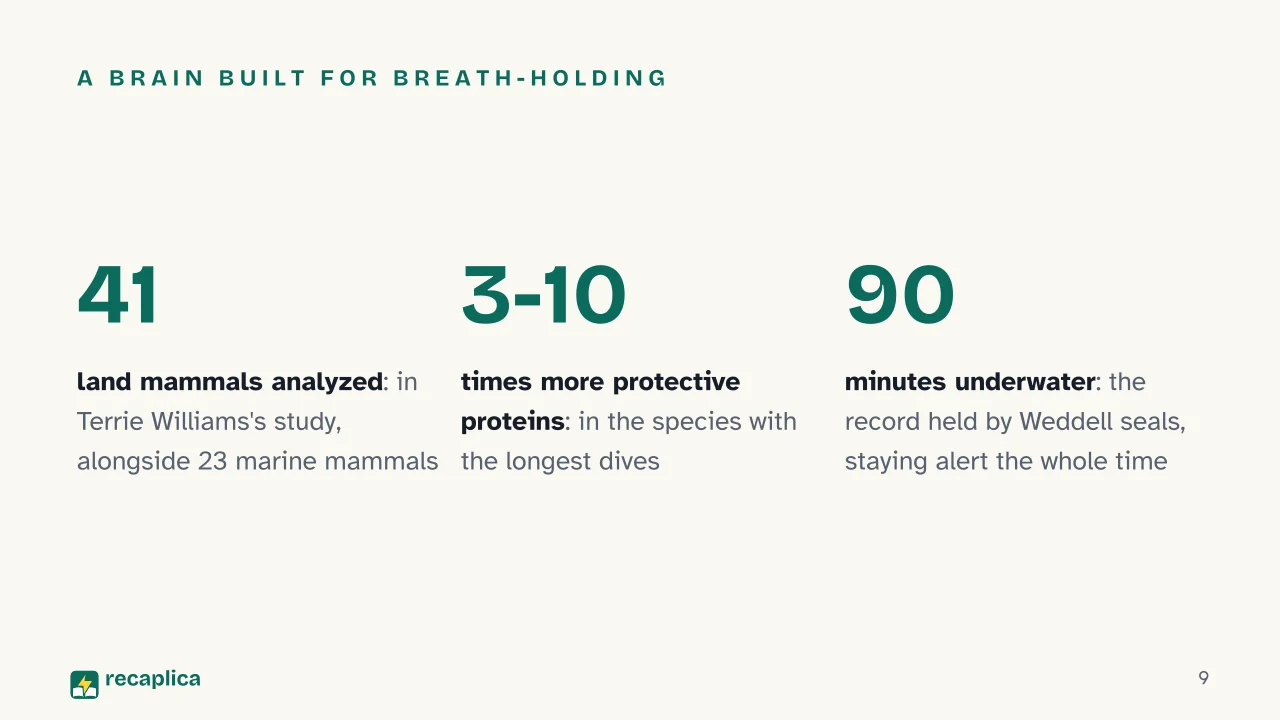
    A second adaptation involves the physiology of breath-holding. A 2007 study led by Terrie Williams (University of California, Santa Cruz) on 41 land mammals and 23 marine mammals found higher concentrations of neuroglobin and cytoglobin in dolphins, whales, sea otters, sea lions, and bobcats: proteins discovered in 2000, distinct from the hemoglobin in blood, that protect brain tissue from oxygen deprivation during long dives. The species studied varied widely, with some animals carrying “three to 10 times more neuroprotecting globins” than others, according to Williams. For comparison among diving mammals, Weddell seals can stay underwater for up to 90 minutes while remaining alert, compared with just a few minutes of survival for humans in similar conditions — an adaptation that natural selection built over time around the need to hunt underwater without lasting damage.

    Swimming style also varies by species: the giant otter, for example, swims using all four limbs at low speed, while at high speed it keeps its legs still and undulates its tail for propulsion.

    Social behavior and communication

    Otter social life doesn’t follow a single pattern. The giant otter forms stable family groups of 5-8 individuals, each made up of a monogamous pair and several generations of offspring, across a territory of about 12 km² (4.6 sq mi). Within the group, communication relies on at least nine distinct vocalizations, likely serving as warning signals against predators or contact calls among family members.

    The sea otter, by contrast, often gathers in temporary groups called “rafts”: typically all-female groups that rest together in a kelp bed, socializing or resting before heading back out to hunt.

    Real-world example: while hunting in shallow water, a giant otter works alone; but when it moves into deeper water, the group can organize synchronized dives and coordinated capture techniques, improving its odds against faster-moving schools of fish.

    Territoriality, though, isn’t a fixed behavior. A 2024 study on a Mediterranean river hit by a progressive drought observed “low signs of territoriality” and wide overlap between the home ranges of the Eurasian otters present: the average distance between activity centers across all individuals was just 465 meters, and 899 meters among males only. By analyzing the DNA of 13 individuals (5 females and 8 males), the researchers found direct family relationships in 7 of them, including one male identified as LU01, found to be the sole parent of four offspring, and two pairs of full siblings. The authors suggest that this widespread kinship may explain the greater mutual tolerance observed when resources are concentrated in a small area, as happens during a drought.

    What they eat

    Diet varies widely by habitat. The sea otter feeds mainly on bottom-dwelling invertebrates such as clams, crabs, sea urchins, and snails, located on the seafloor with the help of sensitive paws and whiskers. The giant otter is mostly fish-eating, with an estimated daily intake of 2.7 to 4 kg (6-9 pounds) of fish, favoring families such as catfish, perches, and characins. In the Mediterranean river studied in 2024, analysis of 101 Eurasian otter droppings showed a diet dominated — nearly 60% — by an invasive species, the red swamp crayfish, followed by common carp and goldfish: a sign of how otters can adapt their diet to whatever species are available in the environment, including non-native ones.

    Conservation

    Otter conservation status varies widely by species. The southern sea otter, legally protected since the 1970s, has seen its population grow slowly, fluctuating around 3,000 individuals according to the U.S. Fish and Wildlife Service species profile consulted in 2026 — under 5% of its historical population: its main threat is shark-bite mortality at the edges of its range, which has blocked any net expansion of its territory for more than twenty years. The giant otter, classified Endangered by the IUCN, is threatened mainly by poaching for fur and by habitat loss linked to logging and mining in the South American river basins where it lives.

    Slide deck

    Slides ready to download and make your own in PowerPoint or Google Slides, with speaker notes. Pick the Flash cut or the Full one.
    Slide 1 of the presentation on Otters: OttersSlide 2 of the presentation on Otters: No fat under the skin: how does a sea otter stay warm in a freezing ocean?Slide 3 of the presentation on Otters: In this RecapSlide 4 of the presentation on Otters: Chapter 01: Who they areSlide 5 of the presentation on Otters: One subfamily, different worldsSlide 6 of the presentation on Otters: Chapter 02: Where they liveSlide 7 of the presentation on Otters: Sea otter · Giant otter · Eurasian otterSlide 8 of the presentation on Otters: Chapter 03: How they adaptSlide 9 of the presentation on Otters: A brain built for breath-holdingSlide 10 of the presentation on Otters: Otters have no layer of fat under their furSlide 11 of the presentation on Otters: Chapter 04: How they behaveSlide 12 of the presentation on Otters: Social life, three different ways: Sea otter, Giant otter, Eurasian otterSlide 13 of the presentation on Otters: Why doesn't the sea otter need a layer of fat like seals do?Slide 14 of the presentation on Otters: Read more
    Flash10 slidesThe essential thread, to present in classFull14 slidesEvery chapter and the deeper detail

    Common myths

    • ✗ Myth All otters live in the ocean.

      ✓ Reality Only the sea otter and, partly, the marine otter of South America live in salt water: of the 14 existing species, most live in freshwater rivers, lakes, and streams, from Africa to Asia to Central and South America, according to the species map from the IUCN Otter Specialist Group.

    • ✗ Myth Otters withstand the cold thanks to a thick fat layer, like seals.

      ✓ Reality Sea otters have no blubber at all: their insulation depends entirely on fur, extremely dense and waterproof, that traps air against the skin. That's also why they need to eat 20-30% of their own body weight every day, to fuel the metabolism that keeps that fur working.

    • ✗ Myth Otters always defend a fixed territory, with very little mutual tolerance.

      ✓ Reality A study on a Mediterranean river during drought conditions recorded low signs of territoriality and wide overlap between the home ranges of Eurasian otters: the authors link this tolerance to genetic kinship among the individuals, more widespread than expected.

    Mind map

    Drag the background to move around and the nodes to reposition them; use − and + to collapse and expand branches.
    Customize
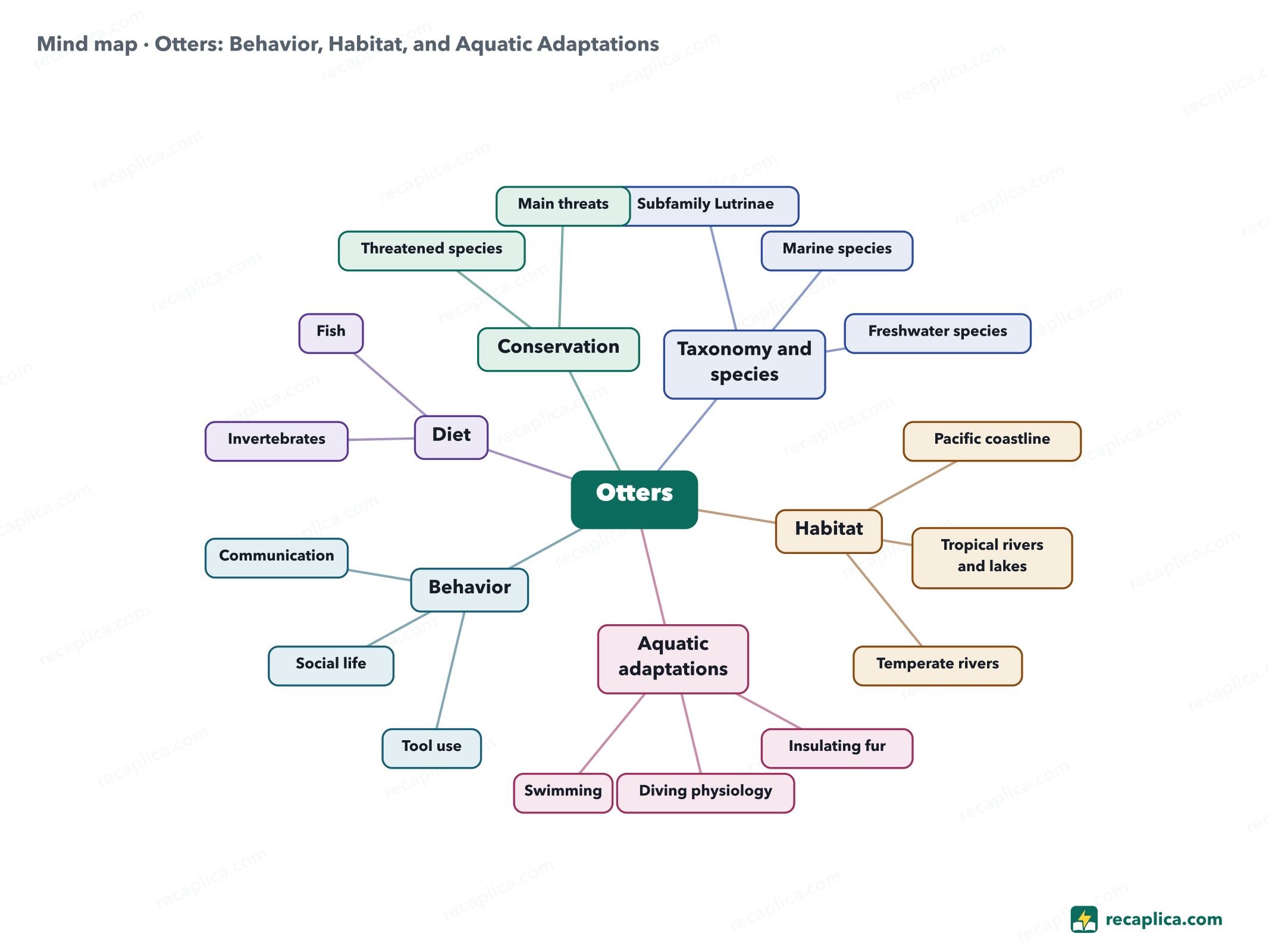
    Mind map: Otters: Behavior, Habitat, and Aquatic Adaptations
    • Otters
      • Taxonomy and species
        • Subfamily Lutrinae 14 species, part of the Mustelidae along with badgers, martens, and weasels
        • Marine species the sea otter and the marine otter, the only ones tied to the ocean
        • Freshwater species most of the 14 species, in rivers and lakes across several continents
      • Habitat
        • Pacific coastline sea otter, bays and estuaries of the California coast
        • Tropical rivers and lakes giant otter, the Orinoco, Amazon, and La Plata basins
        • Temperate rivers Eurasian otter, waterways across Europe and Asia
      • Aquatic adaptations
        • Insulating fur trapped air bubbles standing in for body fat
        • Diving physiology protective brain proteins during dives
        • Swimming limbs or tail depending on species and speed
      • Behavior
        • Tool use stones as an anvil to open shells
        • Social life stable family groups or temporary gatherings, depending on species
        • Communication distinct vocalizations signaling danger or contact
      • Diet
        • Invertebrates mollusks, crustaceans, sea urchins
        • Fish fish-eating species such as the giant otter
      • Conservation
        • Threatened species sea otter, giant otter, and hairy-nosed otter, classified Endangered
        • Main threats poaching, habitat loss, predation mortality at the edges of the range

    Quiz: test yourself

    Answer the questions to check what you have learned: you get instant feedback and a short explanation.

    Grade 0/10 0/5
    1 How many otter species exist today, according to the IUCN SSC Otter Specialist Group?

    The subfamily Lutrinae includes 14 living species, all semiaquatic or marine, spread across Africa, Asia, Europe, and the Americas.

    2 How does the sea otter insulate itself from the cold, having no layer of fat?

    Unlike most marine mammals, the sea otter has no blubber: it uses dense, waterproof fur that traps air bubbles to insulate itself from cold water.

    3 True or false: the giant otter always hunts alone, even in deep water.

    In shallow water the giant otter hunts alone, but in deeper water it can organize synchronized dives and group hunting techniques, according to the Animal Diversity Web at the University of Michigan.

    4 What do dolphins, whales, sea otters, sea lions, and bobcats have in common, according to Terrie Williams's 2007 study?

    The study, published in Proceedings of The Royal Society B, found higher concentrations of neuroglobin and cytoglobin in these species — proteins that protect the brain when oxygen runs low.

    5 What did a 2024 study observe about Eurasian otters in a Mediterranean river during a drought?

    The authors (Jiménez et al., Scientific Reports 2024) recorded a surprisingly high density and wide overlap between territories, linking it to genetic kinship among the individuals surveyed.

    Answers: 1-B · 2-B · 3-B · 4-B · 5-B

    Flashcards

    Tap the card to flip it and check whether you remember the answer, then move to the next one.

    1 / 8

    Explain it in your own words

    The ultimate test: if you can explain it in simple words, you've truly understood it. Write your explanation, then compare it with the Recap.

    Your explanation is saved only on this device.

    Otters are 14 species of carnivorous mammals in the subfamily Lutrinae, related to badgers, martens, and weasels, found in rivers, lakes, and coastlines across most of the world. Most species live in fresh water, but the sea otter of the Pacific spends nearly its entire life at sea. Lacking the thick fat layer of seals or walruses, otters insulate themselves with extremely dense fur that traps air, and several species even use stones as tools to crack open shells and hard-shelled prey. Their social behavior ranges from the stable family groups of the giant otter to the temporary gatherings of the sea otter, with territoriality that, according to a 2024 study, depends heavily on context.

    Frequently asked questions

    Are otters rodents?

    No. Otters belong to the family Mustelidae, the same as badgers, martens, and weasels: they're carnivores, not rodents, even though they're sometimes confused with beavers because of the shared aquatic habitat.

    How long do otters live?

    It depends on the species: for the giant otter, the Animal Diversity Web at the University of Michigan estimates a lifespan of 10-13 years in the wild.

    Why are some otter species at risk of extinction?

    The IUCN classifies the sea otter, the giant otter, and the hairy-nosed otter as Endangered. The main threats are habitat loss and poaching for fur; for the sea otter, shark predation at the edges of its range adds mortality that has blocked expansion for more than twenty years.

    Do otters really use tools?

    Yes: the sea otter is known for using rocks as an anvil and hammer, pulled from a pouch of skin under the forelimb, to open oysters and other hard-shelled mollusks.

    Do otters live alone or in groups?

    It depends on the species and the setting: the giant otter forms stable family groups of 5-8 individuals, while sea otters gather in temporary groups called "rafts," often split by sex.

    Sources

    • IUCN SSC Otter Specialist Group — Otter species
    • U.S. Fish & Wildlife Service — Southern Sea Otter (Enhydra lutris nereis)
    • Animal Diversity Web, University of Michigan — Pteronura brasiliensis
    • UC Santa Cruz News — Why diving marine mammals resist brain damage from low oxygen
    • Jiménez et al. (2024), Scientific Reports — Low signs of territorial behavior in the Eurasian otter
    • NOAA Ocean Today — Sea Otters 101

    Every Recap goes through an independent review before publication.

    Every evening, the day's new Recaps on our Telegram channel. Join the channel →

    Keep learning

    • Science CRISPR: What It Is and Where Gene Editing Hits Its Ethical Limits CRISPR-Cas9 is a tool that uses a short guide RNA to find an exact spot in a strand of DNA, then relies on the Cas9 protein to cut it, opening the door to deleting or inserting genetic code. The sharpest ethical line separates somatic editing, which affects only the treated person's own cells, from germline or heritable editing, which changes embryos or reproductive cells and passes the change on to future generations. In November 2018, Chinese researcher He Jiankui announced that he had used CRISPR to edit the embryos that became twin girls, the most debated case of heritable human gene editing to date. Around the same time, in December 2018, the World Health Organization set up an expert committee on the governance of human genome editing, which published international recommendations spanning nine areas in 2021. Bioethics bodies do not speak with one voice on banning heritable editing outright: the Nuffield Council on Bioethics allows it under very strict conditions, including proven clinical safety and broad public debate. Read the Recap →
    • Science Digestive System: How It Breaks Down Food, Step by Step The digestive system breaks food down, piece by piece, into molecules the body can absorb. It starts in the mouth, where teeth cut food into fragments and saliva carries the first enzymes, continues in the stomach, which churns food with gastric acid, and does most of its chemical work in the small intestine, according to StatPearls (2022). Along the way, the liver, pancreas, and gallbladder — organs outside the digestive tract itself — add bile and enzymes to the mix. What's left moves on to the large intestine, which reclaims water and minerals before waste leaves the body. Read the Recap →
    • Science How Beer Is Made: The Brewing Process, from Barley to Glass Beer comes from four ingredients — water, malted barley, hops and yeast — combined through four main steps: malting, mashing, boiling and fermentation. During malting, barley germinates and is then dried, developing the enzymes that mashing later uses to turn starch into fermentable sugar. Boiling dissolves the hops' alpha acids, which barely dissolve in water on their own, giving beer its characteristic bitterness. The yeast strain and fermentation temperature then determine whether the result is an ale, a lager, or a spontaneously fermented beer like Belgian lambic. Read the Recap →

    recaplica

    Clear in 30 seconds, yours in 10 minutes.

    Recaps Mind maps Request a Recap Telegram channel Mind map maker Our method About Privacy & cookies Legal notes & terms of use

    © 2026 Recaplica · A project by Curi S.r.l. — VAT IT05472000750

    Statistics, only if you say so

    To learn which Recaps help most we would use Google Analytics, with aggregate, anonymous data. It starts only with your OK, and you can change your mind anytime. Privacy policy