recaplica
Clear in 30 seconds, yours in 10 minutes.
In 30 seconds quick read
The cell is the smallest unit capable of living: every living thing is made of cells, from just one (bacteria) to tens of trillions (us). It works like a tiny factory: the membrane controls what comes in and out, the nucleus stores the instructions (DNA), the mitochondria produce energy, and the other organelles build, package and recycle the molecules of life.
Key Points
The cell is the basic unit of all living things: no organism is made of anything smaller that's alive.
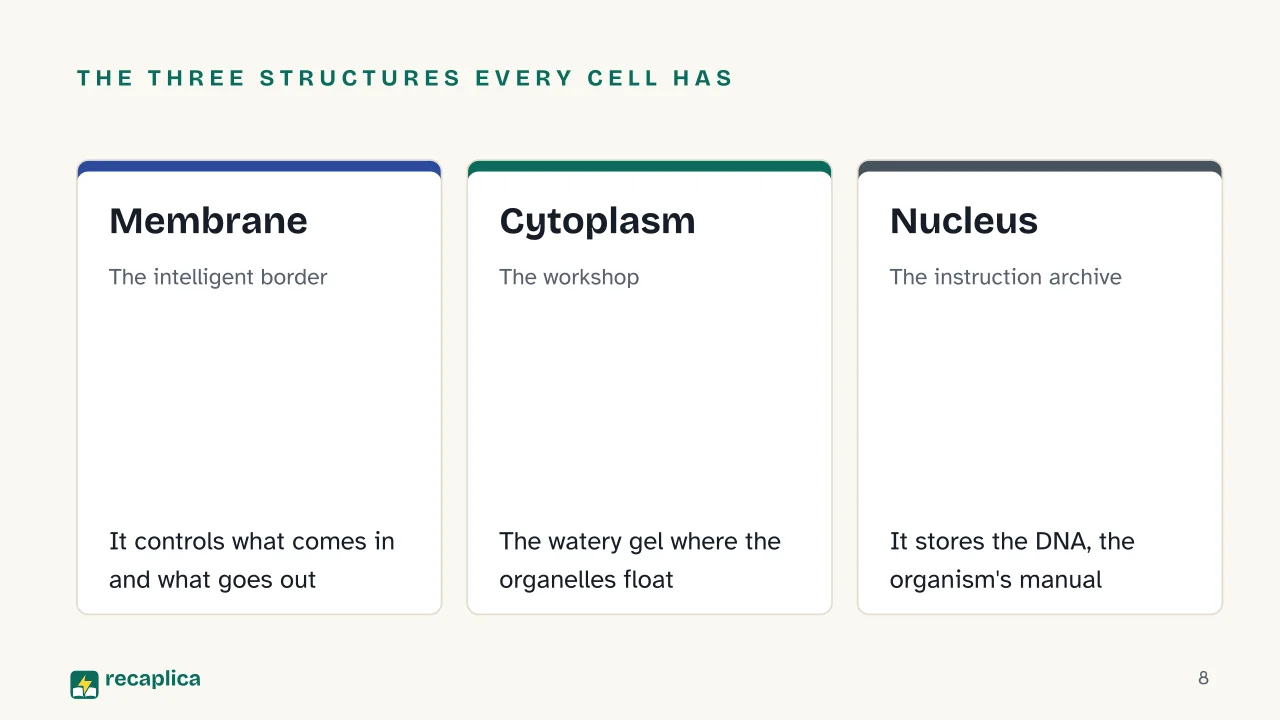
The three core structures: membrane (border and customs), cytoplasm (the workshop), nucleus (the DNA archive).
Mitochondria are the power plants: they burn glucose and oxygen to make ATP, the energy 'currency'.
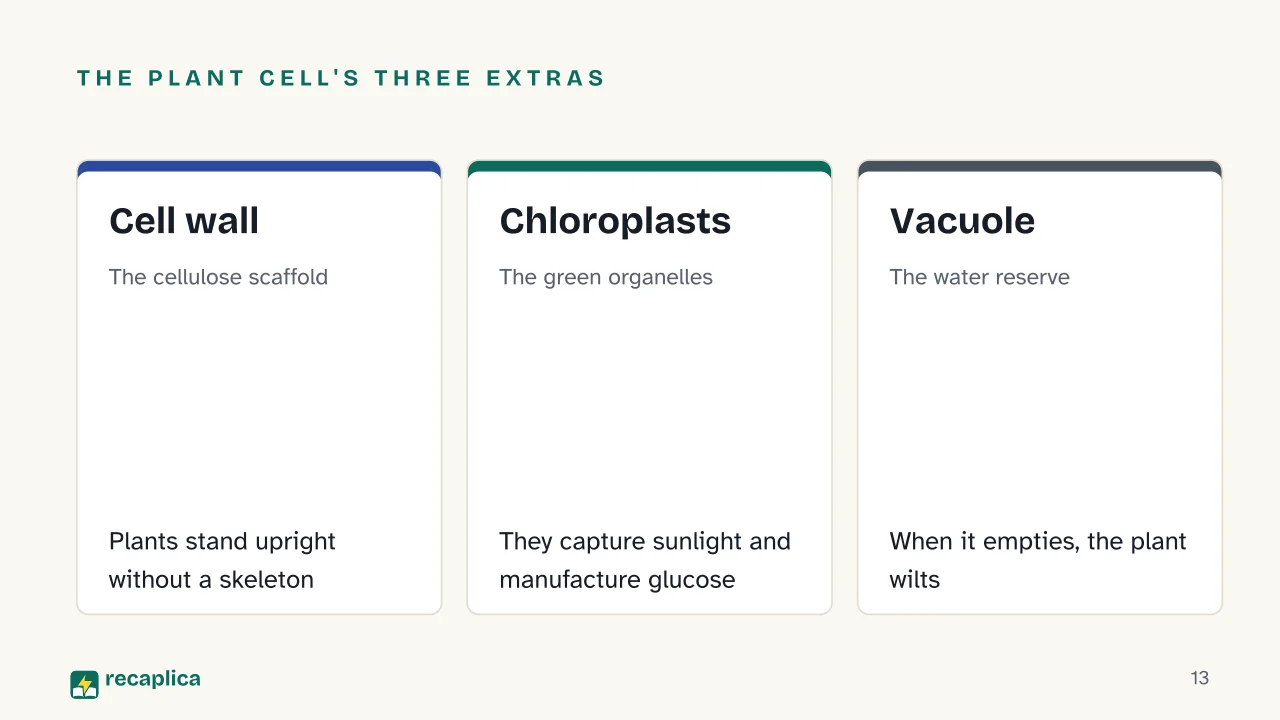
Plant cells add a rigid wall, chloroplasts for photosynthesis and a large central vacuole.
Prokaryotes (bacteria): no nucleus. Eukaryotes (animals, plants, fungi): nucleus and organelles.
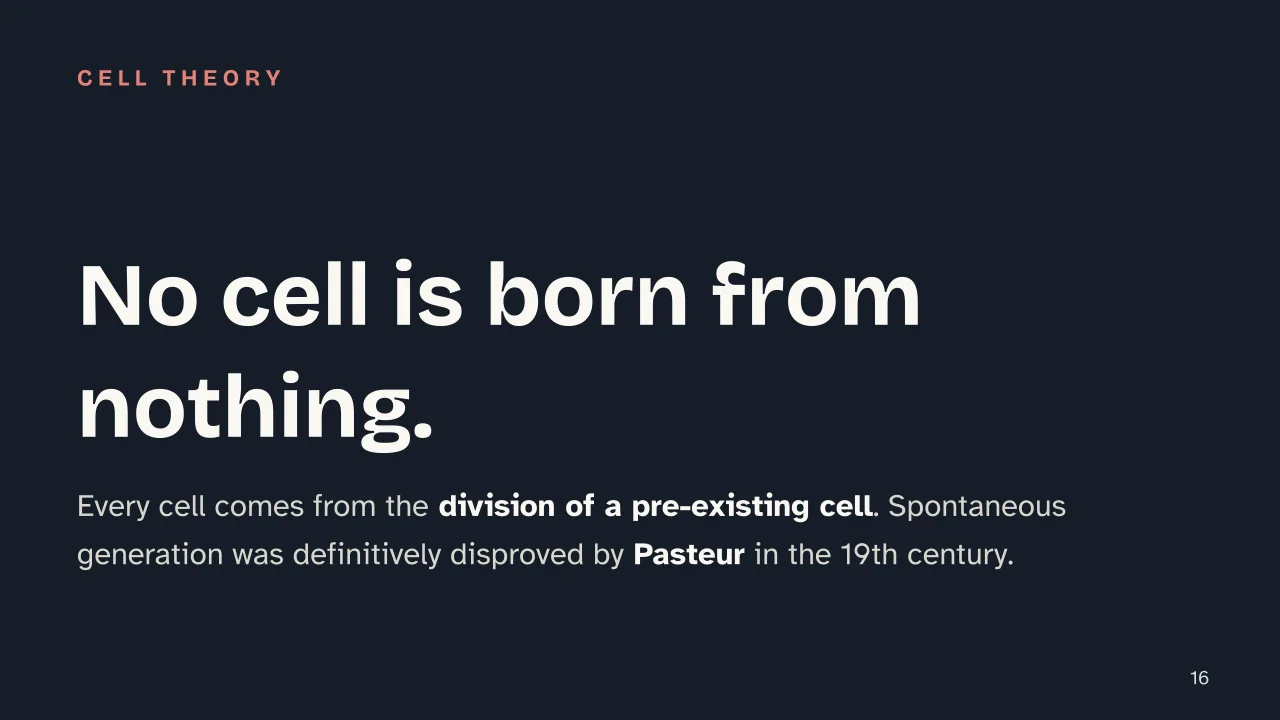
Cells only come from other cells, by dividing.
Key figures
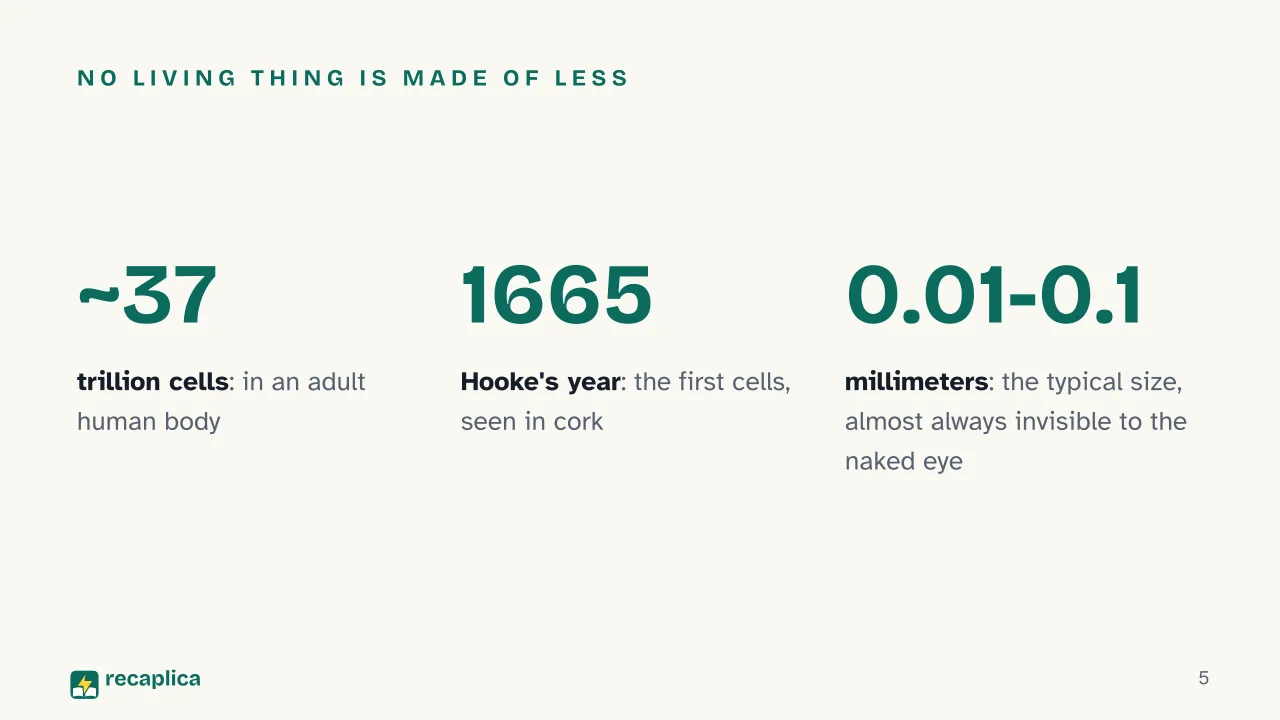
~37 trillion the estimated number of cells in an adult human body Source: Annals of Human Biology, 2013
1665 the year Robert Hooke observed cork and coined the word 'cell' Source: Micrographia, R. Hooke
0.01-0.1 mm the typical size of a human cell, almost always invisible to the naked eye
Deep Dive
The building block of everything alive
Look at your hand: skin, bone, blood, nerves. Everything you can see — and
everything you can’t — is built from the same fundamental brick: the
cell. It is the smallest unit that has all the properties of life: it
feeds, produces energy, responds to its environment, reproduces.
Some organisms make do with a single cell: a bacterium is one cell doing
everything by itself. A human body, by contrast, is a metropolis of about
37 trillion cells, each with a specialty: muscle cells that contract,
neurons that carry signals, red blood cells that deliver oxygen.
Practical example: think of a city. Each cell is a building with its
own function (factories, warehouses, power stations), and the city works
because every building does its job. An organism is exactly that:
specialized cells cooperating.
The three structures every cell has
The membrane: the intelligent border
Every cell is wrapped in a membrane, a double layer of fats
(phospholipids) studded with proteins. It’s not a wall: it’s a selective
customs office that lets nutrients and oxygen in, waste out, and keeps
intruders away.
The cytoplasm: the workshop
Inside the membrane lies the cytoplasm, a watery gel where the
organelles float and thousands of chemical reactions happen every second.
The nucleus: the instruction archive
The nucleus is the cell’s vault: it stores the DNA, the
complete instruction manual for building and running the whole organism.
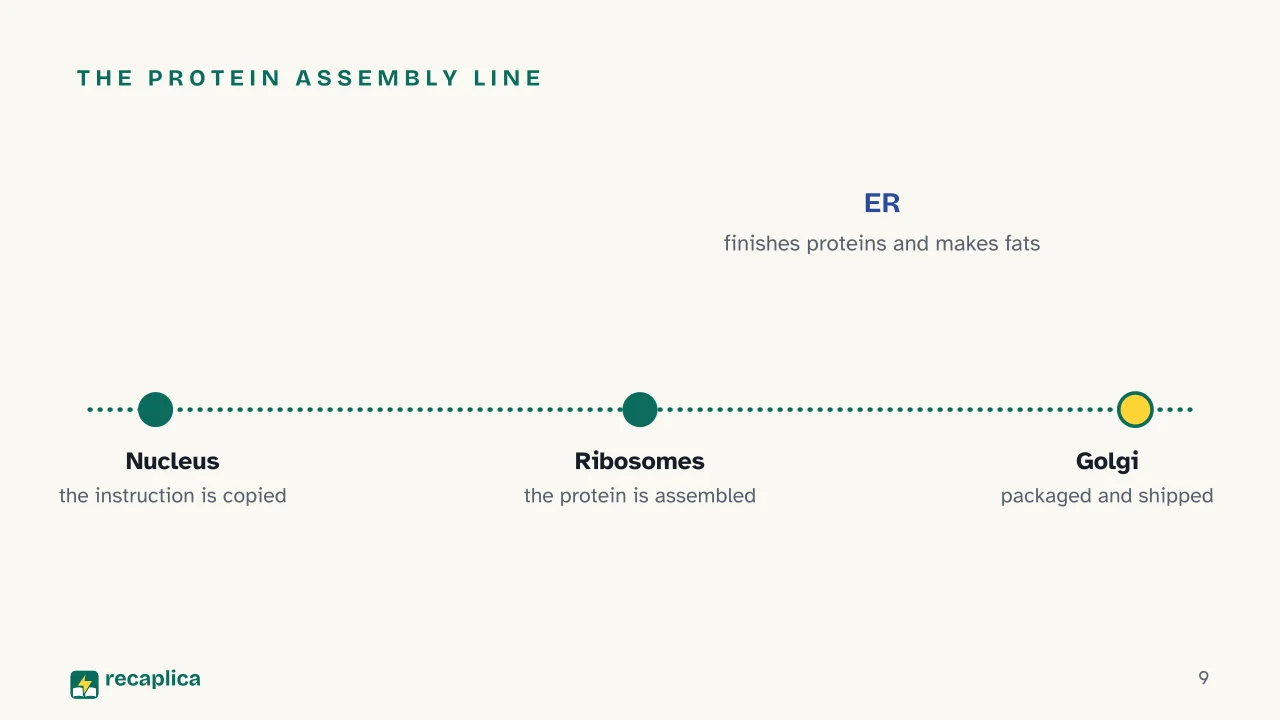
Whenever a protein is needed, the cell copies the right page of the manual
and sends it to production.
The organelles: the factory departments
Organelle
Job
Mitochondria
Power plants: make ATP from glucose and oxygen
Ribosomes
Protein assembly lines
Endoplasmic reticulum
Finishes proteins and makes fats
Golgi apparatus
Packages and ships molecules
Lysosomes
Recycling center: break down what’s no longer needed
Practical example: when you run, your muscles demand energy. The
mitochondria in your muscle cells provide it, burning the glucose from
the carbs you ate with the oxygen you breathe. Being out of breath is
logistics speeding up oxygen deliveries to the power plants.
Prokaryotes and eukaryotes: the two basic designs
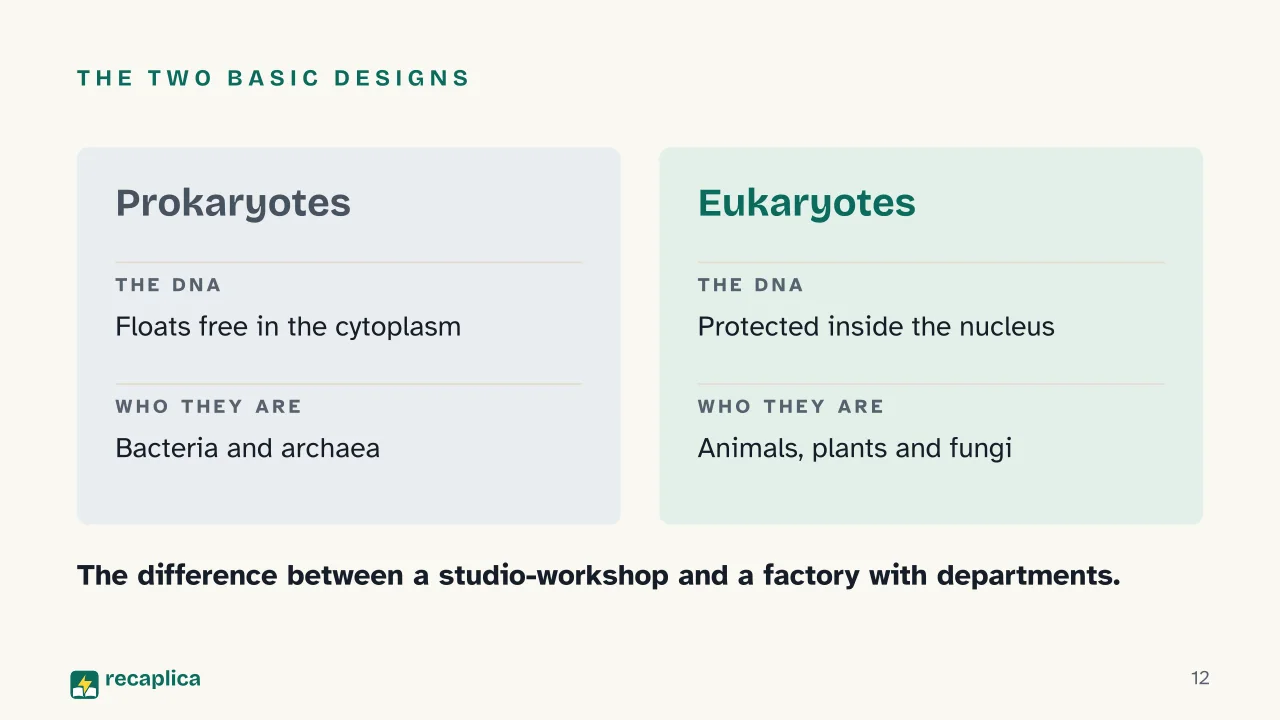
Cells come in two architectures. Prokaryotes (bacteria and archaea)
are the minimal model: small, no nucleus, DNA floating free in the
cytoplasm. Eukaryotes (the cells of animals, plants and fungi) are
up to a thousand times more voluminous and organized into compartments:
the nucleus protects the DNA, and each organelle has its own membrane.
It’s the difference between a studio-workshop and a factory with
departments: the first replicates fast, the second can afford
specialization.
Animal vs plant: three differences that matter
Plant cells have everything animal cells have, plus three exclusive
features:
The cell wall made of cellulose, a rigid scaffold outside the
membrane: it’s why plants stand upright without a skeleton.
Chloroplasts, the green organelles where
photosynthesis happens: they capture sunlight
and manufacture glucose.
A large water-filled central vacuole that keeps the cell firm:
when it empties, the plant wilts.
Where new cells come from
Every cell arises from the division of a pre-existing cell: one of the
pillars of cell theory. Your body replaces billions of cells every day
(skin, blood, gut lining) through a precise, choreographed process,
mitosis, which copies the DNA and splits it
fairly between the two daughter cells.
Slide deck
Slides ready to download and make your own in PowerPoint or Google Slides, with speaker notes. Pick the Flash cut or the Full one.
✗ Myth Cells can only be seen with a microscope, no exceptions.
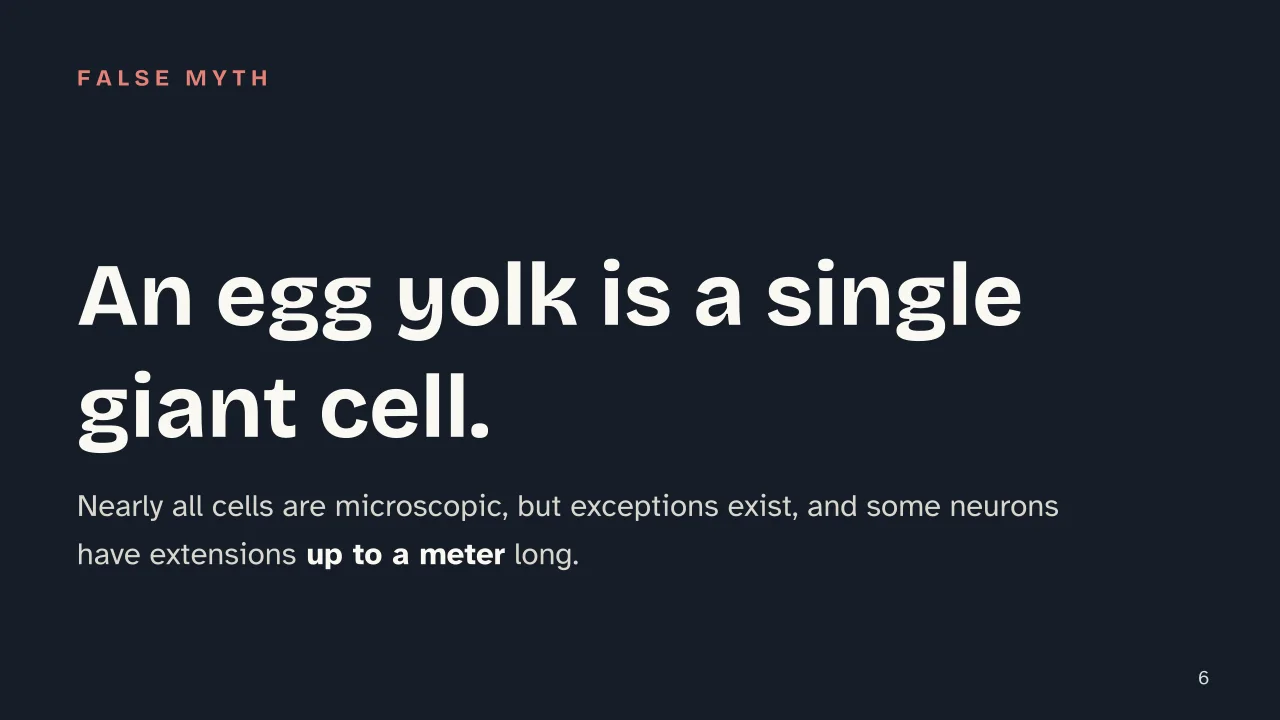
✓ Reality Nearly all are microscopic, but there are striking exceptions: the yolk of a chicken egg is a single giant cell, and some neurons have extensions up to a meter long.
✗ Myth Plant cells have chloroplasts instead of mitochondria.
✓ Reality Plant cells have both: chloroplasts capture the sun's energy through photosynthesis, and mitochondria 'cash it in' by burning glucose. Two different power systems in the same factory.
✗ Myth Every cell in your body has a nucleus.
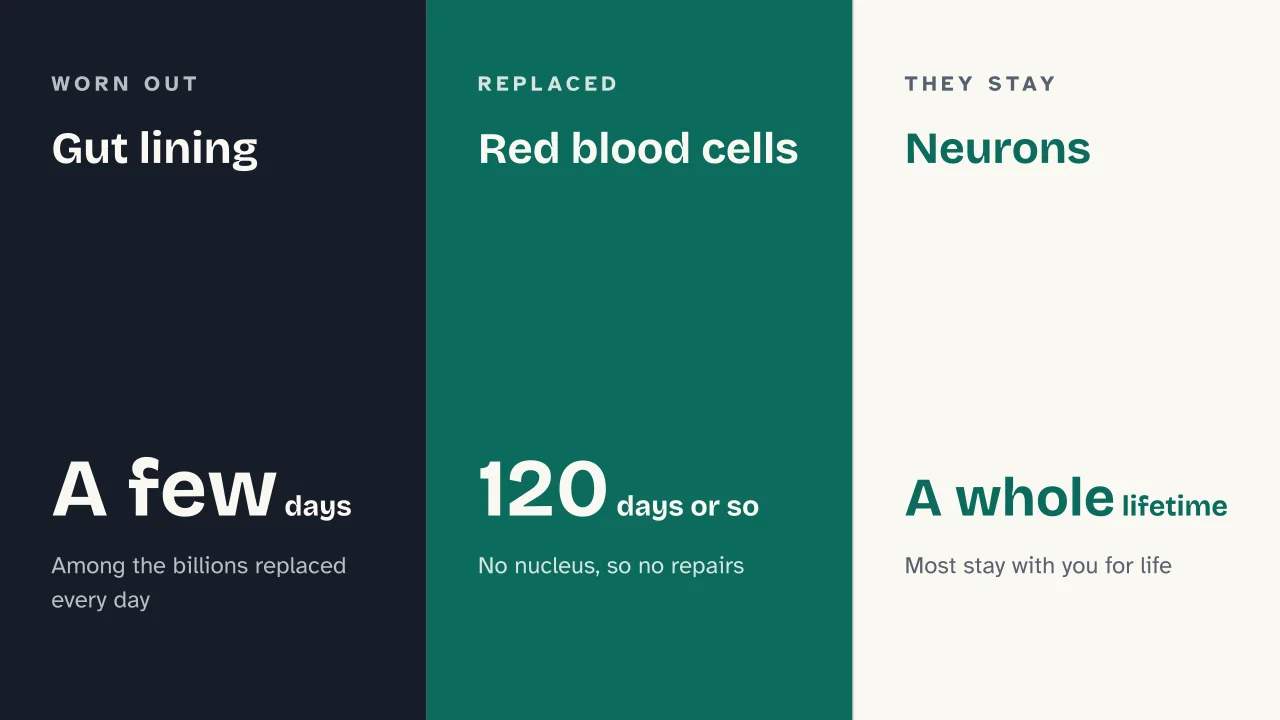
✓ Reality Mature red blood cells don't: they eject their nucleus to make room for the hemoglobin that carries oxygen. They live about 120 days precisely because they can't repair themselves.
Mind map
Drag the background to move around and the nodes to reposition them; use − and + to collapse and expand branches.
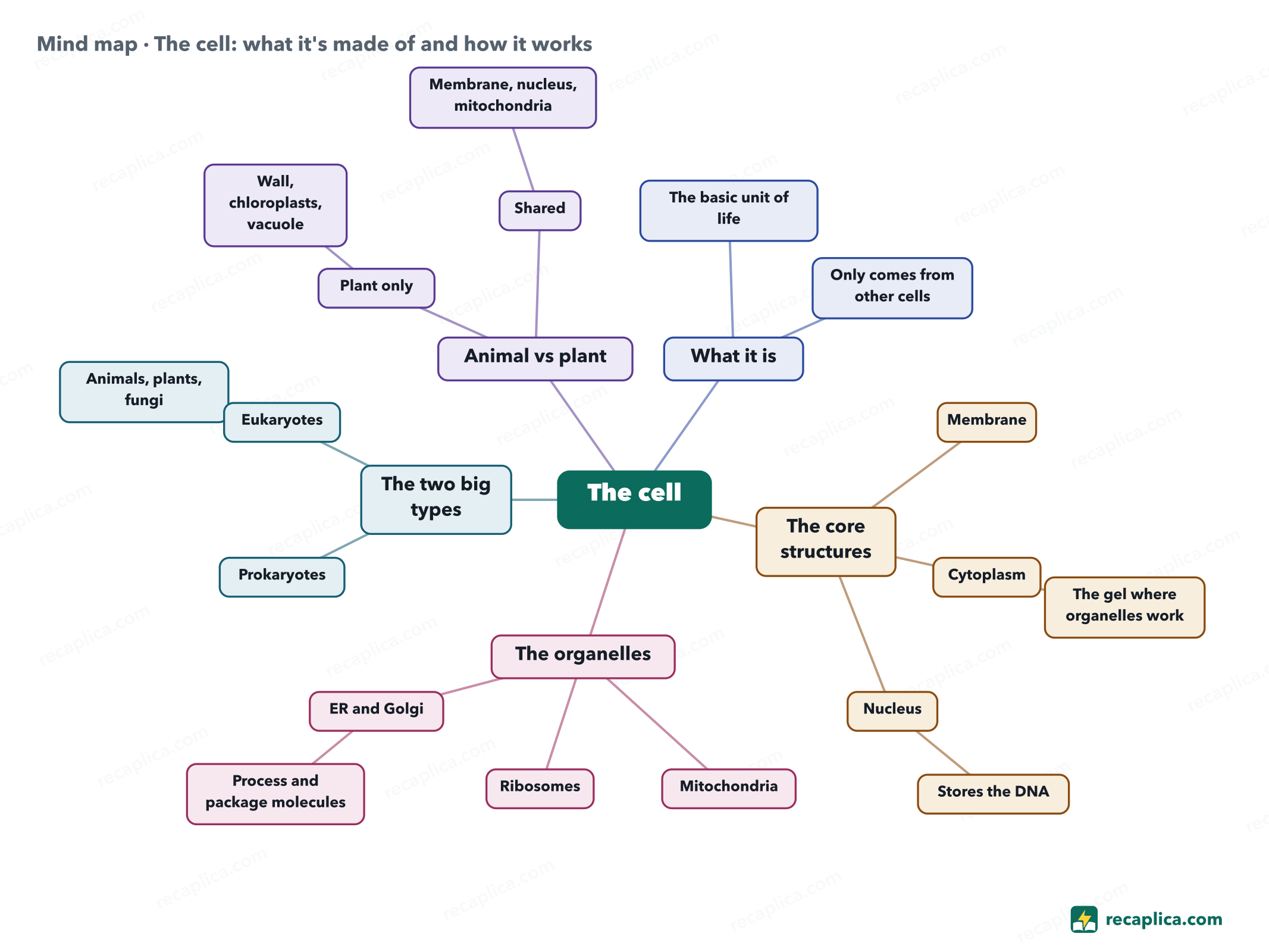
The basic unit of lifeEvery living thing is made of one or more cells.
Only comes from other cells
The core structures
MembraneSelective border, controls what goes in and out.
Cytoplasm
The gel where organelles work
Nucleus
Stores the DNA
The organelles
MitochondriaProduce ATP, the cell's energy.
RibosomesBuild the proteins.
ER and Golgi
Process and package molecules
The two big types
ProkaryotesNo nucleus, like bacteria.
Eukaryotes
Animals, plants, fungi
Animal vs plant
Plant only
Wall, chloroplasts, vacuole
Shared
Membrane, nucleus, mitochondria
Quiz: test yourself
Answer the questions to check what you have learned: you get instant feedback and a short explanation.
Grade0/100/5
Answers: 1-A · 2-B · 3-A · 4-A · 5-B
Flashcards
Tap the card to flip it and check whether you remember the answer, then move to the next one.
1 / 7
Explain it in your own words
The ultimate test: if you can explain it in simple words, you've truly understood it. Write your explanation, then compare it with the Recap.
Your explanation is saved only on this device.
The cell is the smallest unit capable of living: every living thing is made of cells, from just one (bacteria) to tens of trillions (us). It works like a tiny factory: the membrane controls what comes in and out, the nucleus stores the instructions (DNA), the mitochondria produce energy, and the other organelles build, package and recycle the molecules of life.
Frequently asked questions
Who discovered the cell?
Robert Hooke in 1665: looking at a slice of cork under a microscope he saw tiny chambers that reminded him of monks' rooms, and called them 'cells'. Living cells were observed shortly after by Antoni van Leeuwenhoek.
What's the difference between animal and plant cells?
Plant cells have three extras: a rigid cellulose cell wall (support), chloroplasts (for photosynthesis) and a large water-filled central vacuole. Otherwise they share membrane, nucleus, mitochondria and the other organelles.
Do cells die and get replaced?
Constantly: gut-lining cells live a few days, red blood cells about 120, while most neurons stay with you for life. Your body replaces billions of cells every day through cell division.
Are viruses made of cells?
No: a virus is just genetic material in a protein coat, with no cytoplasm or organelles. It can't feed or reproduce on its own, which is why many biologists don't even consider it alive.
Every Recap goes through an independent review before publication.
Statistics, only if you say so
To learn which Recaps help most we would use Google Analytics, with aggregate, anonymous data. It starts only with your OK, and you can change your mind anytime. Privacy policy