|
recaplica
Pelagos Sanctuary: the Mediterranean marine protected area for whales | |||||||||
| © 2026 Recaplica · recaplica.com — All rights reserved | |||||||||
Pelagos Sanctuary: the Mediterranean marine protected area for whalesWhat to print Page numbers appear when printing with default margins. SlidesChoose a cut Flash10 slidesThe essential thread, to present in classFull10 slidesEvery chapter and the deeper detailBoth come with speaker notes. In 30 seconds quick readPelagos Sanctuary is an 87,500 km² marine protected area in the north-western Mediterranean, shared by France, Italy and the Principality of Monaco. The agreement that created it was signed in Rome in 1999 and took effect in 2002, once all three countries had ratified it. Several cetacean species live inside its borders year-round, from the fin whale to the sperm whale, alongside the Mediterranean monk seal. No single government runs the sanctuary: it rests on rules shared between three states, with one body deciding, one advising on science and one handling administration. Key Points
Key figures
Deep DiveWhere it is and how big it isPelagos Sanctuary sits in a specific corner of the Mediterranean: not the whole sea, but the north-western stretch shared by France, Italy and the Principality of Monaco. Its 87,500 km² take in part of the Gulf of Lion, the entire Ligurian Sea, a section of the northern Tyrrhenian and the Sea of Sardinia, running along 2,022 km of coastline from the French Giens peninsula to northern Sardinia, past Liguria and Tuscany. It is a marine protected area created by a treaty between states, the same legal family covered in international law, where several countries commit together to shared rules. A story that starts in 1993The agreement now known as Pelagos took years to build. The first step came in 1993, when France, Italy and Monaco signed a joint declaration of intent in Brussels, a political commitment rather than a binding treaty yet. The final text followed six years later, signed in Rome on 25 November 1999. Even then the agreement needed more time: it entered into force only in 2002, once each of the three countries had ratified it through national law (Italy did so with Law 391 of 11 October 2001).
The species that live in the sanctuaryThe Italian Ministry of the Environment and Energy Security lists the fin whale, striped dolphin, sperm whale, long-finned pilot whale, Risso’s dolphin, bottlenose dolphin, Cuvier’s beaked whale and common dolphin among the species present in the area. The Mediterranean monk seal is also on the list, a pinniped the ministry still counts among the protected marine mammals. How a cetacean feeds and grows is covered by the parent Recap whale; what matters here is that these are Mediterranean species, used to far warmer water than the Arctic habitat of the bowhead whale and the narwhal. The table compares the two main cetacean groups found in the sanctuary.
A cyclonic current runs up along Corsica and Tuscany, and the mistral wind stirs the water enough to trigger upwelling along the coast: according to the DEIMS-SDR record for the sanctuary, these dynamics support very high primary productivity offshore, which in turn feeds large concentrations of krill. That krill, at the base of the food chain, is one reason the cetaceans gather in these waters specifically. Who sets the rules: the agreement’s governanceA treaty between three sovereign states needs bodies to run it. The Meeting of the Parties is where decisions get made: it brings together representatives from Italy, France and Monaco. A Scientific and Technical Committee supports the Parties in an advisory role, drawing on the available research. A Permanent Secretariat handles the day-to-day administration that keeps the structure running. Every decision still passes through the Meeting of the Parties, the one body shared by all three states. What the agreement bans and what it regulatesAnyone operating inside the sanctuary cannot capture a marine mammal or deliberately disturb one: that is the agreement’s first restriction. It also regulates or bans high-speed powerboat races, an activity that brings noise and collision risk into waters the cetaceans use. Tourist whale watching falls under the same framework: the agreement regulates it alongside the other activities that take place in the area. Pelagos and ACCOBAMS: two overlapping agreementsA second agreement covers the same animals on a wider scale. ACCOBAMS, signed in 1996 and in force since 2001, extends across the whole Mediterranean and a neighbouring stretch of Atlantic water. By 2022 it counted 24 member countries, including the same three that signed Pelagos. It exists to cut down the pressures cetaceans face, largely by building better scientific knowledge about them. The two agreements work together through a standing Memorandum of Understanding, with mutual attendance at institutional meetings, and the Pelagos area sits entirely inside the wider ACCOBAMS perimeter. The DEIMS-SDR record for the sanctuary also describes the other side of the picture: the same waters that hold the highest cetacean diversity also carry very high human pressure, from shipping traffic to fishing and pollution. Slide deckSlides ready to download and make your own in PowerPoint or Google Slides, with speaker notes. Pick the Flash cut or the Full one.   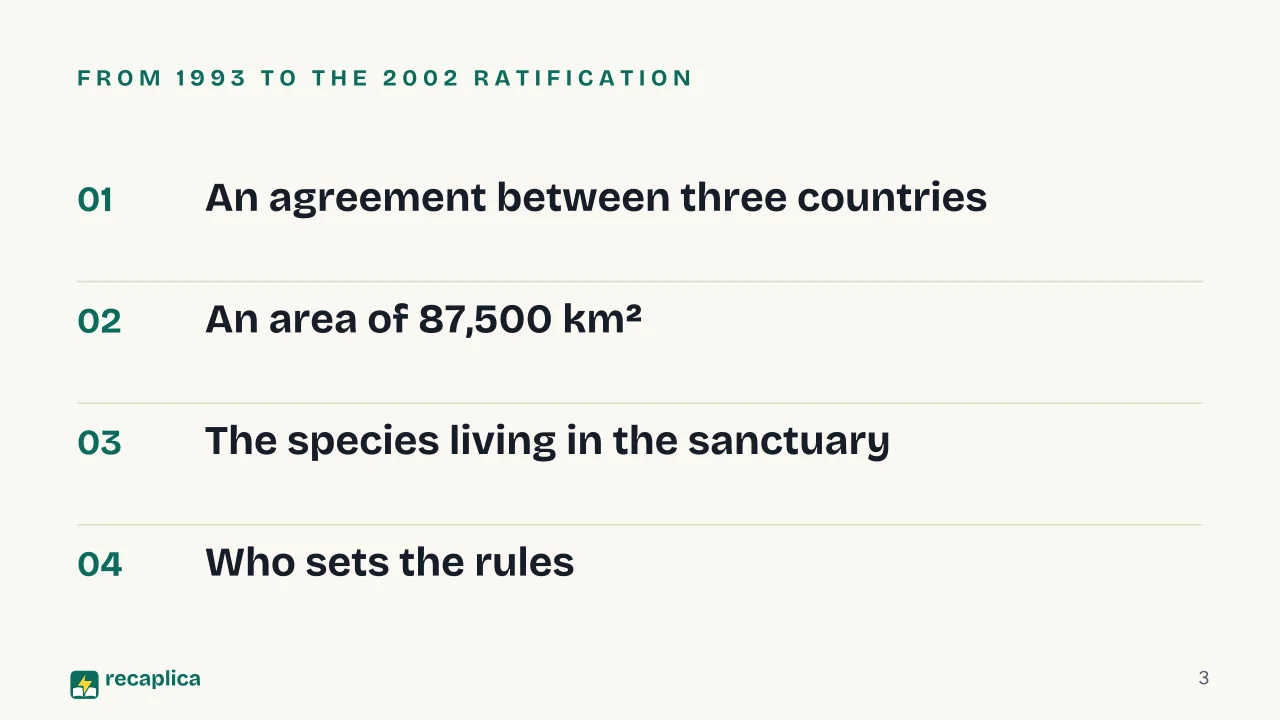 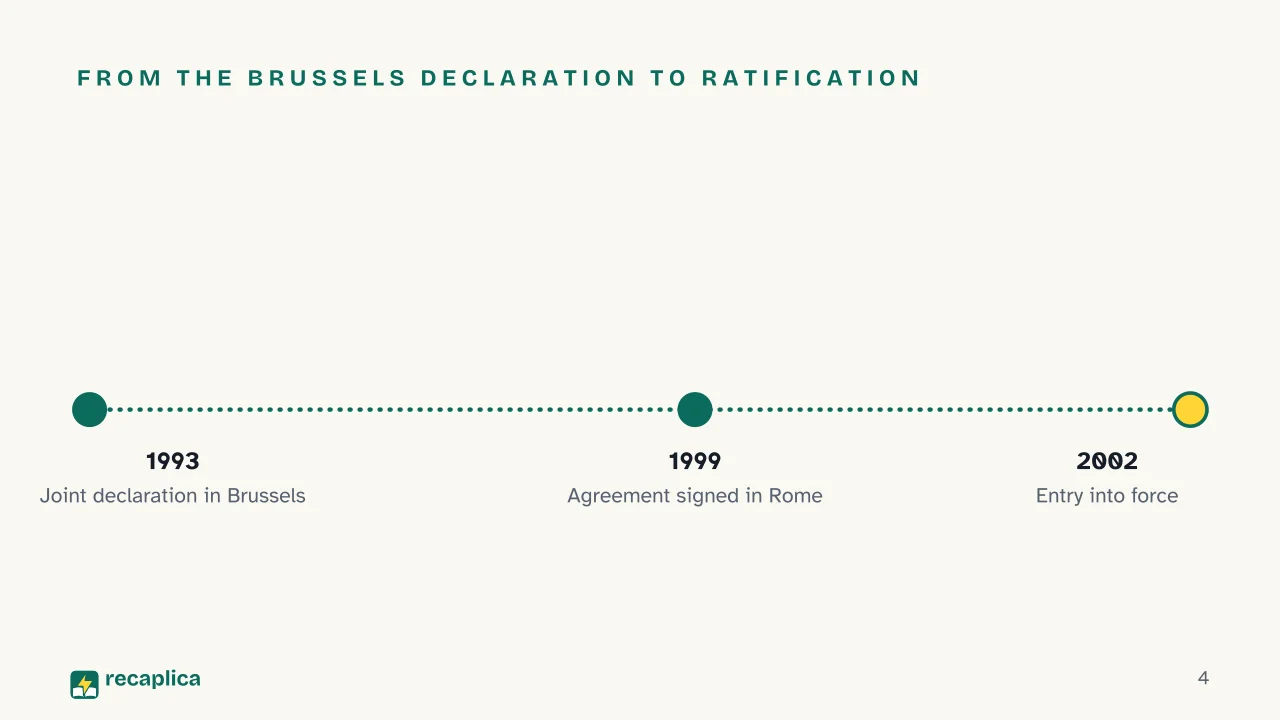 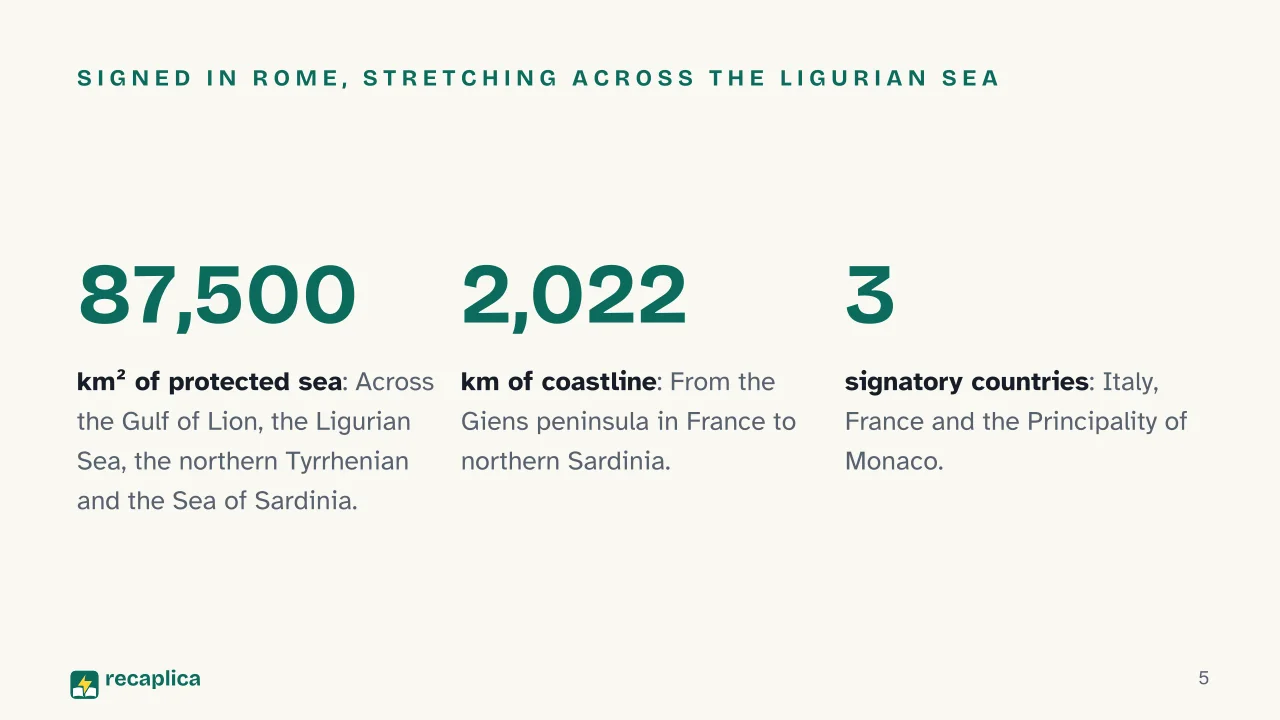 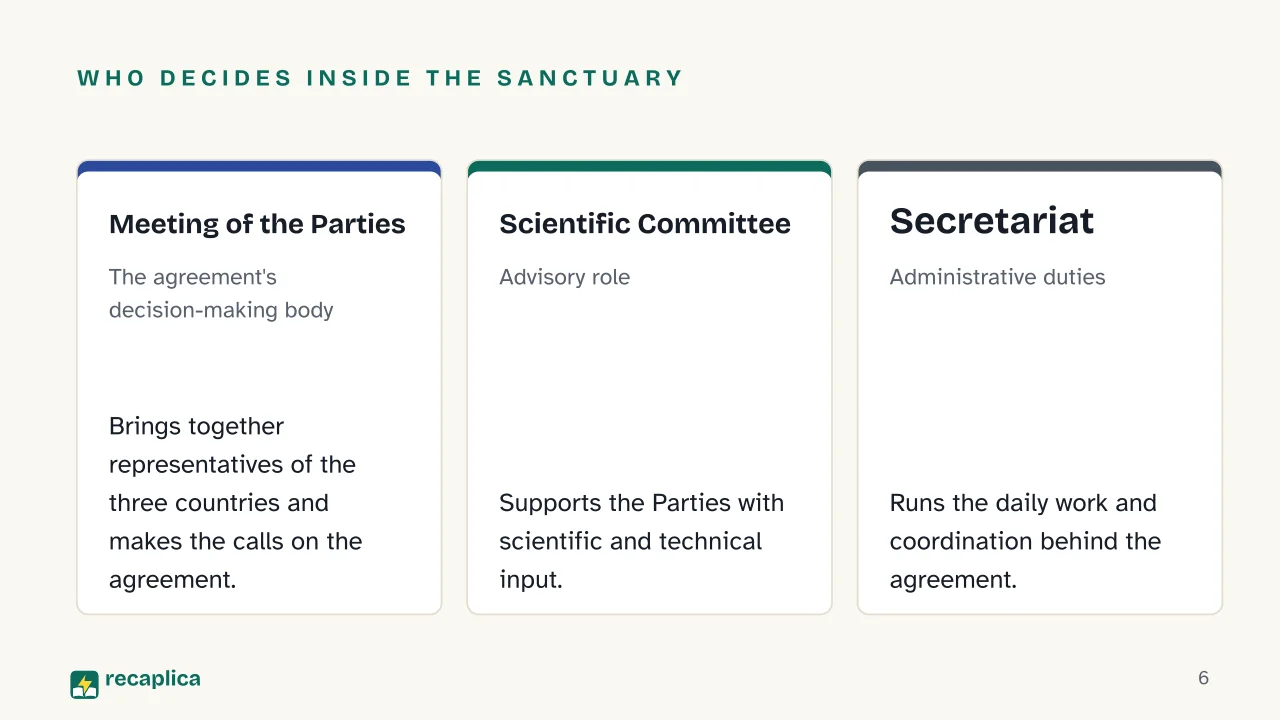 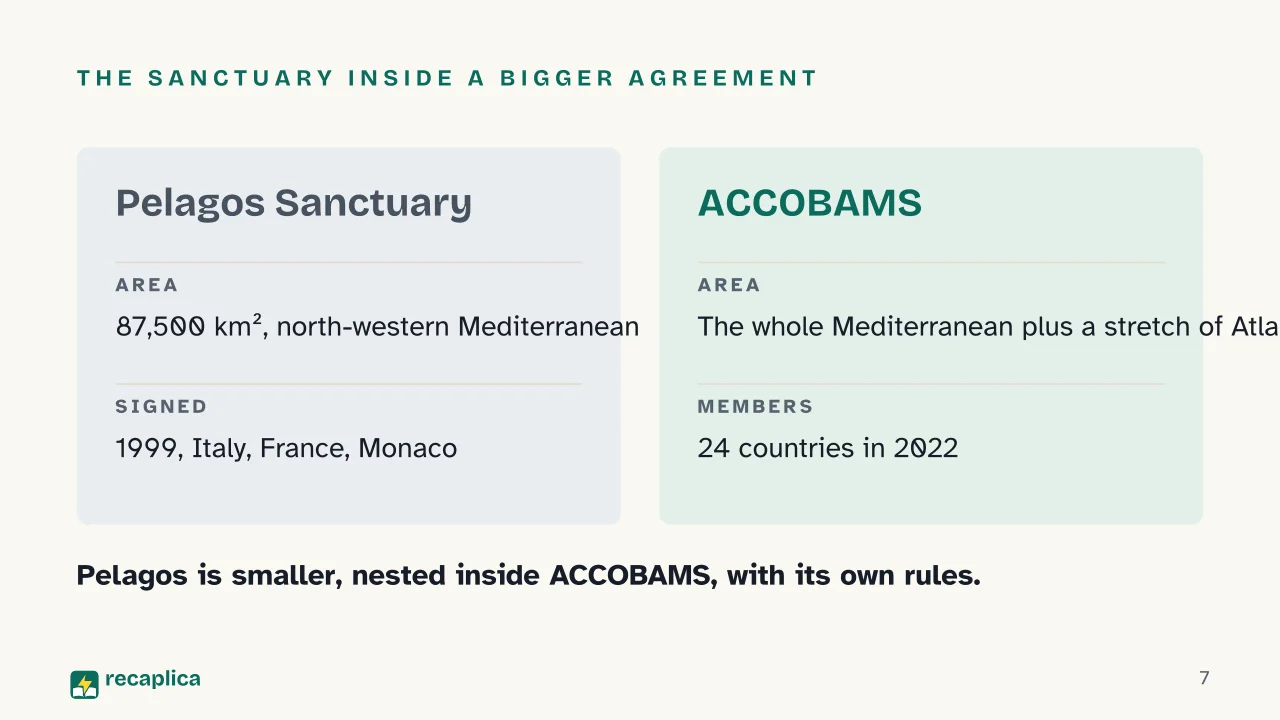 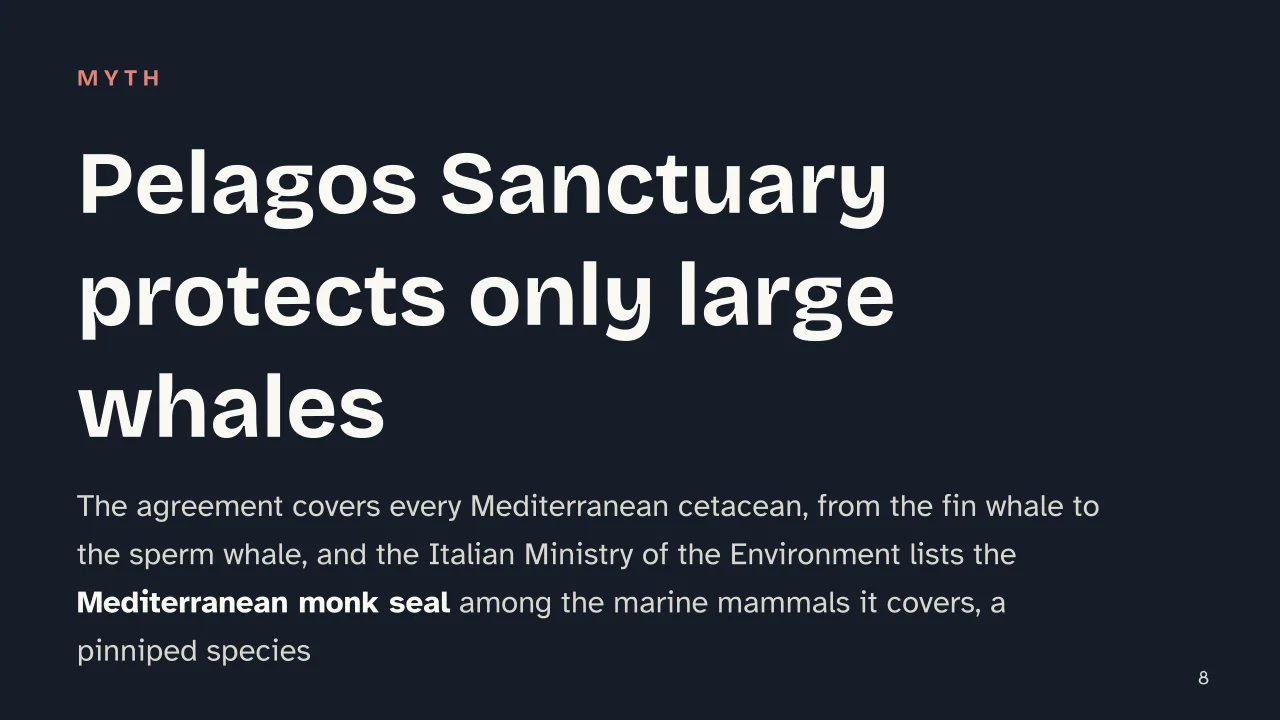 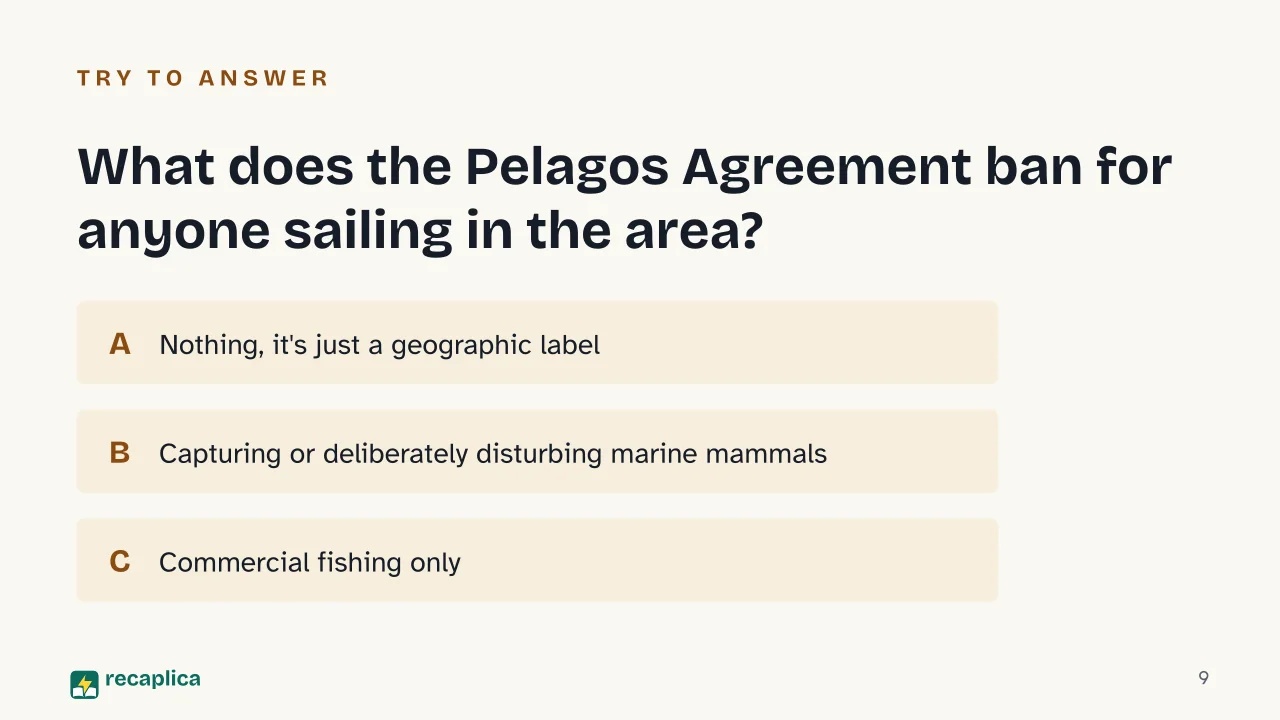  Common myths
Mind mapDrag the background to move around and the nodes to reposition them; use − and + to collapse and expand branches. 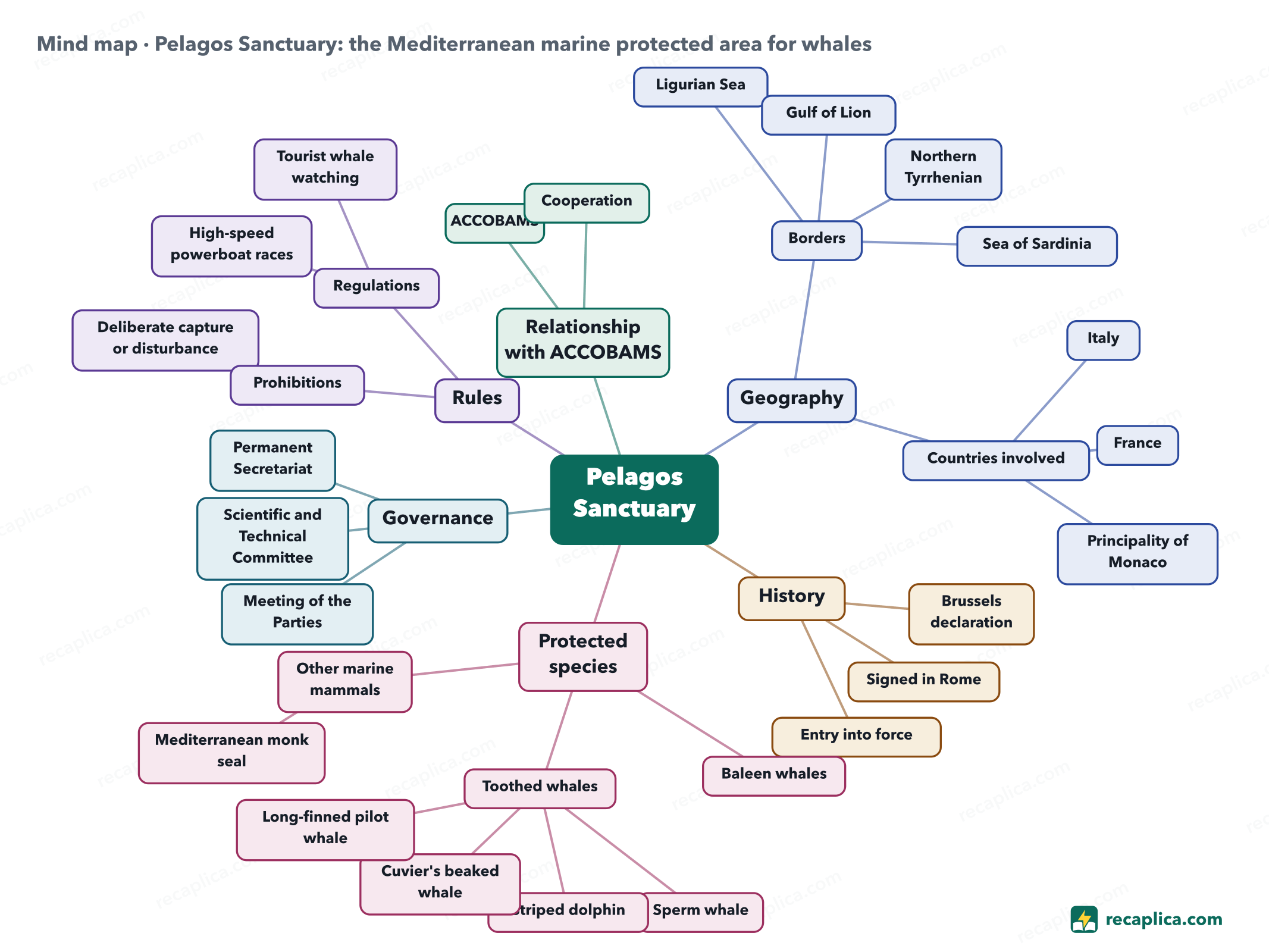
Quiz: test yourselfAnswer the questions to check what you have learned: you get instant feedback and a short explanation. Grade 0/10 0/5
FlashcardsTap the card to flip it and check whether you remember the answer, then move to the next one. 1 / 7 Explain it in your own wordsThe ultimate test: if you can explain it in simple words, you've truly understood it. Write your explanation, then compare it with the Recap. Your explanation is saved only on this device.
Frequently asked questionsWhere is Pelagos Sanctuary located?In the north-western Mediterranean, between France, Italy and the Principality of Monaco: it stretches across a slice of the Gulf of Lion, all of the Ligurian Sea, a stretch of the northern Tyrrhenian and the Sea of Sardinia. Which animals does Pelagos Sanctuary protect?The cetacean species that regularly use this stretch of sea, including the fin whale, sperm whale, striped dolphin and bottlenose dolphin. The Italian Ministry of the Environment's list also includes the Mediterranean monk seal, a pinniped counted among the protected marine mammals. Who signed the Pelagos Agreement, and when?Italy, France and the Principality of Monaco, in Rome, on 25 November 1999; the agreement entered into force in 2002 after national ratification. What does the Pelagos Agreement prohibit for vessels in the area?Anyone sailing inside the sanctuary cannot capture or deliberately disturb a marine mammal: it is one of the agreement's core rules. High-speed powerboat competitions are regulated or banned, and tourist whale-watching activities are regulated too. What is the difference between Pelagos Sanctuary and ACCOBAMS?Pelagos is the specific agreement between three countries covering 87,500 km²; ACCOBAMS is a broader treaty across the whole Mediterranean, with 24 member countries in 2022, and the two cooperate through a Memorandum of Understanding. Every Recap goes through an independent review before publication. |