|
recaplica
Bowhead Whale: The Arctic's Longest-Living Mammal | |||||||||||||||
| © 2026 Recaplica · recaplica.com — All rights reserved | |||||||||||||||
Bowhead Whale: The Arctic's Longest-Living MammalWhat to print Page numbers appear when printing with default margins. SlidesChoose a cut Flash10 slidesThe essential thread, to present in classFull14 slidesEvery chapter and the deeper detailBoth come with speaker notes. In 30 seconds quick readThe bowhead whale (Balaena mysticetus) spends its entire life in Arctic and subarctic seas, from the Bering Sea to the Sea of Okhotsk and the waters off eastern Greenland. According to NOAA Fisheries it can weigh more than 90,000 kg and reach 19 meters in length, and according to NAMMCO it's the longest-living mammal known, with a lifespan that can reach roughly 200 years. It has no dorsal fin, the thickest skull arch of any cetacean, and blubber up to nearly half a meter thick, adaptations that keep it at home in Arctic ice. Commercial whaling, which had effectively ended by 1921, had driven it down to fewer than 3,000 animals worldwide; according to the IUCN's 2018 and 2023 assessments, several stocks are growing. Key Points
Key figures
Deep DiveUnlike other large whales, the bowhead never migrates to the tropics: it stays in Arctic and subarctic waters year-round. According to NOAA Fisheries, its populations are found in the Bering, Chukchi and Beaufort seas, in the Sea of Okhotsk, and off eastern Greenland and Svalbard. Its movements follow the seasonal retreat and advance of sea ice, not a change in climate. The species belongs to the genus Balaena, which it shares with the whale, the largest animal on Earth, and the two have in common an enormous size and a diet of plankton filtered through baleen bristles. Its size places it among the largest animals on the planet. NOAA Fisheries reports a maximum weight of about 90,000 kg and a length of up to 19 meters; NAMMCO puts the maximum at 100 tons and 20 meters, with a typical weight between 70 and 100 tons, and notes that females are larger than males. The head alone, according to NAMMCO, makes up more than a third of the total body length, and the arched skull that gives the species its English name, bowhead, can exceed 5 meters.
The body carries two other signs of Arctic adaptation. The first is the missing dorsal fin: unlike most cetaceans, according to NOAA Fisheries this species has none, and that absence spares it the drag a fin would cause while gliding along the underside of pack ice. The second is its layer of blubber, which according to NOAA Fisheries can reach nearly half a meter in thickness (between 43 and 48 cm), the thickest recorded among all whales: it insulates against Arctic water that often sits close to freezing.
What sets the bowhead whale apart more than anything else, though, is how long it lives. According to NAMMCO it’s the longest-living mammal known, with an age that can pass 200 years; the oldest individual ever estimated, an animal caught in Alaska, was about 211 years old according to a 2022 study (Vasquez et al.). Reaching a figure that large takes more than a simple calculation: the method, described by George et al. in a 1999 study in the Canadian Journal of Zoology, analyzes the core of the eye lens, a tissue the North Slope Borough calls “functionally dead,” because it stops renewing itself once it forms. Amino acids are extracted from that tissue, and researchers measure the ratio between two forms of aspartic acid, a chemical process called racemization: comparing that ratio against a known curve produces an age estimate. One of the samples analyzed in that 1999 study turned out to belong to a whale over 200 years old. No other mammal known today comes close to that figure. Even before this chemical method existed, whalers themselves had left indirect proof of the species’ longevity. Starting in the 1980s and 1990s, finding stone and metal harpoon points embedded in hunted whales led researchers, according to the North Slope Borough, to suspect ages far higher than the 50-60 years scientists had previously estimated. One case reported by NAMMCO involves a whale caught in Alaska that carried a harpoon point in its shoulder blade, used by whalers more than a century earlier: a sign that the animal had lived at least 115 years. A 2008 study (George and Bockstoce, in Polar Biology) used two fragments of historical weapons found in other whales to estimate the species’ longevity and movements. Among the reasons behind such a long life, NOAA Fisheries points to the hypothesis that genes dedicated to repairing damaged DNA may play a role, though the source doesn’t present this as a settled explanation.
Its longevity and size haven’t shielded the species from commercial whaling. According to NOAA Fisheries, before hunting began, the worldwide population was estimated at least 50,000 animals, including between 10,400 and 23,000 in the Western Arctic stock; by 1921, when commercial whaling of the species had effectively ended, the worldwide total had fallen below 3,000 whales. The recovery has been slow but measurable: averaging an ice-based survey from spring 2019 and an aerial survey from summer 2019, NOAA Fisheries estimates the Western Arctic stock at about 15,229 animals, while NAMMCO reports that in 2016 the North Atlantic population, mainly the stock between eastern Canada and western Greenland, numbered nearly 8,000 animals. According to NAMMCO, the IUCN now classifies the species as “low risk” globally (2018 assessment) and as “vulnerable” at the European level (2023 assessment), with populations growing in both cases. Understanding how a mammal can stay alive for two centuries naturally raises the question of how different other large animals are in this respect: comparing it with whale biology in general, or with an aquatic adaptation as specialized as that of otters, helps show just how wide a range of solutions evolution has found for living in water. A longevity this far outside the norm is also a good test case for the mechanisms of natural selection that Darwin described: a body that accumulates two centuries of wear has to keep structures like the immune system and its own DNA repair working far longer than most mammals need to, and this is exactly where the DNA repair genes NOAA Fisheries mentions could play a part. Slide deckSlides ready to download and make your own in PowerPoint or Google Slides, with speaker notes. Pick the Flash cut or the Full one.     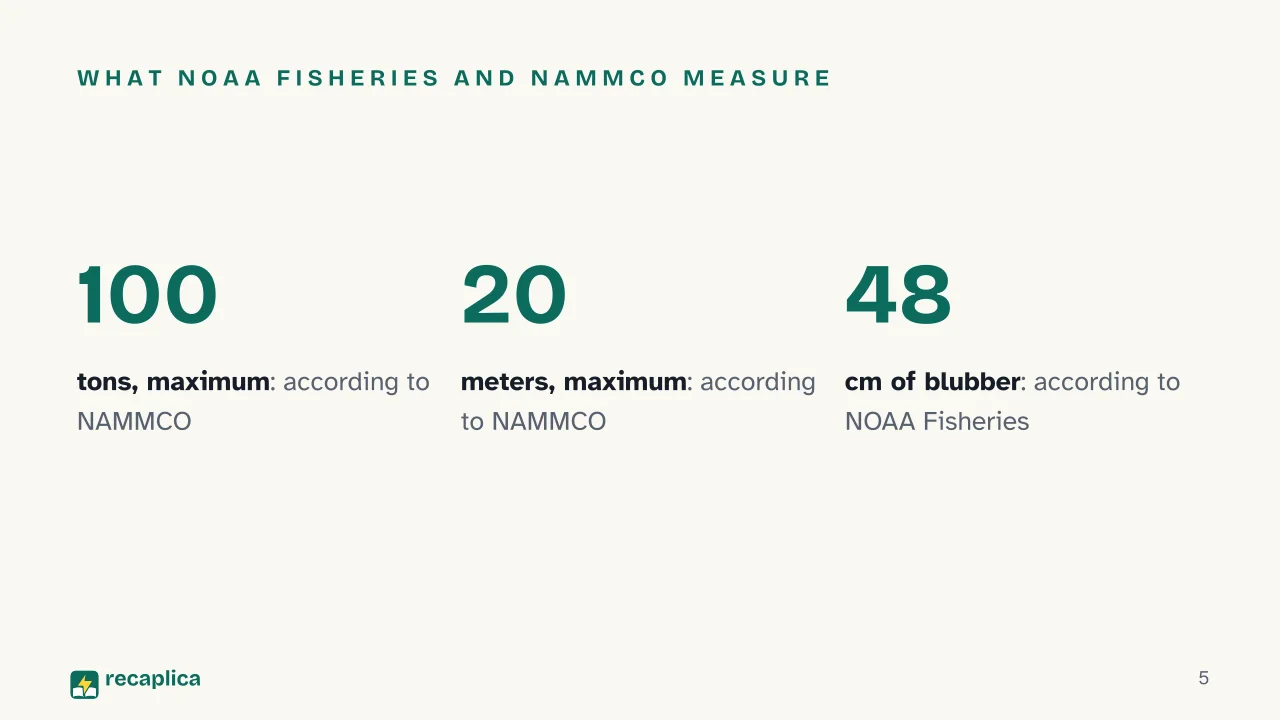 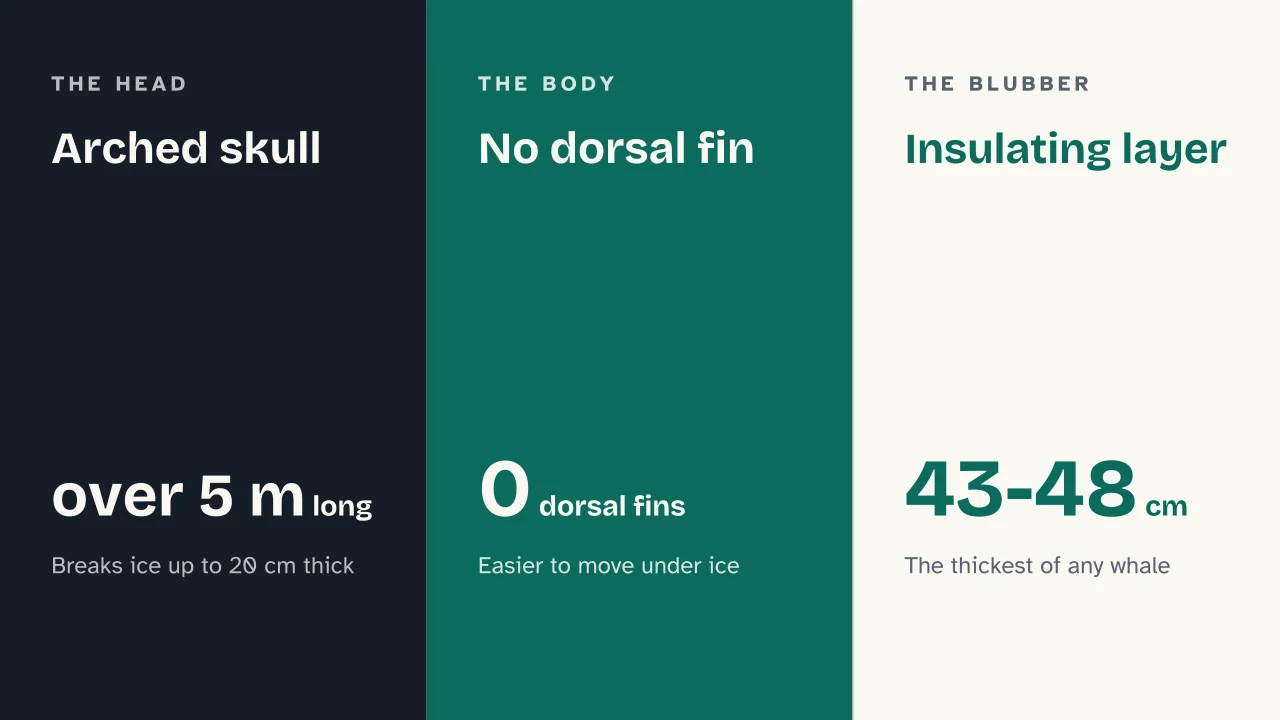  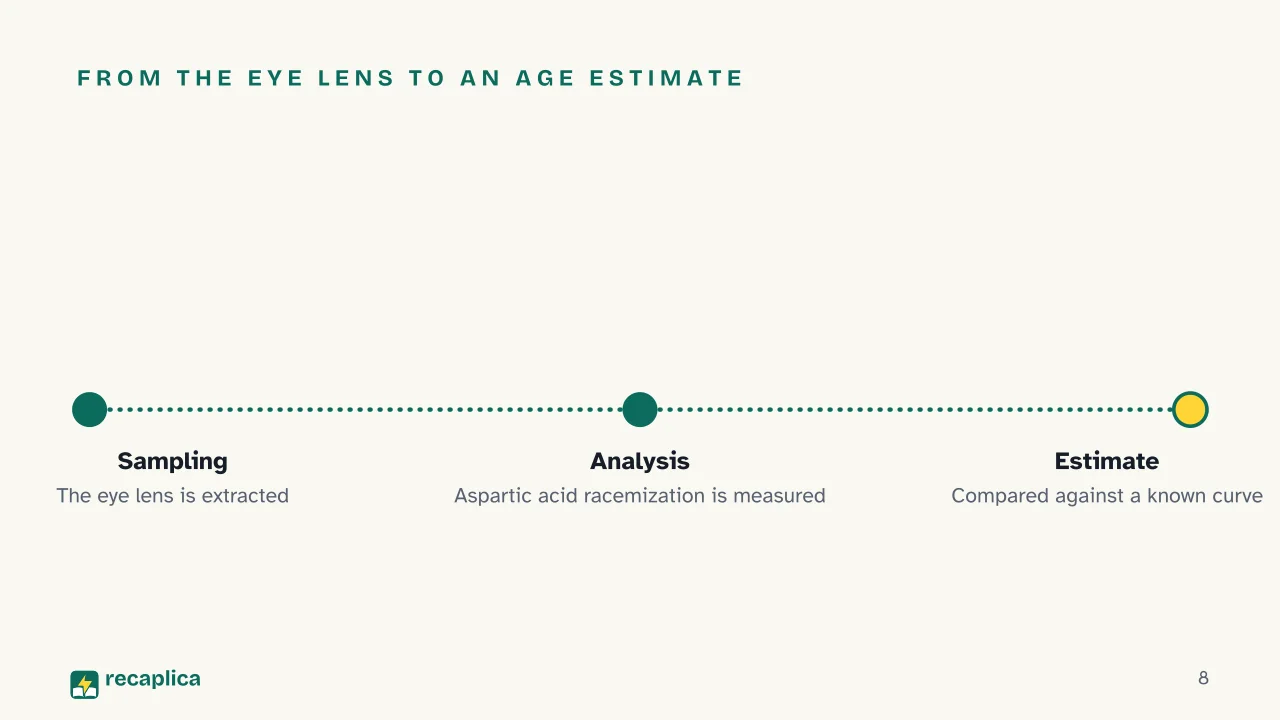  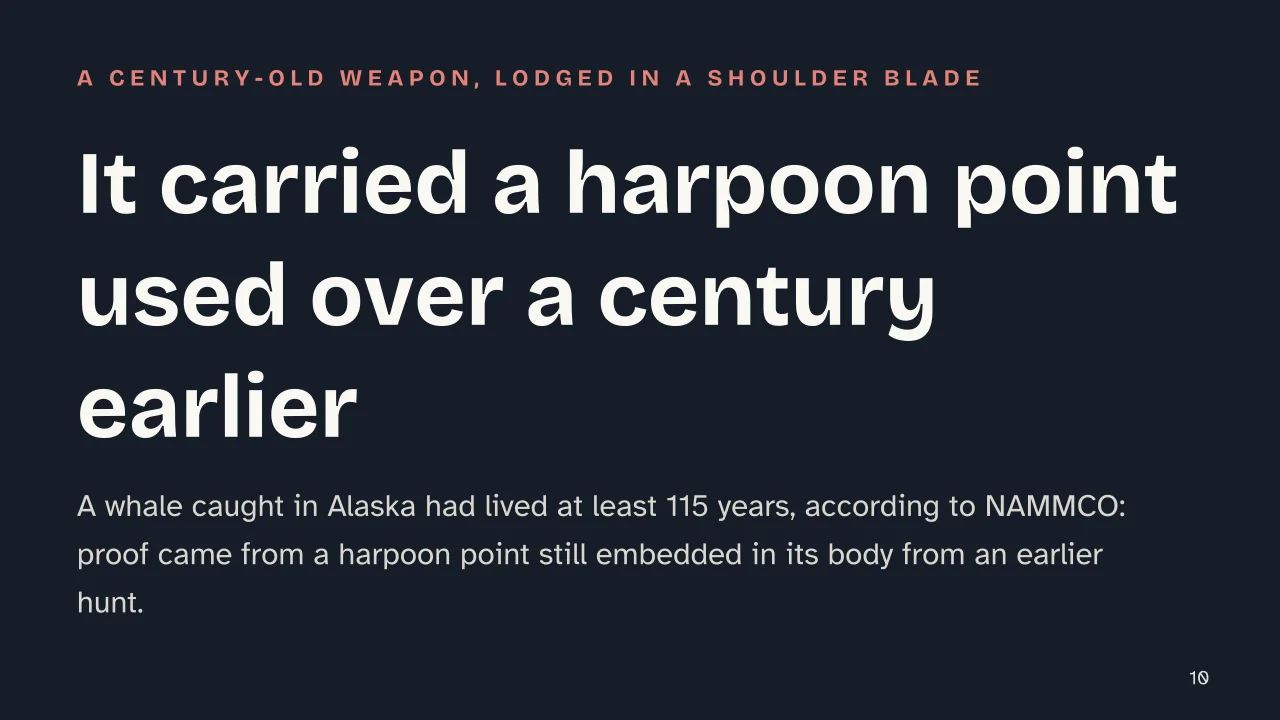  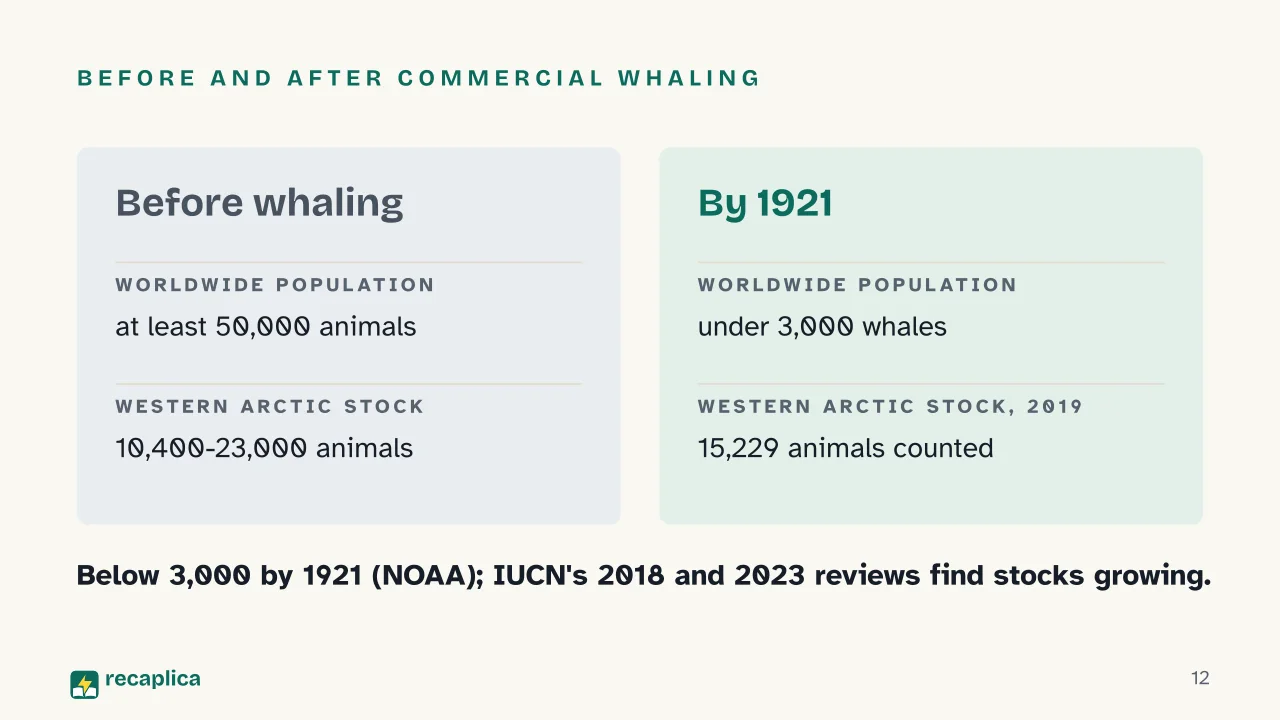   Common myths
Mind mapDrag the background to move around and the nodes to reposition them; use − and + to collapse and expand branches. 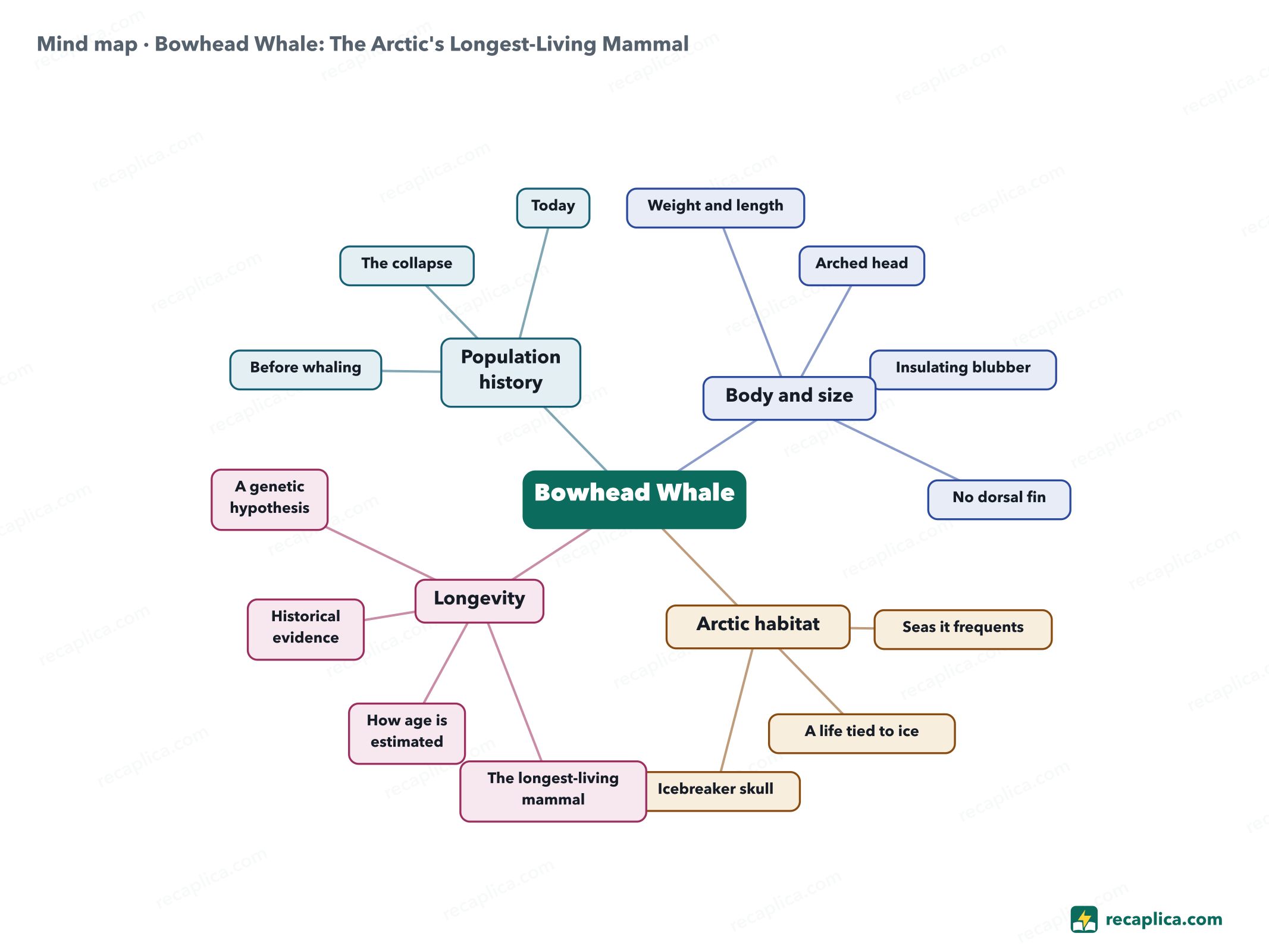
Quiz: test yourselfAnswer the questions to check what you have learned: you get instant feedback and a short explanation. Grade 0/10 0/5
FlashcardsTap the card to flip it and check whether you remember the answer, then move to the next one. 1 / 7 Explain it in your own wordsThe ultimate test: if you can explain it in simple words, you've truly understood it. Write your explanation, then compare it with the Recap. Your explanation is saved only on this device.
Frequently asked questionsHow long does a bowhead whale live?According to NAMMCO it's the longest-living mammal known: its lifespan can reach roughly 200 years. The oldest individual ever estimated, from Alaska, was about 211 years old according to a 2022 study. How much does a bowhead whale weigh and how long is it?According to NOAA Fisheries it can reach about 90,000 kg and 19 meters; according to NAMMCO the maximum is up to 100 tons and 20 meters, with a typical weight between 70 and 100 tons. Females are larger than males. Where does the bowhead whale live?According to NOAA Fisheries, it never leaves Arctic and subarctic waters, with populations distributed from the Bering, Chukchi and Beaufort seas to the Sea of Okhotsk and the waters off eastern Greenland and Svalbard. How do scientists know a whale is over 100 years old?Scientists analyze the eye lens — tissue that stops regenerating once it has formed — by measuring aspartic acid racemization (a method described by George et al. in 1999). Finding old harpoon points embedded in hunted whales has also confirmed ages far higher than previously estimated. Is the bowhead whale at risk of extinction?According to NAMMCO, the IUCN classifies it as 'low risk' globally (2018 assessment) and as 'vulnerable' at the European level (2023 assessment), with populations growing in both cases. The worldwide population had fallen below 3,000 whales by 1921, after decades of commercial whaling. Every Recap goes through an independent review before publication. |