Skip to content
recaplica

    One moment: security check

    Cloudflare wants to make sure you're not a robot. Tick the box below and your search will continue on its own.

    IT
    recaplica CRISPR: What It Is and Where Gene Editing Hits Its Ethical Limits
    © 2026 Recaplica · recaplica.com — All rights reserved
    Home › Science

    CRISPR: What It Is and Where Gene Editing Hits Its Ethical Limits

    By Recaplica Newsroom · Updated on September 19, 2026

    What to print

    Page numbers appear when printing with default margins.

    Slides

    Choose a cut

    Flash10 slidesThe essential thread, to present in classFull16 slidesEvery chapter and the deeper detail

    Both come with speaker notes.

    Telegram channel
    recaplica Clear in 30 seconds, yours in 10 minutes.
    In 30 seconds Key points Figures Deep dive Slides Myths Mind map Quiz Flashcards FAQ

    In 30 seconds quick read

    CRISPR-Cas9 is a tool that uses a short guide RNA to find an exact spot in a strand of DNA, then relies on the Cas9 protein to cut it, opening the door to deleting or inserting genetic code. The sharpest ethical line separates somatic editing, which affects only the treated person's own cells, from germline or heritable editing, which changes embryos or reproductive cells and passes the change on to future generations. In November 2018, Chinese researcher He Jiankui announced that he had used CRISPR to edit the embryos that became twin girls, the most debated case of heritable human gene editing to date. Around the same time, in December 2018, the World Health Organization set up an expert committee on the governance of human genome editing, which published international recommendations spanning nine areas in 2021. Bioethics bodies do not speak with one voice on banning heritable editing outright: the Nuffield Council on Bioethics allows it under very strict conditions, including proven clinical safety and broad public debate.

    Key Points

    • CRISPR-Cas9 uses a guide RNA to locate a specific DNA sequence and the Cas9 protein to cut it; from there, scientists can delete or insert a stretch of genetic code.
    • CRISPR sequences were first spotted in bacteria in the early 1990s, as part of their natural defense against viruses; the lab tool came much later.
    • The core ethical divide separates somatic editing, which isn't inherited, from germline or heritable editing, which passes to children.
    • In November 2018, He Jiankui announced the birth of twin girls whose embryos had been gene-edited, drawing near-universal condemnation from the scientific community.
    • The Nuffield Council on Bioethics, in its 2018 report, permits heritable editing only under precise conditions: proven clinical safety, broad public debate and no new inequality.
    • The WHO also warns that without shared governance, access to these technologies risks staying unequal between richer and poorer countries.

    Key figures

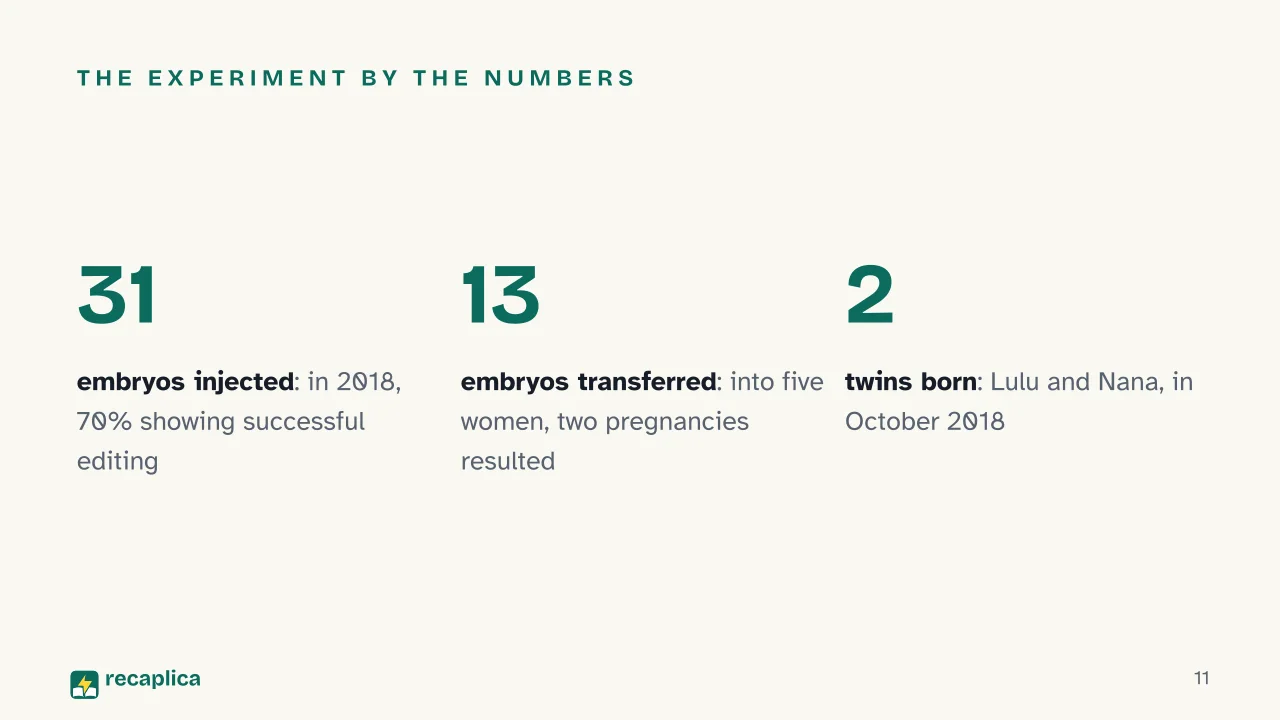
    • 31 human embryos injected with CRISPR in He Jiankui's 2018 experiment, 70% of which showed successful editing. Source: Academic analysis of the He Jiankui case, PMC/NCBI
    • 13 embryos transferred for implantation in five women in the same 2018 experiment, resulting in two pregnancies. Source: Academic analysis of the He Jiankui case, PMC/NCBI
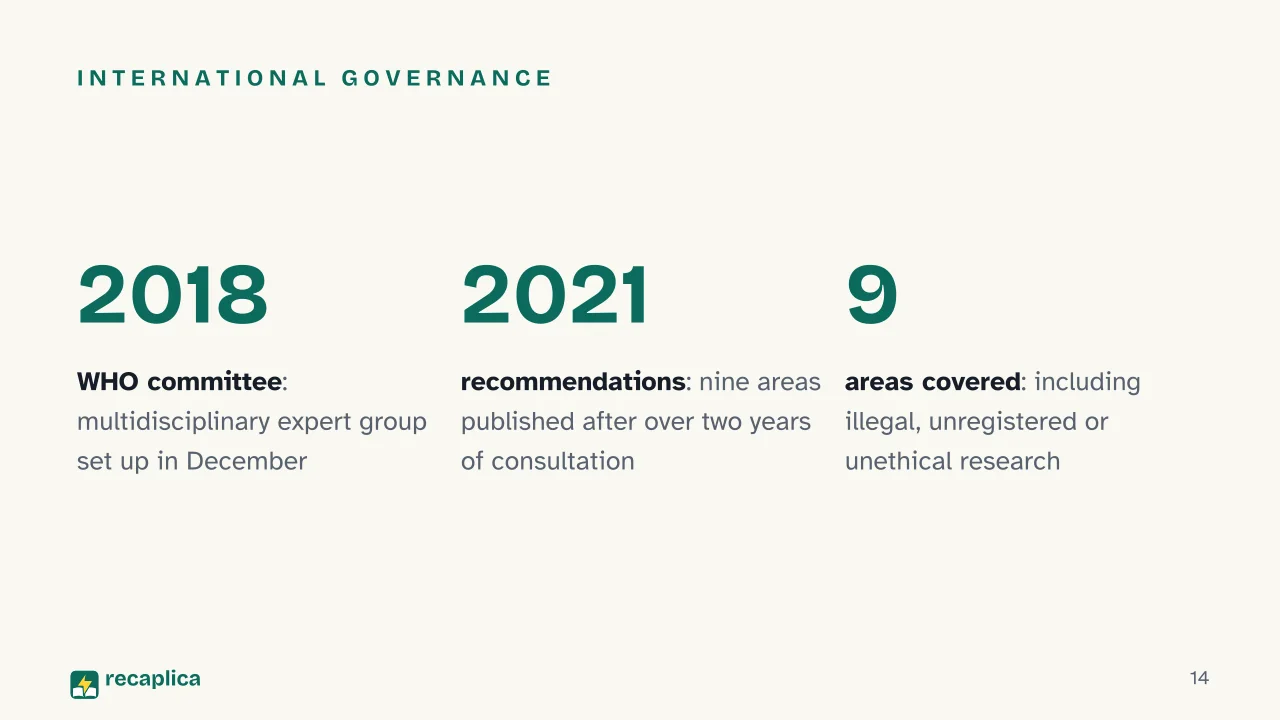
    • 2021 the year the WHO published its global recommendations on governing human genome editing, the result of a consultation lasting over two years. Source: WHO, statement of 12 July 2021

    Deep Dive

    How CRISPR-Cas9 works

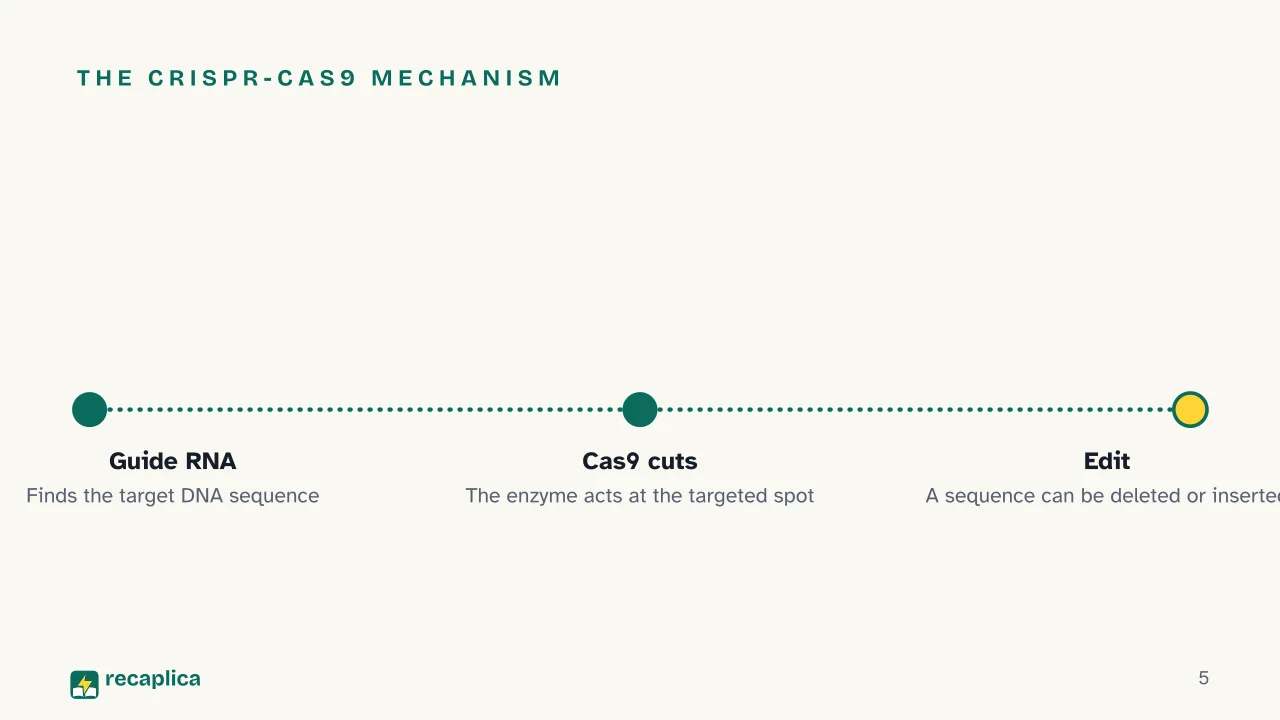
    At the heart of it all is a simple pairing: a guide RNA and a protein that cuts. Researchers build a short synthetic RNA that matches an exact sequence in the DNA they want to change — creating an RNA sequence is far simpler than designing a custom protein from scratch. That guide RNA carries the Cas9 protein to the precise spot in the genome it’s aimed at, where Cas9 cuts both strands of the DNA. From that cut, scientists can get a deletion, or — by supplying an extra template — the insertion of a new sequence.

    The system wasn’t invented in a lab out of thin air. CRISPR sequences were first spotted in bacteria back in the early 1990s: they’re part of the natural immune system these microorganisms use to recognize and destroy the viruses that attack them. Only later did scientists realize that the same recognize-and-cut mechanism could be adapted to work on the genome of other organisms, from yeast to mice to the human cell.

    Somatic versus germline editing: the line that matters

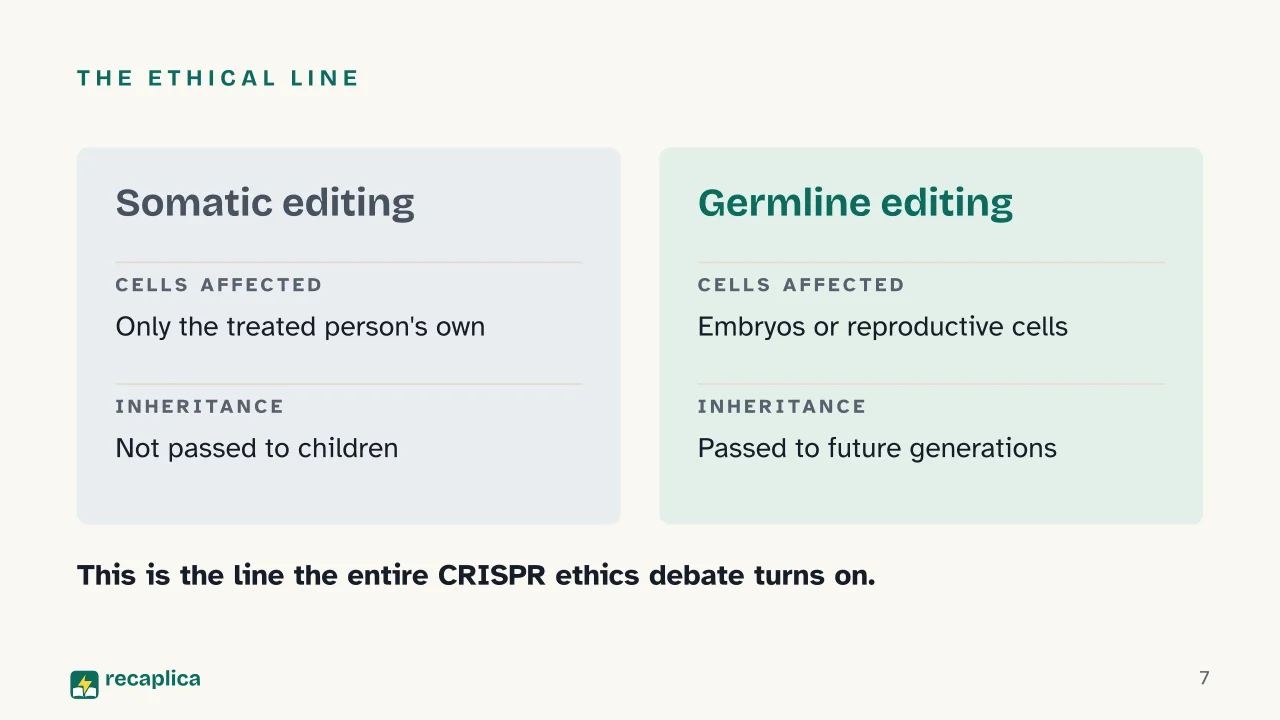
    CRISPR doesn’t always carry the same kind of consequence, and this is where most of the ethical debate plays out. The cells of the human body fall into two broad genetic families: somatic cells, which make up organs and tissue, and germline cells, the ones involved in reproduction and produced through meiosis. Editing the first stays a private matter for the treated person. Editing the second, or an embryo in its early stages, means writing a change that passes to children, and to their children in turn.

    FeatureSomatic editingGermline (or heritable) editing
    Cells involvedCells of organs and tissueEmbryos or reproductive cells
    Passed to childrenNoYes
    Effect on the personLimited to the treated individualExtends to future generations
    How the WHO treats itDistinct, less controversial categoryCategory under closer scrutiny

    Real-world example: a gene therapy applied to the blood cells of a sick adult changes only those cells — the change stays with the patient and never touches their eggs or sperm. That’s somatic editing, categorically different from an intervention on an embryo, which would also affect that person’s descendants.

    The He Jiankui case: when editing reached a human embryo

    In November 2018, Chinese researcher He Jiankui went public, first through scientific press reports and then at the Second International Human Genome Editing Summit in Hong Kong, revealing that he had used CRISPR to edit the embryos that became twin girls, named Lulu and Nana. The stated goal was to make the girls resistant to HIV infection, by artificially reproducing a small deletion in the CCR5 gene that already gives some people this protection naturally.

    The numbers behind the experiment, reconstructed by an academic analysis of the case, show just how immature the technique still was when applied to human embryos: of 31 embryos injected with CRISPR, 70% showed successful editing; of those, 13 were transferred for implantation in five women, resulting in two pregnancies. In at least one of the twins, the edit didn’t affect every cell uniformly, a phenomenon geneticists call mosaicism: the intended genetic change was present in only part of the body, not throughout.

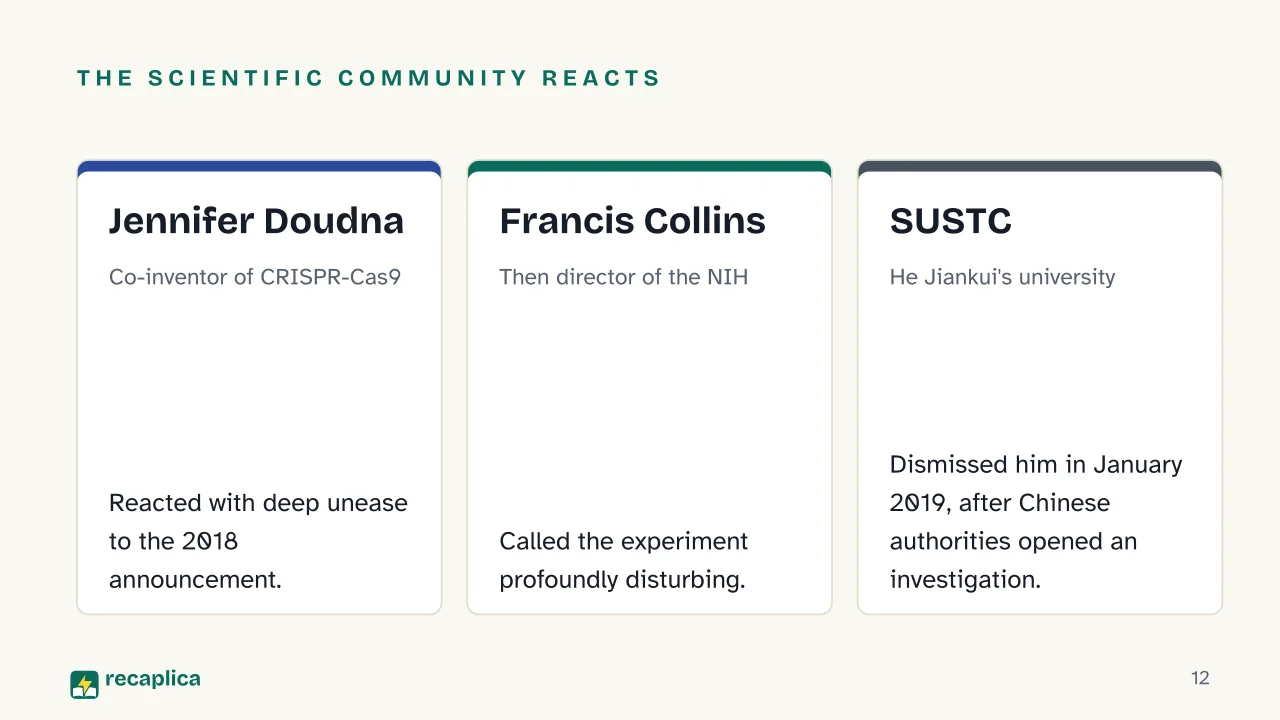
    The scientific community’s reaction was close to unanimous condemnation. Jennifer Doudna, one of the scientists who made CRISPR-Cas9 usable as an editing tool, has described feeling deeply unsettled by the news. Francis Collins, then director of the U.S. National Institutes of Health, called the experiment profoundly disturbing. Not every comment was outright condemnation: some defended the choice of target, HIV resistance, while sharply criticizing how it was pursued — among the most-cited problems were inadequate informed consent and the lack of real medical necessity, since effective, far less risky methods already exist to prevent HIV transmission from an HIV-positive father to an embryo. On the institutional side, Chinese authorities opened an official investigation on January 21, 2019, and SUSTC, the university where He Jiankui worked, dismissed him that same month.

    Where bioethics committees actually stand

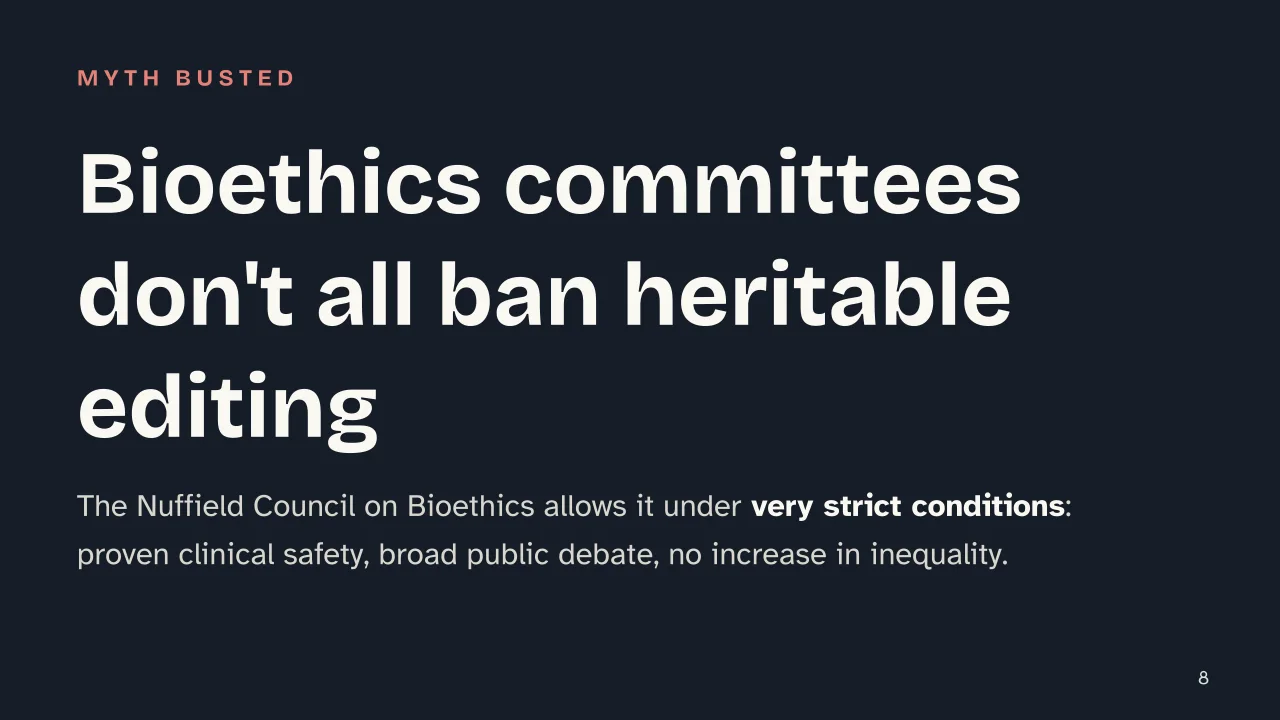
    The He Jiankui case is often retold as proof that heritable editing is banned everywhere. The stance of bioethics committees is more nuanced. The Nuffield Council on Bioethics, a leading British body, published a report in July 2018 devoted specifically to gene editing applied to human reproduction, the result of a preliminary ethical review that had begun back in 2016.

    The Nuffield Council holds that any heritable editing intervention must, above all, be intended for the welfare of the future person and stay consistent with that welfare; it also holds that it must not increase inequality, discrimination or division in society. On top of these principles come more practical conditions: that there has been a genuine opportunity for broad and inclusive public debate about the technique’s use, that further research has established standards of clinical safety, and that risks to individuals, groups and society as a whole have been properly assessed. If those conditions were met, the Council indicates the intervention should still be strictly regulated — in the United Kingdom, by the Human Fertilisation and Embryology Authority — introduced only within a monitored clinical study, and licensed on a case-by-case basis.

    International governance and the equity question

    Around the same time the He Jiankui case was breaking, the World Health Organization had already launched its own governance process: in December 2018, it set up a multidisciplinary expert committee tasked with global standards for overseeing human genome editing, with a mandate to examine somatic, germline and heritable editing as separate categories. The work concluded on July 12, 2021, with the publication of recommendations spanning nine distinct areas, including international registries for human genome editing, international research and medical travel, and — a point that lands differently in light of episodes like the one in Hong Kong, even though the document doesn’t name it — illegal, unregistered, unethical or unsafe research.

    One issue the WHO raises clearly is equity of access: the risk, its 2021 statement notes, is that human genome editing ends up fueling more health inequity between and within countries, rather than reducing it. The recommendations are the result of a consultation lasting over two years, involving hundreds of participants — scientists, patient groups, faith leaders and representatives of indigenous peoples, among others. For now, the 2021 recommendations remain the most recent international framework for governing human genome editing.

    Slide deck

    Slides ready to download and make your own in PowerPoint or Google Slides, with speaker notes. Pick the Flash cut or the Full one.

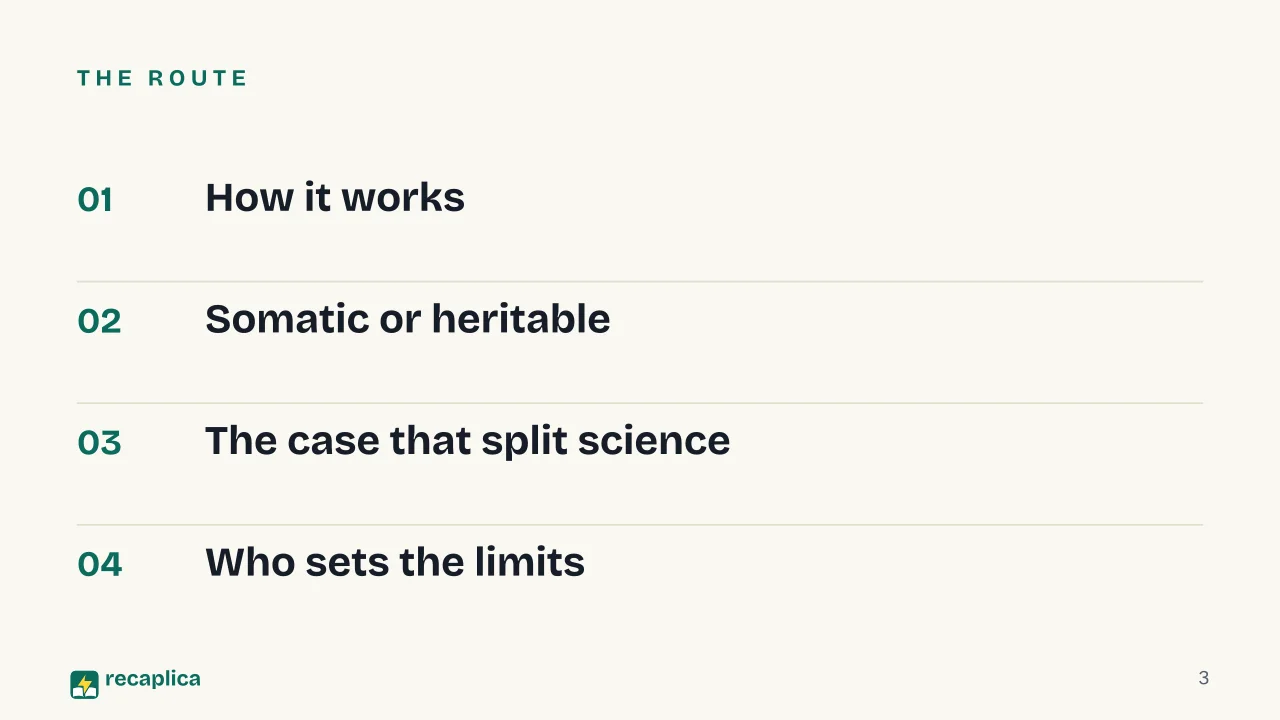
    Slide 1 of the presentation on CRISPR: CRISPRSlide 2 of the presentation on CRISPR: How far should science be allowed to reach into human DNA?Slide 3 of the presentation on CRISPR: The routeSlide 4 of the presentation on CRISPR: Chapter 01: How it worksSlide 5 of the presentation on CRISPR: The CRISPR-Cas9 mechanismSlide 6 of the presentation on CRISPR: Chapter 02: Somatic or heritableSlide 7 of the presentation on CRISPR: The ethical lineSlide 8 of the presentation on CRISPR: Bioethics committees don't all ban heritable editingSlide 9 of the presentation on CRISPR: Chapter 03: The case that split scienceSlide 10 of the presentation on CRISPR: He JiankuiSlide 11 of the presentation on CRISPR: The experiment by the numbersSlide 12 of the presentation on CRISPR: The scientific community reacts: Jennifer Doudna, Francis Collins, SUSTCSlide 13 of the presentation on CRISPR: Chapter 04: Who sets the limitsSlide 14 of the presentation on CRISPR: International governanceSlide 15 of the presentation on CRISPR: What sets somatic editing apart from germline editing?Slide 16 of the presentation on CRISPR: Keep reading on Recaplica
    Flash10 slidesThe essential thread, to present in classFull16 slidesEvery chapter and the deeper detail

    Common myths

    • ✗ Myth CRISPR is a technology that appeared almost out of nowhere in 2018

      ✓ Reality CRISPR sequences were spotted in bacteria as far back as the early 1990s; understanding the mechanism and turning it into a lab tool came later. The media spotlight of 2018-2020 covers its most controversial application, not its origin.

    • ✗ Myth CRISPR editing always cuts DNA precisely and without errors

      ✓ Reality In the twins born in 2018 from He Jiankui's experiment, the edit didn't work uniformly across both copies of the gene: an academic source on the case describes mosaic cells, with the edit present in only part of the body.

    • ✗ Myth Bioethics committees flatly ban heritable gene editing of human embryos

      ✓ Reality The Nuffield Council on Bioethics, in its 2018 report, doesn't rule out heritable editing outright: it considers it permissible under very strict conditions, including proven clinical safety and broad public debate, which points to a conditional stance rather than an absolute ban.

    Mind map

    Drag the background to move around and the nodes to reposition them; use − and + to collapse and expand branches.
    Customize
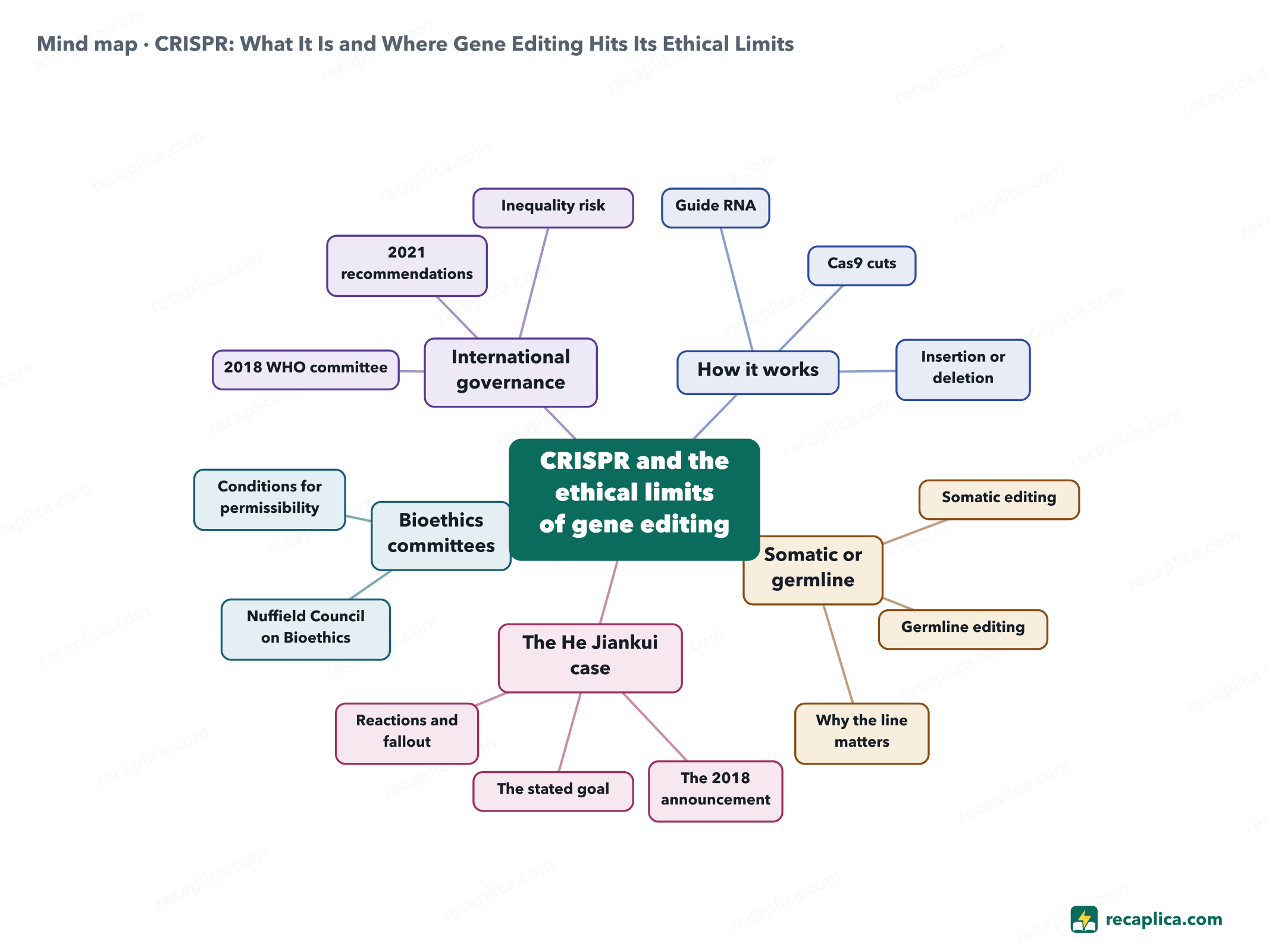
    Mind map: CRISPR: What It Is and Where Gene Editing Hits Its Ethical Limits
    • CRISPR and the ethical limits of gene editing
      • How it works
        • Guide RNA Finds the DNA sequence to edit
        • Cas9 cuts The enzyme acts at the targeted spot
        • Insertion or deletion The step that changes the genetic code
      • Somatic or germline
        • Somatic editing Not heritable, limited to the treated person
        • Germline editing Heritable, passed to descendants
        • Why the line matters It's the focus of the ethical debate
      • The He Jiankui case
        • The 2018 announcement Hong Kong, November 2018
        • The stated goal HIV resistance via the CCR5 gene
        • Reactions and fallout Widespread condemnation, Chinese probe, dismissal
      • Bioethics committees
        • Nuffield Council on Bioethics 2018 report on editing and human reproduction
        • Conditions for permissibility Clinical safety, public debate, equity
      • International governance
        • 2018 WHO committee Multidisciplinary expert group
        • 2021 recommendations Nine areas, including unethical research
        • Inequality risk Unequal access between rich and poor countries

    Quiz: test yourself

    Answer the questions to check what you have learned: you get instant feedback and a short explanation.

    Grade 0/10 0/5
    1 What does the Cas9 protein do in the CRISPR-Cas9 system?

    Cas9 is the enzyme that cuts the DNA at the location the guide RNA identifies; inserting or deleting genetic material happens in a later step, not automatically after the cut.

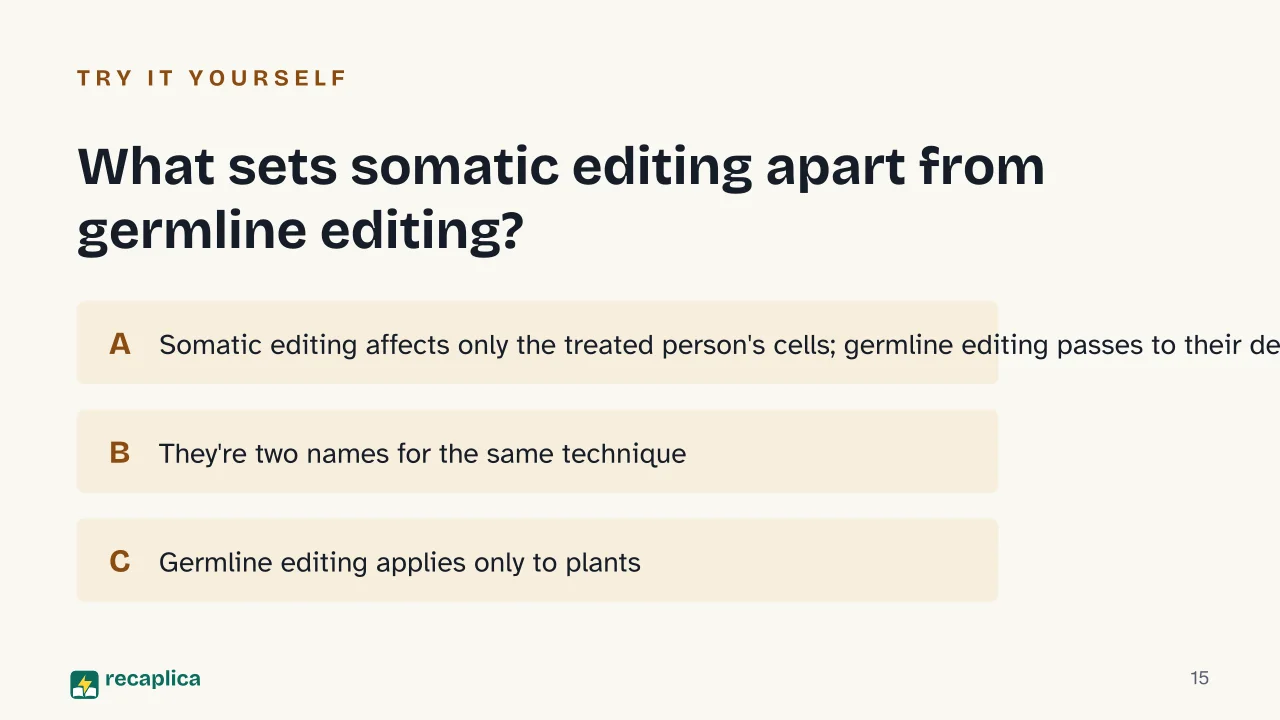
    2 What's the difference between somatic and germline editing?

    Somatic editing works on non-reproductive cells and stays confined to the treated person; germline, or heritable, editing changes embryos or reproductive cells and is passed on to future generations.

    3 What did researcher He Jiankui announce in November 2018?

    At the Second International Human Genome Editing Summit in Hong Kong, in November 2018, He Jiankui announced the birth of twins Lulu and Nana, whose embryos had been edited in an attempt to make them resistant to HIV.

    4 According to the Nuffield Council on Bioethics' 2018 report, is heritable human genome editing...

    The Nuffield Council doesn't rule out heritable editing outright, but ties it to specific conditions: proven clinical safety, broad and inclusive public debate, and no increase in social inequality.

    5 True or false: in He Jiankui's experiment, the gene edit worked identically across all cells of both twins.

    False: an academic source on the case describes an incomplete, mosaic edit, present in only some of the cells, not uniform throughout either twin's body.

    Answers: 1-A · 2-A · 3-A · 4-B · 5-B

    Flashcards

    Tap the card to flip it and check whether you remember the answer, then move to the next one.

    1 / 8

    Explain it in your own words

    The ultimate test: if you can explain it in simple words, you've truly understood it. Write your explanation, then compare it with the Recap.

    Your explanation is saved only on this device.

    CRISPR-Cas9 is a tool that uses a short guide RNA to find an exact spot in a strand of DNA, then relies on the Cas9 protein to cut it, opening the door to deleting or inserting genetic code. The sharpest ethical line separates somatic editing, which affects only the treated person's own cells, from germline or heritable editing, which changes embryos or reproductive cells and passes the change on to future generations. In November 2018, Chinese researcher He Jiankui announced that he had used CRISPR to edit the embryos that became twin girls, the most debated case of heritable human gene editing to date. Around the same time, in December 2018, the World Health Organization set up an expert committee on the governance of human genome editing, which published international recommendations spanning nine areas in 2021. Bioethics bodies do not speak with one voice on banning heritable editing outright: the Nuffield Council on Bioethics allows it under very strict conditions, including proven clinical safety and broad public debate.

    Frequently asked questions

    What's the practical difference between editing an adult's cells and editing an embryo with CRISPR?

    Editing an adult's cells (somatic editing) changes only that person's body: the effect doesn't pass to their children. Editing an embryo or reproductive cells (germline editing) changes DNA that gets passed to future generations, which is why it's at the center of the sharpest ethical debate.

    Has CRISPR already been used to edit human embryos?

    Yes: in November 2018, Chinese researcher He Jiankui announced the birth of twin girls whose embryos had been edited with CRISPR, in an attempt to make them resistant to HIV. The case drew widespread condemnation from the scientific community and a Chinese government investigation, opened in January 2019.

    Do bioethics committees always ban heritable gene editing of human embryos?

    No, not unanimously. The Nuffield Council on Bioethics, in its 2018 report, allows it under very strict conditions: proven clinical safety, broad public debate, and no increase in social inequality.

    What could happen if human gene editing isn't regulated internationally?

    The World Health Organization warns of the risk that access to these technologies stays unequal between wealthier countries and those with fewer resources, widening health disparities instead of narrowing them. That's why it published recommendations across nine areas in 2021, including illegal, unregistered or unethical research.

    Since when has CRISPR existed as a lab tool?

    CRISPR sequences were first spotted in bacteria in the early 1990s, as part of their natural defense system against viruses. Understanding the mechanism and adapting it into a lab editing tool came later, well before the media spotlight of 2018-2020.

    Sources

    • How Does Genome Editing Work? (NHGRI, National Institutes of Health)
    • Human genome editing: a framework for governance (WHO)
    • Genome Editing and Human Reproduction: Social and Ethical Issues (Nuffield Council on Bioethics)
    • WHO issues new recommendations on human genome editing for the advancement of public health
    • CRISPR'd babies: human germline genome editing in the 'He Jiankui affair'

    Every Recap goes through an independent review before publication.

    Every evening, the day's new Recaps on our Telegram channel. Join the channel →

    Keep learning

    • Science Digestive System: How It Breaks Down Food, Step by Step The digestive system breaks food down, piece by piece, into molecules the body can absorb. It starts in the mouth, where teeth cut food into fragments and saliva carries the first enzymes, continues in the stomach, which churns food with gastric acid, and does most of its chemical work in the small intestine, according to StatPearls (2022). Along the way, the liver, pancreas, and gallbladder — organs outside the digestive tract itself — add bile and enzymes to the mix. What's left moves on to the large intestine, which reclaims water and minerals before waste leaves the body. Read the Recap →
    • Science How Beer Is Made: The Brewing Process, from Barley to Glass Beer comes from four ingredients — water, malted barley, hops and yeast — combined through four main steps: malting, mashing, boiling and fermentation. During malting, barley germinates and is then dried, developing the enzymes that mashing later uses to turn starch into fermentable sugar. Boiling dissolves the hops' alpha acids, which barely dissolve in water on their own, giving beer its characteristic bitterness. The yeast strain and fermentation temperature then determine whether the result is an ale, a lager, or a spontaneously fermented beer like Belgian lambic. Read the Recap →
    • Science How Wine Is Made: The Winemaking Process, from Grape to Bottle Wine comes from the alcoholic fermentation of grape must, the process in which yeast converts sugar into ethanol and carbon dioxide. Before fermentation, grapes are crushed and destemmed to free the juice from the berries and separate it from the stems. For red wine, the must stays in contact with the skins during maceration, which gives it color and tannins; for white wine, the juice is drawn off almost immediately, so the wine stays pale. After fermentation, wine rests in barrels, oak casks or steel tanks to age before it's filtered and bottled. Under the standard set by the OIV, the international body that regulates the industry, a drink can only be called wine once it reaches a minimum alcohol content. Read the Recap →

    recaplica

    Clear in 30 seconds, yours in 10 minutes.

    Recaps Mind maps Request a Recap Telegram channel Mind map maker Our method About Privacy & cookies Legal notes & terms of use

    © 2026 Recaplica · A project by Curi S.r.l. — VAT IT05472000750

    Statistics, only if you say so

    To learn which Recaps help most we would use Google Analytics, with aggregate, anonymous data. It starts only with your OK, and you can change your mind anytime. Privacy policy