recaplica
Clear in 30 seconds, yours in 10 minutes.
In 30 seconds quick read
A second-order differential equation with constant coefficients has the form ay''+by'+cy=r(x), built around the second derivative of the unknown function. When r(x) is zero the equation is homogeneous, and it pairs with the characteristic equation ar²+br+c=0: the sign of its discriminant settles whether the roots come out real and distinct, real and repeated, or a complex conjugate pair, and that sign shapes the general solution. When r(x) isn't zero the equation is nonhomogeneous, and a particular solution — found through the method of undetermined coefficients — gets added to the solution of the matching homogeneous equation. The same pattern turns up in physics, describing a mass hanging from a spring.
Key Points
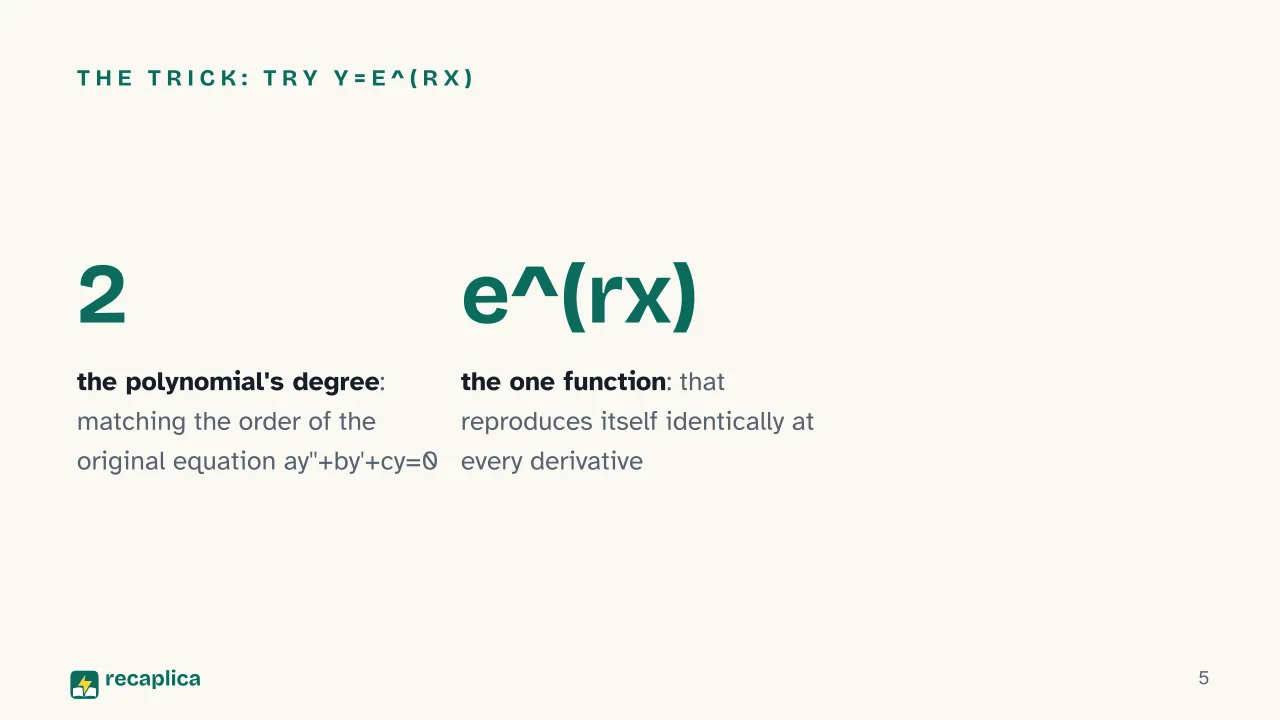
Every homogeneous equation ay''+by'+cy=0 pairs with the characteristic equation ar²+br+c=0, found by testing whether y=e^(rx) solves it.
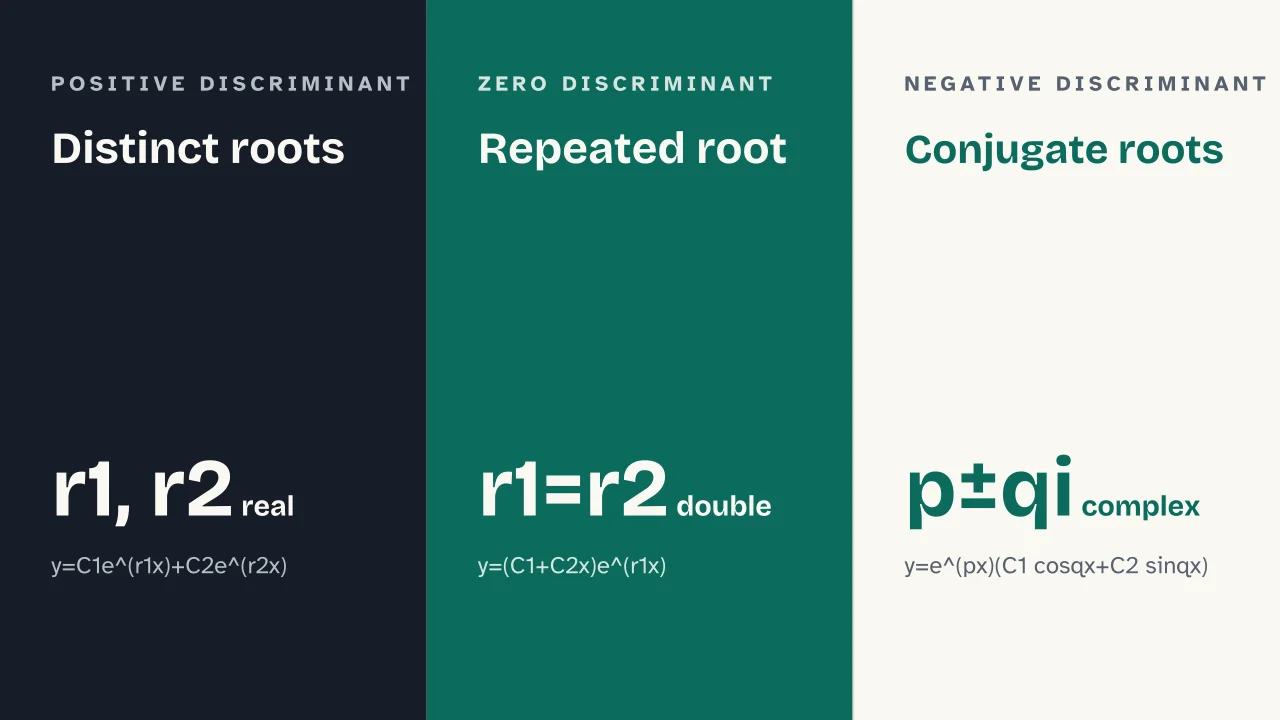
The sign of the discriminant b²-4ac splits the outcome into three cases: real distinct roots, one repeated real root, or a complex conjugate pair.
With real distinct roots r1 and r2, the general solution is y=C1e^(r1x)+C2e^(r2x).
With a repeated root, an extra factor of x is what makes the second solution genuinely independent: y=(C1+C2x)e^(r1x).
With complex roots p±qi, the general solution is y=e^(px)(C1 cosqx+C2 sinqx), an oscillation shaped by an exponential envelope.
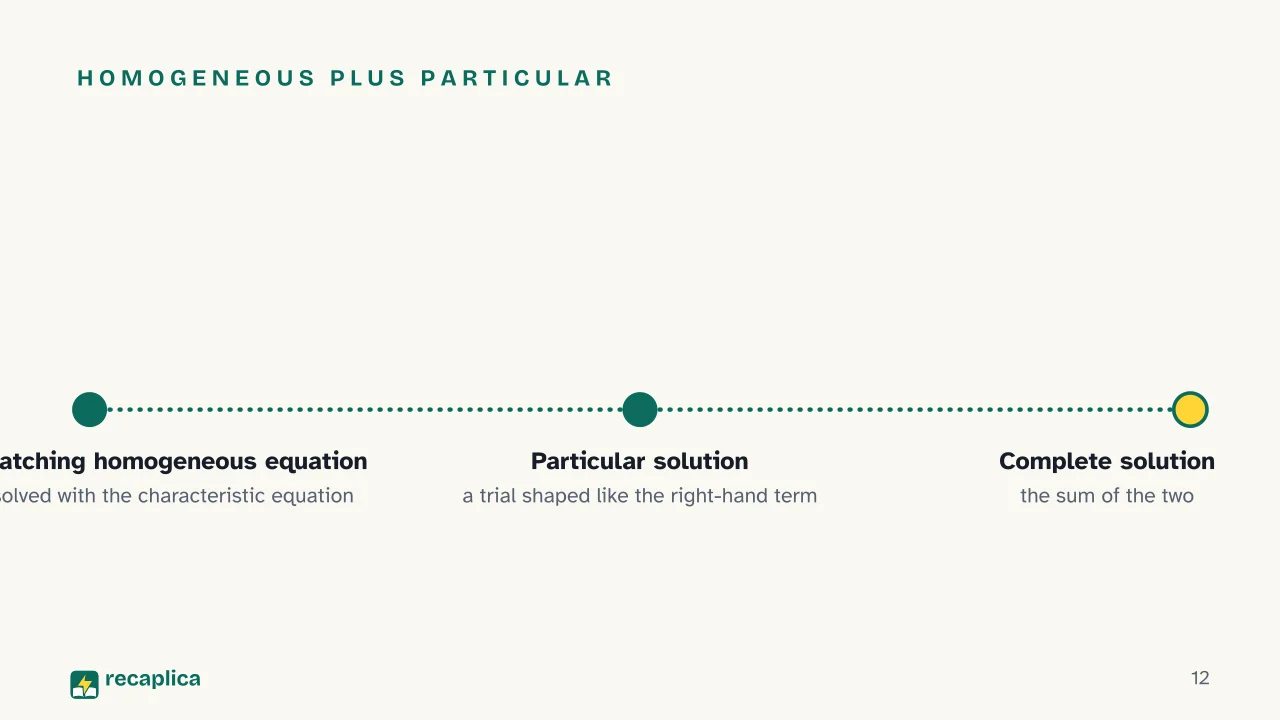
In a nonhomogeneous equation, the general solution is the sum of the matching homogeneous solution and a particular solution, found with the method of undetermined coefficients.
Deep Dive
The Recap on differential equations covers what they are and how order works in general; this one stays on a single case, second order with constant coefficients, and the method for solving it.
The characteristic equation
A linear homogeneous second-order differential equation with constant coefficients is written ay”+by’+cy=0. The method starts from one specific trial, y=e^(rx): it’s the only function that reproduces itself identically at every derivative, so y’=re^(rx) and y”=r²e^(rx). Substituting into the equation and factoring out e^(rx), which is never zero, leaves the characteristic equation ar²+br+c=0: a differential equation problem turns into an algebra problem — finding the roots of a second-degree polynomial.
Three cases, depending on the discriminant
The roots of the characteristic equation set the shape of the general solution, and the sign of the discriminant b²-4ac decides which of three cases applies.
With a positive discriminant, the roots r1 and r2 are real and distinct, and the general solution is y=C1e^(r1x)+C2e^(r2x). With a zero discriminant there’s a single repeated real root: one family e^(r1x) alone can’t cover every solution of the equation, so a second, independent solution is needed, obtained by multiplying by x; the general solution becomes y=(C1+C2x)e^(r1x). With a negative discriminant the roots are a complex conjugate pair, p±qi, and the general solution is y=e^(px)(C1 cosqx+C2 sinqx): an oscillation between sine and cosine, shaped by the exponential envelope e^(px).
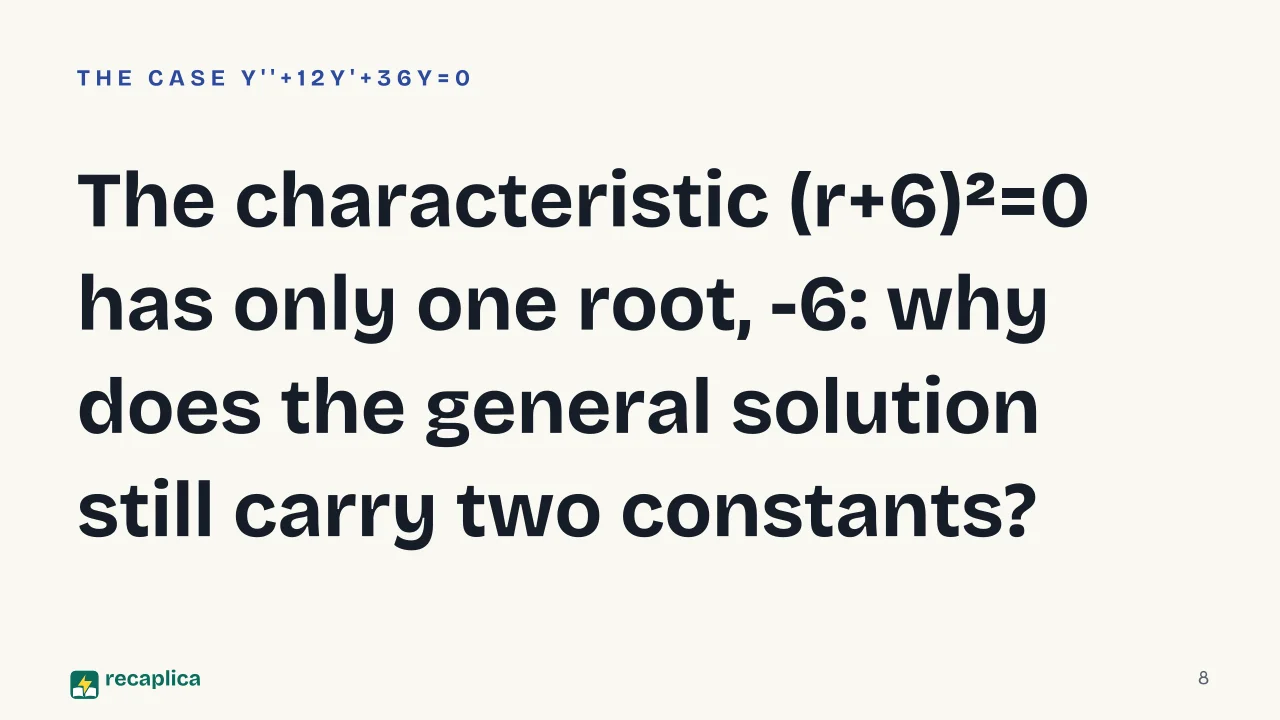
Worked example: the equation y”+9y’+14y=0 has characteristic r²+9r+14=0, which factors as (r+2)(r+7)=0. The roots are -2 and -7, real and distinct, and the general solution is y(x)=c1e^(-2x)+c2e^(-7x). The equation y”+12y’+36y=0, instead, has characteristic (r+6)²=0: a single repeated root, -6, and the general solution becomes y(x)=c1e^(-6x)+c2xe^(-6x).
Case
Discriminant
Roots
General solution
Real distinct roots
positive
r1 ≠ r2, real
y=C1e^(r1x)+C2e^(r2x)
Repeated root
zero
r1=r2, real
y=(C1+C2x)e^(r1x)
Complex conjugate roots
negative
p±qi
y=e^(px)(C1 cosqx+C2 sinqx)
A physics application: the mass-spring system
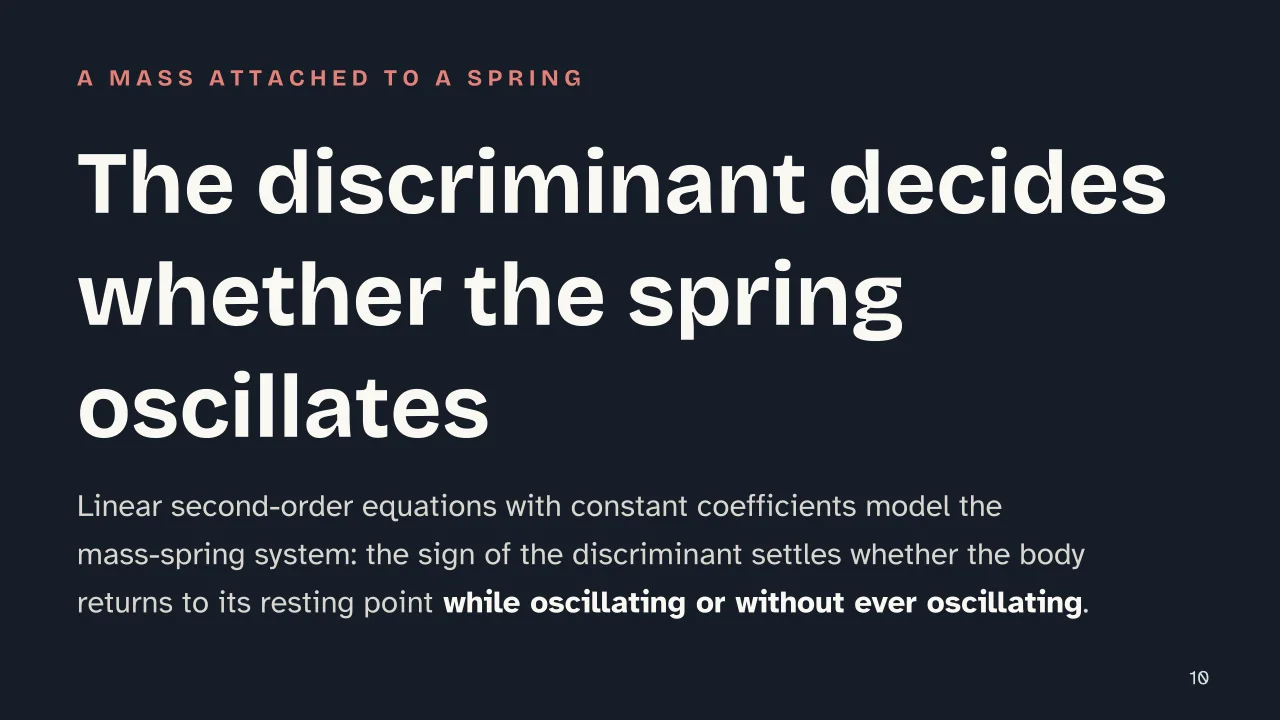
The same type of equation governs a body hanging from a spring: its position over time follows exactly the pattern above, applied to a physical phenomenon. The sign of the discriminant decides whether that body settles back to its resting point oscillating around it, or approaches it without ever oscillating.
The nonhomogeneous case
A linear second-order equation becomes nonhomogeneous when a term r(x) different from zero appears on the right-hand side: ay”+by’+cy=r(x). The general solution comes from combining two pieces: the general solution of the matching homogeneous equation (also called “complementary,” obtained by setting r(x)=0) and any one particular solution of the nonhomogeneous equation.
The method of undetermined coefficients
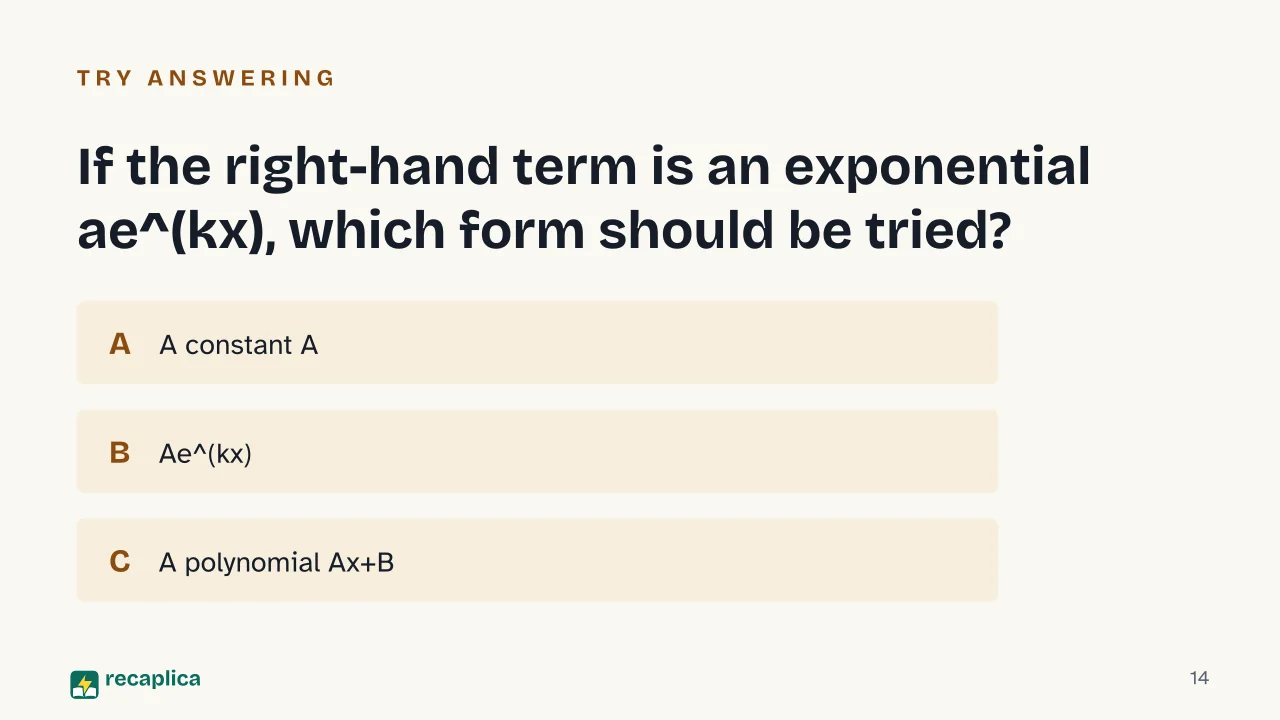
The method of undetermined coefficients looks for the particular solution by trying a form from the same family of functions as the right-hand term, with coefficients still unknown, discovered by substituting that trial into the equation. For a constant right-hand term, try a constant A; for a first-degree polynomial ax+b, try a general polynomial of the same degree, Ax+B; for an exponential ae^(kx), try Ae^(kx); for a combination of sine and cosine, a cosqx+b sinqx, try A cosqx+B sinqx. If the basic trial overlaps with a term already present in the matching homogeneous solution, it needs correcting by multiplying it by x — the same fix used for a repeated root.
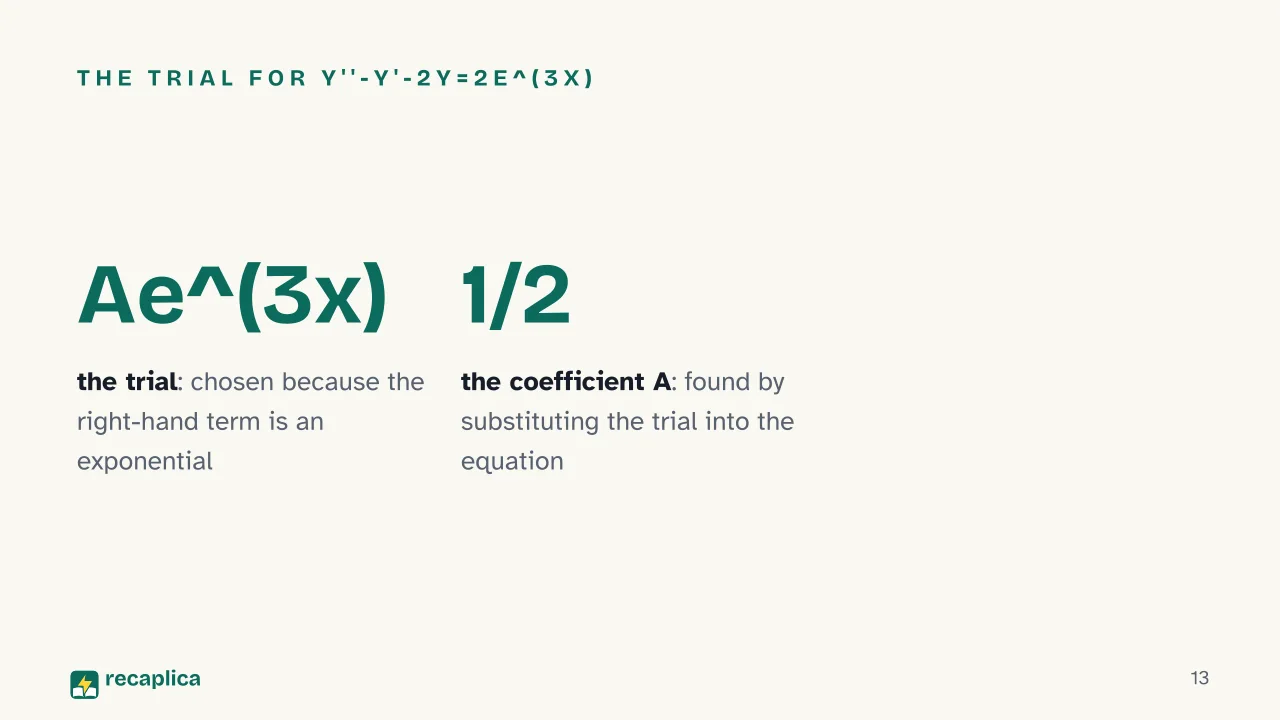
Worked example: for the equation y”-y’-2y=2e^(3x), the general solution of the matching homogeneous equation is c1e^(-x)+c2e^(2x). The right-hand term is an exponential, so the trial for the particular solution is Ae^(3x): it doesn’t overlap with any term of the homogeneous solution, so no correction is needed. Substituting into the equation gives A=1/2, and the complete general solution is y(x)=c1e^(-x)+c2e^(2x)+(1/2)e^(3x).
The method only works when the right-hand term fits one of these families — constants, polynomials, exponentials, sine and cosine — or a combination of them; outside those families, other tools are needed, like the ones covered in the equations Recap and, for exponential equations, in the dedicated one.
Slide deck
Slides ready to download and make your own in PowerPoint or Google Slides, with speaker notes. Pick the Flash cut or the Full one.
✗ Myth Some assume a second-order differential equation always has two exponential functions as its solution, no matter what.
✓ Reality It depends on the sign of the characteristic equation's discriminant. With complex conjugate roots, the general solution is an oscillation — a sine and a cosine multiplied by an exponential — not two separate exponentials.
✗ Myth Some think the discriminant b²-4ac only matters in second-degree algebraic equations, the ones without derivatives.
✓ Reality The same quantity shows up in the characteristic equation tied to a second-order differential equation, and there it decides the shape of the solution: distinct real roots, a repeated root, or a complex pair.
✗ Myth Some believe solving a nonhomogeneous equation just takes finding any one particular solution.
✓ Reality The general solution of the matching homogeneous equation is still needed. The full solution is the sum of both, because only the homogeneous part carries the arbitrary constants that get tuned to the problem's own conditions.
Mind map
Drag the background to move around and the nodes to reposition them; use − and + to collapse and expand branches.
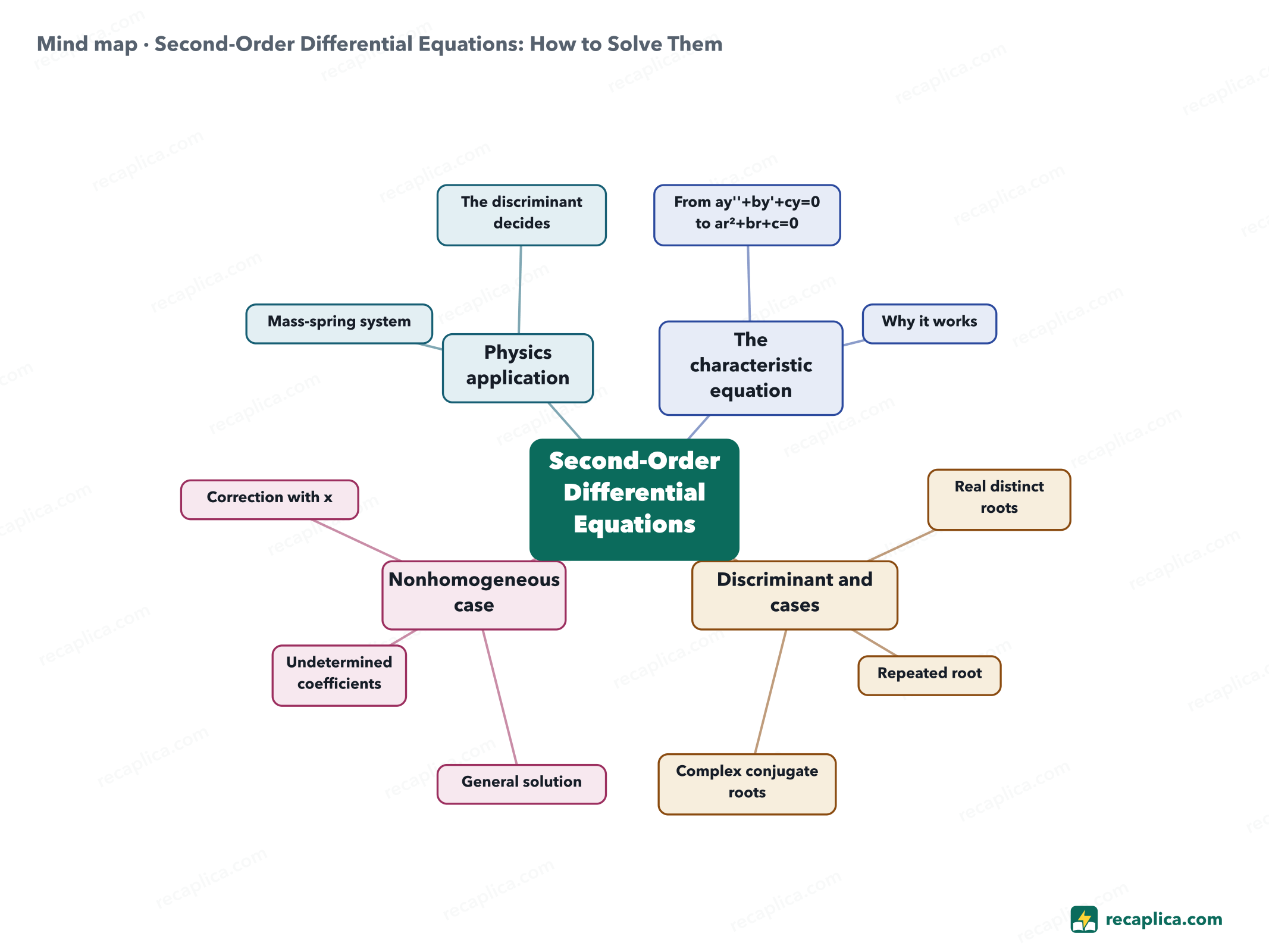
General solutionmatching homogeneous solution plus a particular solution
Undetermined coefficientsthe trial follows the shape of the right-hand term
Correction with xused when the trial overlaps with a piece of the homogeneous solution
Physics application
Mass-spring systemhow the position of a body hanging from a spring changes over time
The discriminant decidesdetermines how the system returns to rest
Quiz: test yourself
Answer the questions to check what you have learned: you get instant feedback and a short explanation.
Grade0/100/5
Answers: 1-A · 2-A · 3-A · 4-A · 5-A
Flashcards
Tap the card to flip it and check whether you remember the answer, then move to the next one.
1 / 8
Explain it in your own words
The ultimate test: if you can explain it in simple words, you've truly understood it. Write your explanation, then compare it with the Recap.
Your explanation is saved only on this device.
A second-order differential equation with constant coefficients has the form ay''+by'+cy=r(x), built around the second derivative of the unknown function. When r(x) is zero the equation is homogeneous, and it pairs with the characteristic equation ar²+br+c=0: the sign of its discriminant settles whether the roots come out real and distinct, real and repeated, or a complex conjugate pair, and that sign shapes the general solution. When r(x) isn't zero the equation is nonhomogeneous, and a particular solution — found through the method of undetermined coefficients — gets added to the solution of the matching homogeneous equation. The same pattern turns up in physics, describing a mass hanging from a spring.
Frequently asked questions
How do you solve a second-order differential equation with constant coefficients?
If it's homogeneous, pair it with the characteristic equation ar²+br+c=0 and build the general solution from its roots. If it's nonhomogeneous, add a particular solution to that result, found with the method of undetermined coefficients.
What changes between real distinct roots, a repeated root, and complex roots?
The shape of the general solution: two separate exponentials in the first case, an exponential multiplied also by x in the second, and an oscillation of sine and cosine shaped by an exponential in the third.
What's the difference between a homogeneous and a nonhomogeneous equation?
In a homogeneous equation the right-hand term is zero. In a nonhomogeneous one it isn't, and the general solution needs an extra piece: the particular solution.
What is the method of undetermined coefficients?
A trial form is chosen for the particular solution from the same family as the right-hand term, with coefficients still unknown, which are found by substituting that trial into the original equation.
What's a real-world use for solving these equations?
A linear second-order equation with constant coefficients also models a body hanging from a spring: the same discriminant sign seen in the homogeneous case decides how the system returns to equilibrium.
Every Recap goes through an independent review before publication.
Statistics, only if you say so
To learn which Recaps help most we would use Google Analytics, with aggregate, anonymous data. It starts only with your OK, and you can change your mind anytime. Privacy policy