|
recaplica
Number Sets: A Definition of Natural, Integer, Rational, and Real Numbers | ||||||||||||||||||||||||
| © 2026 Recaplica · recaplica.com — All rights reserved | ||||||||||||||||||||||||
Number Sets: A Definition of Natural, Integer, Rational, and Real NumbersWhat to print Page numbers appear when printing with default margins. SlidesChoose a cut Flash10 slidesThe essential thread, to present in classFull14 slidesEvery chapter and the deeper detailBoth come with speaker notes. In 30 seconds quick readNumber sets are the nested families that organize every number you use: natural numbers, whole numbers, integers, rational numbers, and real numbers, with irrational numbers filling the gap between the rational numbers and the reals. OpenStax's *College Algebra* lays them out as a chain, each one wrapped inside the next, natural inside whole inside integer inside rational inside real. Counting needs only the naturals; subtraction below zero needs the integers; dividing two numbers needs the rationals; measuring a diagonal or a circle needs the reals. Once you know which set a number belongs to, you already know which operations are guaranteed to work on it. Key Points
Key figures
Deep DiveWhat are number setsOpenStax’s College Algebra builds up the number sets one layer at a time: start with the natural numbers, add zero to get the whole numbers, add negatives to get the integers, add fractions to get the rational numbers, and finally add the irrationals to get the real numbers. Each set sits entirely inside the next one, the way a smaller box fits inside a bigger one. Not every calculation works inside a small set. Subtraction becomes fully reliable once you reach the integers, division once you reach the rational numbers, and square roots — along with a genuinely continuous number line — once you reach the real numbers. Natural numbers and whole numbersThe natural numbers are the ones everyone learns first: the numbers used to count objects, days, people. OpenStax’s College Algebra puts it plainly — “the numbers we use for counting… are the natural numbers: 1, 2, 3, 4, 5, and so on” — which leaves zero out of the set. Zero gets its own step instead, the whole numbers, defined as the natural numbers plus zero: {0, 1, 2, 3, …}. That’s a different convention from the one used in Italy and in Giuseppe Peano’s original axioms, where zero counts as a natural number from the outset; a reader should check which convention a given textbook has adopted before comparing definitions across sources. The operations performed on these numbers, addition, subtraction, multiplication, sit at the core of arithmetic, the branch of math that studies them. Integers: subtraction that always worksInside the whole numbers, subtraction can get stuck: 3 minus 5 isn’t a whole number. The integers solve that by adding the negative counterparts of the whole numbers: {…, −3, −2, −1, 0, 1, 2, 3, …}. With the integers, subtraction always produces an answer, no matter which two numbers you start with. An equation like x + 5 = 2 has no solution among the whole numbers, since it would require a negative number. That’s exactly the kind of wall that equations run into the moment they move past simple counting — and the practical reason the integers exist. Rational numbers: division that always worksEven among the integers, one operation still gets stuck: division. 7 divided by 2 isn’t an integer. The rational numbers fix that by adding fractions: OpenStax defines the set as every number that can be written as m/n, with m and n integers and n never zero. With the rational numbers, division always produces an answer, except when the denominator is zero. Rational numbers always have a decimal expansion that either terminates or repeats. OpenStax uses 15/8, which comes out to 1.875 (a terminating decimal), and 4/11, which comes out to 0.3636… with the digits “36” repeating forever (a repeating decimal). Writing the rule as m/n, with letters standing in for specific numbers, is the same trick algebra uses to state a rule that holds for infinitely many cases at once.
Irrational numbers and the real number systemThe real number system, according to OpenStax, is the union of the rational numbers and the irrational numbers: every number that is either one or the other. Irrational numbers are the ones with a decimal expansion that neither terminates nor repeats — √2 and π are the two most familiar examples. With the real numbers, square roots work for every positive number, and the number line becomes continuous, without the gaps that the rational numbers alone would leave behind. Studying what happens near a single point on that gapless line is the territory calculus works in. The rational numbers are countable: according to Treccani’s Enciclopedia della Matematica, they have exactly as many elements as the natural numbers, despite being dense on the number line (there’s always another rational number between any two you pick). The real numbers, by contrast, are not countable. A short history: from the Pythagoreans to today’s symbolsThe discovery that some quantities can’t be expressed as a ratio — what mathematicians call incommensurability — dates back to the Pythagoreans, according to Treccani. But a long stretch separates that discovery from irrational numbers gaining full standing as numbers: Treccani places that acceptance in the seventeenth and eighteenth centuries, many centuries later still. The rigorous construction didn’t arrive until the nineteenth century: in 1872, Dedekind published Stetigkeit und irrationale Zahlen (“Continuity and Irrational Numbers”), where he used R for the rationals and blackletter R for the reals. The other symbols have their own history too, traced by the MacTutor History of Mathematics Archive at the University of St Andrews. In a different 1888 work, Was ist und was sollen die Zahlen, Dedekind denoted the natural numbers with N; Peano adopted the same symbol the following year. Before Z and Q became standard, other mathematicians used their own notation: in the 1930s, Landau wrote the integers with a fraktur Z topped by a bar, while van der Waerden used C for the integers and the Greek letter Γ for the rationals. Today’s familiar form of Z and Q first appeared in 1947, in the first volume of Algèbre by the group of mathematicians known as Bourbaki. A summary table
Every row of the table sits entirely inside the rows below it: a natural number is also a whole number, an integer, a rational number, and a real number, while the reverse almost never holds. Knowing which set a number belongs to, before doing any arithmetic at all, is what tells you which operations are safe to use on it. Slide deckSlides ready to download and make your own in PowerPoint or Google Slides, with speaker notes. Pick the Flash cut or the Full one.     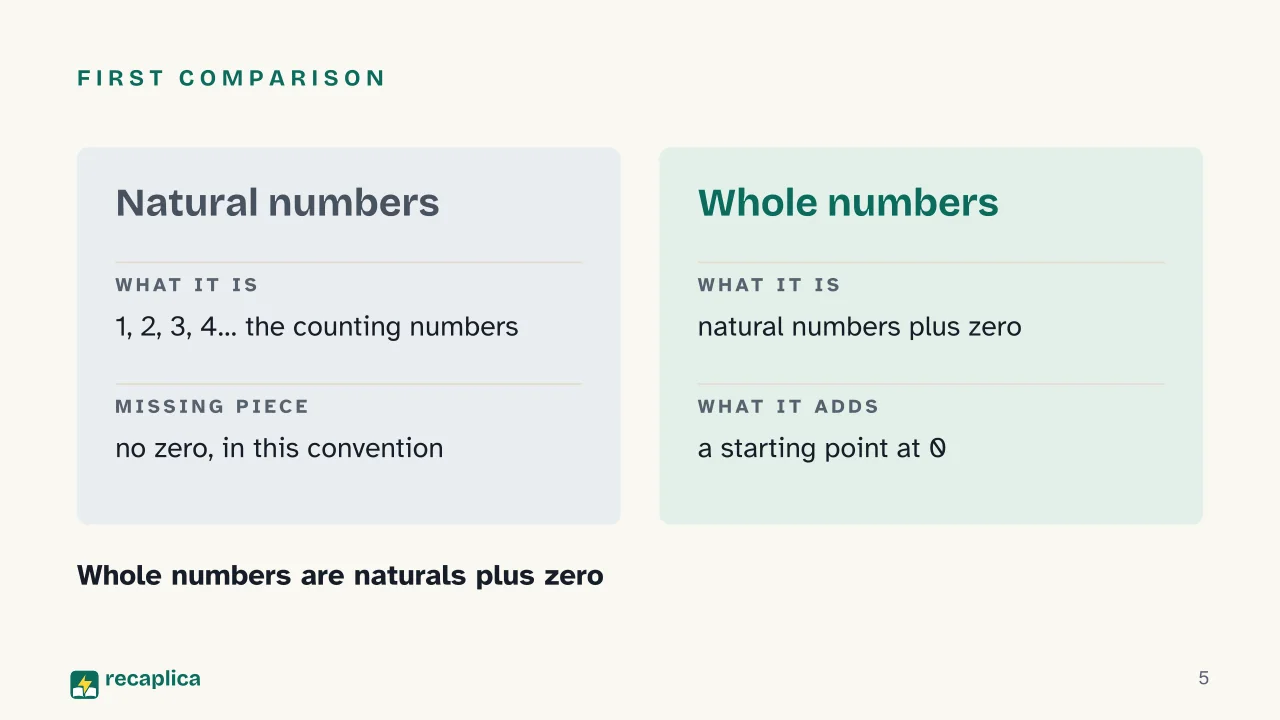  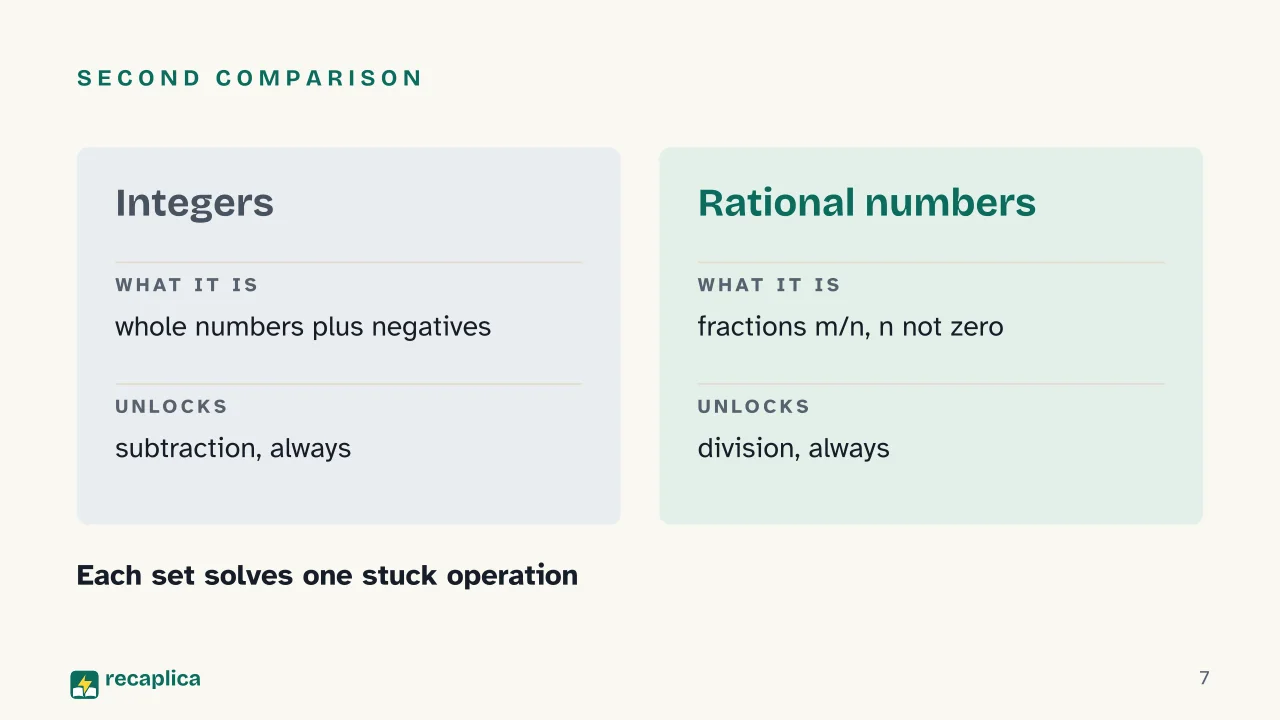  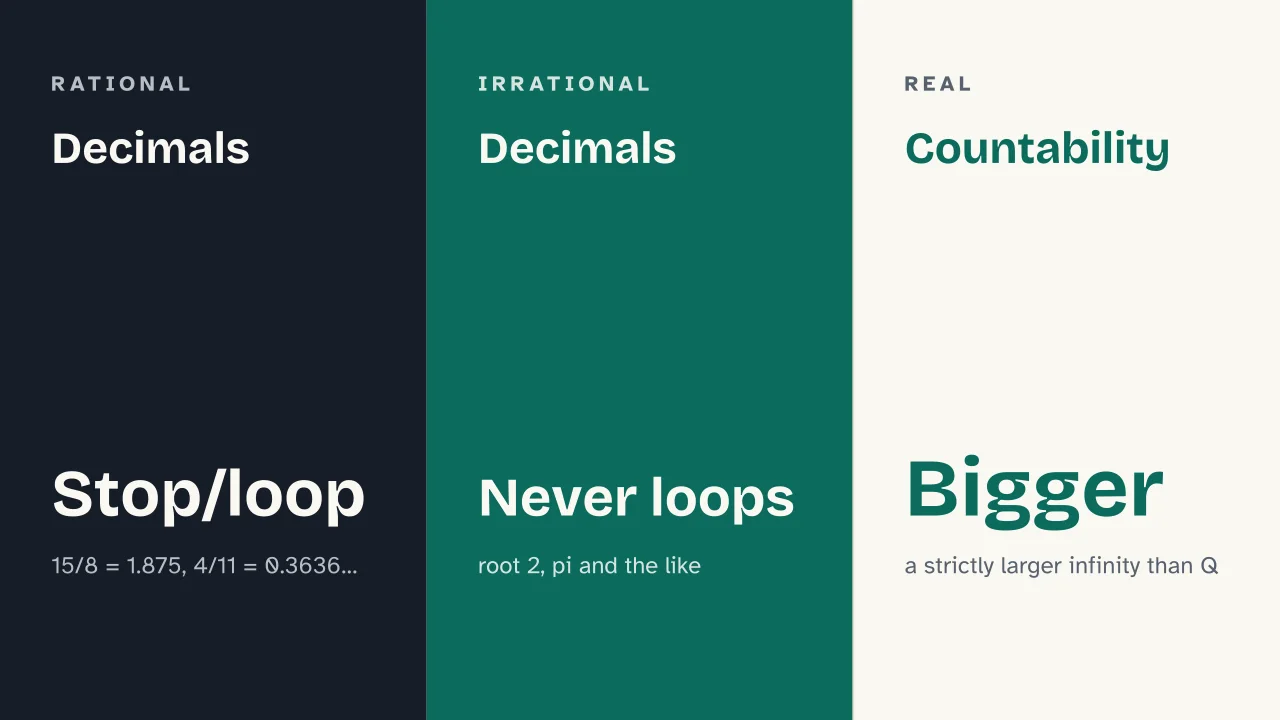  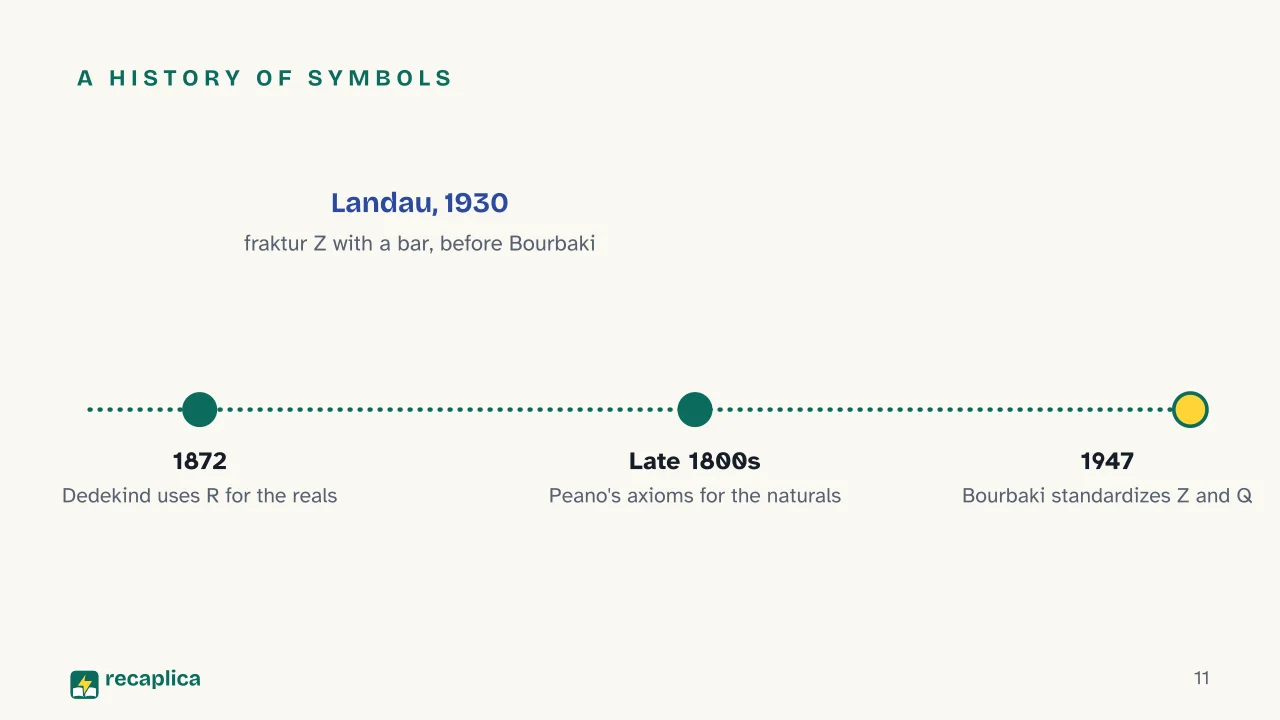 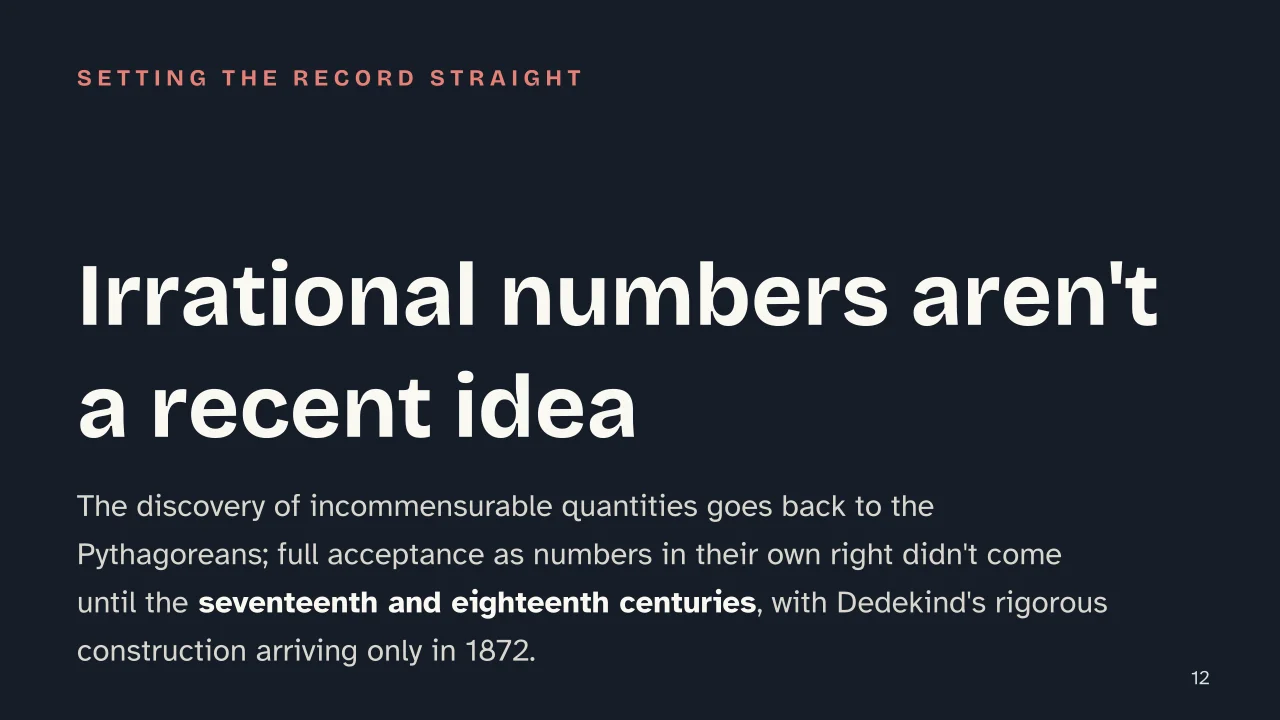 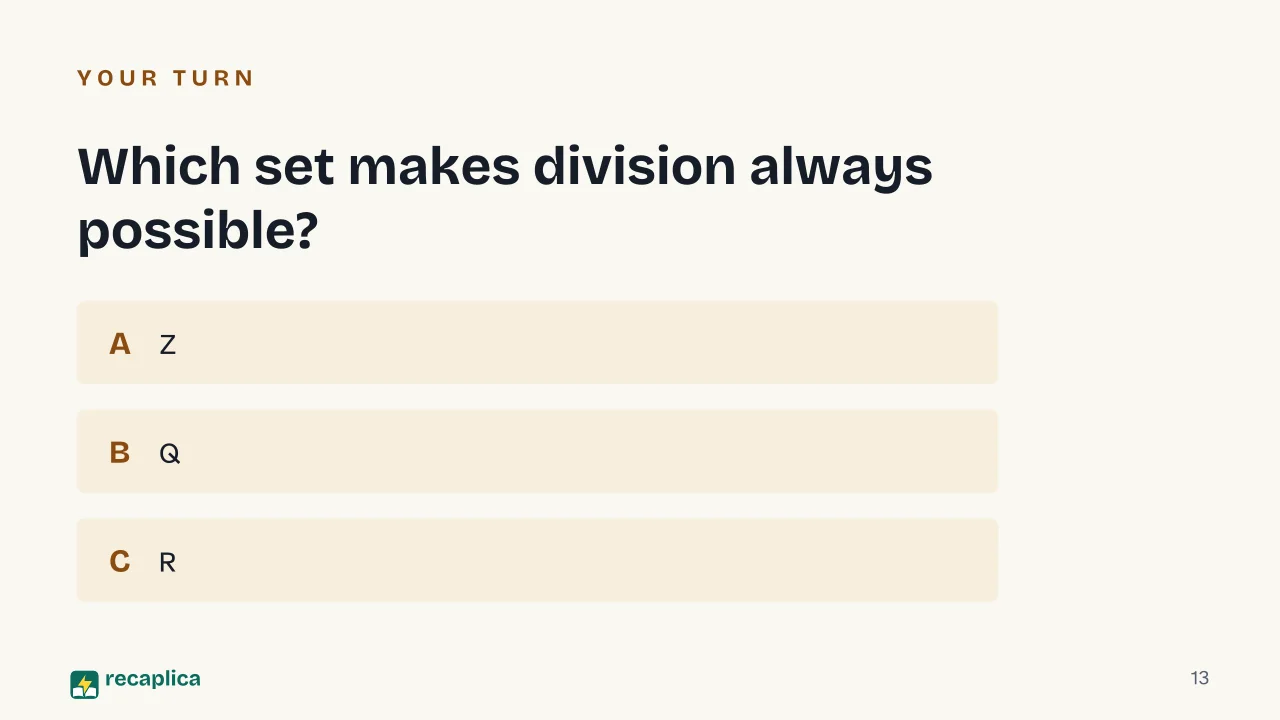  Common myths
Mind mapDrag the background to move around and the nodes to reposition them; use − and + to collapse and expand branches. 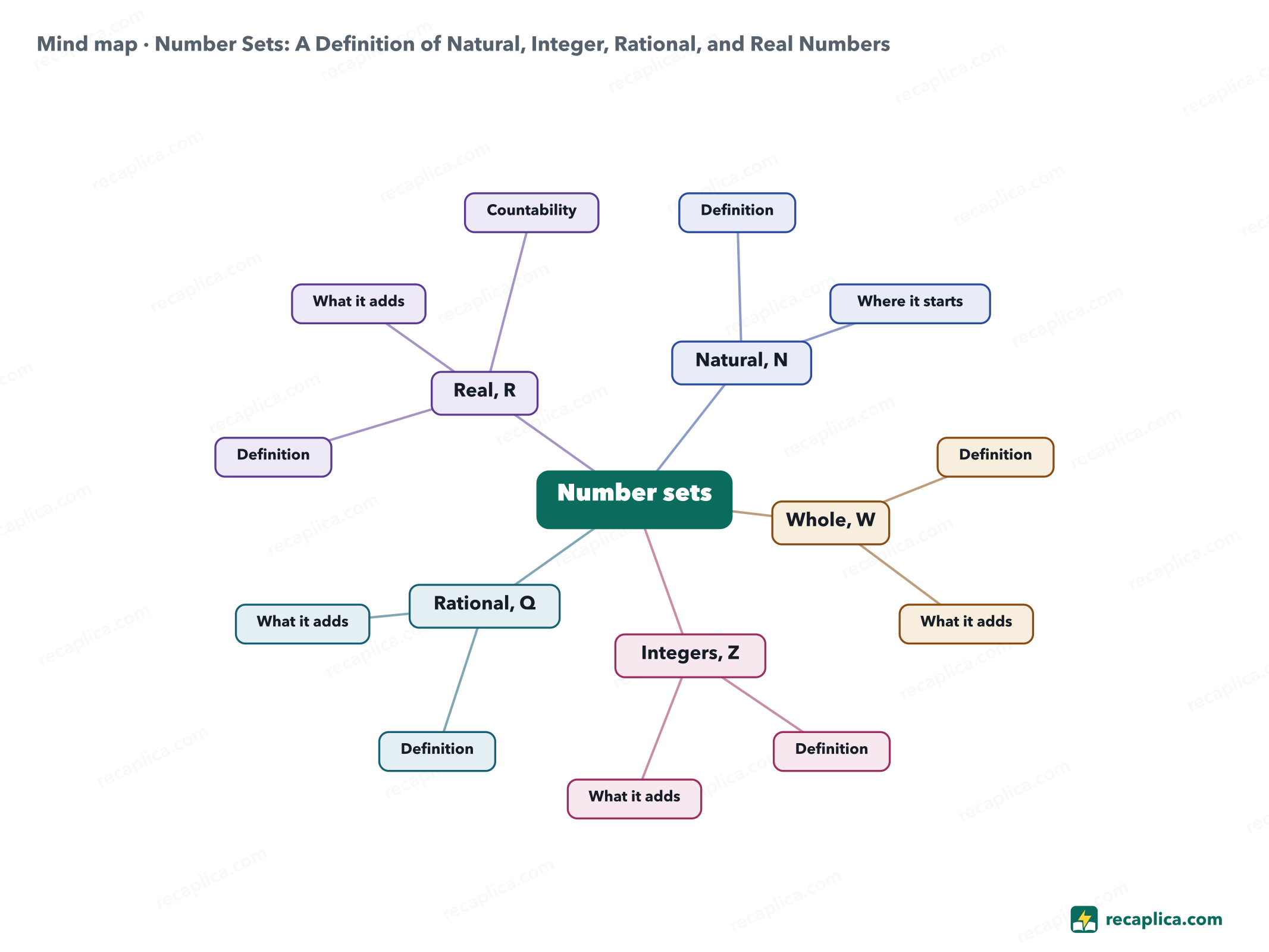
Quiz: test yourselfAnswer the questions to check what you have learned: you get instant feedback and a short explanation. Grade 0/10 0/5
FlashcardsTap the card to flip it and check whether you remember the answer, then move to the next one. 1 / 8 Explain it in your own wordsThe ultimate test: if you can explain it in simple words, you've truly understood it. Write your explanation, then compare it with the Recap. Your explanation is saved only on this device.
Frequently asked questionsWhat do the symbols ℕ, ℤ, ℚ, and ℝ mean?They label the main number sets: ℕ for the natural numbers, ℤ for the integers (from the German Zahlen, 'numbers'), ℚ for the rational numbers (from Quotient), and ℝ for the real numbers. According to the MacTutor History of Mathematics Archive, the modern forms of ℤ and ℚ were fixed in 1947 in the Bourbaki group's Algèbre, while ℝ traces back to Dedekind's 1872 work on irrational numbers. What is the real number system?It's the full collection of numbers you can place on a single continuous number line: every rational number (fractions and integers included) together with every irrational number, like √2 or π. Because it includes the irrationals, the real number system fills in every gap that would otherwise be left by the rationals alone. What is the difference between natural numbers and whole numbers?In the convention OpenStax uses, natural numbers are the counting numbers starting at 1 (1, 2, 3, …), while whole numbers are that same set plus zero (0, 1, 2, 3, …). Other textbooks, following Peano's older tradition, skip the distinction and count zero as a natural number from the start — both conventions are in active use, so it's worth checking which one a given textbook follows. Can you give an example of a real number?Any number you can place on the number line is real: 7 and −3 (integers), 3/4 and 1.875 (rational numbers), and √2 or π (irrational numbers) are all real numbers. The only numbers left out of the real number system are the ones that require a second dimension to represent, like the square root of a negative number. How many rational numbers are there compared to natural numbers?The same amount: the rational numbers are a countable set, exactly the same size as the natural numbers, even though the rationals are dense on the number line — meaning there's always another one between any two you pick. The real numbers, once the irrationals are added in, are not countable and form a strictly larger infinity. Every Recap goes through an independent review before publication. |