|
recaplica
Complex Numbers: What They Are and How They Work, with Examples | |||||||||||||||
| © 2026 Recaplica · recaplica.com — All rights reserved | |||||||||||||||
Complex Numbers: What They Are and How They Work, with ExamplesWhat to print Page numbers appear when printing with default margins. SlidesChoose a cut Flash10 slidesThe essential thread, to present in classFull14 slidesEvery chapter and the deeper detailBoth come with speaker notes. In 30 seconds quick readComplex numbers extend the numbers we already know with a new element, the imaginary unit, which makes it possible to write the square root of a negative number. They are written as two parts joined together, one real and one multiplied by the imaginary unit, and can be drawn as points on a plane, the complex plane. The idea takes shape in the sixteenth century, out of attempts to solve cubic equations that had no solution among the real numbers. Addition, multiplication and the modulus let you work on a+bi almost like an ordinary real number, with one extra rule for i. Today complex numbers also work outside pure mathematics, in electrical engineering, where they describe amplitude and phase shift of alternating currents at once. Key Points
Deep DiveWhat complex numbers areA complex number is written as a+bi: a and b stand for ordinary real numbers, and i is the imaginary unit. The imaginary unit has one property no real number shares: i² = −1. That single difference is enough to separate a, the real part of the number, from b, the imaginary part. Complex numbers extend the ladder of number sets that runs from the natural numbers to the real numbers: they add an element the real numbers don’t contain, rather than replacing anything already there. Why they exist: an equation with no real solutionAccording to the MacTutor History of Mathematics archive at the University of St Andrews, Gerolamo Cardano published the Ars Magna in 1545, the first algebra treatise written in Latin. Solving the cubic equation x³=15x+4, Cardano ran into the square root of −121, an expression real-number arithmetic could not handle: no real number, multiplied by itself, gives a negative result. The same obstacle appears whenever a cubic equation has no real solution, and that is where complex numbers step in. Rafael Bombelli took on this case in detail in his Algebra, published in 1572 (he managed only the first three of five planned books). He was the first to write out, as verbal rules, how to multiply the quantities now called +i and −i, laying the groundwork for complex-number arithmetic. With Bombelli, these quantities become objects with their own calculation rules, extending algebra beyond the real numbers it had been confined to until then. From arithmetic to geometry: the complex planeThe geometric picture of complex numbers arrived long after Bombelli, and not from a single author. According to Wikipedia, Caspar Wessel described it as early as 1799, in a paper that went unnoticed. In 1806, while running a bookshop in Paris, Jean-Robert Argand privately published an essay with the same idea, proposing the interpretation known today as the Argand diagram: a complex number a+bi becomes a point on a plane, with a on the horizontal axis and b on the vertical one. This plane carries Carl Friedrich Gauss’s name too, because according to MacTutor it was Gauss, in 1831, who introduced the term “complex number” in the sense used today: the name belongs to Gauss, not the geometric picture, which Wessel and Argand had already worked out decades earlier. The same logic returns in analytic geometry, where a point is described by two coordinates; here, those two coordinates are the real and imaginary parts of the same number. The basic operations
According to Wikipedia, adding two complex numbers means adding the real parts and the imaginary parts separately. Multiplication follows the distributive property combined with the rule i²=−1 instead: (a+bi)(c+di) expands to ac+adi+bci+bdi², and substituting −1 for i² gives the real and imaginary parts of the result. Two more operations complete the toolkit. The conjugate of a number z=x+yi keeps the same real part and flips the sign of the imaginary part, while the modulus is the square root of the sum of the squares of the real and imaginary parts: on the complex plane, that distance is measured from the origin.
What complex numbers are used forThe textbook “Electric Circuits II” by Tony R. Kuphaldt (LibreTexts) explains that in alternating-current circuits, quantities such as voltage, current and impedance aren’t single-dimension values the way they are in direct current. A complex number is a single mathematical object able to express the amplitude and the phase shift of an alternating electrical quantity at once. HyperPhysics, from Georgia State University, notes that representing voltages and currents with sines and cosines quickly makes the impedance calculation of a multi-component circuit unmanageable; complex exponential functions simplify that calculation, and an alternating voltage or current can be represented by the real part of one such function. On the complex plane, resistance sits on the real axis, while the reactance of a capacitor or an inductor is treated as an imaginary number: a circuit’s impedance therefore has a real part, the resistance, and an imaginary part, the reactance. In series circuits, these values add the way vector components do, with the same arithmetic described above for addition. Anyone studying alternating current in AC circuits meets complex numbers as an everyday calculation tool. Slide deckSlides ready to download and make your own in PowerPoint or Google Slides, with speaker notes. Pick the Flash cut or the Full one.     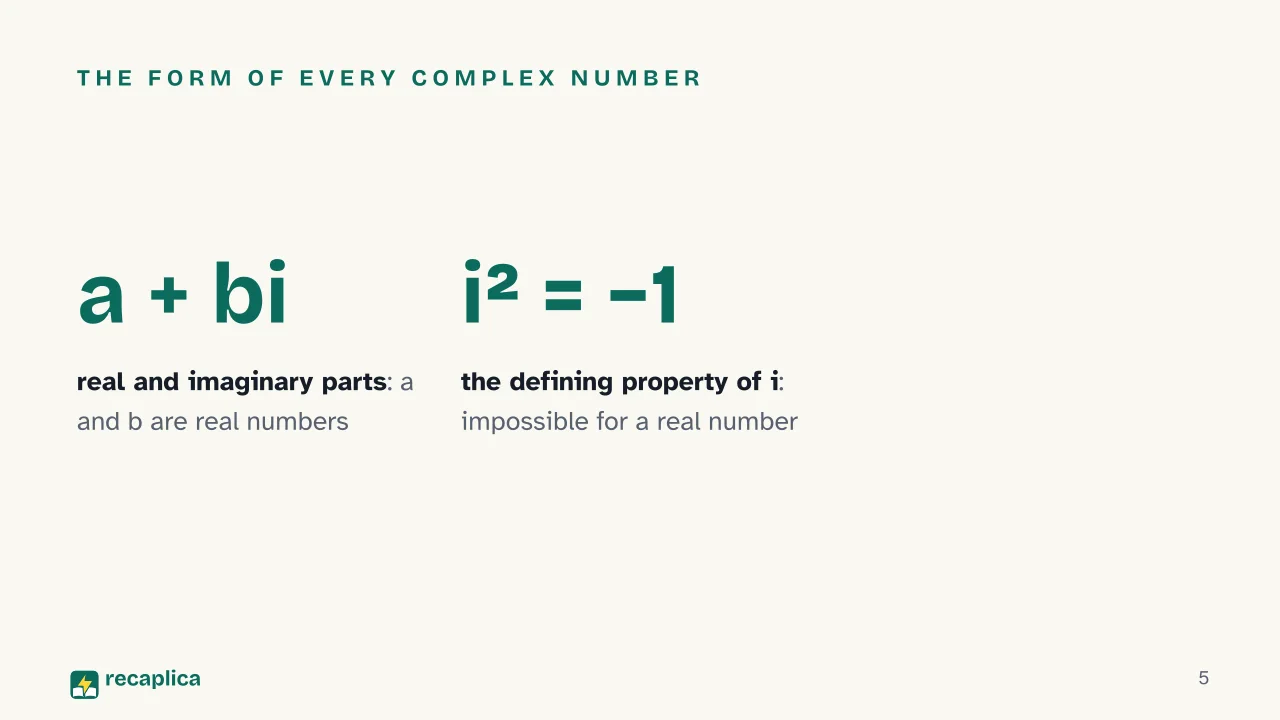  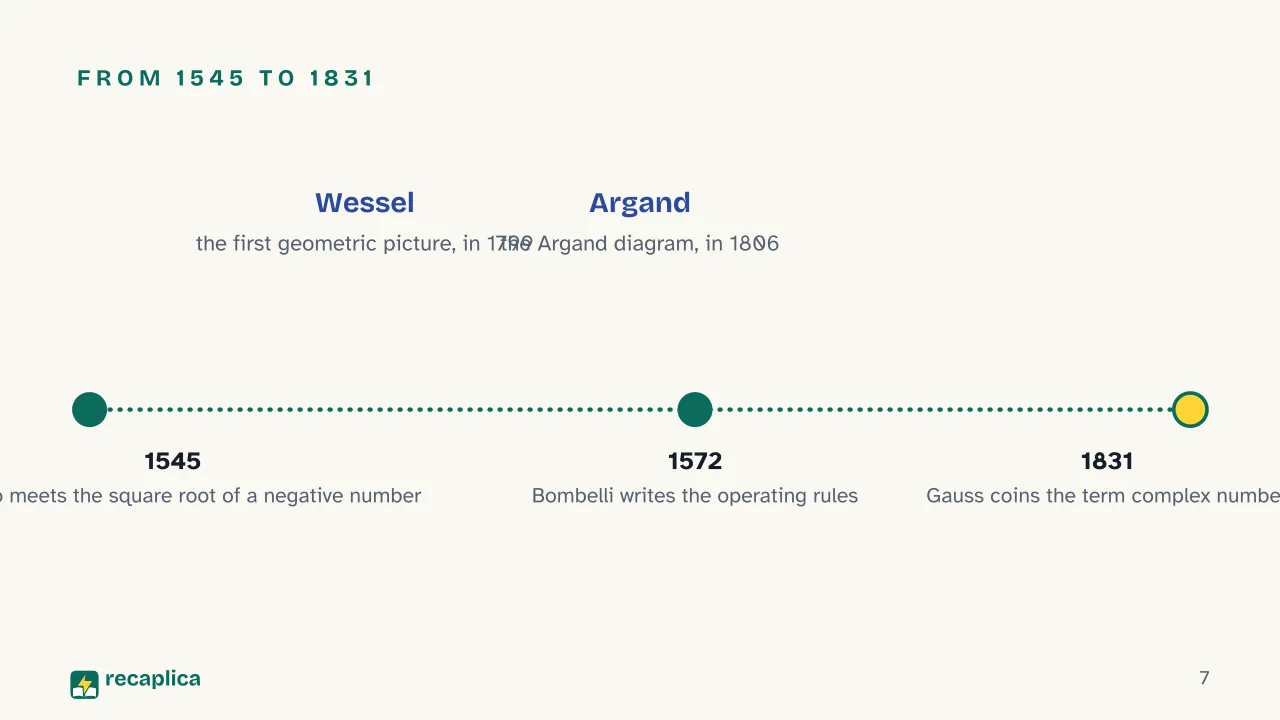  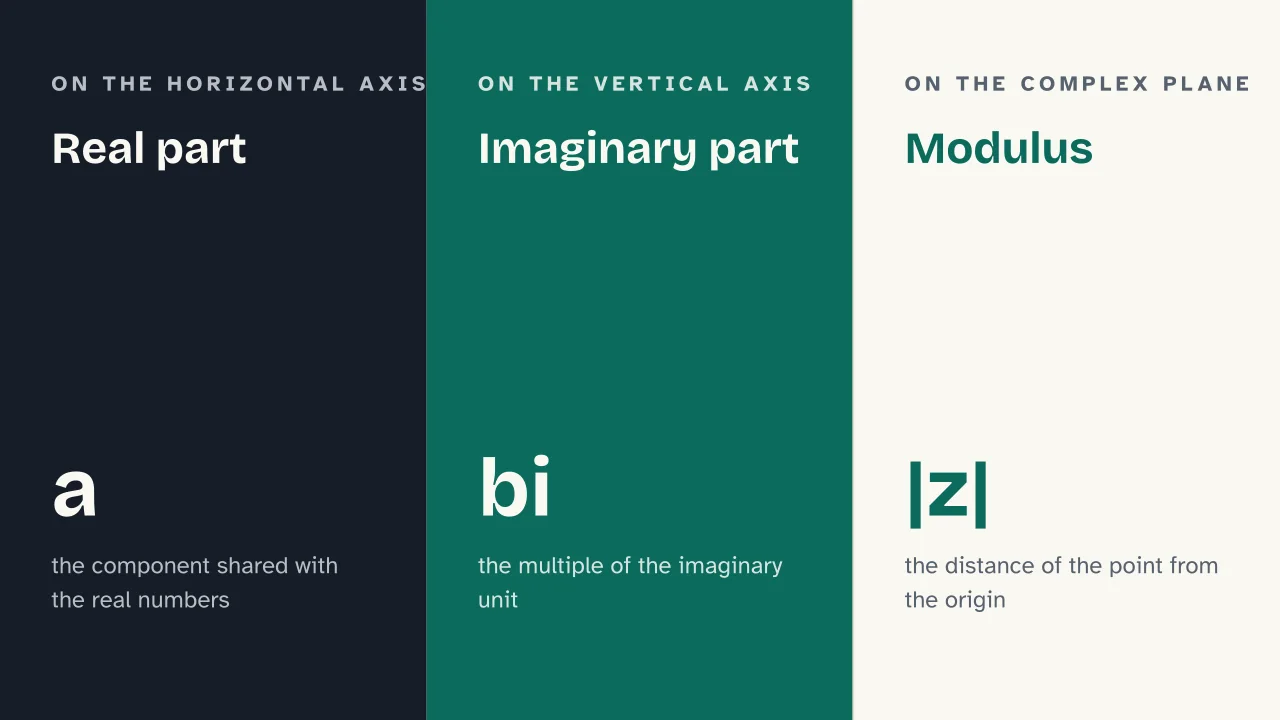  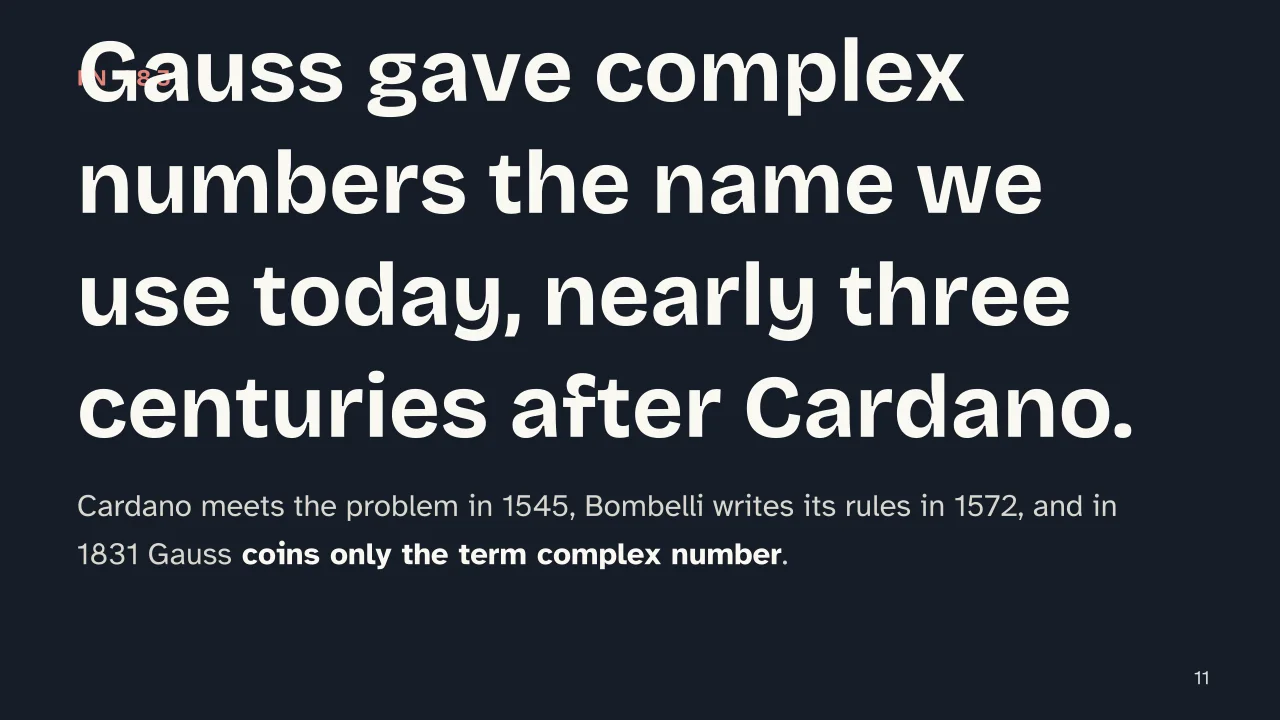 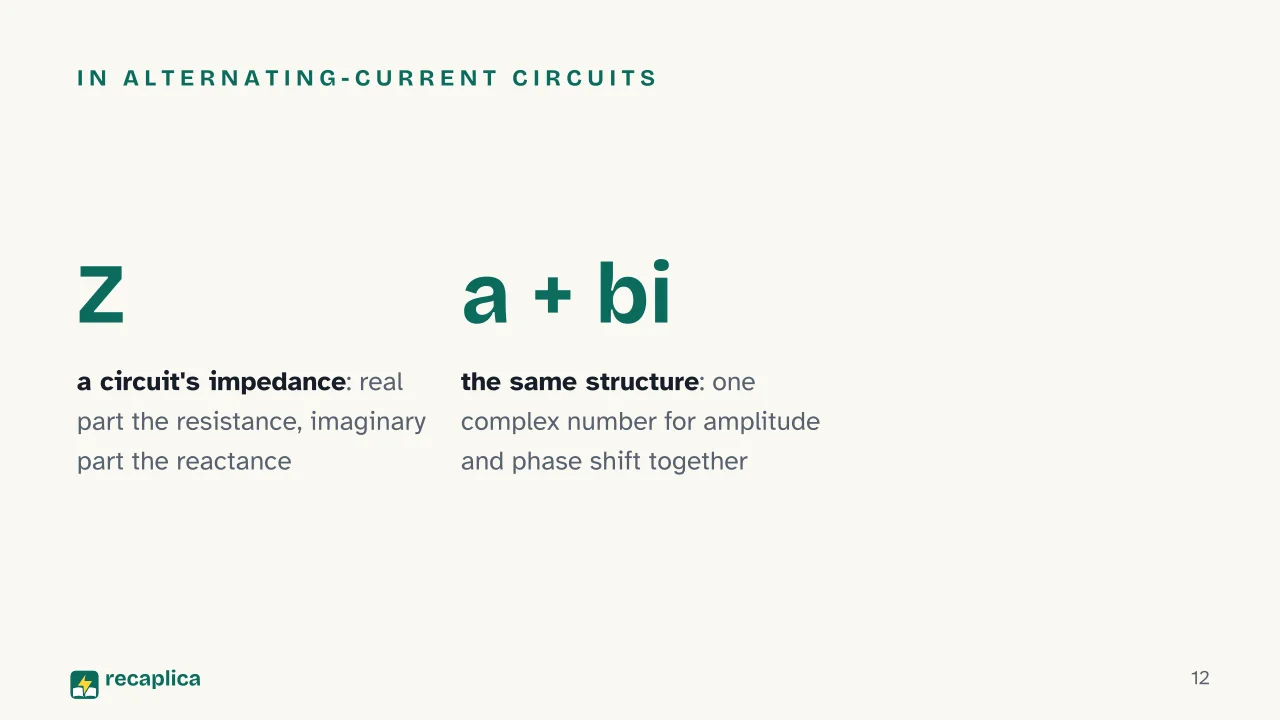 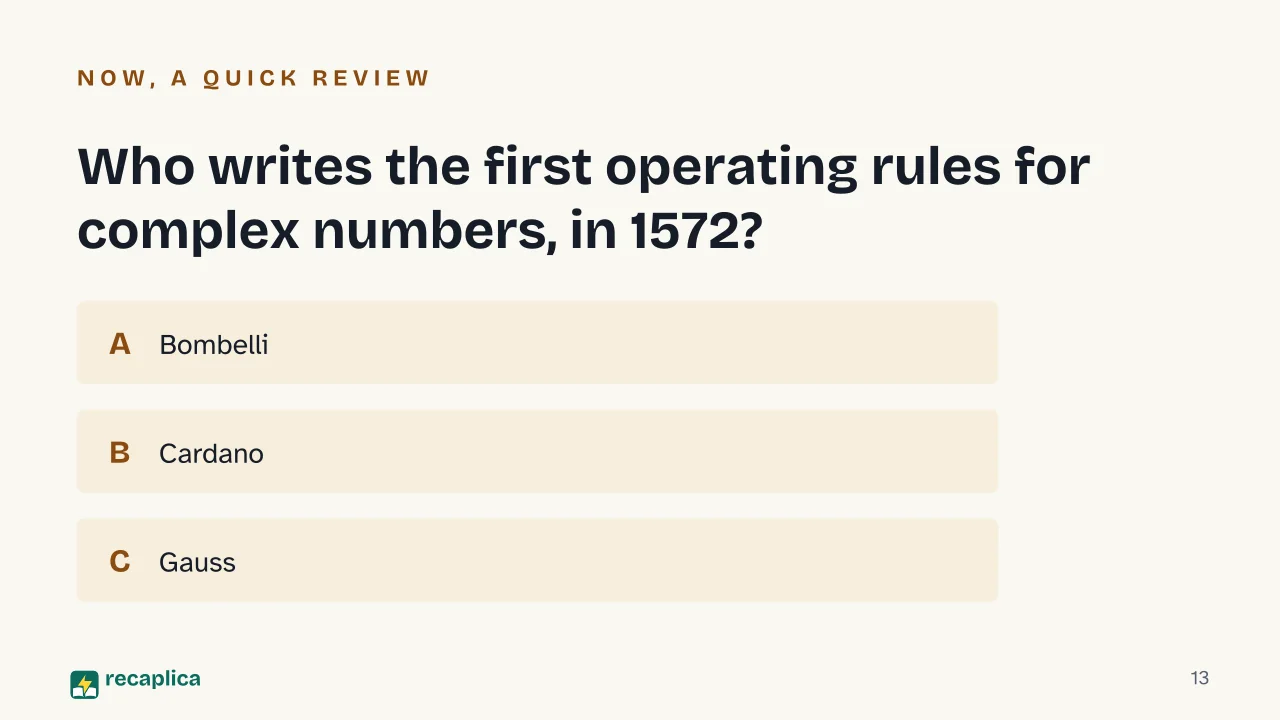  Common myths
Mind mapDrag the background to move around and the nodes to reposition them; use − and + to collapse and expand branches. 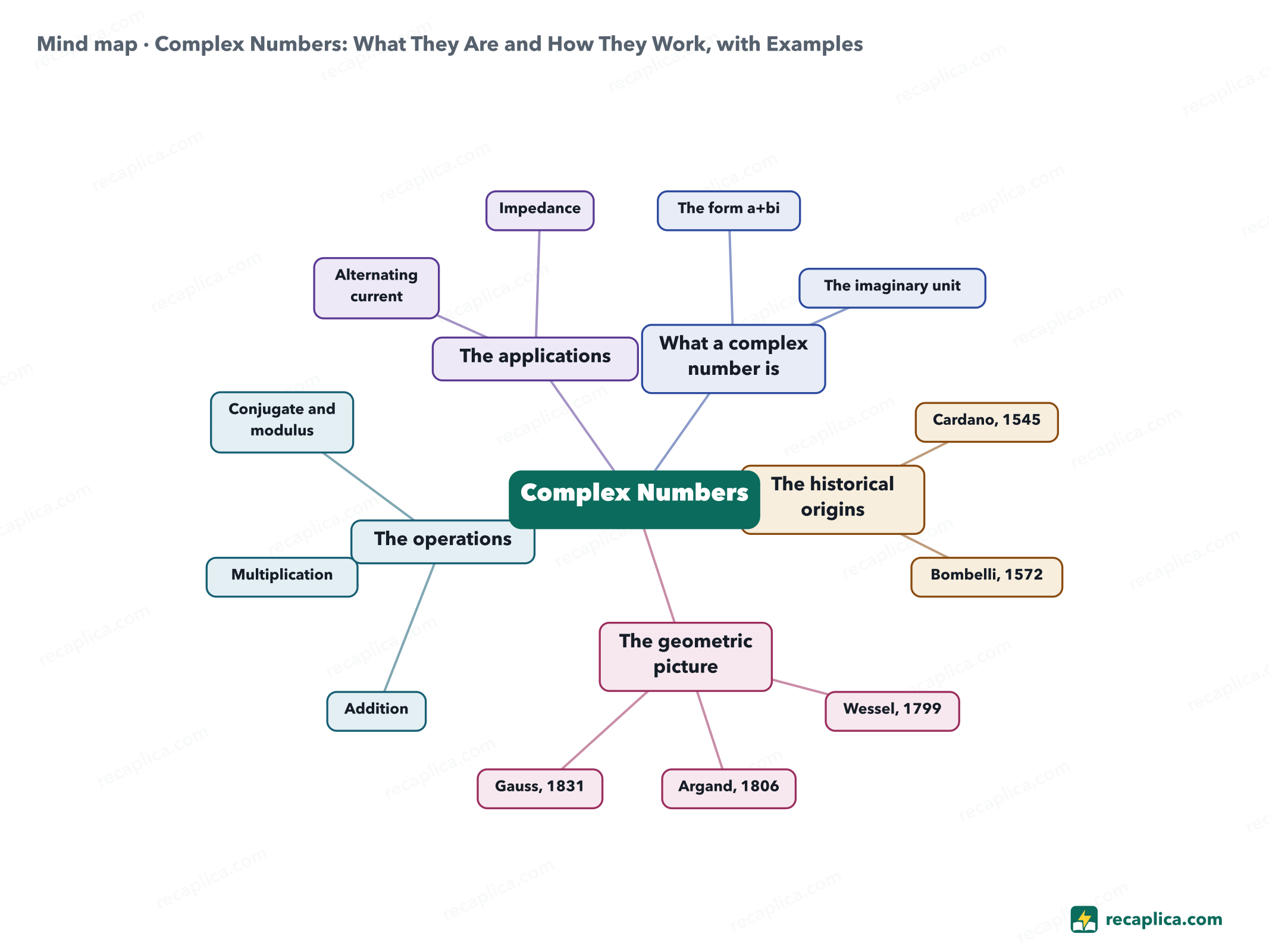
Quiz: test yourselfAnswer the questions to check what you have learned: you get instant feedback and a short explanation. Grade 0/10 0/5
FlashcardsTap the card to flip it and check whether you remember the answer, then move to the next one. 1 / 7 Explain it in your own wordsThe ultimate test: if you can explain it in simple words, you've truly understood it. Write your explanation, then compare it with the Recap. Your explanation is saved only on this device.
Frequently asked questionsWhat are complex numbers?They combine a real part with a multiple of the imaginary unit i, the number defined by i² = −1. On the complex plane, every complex number becomes a point whose coordinates are exactly those two parts. Why are complex numbers also called imaginary numbers?The bi part is called the imaginary part because it involves the imaginary unit i, a number no real number can be; the modern term complex number comes from Gauss, in 1831. What are complex numbers used for outside pure mathematics?In electrical engineering, a complex number holds together how large and how time-shifted an alternating electrical quantity is: Kuphaldt's textbook (LibreTexts) and HyperPhysics both describe it this way. Who invented complex numbers?There is no single inventor: Cardano runs into the problem in 1545, Bombelli writes its operating rules in 1572, Wessel and Argand give it a geometric picture between 1799 and 1806, and Gauss coins the term complex number in 1831. Every Recap goes through an independent review before publication. |