recaplica
Clear in 30 seconds, yours in 10 minutes.
In 30 seconds quick read
Jean Piaget was a Swiss psychologist who spent over fifty years observing how children's thinking changes, from birth through adolescence. His theory describes cognitive development as a path through four stages, sensorimotor, preoperational, concrete operational and formal operational, each with its own way of reasoning about the world. For Piaget, a child doesn't receive knowledge ready-made, but builds it actively, fitting new information into the mental schemas already held or changing those schemas when they no longer fit. The ages given for each stage are a guide rather than a fixed calendar, and sources describing his work place the boundary between the last two stages at 11 or 12 depending on the text.
Key Points
Piaget, a Swiss psychologist born in Neuchâtel in 1896, studied cognitive development mainly by observing his own three children, using a technique he called the clinical method.
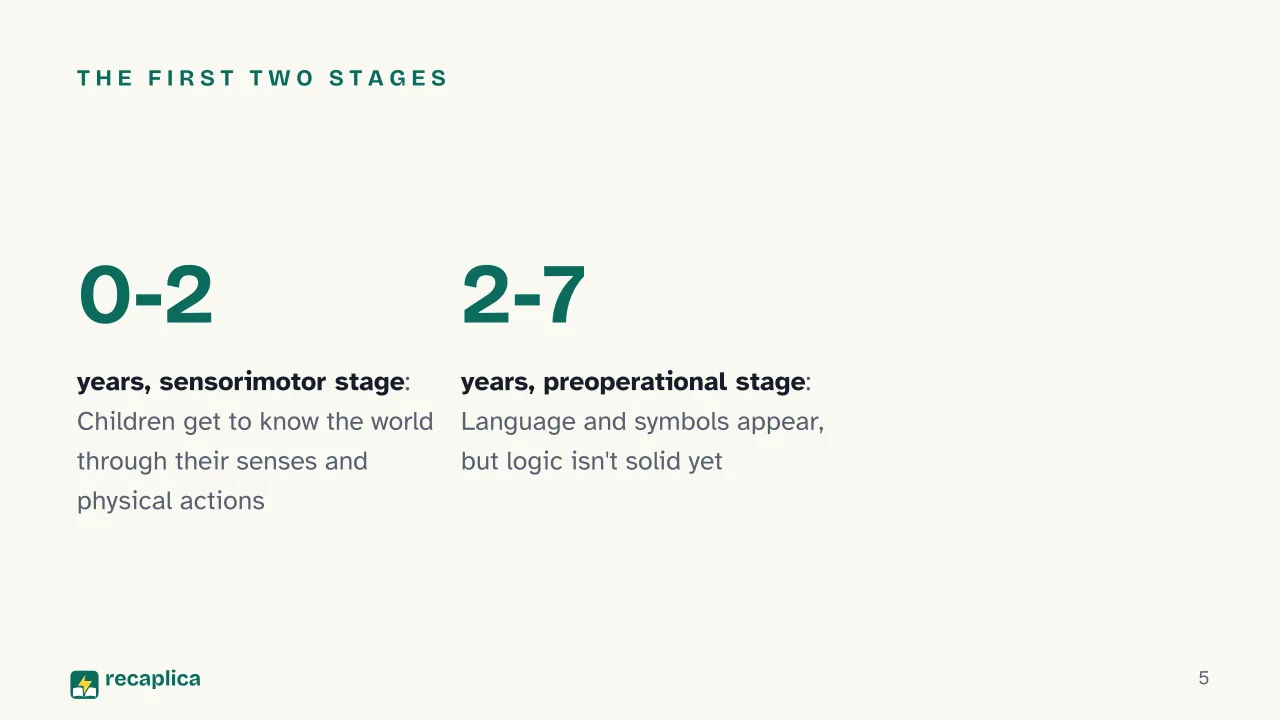
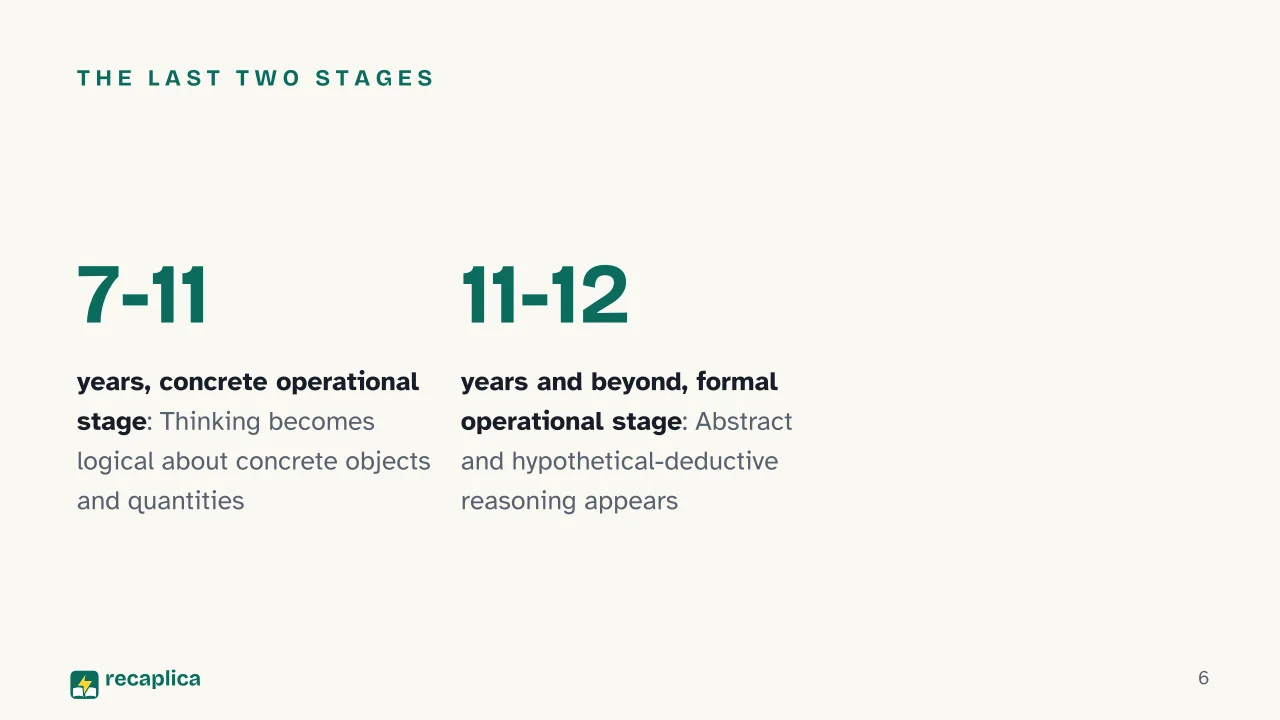
His theory describes four stages: sensorimotor (0-2 years), preoperational (2-7 years), concrete operational (7-11 years) and formal operational (from age 11-12 onward).
A schema is a mental structure that organizes information; knowledge grows through assimilation, when new information fits into an existing schema, and accommodation, when the schema itself changes.
Object permanence appears in the sensorimotor stage, egocentrism (shown by the Three Mountains experiment) in the preoperational stage, and conservation with reversibility in the concrete operational stage.
In the formal operational stage, from age 11-12, thought becomes capable of abstract and hypothetical-deductive reasoning about concepts such as ethics or science.
Sources agree on the first three stages but vary slightly on the boundary between concrete operational and formal operational.
Key figures
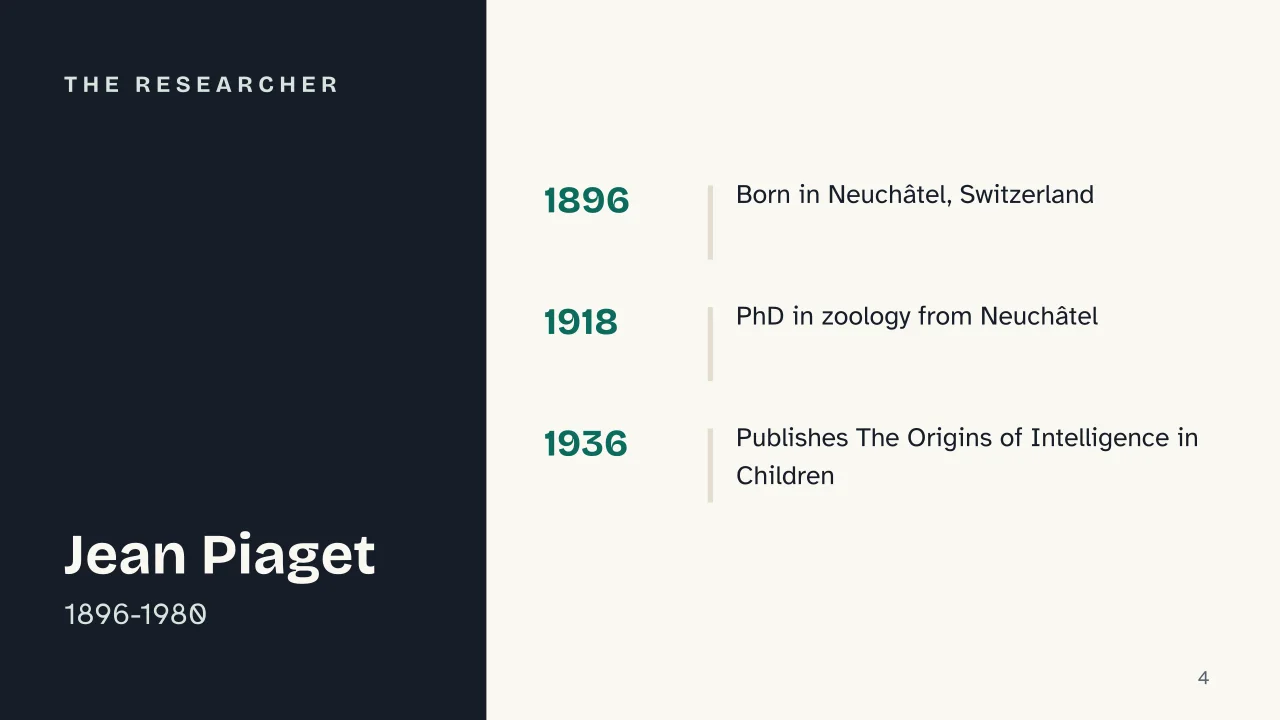
1896 Year Jean Piaget was born, in Neuchâtel, Switzerland. Source: Encyclopedia.com
1918 Year Piaget earned his PhD in zoology from the University of Neuchâtel, before turning to developmental psychology. Source: Encyclopedia.com
1936 Year The Origins of Intelligence in Children was published. Source: Encyclopedia.com
Deep Dive
Jean Piaget was born in Neuchâtel, Switzerland, on August 9, 1896, and died in Geneva on September 16, 1980. He trained as a zoologist, earning his PhD from the University of Neuchâtel in 1918, before turning to philosophy at the suggestion of his godfather, Samuel Cornut. As a boy of ten, he published his first scientific paper, an observation of an albino sparrow, in the Journal of Natural History of Neuchâtel.
To study how children reason, Piaget developed what he called the “clinical method,” a technique combining interview and experiment that he applied first to his own three children, Jacqueline, Lucienne and Laurent, observed from their earliest months. Those observations led to works such as The Language and Thought of the Child (1923), Judgment and Reasoning in the Child (1924) and The Origins of Intelligence in Children (1936).
Schema, assimilation and accommodation
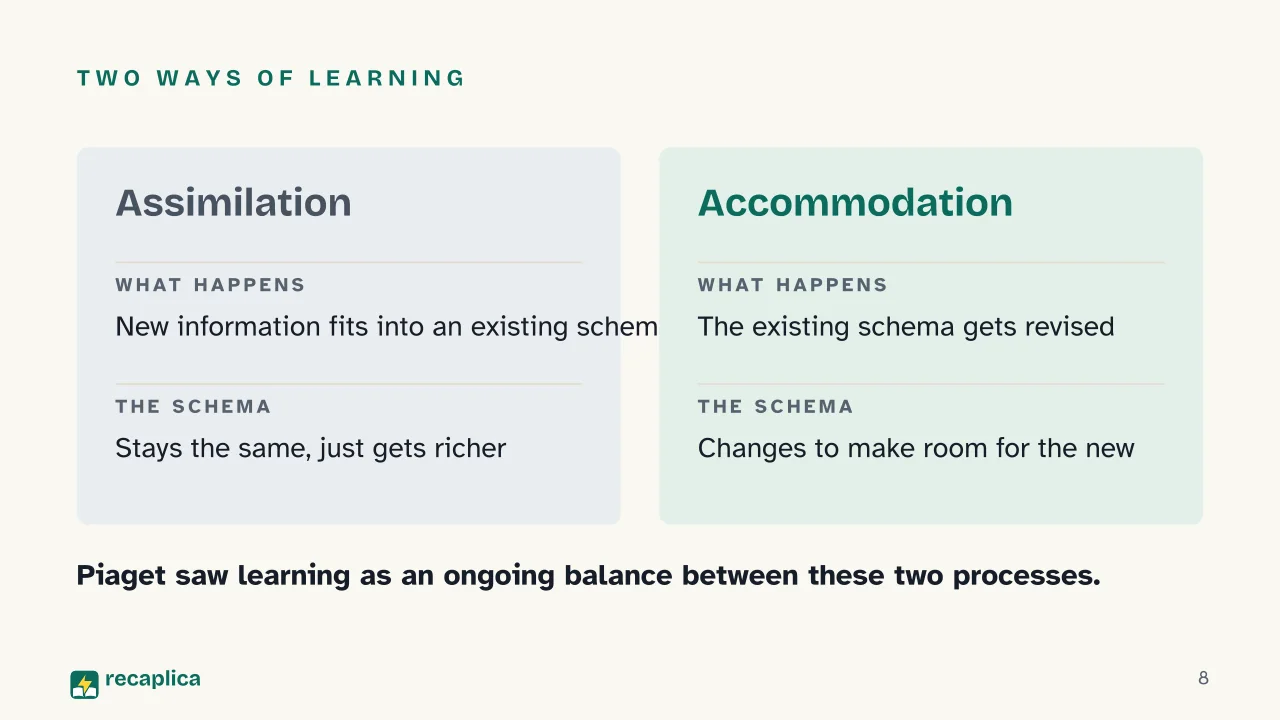
At the center of Piaget’s theory sits the concept of schema: a mental structure that organizes and interprets information about the world, a kind of mental category where a child files what they encounter. Knowledge grows through two movements. In assimilation, new information is folded into a schema that already exists, without changing it. In accommodation, the opposite happens: the schema itself is revised, because the new information doesn’t fit as it is.
Practical example: a child who only knows dogs calls the first cat they see a “dog” too, assimilating it into the schema they already have. Once someone explains it’s a different animal, the child builds or adjusts a schema just for cats: that’s accommodation.
According to Social Sci LibreTexts, for Piaget learning proceeds through this alternation: fitting new experiences into concepts already held, and fitting those concepts to new experiences. OpenStax frames it in a similar way, describing schemata as mental models used to categorize and interpret information.
The four stages of cognitive development
Piaget describes cognitive development as a path through four stages, each with a different way of reasoning about the world.
Stage
Approximate age
What changes
Sensorimotor
0-2 years
Knowledge through the senses and physical actions; object permanence appears
Preoperational
2-7 years
Language and symbols, pretend play; reasoning not yet logical, egocentrism
Concrete operational
7-11 years
Conservation, reversibility, decentering; logic applied to concrete objects and situations
Formal operational
from age 11-12
Abstract thought, hypothetical-deductive reasoning about concepts like ethics and science
The sensorimotor stage
In the first two years of life, according to Simply Psychology, children learn about the world entirely through their senses and physical actions. It’s during this period, around 8 months, that object permanence develops: the understanding that an object continues to exist even once it’s out of sight. Social Sci LibreTexts describes the same milestone as the belief that objects exist whether or not they are actually present.
The preoperational stage
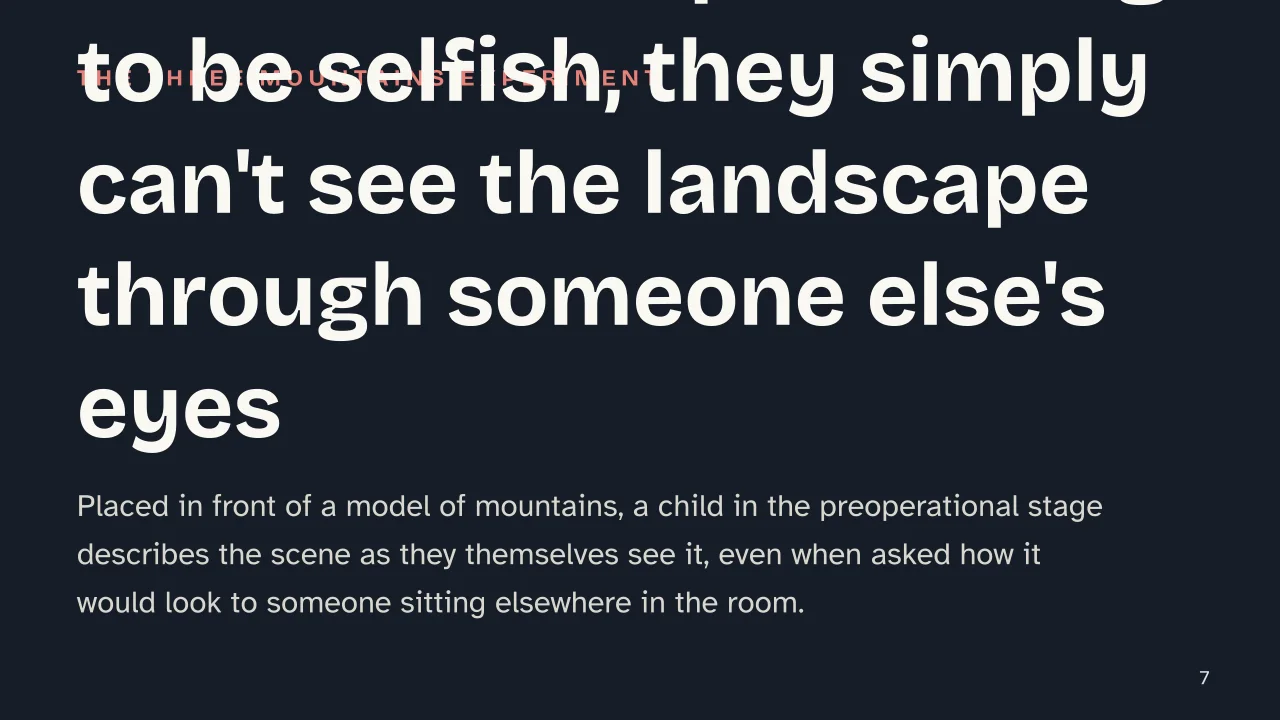
Between ages 2 and 7, language and the use of symbols appear, but thinking still struggles with logic. Social Sci LibreTexts notes dramatic play in this period, the improvised make-believe typical of preschool children. The best-known trait of the stage is egocentrism: difficulty seeing things from someone else’s point of view, demonstrated by Piaget’s Three Mountains experiment, in which a child facing a model landscape keeps describing it as they themselves see it, even when asked how it would look to someone sitting elsewhere in the room.
The concrete operational stage
Between ages 7 and 11, children begin to grasp conservation: a quantity stays the same even if its appearance changes, as with a liquid poured into a different-shaped glass. Not every form of conservation arrives at once: according to Simply Psychology, number is typically the first quantity to be conserved, already around age 6, before the child is fully into the concrete operational stage. Social Sci LibreTexts adds two further abilities to this stage: reversibility, thinking through the steps of a process in any order, and decentering, the capacity to weigh more than one feature of a problem at a time.
The formal operational stage
From age 11-12 onward, thought becomes capable of working on abstract concepts, not just concrete objects. Simply Psychology describes the emergence of hypothetical and deductive reasoning, which lets adolescents tackle complex ideas like ethics, science or mathematics. Social Sci LibreTexts defines the formal operational stage as the period when a person can “operate” on abstract representations, not only on things in front of them.
The ages aren’t a fixed calendar
Sources describing Piaget’s theory agree on the first three stages but vary slightly on the last boundary: Simply Psychology places the start of the formal operational stage at age 12, while Social Sci LibreTexts moves it to 11. Piaget himself treated his ages as indicative, and the theory sits alongside other currents in developmental psychology that have tackled how thinking forms, from behaviorism, which looks mainly at external stimuli, to cognitivism, which describes the mind as an information processor. Piaget’s idea that children actively build their own knowledge underlies the school of thought known as constructivism, one of the references of modern psychological science applied to development.
Slide deck
Slides ready to download and make your own in PowerPoint or Google Slides, with speaker notes. Pick the Flash cut or the Full one.
✗ Myth Piaget's stages are fixed milestones, and every child passes through them at exactly the stated ages.
✓ Reality The same sources that describe the theory give slightly different age ranges: the formal operational stage starts at 12 according to Simply Psychology and at 11 according to Social Sci LibreTexts. Piaget's ages are a guide, not an identical calendar for every child.
✗ Myth The egocentrism Piaget describes means young children are selfish.
✓ Reality In the Three Mountains experiment, a child in the preoperational stage describes a landscape as they themselves see it, even when asked how someone sitting elsewhere would see it. It's a cognitive limit in considering a viewpoint other than one's own, not a personality trait.
✗ Myth If a child fails the conservation test, they have a general problem with logic.
✓ Reality Conservation is acquired gradually, for different quantities at different times: according to Simply Psychology, number is typically the first quantity conserved, already around age 6, before other forms of conservation are solid. It's a developmental milestone, not a judgment on the child's abilities.
Mind map
Drag the background to move around and the nodes to reposition them; use − and + to collapse and expand branches.
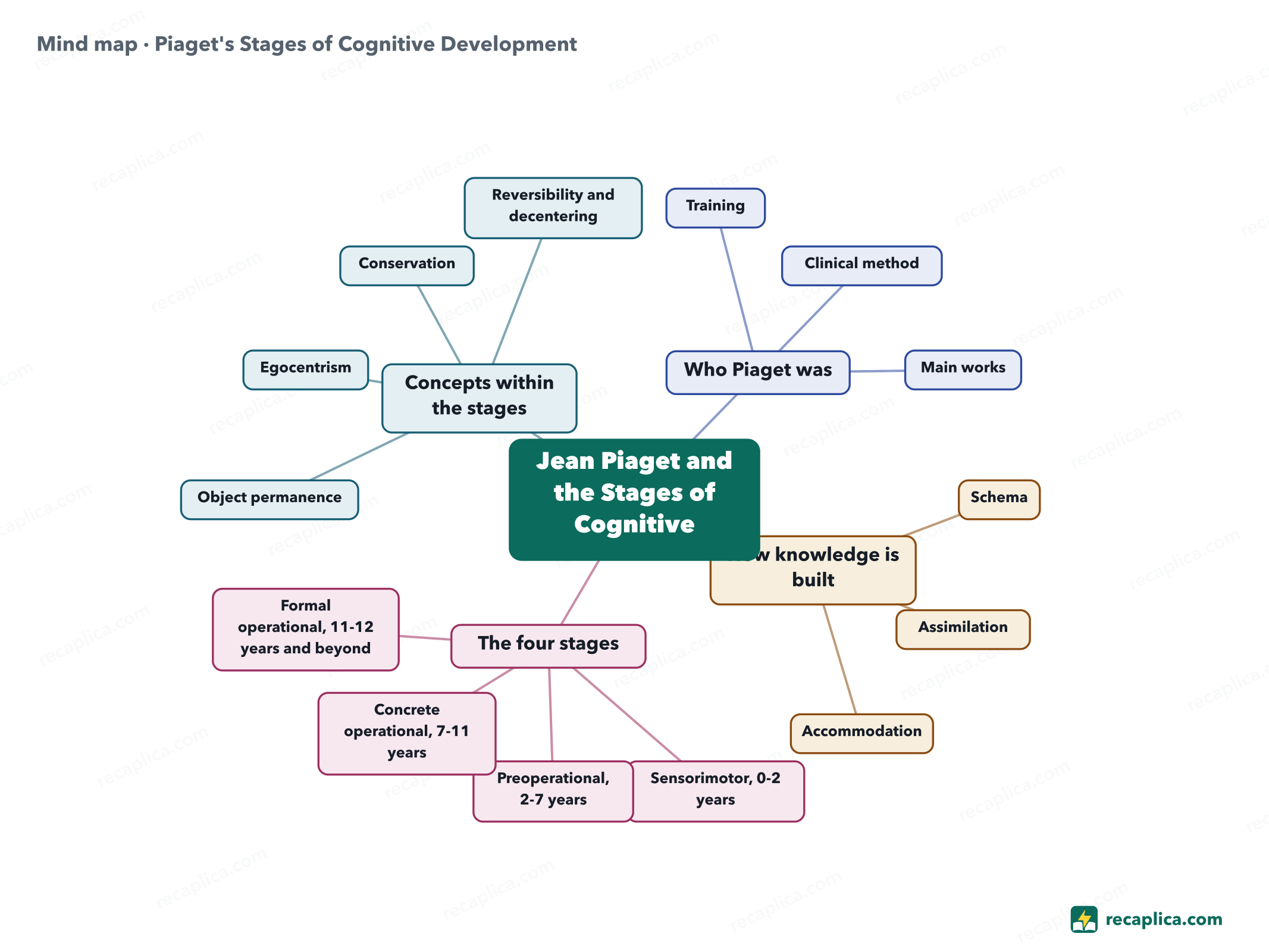
Jean Piaget and the Stages of Cognitive Development
Who Piaget was
TrainingZoologist, PhD from Neuchâtel in 1918, then philosophy on the advice of his godfather Samuel Cornut
Clinical methodInterviews and experiments applied first to his three children, Jacqueline, Lucienne and Laurent
Main worksThe Language and Thought of the Child (1923), The Origins of Intelligence in Children (1936)
How knowledge is built
SchemaMental structure that organizes and interprets information
AssimilationNew information fits into an existing schema
AccommodationThe existing schema changes to make room for new information
The four stages
Sensorimotor, 0-2 yearsKnowledge through senses and physical actions, object permanence appears
Preoperational, 2-7 yearsLanguage and symbols, but not yet solid logic, egocentrism typical
Concrete operational, 7-11 yearsConservation, reversibility and decentering appear
Formal operational, 11-12 years and beyondAbstract and hypothetical-deductive thought about concepts like ethics and science
Concepts within the stages
Object permanenceAn object exists even when no longer seen
EgocentrismDifficulty seeing a viewpoint other than one's own, Three Mountains experiment
ConservationA quantity stays the same even if its appearance changes
Reversibility and decenteringThinking through the steps of a process in any order, weighing more than one feature at once
Quiz: test yourself
Answer the questions to check what you have learned: you get instant feedback and a short explanation.
Grade0/100/5
Answers: 1-A · 2-B · 3-B · 4-B · 5-B
Flashcards
Tap the card to flip it and check whether you remember the answer, then move to the next one.
1 / 8
Explain it in your own words
The ultimate test: if you can explain it in simple words, you've truly understood it. Write your explanation, then compare it with the Recap.
Your explanation is saved only on this device.
Jean Piaget was a Swiss psychologist who spent over fifty years observing how children's thinking changes, from birth through adolescence. His theory describes cognitive development as a path through four stages, sensorimotor, preoperational, concrete operational and formal operational, each with its own way of reasoning about the world. For Piaget, a child doesn't receive knowledge ready-made, but builds it actively, fitting new information into the mental schemas already held or changing those schemas when they no longer fit. The ages given for each stage are a guide rather than a fixed calendar, and sources describing his work place the boundary between the last two stages at 11 or 12 depending on the text.
Frequently asked questions
How does Piaget describe children's cognitive development?
He describes it as a path through four stages, sensorimotor, preoperational, concrete operational and formal operational, in which children actively build their own understanding of the world through the assimilation and accommodation of mental schemas, rather than passively absorbing facts from an adult.
How many stages of cognitive development did Piaget identify?
Four: sensorimotor (0-2 years), preoperational (2-7 years), concrete operational (7-11 years) and formal operational (from age 11-12 onward, with a slight difference between sources on the exact boundary).
At what age does a child first conserve the concept of number?
Number is typically the first quantity children learn to conserve, already around age 6 according to Simply Psychology, before other forms of conservation, such as volume, become solid.
Did Piaget only observe his own children?
His first systematic observations came from his family, with his three children Jacqueline, Lucienne and Laurent, studied with the clinical method he later applied to other children throughout his career.
What are Piaget's main works on child development?
Among the earliest: The Language and Thought of the Child (1923), Judgment and Reasoning in the Child (1924) and The Origins of Intelligence in Children (1936).
Every Recap goes through an independent review before publication.
Statistics, only if you say so
To learn which Recaps help most we would use Google Analytics, with aggregate, anonymous data. It starts only with your OK, and you can change your mind anytime. Privacy policy