|
recaplica
Constructivism: What It Is in Learning, From Piaget to Vygotsky | |||||||||||||||
| © 2026 Recaplica · recaplica.com — All rights reserved | |||||||||||||||
Constructivism: What It Is in Learning, From Piaget to VygotskyWhat to print Page numbers appear when printing with default margins. SlidesChoose a cut Flash10 slidesThe essential thread, to present in classFull18 slidesEvery chapter and the deeper detailBoth come with speaker notes. In 30 seconds quick readConstructivism holds that learners actively build their own knowledge instead of absorbing it ready-made. Jean Piaget looked at the individual child, who fits new information into existing mental schemas and reshapes those schemas when they no longer work. Lev Vygotsky shifted the focus to the social setting: for him, thinking first appears in exchanges with other people and only later becomes something a child can do alone. Jerome Bruner, working in the same tradition, proposed discovery learning backed by scaffolding from a more experienced adult. All three views show up in ordinary classrooms, from group work to teachers who ask guiding questions instead of handing over the answer. Key Points
Deep DiveWhat Constructivism IsTreccani’s entry on learning puts it plainly: under constructivism, “the child always plays an active part in building their own knowledge.” A learner does not receive content ready-made; they work it over and rebuild it inside their own existing schemas. That is a real break from the idea of teaching as simple transmission — the same lesson, heard by two students, produces two different mental constructions, because each student starts from a different set of schemas. The word also has a broader, philosophical origin. Treccani traces constructivism, in its most radical epistemological form, back to a strand of thought that took hold starting in the mid-1970s, with ties to Jean Piaget’s genetic epistemology among other influences. Inside learning theory, though, the field mostly runs along two intertwined paths: Jean Piaget’s individual account and Lev Vygotsky’s social one, with Jerome Bruner’s contribution added later. Piaget: The Individual Construction of KnowledgeJean Piaget was born in Neuchâtel, Switzerland, in 1896, and died in 1980. In his account, mental development comes from two complementary mechanisms: assimilation and accommodation. Through assimilation, a child folds new information into action schemas they already possess; through accommodation, a schema itself changes shape so it can still be applied once reality no longer fits the old version. This back-and-forth marks out four developmental stages with specific age ranges: sensorimotor from birth to age 2, preoperational from 2 to 7, concrete operational from 7 to 12, and finally formal operational. Treccani’s entry on learning frames the underlying shift in similar terms: knowledge changes “as a result of problems and information that cannot be fitted into existing cognitive schemas,” and the stages themselves mark the appearance of new mental structures the child builds along the way. The sensorimotor stage, covering the first two years of life, overlaps with the window our Recap on the first 1000 days of life describes as critical for development. Vygotsky: Social Constructivism and the Zone of Proximal DevelopmentLev Semënovič Vygotsky was born in Orsha in 1896 and died in Moscow in 1934. Where Piaget started from a lone child acting on the world, Vygotsky moved the origin of knowledge into social exchange. In Treccani’s account, Vygotsky held that mental processes rest on the use of signs — language chief among them — that have a socio-cultural origin; the symbolic systems a child picks up let them communicate with other people, absorb the values of their surrounding culture, and regulate their own behavior, through an ongoing process of internalization that unfolds inside the family and social environment. Treccani’s entry on learning sums up this shift as “the gradual passage from the social to the individual, from interpersonal functioning to intrapsychological functioning”: cultural transmission and systematic teaching, the same source notes, come before development rather than simply trailing behind it. This is also where Vygotsky’s best-known idea comes from, the zone of proximal development, defined as the distance between what a child can do alone and what the same child can understand or solve with an adult’s help. The way a child learns to read their own reactions during exchanges with others is another piece of this social construction: our Recap on human emotions covers how those mechanisms work. A source independent of the encyclopedic ones, the GSI teaching center at the University of California, Berkeley, frames social constructivism as “a variety of cognitive constructivism that emphasizes the collaborative nature of much learning.” The same source notes that Vygotsky, while a cognitivist like Piaget, rejected the idea that learning could be separated from the social context in which it happens: in this reading, knowledge is not simply constructed, it is co-constructed. Bruner: Discovery Learning and ScaffoldingWorking in the same constructivist tradition, Treccani’s entry on learning describes Jerome Bruner’s contribution around two ideas: a child’s discovery of strategies, rules, representations, and concepts, and scaffolding — temporary structure an adult builds to guide a less capable learner toward a solution. The scaffolding does not solve the problem for the child; it supports them until they can manage alone, and then it comes away. Putting this into practice in a classroom does not require special equipment. The same source describes techniques built specifically to train reading-comprehension skills.
Constructivism and Social Constructivism in the ClassroomThe two perspectives overlap more often than it might seem. A quick comparison:
UC Berkeley’s GSI center also puts a number on group work: the ideal size is four or five people, and peer collaboration works best as a process the teacher actively structures and mediates, not one left to run on its own. It is a practical recommendation, and it fits the broader idea that knowledge moves better when it passes between people instead of staying locked inside one head. Slide deckSlides ready to download and make your own in PowerPoint or Google Slides, with speaker notes. Pick the Flash cut or the Full one.    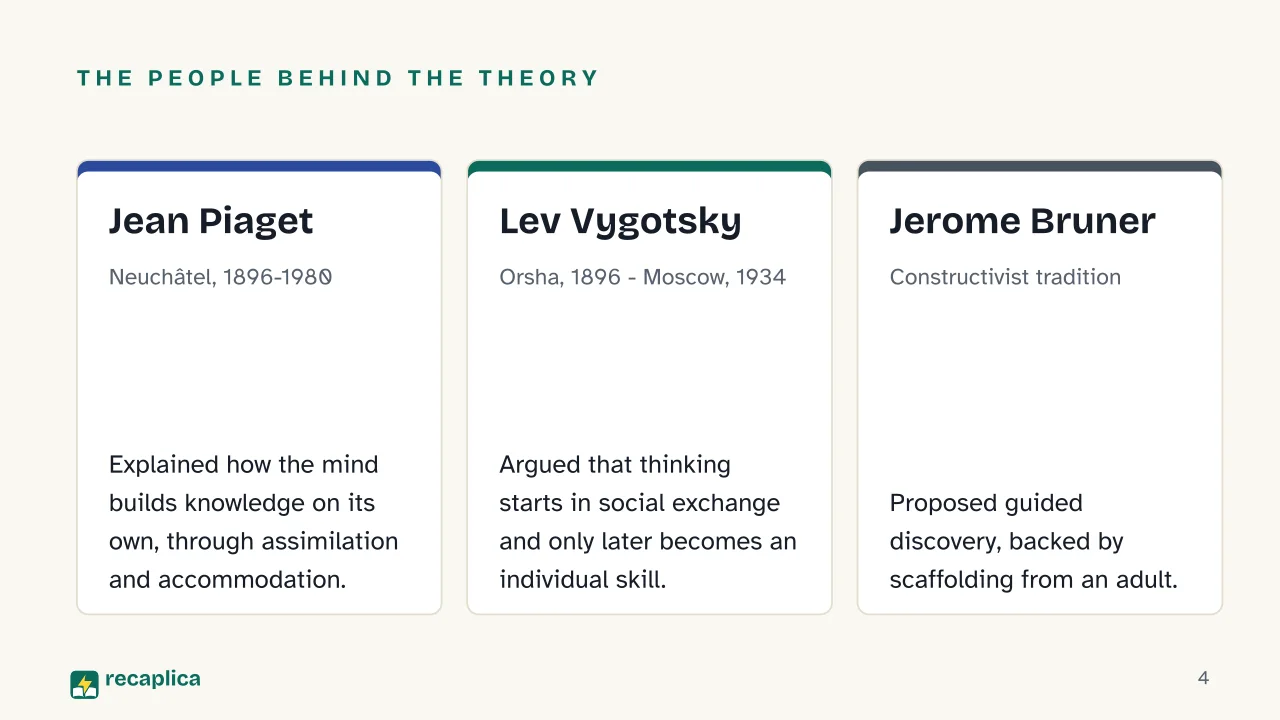  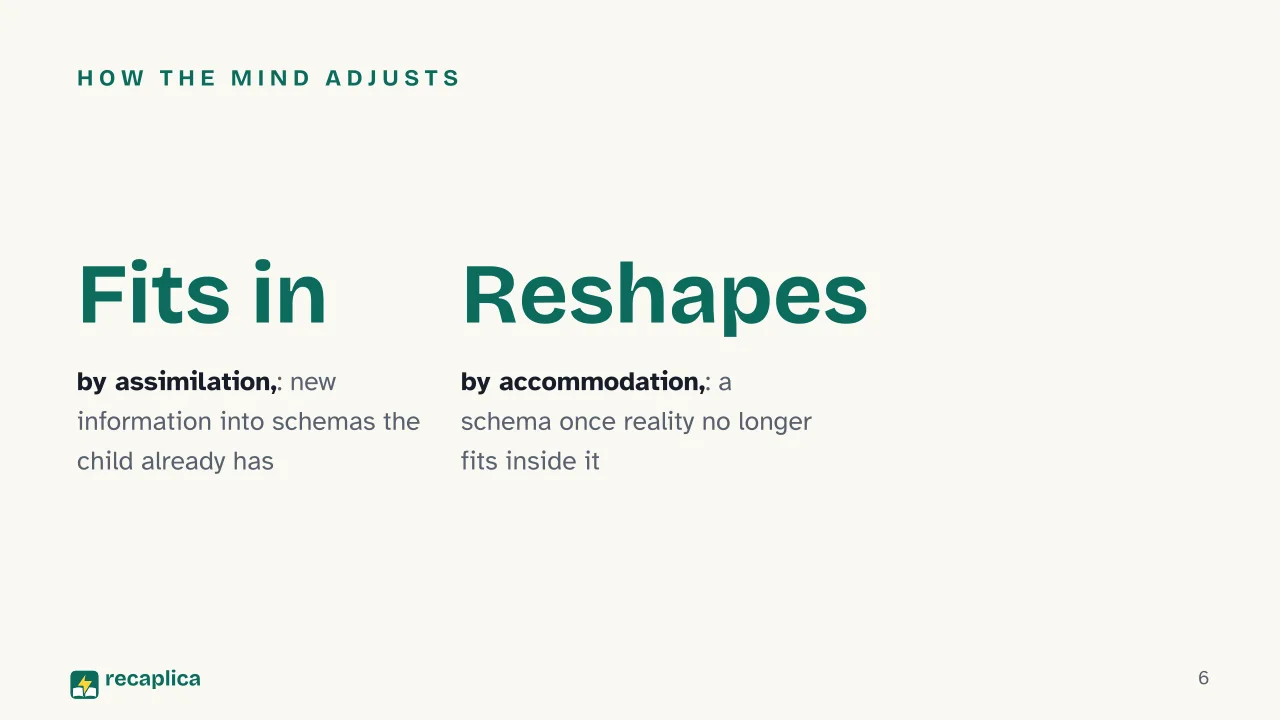 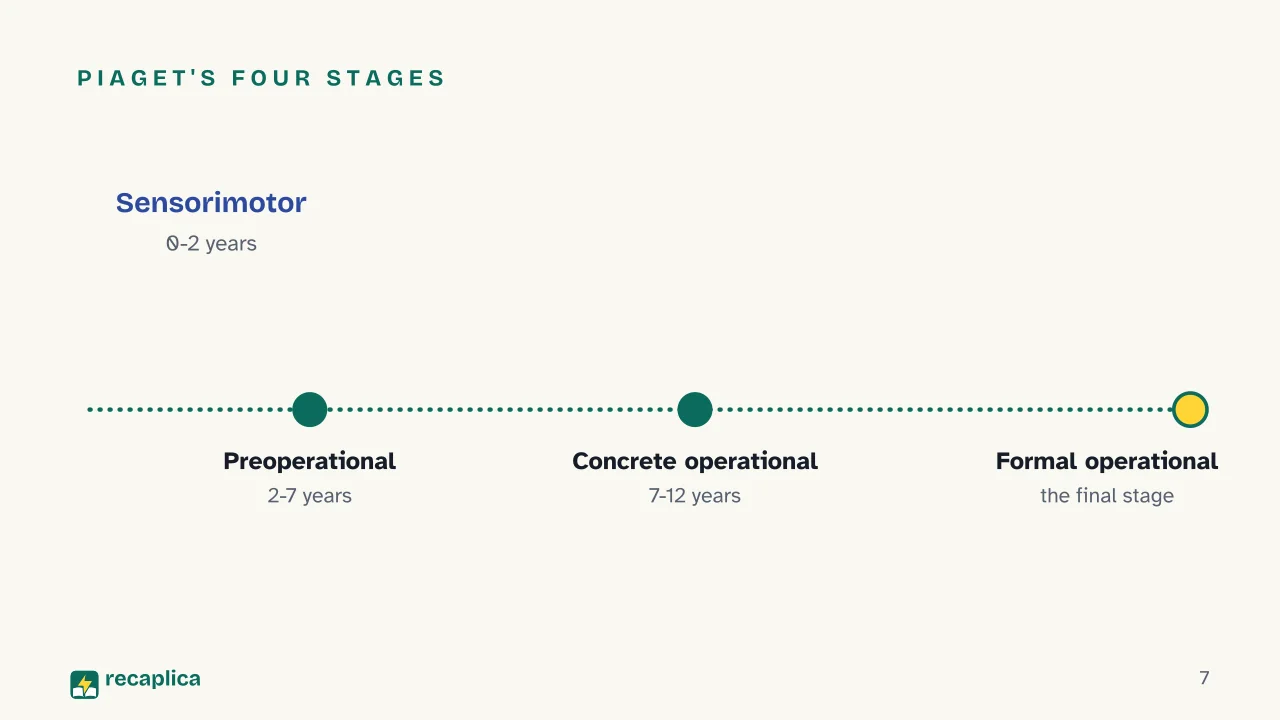  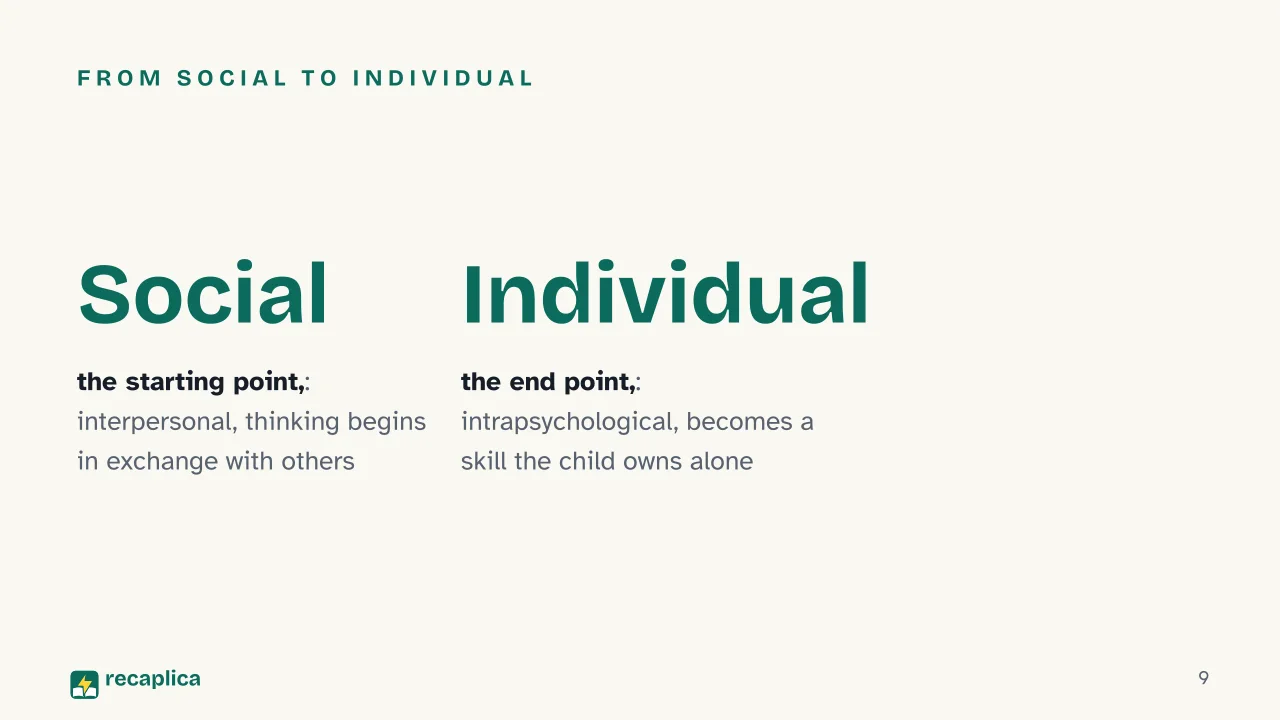 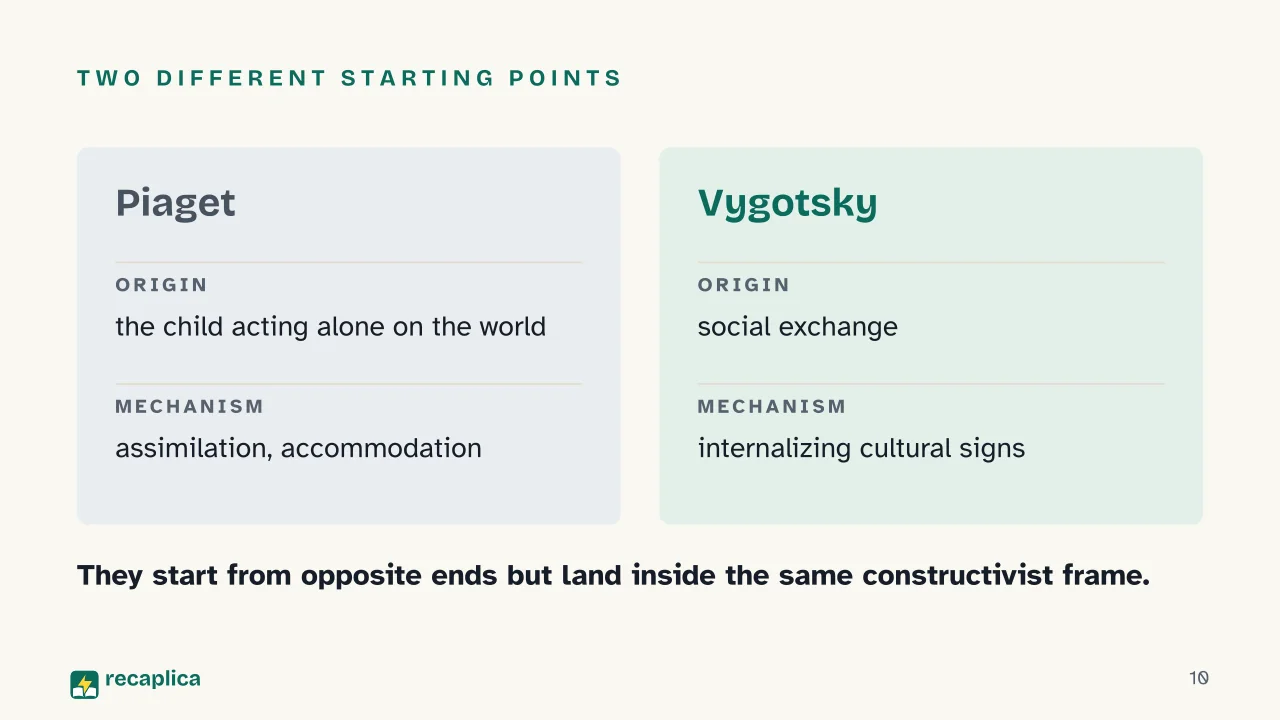 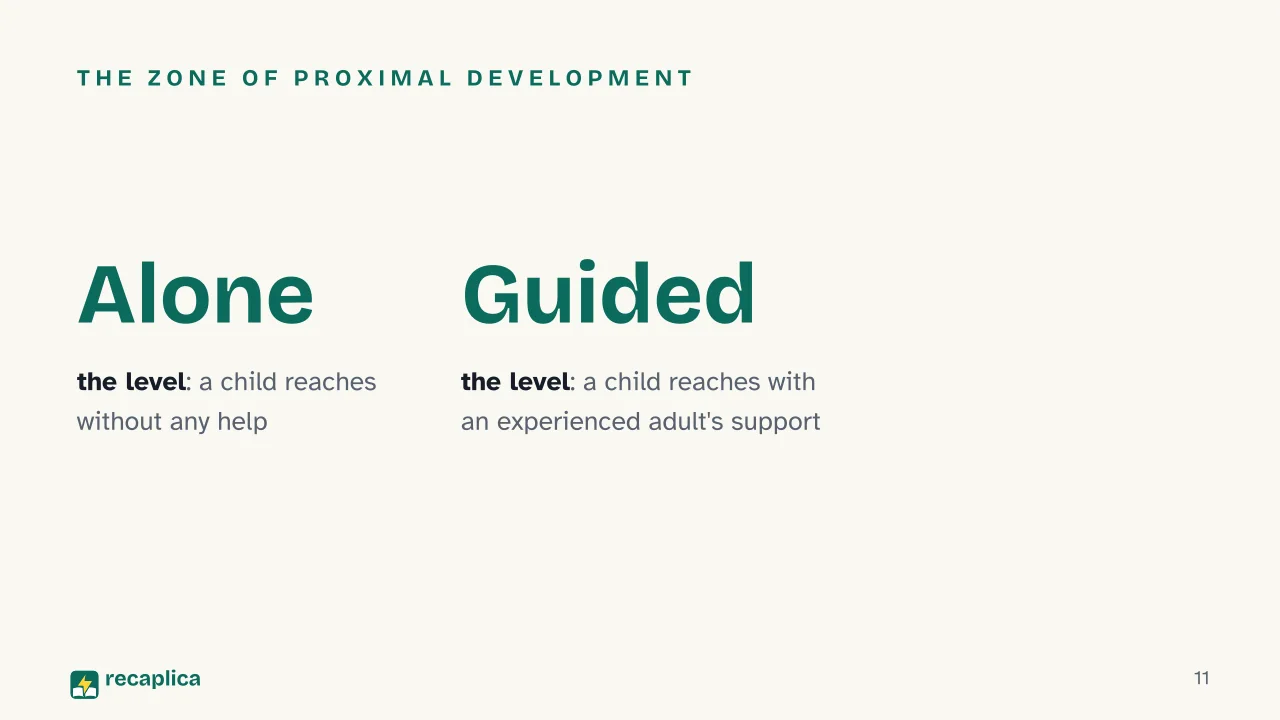  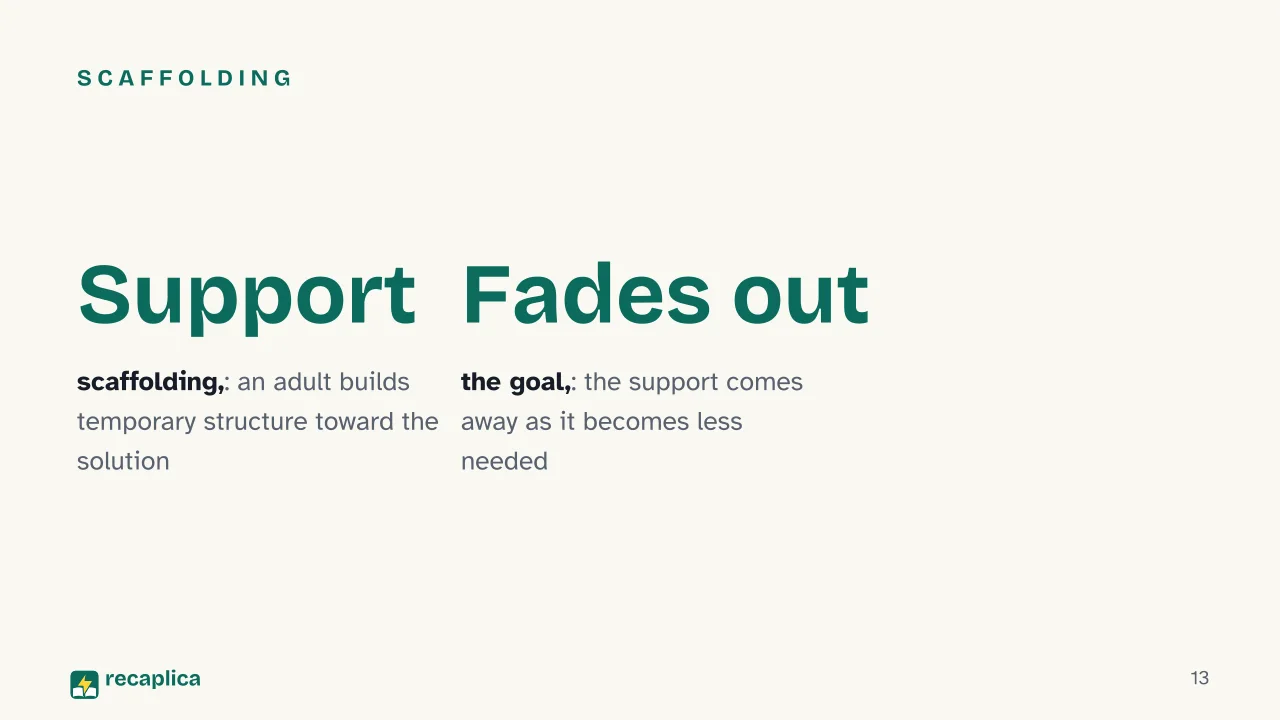   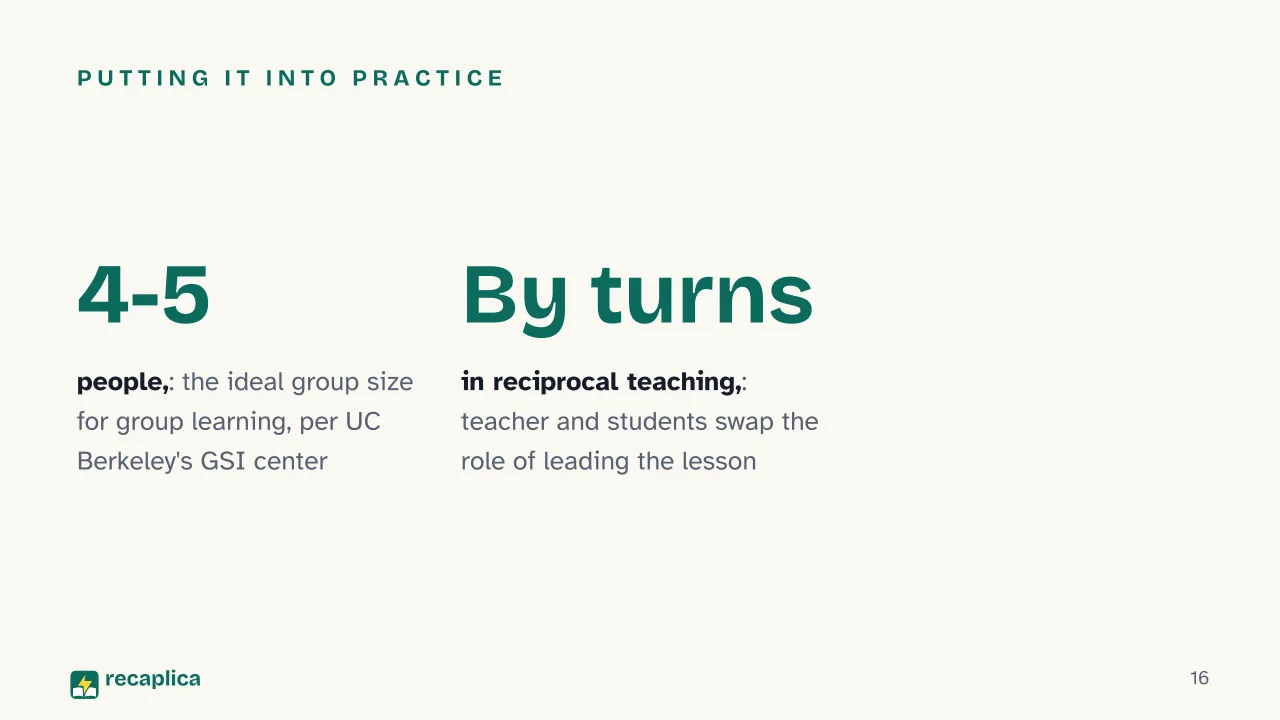 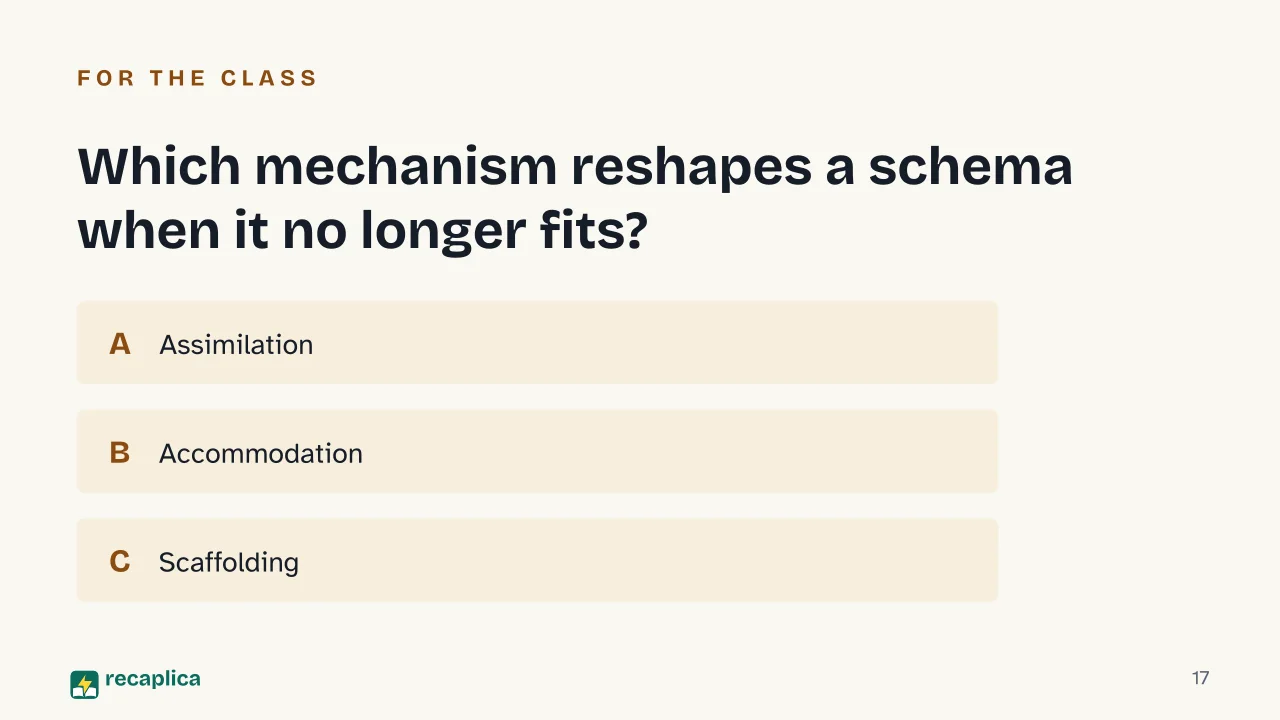  Common myths
Mind mapDrag the background to move around and the nodes to reposition them; use − and + to collapse and expand branches. 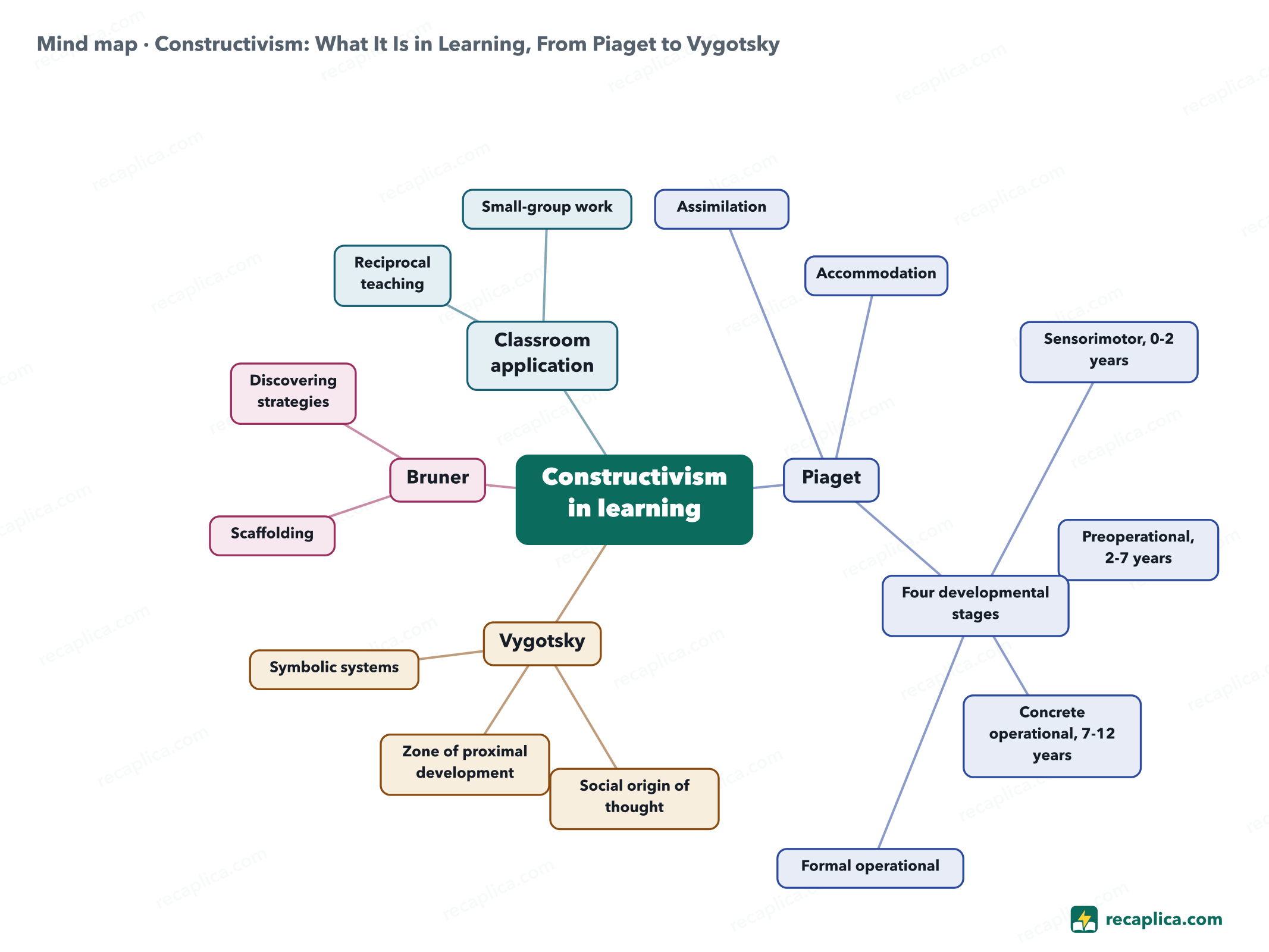
Quiz: test yourselfAnswer the questions to check what you have learned: you get instant feedback and a short explanation. Grade 0/10 0/5
FlashcardsTap the card to flip it and check whether you remember the answer, then move to the next one. 1 / 8 Explain it in your own wordsThe ultimate test: if you can explain it in simple words, you've truly understood it. Write your explanation, then compare it with the Recap. Your explanation is saved only on this device.
Frequently asked questionsWhat is the difference between constructivism and social constructivism?Piaget's constructivism centers on the individual child, who builds knowledge by acting on the world through assimilation and accommodation. Social constructivism, developed by Vygotsky, puts the social and cultural setting first: for Vygotsky, thinking appears first in exchanges with other people and only later becomes something the individual can do alone. Who came up with constructivism as a learning theory?There is no single founder. Jean Piaget (Neuchâtel, 1896 - 1980) laid the groundwork with his genetic epistemology, Lev Vygotsky (Orsha, 1896 - Moscow, 1934) developed the social side of the theory, and Jerome Bruner added discovery learning and scaffolding. What are assimilation and accommodation?They are the two mechanisms Piaget used to explain mental development. With assimilation, a child fits new information into schemas that already exist. With accommodation, the child reshapes those schemas when they no longer explain what is happening in the world. How is constructivism applied in the classroom?Through techniques such as reciprocal teaching, where the teacher and students take turns leading the lesson, and small-group work that encourages students to reason together. The teacher's job is to structure and guide the interaction, not just to deliver content. What is Vygotsky's zone of proximal development?It is the gap between what a child can do alone and what the same child can do with help from an adult or a more capable peer. Vygotsky treated this gap as the space where the most effective learning happens. Every Recap goes through an independent review before publication. |