Skip to content
recaplica

    One moment: security check

    Cloudflare wants to make sure you're not a robot. Tick the box below and your search will continue on its own.

    IT
    recaplica International Law: What It Is and Who Applies It
    © 2026 Recaplica · recaplica.com — All rights reserved
    Home › Civics

    International Law: What It Is and Who Applies It

    By Recaplica Newsroom · Updated on September 30, 2026

    What to print

    Page numbers appear when printing with default margins.

    Slides

    Choose a cut

    Flash10 slidesThe essential thread, to present in classFull16 slidesEvery chapter and the deeper detail

    Both come with speaker notes.

    Telegram channel
    recaplica Clear in 30 seconds, yours in 10 minutes.
    In 30 seconds Key points Figures Deep dive Slides Myths Mind map Quiz Flashcards FAQ

    In 30 seconds quick read

    International law is the set of rules states follow in their dealings with one another and, in some matters, in the way each of them treats the people inside its borders. It comes from two main sources, treaties and custom, listed in Article 38(1) of the Statute of the International Court of Justice. Different institutions apply it: the UN through its Charter, at the political level, the International Court of Justice for disputes between states, the International Criminal Court for individuals accused of serious crimes. Two further branches round out the picture, private international law, which picks the national law that applies to a case with foreign elements, and international criminal law, the branch the International Criminal Court enforces.

    Key Points

    • International law governs relations between states and, in some matters, how they treat people within their own borders.
    • Its main sources are treaties and custom, a general practice accepted as law, under Article 38(1) of the Statute of the International Court of Justice.
    • A treaty binds only the states that signed it, under Article 34 of the Vienna Convention on the Law of Treaties.
    • The International Court of Justice, seated in The Hague, rules on disputes between states (its binding contentious function) and gives non-binding advisory opinions when the General Assembly or the Security Council asks for one.
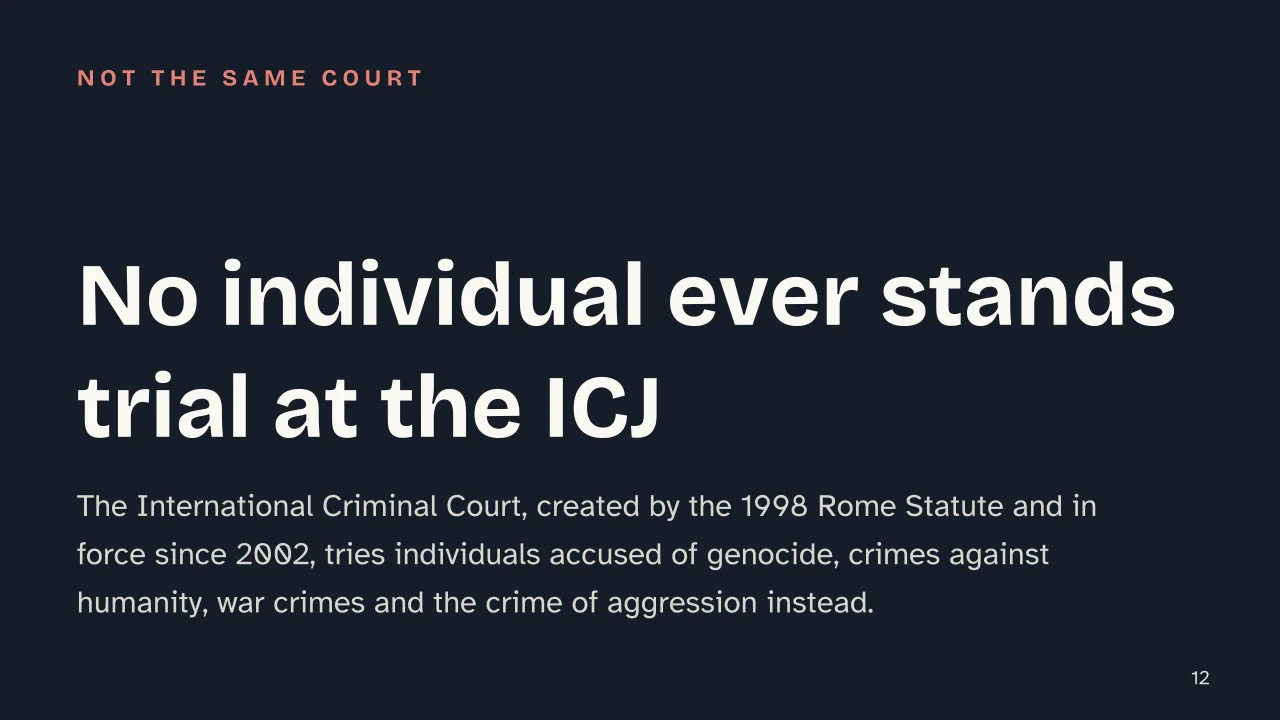
    • The International Criminal Court, created by the 1998 Rome Statute and operating since 2002, tries individuals accused of genocide, crimes against humanity, war crimes and the crime of aggression.
    • The International Law Commission promotes the progressive development of international law and its codification.

    Key figures

    • 1946 The ICJ, the UN's principal judicial organ, was established by the 1945 Charter and began work in 1946. Source: United Nations / Wikipedia, International Court of Justice
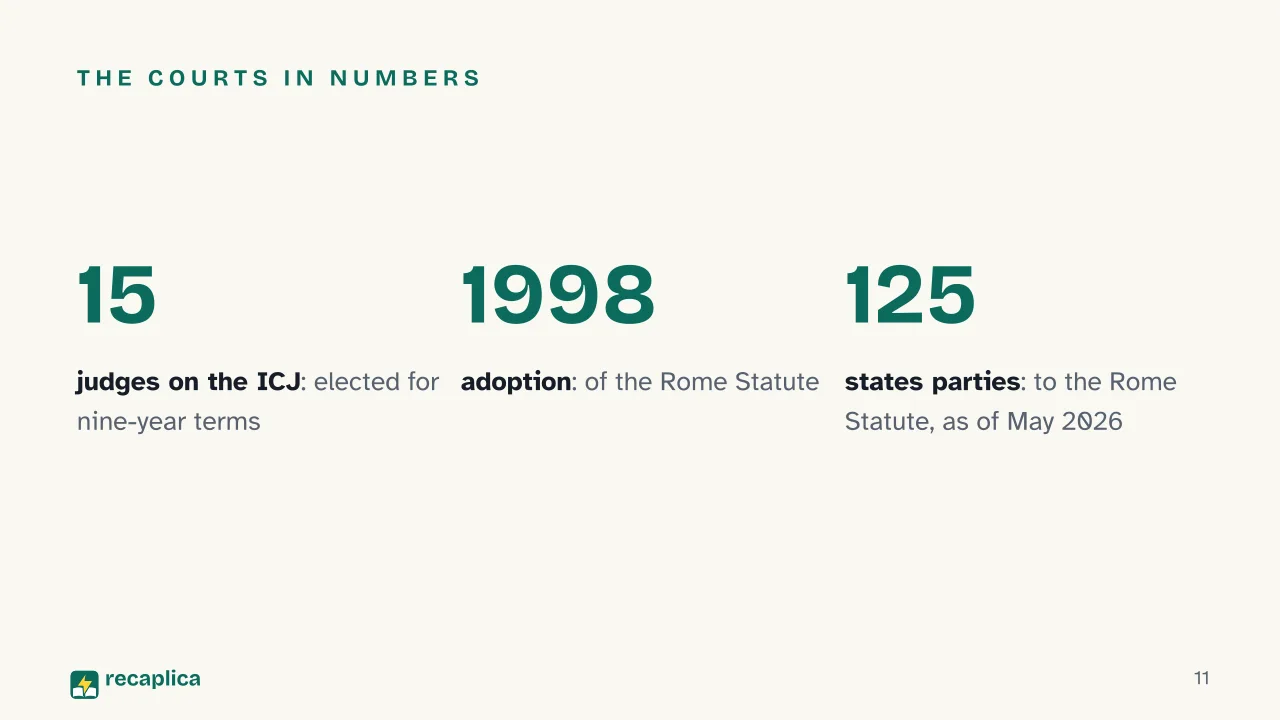
    • 15 The International Court of Justice has 15 judges, elected for nine-year terms by the General Assembly and the Security Council. Source: United Nations, Uphold International Law
    • 125 States parties to the Rome Statute, which brought the International Criminal Court into operation in 2002, numbered 125 as of May 2026. Source: Wikipedia, States parties to the Rome Statute

    Deep Dive

    An order with no single legislator

    International law is the body of rules that governs relations between states and, for some matters, how a state treats people within its own borders. According to the United Nations, its domain covers a wide range of issues: human rights, disarmament, international crime, refugees, migration, the treatment of prisoners, the use of force, the conduct of war, as well as the environment, sustainable development, international waters, outer space, global communications and world trade.

    Unlike the law of a single state, international law has no parliament above states to pass it and no single government to enforce it: it grows out of the consent of states themselves, expressed in different forms.

    The sources: treaties and custom

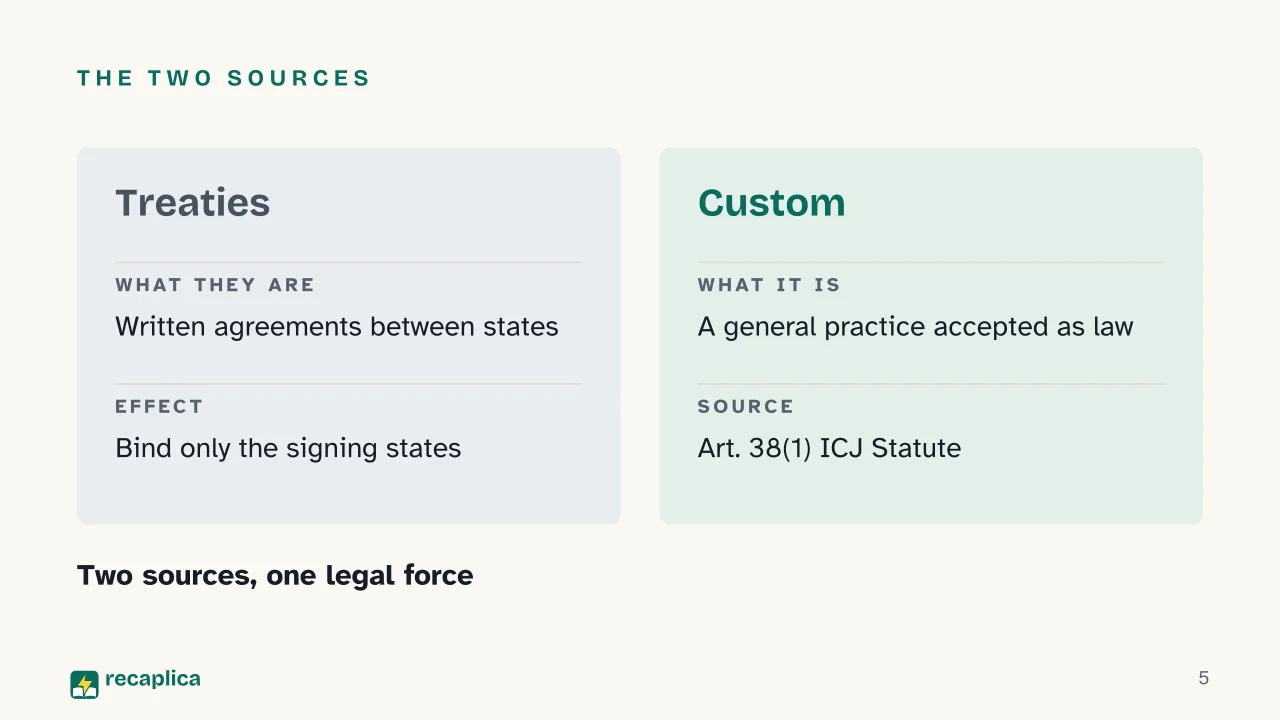
    Article 38(1) of the Statute of the International Court of Justice lists the sources the Court draws on to decide a dispute. The two main ones, with no real equivalent in a single state’s domestic law, are treaties and customary international law. A treaty is a written agreement between states. It binds only the states that sign it: the Vienna Convention on the Law of Treaties, at Article 34, says a treaty creates no obligations and no rights for a third state without that state’s consent. Custom, by contrast, is written in no single text: it is a general practice accepted as law, to use the ICJ Statute’s own phrase, and it forms when a pattern of behavior becomes so widespread and repeated among states that they come to treat it as binding.

    A legal norm inside a single state comes from a defined process, with a parliament that passes it and an authority that enforces it. A rule of international law instead comes from repeated conduct or from an explicit agreement between states.

    Public and private international law

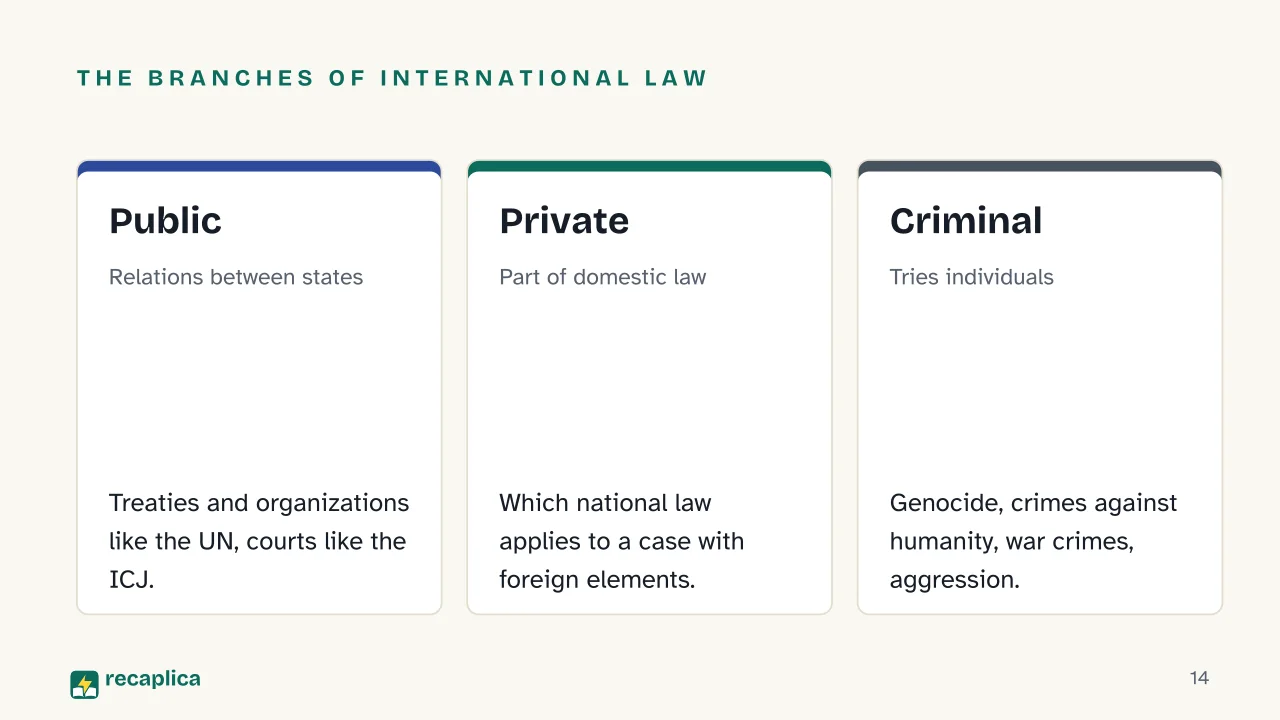
    The international law discussed so far, the law of treaties and custom between states, is more precisely called public international law. There is also a field called private international law, but it is a different subject: it belongs to the domestic law of each country and it decides which national law applies when a specific case involves people or property from different states: a contract, a marriage, an inheritance. An Italian judge who has to decide which law governs a contract between a company in Milan and one in Lyon will apply the rules of Italian private international law, not a treaty between Italy and France.

    Who applies international law

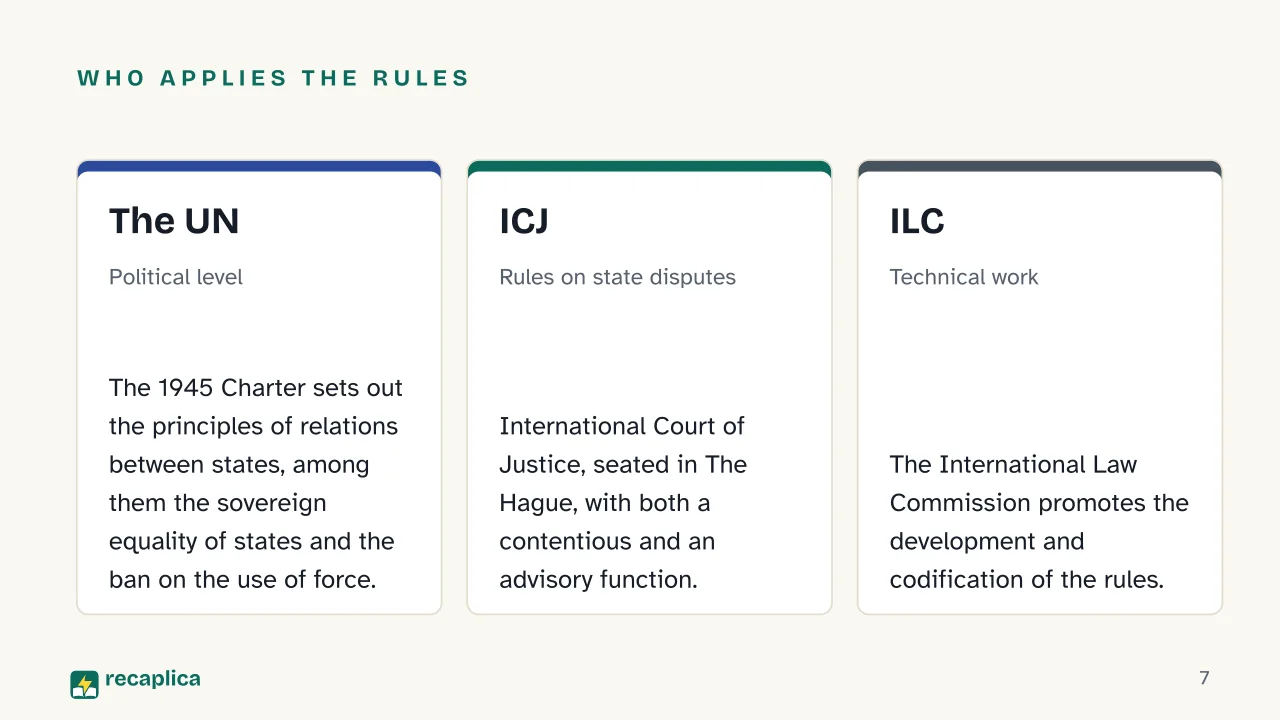
    The United Nations distinguishes three bodies with different tasks. The UN Charter, signed in 1945, sets out the major principles of international relations, from the sovereign equality of states to the ban on the use of force: this is the political level, the founding text the other bodies refer back to.

    Practical example: when a state joins the United Nations, it automatically becomes a party to the Statute of the International Court of Justice as well. Article 93 of the UN Charter provides for this: every UN member is a party to the Statute of the Court without signing any separate treaty. A state that is not a UN member can still accede to the Statute, but only on conditions set case by case by the General Assembly, on the recommendation of the Security Council.

    The second level is judicial. The International Court of Justice (ICJ), the UN Charter’s principal judicial organ of the United Nations, sits in The Hague and rules on disputes between states. Its contentious function, governed by Article 94, produces rulings that bind the parties in the case, who can turn to the Security Council if the other side does not comply. Its advisory function, set out in Article 96, is different: the General Assembly and the Security Council can ask the Court for legal opinions on questions of law, but those opinions are not binding.

    The third level is technical: the International Law Commission, as its name suggests, has the job of developing international law progressively and codifying it, putting into systematic written form rules that often already existed as custom.

    On the ground, a state brings its positions before these bodies through its own diplomacy: for Italy, that task falls to the Italian Ministry of Foreign Affairs and International Cooperation.

    ICJ and ICC, two courts in The Hague

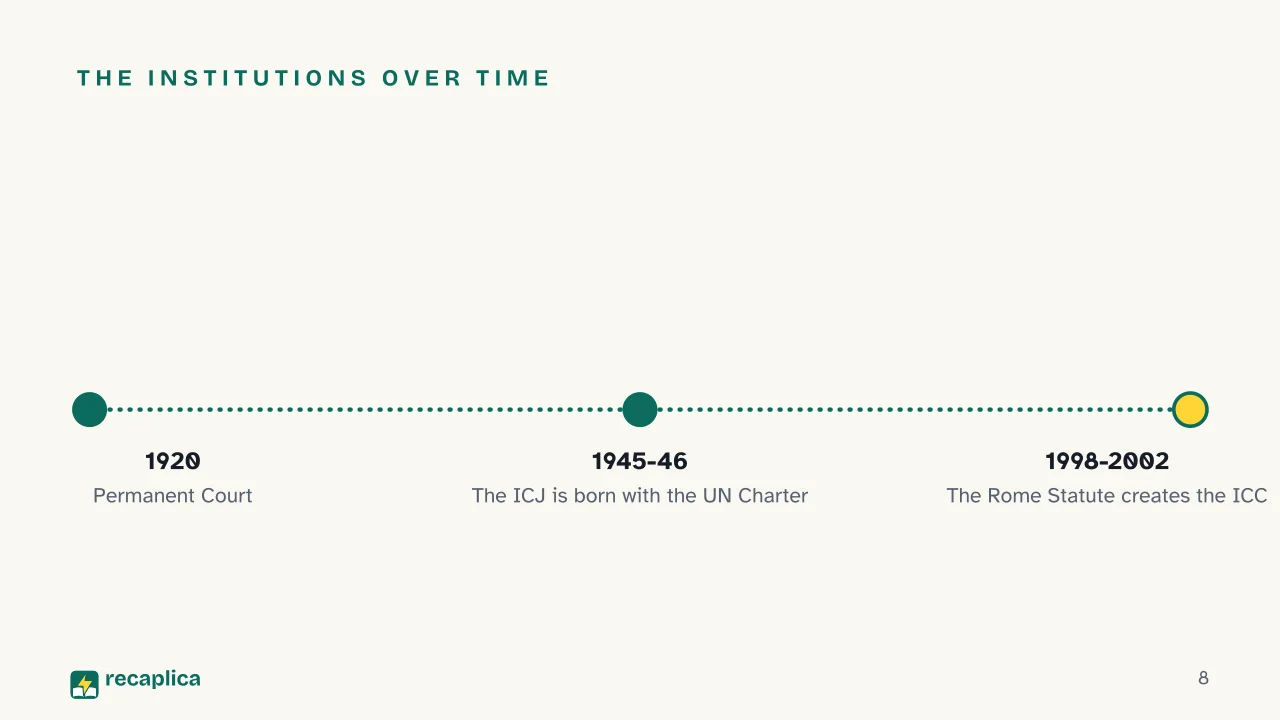
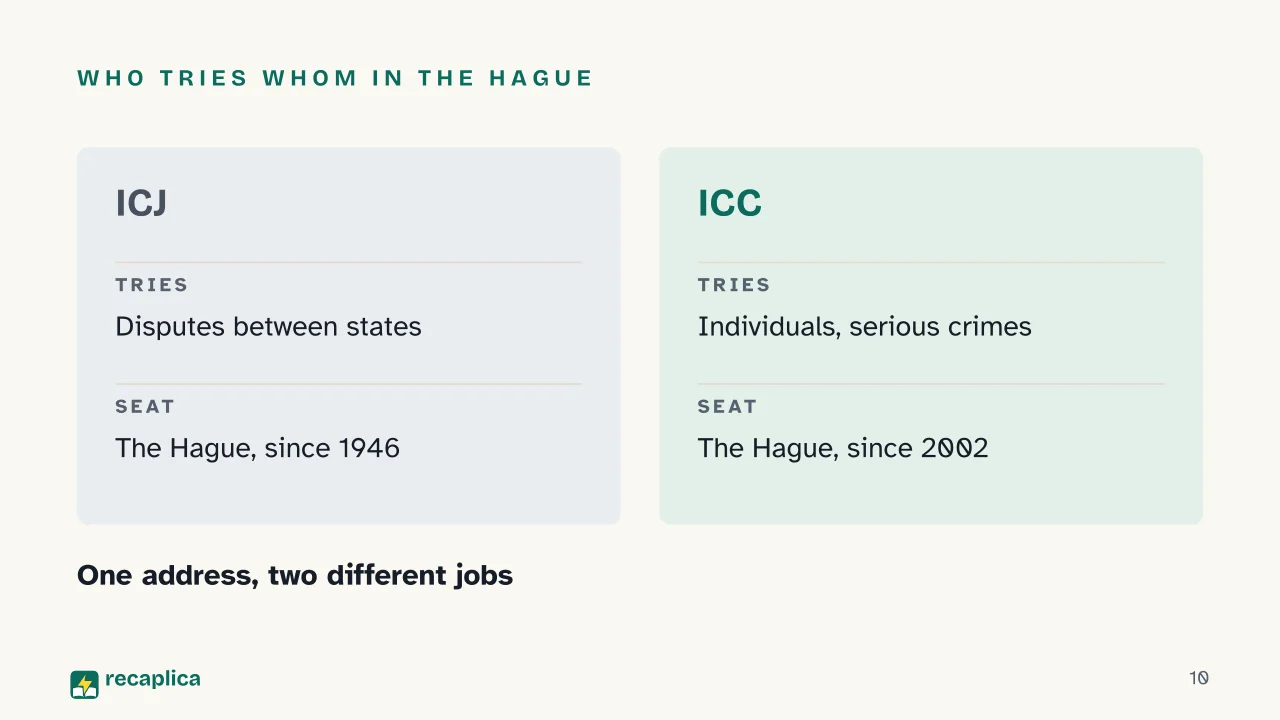
    There is a fourth institution, distinct from the first three because it tries not states but individuals: the International Criminal Court (ICC). It was created by the Rome Statute, adopted on 17 July 1998 and in force since 1 July 2002 after gathering 60 ratifications; by May 2026 its states parties numbered 125. It sits in The Hague, like the ICJ, and tries individuals accused of war crimes, genocide, crimes against humanity and the crime of aggression: it is the home of international criminal law, a branch separate from public international law, which governs relations between states.

    International Court of Justice (ICJ)International Criminal Court (ICC)
    TriesStatesIndividuals
    FoundedUN Charter, 1945; at work from 1946Rome Statute, 1998; in force from 2002
    Branch of lawPublic international lawInternational criminal law
    SeatThe HagueThe Hague

    Confusion between the two courts is common because both sit in The Hague, even though a case can only go before one of them.

    The ICJ, for its part, did not appear out of nowhere in 1945: it took over from the Permanent Court of International Justice, established in 1920 by the League of Nations, the organization that preceded the UN. Within a single state, a system of courts with different levels and jurisdictions exists too: the entry on the Italian legal system tells that story, useful for comparison with a system, like the international one, that has no single judicial apparatus sitting above states.

    Among the matters international law covers is the protection of people’s rights, an area with its own reference text in the Universal Declaration of Human Rights.

    Slide deck

    Slides ready to download and make your own in PowerPoint or Google Slides, with speaker notes. Pick the Flash cut or the Full one.
    Slide 1 of the presentation on International Law: International lawSlide 2 of the presentation on International Law: Who settles a dispute between two states?Slide 3 of the presentation on International Law: From sources to courtsSlide 4 of the presentation on International Law: Chapter 01: The sourcesSlide 5 of the presentation on International Law: The two sourcesSlide 6 of the presentation on International Law: Chapter 02: Who applies the rulesSlide 7 of the presentation on International Law: Who applies the rules: The UN, ICJ, ILCSlide 8 of the presentation on International Law: The institutions over timeSlide 9 of the presentation on International Law: Chapter 03: Two courts in The HagueSlide 10 of the presentation on International Law: Who tries whom in The HagueSlide 11 of the presentation on International Law: The courts in numbersSlide 12 of the presentation on International Law: No individual ever stands trial at the ICJSlide 13 of the presentation on International Law: Chapter 04: Public, private, criminalSlide 14 of the presentation on International Law: The branches of international law: Public, Private, CriminalSlide 15 of the presentation on International Law: Which court tries individuals, not states?Slide 16 of the presentation on International Law: Keep reading
    Flash10 slidesThe essential thread, to present in classFull16 slidesEvery chapter and the deeper detail

    Common myths

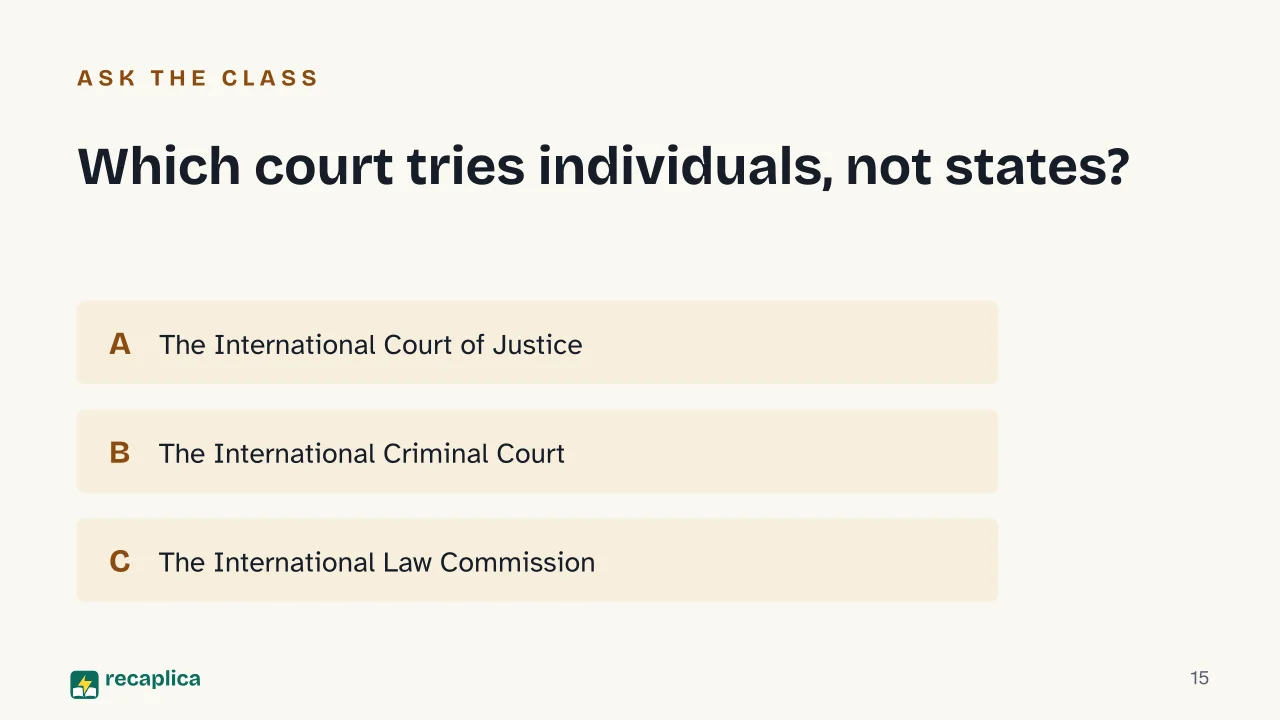
    • ✗ Myth The International Court of Justice tries individuals accused of war crimes.

      ✓ Reality The ICJ only hears disputes between states. Individuals accused of war crimes, and likewise of genocide, of crimes against humanity and of the crime of aggression, are tried by the International Criminal Court, created by the 1998 Rome Statute and operating since 2002: two different courts that happen to share a city, The Hague.

    • ✗ Myth An international treaty binds every state in the world, even those that never signed it.

      ✓ Reality Article 34 of the Vienna Convention on the Law of Treaties says a treaty only produces effects for the states that signed it. Custom works differently: it grows out of a general practice that states come to accept as law, with no signed text required.

    • ✗ Myth Public international law and private international law are the same subject under two names.

      ✓ Reality Public international law governs relations between states and the institutions that represent them. Private international law is instead part of each country's own domestic law: it decides which national law applies when a case, a contract, a marriage, an inheritance, involves people or property from different states.

    Mind map

    Drag the background to move around and the nodes to reposition them; use − and + to collapse and expand branches.
    Customize
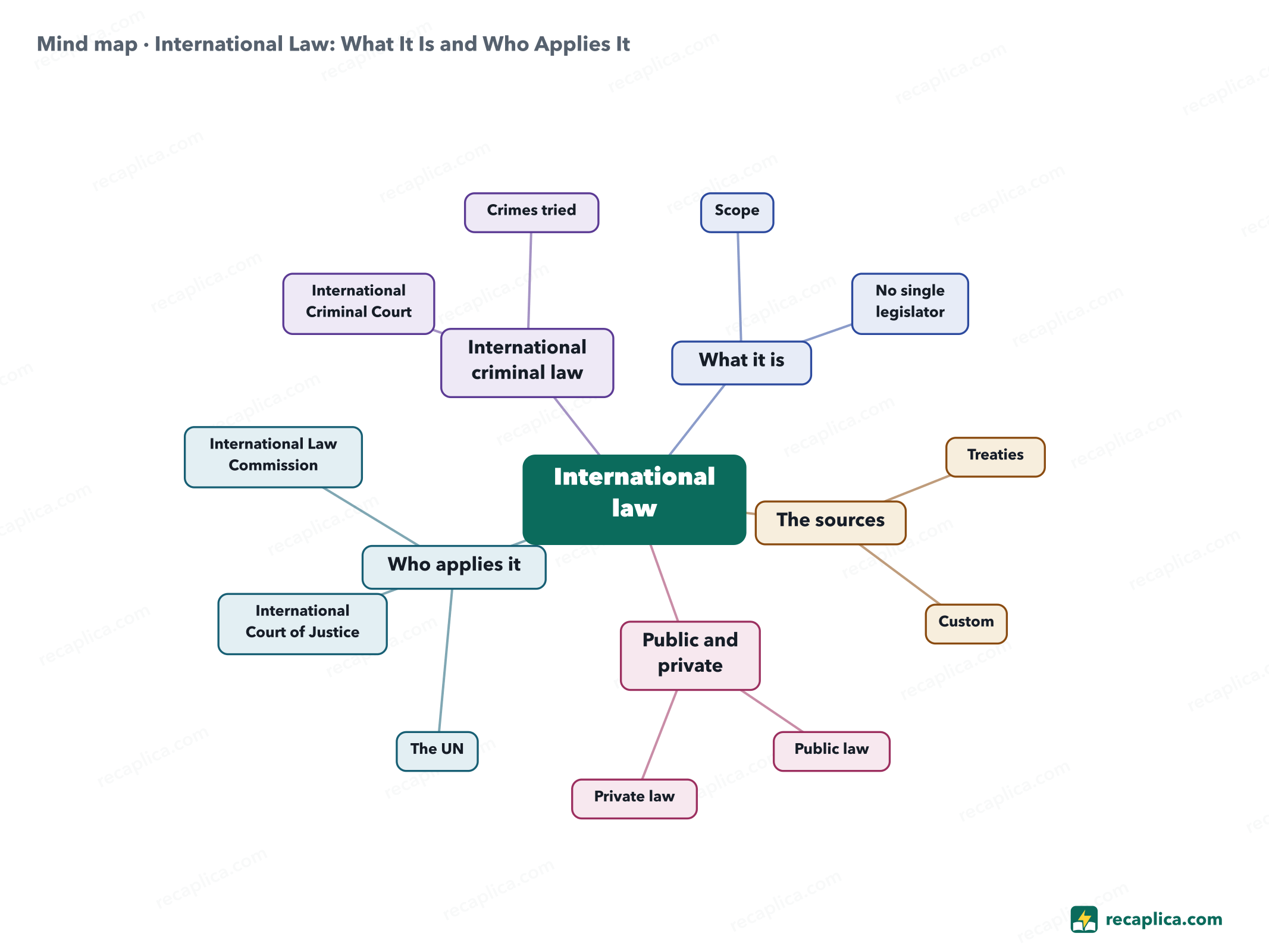
    Mind map: International Law: What It Is and Who Applies It
    • International law
      • What it is Rules between states, and partly toward individuals
        • Scope Human rights, war, the environment, trade, among other areas
        • No single legislator States remain sovereign
      • The sources Article 38(1) of the ICJ Statute
        • Treaties Bind only the signing parties, Vienna Convention art. 34
        • Custom A general practice accepted as law
      • Public and private Two distinct branches
        • Public law Relations between states
        • Private law The law that applies to cases with foreign elements
      • Who applies it The UN, a court and a commission, different tasks
        • The UN 1945 Charter, the principles of relations between states
        • International Court of Justice Disputes between states, contentious and advisory functions
        • International Law Commission Technical development and codification
      • International criminal law Tries individuals, not states
        • International Criminal Court Rome Statute, in force since 2002
        • Crimes tried Genocide, crimes against humanity, war crimes, aggression

    Quiz: test yourself

    Answer the questions to check what you have learned: you get instant feedback and a short explanation.

    Grade 0/10 0/5
    1 What are the two main sources of international law under Article 38(1) of the Statute of the International Court of Justice?

    Article 38(1) of the ICJ Statute lists treaties and customary international law, a general practice accepted as law, as the main sources.

    2 Which body rules on disputes between states, not individuals?

    The International Court of Justice is the UN's principal judicial organ for disputes between states; the International Criminal Court instead tries individuals.

    3 An international treaty automatically binds even the states that never signed it.

    Under Article 34 of the Vienna Convention on the Law of Treaties, a treaty's obligations fall only on the states that signed it: a state that stays outside the agreement is not bound by it.

    4 What does the International Court of Justice do when it exercises the advisory function set out in Article 96 of the UN Charter?

    Article 96 of the UN Charter authorizes the General Assembly and the Security Council to request advisory opinions, which stay non-binding; the binding function between parties is the contentious one, governed by Article 94.

    5 In what year did the Rome Statute, which created the International Criminal Court, enter into force?

    The Rome Statute was adopted on 17 July 1998, but only entered into force on 1 July 2002, after gathering 60 ratifications.

    Answers: 1-A · 2-A · 3-B · 4-A · 5-B

    Flashcards

    Tap the card to flip it and check whether you remember the answer, then move to the next one.

    1 / 7

    Explain it in your own words

    The ultimate test: if you can explain it in simple words, you've truly understood it. Write your explanation, then compare it with the Recap.

    Your explanation is saved only on this device.

    International law is the set of rules states follow in their dealings with one another and, in some matters, in the way each of them treats the people inside its borders. It comes from two main sources, treaties and custom, listed in Article 38(1) of the Statute of the International Court of Justice. Different institutions apply it: the UN through its Charter, at the political level, the International Court of Justice for disputes between states, the International Criminal Court for individuals accused of serious crimes. Two further branches round out the picture, private international law, which picks the national law that applies to a case with foreign elements, and international criminal law, the branch the International Criminal Court enforces.

    Frequently asked questions

    What is the difference between public international law and private international law?

    Public international law governs relations between states, through treaties, organizations like the UN and courts like the International Court of Justice. Private international law is instead a branch of each country's own domestic law: it says which national law a judge must apply to a case with foreign elements, for instance a contract signed by a company in Milan with one in Lyon.

    What is the difference between the International Court of Justice and the International Criminal Court?

    The ICJ rules on disputes between states and sits in The Hague; its contentious function (Article 94 of the UN Charter) is binding between the parties, while the opinions requested by the General Assembly or the Security Council (Article 96) are not. The International Criminal Court, also in The Hague but created by the 1998 Rome Statute, tries individuals instead: the charges it hears are genocide, war crimes, crimes against humanity and the crime of aggression. That makes it the seat of international criminal law, a separate branch from the public international law that governs relations between states.

    What is customary international law?

    It is one of the two main sources listed in Article 38(1) of the Statute of the International Court of Justice, alongside treaties. It forms when states generally follow a certain conduct and come to regard it as law; no signed written text is needed.

    How does a state become party to the International Court of Justice?

    Automatically: under Article 93 of the UN Charter, every UN member state is a party to the Statute of the Court. States that are not UN members can still accede to the Statute, but only on conditions set case by case by the General Assembly, on the recommendation of the Security Council.

    What is the International Law Commission?

    It is the technical body of the United Nations, with two jobs: pushing international law forward and codifying it, that is, putting its rules in written form. While the UN sets political direction and the ICJ rules on disputes, the Commission works on the text of the rules themselves.

    Sources

    • United Nations, Uphold International Law
    • Charter of the United Nations, Chapter XIV (the International Court of Justice)
    • Stanford Encyclopedia of Philosophy, Philosophy of International Law
    • Wikipedia, International Court of Justice
    • Wikipedia, International Criminal Court
    • Wikipedia, States parties to the Rome Statute

    Every Recap goes through an independent review before publication.

    Every evening, the day's new Recaps on our Telegram channel. Join the channel →

    Keep learning

    • Civics ARAN, Italy's public-sector collective bargaining agency ARAN is the agency that negotiates Italy's public-sector employment contracts on behalf of every public administration in the country. It was set up in 1993 as a technical agency under public law, and its role was later confirmed by two further laws, in 2001 and 2009. Public administrations, through sector committees, give ARAN its mandate for the negotiation. And a contract ARAN negotiates only takes effect once Italy's Court of Auditors has certified that it is financially sustainable. Read the Recap →
    • Civics Civil Service: What It Is and How It Works in Italy The civil service is both the activity of running public affairs and the set of bodies that carry it out: ministries and agencies, public bodies, independent authorities, state-owned enterprises, and local government such as regions, provinces and municipalities. In Italy, the Constitution's Articles 97 and 98 require sound administration and impartiality, entry to public jobs through open competitive exams, and service to the Nation rather than to any government or party. Part of this machinery — state bodies such as ministries — has no legal personality of its own, because it coincides with the state itself; another part, public bodies, has its own separate legal personality. In 2022, Italy's statistics agency ISTAT counted 12,776 active public institutions, employing more than 3.4 million people. Read the Recap →
    • Civics What Is Fiscal Federalism? Who Raises the Money and Who Gets It Fiscal federalism is the system that lets municipalities, provinces, metropolitan cities and regions in Italy pay for schools, roads and healthcare without relying only on money handed down from the State. Article 119 of the Italian Constitution names three sources: own-source taxes each level of government sets for itself, a share of national tax revenue such as VAT, and an equalization fund that helps territories with less fiscal capacity. Law 42/2009 turned that principle into practice, replacing the old benchmark of historical spending with a standard-needs calculation. At the municipal level the equalization tool is called the Municipal Solidarity Fund, partly financed by a share of property-tax revenue. The system is still a work in progress: the essential service levels, the yardstick for full equalization, have not been defined yet. Read the Recap →

    recaplica

    Clear in 30 seconds, yours in 10 minutes.

    Recaps Mind maps Request a Recap Telegram channel Mind map maker Our method About Privacy & cookies Legal notes & terms of use

    © 2026 Recaplica · A project by Curi S.r.l. — VAT IT05472000750

    Statistics, only if you say so

    To learn which Recaps help most we would use Google Analytics, with aggregate, anonymous data. It starts only with your OK, and you can change your mind anytime. Privacy policy