Skip to content
recaplica

    One moment: security check

    Cloudflare wants to make sure you're not a robot. Tick the box below and your search will continue on its own.

    IT
    recaplica Nuclear Fission and Fusion: How They Differ
    © 2026 Recaplica · recaplica.com — All rights reserved
    Home › Science

    Nuclear Fission and Fusion: How They Differ

    By Recaplica Newsroom · Updated on October 20, 2026

    What to print

    Page numbers appear when printing with default margins.

    Slides

    Choose a cut

    Flash10 slidesThe essential thread, to present in classFull14 slidesEvery chapter and the deeper detail

    Both come with speaker notes.

    Telegram channel
    recaplica Clear in 30 seconds, yours in 10 minutes.
    In 30 seconds Key points Figures Deep dive Slides Myths Mind map Quiz Flashcards FAQ

    In 30 seconds quick read

    Nuclear fission splits the nucleus of a heavy atom, such as uranium-235, after it absorbs a neutron, releasing energy and more neutrons. Nuclear fusion joins two light nuclei, such as deuterium and tritium, into a heavier one; it is the process that powers the Sun and every other star. Fission releases more energy per single event, but fusion releases more energy per kilogram of fuel. The ITER project, under construction in France, aims to produce net energy from fusion; the January 2025 plasma record set by China's EAST tokamak and the December 2022 experiment at the U.S. laboratory NIF mark progress along the same research path.

    Key Points

    • Fission breaks apart the nucleus of a heavy atom, such as uranium-235, after it absorbs a neutron.
    • Fusion combines two light nuclei, deuterium and tritium, both isotopes of hydrogen.
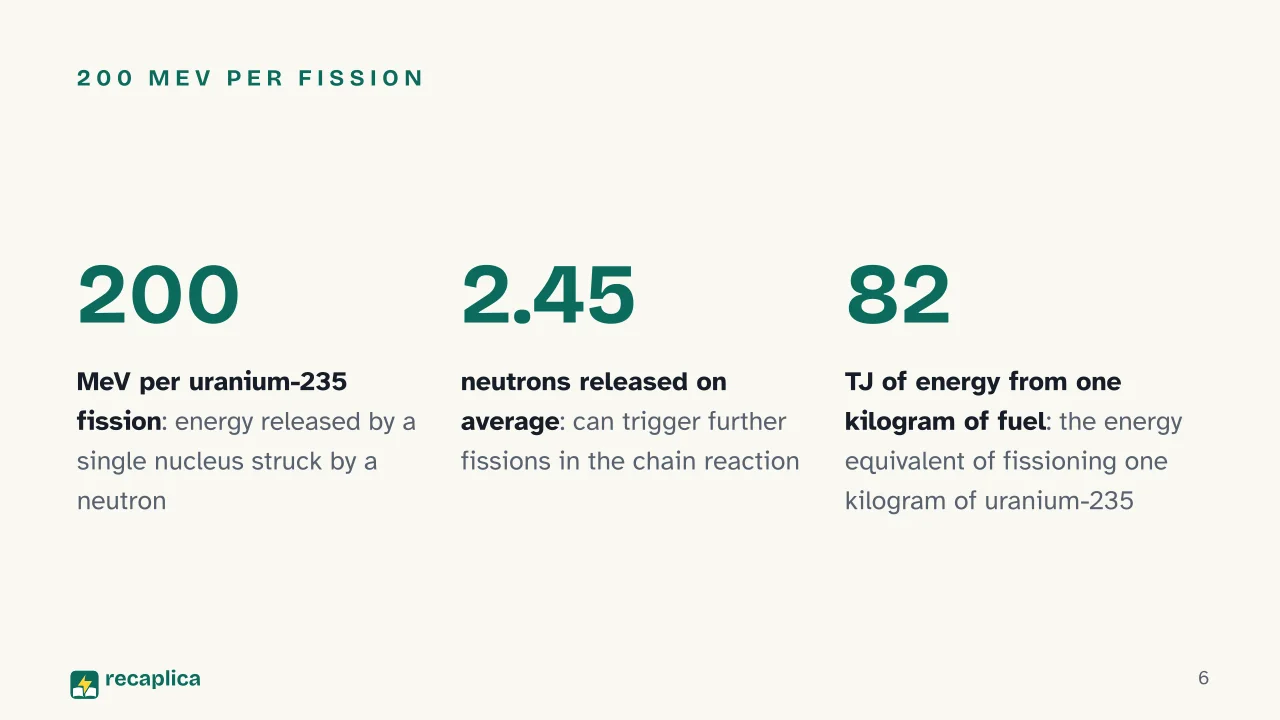
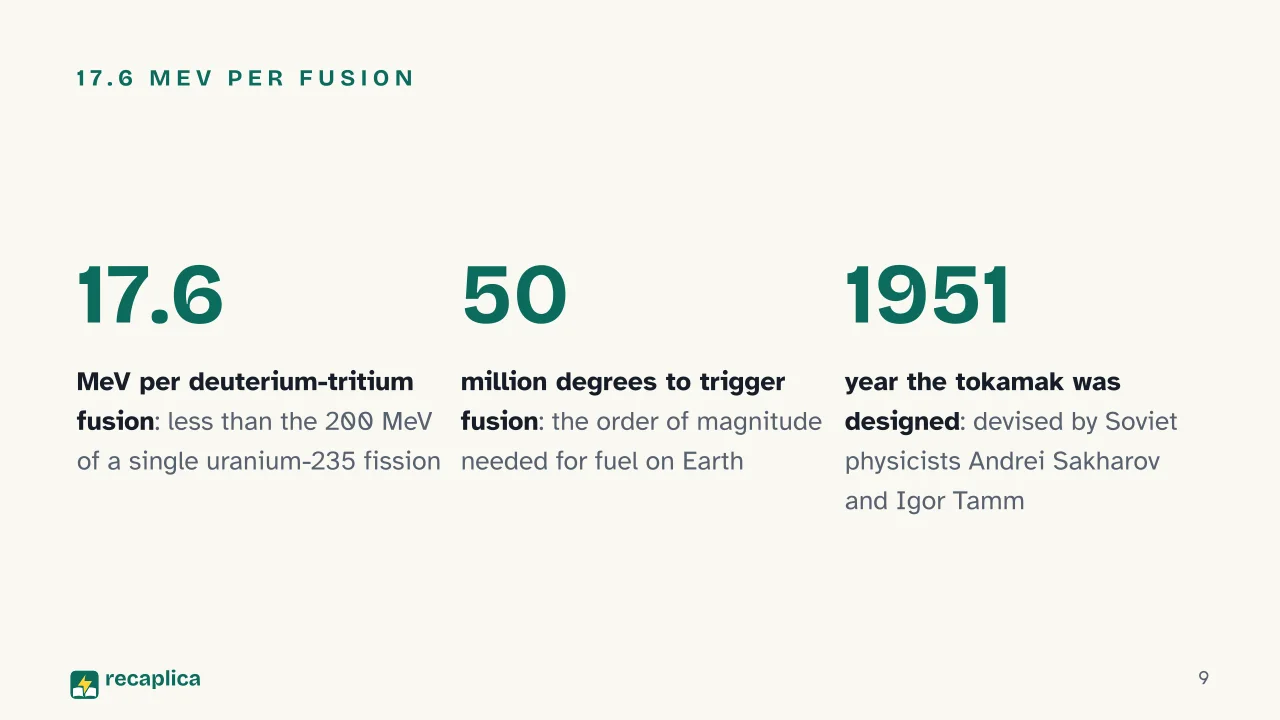
    • A single uranium-235 fission releases about 200 MeV, far more than the 17.6 MeV of one deuterium-tritium fusion event.
    • Per kilogram of fuel, though, fusion releases more energy than fission.
    • Fission powers nuclear plants already in operation and leaves long-lived radioactive waste; fusion is not expected to produce that kind of waste.
    • As of October 2026, no fusion plant generates electricity at commercial scale: the ITER tokamak is still being assembled in France.

    Key figures

    • 200 MeV Energy released by a single fission of a uranium-235 nucleus struck by a neutron, a baseline figure in reactor physics. Source: World Nuclear Association
    • 17.6 MeV Energy released when a deuterium nucleus fuses with a tritium nucleus, less than fission releases per single event. Source: World Nuclear Association
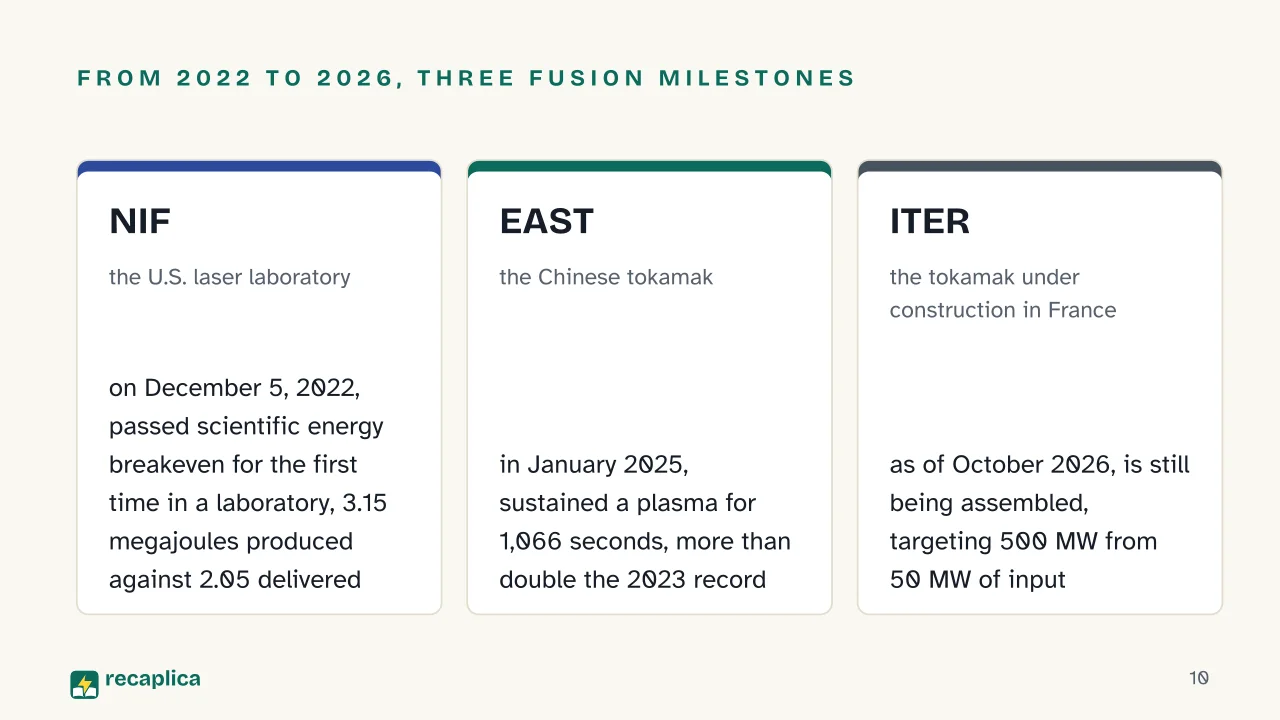
    • 1,066 seconds Duration of the plasma sustained by China's EAST tokamak in January 2025, a world record more than double the 2023 mark. Source: World Nuclear Association

    Deep Dive

    A heavy nucleus that splits and two light nuclei that join are, in physics, two different routes to the same outcome: releasing energy from inside the atom. The first process is called fission, the second fusion, and they sit behind very different technologies: power plants already in operation, as the Recap on how nuclear power plants work explains, and research experiments still underway.

    How nuclear fission works

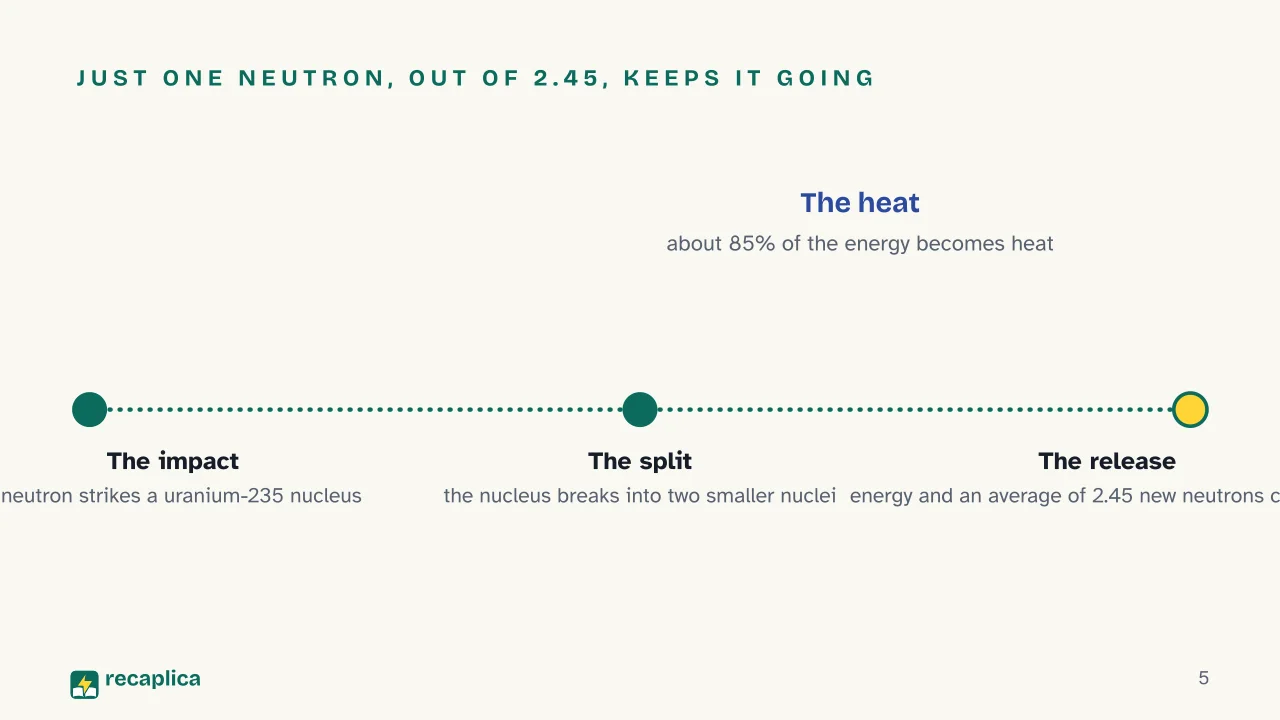
    Nuclear fission starts with an impact: a neutron strikes the nucleus of a heavy atom, typically uranium or plutonium, and splits it into two smaller nuclei. In the case of uranium-235, each fission releases about 200 MeV of energy and an average of 2.45 new neutrons. Not every one of those neutrons needs to hit another nucleus; one is enough to sustain the chain reaction, while the rest are lost or absorbed without causing a new fission. A faster, uncontrolled version of the same principle sits behind the atomic bombs dropped on Hiroshima and Nagasaki.

    About 85% of the energy released by fission shows up as kinetic energy in the nucleus fragments, which later turns into heat.

    Worked example: one kilogram of uranium-235 fuel that undergoes fission releases about 82 terajoules of energy. That heat, generated inside the reactor, is what drives the turbines of a nuclear plant.

    How nuclear fusion works

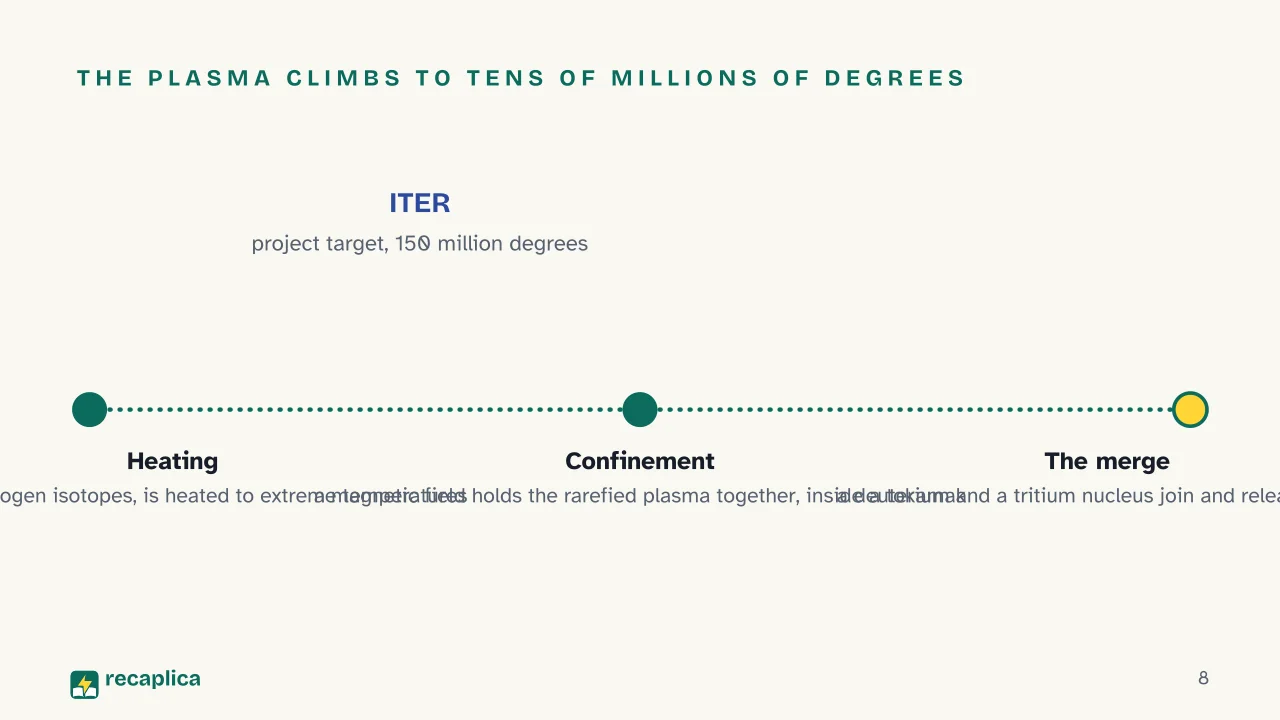
    Nuclear fusion starts instead from light nuclei: hydrogen isotopes such as deuterium and tritium, elements near the top of the periodic table. Fusing them on Earth requires heating them to extreme temperatures, on the order of 50 million degrees Celsius. At that temperature matter turns into plasma, a very rarefied gas of charged particles (less than a milligram per cubic meter), held together through magnetic confinement across volumes of hundreds of cubic meters.

    The ring-shaped chamber used by most experimental fusion reactors is called a tokamak, first designed in 1951 by Soviet physicists Andrei Sakharov and Igor Tamm. Each fusion between a deuterium nucleus and a tritium nucleus releases 17.6 MeV, less than the 200 MeV of a single uranium-235 fission, yet fusion releases more energy per unit of fuel mass.

    The ITER project, under construction at Saint Paul-lez-Durance in France, aims to heat its plasma to 150 million degrees Celsius, ten times the temperature of the Sun’s core, and to produce 500 MW of fusion power starting from 50 MW of input heating, a tenfold energy gain sustained for 400 to 600 seconds. As of October 2026 the machine’s assembly is underway, with components built by suppliers from six domestic agencies across China, the European Union, Japan, South Korea, Russia, and the United States. Once assembly finishes, ITER will hold the record for the biggest tokamak ever made, enclosing a plasma volume of 830 cubic meters, a scale meant to bring fusion research closer, for the first time, to a machine that gives back more energy than it takes in.

    Two recent experiments

    Two results, in different years, show how far the research has come. On December 5, 2022, the National Ignition Facility at the U.S. laboratory LLNL ran the experiment that first passed scientific energy breakeven in a fusion laboratory: lasers delivered 2.05 megajoules to the target, which produced 3.15 megajoules of fusion energy. In January 2025, China’s EAST tokamak instead sustained a high-confinement, steady-state plasma for 1,066 seconds, a world record more than double the previous 403-second mark set in 2023.

    The two processes, side by side

    AspectFissionFusion
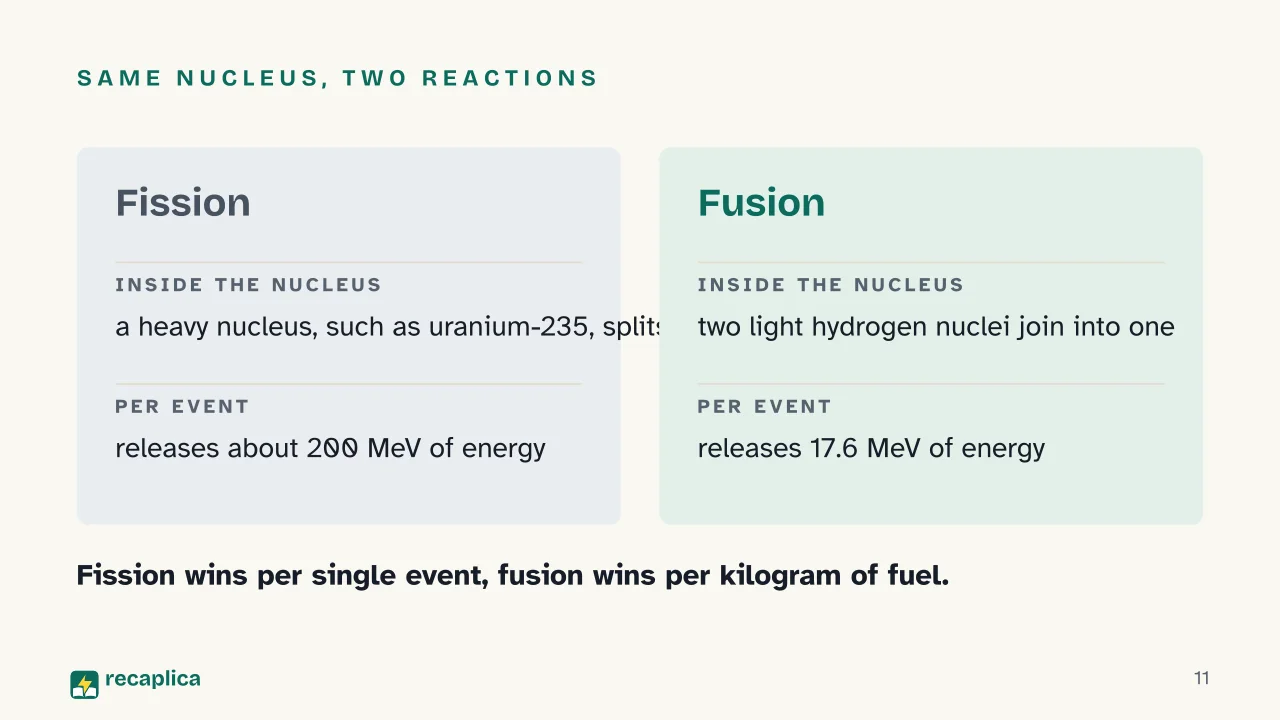
    Inside the nucleusa heavy nucleus (uranium or plutonium) splits in twotwo light nuclei (hydrogen isotopes) join into one
    Energy per single eventabout 200 MeV (uranium-235)17.6 MeV (deuterium-tritium)
    Condition to occura neutron strikes the nucleustemperatures of tens of millions of degrees
    Wasteradioactive, long-livedno long-lived waste expected
    Status as of October 2026already running today’s nuclear plantsstill experimental (ITER in assembly, EAST and NIF records)

    Per single event, fission releases more energy than fusion: 200 MeV against 17.6 MeV. Look at a kilogram of fuel instead, and fusion comes out ahead, because a gram of deuterium and tritium packs far more nuclei available to fuse than a gram of fission fuel packs uranium-235 nuclei.

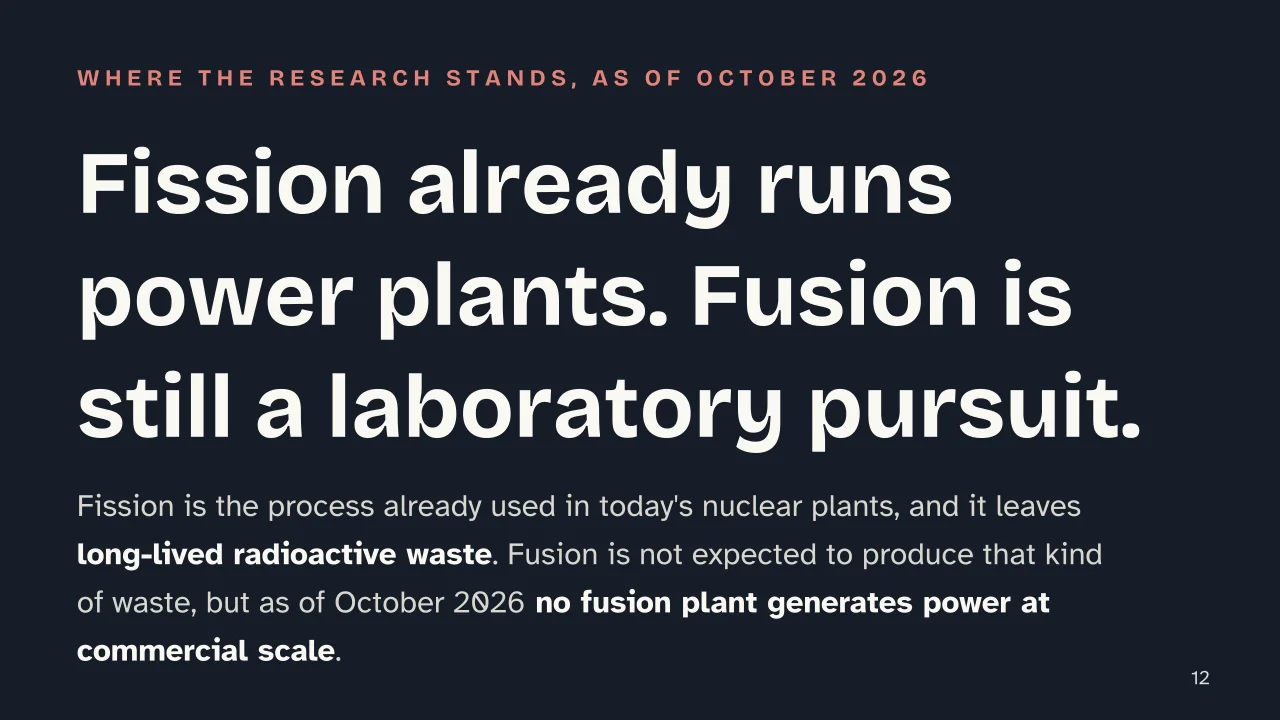
    The more practical difference, as of October 2026, is about use. Fission runs nuclear plants operating in several countries, and the electric current that reaches homes passes through some of them. Fusion, as of October 2026, remains a research goal: a plant like ITER has not yet started operating, and the strongest results so far are laboratory records, like those from NIF and EAST, not electricity delivered to a grid.

    Fission’s long-lived waste stays radioactive for that very reason: it keeps releasing energy through radioactive decay, the same spontaneous process behind any unstable nucleus.

    Slide deck

    Slides ready to download and make your own in PowerPoint or Google Slides, with speaker notes. Pick the Flash cut or the Full one.
    Slide 1 of the presentation on Nuclear Fission and Fusion: Nuclear Fission and FusionSlide 2 of the presentation on Nuclear Fission and Fusion: Do a nuclear plant and the Sun run on the same process?Slide 3 of the presentation on Nuclear Fission and Fusion: From a heavy nucleus to a light oneSlide 4 of the presentation on Nuclear Fission and Fusion: Chapter 01: FissionSlide 5 of the presentation on Nuclear Fission and Fusion: Just one neutron, out of 2.45, keeps it goingSlide 6 of the presentation on Nuclear Fission and Fusion: 200 MeV per fissionSlide 7 of the presentation on Nuclear Fission and Fusion: Chapter 02: FusionSlide 8 of the presentation on Nuclear Fission and Fusion: The plasma climbs to tens of millions of degreesSlide 9 of the presentation on Nuclear Fission and Fusion: 17.6 MeV per fusionSlide 10 of the presentation on Nuclear Fission and Fusion: From 2022 to 2026, three fusion milestones: NIF, EAST, ITERSlide 11 of the presentation on Nuclear Fission and Fusion: Same nucleus, two reactionsSlide 12 of the presentation on Nuclear Fission and Fusion: Fission already runs power plants. Fusion is still a laboratory pursuit.Slide 13 of the presentation on Nuclear Fission and Fusion: Which releases more energy: a single uranium-235 fission or a single deuterium-tritium fusion?Slide 14 of the presentation on Nuclear Fission and Fusion: Now, the recap
    Flash10 slidesThe essential thread, to present in classFull14 slidesEvery chapter and the deeper detail

    Common myths

    • ✗ Myth Many people think fission and fusion are just two names for the same phenomenon.

      ✓ Reality They are opposite reactions: in fission, a neutron splits a heavy nucleus in two; in fusion, two light nuclei combine into one. The energy involved also differs, 200 MeV against 17.6 MeV per single event.

    • ✗ Myth Many people think fusion already supplies electricity to homes.

      ✓ Reality As of October 2026, no fusion plant feeds the electrical grid at commercial scale. The U.S. NIF reached the first scientific energy breakeven in December 2022, and ITER, under construction in France, has not finished assembly.

    • ✗ Myth Many people think fusion is simply fission run backward, using the same materials.

      ✓ Reality Fission works on heavy nuclei such as uranium and plutonium; fusion works on light nuclei such as deuterium and tritium, hydrogen isotopes. The materials differ, and so do the conditions: fusion needs temperatures of tens of millions of degrees, fission does not.

    Mind map

    Drag the background to move around and the nodes to reposition them; use − and + to collapse and expand branches.
    Customize
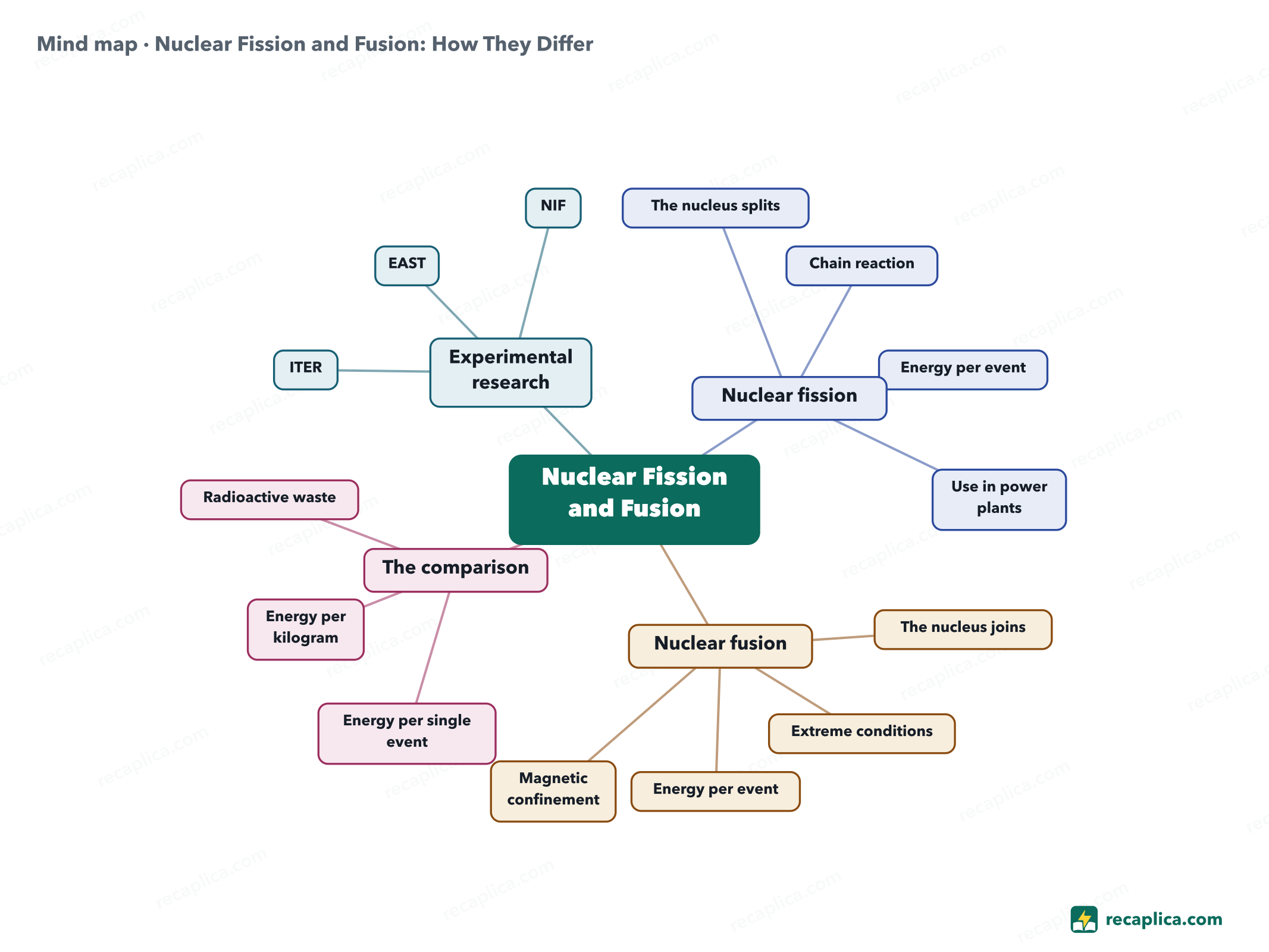
    Mind map: Nuclear Fission and Fusion: How They Differ
    • Nuclear Fission and Fusion
      • Nuclear fission inside the nucleus of a heavy atom
        • The nucleus splits a neutron strikes uranium-235
        • Chain reaction an average of 2.45 neutrons released per fission
        • Energy per event about 200 MeV per fission
        • Use in power plants long-lived radioactive waste
      • Nuclear fusion inside the nucleus of light atoms
        • The nucleus joins two hydrogen nuclei, such as deuterium and tritium
        • Extreme conditions temperatures of tens of millions of degrees
        • Energy per event 17.6 MeV for a deuterium-tritium fusion
        • Magnetic confinement a rarefied plasma held by a magnetic field, inside a tokamak
      • The comparison
        • Energy per single event fission releases more
        • Energy per kilogram fusion releases more
        • Radioactive waste long-lived, only from fission
      • Experimental research
        • ITER tokamak under construction in France, targeting 500 MW from 50 MW of input
        • EAST 1,066-second plasma record, set in January 2025
        • NIF scientific energy breakeven, reached in December 2022

    Quiz: test yourself

    Answer the questions to check what you have learned: you get instant feedback and a short explanation.

    Grade 0/10 0/5
    1 What happens inside the nucleus during fission?

    In fission, a neutron strikes a heavy nucleus, such as uranium-235, which splits into two smaller nuclei and releases energy.

    2 What happens inside the nucleus during fusion?

    In fusion, two light nuclei, typically hydrogen isotopes, combine to form a heavier nucleus.

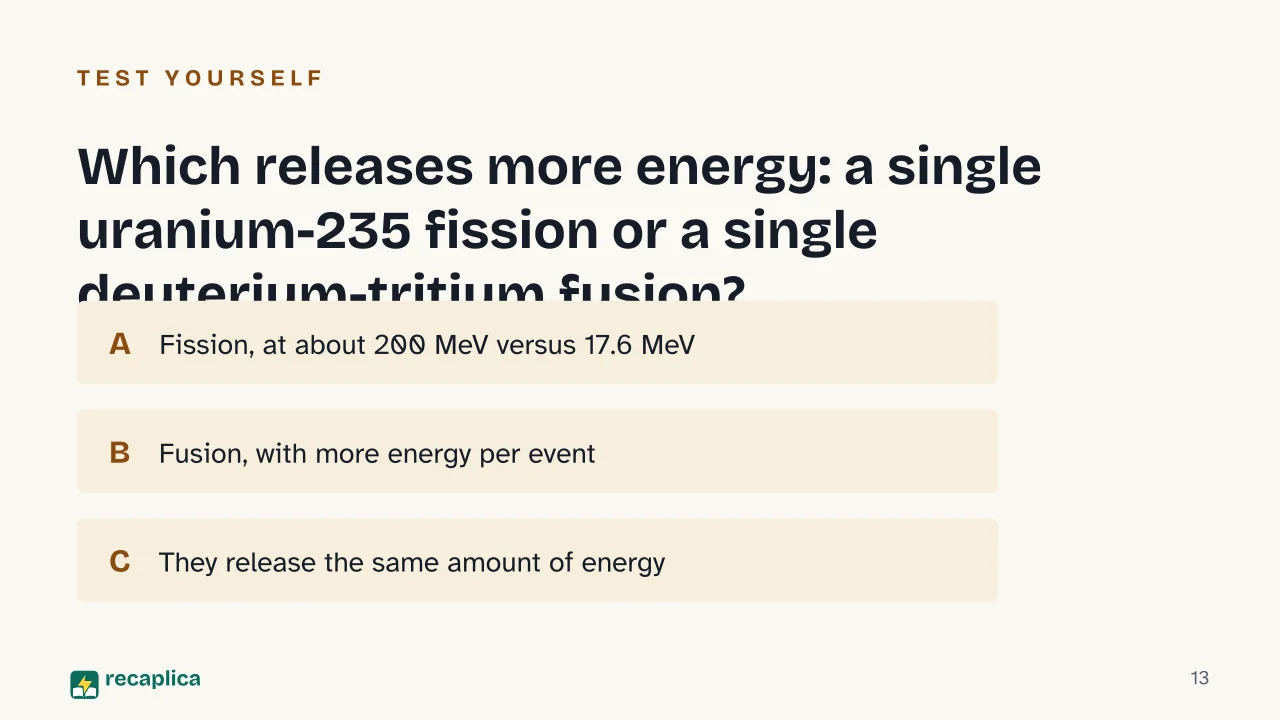
    3 Which releases more energy: a single uranium-235 fission or a single deuterium-tritium fusion?

    Per single event, fission releases more energy (200 MeV versus 17.6 MeV); per kilogram of fuel, fusion releases more.

    4 True or false: fusion is not expected to produce long-lived radioactive waste, unlike fission.

    True. The U.S. Nuclear Regulatory Commission links fission to long-lived radioactive waste, a problem fusion does not pose in the same way.

    5 What is the ITER project?

    ITER is the tokamak under construction in France: once complete, it will be the largest ever built, targeting an energy gain ten times the power used to heat the plasma.

    Answers: 1-A · 2-B · 3-A · 4-A · 5-A

    Flashcards

    Tap the card to flip it and check whether you remember the answer, then move to the next one.

    1 / 8

    Explain it in your own words

    The ultimate test: if you can explain it in simple words, you've truly understood it. Write your explanation, then compare it with the Recap.

    Your explanation is saved only on this device.

    Nuclear fission splits the nucleus of a heavy atom, such as uranium-235, after it absorbs a neutron, releasing energy and more neutrons. Nuclear fusion joins two light nuclei, such as deuterium and tritium, into a heavier one; it is the process that powers the Sun and every other star. Fission releases more energy per single event, but fusion releases more energy per kilogram of fuel. The ITER project, under construction in France, aims to produce net energy from fusion; the January 2025 plasma record set by China's EAST tokamak and the December 2022 experiment at the U.S. laboratory NIF mark progress along the same research path.

    Frequently asked questions

    What is the difference between nuclear fission and fusion?

    In fission, a heavy nucleus, such as uranium-235, splits in two after absorbing a neutron. In fusion, two light nuclei, such as deuterium and tritium, join into a heavier one. Fission releases more energy per single event, fusion releases more per kilogram of fuel.

    How does nuclear fusion power the Sun?

    Inside the Sun, fusion joins light nuclei at extreme temperatures, releasing the energy that powers the star. Experimental projects such as ITER try to reproduce the same process on Earth, aiming for a plasma roughly ten times hotter than the Sun's core.

    What is fusion energy, and why isn't it available yet?

    Fusion energy is the electricity that fusion plants would generate at commercial scale. As of October 2026 none exists: the U.S. National Ignition Facility passed scientific breakeven in a laboratory experiment in December 2022, and the ITER tokamak, under construction in France, has not yet finished assembly.

    What is a tokamak fusion reactor?

    A tokamak is a doughnut-shaped chamber that confines fusion fuel as a plasma using magnetic fields, first designed in 1951 by Soviet physicists Andrei Sakharov and Igor Tamm. Most experimental fusion reactors, including ITER and China's EAST, use this configuration.

    Does a nuclear fission reactor produce the same waste as fusion?

    No. Fission reactors, the kind that power nuclear plants already in operation, produce long-lived radioactive waste. Fusion, according to the U.S. Nuclear Regulatory Commission, is not expected to produce that type of waste.

    Sources

    • World Nuclear Association, Physics of Uranium and Nuclear Energy
    • World Nuclear Association, Nuclear Fusion Power
    • ITER Organization, Facts & Figures
    • U.S. Nuclear Regulatory Commission, Understanding the Difference Between Nuclear Fission and Fusion Technologies
    • Lawrence Livermore National Laboratory, Fusion Ignition and the Path to Inertial Fusion Energy

    Every Recap goes through an independent review before publication.

    Every evening, the day's new Recaps on our Telegram channel. Join the channel →

    Keep learning

    • Science Balancing Redox Reactions: Half-Reaction and Oxidation Number Methods A redox reaction is balanced when every element has the same number of atoms on both sides and the total charge is the same too. There are two routes. With the half-reaction method you write oxidation and reduction separately, add water, H⁺ and electrons, and then add the two halves together. With the oxidation number method you look at how much each element's number rises and falls, and pick coefficients that make the total rise equal the total fall. In basic solution you start as in acid, and at the end the H⁺ ions are turned into water with OH⁻. Read the Recap →
    • Science Brønsted-Lowry theory: definition of acids, bases and conjugate pairs In 1923 Johannes Brønsted and Thomas Lowry, working independently, defined an acid as a species that gives away a proton and a base as a species that takes one in. An acid-base reaction is therefore a transfer of a proton, and every transfer produces two conjugate pairs. Water can act as either an acid or a base, and ammonia is a base even though its formula has no OH-. The theory generalizes Arrhenius's, which holds only for water solutions. Read the Recap →
    • Science Chemical Equilibrium: Definition, the Constant K and the Reaction Quotient Q A reversible reaction can run in either direction, and in a closed system it reaches a point where the amounts of reactants and products stop changing. At that point the forward and reverse reactions keep going at the same rate. The equilibrium constant K depends on temperature. Comparing the reaction quotient Q with K shows which way the reaction is heading. An ICE table handles the calculations. Read the Recap →

    recaplica

    Clear in 30 seconds, yours in 10 minutes.

    Recaps Mind maps Request a Recap Telegram channel Mind map maker Our method About Privacy & cookies Legal notes & terms of use

    © 2026 Recaplica · A project by Curi S.r.l. — VAT IT05472000750

    Statistics, only if you say so

    To learn which Recaps help most we would use Google Analytics, with aggregate, anonymous data. It starts only with your OK, and you can change your mind anytime. Privacy policy